Anthropologists universally recognize food as being “good to think” (sensu Lévi-Strauss Reference Lévi-Strauss1963). Looking beyond its role as a subsistence resource, they recognize the dialectic relationship between food and the social, economic, and political worlds in which it is selected, prepared, consumed, and discarded (Appadurai Reference Appadurai1981; Bourdieu Reference Bourdieu1984; Crowther Reference Crowther2013; Goody Reference Goody1982; Gumerman Reference Gumerman1997; Peres Reference Peres2017; Van der Veen Reference Van der Veen2003). Food—and in particular its consumption—plays an active role in the creation and negotiation of social identities and relationships (Kerner et al. Reference Kerner, Chou and Warmind2015). Most archaeological discussion of food as a socially charged material comes from the current emphasis on feasting. In the introduction to their volume on this topic, Dietler and Hayden (Reference Hayden, Dietler and Hayden2001:2) state, “We need to think seriously and critically about what feasts are, how they operate, and how we can detect and interpret them. Otherwise, they risk becoming one more ill-digested archaeological interpretative fad.”
In this article, I contribute to this critical examination of feasting by reimagining how we define what a feast is and the social effects it may have. I then develop this reconceptualization into a dual-dimensional model that facilitates both interpreting the archaeological and ethnographic record of feasts and other eating events and understanding how the variable contexts in which these events occurred may have affected their social outcomes. Finally, using a case study from the precontact American Southeast, I emphasize noncompetitive outcomes of feasting behavior.
Anthropological and Archaeological Approaches to Feasting
The practice of feasting has global distribution (Dietler and Hayden Reference Dietler, Hayden, Dietler and Hayden2001:2; Hastorf Reference Hastorf2017:216). Its widespread nature suggests great time depth, and the archaeological record bears out this supposition. Archaeologists assume that as a form of ritual practice, feasts would have held great meaning to the individuals who participated in them, with feasting events providing stages for negotiating social identities and relationships, conducting political and economic transactions, and performing religious and ceremonial duties. Thus, some feasts, particularly those that were qualitatively different from normal consumption, would have been “intimately involved in the processes of social change” and would have provided “central arenas of social action that have had a profound impact on the course of historical transformations” (Dietler and Hayden Reference Dietler, Hayden, Dietler and Hayden2001:16; see also Hayden and Villeneuve Reference Hayden and Villeneuve2011; Swenson Reference Swenson2015). In other words, “up until the industrial revolution, there may have been no other more powerful engine of cultural change than feasts” (Hayden Reference Hayden2014:1). However, other feasts, particularly those that essentially represented larger, more communal versions of everyday meals, may have had social outcomes that did not differ drastically from those negotiated in everyday life, serving to reinforce and magnify whatever social norms were present at the time. Regardless, evidence of feasting events and the ritual activities associated with them can inform on some of archaeology's most fundamental questions.
Archaeological discussions of feasting suffer from many of the same pitfalls as broader discussions of ritual. Defining and identifying ritual practice in archaeological deposits is notoriously difficult, especially when relevant ethnographic data are not available (Brück Reference Brück1999; Fogelin Reference Fogelin2007; Garrow Reference Garrow2012; Insoll Reference Insoll2004). This difficulty has led to the tendency of labeling something “ritual” whenever modern archaeologists cannot easily ascertain a functional or practical explanation for its appearance (Brück Reference Brück1999:317–318; Fogelin Reference Fogelin2007:59; Goody Reference Goody1961:156–157; Richards and Thomas Reference Richards, Thomas, Bradley and Gardiner1984:189). This propensity is also present in the feasting literature, as concentrations of food remains are sometimes labeled feasts with little to no consideration for context or meaning (Peres Reference Peres2017). Correcting this tendency in the study of ritual entailed the development of distinctly archaeological approaches (e.g., Brück Reference Brück1999; Gillespie Reference Gillespie Susan, Mills and Walker2008; Renfrew Reference Renfrew1985; Richards and Thomas Reference Richards, Thomas, Bradley and Gardiner1984; Swenson Reference Swenson2015); such materially and contextually driven approaches aptly illustrate the type of work that remains to better recognize and interpret ancient feasts (see also Hayden Reference Hayden2014:77).
Hayden and Villeneuve (Reference Hayden and Villeneuve2011) review the development of historic, ethnographic, and archaeological interest in feasting, and I draw heavily on their summary in formulating this overview. The earliest accounts of feasts in the classical literature focus on the motivations and actions of elite hosts (see Sherratt Reference Sherratt2004); likewise, early ethnographic work emphasized examples of lavish feasting stimulated by competition (e.g., Boas's interpretation of potlatching [Codere Reference Codere1950]). During the mid-twentieth century, some ethnographers (e.g., Firth Reference Firth1951) began to favor interpreting feasts as mechanisms for building social solidarity, whereas others (e.g., Sahlins Reference Sahlins1972) emphasized their redistributive role, and many (e.g., Codere Reference Codere1950; Young Reference Young1971) maintained a focus on competitive behavior.
Archaeological interest in feasting arose during the 1970s and blossomed in the 1990s and 2000s. Early interpretations (e.g., Friedman and Rowlands Reference Friedman and Rowlands1977) were situated in a processual framework and “place[d] feasting at the theoretical forefront of archaeology concerning resource intensification and economically based competition” (Hayden and Villeneuve Reference Hayden and Villeneuve2011:438). These early understandings drew heavily on ethnographic evidence, and many have continued to do so (Hayden Reference Hayden2014).
Interpretations of feasts in empires and states have relied on sources such as the detailed ethnohistoric accounts of status-building feasts in the Inca Empire (Bray Reference Bray and Bray2003) and royal feasts described in the classical literature (see Wright Reference Wright2004). In chiefdoms, elite-sponsored feasts from Southeast Asia, Polynesia, and Africa have driven archaeological interpretations through the ethnoarchaeological work of Dietler (Reference Dietler, Dietler and Hayden2001) and Hayden (Reference Hayden, Dietler and Hayden2001, Reference Hayden2014:233–295).
Even when considering less strict hierarchical systems, ethnographic analogies highlight competitive behavior: Melanesian examples that focused on the prestige goods economy have greatly impacted interpretations of feasting in horticultural societies (Hayden Reference Hayden2014:162–232), and Northwest Coast potlatches have done the same for transegalitarian or complex hunter-gatherer feasting (Hayden Reference Hayden2014:47–108). A clear exception to this pattern has emerged from ethnographies of the American Southwest that emphasize the integrative role of feasts in Puebloan society (see Wills and Crown Reference Wills, Crown and Mills2004). However, in other cases where ethnographic accounts do not include competition, they have been discounted as examples of feasting even when they have every other defining characteristic (e.g., Hayden Reference Hayden2014:35–46).
The material visibility of feasts makes them ideal for direct archaeological interpretation. As events that involve massive amounts of production, consumption, and discard, feasts often leave impressively large and visible material signatures including but not limited to food remains, ceramic vessels, monumental architecture, and prestige goods (see below). As archaeological interest in feasting has blossomed, interpretations of the function and meaning of feasting behavior have diversified.
Feasts can accomplish many goals, including increasing group solidarity, payment of debts, collection of tribute, recalling past glories, amassing labor surplus, promoting prestige, displaying opulence, soliciting allies, frightening enemies, equilibrating and exchanging valuables, seeking marriage partners, celebrating a life passage, arbitrating disputes, maintaining social control, making peace, instigating war, communicating with the deities, and honoring the dead [Hastorf Reference Hastorf2017:195].
Throughout these discussions, considerations of politics and status have remained key, and large, competitive feasts and those that clearly culminated in the increased status of certain individuals or groups have garnered the most attention, perhaps because they have the most identifiable archaeological signatures (Hastorf Reference Hastorf2017:203, 216; Twiss Reference Twiss, Metheny and Beaudry2015:94–95). This observation is supported by the titles of edited volumes dealing with the topic (e.g., Food and the Status Quest: An Interdisciplinary Perspective [Wiessner and Schiefenhövel Reference Wiessner and Schiefenhövel1996]; Feasts: Archaeological and Ethnographic Perspectives on Food, Politics, and Power [Dietler and Hayden, eds. Reference Dietler and Hayden2001]; The Archaeology and Politics of Food and Feasting in Early States and Empires [Bray, ed. Reference Bray2003]). That said, the recognition of feasts as central to community building and identity construction is also common (Hastorf Reference Hastorf2017:260–271; Mills Reference Mills and Mills2004, ed.; Potter Reference Potter2000; Potter and Ortman Reference Potter, Ortman and Mills2004). In addition, feasts have been recognized as relating to performance, emotion, and sensory experience (Hastorf Reference Hastorf2017), as well as the development of technologies related to pottery (Clark and Gosser Reference Clark, Gosser, Barnett and Hoopes1995; Sassaman Reference Sassaman1993), agriculture (Hayden Reference Hayden, Dietler and Hayden2001, Reference Hayden2009, Reference Hayden2014), fermentation (Jennings et al. Reference Jennings, Antrobus, Atencio, Glavich, Johnson, Loffler and Luu2005), and monumental architecture (Artursson et al. Reference Artursson, Earle and Brown2016; Lehner Reference Lehner1997).
In response to the proliferation of feasting literature in recent decades, some authors have argued that archaeologists have neglected theoretical discussions of everyday consumption (Hastorf and Weismantel Reference Hastorf, Weismantel and Twiss2007; Pollock Reference Pollock and Pollock2015; Twiss Reference Twiss and Twiss2007). Importantly, in offering this critique, these authors do not call for the cessation of feasting studies but for recognizing the dialectical relationship between quotidian meals and feasts, emphasizing that “it is impossible to fully grasp what happens on either side of the boundary between public and private without paying attention to the other side as well” (Hastorf and Weismantel Reference Hastorf, Weismantel and Twiss2007:315).
This diversity of approaches has characterized previous studies of feasting and food consumption focused on the southeastern United States as well. However, “foodways archaeology in the American Southeast has been dominated by a search for extraordinary events to make grand statements about the construction and maintenance of political and social power” (Peres Reference Peres2017:437), especially due to the long-standing focus on studies of the role of food within Mississippian chiefdoms (e.g., Jackson Reference Jackson, Arbuckle and McCarty2014; Jackson and Scott Reference Jackson and Scott1995, Reference Jackson and Scott2003; Knight Reference Knight2004; VanDerwarker Reference VanDerwarker1999; Welch and Scarry Reference Welch and Margaret Scarry1995). As they have moved away from emphasizing the grandness of the event, some southeastern archaeologists have turned toward investigating the social roles that eating events of all kinds played within past societies by drawing together multiple lines of evidence, including plant, animal, and ceramic remains; contextual information; and historic and ethnographic documentation (e.g., Kassabaum Reference Kassabaum, Peres and Deter-Wolf2018; Kelly Reference Kelly, Dietler and Hayden2001; Pauketat et al. Reference Pauketat, Kelly, Fritz, Lopinot, Elias and Hargrave2002; Peres Reference Peres2017:432; VanDerwarker and Peres Reference VanDerwarker and Peres2010). In the second half of this article, I combine these datasets to interpret eating events that occurred at a precontact site in the American Southeast. In striving to develop a materially and contextually driven method for recognizing and interpreting the variety of functions eating events may have had in their respective social milieus, I first draw on a wide variety of literature regarding the archaeological correlates of feasting and everyday consumption.
Conceptualizing and Classifying Feasts
During the recent proliferation of feasting literature, a variety of definitions have been provided for the term (e.g., Bray, ed. Reference Bray and Bray2003; Dietler and Hayden, eds. Reference Dietler and Hayden2001; Hayden Reference Hayden2014; Hayden and Villeneuve Reference Hayden and Villeneuve2011; Mills, ed. Reference Mills2004; Twiss Reference Twiss, Metheny and Beaudry2015:93–98; Twiss, ed. Reference Twiss2007; Wiessner and Schiefenhövel Reference Wiessner and Schiefenhövel1996). One of the broadest is posited by Twiss (Reference Twiss2008:419), in which “feast” is defined as any eating event consciously distinguished from an everyday meal. My goal is not to posit a new definition but to create a classificatory scheme that distinguishes two key spectra of variation commonly emphasized in the feasting literature—group size and level of sociopolitical competition. By giving each an equal role in determining what qualifies as a feast, my scheme eliminates confusion about eating events that are excluded from the category by some researchers and included by others and provides a means of comparison among eating events that allows for more sophisticated interpretations of archaeological remains.
Most attempts to pick apart the variability present in the feasting concept have taken the form of defining subcategories of feasting—for example, Dietler's (Reference Dietler, Wiessner and Schiefenhövel1996, Reference Dietler, Dietler and Hayden2001) empowering, patron-role, and diacritical feasts and Hayden's (Reference Hayden, Dietler and Hayden2001) alliance/cooperation, economic, and diacritical feasts (see Hastorf Reference Hastorf2017:197–204; Hayden Reference Hayden2014:9–12). However, these schemes have the same problematic tendency “to present everyday domestic meals and feasts as mutually opposed rather than dialectically related” (Twiss Reference Twiss and Twiss2007:51). Innovatively, Twiss (Reference Twiss and Twiss2007:51) connects feasting with everyday consumption by visualizing all eating events as existing “along a continuum that runs from the meanest of snacks to the grandest of feasts” (see also Hastorf Reference Hastorf2017:197; Spielmann Reference Spielmann2002). Certain flamboyant events are characterized by large quantities of special foods shared between large groups at special places using special tools; other events are clearly everyday affairs characterized by moderation in food type and quantity, people involved, and all other aspects of preparation, consumption, and disposal. Because of these characteristics, everyday meals have certain social outcomes, while feasts have others (Twiss Reference Twiss and Twiss2007:53–54; see also Hayden Reference Hayden, Dietler and Hayden2001).
Although this is more satisfactory than any attempt to dichotomize the distinction into feasts and nonfeasts, I remain unsatisfied with this model's ability to productively differentiate middle-ground cases, which combine attributes of domestic consumption and feasting and therefore share material and social consequences. For example, cases exist in which a small number of people share foods on an important occasion, thereby conferring prestige on the host (e.g., Hammond Reference Hammond1993; Strong Reference Strong2002; Windham Reference Windham2011:24–25). Likewise, large numbers of people sometimes gather for communal eating with little to no evidence of status negotiation (e.g., Knight Reference Knight, Dietler and Hayden2001; Potter and Ortman Reference Potter, Ortman and Mills2004). These events leave different archaeological signatures and have different social outcomes (Peres Reference Peres2017:433), but in Twiss's conception, each would fall in the middle of the spectrum, and further differentiation would be impossible. My scheme attempts to differentiate these middle-ground cases in a useful way. However, this aim is complicated by the presence of multiple dimensions that do not always vary in tandem.
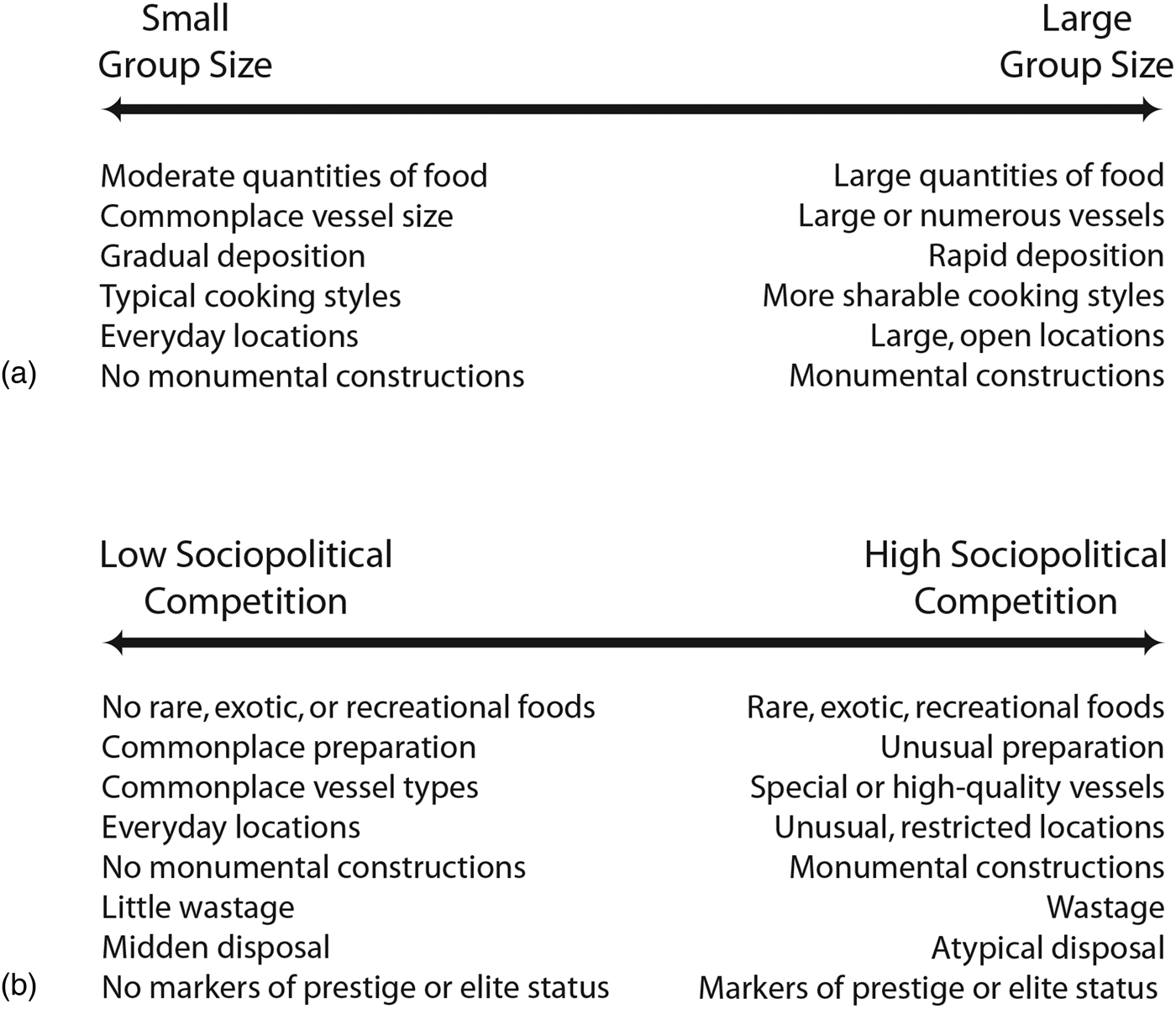
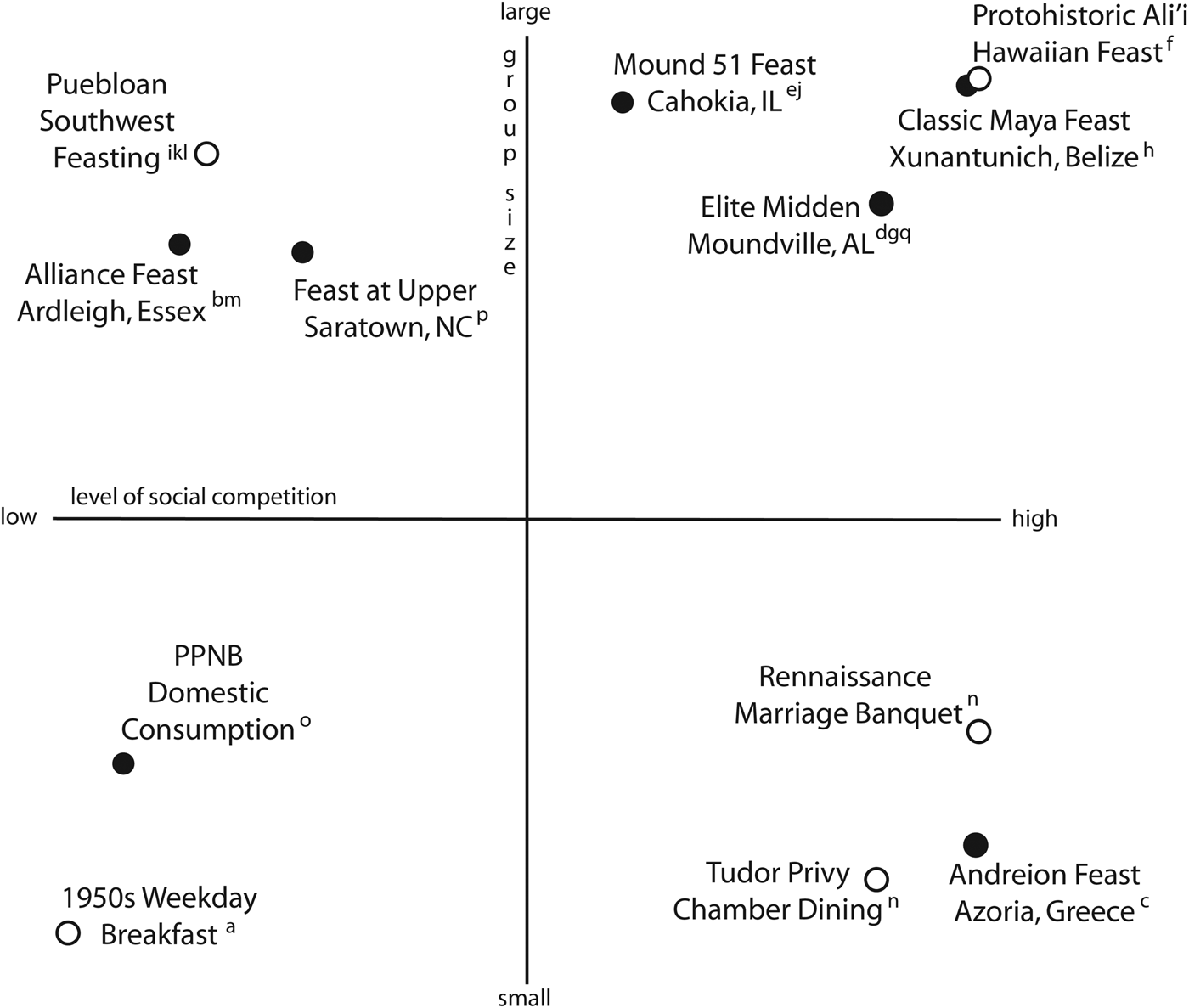
In reviewing the array of feasts described in the archaeological and ethnographic literature, I noted an emphasis on two characteristics: (1) the size of the group involved (as seen through the abundance of food remains, number and size of vessels, magnitude of dining locations, etc.) and (2) the level of sociopolitical competition taking place (as seen through differential consumption and resultant differences in wealth and sociopolitical status; Figure 1). If each eating event is measurable in two dimensions—(1) group size (GS, ranging from small to large) and (2) level of sociopolitical competition (SC, ranging from low to high)—then these axes can be used to define a two-dimensional space in which the location of an eating event is determined by its position along both continua.Footnote 1 Thus, each event will fall into one of four quadrants: small domestic meals or snacks (small GS, low SC); competitive events with limited attendance (small GS, high SC); large-scale, egalitarian communal events (large GS, low SC); and large-scale, competitive events (large GS, high SC; Figure 2).
Continua with archaeological correlates listed at either extreme: (a) group size; (b) level of sociopolitical competition.

Dual-dimensional visualization created by superimposing the GS and SC continua to create four general categories of eating events. Twiss's (Reference Twiss2007) continuum is included to show that it recognizes only two of the four quadrants.

While I found these two criteria the most useful for capturing variation within a wide range of examples, an important outcome of generating a multidimensional model is that it can accommodate additional dimensions or the replacement of one dimension with another based on the specific dataset and research questions at hand. Hastorf and Weismantel (Reference Hastorf2007:314) remind us that “there may be no cross-culturally valid set of criteria that can be applied uncritically to any situation in order to determine whether given sets of food remains represent feasts or ordinary meals; rather, the significant criteria for differentiation must be established by the data themselves.” Much like statistical techniques such as principal components analysis or correspondence analysis (see VanDerwarker Reference VanDerwarker, Peres and VanDerwarker2010), a dual- or multidimensional model of feasting maintains the benefits of typological thinking (i.e., simplifying variation to allow for fruitful comparison) while moving beyond many of its limitations.
Material Correlates of Feasting and Everyday Consumption
Twiss (Reference Twiss2008:Table 1) provides a robust account of the material correlates of feasting alongside citations to ethnographic and archaeological literature, and Peres (Reference Peres2017:Table 2) provides a similar examination specifically for the southeastern United States. I have borrowed from these and other sources in compiling the correlates discussed here (see Figure 1).
Primary archaeological indicators on the GS dimension include quantity of food and vessel capacity. Clearly, more people require more food and therefore more or larger pots in which to store, prepare, and serve that food (Blitz Reference Blitz1993; Hayden Reference Hayden, Dietler and Hayden2001; Potter and Ortman Reference Potter, Ortman and Mills2004; Ralph Reference Ralph2007; Van Keuren Reference Van Keuren and Mills2004). However, large quantities of food and high vessel counts can be accounted for by either long-term, gradual deposition or short-term, rapid deposition. Therefore, understanding the speed with which such materials were deposited is key to utilizing these characteristics to identify feasting (Pluckhahn et al. Reference Pluckhahn, Compton and Bonhage-Freund2006; Wallis and Blessing Reference Wallis and Blessing2015). Food quantity and vessel capacity are frequently lumped with the presence of rare or labor-intensive foods, unusual cooking styles, and/or special or high-quality vessels; however, these characteristics more appropriately mark high SC. It is important to separate these traits, as many documented feasts use large quantities of everyday foods and tools (Potter and Ortman Reference Potter, Ortman and Mills2004; Van der Veen Reference Van der Veen2003; VanDerwarker et al. Reference VanDerwarker, Scarry, Eastman and Twiss2007; Van Keuren Reference Van Keuren and Mills2004; Wallis and Blessing Reference Wallis and Blessing2015).
Event locations of unusual size, layout, and design can be associated with either dimension (Hayden Reference Hayden, Dietler and Hayden2001; Potter and Ortman Reference Potter, Ortman and Mills2004; Ralph Reference Ralph2007). As a group gets larger, eating within the domestic context would no longer be possible, requiring abnormally large areas often left open or unroofed. Likewise, as sociopolitical competition becomes more explicit, the organizer may want to remove the event from the everyday landscape or restrict access to it. Related to this discussion is the presence or absence of monumental constructions at feasting sites (Dietler Reference Dietler, Wiessner and Schiefenhövel1996; Knight Reference Knight, Dietler and Hayden2001; Pauketat et al. Reference Pauketat, Kelly, Fritz, Lopinot, Elias and Hargrave2002; Ralph Reference Ralph2007). Monuments are often interpreted as signs of hierarchy—and thus the competitive and self-aggrandizing behaviors commonly associated with this type of sociopolitical organization (Haas and Creamer Reference Haas, Creamer, Burger and Rosenswig2012; Peebles and Kus Reference Peebles and Kus1977; Trigger Reference Trigger1990). While monumental constructions were regularly built in many hierarchical societies, groups lacking institutionalized systems of sociopolitical differentiation and without significant evidence for status-seeking behaviors have also been shown as interested in and capable of amassing the resources needed for monumental constructions (Adler and Wilshusen Reference Adler and Wilshusen1990; Brown Reference Brown, Butler and Welch2006; Lindauer and Blitz Reference Lindauer and Blitz1997). Such built landscapes were social spaces used for public rituals aimed at emphasizing inclusiveness and shared interests. Moreover, by definition, monumental construction requires a labor force beyond that of the household unit (Dietler Reference Dietler, Wiessner and Schiefenhövel1996:104–105; Trigger Reference Trigger1990:119). In light of these characteristics but without discounting the accepted connection between monumentality and hierarchy, I identify monumental constructions as markers of both large GS and high SC.
Additional characteristics can raise an event's SC score. Wastage, such as animal sacrifice, ritual “killing” of vessels, destruction of personal property, and deliberate throwing away of edible portions, as well as other conspicuous displays of wealth, are commonly associated with status negotiation because squandering material goods sends the message that one has so much that there is no need to value it (Hayden Reference Hayden, Dietler and Hayden2001:40–41; Ralph Reference Ralph2007:41, 44). That said, because atypical disposal could also result from the need to dispose of ritually important garbage in specific ways, the assignment of a high SC value relies on the presence of other traits explicitly tied to the display of power, such as prestige goods, elaborate burials, site hierarchies, craft specialization, aggressive warfare, and elite houses (Blitz Reference Blitz1993:92; Hayden Reference Hayden, Wiessner and Schiefenhövel1996:140–141, Reference Hayden, Dietler and Hayden2001:40–41; Kirch Reference Kirch, Dietler and Hayden2001:180; Knight Reference Knight2004:309–311; Ralph Reference Ralph2007:33–34).
Many accounts of feasting focus on the political and economic roles of feasts in creating power and/or status differences among the people participating (e.g., Dietler Reference Dietler, Dietler and Hayden2001; Hayden Reference Hayden2014; Mills Reference Mills and Mills2004; Pollock Reference Pollock and Bray2003; Wiessner and Schiefenhövel Reference Wiessner and Schiefenhövel1996). As discussed above, this is likely related to the interpretive emphasis on certain case studies and the fact that competitive feasting generates the most easily recognizable material remains. In a feast characterized by large quantities of everyday things, however, one may expect that the social outcomes would not differ drastically from those negotiated in everyday life; thus, feasts in more egalitarian communities likely reinforced group cohesion and equality. While many authors recognize that both effects—increasing solidarity among a community and emphasizing differences among its members—may happen simultaneously, primacy of both effect and intention is often given to the latter (e.g., Blitz Reference Blitz1993; Bray, ed. Reference Bray2003; Dietler Reference Dietler, Wiessner and Schiefenhövel1996; Dietler and Hayden Reference Dietler, Hayden, Dietler and Hayden2001; Hayden Reference Hayden2014; cf. Knight Reference Knight, Dietler and Hayden2001). Researchers that have brought communal, noncompetitive feasting into larger theoretical discussions (Potter Reference Potter2000; Potter and Ortman Reference Potter, Ortman and Mills2004; Spielmann Reference Spielmann2002; Van der Veen Reference Van der Veen2003) have been faced with the fact that accepted definitions often include political or status-seeking behavior as part of what defines a feast (e.g., Hayden Reference Hayden2014:39–40). Separating the competitive dimension from that of scale alleviates this issue.
Central to the development of this dual-dimensional model is the idea that “not all feasts are created equal” (Potter Reference Potter2000:47; Ralph Reference Ralph2007:83). The examples below demonstrate the variability inherent in the concept. My conceptualization refocuses the definition of feast and increases the specificity with which we can interpret the material signatures of various eating events. Any given feast would likely have the effects of emphasizing the similarities among people and marking differences in status, wealth, and power; however, which is emphasized could change (Potter Reference Potter2000:475). As the social goals of feasting varied, so would the means by which one reached these goals, leaving behind different archaeological signatures. By explicitly focusing on this variation and undertaking a detailed examination of a particular case study, this article highlights the importance of feasts focused on community building and solidarity.
Applying the Model
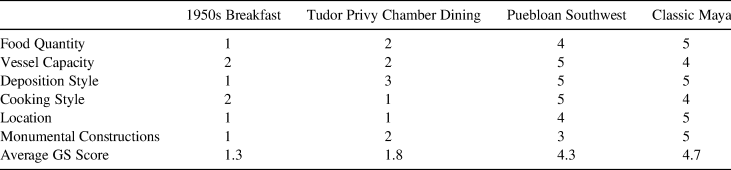
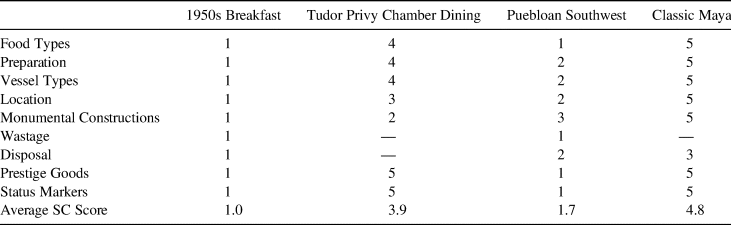
The dual-dimensional model can be used in two distinct ways. First, the characteristics associated with each dimension can be used to identify which contains the most variation at a particular site. Given the degree to which the deposit varies from the midpoint on each continuum, the researcher can interpret what the likely social outcomes of the event may have been. Second, the dual-dimensional model can serve as a framework for comparison, either by comparing material signatures from two contexts to better understand how the events that led to them may have differed or by using the placement of a society for which the social meaning of feasts is fairly well understood (e.g., via a robust ethnographic record) to help interpret a less well-understood example. To illustrate these uses, I have added 12 archaeological and ethnographic cases to the axes (Figure 3) by determining the degree to which the archaeological or ethnographic evidence supported the presence of the characteristics listed in Figure 1 (see examples in Tables 1 and 2).
Dual-dimensional visualization showing specific ethnographic (open circles) and archaeological (closed circles) examples of eating events as they would be placed on the axes. Placements are based on data presented in Bossard and Boll (Reference Bossard and Ball1950),a Brown (Reference Brown1999),b Haggis et al. (Reference Haggis, Mook, Fitzsimons, Margaret Scarry, Snyder and West2011),c Jackson and Scott (Reference Jackson and Scott2003),d Kelly (Reference Kelly, Dietler and Hayden2001),e Kirch (Reference Kirch, Dietler and Hayden2001),f Knight (Reference Knight2004),g LeCount (Reference LeCount2001),h Mills (Reference Mills and Mills2004),i Pauketat et al. (Reference Pauketat, Kelly, Fritz, Lopinot, Elias and Hargrave2002),j Potter (Reference Potter2000),k Potter and Ortman (Reference Potter, Ortman and Mills2004),l Ralph (Reference Ralph2007),m Strong (Reference Strong2002),n Twiss (Reference Twiss and Twiss2007),o VanDerwarker et al. (Reference VanDerwarker, Scarry, Eastman and Twiss2007),p and Welch and Scarry (Reference Welch and Margaret Scarry1995).q

Example of Events Placed along the GS Continuum for One Case per Quadrant.

Note: Each case was given a score of 1 (very low), 2 (low), 3 (medium), 4 (high), or 5 (very high) for each characteristic. These scores were then averaged to determine the event's placement in Figure 3.
Example of Events Placed along the LC Continuum for One Case per Quadrant.

Notes: Scored as described in Table 1. Dashes indicate no data available at this time, discounted from average.
In the quadrant characterized as small meals or snacks, ethnographic examples abound because all societies consume moderate amounts of food on a daily basis for sustenance. I have included an account of a 1950s American weekday breakfast as an ethnographic example (Bossard and Ball Reference Bossard and Ball1950) and domestic consumption during the Pre-Pottery Neolithic B (PPNB) as an archaeological one (Twiss Reference Twiss and Twiss2007:57–61, Reference Twiss2008:428–432). Archaeological evidence from the PPNB suggests that food consumption was a household activity, whereas food preparation may have been split between private and public contexts; thus, the PPNB case study sits above and to the right of the American breakfast.
In the competitive events with limited attendance quadrant, I have included two historic accounts of royal feasts in monarchies—a Renaissance marriage banquet and Tudor privy chamber dining—and one archaeological example from Crete. Artists’ renditions of Renaissance marriage banquets include impeccably decorated rooms and credenzas covered with elaborate and unusual vessels, often plated in silver and gold (Strong Reference Strong2002:163–165). While numerous feasts were held during royal nuptials, the marriage feast itself was not widely attended. The status of the few attendants was paramount and determined everything from seating arrangement to serving ware to dinner entertainment (Strong Reference Strong2002:174–175). Even more private, and thus positioned lower on the diagram, are meals taken by Tudor kings in their privy chambers. Often the monarch ate alone with only his servants nearby and a buffet of lavish foods (Strong Reference Strong2002:204–207). Finally, attendance at the andreion (or civic dining complex) at Azoria, Crete, was limited such that the small dining hall materialized the hierarchical relationships within the city. It housed rare and luxurious foods and aristocratic status items, such as ceremonial drinking and eating wares and armor (Haggis et al. Reference Haggis, Mook, Fitzsimons, Margaret Scarry, Snyder and West2011).
Representing the large-scale, egalitarian communal events quadrant is the ethnographic example of the Puebloan Southwest. At Puebloan feasts, food is contributed anonymously by masked kachinas (Potter and Ortman Reference Potter, Ortman and Mills2004:174), thereby eliminating the chance for donating to lead to social mobility. At times, the debt incurred by the feast-givers served to actually lower their status (Potter Reference Potter2000:476). Highly structured by a ritual cycle, the primary purpose of feasting was to redistribute food resources and facilitate social integration (Mills Reference Mills and Mills2004; Potter Reference Potter2000).
Likewise, in her discussion of Ardleigh in Essex, Ralph (Reference Ralph2007:41) states that feasting “represented a conscious effort to create alliance and community ‘spirit’ among the inhabitants of the site.” She emphasizes that they actively maintained local traditions of consumption in the face of the advancing Roman army, highlighting the large assemblage of everyday materials and the continued use of traditional drink recipes even when Roman equivalents were available. Feasting at Ardleigh was associated with construction and maintenance of monumental architecture but left behind no evidence for status-seeking behavior (see also Brown Reference Brown1999).
A second archaeological example comes from Upper Saratown in North Carolina (VanDerwarker et al. Reference VanDerwarker, Scarry, Eastman and Twiss2007). In this relatively nonhierarchical society, plant-based feasting foods differed from normal consumption only in the amount present. However, the ability of a family or individual to provide choice cuts of meat or entire animals may have led to some status differentiation.
Finally, large-scale, competitive events are frequently discussed in the feasting literature. During a Classic Maya feast at Xunantunich, specialized vessels and distinctive foods (e.g., chocolate) were used by powerful elites to create and maintain power (LeCount Reference LeCount2001). Highly stratified Hawaiian culture provides an ethnographic example, as feasting was limited to elites and occurred in restricted venues. In addition to large numbers of people and concomitant amounts of food, these feasts involved the consumption of prestige foods such as prized fish species, pork, and dog (Kirch Reference Kirch, Dietler and Hayden2001:177–180).
Archaeological examples from eastern North America are positioned below and to the left of these cases. Jackson and Scott (Reference Jackson and Scott2003), Knight (Reference Knight2004), and Welch and Scarry (Reference Welch and Margaret Scarry1995) all identify elite feasting deposits at Moundville in Alabama through the presence of large middens filled with rare foods and large, high-quality vessels utilized at special locations and associated with abundant ritual and prestige items. However, neither the population size nor the level of competition matches the Mayan or Hawaiian examples.
Mound 51 at Cahokia provides yet another southeastern example (Hastorf Reference Hastorf2017:204–214; Kelly Reference Kelly, Dietler and Hayden2001; Pauketat et al. Reference Pauketat, Kelly, Fritz, Lopinot, Elias and Hargrave2002). While the amount of material, the speed with which it was deposited, and the understood population of Cahokia place it very high on the group size dimension, the level of sociopolitical competition is more ambiguous. Most of the remains differ little from normal domestic refuse, but the presence of materials such as quartz, painted pots, swan bones, and tobacco certainly differentiate it. Mound 51 sits near the middle of the sociopolitical spectrum because it was “simultaneously low status and high status or communal and political … a blend of the ordinary and the extraordinary” (Pauketat et al. Reference Pauketat, Kelly, Fritz, Lopinot, Elias and Hargrave2002:276).
Archaeology of the Feltus Mounds
In many of these cases, a great deal is known about the society in question from sources other than food remains. This section provides a case study in which much remains unknown about the nature of the society in which the eating event occurred; thus, our understanding may be augmented by comparison with similarly placed but better understood sites.
Coles Creek culture flourished in the southern portion of the Lower Mississippi Valley from AD 750 to 1200. Research in this region has long focused on how changes in mound construction practices and ceramic decorative styles align with shifts in sociopolitical organization. Because Coles Creek is positioned just before the rise of highly stratified Mississippian cultures in the region, much of the research (Barker Reference Barker1999; Kidder Reference Kidder, Barker and Pauketat1992; Roe Reference Roe2010; Wells Reference Wells1998) has focused on whether it represents a shift from a more egalitarian to a more hierarchical social organization. Though the answer to this question has the potential to influence discussions about the development of chiefly society in the eastern United States, the material evidence for Coles Creek sociopolitical organization remains ambiguous.
Formalized platform mound and plaza complexes have been taken as signs of social differentiation (Barker Reference Barker1999; Kidder Reference Kidder, Barker and Pauketat1992; Steponaitis Reference Steponaitis1986; Wells Reference Wells1998), but Coles Creek sites generally lack evidence for large-scale consumption of corn or any other cultigen, making it unclear how emerging elites would have controlled and distributed a surplus (Fritz and Kidder Reference Fritz, Kidder and Lentz2000; Kidder and Fritz Reference Kidder and Fritz1993; Listi Reference Listi2008; Roberts Reference Roberts2006). Likewise, the Coles Creek mortuary program implies a more egalitarian social structure consisting of mass burials lacking grave goods (Kassabaum Reference Kassabaum2011; cf. Barker Reference Barker1999), and there is no evidence for long-distance trade or accumulation of prestige items. Use of mound summits is variable, with some showing formal buildings, others showing periodic use of temporary structures, and still others showing no evidence of buildings (see Roe and Schilling Reference Roe, Schilling and Rees2010:163–164). Because of the ambiguity of the evidence, answering the question of where Coles Creek culture falls on the egalitarian-hierarchical spectrum relies on understanding the nature of activities that took place at mound sites.
The remainder of this article draws on data from the Feltus Archaeological Project (Kassabaum Reference Kassabaum2014, Reference Kassabaum, Peres and Deter-Wolf2018; Steponaitis et al. Reference Steponaitis, Kassabaum and O'Hear2012, Reference Steponaitis, Kassabaum, O'Hear, Alt and Pauketat2014). Feltus (22JE500) is located in Jefferson County, Mississippi, and originally had four mounds symmetrically arranged around a plaza (Figure 4). Excavations revealed a use history spanning more than 400 years with little to no evidence for permanent occupation. Especially when compared with assemblages from the small number of excavated Coles Creek domestic sites (Hunter et al. Reference Hunter, Fritz, Autin and Liu1995; Kelley Reference Kelley1990; Kidder Reference Kidder1993; Lee et al. Reference Lee, Smith, Yakubik, Kidder, Saenz, Maygarden, Fritz and Saucier1997; Roe Reference Roe2010; Ryan Reference Ryan2004; Wells Reference Wells1998), the stratigraphic relationships, ceramic materials, and radiocarbon dates suggest episodic use by a dispersed population, resulting in large, rapidly accumulated middens that provide ample evidence of feasting (Kassabaum Reference Kassabaum2014, Reference Kassabaum, Peres and Deter-Wolf2018).
Sketch map of Feltus showing the shape, size, and position of the four original mounds.

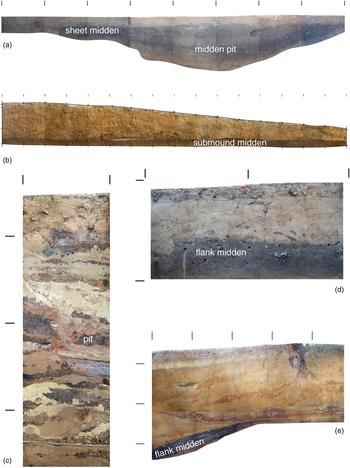
A large pit near the former location of Mound D provides the earliest feasting evidence (ca. AD 750; Figure 5a). The character of this refuse suggests rapid dumping with large, uninterrupted fill episodes, pot breaks, and portions of articulated animal skeletons (see Pluckhahn et al. Reference Pluckhahn, Compton and Bonhage-Freund2006; Wallis and Blessing Reference Wallis and Blessing2015). Additional feasting occurred just before the construction of Mound A (ca. AD 900) as evidenced by a dense submound sheet midden deposit (Figure 5b). Large barbeque pits on the Mound A summit (Figure 5c), a flank midden deposited off its southwestern flank in a short-term event (Figure 5d), and an expansive midden around Mound D indicate that feasting continued after mound construction began (ca. AD 1000). Finally, a dense midden on the summit of Mound B (Figure 5e), a flank midden at the base of Mound C, and a midden in a borrow pit south of Mound D may indicate that feasting continued into the site's final occupation (ca. AD 1100). While these deposits span approximately 300 years, their excavation and the analysis of the associated materials suggest a relatively consistent pattern of use (Kassabaum Reference Kassabaum2014, Reference Kassabaum, Peres and Deter-Wolf2018) and reveal much about the characteristics listed in Figure 1, thus allowing me to place the site on the axes defined in Figure 3.
Photomosaics of Feltus profile walls showing feasting deposits; hash marks are spaced at 1 m intervals: (a) a large midden pit and an overlying sheet midden near the former location of Mound D; (b) a dense submound midden overlaid by mound fill from Mound A; (c) a bathtub-shaped roasting pit on an early summit of Mound A; (d) a flank midden off the southwest corner of Mound A; (e) a flank midden on the penultimate summit of Mound B.

Ceramic Remains
The ratio of plain to decorated wares and the decorative varieties represented in the feasting assemblages at Feltus do not differ dramatically from any Coles Creek site and show no consistent difference in quality of manufacture (Kassabaum Reference Kassabaum2014:90–186; see also Pluckhahn et al. Reference Pluckhahn, Compton and Bonhage-Freund2006:276). The shapes and sizes of the vessels, however, stand out. The Feltus assemblage includes bowls, restricted bowls, jars, and beakers—all common at Coles Creek sites. Drawing on experimental and ethnographic data, Braun (Reference Braun, Fiero, Munson, McClain, Wilson and Zier1980; see also Henrickson and McDonald Reference Henrickson and McDonald1983) determined two key characteristics for identifying vessel function: degree of containment security (i.e., a measure of a vessel's ability to hold its contents without spillage) and frequency of access (i.e., a measure of how much material can concurrently pass through a vessel's orifice). Storage vessels requiring low frequency of access and high containment security are generally deep with restricted orifices and are represented by jars at Feltus. Serving vessels requiring high frequency of access and low containment security are generally shallow and unrestricted and are represented by bowls at Feltus. Finally, food preparation or cooking vessels requiring high frequency of access and high containment security are moderate in depth and orifice size and are represented by restricted bowls and beakers at Feltus (Kassabaum Reference Kassabaum2014:201–204, Reference Kassabaum, Peres and Deter-Wolf2018). Cooking pots typically dominate Coles Creek domestic refuse because they frequently break due to being moved around often and subjected to rapid heating and cooling (Roe Reference Roe2010:132). Necked storage vessels are also common. Looking at the Feltus feasting assemblage, serving vessels are more frequent than would be expected (57%, n = 210) whereas cooking vessels occur at lower than expected levels (24%, n = 90) and storage vessels are rare (19%, n = 71) (Kassabaum Reference Kassabaum, Peres and Deter-Wolf2018). The lack of commensal animals also implies a lack of storage and long-term, open trash deposits (Kassabaum Reference Kassabaum2014:227–232, 273).
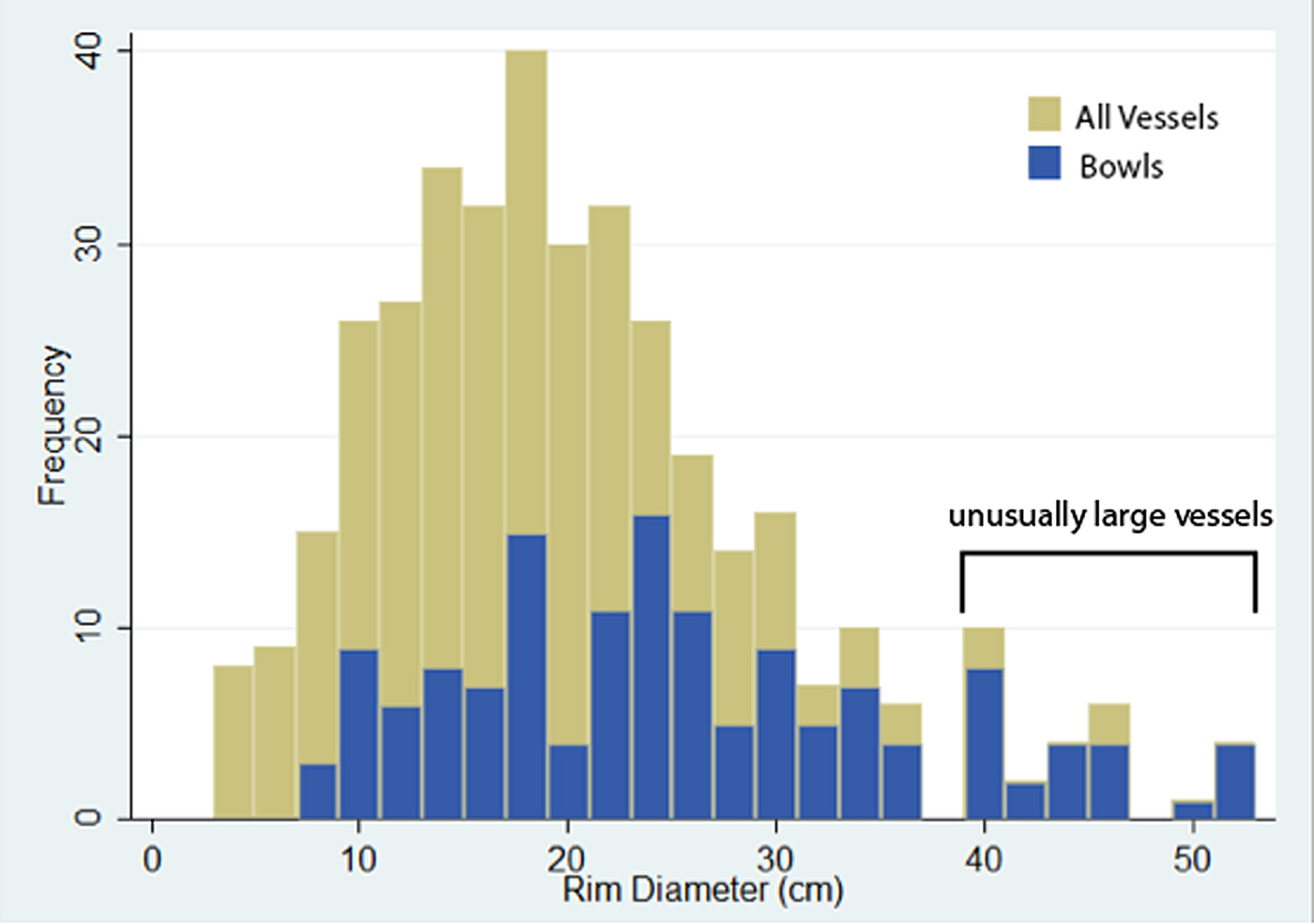
While orifice diameter measurementsFootnote 2 indicate that the range of typical Coles Creek vessel sizes (i.e., 8–35 cm) are present at Feltus, there is also a substantial number of exceptionally large vessels (i.e., >40 cm) that fall outside the range for a domestic site and indicate communal eating. When shape and size data are combined, the character of the Feltus feasting becomes clearer. Layered histograms of rim diameters for the entire Feltus assemblage and the bowl assemblage show that bowls make up a fairly consistent percentage of the total vessel count through 30 cm; yet above that, bowls dominate the assemblage (Figure 6). This would be expected if Coles Creek people were living (and thus storing and even preparing food) in scattered homesteads and gathering at Feltus occasionally for communal events including feasting. The fact that the most dramatic patterns in the ceramic data relate to size and form, not style or quality, suggests a high GS and low SC score.
Stacked histograms of rim diameter measurements of all vessels for which >5% of the rim was present (n = 378, lighter color) and the subsample of bowls (n = 127, darker color) showing that bowls dominate the assemblage after ~30 cm.

Food Remains
When compared with Coles Creek domestic sites, Feltus has a similar botanical assemblage showing heavy reliance on nuts and seeds. However, the feasting contexts show lower than expected plant diversity, perhaps reflecting rapidly deposited materials resulting from one or two concentrated episodes of activity (Kassabaum Reference Kassabaum, Peres and Deter-Wolf2018). By standardized count,Footnote 3 acorn is the most abundant plant resource (3.63/g), followed closely by hickory (3.16/g); combined, these two plant resources account for 56% of the identifiable assemblage. Three additional resources—chenopod (1.10/g), maygrass (0.85/g), and purslane (0.36/g)—make up an additional 22%, and every other taxon accounts for 3% or less. Thus, the Feltus feasts relied heavily on nuts supplemented by certain starchy seeds to provide carbohydrates, protein, and fat and greens to provide essential vitamins and minerals (Kassabaum Reference Kassabaum2014:240–270, Reference Kassabaum, Peres and Deter-Wolf2018). This evidence suggests that while feasts included the same plants consumed at domestic sites, attendees may have focused on resources that were easy to amass and store in bulk, leading to less diverse assemblages (Claassen Reference Claassen2010:151; Jackson and Scott Reference Jackson and Scott2003; Peres Reference Peres2017:Table 1).
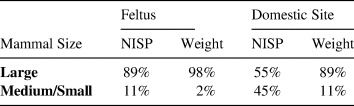
Over 12,000 animal bones were recovered from the feasting contexts at Feltus. Though the identified animals are common at Coles Creek sites more generally, the assemblage is not representative of the high faunal diversity of the Lower Mississippi Valley. Current understandings of Coles Creek faunal exploitation emphasize deer consumption alongside heavy reliance on fish, small mammals, and aquatic turtles (Kelley Reference Kelley1990). The Feltus feasting assemblage is dominated by large mammals (NISP = 24%, weight = 66%) and fish (NISP = 36%, weight = 10%) and lacks the smaller mammals and reptiles common at domestic sites (Kassabaum Reference Kassabaum2014:Table 5.13). Compared with the best analyzed Coles Creek domestic assemblage (Kelley Reference Kelley1990), the proportion of the Feltus mammal assemblage made up of medium and small species is unexpectedly low, while the identified number of large mammals, primarily bear and deer, is high (Table 3). A focus on meat consumption (over marrow or grease extraction or bone tool production) further suggests feasting and is indicated by low overall utilization of the deer carcasses (Kassabaum Reference Kassabaum2014:Table 5.9; see also Claassen Reference Claassen2010; Jackson and Scott Reference Jackson and Scott2003; Peres Reference Peres2017:Table 1). Beyond large mammals, very large sucker, catfish, and alligator gar dominate the assemblage. Gar scales and vertebrae indicate that some specimens were more than 1.5 m long. A lower tier of animal resources includes rabbits, squirrels, and turtles, species that are comparatively easy to capture in large quantities (Kassabaum Reference Kassabaum2014:270–298; see also Pluckhahn et al. Reference Pluckhahn, Compton and Bonhage-Freund2006). The floral and faunal data from Feltus further support a model of feasting that focused on bringing together many everyday resources at a central location, implying a high GS and low SC score.
Comparisons by Mammal Size for Feltus and a Coles Creek Domestic Site.

Source: Data from Kassabaum Reference Kassabaum2014 and Kelley Reference Kelley1990.
Ritual Remains
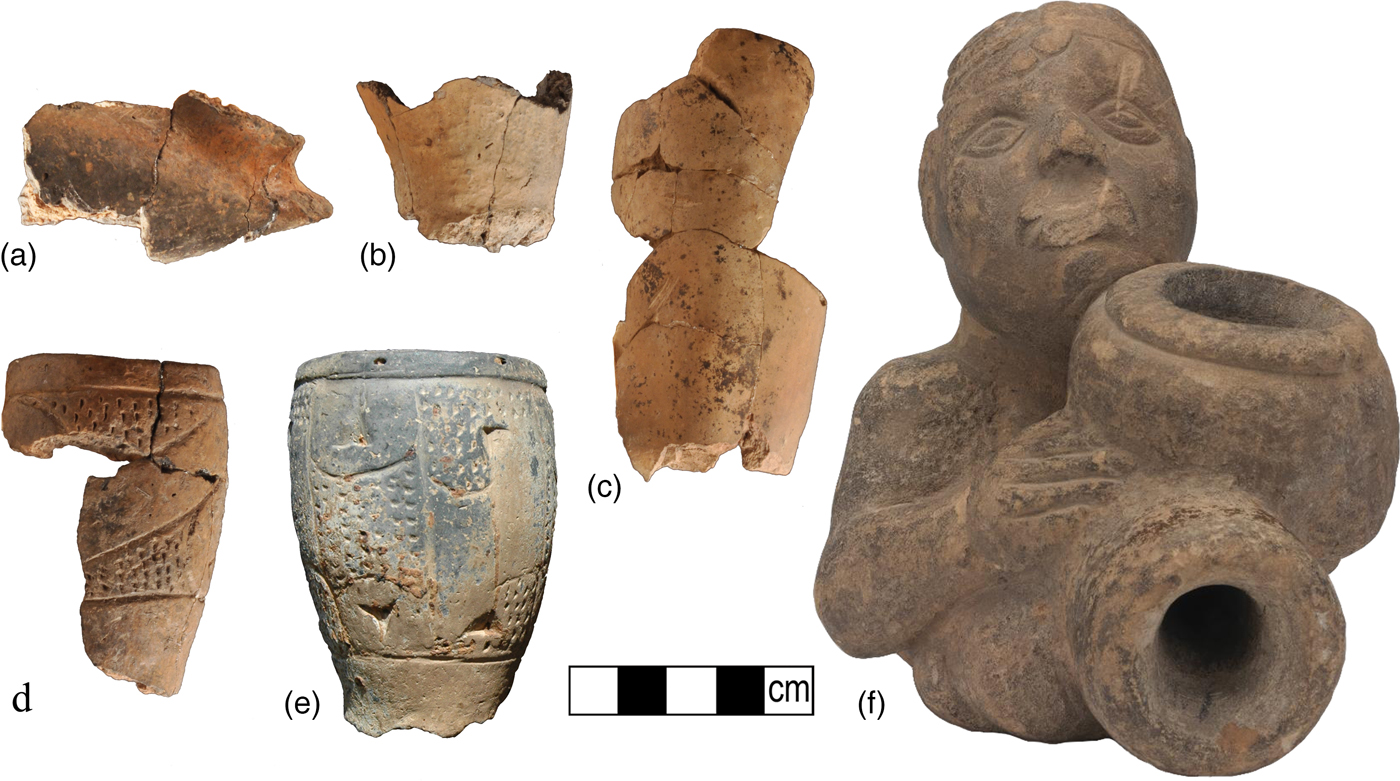
The Feltus feasting assemblage generally does not include rare, exotic, or labor-intensive foods, high-quality vessels shaped or decorated in distinctive ways, or overt prestige items; in other words, indications of a high SC score are lacking. That said, a few unusual and presumably ritual items are associated with the feasting deposits and must be discussed. Ritual use of plants is suggested by the presence of nightshade, morning glory, sumac, pokeweed, and other plants that may have had medicinal or ritual rather than dietary uses (Kassabaum Reference Kassabaum2014:240–270; Williams Reference Williams2000; see also Pluckhahn et al. Reference Pluckhahn, Compton and Bonhage-Freund2006:266). Moreover, maygrass (and potentially other dietary staples) may have played important roles in premaize ritual events (Fritz Reference Fritz and Minnis2014). Finally, while no tobacco seeds have been identified from Feltus, we collected fragments of more than 20 ceramic pipes (Figure 7), and initial residue analysis suggests both tobacco and other plants were smoked during the feasts (Carmody et al. Reference Carmody, Kassabaum, Hunt, Prodanovich, Elliott and Russ2018). For most Native groups, the act of smoking signifies or creates community bonds and helps to facilitate interactions by concealing apparent differences and making strangers into temporary kin (Rafferty and Mann Reference Rafferty and Mann2004; Springer Reference Springer1981; Steinmetz Reference Steinmetz1984), suggesting a solidarity-driven purpose behind these inclusions.
Photographs of Feltus pipes: (a–c) undecorated elbow pipes from Feltus Archaeological Project excavations; (d) French Fork Incised pipe bowl from Feltus Archaeological Project excavations; (e) French Fork Incised pipe bowl in the collection of Robert Prospere, Natchez, Mississippi; (f) stone pipe collected in the 1840s by Montroville W. Dickeson (image courtesy of the Penn Museum, Image #237710, Object 14328). The stone pipe is in the collections of the University of Pennsylvania Museum of Archaeology and Anthropology.

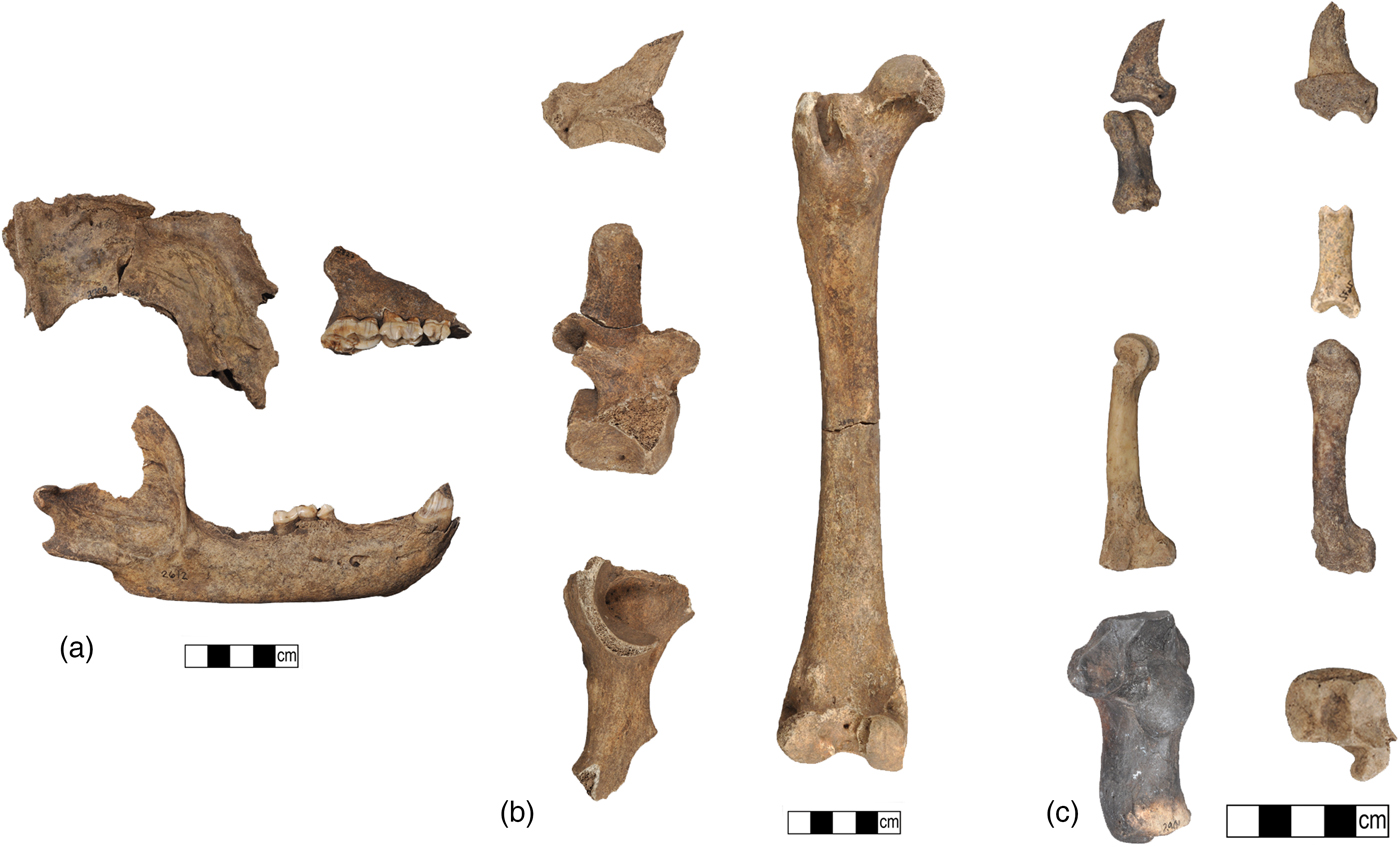
An even more compelling case for ritual activity comes from the abundance and treatment of bear bone (Figure 8). Archaeologists tend to focus on the utilitarian and economic roles that animals play; however, “human–animal interactions were often intimate and relational, integral to the fabric of society and part of the ‘total social phenomenon’… as essential to the constitution of society as humans themselves” (Hill Reference Hill2013:117).
Sample of bear remains recovered from Feltus: (a) skull elements; (b) appendicular and axial elements; (c) paw components (adapted from Kassabaum and Peles Reference Kassabaum, Peles, Carmody and Barrier2019:Figure 7.2).

Interpretations of the Feltus bear remains have been discussed at length elsewhere (Kassabaum and Nelson Reference Kassabaum and Nelson2016; Kassabaum and Peles Reference Kassabaum, Peles, Carmody and Barrier2019; Nelson and Kassabaum Reference Nelson and Kassabaum2014; Peles and Kassabaum Reference Peles, Kassabaum, Lapham and Waselkov2020), but I summarize the data here. First, bear remains are unexpectedly abundant at Feltus (NISP = 137) when compared with other Lower Mississippi Valley sites, with elements from all major parts of the skeleton having been found in each feasting deposit. A ratio of bear NISP to deer NISP was calculated for 11 Lower Mississippi Valley sites dating to Coles Creek and early Mississippian times. Feltus's ratio (12.35) is over three times the average of the other 10 sites (4.09), clearly indicating that bear were of particular importance there (Peles and Kassabaum Reference Peles, Kassabaum, Lapham and Waselkov2020:Table 10.2). In addition, bear bone was treated differently from the bones of other species at Feltus—more frequently burned and almost always discarded whole. Finally, bear bone was purposefully included in a post pit in Feltus's southern plaza, along with a small assemblage of faunal and ceramic remains and the remains of four or five human children under the age of five. Combined, these factors suggest bears played a significant social role in Coles Creek society. While this would not necessarily have precluded them from being eaten, it does suggest that Coles Creek people, like many hunter-gatherers, maintained relationships with animals that went well beyond subsistence; therefore, understanding the nature of that relationship is important to understanding the associated rituals.
Since Paleolithic times, bears have been potent ritual symbols for peoples throughout Eurasia and North America. Though the details change based on context, the meaning of bear has stayed remarkably constant (e.g., Black Reference Black1998; Hallowell Reference Hallowell1926; Rockwell Reference Rockwell1991). The geographic and temporal span of these belief systems implies that they have great time depth allowing for careful extrapolation to precontact times. In ethnohistoric accounts from the United States, bears are consistently portrayed as food providers, kin, healers, and spirit guides (as summarized in Hallowell Reference Hallowell1926; Kassabaum and Peles Reference Kassabaum, Peles, Carmody and Barrier2019; Peles and Kassabaum Reference Peles, Kassabaum, Lapham and Waselkov2020). As the most humanlike animal, bears were considered capable of social and kin-based relationships with humans and of taking part in social gatherings. Their ability to communicate with the spirit and animal worlds drew together an extended social network of nonliving and fictive kin (Kassabaum and Nelson Reference Kassabaum and Nelson2016; Nelson and Kassabaum Reference Nelson and Kassabaum2014). Thus, like pipes, the abundance of bear remains supports an interpretation of the Feltus feasts that emphasizes the creation and maintenance of social ties.
Discussion
Returning to the dual-dimensional model, the vessel size, amount of food, rapid deposition, and an open communal location imply Feltus should have a high GS score. Lack of evidence for high-quality vessels, wastage, atypical disposal, prestige items, or markers of status differentiation suggests a low SC score. Pipes and bears, unusual inclusions in the Feltus feasting deposits, are associated with community-building rituals through establishing and maintaining relationships between participants and are rarely included in rituals associated with status negotiation. While their presence certainly indicates a ritual component to the Feltus events, it does not support a political or competitive focus.
Combined, these lines of evidence place Feltus squarely in the large-scale, egalitarian communal events quadrant, thereby suggesting that archaeological case studies such as Upper Saratown in North Carolina (VanDerwarker et al. Reference VanDerwarker, Scarry, Eastman and Twiss2007) and ethnographic case studies such as those from the Puebloan Southwest (Mills Reference Mills and Mills2004) will aid in understanding the activities that took place there. Looking at these and other examples of eating events where material assemblages produce similar GS and SC scores allows for meaningful comparisons between Feltus and sites with similar archaeological signatures, regardless of their temporal or geographic relationships. By allowing cross-cultural comparisons, this model encourages researchers to be open to explanations and understandings that move beyond the deeply entrenched interpretive frameworks that characterize archaeological work in many regions. In the Feltus case, it provides the impetus and opportunity to take a less Mississippian-centric view of Coles Creek social life. The interpretation of the Feltus feasts as events that emphasize community solidarity and identity construction over sociopolitical competition and status-seeking behavior thus joins other lines of evidence (i.e., communal burial, lack of corn agriculture, and absence of prestige items and trade goods) to reject the notion of a hierarchical sociopolitical system during Coles Creek times.
Conclusion
Feasts, as eating events that differ in some way from everyday consumption, are a highly variable phenomenon with a deep history. Due to their decidedly material nature, they are easily identifiable in the archaeological record and have recently garnered much theoretical attention. Archaeological signatures related to the quantity, size, and types of food remains; the nature of depositional events; the number, quality, and types of preparation and serving implements and facilities; and the presence of ritual paraphernalia and prestige goods have been used to suggest that everyday meals had certain social outcomes while feasts had others. However, variability in their material correlates suggests that not all feasts were created equal.
I have argued that much of this variation can be captured on two axes—group size and level of sociopolitical competition—and that by pairing them in a dual-dimensional model, we can avoid the pitfalls of dichotomizing the feast–nonfeast distinction. By separating the competitive dimension from that of scale and viewing each as a continuum, we avoid confusing large, competitive feasting practices with the kinds of practices that differentiate feasts in general from everyday consumption. Moreover, the model leaves open the possibility that other axes of variation may be important in particular cases and that their integration could create even more precise methods for understanding the social and material outcomes of eating events in the past.
As evidenced by the Feltus case study, the dual-dimensional model allows for more sophisticated interpretations of material remains by suggesting appropriate cross-cultural comparisons. Combined, these lines of evidence emphasize that Coles Creek feasts fit within a category that has been under-theorized in archaeology—feasts whose purpose and outcome were to build community and increase solidarity within a group. Focusing on this category brings the kinds of eating events common in the pre-Mississippian southeastern United States to the forefront of theoretical discussions of feasting. Though not undertaken here, such a rich and contextualized archaeological case study of a feast from the competitive events with limited attendance quadrant would be similarly useful at drawing often ignored feast types into broader theoretical discussions.
Acknowledgments
As directors of the Feltus Archaeological Project, Vin Steponaitis and John O'Hear made this research possible. While no permit was necessary, I am grateful that the landowner provided us access and permission. Ed Jackson and Lynn Funkhouser completed the faunal analysis. This article is based on a chapter from my dissertation, completed under Vin's direction at the University of North Carolina. I am grateful to him, Margie Scarry, Kathy Morrison, and three anonymous reviewers for helping to shape my thinking on this topic and supporting its publication.
Data Availability Statement
Digital data from Feltus are available through the author or the Research Laboratories of Archaeology at University of North Carolina, which houses the archaeological collections. Raw data are presented in my dissertation (Kassabaum Reference Kassabaum2014) and a number of subsequent publications (Kassabaum Reference Kassabaum, Peres and Deter-Wolf2018; Peles and Kassabaum Reference Peles, Kassabaum, Lapham and Waselkov2020).