Early access to innovative medicines addressing unmet medical needs is important for patients, as well as for the pharmaceutical industry. However, new medicines that have been approved as safe and effective by the European Medicines Agency (EMA), may not always be reimbursed by national health systems because requirements for reimbursement differ widely between the regulators and health technology assessment bodies (HTABs) in each country (Reference Bouvy, Jonsson, Longson, Crabb and Garner1–Reference Drummond4). As a result, pharmaceutical companies must adapt, change, or conduct additional trials in order for their new medicine to be eligible for reimbursement in different European countries (5;6).
There is a need to align requirements early on to make regulatory assessment and reimbursement processes more rapid and efficient. Early dialogues (ED), having HTABs and Regulators at the table in the early stage of drug development, could be the solution (Reference Leyens and Brand7;Reference Maignen, Osipenko, Pinilla-Dominguez and Crowe8). ED between regulators, HTABs, and pharmaceutical companies could facilitate this process by clarifying the needs, expectations and requirements for specific patient populations, comparators, endpoints, and assure faster access to new drugs as a result of efficient drug development plans (9;Reference IJzerman, Koffijberg, Fenwick and Krahn10). Many workshops have been held, and guidelines organized and published by the EMA, but there is still a knowledge gap about ED in the pharmaceutical industry, that is, how people in the pharmaceutical industry perceive ED. Accordingly, this study aims to assess the current benefits and limitations of ED and seeks to identify the existing gaps with regard to the development and introduction of pharmaceuticals, in trying to set up a permanent collaboration of all stakeholders.
METHODS
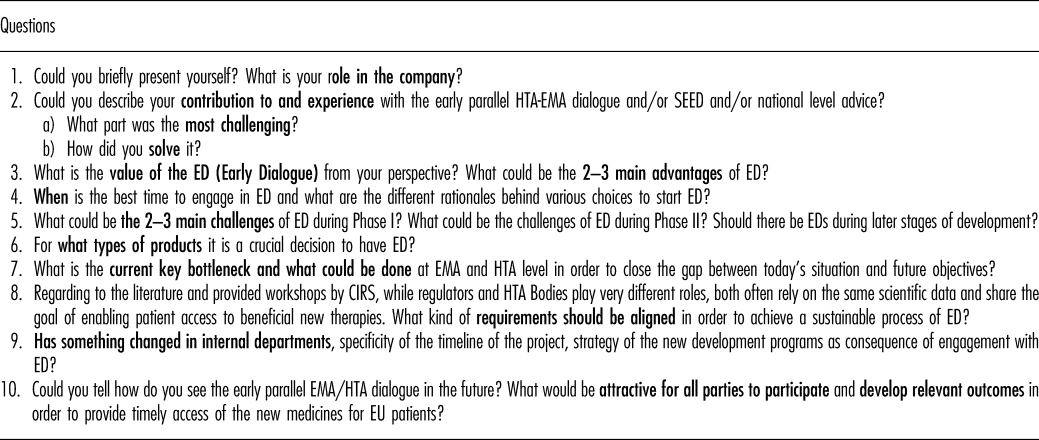
A questionnaire consisting of ten open-ended questions (see Table 1) was used for the interviews. An interview guide was developed and the interview questions were formulated after a nonsystematic literature review of articles in scientific databases such as PubMed, Cochrane, as well as gray literature. The questionnaire initially developed by the research team (n = 3) was further evaluated by two professionals from the pharmaceutical industry who were familiar with the topic; some corrections were made regarding their suggestions to create a clear and informative questionnaire. A total of eleven interviews were conducted purposively with professionals who had relevant experience in ED. Interviewees represented different positions within the pharmaceutical companies: Regulatory Affairs (Reference Cuche, Beckeman and van Weelden3), Regulatory Policy (2), Outcomes Research (Reference Bouvy, Jonsson, Longson, Crabb and Garner1), and Market Access (2).
Questions Asked during the Interviews

EMA, European Medicines Agency; HTA, health technology assessment; SEED, Shaping European Early Dialogues.
In addition, interviews were conducted with participants from EMA (Reference Bouvy, Jonsson, Longson, Crabb and Garner1), European Federation of Pharmaceutical Industries and Associations (EFPIA) (Reference Bouvy, Jonsson, Longson, Crabb and Garner1), and a Health Economist from a private consultancy company (Reference Bouvy, Jonsson, Longson, Crabb and Garner1). Interviewees were recruited from Belgium, the Netherlands, the United Kingdom, Switzerland, and Germany. Nobody refused to be interviewed. Interviewees were contacted through email, and after they agreed to participate in this research, teleconferences were arranged. After the completed interviews, the conversations were transcribed and sent back to the respondents to review the correctness of the transcripts. Due to the small sample size, no specific software was used and one researcher did the coding. Submission to the Ethical Research Committee is not required for this type of study in the Netherlands, as our research did not involve any intervention. The interviewees agreed to participate voluntarily and were assured of personal anonymity so that they could respond to the questions as openly as possible. The COREQ Checklist was used, to ensure that our research was efficiently reported (Reference O'Brien, Harris, Beckman, Reed and Cook11). Data were analyzed using a coding approach following recommendations in the literature (Reference Polit and Beck12).
RESULTS
Value of Early Dialogue
All representatives mentioned that ED provides for having all stakeholders at the table, discussing possible hurdles and how they can be overcome to design the most efficient program for developing new medicines. As a result, ED facilitates the delivery of new drugs to patients. Five interviewees stated that EDs provide an opportunity to understand the rationales of the requirements established by regulators and HTABs.
Challenges Faced during the Early Dialogue Experience
Regarding external challenges, six interviewees mentioned difficulties in communication with HTABs and the challenges they faced in getting the HTABs to the table for face to face meetings. Regarding internal challenges, seven professionals seemed convinced that aligning internal people and processes was the most challenging part. Two interviewees mentioned that they were developing drugs for orphan diseases with no clear guidelines or requirements from regulators and HTABs. ED was chosen as a solution that could accelerate data generation to provide faster access to new drugs, and the solution brought more efficient process with no delays.
With regard to resolving the challenges mentioned above, two interviewees stated that separate dialogue with HTABs and the regulatory agency was chosen. Some organizations participated only in the Shaping European Early Dialogues (SEED) project in Joint Action 2, where joint multi HTA advice was given separately from regulators. To solve internal and external obstacles, one interviewee stated that an external consultancy company was hired to help manage the complex process.
The Most Efficient Time for Early Dialogue
All participants stated that there are various options and that every option has its rationales. However, six of interviewees expressed that the best time to initiate ED with pharmaceutical companies is after they have established the proof of concept for a new compound, which allows them to move into Phase 3 clinical development.
Types of Products
Opinions about what types of products (for example, orphan drugs or drugs for children) would benefit from ED varied among the interviewees. Three people claimed that the decision to use ED is very selective in their company because it is resource intensive and companies could not manage the process for all new medicines. Overall, all participants agreed that engagement with ED should be voluntary and open to all products and companies, but that priority should be given to new medicines addressing a highly unmet medical need. This would include innovative medicines and medicines for orphan diseases, because these fields lack researches, guidelines, and examples of efficient development.
Current Bottlenecks
The majority of participants mentioned that the process of ED has improved considerably since the beginning. However, some bottlenecks still exist and these should be resolved. The notion that ED is resource intensive was acknowledged by three interviewees. All participants mentioned the capacity of HTABs as the major bottleneck during the processes of ED.
Divergence among HTABs was mentioned by four interviewees. They claimed that there are huge differences between British and German HTABs because of different legal requirements and different approaches of HTA methodology. As a result, these divergences usually require additional time and resources to solve the problem and align the process.
Finally, different requirements between the relevant regulatory agency and HTABs were mentioned as a very important bottleneck that sometimes requires additional resources or clinical trials, delaying the introduction of a new drug.
Difference in Requirements between the Regulatory Agency and HTABs
Interviewees pointed out that alignment of the comparators used during clinical trials is currently the most important issue. In addition, endpoints, study duration, the target population, and medical need were also mentioned.
The majority of interviewees agreed that the ED is evolving, and both regulators and HTABs are becoming more aware of the rationale behind each other's requirements. Accordingly, it is helpful to begin aligning requirements, to avoid doubling the work for pharmaceutical companies.
Future Perspectives
All interviewees stated that the work is heading in the right direction, as all parties are becoming aware of the significant benefits of ED, seeing that this process can help to make the development of drugs more efficient and speed the treatment of unmet medical needs. Certainly, this is valuable for both patients and the pharmaceutical industry. According to the interviewee from the regulatory agency (the European Medicines Agency), the number of EDs is increasing every year and this demonstrates that the pharmaceutical industry perceives ED positively. The majority of participants mentioned that defining a well-resourced and scalable process of ED that meets the needs of the EMA and HTABs should be the first step in the near future. Therefore, more dialogues, openness, and collaboration are needed to decide on the feasibility of a permanent infrastructure, on how to involve sufficiently the right number of HTABs and provide appropriate timelines for the process.
The new parallel consultation process announced by EMA and EUnetHTA in July 2017 is a step in the right direction (Reference Harousseau, Pavlovic, Mouas and Meyer13). However, alignment across the HTABs in Europe should be achieved first. Six interviewees mentioned a new Standing Committee recently established by EUnetHTA at JA3; this committee will be comprised of the most experienced and committed HTA members. As a result, better alignment of requirements across Europe can be reached and a representative number of HTA participants in ED meetings can be ensured.
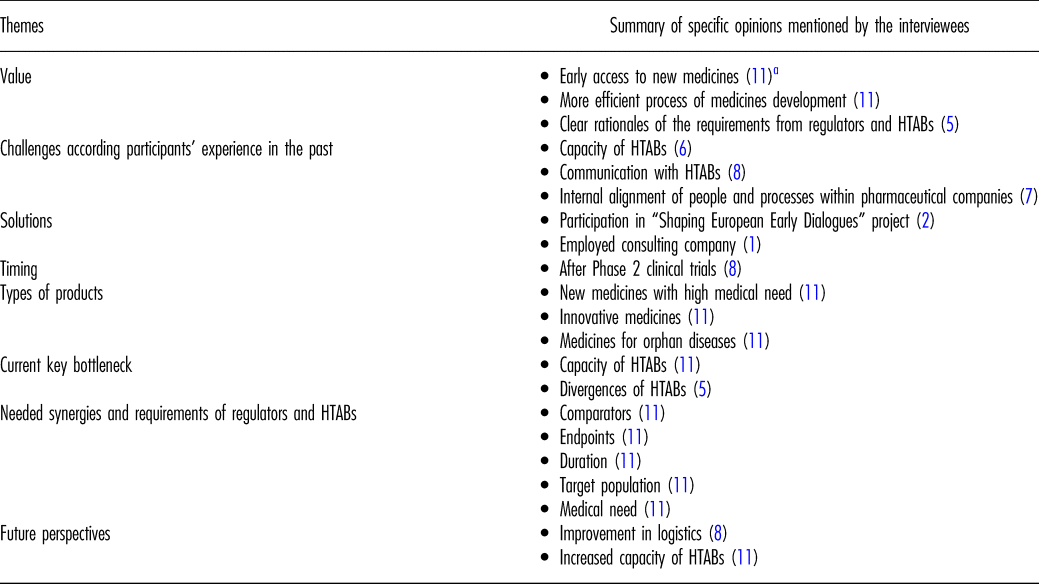
A clear overview of the findings can be found in Table 2, which summarizes the key bullet points of our research.
Interview Findings

a Number of interviewees who described a specific issue.
HTABs, health technology assessment bodies.
DISCUSSION
This research confirms that people working for the pharmaceutical industry appreciate having regulators and HTABs at the table for early discussions. These results supplement the opinions and suggestions from regulators and the network of HTA agencies (2;9). During this research, ED was confirmed as an important determinant during the research and development of a new drug in a pharmaceutical company, where ED provides the opportunity to learn and clarify the requirements of the EMA and HTABs in the early stages of development. As a result, divergent data requirements can be minimized and mutual reliance should lead to better scientific advice, avoidance of duplication, and efficient development processes for new medicines (6;9;14;Reference Schee Genannt Halfmann, Evangelatos, Schröder-Bäck and Brand15). In addition, further research needs to be done to answer questions on how to better align regulatory and reimbursement assessments.
During our research, the pharmaceutical company agreed that more synergies between HTABs and EMA requirements are needed to avoid double work and some of the misunderstandings pharmaceutical companies face. This expressed need reinforced ideas which surfaced at CRIS or EMA-HTA workshops (6;16;Reference Tafuri, Pagnini and Moseley17). Following our research, “Guidance on Parallel Consultation” was published by EMA and EUnetHTA. Actors and scope, pathways, processes and advice formats of ED are discussed in this study. We believe this will encourage more pharmaceutical companies to engage in early parallel dialogue with regulators and HTABs in the near future (18).
Limitations
This study was conducted with a limited number of interviews with people from HTABs. It would have been valuable to receive more comments on the need to align the requirements and future perspectives of ED from that perspective. Coding and analysis of two researchers might have brought more versatile results; only one researcher was able to do this as timing was a limiting factor. The confidentiality of interviewees was ensured so that they could be transparent and provide all necessary information.
In conclusion, this study suggests that people from the pharmaceutical industry perceive ED as a valuable tool that can bring medicines to patients faster due to streamlined development. Effective ED could lead to clinical trials that are better suited to the expectations and requirements of regulators and of HTA agencies, and thus increase the number of positive reimbursement recommendations, bringing medicines to the market faster. Stakeholder perspectives indicate that, while of benefit to all parties, ED processes can achieve greater value by starting the alignment of requirements between EMA and HTABs. That should be the next step on the way to reducing time, saving resources and improving the engagement of pharmaceutical industry, providing an effective, fast, and clear process of ED.
CONFLICTS OF INTEREST
The research was done during an internship at MSD. This had no influence on the results of the research.