Prostitution is a form of our national People's Livelihood. No thriving commercial port is not chockablock with brothels . . . Last year [1911] due to the revolution, all Shanghai businesses did badly, with the exception of brothels, which thrived . . . The commerce of prostitutes . . . is central to the Republic's economic power . . . Why not emulate Guan Zhong by crafting a deft policy to use it to enrich the state?
‘Using brothels to recover national rights’, Shenbao 1 Oct. 1912, ‘Free Talk’ section.Footnote 1
On 24 July 1935, Suzhou's prostitutes declared that they had had enough. Though proscribed since 15 June 1929, prostitution had continued to be a formative aspect of the city's urban geography and a significant component of its commerce. More than 400 ‘unlicensed prostitutes’ (sichang)Footnote 2 illegally plied their trade in the shadows of the horse-road area outside the city wall between Xu and Chang Gates, indicating that sex work continued to be a leading, if not the most popular, employment for women, as it had been just before state prohibition. This flurry of concentrated, barely concealed illegality (most bawds solicited customers from the open doorway of a brothel entrance) relied on the acquiescence and protection of area police, who demonstrated a token interest in the statutory prohibition by regularly arresting a handful of women.Footnote 3 Police tolerance not only stemmed from self-interest born of engorgement from bribes and fines, it bespoke wide support among municipal and business interests for prostitution as an essential stimulus for other commerce and source of state monies.
During the summer of 1935, however, reformist rectitude prevailed, and the cops enforced the law with unusual vigour. Women were apprehended in large numbers and fined 5–10 yuan. Forced to surrender the entire sum they had earned over one or several nights of selling their bodies, prostitutes found themselves, in effect, working for the profit of the state – and at cut wages. Prices in the local sex market had recently collapsed by a third, seemingly due to the constant influx of poor rural women into vice. A night with a high-, mid-, and low-level prostitute, respectively, had previously run 5–6, 4 and 2–3 yuan; rates were now 4, 3 and 2 yuan, if not less. (One report claimed that a 7–8 yuan evening with a top courtesan could now be got for 3, and a 4–5 yuan night with a hooker now cost 1 or 2.) Lower prices decreased women's earnings, which were depleted further by extractions by hotel and brothel personnel. As the summer wore on, the women found the police action increasingly unfair and impossible to accept, leading one newspaper to poetically note, ‘In Chang [Gate] Pavilion quarter, swallows scold and orioles sob.’Footnote 4
Changzhou Old Five had long been active in the Suzhou sex trade, initially likely as a brothel ‘flower’ and now as a madam. As such, she may have been expected to be inured to the vagaries of the police. Yet, when one of her fledgling prostitutes was arrested and fined 5 yuan, Old Five was so incensed that she co-ordinated with ten sister brothel madams and senior attendants to call a general prostitute strike for 8 pm on 24 July.
The strike took. Newspapers reported that at 8 pm, many women were already entertaining clients, but at the appointed hour, most stopped and returned their fee to their now dismissed clientele. The normally raucous entertainment quarter grew eerily quiet. Most prostitutes were reported to support the action, yet it was unclear how long they could afford to stop working. Within a few days, some had moved to alternate locations, where they solicited in secret, while others had simply resumed working. By early August, the walkout seems to have collapsed.
Several media commentators labelled the action ‘bizarre’, ‘laughable’ or ‘pitiful’. These disparaging characterizations aside, the strike was undeniably quixotic: encumbered by low social status and the illegal nature of their work, the prostitutes were seemingly not destined to best the police.Footnote 5 One local editorial writer opined that the walkout did, at the least, inconvenience the cops: once prostitutes ceased plying their trade, no fines flowed into police and general state coffers, causing a financial shortfall for city authorities. Yet, the writer continued, others, including ‘men in dire need of sexual release’ and area businessmen, particularly hotel owners, were more seriously affected.Footnote 6 Many area hotels were so dependent on prostitution for their trade that by 25 July, the second day of the strike, concerned parties had pressured Hotel Association head Xue Yunlong to petition the county administration to legalize prostitution so as to prevent future disruptions. Recognizing that this request might cast the association in a disreputable light, Xue declined to confirm whether he had delivered the plea.Footnote 7 One Suzhou mingbao editorialist did not doubt the hoteliers’ position, ‘Some argue that prostitution contributes greatly to urban commercial vitality. If prostitution were ended today, shops and hotels would beg for mercy.’ No shop or hotel would choose to abjure it for a completely licit mode of business.Footnote 8 There is no evidence that the strike moved the authorities to alter their tactics. Nonetheless, Changzhou Old Five did succeed in manifesting the demimonde's collective power over city commerce and its hold on the horse-road area, as well as the intimate interlinkages among the state, business and vice.
Despite their abject position, Xu/Chang Gate prostitutes were sufficiently aware and confident of their place in the physical space of the city and its social and economic hierarchies to imagine that their work stoppage would be taken seriously and provide them an opportunity to remonstrate publicly with the police. One reporter condescendingly dismissed this optimism as the ignorant naïvety of uneducated women, yet, as this article will discuss, several decades of explicit state and business community policy had affirmed the key role of the prostitute and her trade as a characteristic – and, for some, economically fundamental – definitively urban Suzhou institution.Footnote 9 Similarly, despite the media conceit that the strike was a frivolous ‘wacky happening’, the walkout was not the first time that prostitutes had struck in an attempt to renegotiate the terms of the state's regulation and economic interest in prostitution. Mutual economic benefits had fostered a decades-long symbiosis between vice, area business and local government that endured, whether prostitution was legal or not. (The county government did not receive licence fees or other tax monies from brothels after the 1929 proscription, but it did continue to derive secondary assessments via taxes paid by hotels, shops and other enterprises that profited from the patronage of prostitutes and their clients.) Furthermore, in light of the eventual re-legalization and state regulation of prostitution in Suzhou (ostensibly a stage toward gradual abolition) on 1 March 1936, one could argue that by forcing reconsideration of the perennial debate between legalization vs. abolition as the most efficacious means of managing vice, Old Five and the strikers ultimately achieved their aims.
Sexual commerce had long been viewed as central to the city's political economy and proved to be a key site of negotiation among the state, business, local denizens, brothel clientele and prostitutes themselves over its proper place in Suzhou. During the late Qing and Republic, Suzhou state officials and business leaders openly exploited prostitution to foster economic development, especially along the railway station horse-road outside the northern city wall. City leaders correctly surmised that the ‘spill-over’ from prostitution would support an array of other commercial activities. This practice, which one should view as an explicit if semi-informal state policy, was not uncontroversial. Nor was it unusual. Prostitution, whether legal or not, underlay the political economy of many cities and towns, large and small, as an essential stimulus to commerce and source of state revenue. At the same time, during the first decades of the twentieth century, female and male reformers alike militated against female prostitution as a local and national shame that bespoke the noxious effects of male lust and sexism, and national poverty and foreign and domestic capitalist exploitation, phenomena that were anathema to a modern independent republic dedicated to the rights of male and female citizens alike. By the mid-1920s, abolitionists had successfully captured the public imagination and calls for the eradication of vice had become a common refrain in the press and catchphrase of reformist politics. With the founding of the Guomindang (GMD) Nanjing regime, they were finally in a position to curtail and prohibit prostitution. Numerous measures barred prostitution in individual cities and entire provinces with the aim of creating a more just and modern society. Irrational and retrograde, prostitution both represented and perpetuated the social and economic structures of ‘old society’, the very things that Republican era cities such as Suzhou sought to dispel through the creation of new modes of urban commerce and life. In a complementary fashion, as we will explore below, some Republican era Suzhou businessmen feared that the prominence of vice interfered with the expansion of licit commerce and development. Whether in terms of male and female equality, economic and social development, or other registers of local urban and greater national progress, prostitution was widely denounced as backward and unmodern, a practice that was simultaneous anachronistic and noxious to a forward thinking republic.
This groundswell in reformist scruple was increasingly at odds with the alternate, even antithetical, modernizing imperative of promoting urban economic growth and state-guided city planning. In Suzhou and other cities, a host of state and business interests deployed sexual commerce for its financial benefits irrespective of its legality. In the end, both abolitionists and defenders of prostitution agreed that prostitution and the prerogatives of male desire were inextricably linked to the fortunes of the greater urban economy and the creation of the modern city. The conflict between those who would prohibit prostitution as unjust and regressive and those who would foster it as productive of urban commerce and state finance highlighted the fundamental tensions between key aspects of modern urbanity and nationalism: the exigency of reforming societal relations, especially through the levelling of gender and class hierarchies, vs. the exigency of promoting urban economic activity and city growth and development.
This article locates this conflict between alternate facets of urban modernity within local debates regarding the physical, discursive and political-economic place of prostitution within Suzhou during the late Qing and Republic. Starting with the first decade of the twentieth century, when prostitution provided a rich source of state income, this article examines a 1907 move by Suzhou state and gentry investors to stimulate real estate speculation via the strategic siting of elite ‘Long Three’ bordellos patronized by the wealthy. The analysis then moves on to examine some of the public policy and commercial considerations that led to its 1929 ‘abolition’. The article ends by considering how concerns regarding the ineffectiveness and deleterious economic consequences of wholesale prohibition helped provoke its 1936 re-legalization under a regime of state regulation and ostensible gradual prohibition.
Influential scholarship by Gail Hershatter, Christian Henriot, Paula Zamperini and others has explored the central place of prostitutes and vice in the late imperial and Republican era urban cultural imaginary and limned the increasing sway of the nationalist abolition movement. The impact of prostitution on the economy and state finances of Chinese cities, while widely noted, has been little studied outside of Guangzhou, where, as Elizabeth Remick and Virgil Ho have demonstrated, flower taxes constituted a leading source of revenue and thus bankrolled the slate of ambitious late Qing and Republican era state-building initiatives in Guangdong province.Footnote 10 This article builds on these works by arguing that state and business interests effectively fostered and deployed prostitution as a political-economic instrument to support state and private commercial and urban development efforts. As such, prostitutes and the sex trade not only contributed to late Qing and Republican state-building projects, they also interacted with Suzhou government and business leaders as a formative constituency in the building of the modern city, its economy and social life. Like the articles by Xiong Yuezhi and Liu Haiyan in this issue, this article emphasizes the reciprocity between social and political networks, which shaped the built environment and were, in turn, affected by the resultant urban space.
Vice was, therefore, imbricated in the formation and function of the entirety of the urban space of modern Suzhou – not only in the areas in which it was concentrated. To some extent, this generativity attests to the overall sexualization of urban space. As in other cities, prostitution was not effectively confined to particular locations: brothels, streetwalkers and other modes of sex work were spread throughout Suzhou – or, rather, extended throughout the city during the Republic as a result of rural economic hardship, the mobile nature of the work and the ubiquity of client demand. At the same time, however, the impact of prostitution on the overall urban political economy stemmed from its concentration in the Xu/Chang Gate horse-road area, the site of Suzhou's initial urbanist planning projects and the inspiration for consequent modernizing efforts elsewhere in the city. By recognizing prostitution as an organizing principle of the city's late Qing and Republican social geography, one can also gain heightened appreciation for the formative yet often overlooked effects of women's labour, male desire and consumerism in the creation of modern urban social space. That these forces were simultaneously promoted and denounced in the name of city improvement and modernization highlights the multifarious and, at times, antagonistic aims of both Republican urbanism and nationalism.
‘To make these losses good . . . turn out the prostitutes . . .’
Begun in 1896 as a vector for Chinese industrial development and a cordon sanitaire against foreign incursions, the Suzhou horse-road was a successful failure. Official, local gentry and merchant investors found that the textile factories that were to be its mainstay were not greatly profitable, and the street failed to coalesce into an extensive factory zone akin to that of Shanghai. Nonetheless, elite backers enjoyed excellent returns on their investments due to an amalgam of other mutually beneficial industries: real estate, female prostitution, opium dens, retail shops and other urban entertainments. These businesses made the horse-road so financially successful that state and private investors soon initiated several extension projects, which by 1906 brought the street from outside the south-western Pan Gate to the east of the new railroad station built beyond the northern city wall beyond Chang Gate.
Opium dens had sprung up along the road even as it was being built. The appearance of the first brothel may have gone unremarked, but by 1899, the selling of sex was so pronounced as to prompt Shenbao to report on the proliferating brothels, opium dens and other lively haunts, many run by notorious Shanghai toughs attracted by the easy profits from good business. Aggressive solicitations from young teenage harlots and the procession of evening carriages bringing prostitutes and clients to their assignations became well-known markers of the Xu/Chang Gate horse-road scene. Although a commercial mainstay, prostitution along the street was generally down-market, dominated by middling and lower level brothels and streetwalkers, as the city's celebrated elite bordellos were ensconced within the city wall near Chang Gate. The horse-road streetscape was, nonetheless, a lucrative engine of commercial profits for brothel bawds, shop owners and landlords, and a rich generator of licence and other fees from prostitution, opium and various business enterprises.Footnote 11
Map of western area of Suzhou, 1927

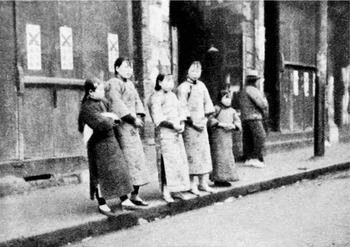
Prostitutes soliciting customers on the street: Republican period

This cornucopia was imperilled in 1907, shortly after the street had been extended, at great expense, beyond the station for the recently opened railroad line to Shanghai and Nanjing. Per the gradual decade-long prohibition campaign initiated by a September 1906 imperial edict, commercial opium dens were shuttered in August 1907. Many commentators soon noted that the prohibition was in name only. Official notices had appeared on city shopfronts, yet backdoors, literal and metaphorical, remained opened. Though the trade in opium continued – at least for those who could afford their own smoking equipment and thus consume opium at home; poor addicts, who relied on public opium dens, by contrast, suffered withdrawal and, sometimes, death – the opium den closure eviscerated the horse-road commercial property market. This reversal prompted a sharp decline in property and business taxes, exacerbating the incipient financial crisis created by the fall in state opium revenues.Footnote 12
Financial woes were not, however, the administration's sole concern. In light of the ongoing public security crisis afflicting Jiangnan, in September, police closed some 60–70 inns near Xu Gate for being redoubts for river bandits, gamblers and petty thieves that also facilitated traffic in ‘lascivious women’ and other turpitude. This move to improve social order deepened the area's economic travails.Footnote 13 The overall downturn moved the horse-road engineering authority and the owners of 30-odd horse-road shops to petition Zhu Zhizhen, a provincial judge, in the early autumn of 1907 to order the exclusive Long Three bordellos inside Chang Gate to move to the horse-road ‘to maintain the business district by reviving commerce’. Left unmentioned was the desired revival in state finance, which was predicated on the recovery of horse-road business and real estate. Zhu complied, and police authorities dispatched runners to order some 123 elite brothels to relocate, commence operations and begin paying horse-road district taxes and fees by the end of the ninth month (early November). This decree was ignored until reiterated in mid-December. The brothels seem to have finally moved in early 1908, when the port's maritime customs inspector reported to his superior on machinations to turn out the prostitutes living inside Chang Gate to make good the losses suffered by horse-road property owners.Footnote 14
The vulnerability of horse-road speculative property and infrastructural investments to the opium den shutdown and their redemption via prostitution underscored the extent to which the project relied on vice, not industry or the licit forms of commerce celebrated by its initial champions, for economic success. Despite its failure to realize its intended purpose as an industrial venue, the horse-road became a template for urban economic development within the city walls. City boosters largely overlooked the role that prostitution had played in the street's financial success, yet one could view the propagation of the horse-road model as a tacit endorsement by the state, business and gentry forces supporting city redevelopment of prostitution as a key instrument of modern political economy.
This same cohort of elite horse-road investors also proved rapacious in the pursuit of commercial profits and tax revenues. They skillfully manipulated the relocation to forestall the dispersal of brothels to different areas, thus making sure that the full complement of Long Three houses could be used to reshape the city's social geography. It seems logical that the obverse of the horse-road property holders’ recovery plan also held true: relocating the brothels probably dampened commercial activity in the vicinity of Chang Gate within the city wall, though the magnitude of any repercussion remains unclear. In the end, however, inner Chang Gate businessmen failed to command the influence of state and gentry underwriters of the horse-road, who ruthlessly played one area off against another to ensure the economic and symbolic return on their investments.
To date, it is unclear how much revenue local prostitution contributed to the Suzhou treasury during the late Qing. In light of the flourishing sex trade, especially along the horse-road, however, it seems that prostitution was responsible for sizeable sums, in both direct taxes (mostly earmarked for policing) and secondary exactions from allied businesses (much of which supported area infrastructure development). In fact, as an early 1908 incident in Zhenjiang, Jiangsu Province, made clear, vice taxes were viewed as an integral component of urban existence. Zhenjiang government customs stations had realized a slight increase in revenue, which some suggested could be used to close a shortfall in police funding. The windfall would then allow the police to halt collecting prostitution taxes, which were used to support public order. Local businessmen and gentry opposed the proposal, noting that similar levies on prostitution were collected throughout the empire. Since the taxes were not a local imposition, there was no need to do away with them from a misplaced concern that local taxes might be too high. Furthermore, they noted, at a time of increased banditry, abolishing the tax would not be as beneficial as increasing the number of police, gendarmes or other security forces. These local elites therefore asked that the tax be collected as usual.Footnote 15 This request likely carried the day – how many government administrations have contradicted local business requests to forgo suspending commercial taxes? This debate attested to the significance of prostitution taxes, not only for the state, but also for local businessmen, who viewed them as a necessary support for the urban commercial and general social environment. In Zhenjiang, as in Suzhou and many other cities, vice functioned as an adjunct of state and business interests.
‘Such are the results of prohibiting prostitution’
During the early Republic, prostitution continued to be taxed and provided a rich revenue stream to local governments. Nonetheless, the rhetoric and practice of revolutionary republicanism, coupled with the rise of feminist and other socially progressive movements during the May Fourth period began to question state and public acceptance of prostitution as a legal vice. In 1920, the Jiangsu assembly and provincial police authorities passed a slate of ‘temporary’ regulations for the inspection of prostitutes in response to rising fears regarding the disabling effects of venereal disease on the national body politic. In 1923, provincial policy began to emphasize the rehabilitation of prostitutes through the creation of social work institutes. Although symbolically significant, this shift had little effect.
The centrality of prostitution for state finance was underscored when the revolutionary governments in Nanjing and other Jiangsu cities reimposed the flower tax and other ancillary fees in 1927 in the wake of the Northern Expedition.Footnote 16 At the same time, GMD women's associations and other reform groups increasingly militated for the abolition of prostitution on the grounds that it was an affront to female dignity and human rights. Leftist critics, in fact, urged the women's movement in Suzhou and elsewhere to broaden its purview beyond the upper class, who ‘in terms of class, education, and economic status do not receive one tenth the oppression of lower-class women’, and relieve the situation of prostitutes and other ‘discarded, pathetic’ lower-class women. ‘From a revolutionary perspective, find them pitiable, not repulsive. If female compatriots wish to carry out liberation, they must start with the low level downtrodden such as these.’Footnote 17 The new regime was not unmoved by these concerns, yet as with late Qing and contemporary attempts to prohibit opium, expensive reformist ambitions and the lucrative return on state levies on prostitution provided a powerful disincentive to immediate prohibition.Footnote 18
The state's appetite for additional revenue increased its financial demands upon and, hence, its valorization of brothels. During the late autumn of 1927, the Suzhou municipal authorities announced that all enterprises, including brothels, would soon be required to pay a one jiao stamp tax for each business transaction receipt. The merchant community immediately voiced displeasure and co-ordinated a counter-campaign. The sex industry response, however, was even more pointed. The proprietors of the 40–50 horse-road Long Three bordellos voted to enact a brothel strike in protest; they were seemingly confident that the suspension of prostitution tax payments, dampening effect on commerce and deprivation of their upper-crust patrons might force the authorities to capitulate. Bordello owners claimed that their complaint stemmed from the particular unreliability of their clientele, who often skipped out without paying. Being saddled with this new tax in addition to the many fees for which they were already liable would, they argued, constitute an excessive burden unfairly directed toward them – apparently other enterprises attracted fewer deadbeat clients. The Chamber of Commerce and other business organizations lobbied against the tax on behalf of all city enterprises. (It is currently unclear whether brothel owners, having struck for a particular exemption from the new tax, joined in collective business action.) Objections that the tax would have a pernicious effect on retail sales yet raise little revenue and that the deployment of the tax had been delayed in Nanjing – and therefore should be so in Suzhou, as well – seem not to have quelled the inexorable move to impose yet another excise tax.Footnote 19
Brothel owners may have taken particular exception to the new revenue stamp. Nonetheless, the controversy did demonstrate that brothels were sufficiently confident of their legal obligations and status to take on the municipal government, and the extent to which the city government treated the Long Three houses like any other city business. These salient points, established by decades of institutional practice, likely seemed obvious and unremarkable in mid-December 1927. Soon, however, the status of prostitution as a normal business undertaking subject to tax and regulatory burdens like any other run-of-the-mill enterprise would be imperilled.
By the summer of 1928, feminist and nationalistic anti-prostitution arguments had captured the imagination of key GMD leaders and much of the public: that summer, the Nanjing government formally outlawed prostitution within the national capital and recommended that local authorities, especially those in large cities, eliminate prostitution taxes and encourage women to find other lines of work, whether by expelling them from brothels and/or creating shelters or businesses that could take care of them. The exact content and timing of any prohibition measures were left to the discretion of provincial and local authorities. (Formal abolition did not end prostitution in Nanjing any more than it would in Suzhou. As a 1935 Shenbao piece argued, all cities, even the large number where prostitution had been abolished, taxed sexual commerce: Nanjing, for instance, continued to tax sing-song girls, which was tantamount to directly taxing prostitution, albeit in the anodyne guise of an ‘entertainment’ levy.)Footnote 20 In Suzhou, this directive resonated with the moralism of the new mayor, Lu Quan, who in the autumn of 1928 helped push through a slate of public safety measures, including the full abolition of prostitution effective from 15 June 1929.Footnote 21 In retrospect, the December 1927 strike represented the twilight of prostitution's status as a quotidian commercial undertaking.
Indeed, the status of commercial sex as an unremarkable business endeavour had already shifted by the end of the month. The activist municipal government preparatory authority announced that it intended to stamp out the hidden, unlicensed selling of sex and arrest the spread of VD by requiring all sex workers to submit to regular health inspections, in addition to being registered and subject to taxes. The health inspection system was based on the assumption that higher level prostitutes entertained fewer clients and thus required less frequent tests: first-class prostitutes were thus required to have monthly check-ups, second-class ones once every fortnight, and third-class ones once a week. The new regime would involve only a portion of the city's sex workers: the 440 or so officially registered prostitutes were augmented by a population of unlicensed prostitutes, who were so numerous that they were often characterized as ‘ubiquitous’. Even so, as the pseudonymous ‘Suzhou Ignoramous’ argued in a Shanghai paper, the 1,200+ gynaecological exams mandated under the new health regulations would likely prove beyond the municipality's administrative capacity – and the women's modesty and forbearance.Footnote 22 His criticisms seem to have been prescient, for Suzhou was attempting to impose a level of public health oversight beyond anything in force in Shanghai or other cities. More significantly, however, in Suzhou, reformist zeal was on the ascendant. Prostitution, like other forms of vice, was deemed unfit for a modern republican city.
In the months leading up to abolition, the local press printed comments by local people praising the move. For example, Jin Tianyu, the author of The Woman's Bell, disparaged, ‘We talk about human rights every day yet still stroll the bordellos and summon harlots; can our consciences accept this?’, but happily noted that this hypocrisy would soon cease. Suzhou would thus come closer to realizing true equality for male and female citizens alike through the curtailment of licit sexual and economic exploitation of women. Similarly, one Suzhou mingbao reader wrote that abolition would improve morals, but worried that the city's methods, including barring non-local former prostitutes from the city, lacked sufficient moral concern.Footnote 23 City officials, for their part, composed flowery encomia, but also admitted that social progress would exact an economic price. The city government and its various urban planning and development schemes had shamelessly profited from ‘undesirable’ taxes on houses of pleasure and individual prostitutes, but that this addiction would now be cut off at the root.Footnote 24 In truth, the direct financial cost to urban government was somewhat less arresting than reformist rhetoric would have it. On the basis of published municipal statistics for the first half of 1929, it seems that the suspension of prostitution taxes cost the city between 700 to 1,000+ yuan out of an average monthly income of 16,772 yuan, i.e., 4–6 per cent of municipal income. This figure falls in line with Elizabeth Remick's findings that during the 1920s and 1930s prostitution taxes accounted for a relatively small percentage (well under 10 per cent) of municipal income, except in Guangzhou, where intensive tax policies extracted 7–20 per cent of revenue from the sex trade.Footnote 25 It seems clear, then, that in Suzhou and elsewhere, prostitution was economically most significant for its spill-over effect, which magnified the commercial and tax effects of prostitution and which businessmen and officials had made a cornerstone of horse-road growth.
Chang Gate businessmen were, therefore, unsurprisingly forthright in expressing their fears that prohibition would greatly harm their individual businesses and hamper the greater urban economy. Shortly before the abolition went into effect, a group petitioned the municipal government to exercise restraint by limiting but not completely prohibiting prostitution.Footnote 26 Their plea came too late, but they correctly foretold the ban's economic effects.
Even as the anti-prostitution campaign was underway and abolition still five days hence, a feature story in the Suzhou mingbao noted, ‘Due to prostitution, the Chang Gate horse-road thrived as a lively area’, and confidently stated that this affluence was about to end. In place of the usual crowds, the Xu/Chang Gate horse-road was essentially deserted. There were no bands of men seizing their last chance to carouse and whore in the open. Rather, it seemed that the city was already adjusting to what life would become after abolition. The day before, area stores, already reeling from the downturn in their business, had decided that they would not illuminate their shop door lamps to protest their lot. Without prostitution as an institutional support, it was as if they might as well close – or at least appear to be so. Not everyone was sympathetic to their assessment and sense of victimization. When the shop proprietors had taken to the street earlier the same day to stage a mute protest, some onlookers had taken exception. Whether the objection was based on the merchants’ rejection of the anti-prostitution campaign, the disruptive nature of co-ordinated protests or some other cause, someone saw fit to inform the police, who forced the merchants to relight their lamps after an hour of darkened shopfronts.Footnote 27
The relit lamps did not augur a return to business as usual. Over the next several months, local reports consistently described the post-prostitution horse-road as ‘deserted’ and its business as ‘depressed’. As one report from July 1929 concluded, ‘Such are the results of prohibiting prostitution.’ (Indeed, for years afterward, the Suzhou and Shanghai press attested that area commerce had never revived to pre-abolition levels.)Footnote 28 By late July, businessmen were already scheming to revive prostitution under another guise to buoy area commerce: some of the hundreds of brothel denizens liberated by abolition soon returned to work as ‘teahouse entertainers’, not prostitutes per se.Footnote 29 Taking inspiration from the burgeoning rent reduction movement, some area merchants attempted to bring their rents for shop space in line with the area's depressed commerce by arguing that the high local rents were an oppressive vestige of the prostitution quarter's now bygone halcyon days.Footnote 30
In the first two months of abolition, some first-class brothels had moved to Wuhan, Tianjin and Shanghai, where they could operate without official hindrance, and some second-class establishments had relocated to the city proper and gone underground. Most bordellos, however, continued to operate pretty much as before. Courtesans no longer went out to restaurants, but entertained at the homes of rich clients. Second-class prostitutes no longer solicited on the street; that duty was performed by bordello servants, who brought johns back to the brothel. Streetwalkers presumably continued to ply their trade, though perhaps with more discretion. In other words, despite the fact that the police were enforcing abolition, only the brothel signs and prostitution taxes had been fully discarded. Nonetheless, brothel proprietors found that conducting business under a veil of secrecy, albeit a thin, opaque one, inconvenient.
As such, pimps and madams were purportedly embroiled in discussions with Japanese authorities regarding the possibility of relocating en masse to the concession, located beyond the southern city wall. Other horse-road businesses had been decimated by the retreat of prostitution to the shadows. It therefore seemed likely that wherever prostitutes resurfaced to public view, horse-road businessmen might follow. This revived scheme, however, came to naught, likely due to the above-mentioned perceptions regarding the concession's inconvenient location. In addition, once a modus vivendi between the brothels and the police was established, relocation may have seemed unnecessary. By and large, the sex industry did not move, but stayed hidden within open secrecy along the Xu/Chang Gate horse-road.Footnote 31 According to a 1930 guidebook, in the present, ‘the flowers having flown and the orioles scattered, the phoenix goes to an empty nest’.Footnote 32 This nostalgic longing for the sensual pleasures of pre-abolition greatly exaggerated the horse-road's desertion. Prostitution was no longer a streetside explicitly public spectacle anchored by well-known brothels openly advertising their talents, yet it remained a vibrant social force. Far from being eradicated – in fact, journalists usually described ‘unlicensed prostitutes’ as omnipresent around Xu/Chang Gate – vice was less publicly prominent and economically robust than in the past.
‘Transforming that which is private to public’
In a bold, if not slightly desperate, move to increase retail sales, in the summer of 1935 (just a few weeks before Changzhou Old Five called her strike), the city's National Products Department Store convinced the management of a ‘sing-song girl’ café, the Minshengshe (People's Livelihood Association), that its singers should move from their current horse-road location to the store's new rooftop garden. This opportunity was likely welcomed by the Minshengshe, as economic doldrums had caused the company to suspend performances. Yet some city leaders did not share this enthusiasm. Wang Yi, the chairman of the public censorship association, citing serious doubts as to whether the women's moral ‘reliability’ denied them permission to perform there lest they ‘knowingly imitate vice’ and sully the moral climate of the garden and the surrounding neighbourhood. Given the fact that prostitution was currently prohibited, brothels were less publicly visible than in the past; nonetheless, some 20–30 bordellos were known to function in the Chang gate area under the guise of musical ‘tea associations’. Wang asked the police to investigate his suspicions and should they be corroborated, deny the troop permission to relocate to inside the city wall.Footnote 33
‘Rose’, writing an opinion piece in the Wuxian jingbao, noted that the National Products Store management clearly hoped to transform the garden into a spot to solicit customers – for sex, as well as less prurient transactions, such as the selling of national products. Store sales were, like business at the city's sing-song girl ‘tea associations’ and most other enterprises, depressed.Footnote 34 Despite the fact that the local business elites had been in the vanguard of the national products movement for decades and that the store was a stage for exhorting patriotic citizens to buy Chinese, the department store was a mixed success. In addition to macro-economic fluctuations, it weathered the public's mercurial attitude toward national products.
As such, store management hoped to deploy a somewhat unusual retail strategy. Most advertisements and political education campaigns at the Suzhou national products store or similar enterprises elsewhere were directed toward women, who, as housewives, largely determined household consumption patterns. Far from imparting the prim female-directed nationalist bromides that were the stock of the national products movement, store management attempted to seduce male customers with lascivious entertainment, not retail patriotism. It remains unclear whether the intent was to increase sales of domestically manufactured goods, the store's raison d’être, by bringing large numbers of men into (and through) the sales floors on their way to garden, or merely to improve the store's bottom line by developing the garden in its own right as a venue for song and solicitation. In either case, the turn to the Minshengshe singers reflected a canny attempt to exploit a received notion of maleness as characterized by spendthrift homosociability for commercial profit.
This promotion of the sybarite as a template for male consumerism contravened licit norms for male and female behaviour. Advocates of the New Life and national products movements, among others, entreated both sexes to demonstrate rectitude and thrifty domesticity in their personal and familial expenditure. Nonetheless, consumerist discourse was largely directed at women. Scholars have recently paid close attention to the complexities surrounding the creation of the persona of the modern female consumer during the Republican period. Calls to female frugality were countermanded by advertisers’ promotion of product obsolescence and fickle consumer taste as attributes of fashion and informed consumption, both of which were closely identified with the ‘modern woman’. As such, the pleasures and perils of female consumption appear to have been shaped and policed with much greater assiduousness than corresponding male behaviour.Footnote 35 The national products store garden controversy, however, highlights the recourse by business interests to the rake as a male gender ideal to sustain and develop commerce.
Such creativity was not widely appreciated. Business worries notwithstanding, social concerns surrounding prostitution, ‘Rose’ noted, made the city store less suitable than almost any alternate site along the horse-road, which had long been a locus for brothels and other entertainment establishments. The singers were, in due course, denied permission to perform.Footnote 36
The controversy underscored the prominent role the Minshengshe had and would continue to play in the debate regarding the place of prostitution within the city and its economy. The troop had been created shortly after the 1929 abolition of prostitution by horse-road shop owners eager to find a legal substitute for prostitution to revitalize area commerce. With a nod to the third of Sun Yat-sen's ‘Three Principles of the People’, the businessmen named the group the ‘People's Livelihood Association’. While the name may have been intended to portray the potentially controversial (and, now, illegal) enterprise as beyond reproach, it also represented accurately the group's avowed purpose: providing a viable livelihood (customers paid 6 yuan a song per the official rate) for the now officially unemployed former brothel singers – and the shop owners and employees whose businesses depended on the female ‘entertainment’ market for survival.Footnote 37 As in Shanghai and other cities where prostitution bans had threatened sing-song girls’ livelihood, Minshengshe songstresses were adamant that they ‘Only sell songs, not their bodies.’ These arguments were often dismissed summarily in the press.Footnote 38 Scepticism was also fed by occasional reports of Minshengshe singers being arrested for sexual solicitation, though the circumstances were sometimes less than clear.Footnote 39 Yet, the association was allowed to operate publicly – and suffer from economic downturns – as any other business.
The GMD Women's Association, for its part, was adamant that the Minshengshe was ‘an organ of prostitute propaganda’, and, in April 1934, asked the police to investigate. The police responded with a letter that readily admitted, ‘It is clearly known that this association is a source of social contagion and that there is no way to wash it clean.’ This exchange sparked controversy in the press and local government regarding the best ways of redressing prostitution. How could the police neglect their duty, if, as they readily agreed, the Minshengshe was a covert brothel? Were the singers actually eking out a subsistence existence by selling songs alone, or were they indeed selling their bodies? If the women were selling sex out of financial desperation, what role should the Women's Association play in redressing the question? Could it solve the women's need for a secure livelihood, yet if it could not, would banning the association constitute an advance for the dignity of women or yet another act of oppression against ‘several score weak women’? To complicate matters, the Women's Association was bringing charges against the Minshengshe on the basis of information ‘duplicitously’ gathered by the husband of Chen Ruiwu, the Women's Association head. Some claimed that he had misrepresented his identity and intent on a visit to the tea association, albeit justly so, in order to collect damning evidence regarding vice operations. Others asserted that Chen's husband had ‘worn yellow-colored glasses’ during his reconnaissance of the Minshengshe, from which he attempted to extort 300 yuan (‘yellow’ being associated with lascivious or pornographic actions and thoughts, the implication being that he had sought sexual gratification, not just information). He purportedly reduced his demand to 50 yuan, but left empty handed, at which point he reported the tea association as a vice ring. The veracity of these charges seems uncertain, though the claims were substantiated in the court of public rumour and the media. As for whether the Minshengshe was a cover for prostitution, one story exclaimed that ‘no one would dispute that it is a center of vice and moral filth’.Footnote 40 The question of what the Women's Association or the local government should do to secure the women a stable livelihood and eliminate vice, however, remained unclear.
The perennial question regarding what might constitute the proper state policy toward prostitution was, also, being more generally broached. In October 1934, the provincial government succeeded in passing a gradual prohibition policy that authorized state regulation and taxation of licensed prostitution, with mandatory periodic health exams. This regime was initially deployed in Zhenjiang and, perhaps, other areas in February 1935. Whether due to official dispensation, opposition by state and business interests, incapacity or other factors, Suzhou did not follow suit.Footnote 41 The new provincial law did, however, yet again raise the question of how the city should address vice.
Calls for legalization and true, effective abolition were both voiced in the press, yet many commentators, irrespective of their position, noted that unlicensed prostitution had grown markedly since prohibition. To some extent, this was a truism, since all prostitution effectively became unlicensed at abolition. Yet, some noted, it seemed that the more one prohibited vice, the more prevalent it became. Would there not be health, social and various other benefits to transforming that which was hidden into a publicly acknowledged phenomenon? Moreover, there were economic considerations: horse-road shop owners, complaining that their business remained depressed due to abolition, requested that city officials lower their taxes. More broadly, a Shanghai editorialist claimed, ‘Most businessmen [throughout Jiangsu] do not desire to see prostitution abolished’ – with any effectiveness, with hotels, tea houses and restaurants; silk, clothing and jewelry stores; and VD specialists purportedly benefiting most from prostitution and supporting its legalization.Footnote 42 In the end, gradual prohibition, with its allowance for ‘temporary’ legalization and taxation, carried the day. Per ideals of national progress, prostitution was redolent of ‘old society’, yet notions of morality and justice were decidedly secondary to concerns regarding the vigour and growth of the urban economy. Therefore, a sharp opinion piece in the Suzhou mingbao claimed, no one believed that the state was creating the licensing system as a means towards the eventual eradication of prostitution:
Whether society should allow prostitution to exist or not is a question worthy of study. However, in this age when the people are pallid from wild famine and must therefore first attend to their food and clothing before considering higher things, conditions are too far removed for a clear consideration of this question.Footnote 43
After several false starts in the autumn and winter of 1935–36, Suzhou reinstated public prostitution in April 1936.
Under the new licensing regime, prostitutes were divided into three classes and restricted to clearly delineated areas divided by class along the Xu/Chang Gate horse-road.Footnote 44 Women were not allowed to meet with clients anywhere other than the brothel, nor were they allowed to live at the brothel, except when with a client. The rates for a full night of companionship with first-, second- and third-class prostitutes were, respectively, set by the government at 10, 8 and 5 yuan. These price levels provoked varied responses among different prostitute constituencies, as first-class workers thought the rate so low as to demean their qualifications, while third-class ones were pleased that they had effectively been given a raise.Footnote 45
When the licensing process began in mid-November, the response was originally slow. After the first week, only 204 women had registered, most as second-class prostitutes. The Minshengshe was already located in Minqing Lane along the Chang Gate horse-road, the exact area designated as the first-class brothel district. (This was not a coincidence.) The Minshengshe singers, however, refused to register en masse lest they and their artistry be denigrated through an institutional affiliation with prostitution. The area police commander announced that the Minshengshe women were free to make this decision, but that they would have to vacate the premises in a week lest ‘fish eyes be mixed up with pearls’. This ultimatum was denounced in the press as draconian and infantilizing by denying women the autonomy to decide whether to sell or withhold sex. Some also questioned why the Minshengshe women should bear the onus of legal persecution while their customers went scot-free.Footnote 46 Such sentiments did not, however, alter their predicament.
Local papers provided a daily tally of registrations, printing the prostitution class, names and photos (provided for the city licence) of applicants. Running under headlines like ‘Rouge Hell’ and ‘Pathetic Insects Register’, these stories presented the advent of licensed prostitution as a morality tale: the city was exploiting economic desperation to sacrifice women to concupiscence and cupidity.Footnote 47 This rebuke was augmented by a developing economic story. It quickly became clear that the registrations were failing to meet expectations regarding the structure of the vice market. Within a few days, the 120 second-class registrants exceeded the official quota of 100, and there were more than 200 third-class registrants. By contrast, only 12 women had registered as first-class prostitutes. This shortfall promised to undermine the economic rationale in place since the late Qing of courting elite men, whose free spending habits would enrich brothels and area businesses alike. A canny unnamed madam of a second-class brothel welcomed the Minshengshe refusal to register. She surmised that the shortage would be advantageous to second-class brothels and prostitutes, who might be allowed to rise to first-class status. Her remark was prescient. Within a few days, the authorities announced that the better second-class brothels could petition to rise in rank.Footnote 48
The Minshengshe women continued to resist registration and were told that they would therefore have to leave the Minqing Lane brothel district by early December. They nonetheless managed to stay put, albeit under the threat of eviction. By mid-February, the impasse had taken its toll and the women indicated that they now wished to register. As a result, the second-rank houses that had been raised to first class were demoted to their original status. The Minshengshe women, though now assured of their right to live and work as they saw fit, complained that the state-set fee schedule robbed them of their integrity as working women and that the prices were too low to provide a living wage.Footnote 49
‘Rouge Hell: Fallen Flowers! Pathetic Insects!’: women register as public prostitutes

Local landlords also complained that the establishment of the state-regulated system of prostitution would degrade the value of their holdings and thus violate their rights as property owners. In November, as the registration process was ongoing, Minqing Lane landlords publicly opposed the inclusion of their properties within the prostitution zone for fear that area rents would fall. This objection was somewhat odd since it went against previous experience in Suzhou. It therefore seems likely to have been rooted in the increasingly prevalent moral discourse regarding the noxious effects of prostitution on urban morals and national virtue, leading some to fear its deleterious effects on rents. Their concern may also have been provoked by the proposal that households not engaged in prostitution, many of whom may have been renters, should be forced to move out of the prostitution district. (This order was rejected as too complex to carry out.) In any case, the landlords’ objections proved premature. Less than a month later, the press reported that due to the ‘unusual commerce’ slated to recommence, landlords had abrogated outstanding leases and successfully raised rents by up to 50 per cent for properties in the now-much-in-demand prostitution district.Footnote 50 Prostitution, morally abhorrent or not, had already been reconfirmed as highly remunerative.
Shop owners and brothel proprietors were initially pleased with the return of public prostitution, yet both they and the prostitutes found the new business climate difficult. Merchants lamented that their commerce, while improved, failed to match the golden age of the 1920s. More women were attracted to the licensing system than in the past; by July 1936, over 600 women had registered. Yet the number of unlicensed prostitutes seems not to have diminished, to the relief of hotel owners, who could no longer rely on licensed women and their customers to support their business, as the potential fines that women faced could be extremely costly.Footnote 51 By the summer of 1937, the unending influx of women into unlicensed sex work had driven rates far below the officially mandated ones, causing brothels to close. For instance, a night with a second-class prostitute cost 4 yuan instead of the mandated 8. Yet, these lower prices were credited with sparking demand for second-class brothels, which during the first year and a half of the revived licensing system had increased from 13 to 16. Times were far more difficult for third-class prostitutes, whose already low wages had also declined, making survival difficult, and for first-class prostitutes, who found falling demand for their artistic services, even at lowered rates, causing many to join the lower ranks. There had been 15 first-class brothels populated by women from the Minshengshe and other tea associations when the licensed sex trade recommenced. Now there were only 3.Footnote 52 Changing taste and economics had gone beyond Wang Yi withholding permission to perform and irrevocably denied the Minshengshe singers any place within the structure of Suzhou prostitution.
Conclusion
A satiric piece published in Suzhou mingbao during the summer of 1935 maintained that according to a truly modern dictionary, the definition of a city would be a ‘gathering place for thieves, prostitutes, gambling dens, and dance halls’, among other things.Footnote 53 This entry, like the accompanying entries for ‘modern’, ‘electricity’, ‘suicide’ and other select keywords, attempted to project jaded urbanity. The dark humour simultaneously resonated with the definitive role of prostitution as a component of the urban in Suzhou and other cities, as well. As discussed in this article, prostitution not only functioned as a defining characteristic and social phenomenon of the city. Through a combination of state taxes and compounded economic effects consciously deployed by city officials and business interests, it helped generate the urban fabric of modern Suzhou. This function was not a product of mere circumstance. Rather, officials, gentry and businessmen co-ordinated to deploy prostitution as a political-economic instrument to develop and foster the modern physical structure and commercial vitality. Thus, in Suzhou, not to mention the many other cities and towns where prostitution served as an important component of commerce and state finance, the practice of urban economic life was at odds with the moral dictates of modern national progress. Sexual commerce was seen as so economically productive and essential that considerations of commerce and urban development trumped concerns regarding the justness of female prostitution. Such tension among the various constitutive components of modernity was not unique to Suzhou, nor to China as a whole. The distinctiveness of Suzhou's early twentieth-century political economy becomes clear with comparison to the situation after 1949, when the exigencies of gender equality and citizenship disallowed Republican era urban sexual commerce. This shift did not, however, erase the fact that Suzhou prostitutes were ensconced within the physical, social and economic valences of urban space; to a great extent, city business and real estate development had been built through the labour of women working in the sex trade. All cities may be the cumulative product of their pasts. Yet inasmuch as present-day Suzhou retains traces of the late Qing and Republican era streetscape far more than most other Chinese cities, the labour and struggles of these women, along with the perquisites of male sexual desire and homosociability that provided the context for the city's sex trade, remain tangible, if not physically visible, within the built environment today.