


In 1909, an expatriate Indian living in British southern Africa wrote a Gujarati-language political tract that he later translated into English, calling it Hind Swaraj, or Indian Home Rule. The English subtitle was perhaps misleading; a more straightforward translation of sva- (self) rajya (rule) would have been “self-rule” or “self-government” (Hind is an Arabic-derived word for India).Footnote 1 This precise equivocation was, however, at the heart of our author’s intellectual project. For M. K. Gandhi, anticolonial politics or the liberation of India from empire (“home rule”), was inseparable from anticolonial ethics or the fashioning of self-governing subjects (“self-rule”). At both these registers, state and self—or, more to the point, at the link conjoining them—Gandhi found himself reimagining a keyword, perhaps the keyword, of the modern political lexicon.
Freedom. What is it? In colonial India, attempts to answer this question were constrained by the apparent complicity of liberalism with empire. The British had, as part of their self-proclaimed civilizing mission, sought to educate India toward liberal ideals of freedom, enterprise, and individualism, peeling back what they saw as the stagnating force of Indian tradition. India, it was said, had been too thoroughly steeped in Oriental despotism to rule itself, at least for now; it needed the benevolent despotism of colonial rule to bend it toward freedom so that someday, in a perpetually deferred future, it could assume the mantle of self-government.Footnote 2
Anticolonial intellectuals like Gandhi thus found themselves in something of a double bind. They wanted to lay claim to liberty but needed to do so in terms that did not reinforce the hegemony of liberalism, with its valorization of the free individual—a consumer subject who, as Gandhi well knew, was implicated in the capitalist market that had subordinated India to British factories.Footnote 3 Accordingly, anticolonial thinkers sought to pry the ideal of freedom away from England and Englishness.Footnote 4
Gandhi’s reflections on “self-rule” were part of a wave of Indian discourses on the self that began to crest around 1910.Footnote 5 These South Asian intellectuals, I propose, were able to draw out a fundamental ambiguity in the notion of the autonomous self, and one with a strongly Foucauldian tinge: the self-ruling subject is always necessarily the product of disciplinary techniques. Even the “free” subject exists only through the application of forms of power or government that render this self as double, both the subject and object of disciplinary power.
What does this history tell us about the global circulation of liberalism as a political system? How might it help us to reimagine liberalism from the colonial margin, with an eye to intervening in the neoliberal present? In my book, Spiritual Despots: Modern Hinduism and the Genealogies of Self-Rule (on which I have been invited to write a reflection for this journal), I attempt to provide one possible set of answers to these questions.Footnote 6
Spiritual Despots, as its subtitle indicates, provides a genealogy for Gandhi’s notion of self-rule by looking to the archive of what I call “modern Hinduism”—that is, the body of nineteenth-century reformist writing that, in significant ways, reinvented Hindu tradition for colonial modernity (the phrase can also, moving into the twentieth and twenty-first centuries, refer to a host of other phenomena, from the RSS to Deepak Chopra). I began the project by asking how the English word priestcraft, which had been integral to Reformation and Enlightenment critiques of religion, shaped religious debate in India. The resulting book would be a study of a “word in motion,” an effort to trace the global circulation of one keyword of Enlightenment thought as it moved into Hindi and Gujarati, as well as Indian English.Footnote 7 My aim was not to tell a tale of colonial influence per se, but rather to insist on the importance of “the global” for understanding modern Hindu thought, and vice versa. Spiritual Despots presumes a radically interconnected world of global cultural flows, leaning heavily on earlier explorations of the crosscurrents of empire by scholars such as Gauri Viswanathan and Peter van der Veer.Footnote 8 It is firmly aligned with the scholarly method that Edward Said called contrapuntalism.Footnote 9
As I worked on the topic, I began to notice a pattern. The religious reformers who sought to free India from the thrall of priests and other figures of religious authority (brahmans, gurus, saints, and the like) often turned to asceticism as a technology of spiritual self-rule that would, they implied, immunize selves against external spiritual influence. This opposition of priest and ascetic, of spiritual heteronomy and spiritual autonomy, is evident in the writings of late-nineteenth-century reformers such as Karsandas Mulji, Dayananda Saraswati, Keshub Chunder Sen, and Helena Blavatsky. It also, I argue, helped to pave the way for Gandhi and Hind Swaraj. Like these earlier thinkers, Gandhi was interested in a worldly asceticism that could redirect religion toward new political ends.
Spiritual Despots is thus, at one level, a work of intellectual history. At another level (and as the word genealogy is meant to suggest), it is heavily invested in theoretical debates around questions of secularism, postcolonialism, and comparative religion. In particular, I work to recast Max Weber’s notion of the Protestant ethic and Michel Foucault’s notion of pastoral power (the genealogical predecessor of governmentality) by thinking these notions in tandem, as well as by pushing both onto the cross-cultural, multi-religious terrain of the British empire. What would it look like to produce a global history of pastoral power? Did colonial thinkers like those featured in my book open up intellectual space that was later occupied by metropolitan social theorists like Weber and Foucault?
I have come to describe Spiritual Despots as a theory book set in nineteenth-century India. This turn of phrase indicates the fundamental tension between “history” and “theory,” between gritty specificity and giddy generality, which I think characterizes postcolonial studies more broadly. In a methodologically promiscuous manner, my book positions theory as archive and archive as theory. Often, this becomes a means of highlighting connections between colony and metropole. Thus, for example, I return to a classic Weberian reading of Gandhi as a worldly ascetic and point out that Gandhi and Weber were in fact historical contemporaries; both, I argue, were politician-theorists who drew on similar nineteenth-century materials to reimagine worldly religion for the twentieth century. (One colleague thanked me for this discussion by saying, humorously, that he had not previously realized that Gandhi and Weber “were so—what’s the word?—alive at the same time.”) By expanding the canon of “theory” to include lowly or ephemeral writings, including religious tracts and pamphlets, I hope to reveal a more raucously capacious conversation around questions of religion and politics. Religious writing, including popular religious writing, has often been a generative site for theorizing power, and we as scholars could do more to draw out the theoretical implications of such texts. Such a project is, of course, necessarily interdisciplinary, moving between cultural and intellectual history on the one hand, and social, cultural, and political theory on the other.
In this essay, I revisit and expand on the arguments in Spiritual Despots. Some of what follows can be found in my book. Other portions cannot, including the notion that provides this essay with its conceptual spine: the “sociality of secularism.” What I mean by this phrase emerges incrementally over the course of the three semi-independent “reflections” that follow, each of which draws out ideas and arguments that are only implicit in Spiritual Despots. A definition may, however, be needed at the outset: “the sociality of secularism” gestures to how secularism structures the social field, becoming an intimate part of the practice of self for subjects who are always inextricably intertwined with others in a network of connectedness that is part and parcel of what it means to be “worldly.” The following tour of such secular socialities traverses highly varied terrain: ideology critique, queer theory, and postcolonial ethics; lascivious priests, disenchantment, and E. M. Forster; archery, mimicry, and even, at the end, Margaret Thatcher. My aim, obviously, is not to offer a focused exploration of a single historical archive, but rather to attempt a peripatetic meditation on how I see Spiritual Despots contributing to and bringing together several different scholarly conversations. Let us begin, then, where I began, in what might seem the unlikeliest of places: the history of the now-antiquated English word priestcraft.
The Premise of All Criticism: Priestcraft and the Globalization of the English Enlightenment
The story of the word priestcraft is, one might say, the story of modernity itself. Priests and other figures of religious authority have been objects of criticism and parody since time immemorial. It was only in the early modern period, however, that the critique of priestcraft came to constitute an entire theory of religion.Footnote 10 In the fifteenth century, Protestants alleged that perfidious priests were responsible for corrupting the Roman church. By the eighteenth century, more radical Enlightenment thinkers were claiming that all religion was a ruse cooked up by crafty priests to dupe and control the gullible masses. In making this claim, these thinkers both relied on and helped to reify our modern notion of “religion,” a category that took shape between the seventeenth and nineteenth centuries, in intimate relationship to empire. By the time that “religion” was visible as such—that is, as a distinct domain universally present across all societies—it was already in the process of being of circumscribed and subsumed by the secular.Footnote 11 The priestcraft narrative played a significant role in this process in the seventeenth and eighteenth centuries.
The critique of priestcraft also arguably gave rise to modernity’s more generalized hermeneutic of suspicion, or at least one important varietal thereof. As historian Mark Goldie explains, the “sociology of religious error” articulated by Reformation attacks on “popery” and Enlightenment attacks on “priestcraft” was later reworked into our now-familiar notion of ideology—a word coined by Antoine Destutt de Tracy in the 1790s and then further developed by Karl Marx in the 1840s.Footnote 12 No less an authority on ideology than Louis Althusser confirms this lineage. The eighteenth century, by his account, provided a “simple solution” to the question of why people accept imaginary transfigurations of reality: “Priests and Despots, who are usually in alliance in their imposture,” forged “Beautiful Lies” that induced the masses to obey them, thus establishing “their domination and exploitation of the people.”Footnote 13 Later, Feuerbach and Marx altered this narrative by relocating the source of illusion into the self-alienated psyche of the individual. Still, however, paranoia prevailed: whether some man behind a curtain has masked the truth, or whether we simply delude ourselves, the task of the critic is to expose pervasive lies.
To make a long story short, one could say that the criticism of religion is the premise of all criticism. Marx’s mantra, in other words, presumes a very specific intellectual history: without the priestcraft narrative, there would be no ideology critique. This mantra, in fact, not only presumes this history; it also sets it within a secularizing plotline. The criticism of religion is the “premise” [die Voraussetzung] of criticism as such; and in Germany, Marx tells us, this critique of religion is essentially complete.Footnote 14 Priestcraft, as an overly folksy sociology of religious error, gives way to more scientific modes of thinking, just as the question of religion is subsumed by larger historical-materialist struggles. This type of narrative is, of course, quite common: secular modernity needed discourses on religion as training wheels, but it sheds these wheels as it ascends to maturity.Footnote 15
In Spiritual Despots, I set out to use the nineteenth-century history of the word priestcraft to complicate such tidy tales. I do so by drawing on two different scholarly conversations, around the postcolonial and the “postsecular”—or, as I prefer, following Saba Mahmood, “critical secular studies.”Footnote 16
For critical secular studies, what is most striking about this intellectual history is its supersessionism. Religion, and the criticism thereof, are rendered as mere prologue to modernity proper. Such an account, of course, tendentiously obscures the historical record. Throughout the nineteenth century and beyond, “priestcraft” remained an obsession of public discourse in Britain, France, and the United States, as well as in colonies like India. If ideology critique was an outgrowth of Protestant (and later deist) anticlericalism, it did not kill the tree from which it sprang. Rather, secular and Christian anticlericalisms existed side by side, each drawing energy from the other. Luther and Marx, rather than representing distinct historical phases, appear here as sort of strange bedfellows, locked in symbiotic embrace. To indicate this broadened scene, which includes both secular and religious attacks on religious authority, I propose the phrase “anticlerical modernity.” What would it mean, I ask, to conceive of modernity as a historical period marked by an intensified mistrust of external religious authority and, indeed, external authority per se?
For the postcolonial critic, meanwhile, the most striking aspect of this intellectual history is the way in which it secures the cultural self-enclosure of the North Atlantic region, immunizing modernity against the colonies during the very centuries in which the colonies were in the process of defining “the West” as such. In my book, I wanted to follow the priestcraft narrative to the colonies in order to provincialize this European folk story about the origins of bad religion. What other such stories did it encounter in its travels? One could of course pose this question of any number of geographical contexts; my inquiry was limited to India, my area of scholarly competence.
Spiritual Despots does not attempt to provide an exhaustive account of anticlericalism in colonial India. Instead it isolates several stops in the transcolonial travels of the English word priestcraft and analyzes them as indexes of a broader anticlerical scene—a study of a word in motion must, of necessity, focus on sites where motion is at a pause. Spiritual Despots is, in its way, a sort of companion project to Guru English (2005) by the late Srinivas Aravamudan (one of my graduate school mentors), who had already, in Tropicopolitans (1999), tracked the Enlightenment into empire.Footnote 17 Where Aravamudan traced the circulation of words from the lexicon of modern Hinduism (e.g., karma) as they entered global English, Spiritual Despots traced the entry of global English into the lexicon of modern Hinduism. In these complementary movements, we can see the constitutive entanglement—in both directions—of modern Hindu thought with global intellectual and cultural history.
What emerges through my work, I hope, is not only a more nuanced empirical account of colonial modernity, but also the opportunity to revisit old theoretical debates with fresh eyes. The global history of the word priestcraft might seem an unlikely point of entry onto the study of such things as secularism. But, I would argue, its apparent marginality is precisely what makes this history theoretically generative—or, at least, potentially so.
There are a number of ways to press priestcraft for theoretical insight. Some of these are canonically Foucauldian. When Enlightenment writers anxiously obsessed about the power of priests, they may have thought that there were working to sideline priestly power, to reduce or eliminate religious interference in the realm of the political. In fact, however, what we see is an operation similar to the one outlined in the first volume of The History of Sexuality. The effort to repress priestcraft resulted in a profusion of discourse about the repressed; this discursive explosion then facilitated the identification and isolation of a distinct species of power that could then be redeployed elsewhere. This is what Foucault called pastoral power or, in its secularized form, governmentality. Enlightenment and colonial rhetoric about priestcraft, I suggest, are an important chapter in this story, although one not taken up by Foucault. In their anticlerical fulminations, political thinkers were able to fantasize freely about capillary power in a paranoid and thus absolute form infrequently found elsewhere.
To read Foucault as a theorist of priestcraft is, I think, to begin to work toward a slightly revised understanding of key Foucauldian themes (askesis, governmentality). I attempt this in various ways in my book. Rather than rehearsing those rereadings of Foucault here, I instead want to explore a related line of thought. The question of priestcraft helps to bring into clearer view what I am calling the sociality of secularism. Foucault points us in the right direction: if the pastorate-governmentality represents a set of techniques for guiding people, it bears asking how these techniques have been historically situated within broader social fields.
The history of priestcraft reveals an Enlightenment rooted in persons, not ideas. Priestcraft rhetoric suggests that the social worlds of religion are endemically beset by trickery, manipulation, and outright fraud. This mood of paranoia, moreover, is hard to contain, oozing outward from religion into other spheres. The religious charlatan, after all, is never so far from the huckster, the confidence man, the sideshow impresario.Footnote 18 Jacques Derrida provides a potentially useful term for exploring this terrain in his reflections on the “fiduciary”: religious belief cannot be readily separated from the diffuse networks of trust that undergird everyday social and financial interactions, from the act of faith implicit in every successful speech act, including techno-scientific ones. To believe any statement is to enter a social relation, to open oneself to the prior existence of the other.Footnote 19
Religion, in the refrain of a generation of scholars, is not just about belief. Dogma and doctrine should not be abstracted from the lived textures of bodies and buildings, of media and materiality. The standard undergraduate question—“What do Buddhists/Muslims/Methodists/Jews/Scientologists believe?”—is, in other words, fundamentally misguided. I join this conversation by pointing out that “belief” itself is not so simple a thing. It is never just an abstract assent to ideas, but is also always and necessarily a social practice, a trusting assent to persons or a mistrustful refusal of such assent (a meaning reflected by the word’s etymology). Or, better, given that one’s assent is often not to a person but rather a book or a screen, let us say that belief necessarily involves the believer in a social assemblage that includes both human and nonhuman actors.
Rather than being the prologue to modernity proper, then, the priestcraft narrative, with its gossipy mistrust of such actors, becomes integral to the cultural texture of secular modernity as such. To be a secular modern, as Charles Taylor says, is to exist in a world where even the staunchest religious belief is shadowed by the possibility of unbelief.Footnote 20 Perhaps this is true for social faith as well. One should at least concede that the social economy of faith is a slippery zone in which the “religious” and the “secular” are seldom neatly separable. Mistrust as a mood—a refusal of connection—can exist in either mode or in both at the same time. More conventional secularisms are blind to this blurriness of the fiduciary.
Secularism and the Intimacies of Empire
Secularism is not just about the state, then, nor can it be distilled in a list of ideological tenets. It is those things, of course. But it is also something else: a means of ordering the social field. Or, more precisely, given that there are multiple secularisms with multiple histories, let us say that any given secularism assumes its cultural salience partly through its ability to order the social.
This is, of course, a claim with ample precedent, from Saba Mahmood’s work on the social field constituted by Egyptian piety movements to, more recently, Finbarr Curtis’s exploration of how the American ideal of religious freedom emerged against the backdrop of Protestant efforts to train “free” subjects.Footnote 21 The intellectual richness of critical secular studies derives from the field’s refusal to limit itself to conventionally “political” topics, preferring instead to approach secularism as a cultural imaginary. Critical secular studies has not, however, always foregrounded the question of sociality as such nor explicitly highlighted the relationship between subjectivity and the social. Hence my attention to these questions here.
The social field is, of course, constitutively gendered. This is, moreover, a decisive fact for the history of secularism, as Joan Wallach Scott has recently argued. The claim that Western secularism entails gender equality (in contrast to an allegedly antifeminist Islam) dates only to the late twentieth century and rests on a substantial historical amnesia. As Scott contends, gender inequality was in fact at the “very heart” of the secular order that arose in the late eighteenth century.Footnote 22 Secularism emerged alongside of and in symbiosis with the modern distinction between the public and the private, and this distinction was, among other things, a distinction of sex: “‘Public’ and ‘private’ separated the market and politics, instrumental rationality, and bureaucratic organization from home and family, spirituality, affective relationality, and sexual intimacy. Men figured on the public side, women on the side of the private.”Footnote 23 The more religion came to be figured as “private,” then, the more it came to be feminized. This was true both in rhetoric and in practice: during the nineteenth century, women became a majority in pews and religious organizations, while the idea that women were more religious was used to impugn their rationality and keep them out of the public domain. Scott’s narrative resonates strongly with classic work in postcolonial theory, particularly Partha Chatterjee’s argument about the importance of the “inner” sphere in the emergence of anticolonial nationalism, as well as Mrinalini Sinha’s work on the effeminate Bengali. Colonized men, one might say, had an ambivalent status in the secularist circumscription of the domestic-religious-affective sphere, neither entirely public nor entirely private.Footnote 24
Anticlerical rhetoric played an important role in this secular-sexual division of the world. As Scott explains, rumors about priests seducing women or using convents as brothels helped to fuel the rise of the ideal of laïcité in nineteenth-century France. Jules Michelet’s Du Prêtre, de la femme, de la famille (1845), for instance, opens with the claim that the new system of marriage has three parties: the virile husband, the weak woman, and the priest, a man born strong but become weak by associating with women in order to infiltrate their marriages. The republican husband needs to reconquer the domestic sphere by banishing the lascivious, effeminate priest.Footnote 25 France was not alone in producing such tales; similar stories circulated in the Anglophone world, with a strongly anti-Catholic thrust.Footnote 26 India too had its lascivious priests—a figure perhaps most visible in scandals like the Maharaj Libel Case affair of 1860s Bombay or the Tarakeswar Murder affair of 1870s Calcutta. In these scandals, we see bourgeois men panicking at the prospect that their wives might be having affairs with temple priests and thus working to reorder religion so that it could be done more easily at home.Footnote 27 Print media came to define the contours of this new mode of privatized religion, which some scholars have viewed as a sort of colonization of the domestic space by men.Footnote 28
Anticlericalism also, of course, structured relations between men—and it is this terrain, that of male homosociality, that Spiritual Despots explores. It highlights the experiments in ecstatic fraternity of Keshub Chunder Sen and his branch of the Brahmo Samaj; the frustrated intimacy of Henry Steel Olcott and his guru, the astral projection Koot Hoomi; and the lionization of the ascetic body of Dayananda Saraswati by members of the Arya Samaj. It also asks how intimacies were formed through the mediation of printed objects, coursing across M. K. Gandhi’s first copy of the Bhagavad Gita, for example, or the pages of Karsandas Mulji’s conduct manuals, which outlined ascetic practices for readers to enact at home.
It perhaps bears stating explicitly here that Spiritual Despots offers an extended engagement with queer theory. It is, however, a silent engagement, marked only by the recurrence of a handful of queer theorists (Leela Gandhi, Michel Foucault) who fundamentally shape the book’s argument and approach. Most readers will not notice this queer subtext. To other readers, meanwhile, the book’s debts to queer theory will be abundantly clear—perhaps most glaringly around all of the Forsterian talk of personal relations, spiritual affinity, happenstance connection, and nonlineal inheritance.
Why put the queer theory on mute? I was interested, while writing the book, as to whether queer theory might come to constitute an intellectual horizon different from gay and lesbian studies partly by detaching itself from gender and sexuality as objects of analysis. When and how does queerness come to define a mood or aesthetic, to function less as an academic specialization than as the setting or background condition for intellectual work? What might be achieved by queer theory experimenting, again and belatedly, with the aesthetics of the closet, opting not to speak its name outright, but rather to reenter the zone of the tacit or unsaid? Is it intellectually interesting for an academic work to hail parallel publics, queer and not? Eve Kosofsky Sedgwick long ago distinguished between minoritizing and universalizing currents within queer theory: where the former locates gayness in a particular group of people, the latter uses the minority position to reread fundamental categories of the majority culture.Footnote 29 Spiritual Despots, insofar as it is a work of queer theory (a status that it does not claim), would be aligned with the latter project. It lends a queer cast to culture, but without making any effort to mark, define, or map out what in the book could or should be construed as queer. This ambient queerness is, however, integral to its method.
To bring Spiritual Despots into closer conversation with Joan Scott’s insights on the secularist production of sex difference, then, would be to try to think past the heterosexual relation that she foregrounds. This could, of course, be done in a number of ways. Here, I will do so by joining Scott in her rereading of Max Weber’s lecture “Science as Vocation” (1918).Footnote 30 In the famous passage where Weber speaks of “the disenchantment of the world,” he goes on to define disenchantment as the condition in which “the ultimate and most sublime values have retreated from public life either into the transcendental realm of mystic life or into the brotherliness of direct and personal human relations.”Footnote 31 This definition echoes Scott’s argument nicely: disenchantment or secularization entails a sharpened division between public and private, rendering the latter sphere the domain not only of the religious sublime but also of affect and intimacy. This retreat, Weber suggests, means that religious forces that once had swept grandly across society now “pulsate” only “within the smallest and intimate circles, in personal human situations, in pianissimo.”Footnote 32 The proper sphere of modern secularized religion is, in other words, the microscopic intimacies of everyday social life.
Weber’s phrasing here resonates strongly, I would suggest, with a slightly earlier text: E. M. Forster’s Howards End (1910), a novel that likewise draws a distinction between an “outer life” of economic transactions and an “inner life,” where art and “personal relations” rule supreme, and for which “spiritual” serves as a frequent descriptor.Footnote 33 Forster’s distinction between the inner and the outer life is not identical to Weber’s distinction between “public life” and “personal human relations,” but they are part of the same historical-cultural milieu.Footnote 34 Howards End fits neatly enough, after all, into Scott’s historical framework, with the inner domain of the Schlegel sisters being strongly feminized in relation to the outer domain of the Wilcoxes.
What would it mean, apropos of these affinities, to read Forster as a theorist of the secular? Leela Gandhi, I think, offers one possible answer to this question. By her account, the turn of the twentieth century saw the emergence of a radical subculture wherein assorted anarchists, aesthetes, occultists, vegetarians, socialists, homosexuals, and anticolonialists joined together in an oppositional movement that was never quite legible as properly or maturely political. It was disbarred from politics not just by its motley eclecticism, but also by its penchant for sentimental gesture, fringe religion, and the like. One might say that this fin-de-siècle radicalism took shape from within, or at least around the margins of, the private or intimate sphere, attempting to turn this inner domain into a site of politics. In a succinct distillation of this attempted transgression, Gandhi frames her study with a phrase that involves what should seem a category error: the “politics of friendship,” wherein the preposition sutures a quintessentially public property to a quintessentially private one.
To theorize this politics, Gandhi turns to none other than E. M. Forster. The 1938 essay “What I Believe” features Forster’s famous maxim on politics and friendship: “I hate the idea of causes, and if I had to choose between betraying my country and betraying my friend I hope I should have the guts to betray my country.”Footnote 35 Here, we see a clear echo of the distinction drawn in Howards End between the inner, spiritual world of personal relations, where the tribal differences of class and country are (or at least should be) meaningless, and the outer world of “anger and telegrams,” where they are anything but. The inner domain thus stands at odds with the outer, its personal connections always in potential conflict with the official gridlines of classes and nations. The fin-de-siècle homosexual was, moreover, perhaps uniquely positioned to experiment in the “radical reconfiguration of association, alliance, relationality, community” that this conflict implies. The more that civilization came to be defined in terms of lineal or racial descent, the more it was conceptually linked to heterosexuality; the homosexual, newly emerged as a sort of “‘civilizational’ aberration,” thus found himself at odds with the civilizational maps of empire. Thus precariously placed, he “made it homosexuality’s business to think of itself, first and foremost, as a capacity for radical kinship.”Footnote 36
Howards End is nothing if not a meditation on unexpected, nonlineal inheritance. It thus sets a congenial mood for asking whether this queer capacity for radical kinship could extend beyond the Edwardian homosexual—not least because the novel’s plot hinges on just such a spiritual affinity, with the friendship between Ruth Wilcox and Margaret Schlegel being ambiently queer without ever becoming remotely gay. Add to this the pleasing coincidence of the publication of Howards End and Hind Swaraj, both 1910, and one starts to have an appropriately serendipitous template for beginning to theorize the intimacies of colonial encounter.
Or, if the Forsterian aesthetic of serendipitous micro-connection does not appeal, one might, with Lisa Lowe, attempt a “political economy of intimacy.” Simultaneously building on and departing from the rich scholarship documenting the importance of sexuality to the histories of race, slavery, and colonialism, Lowe takes “the concept of intimacy as a heuristic” that can be detached from the “‘intimate’ sphere of sexual, reproductive, or household relations.” Indeed, as she suggests, refusing to circumscribe intimacy in this way is itself a political project. Where dominant cultural frameworks would privatize intimacy, restricting it to the familial relations of the bourgeois household, Lowe looks for intimate inheritances in other spheres and at other scales. She asks how the global economy distributed and organized intimacy unevenly, as well as how it established intimacies across vast distances through the exchange of commodities.Footnote 37 For Lowe (as, in a different way, for Spiritual Despots), sexuality generates a scholarly analytic that can then be divested of sex—it being precisely this opening out that lends the analytic, born of the minor, its ability to refigure the major currents of history. Lowe’s imperial intimacies are as much a transgression of the public-private divide as Gandhi’s politics of friendship; both notions thus resonate with Scott’s reimagining of the gendered politics of secularism. These theorists crack the door of the private so that intimacy can sneak into public; religion, peering out after, can do much the same.
What this eclectic set of theorists brings us is a sense of culture in pianissimo (to recall Weber’s phrase). Colonialism and secularism can both be generatively studied at the scale of a single friendship, a circulatory word, or a roving commodity. This is the scale of analysis that I mean to foreground with the phrase “the sociality of secularism.” At first glance, this phrase might read as involving a category error—secularism is public, sociality private. As Scott’s work helps us to see, however, secularism is more productively understood as the background condition to the public-private distinction; it is a cultural regime that legislates the affinity among affect, intimacy, religion, domesticity, femininity, and so on. To study the sociality of secularism is thus not only to bring analytic attention to the emotional textures of the private sphere, but also to show how publics too are shot through with intimacy, affect, and, yes, invocations of religion.Footnote 38 Sociality, intimacy, affect: as generalized heuristics, these terms set a mood that upends the secularist distinction between public and private and reveals a queerer, more curious world, replete with previously unseen affinities and connections.
Friend, Enemy, Other Self: Postcolonial Ethics and the Sociality of Self-Mastery
The phrase “postcolonial ethics” might seem of relatively recent origin, associated in particular with Leela Gandhi’s effort to identify a democratic ethic of imperfection that circulated across Europe and its colonies in the early twentieth century.Footnote 39 As Gandhi is well aware, however, the phrase has much broader potential purchase. One might, in fact, argue that ethics was at the heart of postcolonial theory from its very inception, just as it had been at the heart of one version of anticolonial thought: opposition to colonialism was (and is) a moral claim that pits a value-laden vision of how the world should be against the manifest injustices of actual existence.
Gandhi, I think, offers a useful narrowing of this broad moral canvass with her Foucauldian specification of ethics as a mode of self-fashioning. As such, ethics (always plural) are best understood as historically and culturally particular practices of the self that are closely intertwined with broader social and political forms. By this account, ethics is not a universalizing philosophical field; rather, in keeping with postcolonial theory more broadly, it is committed to the singular and the contingent.Footnote 40 Philosophical ethics is inextricable from the history and anthropology of ethics, with each of these three distinct fields reshaping the others into precisely the sort of interdisciplinary mélange for which postcolonialism has come to be known.
Within South Asian studies, the history and anthropology of ethics has begun to emerge as a distinct and generative field of inquiry.Footnote 41 My work has explored one small corner of this larger story: the ethical tracts and conduct manuals that were a staple of nineteenth-century Indian print culture. I have been interested in how colonial writers reimagined Hindu asceticism, not only by converting it into a quasi-military discipline that could be marshalled for the anticolonial cause (as in Bankimchandra Chatterjee’s 1882 novel Anandamath, as well as later Bengali anarchist movements), but also by aligning it with the staid cultural forms of bourgeois worldly asceticism.Footnote 42 This “bourgeois Hinduism,” to recall Brian Hatcher’s term, emerged through networks of translation among several languages, not only Indian vernaculars like Bengali and Gujarati but also Sanskrit and English.Footnote 43 If the Bhagavad Gita was one touchstone for this bourgeois Hindu ethics, Victorian classics like Samuel Smiles’s Self-Help (1859) were another.Footnote 44
To get a sense for this literature, let us turn to a book by Debendranath Tagore (father of the poet Rabindranath), which was published in 1890 for use in daily prayers. Here we see a strong enjoinder toward the norm of the self-possessed individual:
All that lays a man under the dominion of another, is a source of misery; all that places him under the dominion of himself, is the source of happiness. Therefore, Brahmos [members of the Brahmo Samaj, a prominent Hindu reform group] must strive for independent lives. Each must practice thinking for himself and depending upon himself. Never be a dependent upon another, if you have power to do otherwise.Footnote 45
This passage is characteristic of period discourses on ascetic self-rule as a bourgeois practice. In the very next line, Tagore advises that “ye shall, by economy, maintain the well-being of the family and of society; never be defiled by the evil of miserliness” or of “excessive greed.”Footnote 46 For Tagore, religion seems a means of securing the bourgeois household and the bourgeois self against ruinous external dependency.
Or, at least, that is what appears at first glance. Within this mythos of bourgeois independence, however, lurks something far stranger. As Tagore goes on to write of the self-regulating bourgeois subject, “The self by which the self is conquered—that self is the friend of the self. Self is always friend, and self is always enemy.”Footnote 47 This vertiginous reduplication of selves is a riff on the Gita (specifically the 1887 version by theosophist Mohini Chatterjee, who also wrote a preface for Tagore’s book).Footnote 48 Its resonance, however, is much broader. Tagore is rehearsing a practice of self-struggle and self-mastery that perhaps anticipates the themes of nationalism, à la Partha Chatterjee; it certainly, I think, anticipates Gandhi.Footnote 49 The passage also, and perhaps more fundamentally, indicates the extent to which ascetic self-mastery necessarily entails psychic slippages and instabilities. As readers, we find ourselves in a sort of funhouse mirror refiguring of Carl Schmitt (for whom the distinction between friend and enemy was the basis for the political as such), with friends and foes proliferating and swapping positions in an unstable intra-psychic drama. This shifting, internally divided self is a far cry from the bourgeois independence that Tagore recommends to his readers.
It would be easy to pursue this line of thought in the mode of ideology critique, exposing Tagore’s sleight of hand in insisting on the coherence of the bourgeois Hindu subject. I would suggest, however, that there is something much more interesting going on here. Nineteenth-century Hindu reformers were exploring and expanding this vein of subjective instability in a variety of period writings on asceticism. In doing so, they brought into view an occluded tension within the Victorian liberal ideal of individual autonomy. These ascetic efforts at immunizing the self against external dependency came to demonstrate the necessary imbrication of the ascetic self with larger structures of power and, eventually, turned this imbrication of self with others into a novel mode of ascetic politics. This is the historical arc that I trace in Spiritual Despots.
In the introduction to Spiritual Despots, I clarify the distinction between these two models of subjectivity (i.e., the self-contained subject of liberalism and the internally fractured subject of asceticism) by contrasting two quite different “texts”: a nineteenth-century Protestant missionary engraving and a story from the epic Mahabharata.Footnote 50 (The latter, I should say, is my own interpolation and not something I found in my nineteenth-century archive). Let me summarize that contrast here as I continue to find these texts useful to think with.
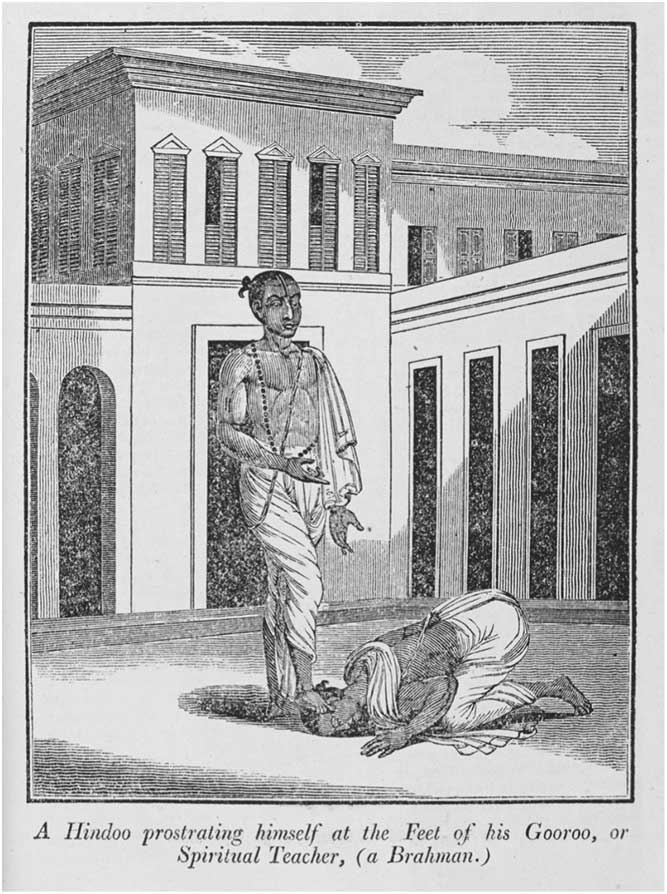
First, the engraving. The stock narrative of priestcraft that Protestant missionaries carried to India posited a radical power imbalance. James Mill, who read missionary accounts of Hinduism while writing his History of British India (1817), said that India’s Brahmins were “the uncontrollable masters of human life”; they rule “every hour of the day” and “every function of nature and society,” controlling the duped masses “from the cradle to the grave.”Footnote 51 Such claims, of course, said more about the colonizer than about the colonized. Among other things, they offered a dark and dystopic vision of what men like Mill took as the foil for British-Protestant liberty. The absolute disparity of this religious power relation is suggested by an 1822 engraving published by the Baptist Missionary Society and reproduced as my book’s frontispiece (see Figure 1). Here, nestled in the dark fantasia of missionary Orientalism, we find a succinct figure for total heteronomy. The “Hindoo” and the “Gooroo” are polar opposites, mirror images, ruler and ruled, complete power and utter abasement. Part of a much broader stratum of popular religious culture in the nineteenth century, this image functions as a sort of folk political theory. It sketches a binary power relation that, however caricatured, had in its various permutations been important to the emergence of the modern ideal of the autonomous subject in Europe and beyond. This is the sort of relation, I would suggest, that Debendranath Tagore, writing some sixty odd years later, was trying to immunize his readers against.
News from Afar: Or, Missionary Varieties, Chiefly Relating to the Baptist Missionary Society: Being a Re-publication of the Quarterly Papers of the Said Society, from 1822 to 1828 (London: Baptist Missionary Society, 1832), 7. Courtesy of the Burke Library at Union Theological Seminary and the Columbia University Libraries
As we have seen, however, by instituting a structure of self-rule in the subject, thinkers like Tagore produced something other than simple autonomy. Or, rather, they showed how autonomy or self-rule necessarily implicates the subject with external others. This internally fissured ascetic subject leads us to a more nuanced reading of the aforementioned pictorial binary, as we shall see.
A story from the Mahabharata helps to elucidate this intra-psychic splitting. Briefly: Eklavya, a forest-dwelling tribal prince, wanted to study archery under the great teacher in that field, Drona. When he presented himself to his would-be guru, Drona rejected him. Eklavya then returned to his forest, where he made a statue of Drona out of clay. This proxy guru became his master. Under its tutelage, he became the best archer in the land. Until, one fateful day, Drona and his students visited Eklavya’s forest. Upon seeing Eklavya’s skill, one of the students (Arjuna) expressed envy: Hadn’t Drona promised him that he would be the world’s best archer? Traditionally, a student makes a ritual payment to his guru. Drona realized that he could use this convention to quell Arjuna’s envy. The time had come to demand a gift from Eklavya, and that gift was to be a bloody one: Eklavya’s right thumb. The forest prince complied unquestioningly with his guru’s cruel demand. Henceforth, his shot would not be as fast as before.
My reading of this story centers on the strange figure of the clay guru, which mediates the power relation between guru and disciple, both establishing and unsettling that relation. (Other readings are, of course, possible: this story remains important to contemporary Dalit activism and is cited by public figures in India with some regularity).Footnote 52 The clay guru is two different things at the same time. It is a tool that splits and displaces Eklavya’s subjectivity, so that his ascetic self-rule appears to him as an inter-subjective relation; as such, it is what allows Eklavya to become a master archer. At the same time, the clay guru is also a tool that opens Eklavya to the violently despotic external rule of the actual Drona; it is a cipher or empty space into which an all-too-real other can step. This cipher, then, facilitates an intra-subjective power relation as well as an inter-subjective one. In it, self and other enter a zone of indistinction in which the difference between the two becomes dangerously confused.
Let us now bring this discussion to bear on our missionary image. Perhaps this starkly binary scene is also shadowed by some version of the clay guru, a mediatory third term that provides the psychic substratum for the power relation depicted therein. Our twosome becomes a threesome, or even a foursome, as projections proliferate. The debased “Hindoo” generates his own internal “Gooroo,” an echo of the external one, as he imagines and learns to inhabit the subjective position of his would-be ruler; the Gooroo then shuttles between his own subjectivity and the spectral guru-position projected by the Hindoo. That shadow or spiritual despot thus becomes the key to the scene. He/it occupies an undecidable position, both intra- and inter-subjective, a tool by which the agonized self (in the literal sense of agon: the self as psychic wrestling match) enters into assemblage with a field of social relations that is irreducibly freighted with power imbalance.
The self, produced through such scenes of subjectivation, is thus inherently social. This sociality should not, however, be sentimentalized. To open oneself to the other is to risk hurt at the hand of the other. Such hurt need not always be physical, as with Eklavya. What that tale does an especially clear job of showing, however, is how even subject positions that seem entirely self-enclosed—happy idylls of self-government—contain within them traces of intersubjectivity, with the phantasmatic, internalized other being the necessary precondition for ascetic self-mastery, the splitting of self into both friend and enemy. The practice of self-mastery thus carries within itself, as its very condition of possibility, the potential for self-loss.
This is an insight that, I think, runs deep in postcolonial theory. Colonial enemies are intimate enemies, lodged inside the self.Footnote 53 One might, for example, compare the tale of Eklavya to the scene of subjectivation outlined by Homi Bhabha: the colonized seeks the recognition of the colonizer by mirroring or mimicking his behavior. This mirroring would seem to establish a clear power structure, in which the colonized is subordinate, the purely reactive party who has become a secondary reflection of the primary or master subject. But the very act of mimicry unsettles and disallows the binary relation of master-slave. It establishes a sort of third position that is both and neither. When the colonizer looks at the colonized, he does not see an other, but rather a reflection of himself. This is an uncanny reflection, to be sure; it’s slightly off, a partly failed performance. Still, it produces within the colonizer what we might call spacing: suddenly seeing himself as other, he finds himself enacting an intra-psychic drama in which self-identity becomes increasingly impossible. He too, he realizes, is a kind of mimic, trying to emulate himself—to close a gap within his psyche that, once opened, can never heal.Footnote 54
Ethics is the name that I would give to this simultaneous practice of self-mastery and self-loss. From its inception, postcolonial theory, precisely in its insistence on power relations as fundamental to subjectivation, has tended to read ethics or the practice of the self as inescapably social. Our fissured, fractured selves are always already relational, caught up with indeterminate webs of others. This sociality might not have the utopian conviviality of friendship, as the “co-belonging of non-identical singularities.”Footnote 55 It does, however, accord with Foucault’s insistent reminders that power is a form of relationality. Power constitutes connection. The reverse of this equation is thus perhaps also necessarily true, or at least potentially so: relationality is power.
Power differentials can, of course, result in violence. They are also, however, the ground and condition for ascetic self-mastery, for the articulation of a power differential within the self. In some cases, this intra-subjective differential may even become a tool for scrambling or reconfiguring external power differences (as in Bhabha, or in Foucault’s work on asceticism as a practice of freedom). But, as Saba Mahmood has argued, to presume that the only valid response to external power structures is to subvert or reject them is a distinctively secular modern orientation that tends to invalidate the life-worlds of many religious subjects.Footnote 56 Better, surely, to begin with a simple recognition of the ambivalences of freedom, of its necessary imbrication with power.
Conclusion: On Worldly Connection
In this essay, I have explored how and why one might study something called the sociality of secularism. Weber once advised that, if definitions are possible at all, they should be attempted only at the end of an inquiry, never at the outset: meaning emerges immanently from within discussion; it cannot be imposed from the outside.Footnote 57 Flouting this advice, I offered a provisional definition of “the sociality of secularism” at the start of my three reflections. Still, I hope the phrase’s use or resonance (if any) has emerged incrementally over the course of the essay, through the perambulatory process of reflection itself.
To review, I have explored three layered sets of meanings: (a) The sociality of secularism operates at the level of fiduciary, structuring an economy of faith and trust for which crafty priests are perhaps paradigmatically deceitful actors; (b) The sociality of secularism involves a binary structuration in which the public and the private are increasingly differentiated at an official level, even as the idioms of the intimate continue to shape the “outer” domain of political economy; (c) The sociality of secularism indicates how even the most inwardly turned subjects, including those subjects apparently buffered from others by their orientation toward the transcendent, remained enmeshed in inter-subjective power relations. Together, these three layers reveal a secular subject defined by vulnerability to others and for whom “the intimate” scales vertiginously into the political, the economic, and other domains; if secularism, as Scott argues, tends to impose division, the anxious inter-subjectivity of these secular selves creates connection, unsettling the cultural codes of public and private, self and other.
The third and last layer requires some additional elaboration. Recall that for Weber disenchantment implies a retreat of the sublime either into the transcendental realm of the mystic or into personal human relations. I would resist this bifurcation of religion and personal relations as two distinct components of the intimate sphere. Part of the theoretical work of Spiritual Despots is to show how the transcendent facilitates the formation of horizontal human bonds. When the ascetic subject works toward self-transcendence, she or he splits the self in two in the manner described in the previous section; the self is both the subject and the object of ascetic practice. Thus, to reframe my argument using Charles Taylor’s terms (and also, in the process, reframe his argument in A Secular Age): when the desire for the transcendent interrupts the immanent domain of human flourishing, it does not produce self-enclosed or buffered subjects; rather, it denies the immanent subject its self-equivalence, ghosting that subject and its immanent domain and entangling them within networks of mediatory, spectral connections that are horizontal and worldly, not vertical and divine.Footnote 58 Thus does “spirit” serve to interlace subjects into a loose and open-ended inter-subjective network that is the basis of the social.
In Spiritual Despots, riffing on the etymology of “the sacred” as that which is set apart from circulation, I define the secular as that which moves.Footnote 59 Secularity is defined by worldly circulation. Here, I am using the term sociality to extend that argument. Circulation establishes connections that, however fleeting, have lasting effects. (I should, moreover, reiterate that although my discussion has focused on human sociality, this is an artificial narrowing; angels, avatars, books, clothes, animals, and more can and should also be taken as part of secularism’s social assemblage.Footnote 60 )
If one wanted to distill this secular ethic into a maxim, one could do worse than to poach from Forster: “Only connect!” Plucked like a sunflower from Howards End, the phrase has assumed a mobile set of meanings that leave its original context well behind.Footnote 61 Surely, however, the maxim’s ability to circulate in this way enacts a certain kind of performative truth—it finds affinities well beyond its point of origin, forging new and unexpected lines of kinship that leave it permanently changed. So too with the secular.
The word priestcraft is, I would argue, secular in this sense, or so the archive explored by Spiritual Despots would suggest. In nineteenth-century India, as this word came to be opposed to asceticism-as-self-rule, priestcraft—a term that, by promulgating mistrust, had tended to reduce connection—ended up establishing new cultural networks and formations. It showed up across languages (at least Hindi, Gujarati, and English, and likely also Marathi and Bengali). It also lent a distinctively personalist cast to anticolonial efforts to rethink the liberal ideal of freedom. Gandhi’s politics of self-rule were rooted in the body to a remarkable degree, sublimating the figure of the guru or charismatic saint into a practice of intimate publicity, which refigured the nation as a mass of interlinked ascetics. Surely this vision of the postcolonial future owed something to the previous century’s intimate effort to extricate the subject from spiritual heteronomy.
One could extend the set of questions posed by Spiritual Despots in any number of different directions. In my current work, I am exploring the affective relations established by colonial law in its effort to regulate speech about religion, as well how this legal secularism intersected with ethical tracts similarly directed at the regulation of affect and bodily habitus.Footnote 62 One could just as easily, however, and perhaps more obviously, ask how anticlericalism trailed modern Hinduism from India onto the global stage. The celebrity gurus of the twentieth century were frequently accused of what amounts to priestcraft: they were said to be charismatic charlatans who wielded despotic authority over their deluded followers. At the same time, however, even some of the most infamous of these men and women decried priestly malfeasance in their published speeches and writings, sometimes making use of nineteenth-century anticlerical classics in the process (as, for example, in Osho’s invocations of Nietzsche).Footnote 63 It would seem that modernity’s expulsion of sacerdotal authority remains unfinished business. The priestly despot is still a site of cultural ambivalence, the object of both revulsion and desire—hence, perhaps, the appeal of recent entertainments that retell the stories of these Indian gurus’ alleged abuses.Footnote 64
I want to close this essay by returning to my opening questions: What does the history outlined in Spiritual Despots tell us about the global circulation of liberalism? How might it help us to reimagine liberalism from the colonial margin, with an eye to intervening in the neoliberal present? If the ideal of freedom proved a key alibi for the British empire, much the same can be said for that empire’s geopolitical successor. The US empire too has advanced under the banner of freedom. At times, this imperial project was justified as an exporting of the legal principle of “religious freedom”; in the Philippines and other majority-Catholic colonies, American freedom even sometimes took priestly despotism as a foil.Footnote 65 At other times, corporations took the lead in exporting religiously coded ideals of freedom to foreign markets dominated by US interests.Footnote 66 How this ideal was understood, of course, changed substantially between the 1890s, when the United States assumed control of the Philippines, and the 2000s and 2010s, the era of Iraq. By the early twenty-first century, “freedom” was increasingly understood via the cultural logic indicated via the shorthand “neoliberalism,” with its historically specific emphasis on consumer choice, individual responsibility, personal brands, and the like.Footnote 67 Thus, for example, at the time of this writing, the American Civil Liberties Union is giving interviews about its post-Trump efforts to market “liberty” as a personalized lifestyle in the same way that the National Rifle Association successfully marketed a personalized gun culture (thus, of course, radically reimagining the US Constitution’s provision for community militias).Footnote 68
Clearly, there is a need for the critical humanities to keep interrogating this changeable ideal. One should not, of course, deny the importance of the intimate or personal register in the constitution of “freedom” (neoliberalism is right about that, at least); but rather simply to flag its complexities and ambivalences. The study of religion, I think, provides a promising avenue for doing such work. One of the most refreshing studies of neoliberalism that I have read in recent years is Eliza Filby’s God and Mrs. Thatcher (2015), which shows how Thatcher’s famed disbelief in “society” grew out of her Methodist childhood; for her, the solitary believer was, in some fundamental sense, the paradigm of what it is to be human. Once you realize that not only was Thatcher’s father a Methodist preacher, but she herself did a turn at preaching while attending university and continued to read the Bible most mornings while serving as prime minister, her creepily Foucauldian dictum (“Economics are the method; the object is to change the soul”) appears in a new light.Footnote 69 To read Thatcher’s neoliberalism as Protestant, however, brings us back to the world of Weber’s Protestant ethic. His anxious, agonized selves, forever split in two by their transcendent orientation, are, perhaps, not as solitary as they might appear at first glance—or so runs the argument of Spiritual Despots.
As part of her much-vaunted return to Victorian values, Thatcher sponsored the republication of Samuel Smiles’s Self-Help (1859), a nineteenth-century bestseller that was a global phenomenon. People camped out overnight to buy the translation released in Meiji Japan, and the khedive of Egypt had Smiles’s words painted in calligraphy on the walls of his palace alongside verses of the Qur’an. In India, by the early twentieth century, Smiles’s writings (including, but not limited to, Self-Help) had been translated, in full or in part, into Gujarati, Hindi, Urdu, and quite possibly other languages.Footnote 70 Thatcher wants us to read Smiles, anachronistically, as a neoliberal: “over-government” kills the work ethic of the bootstraps subject of “self-help” and renders him “helpless.”Footnote 71 This is certainly the keynote of Smiles’s book, and it is part of why a global readership was interested in him; people wanted to use Smiles to modernize their populations at the level of individual behavior. Still, this is only a partial reading. The transnational circulation of Victorian ethics was far stranger than Thatcher imagined. In India, it was a short jump from Smiles’s “self-help” to Gandhi’s “self-rule.” Indian intellectuals like Gandhi inherited Victorian-liberal discourses on the self and revealed what had perhaps been invisible to the Victorians. The subject of “self-help” is always necessarily a split subject, less than one and double, that precisely in its efforts at self-government opens itself ineluctably to the rule of others.
Circulation connects and transforms. This is true for priestcraft and self-help, as well as (in the other direction) karma and yoga. Surely it is also true, in the twenty-first century, for some of the keywords of neoliberalism. To trace such circulations is, in the spirit of Edward Said’s secular criticism, to use the murk of history to dethrone whatever presents itself as quasi-transcendent, to resist sacralization as an “agent of closure.”Footnote 72 This project should extend to the transcendent ideal of the “free individual.” History reveals the worldly connections that shape and sustain that seemingly invulnerable subject.



