Introduction
Sustainable conservation and improvement of animal genetic resources (AnGR) are important for food security and for adaptation to possible future changes in production environments, such as climate, market and disease challenges (FAO, 2007b; Boettcher et al., Reference Boettcher, Tixier-Boichard, Toro, Simianer, Eding, Gandini, Joost, Garcia, Colli, Ajmone-Marsan and Consortium2010; Hoffmann, Reference Hoffmann2010). To achieve sustainable genetic improvement of livestock, identification of appropriate breeding objectives and implementation of long-term breeding programmes are required. Traditions, culture and national rules and their variation across countries determine the setup of infrastructure needed to support livestock breeding (Fimland and Oldenbroek, Reference Fimland, Oldenbroek and Oldenbroek2007). For animal breeding strategies to be successful certain activities are essential, such as livestock recording, evaluation of data and supporting the farmers with selection tools.
Most breeds have been developed based on traditional knowledge and improved through human interventions and natural selection (FAO, 2009a). However, only structured and systematic breeding programmes have resulted in the impressive genetic improvements starting in the 20th century. For these programmes livestock identification and performance recording that enable use of information for selection of superior breeding stock of appropriate breeds have been essential. On the contrary, in low to medium input systems functioning infrastructure to support breeding activities is often lacking, or is underdeveloped (Wollny, Reference Wollny2003; Rewe et al., Reference Rewe, Herold, Kahi and Valle Zárate2009; Rege et al., Reference Rege, Marshall, Notenbaert, Ojango and Okeyo2011). In order for breeding programmes to succeed, infrastructure such as physical facilities, functioning recording and genetic evaluation systems, are required (Cardellino and Boyazoglu, Reference Cardellino and Boyazoglu2009). Supportive policies, efficient organizations and institutions, competent staff, long-term financial support and strong links between these components are also needed (FAO, 2009b, 2010, 2011; Philipsson et al., Reference Philipsson, Rege, Zonabend, Okeyo, Ojango, Malmfors and Okeyo2011; Rege et al., Reference Rege, Marshall, Notenbaert, Ojango and Okeyo2011). In many cases systematic breeding programmes, especially for smallholders, have failed (Wurzinger, Solkner and Iniguez, Reference Wurzinger, Solkner and Iniguez2011). Most countries in Africa and Asia lack functioning breeding programmes, whereas some Latin American countries developed commercially viable breeding programmes for indigenous breeds and crosses (Madalena, Reference Madalena2012). Common reasons for the failures are lack of involvement and engagement of farmers and other stakeholders (Rewe et al., Reference Rewe, Herold, Kahi and Valle Zárate2009; Faco et al., Reference Faco, Lobo, Gouveia, Guimaraes, Fonseca, dos Santos, da Silva and Villela2011; Wurzinger, Solkner and Iniguez, Reference Wurzinger, Solkner and Iniguez2011). There is therefore a need to have long-term plans for breeding programmes, which adequately respond to both the present and anticipated future market needs. Both farmers and governments, through supporting policies, need to be engaged and collaborate (Faco et al., Reference Faco, Lobo, Gouveia, Guimaraes, Fonseca, dos Santos, da Silva and Villela2011).
In the FAO report “The State of the World's Animal Genetic Resources for Food and Agriculture” (SoW) (FAO, 2007b), presented at the first “International Technical Conference on Animal Genetic Resources for Food and Agriculture, Interlaken”, a first assessment of global status of livestock biodiversity was reported. Drawing on 169 country reports, contributions from a number of international organizations and 12 specially commissioned thematic studies, an analysis of the state of agriculture biodiversity in the livestock sector was presented. Information on origins and development of the AnGR, their uses and values, distribution and exchange, risk status and threats, as well as the capacity to manage these resources (i.e. institutions, policies and legal frameworks, structured breeding activities and conservation programmes) were presented.
The report provides an overview of AnGR in the world and indicated that countries in Africa are short of the technical, physical, institutional and financial resource capacity needed to enable sustainable utilization and genetic improvement of their livestock. In particular, the critical mass of trained human resources for the management of AnGR is highly insufficient (Ojango et al., Reference Ojango, Panndam, Bhuiyan, Khan, Kahi, Imbayarwo-Chikosi, Halimani, Kosgey and Okeyo2010, Reference Ojango, Malmfors, Mwai and Philipsson2011). The SoW report also underlines the importance of research for development of sustainable breeding programmes. So far, most research has been directed towards characterization of indigenous breeds, especially by use of neutral molecular genetic markers, with emphasis on domestication process, trends, and genetic diversity and relationships between populations (Bruford, Bradley and Luikart, Reference Bruford, Bradley and Luikart2003; Kugonza et al., Reference Kugonza, Jianlin, Nabasirye, Mpairwe, Kiwuwa, Okeyo and Hanotte2011; Muigai and Hanotte, Reference Muigai and Hanotte2013), but rather little on different breeding strategies for improvement of indigenous breeds (Cardellino and Boyazoglu, Reference Cardellino and Boyazoglu2009).
Following the Interlaken Declaration (FAO, 2007b), a Global Plan of Action (GPA) for AnGR was internationally agreed upon (FAO, 2007a). The plan spells out the needs for improved productivity and drawing of long-term and sustainable breeding programmes, which are currently mostly non-existent for the indigenous livestock breeds. Four strategic priority areas were listed: (1) Characterization, Inventory and Monitoring of Trends and Associated Risks, (2) Sustainable Use and Development, (3) Conservation and (4) Policies, Institutions and Capacity Building. The latter emphasizes the strengthening of all institutions involved in AnGR management. Comprehensive assessments of the existing institutional frameworks and capacities need to precede such strengthening to be effective. So far very little has been done to investigate the situation in Sub-Saharan Africa, except for the review by Rewe et al., (Reference Rewe, Herold, Kahi and Valle Zárate2009) of breeding indigenous beef breeds, and an assessment of the Kenyan organization of dairy and beef recording by Kosgey et al. (Reference Kosgey, Mbuku, Okeyo, Amimo, Philipsson and Ojango2011). The latter revealed that even though the country has large potentials, relatively few records on livestock are captured and organizations lack coordination. The study concluded that a comprehensive mapping of all institutions and their interests in the sector is necessary and that appropriate reorganization is required to enable closer institutional working relationships and collaboration, as opposed to competition.
The main objectives of this study were to describe and critically assess the existing and needed infrastructure for sustainable utilization of ruminant breeds in a sample of countries in Southern and Eastern Africa. An additional objective was to suggest priority areas for development of sustainable breeding programmes regarding ruminants in the various countries.
Materials and methods
The study comprised three Eastern African countries: Kenya, Tanzania and Uganda, and three Southern African countries: Botswana, Mozambique and Zambia. The countries chosen show a wide variation in production systems, yet are thought to be representative of their region. In-depth examples of infrastructure are given for Tanzania and Zambia.
Livestock in countries studied
In all the countries livestock contributes significantly to people's livelihoods and to the respective countries' Agricultural Gross Domestic Product (percentage of GDP). Table 1 presents a brief summary of general statistics about the number of livestock (ruminants) and the relative importance of agriculture and livestock in each country.

In total there are about 54 million cattle, 47 million goats and 17 million sheep in the six countries. Although large populations of ruminants are kept in Kenya and Tanzania, the relative contribution of livestock to the agriculture GDP is less than 50 percent. Botswana's livestock's contribution to the agriculture GDP is the highest although agriculture contributes to only 2 percent of the total national GDP.
Sources of data
The study is based on materials providing information collected from three sources: the SoW country reports of the six countries prepared between 2003 and 2004 (FAO, Reference Rischkowsky and Pilling2007c), a workshop with targeted persons in 2009, and from semi-structured interviews carried out at country visits undertaken during 2010. Furthermore, the authors have continued to collate information on relevant issues through various ongoing projects in the countries studied until 2012. Websites of relevant ministries and organizations were also visited to collate recent developments.
Priority has been given to identify the appropriate structures and frameworks needed to achieve the sustainable use of AnGR. Information about the existence and functionality of relevant infrastructure is usually not published, hence specific qualitative methods are needed to gather and analyse pertinent information. In this study we have based the information primarily on interviews and presentations including discussions with highly ranked people as regards knowledge on animal breeding or conservation activities in the chosen countries.
The first type of information consisted of a brief review of the country reports delivered to FAO as basis for the SoW report (FAO, Reference Rischkowsky and Pilling2007c). Grey literature such as annual reports, project and industry reports and websites were also used. These sources were used to indicate issues that could be followed up in the workshop and in semi-structured interviews when visiting targeted people of the countries in question.
The second source of information was the results of a joint workshop, held in 2009, by members of the AnGR groups of the International Livestock Research Institute (ILRI), the Food and Agriculture Organization of the United Nations (FAO) and of the Swedish University of Agricultural Sciences (SLU), in collaboration with the East African Community (EAC) and Southern African Development Community (SADC). Participants at the workshop were drawn from key persons responsible for AnGR issues or related research and development programmes of national institutions including ministries within the countries of the EAC and SADC region. Participants presented and discussed AnGR-related institutions for their respective countries, their activities and current working relationships, and, what priorities and constraints the institutions were facing.
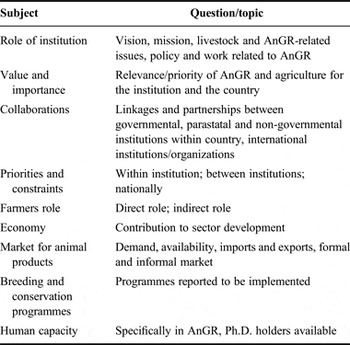
The third type of information was obtained at visits to the six study countries. Qualitative research interview methods, as described by Kvale (Reference Kvale1996) were used. Interviews focussed on a number of thematic issues that relate to livestock policies and infrastructure that support AnGR improvement and conservation. The subjects covered during interviews are presented in Table 2. To study the various networks and organizations involved in a given country, a two-stage snowball method was used (Hanneman and Riddle, Reference Hanneman and Riddle2005). First the stakeholders in the countries provided a listing of all organizations with any kind of involvement in AnGR. Thereafter, through on-site interviews, representatives of each institution listed were asked which bodies they were collaborating with, using snowball selection. This method gave the opportunity to successively highlight institutions that were not initially known to the interviewer. Thus, the risk of missing important institutions was minimized. The interviews were semi-structured in order to ensure that the same questions were put forward to all interviewees. Each interview lasted 1–2 h and was transcribed, summarized and analysed separately for each country. Three to ten key persons were interviewed per country, and were later followed up by correspondence for completing questions where needed. The institutions visited and engaged in each of the six countries gave an opportunity for direct contact with people highly involved with different aspects or parts of the livestock sector, such as livestock ministry directors, deans and professors of agricultural schools, representatives from different institutions and organizations responsible for livestock production development or animal breeding issues. In total 15 ministry institutions (excl. research), 11 universities and research institutes and 11 non-governmental organizations or companies were visited.
Main topics covered in semi-structured qualitative interviews.

Results and discussion
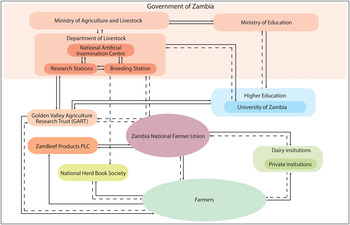
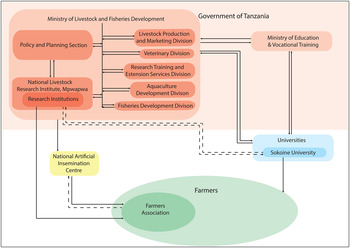
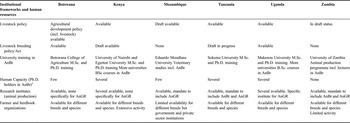
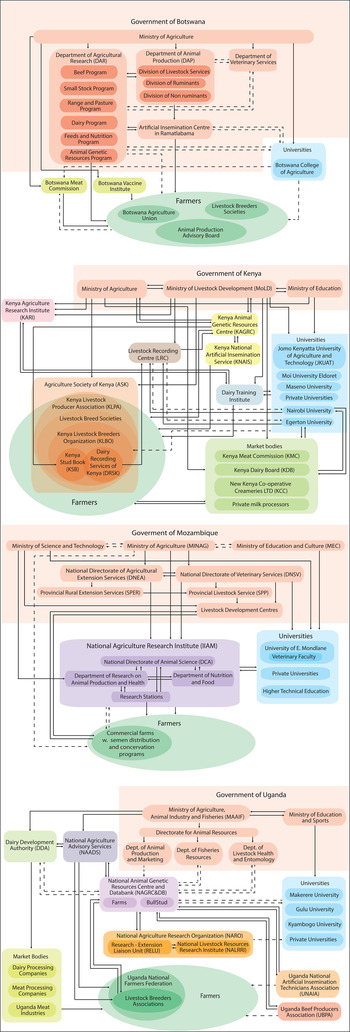
An overview of the existing institutional frameworks and indications of human capacity is given in Table 3. This is followed by organograms showing more of the details and the relationships between institutions and organizations within Zambia and Tanzania (Figures 1 and 2) and the other countries (Appendix).
Organogram of institutions related to work with animal genetic resources in Zambia, where a solid line shows high level of interaction and a dotted line shows some degree of interaction. Institutions in circular shape are farmer owned.

Organogram of institutions related to work with animal genetic resources in Tanzania, where a solid line shows high level of interaction and a dotted line shows some degree of interaction. Institutions in circular shape are farmer owned.

Existing components of infrastructure as regards institutional and organizational frameworks related to livestock breeding activities (AnBr and AnGR) in countries studied.

1Few meaning 1–3, several meaning >3; AnBr = animal breeding; AnGR = animal genetic resources.
As shown the six countries use different institutional setups to tackle the livestock breeding issues, albeit with quite variable ambition and success. Although the animal production conditions and institutions involved vary substantially between the countries, clear common trends and coherent results have been obtained across the countries.
Policies
A livestock breeding policy is an important tool to show the direction of priorities and activities to be conducted in livestock breeding. All the countries have policies on agriculture or livestock development, and in all countries livestock are considered important and thus recognized at government level (Table 3). Since the SoW and the GPA were developed and agreed upon, many countries have recasted their policies and are making efforts to develop breeding policies, although much remains to be done as regards infrastructure and organization. Uganda has legislated a breeding policy with a Livestock Improvement Act since 2009. Also Botswana has a livestock improvement act since 2009. Kenya has a draft livestock breeding policy, but it is not yet published. Tanzania has prepared an animal breeding policy act that is under review by the cabinet.
Higher education and research institutions including animal breeding
All study countries except Mozambique and Zambia offer training at M.Sc. and Ph.D. level including Animal Breeding (AnBr, Table 3). In Mozambique, the animal breeding training is a minor part of the veterinary studies, and in Zambia the subject is covered in the M.Sc. animal production programme. The latter two countries have limited teaching and research support resources for AnBr. The number of Ph.D. holders who are actively involved in higher education (teaching), research or in ministries or organizations directly supporting practical livestock breeding, is an important indicator of the ability of a country to develop and implement breeding programmes. Kenya is best resourced with trained staff holding Ph.D. in AnBr. Uganda and Tanzania have also several Ph.D. holders in AnBr, whereas Botswana and Mozambique have few and Zambia none, at the time of the study. Botswana has, however, gained in its development of recording schemes from cooperation with neighbouring South Africa. Also Zambia and Mozambique are gaining from expertise in South Africa.
Reasons for limited training in AnBr in most of the study countries depend on few or no teachers trained in AnBr. This makes a downward spiral where few teachers train few students. Furthermore, many students think that AnBr is a difficult subject to grasp and it requires well-trained teachers (Ojango et al., Reference Ojango, Malmfors, Mwai and Philipsson2011).
Farmer and herdbook organizations
Organizations that support farmers exist in many forms. In Botswana breed associations exist for both cattle and small ruminants. According to their livestock improvement act, cattle should be recorded in a national herdbook. To some extent, the South African Stud Book Association undertakes such recordings. The act also aims at supporting the formation of local breederś societies in Botswana.
Kenya has a national livestock breeding organization that runs a studbook and keeps records on performance of dairy cattle. The country also has associations for the different species and livestock breeds (Kosgey et al., Reference Kosgey, Mbuku, Okeyo, Amimo, Philipsson and Ojango2011). The organizations are governed independently by farmers, and are thus directly less influenced or controlled by government compared with the other countries. More recently, in 2012, the Kenya Animal Genetic Resource Centre (former Central Artificial Insemination Station) was created; its mandate includes conservation of the national AnGR.
Mozambique has a few commercial farms that support various breed developments, but there is no national breeders' association. Government run institutions are, however, responsible for breed conservation. Tanzania has several farmer associations and proposals for breeders' associations. Uganda has several breeders' associations. Zambia has a herdbook society for cattle and a farmers union including livestock breeding associations.
Whatever is to be implemented, it is important that farmers are part of it (FAO, 2007a; Philipsson et al., Reference Philipsson, Rege, Zonabend, Okeyo, Ojango, Malmfors and Okeyo2011). Although some farmer organizations with a mandate to improve livestock exist in most countries, they are usually weakly organized, partly due to shortage of trained staff to technically support them. Thus, supporting farmer organizations, or facilitating their formation, to enable them take active part in development of breeding programmes is extremely important (Rewe et al., Reference Rewe, Herold, Kahi and Valle Zárate2009). This would enable the farmers to not only own the process, but also effectively and sustainably run the activities. For these reasons an active extension service with well-trained advisors are also needed in all the countries. Relevant universities through innovative and well thought-out partnerships with government extension services can play this role.
Institutional relationships – organograms
Livestock issues usually fall under a ministry of agriculture, but in a few cases separate ministries are responsible for livestock development. In the countries studied, research institutes either fall under a ministry responsible for agricultural affairs or livestock development, or are semi-autonomous government institutions (Figures 1 and 2 and Appendix). Universities offering higher education in AnBr are, however, invariably under a ministry of education or higher education in all the countries except for Botswana, where the university falls under the Ministry of Agriculture.
Figure 1 shows the organogram for Zambia, where the Department of Livestock is responsible for research and artificial insemination (AI). A semi-autonomous research trust (GART) was developed in 1993 jointly by the government and Zambia National Farmers Union and is working with farmers to promote agricultural and livestock conservation and improvement. The National Herd Book Society registers animal identities in hard copy registries without continuous trait recording. The largest national market player of animal products is the public limited company ZamBeef Products PLC, which mainly benefits the large-scale farmers.
In Tanzania, a number of divisions and sections are organized directly under the Ministry of Livestock and Fisheries Development and are responsible for the related development activities and services to the livestock sector. The country has an AI centre, but there is presently no herdbook system for performance recording and registration of livestock at farm level. However, the ministry is presently launching a pilot project on animal identification and traceability. The National Livestock Research Institute at Mpwapwa is the only institute directly responsible for livestock genetic improvement. Other institutions, such as the Sokoine University of Agriculture, also play a role in research and training in animal breeding and genetics. Farmers are increasingly organizing themselves into breeding and marketing societies or associations.
AnGR activities in Botswana are centralized and are mainly run by the ministry with few institutions covering most important issues in livestock breeding (see Appendix). Within the Department of Agricultural Research there are six programmes: beef, small stock, range and pasture, dairy, feeds and nutrition, and the animal genetic resources programme. Infrastructure is set up for the market and specifically for export of beef. Kenya has fewer institutions under the government, yet there are many institutions working on livestock issues. Their roles are often overlapping, with reportedly weak interactions between the programmes and related institutions (Kosgey et al., Reference Kosgey, Mbuku, Okeyo, Amimo, Philipsson and Ojango2011). In Mozambique, there are few institutions related to AnGR and emphasis is on the National Agriculture Research Institute. Overall the country has a severe shortage of resources and human capacity in AnBr. Uganda shows a well-developed infrastructure for use of AnGR with institutes covering most topics. However, limited activities are being carried out compared with what the institutions are mandated for, owing to limited resources and infrastructure within the institutions. A special institute is organizationally and legally devoted to AnGR, with a full-fledged livestock breeding policy in place. However, livestock recording and its application to support effective selection and national livestock breeding programmes is not yet practiced by the farmers. For all countries, limited collaboration between the institutions is a big constraint.
Well coordinated institutions and organizations constitute important parts and roles for the development of the livestock sector (Philipsson et al., Reference Philipsson, Rege, Zonabend, Okeyo, Ojango, Malmfors and Okeyo2011; Rege et al., Reference Rege, Marshall, Notenbaert, Ojango and Okeyo2011). As would be expected, all the countries have some institutional setup to support or carry out animal breeding activities, e.g. research and development institutions, universities, AI centres etc., but a general finding is that the institutions are weakly linked to each other and are severely under-resourced. This is in agreement with the previous findings of Kosgey et al. (Reference Kosgey, Mbuku, Okeyo, Amimo, Philipsson and Ojango2011) and Philipsson (Reference Philipsson, Galal, Boyazoglu and Hammond2000) for Kenya.
Reported activities related to animal genetic resources
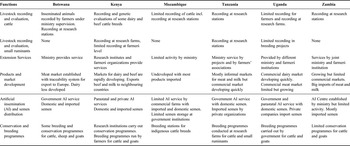
Table 4 shows the activities reported to be supported by the infrastructure as outlined in the previous section. They include: Livestock recording and evaluation, AI and semen distribution, Conservation and breeding programmes, Extension services, and Products and market development.
Existing components of infrastructure as regards functions related to livestock breeding activities in countries studied.

Livestock recording, evaluation of data and extension service
Livestock registration and some limited performance recording exist in all countries, mostly at research stations (Table 4). At the general farmers' level, only in Kenya cattle recording is being implemented at a rather large scale. In Botswana, large export beef producing herds and few dairy animals that are inseminated are recorded and can be traced from animal to export. Although Uganda has initiated a performance recording scheme for dairy animals, it is yet to take off. In Mozambique, Tanzania and Zambia, no regular livestock recording at farmer's level is practiced, although Tanzania has plans to implement a recording and traceability system. Genetic evaluations of dairy cattle and beef cattle are currently being undertaken for some breeds in Kenya and Botswana. Otherwise no routine genetic evaluations, or applications of modern evaluation methods, are undertaken in any of the other countries.
In all the countries, the government provides extension services, but activities specifically focused on animal breeding are limited, due to dwindling financial support and shortage of trained advisors.
The lack of livestock recording, or limited use of it, is a serious bottleneck in all countries despite that it is at the core of any animal breeding programme. It is very important that existing institutions are empowered and are well linked with each other in order to execute essentials of a livestock recording scheme. It is not enough to record identities and some morphological traits as has been common for herdbook registrations, but more important are systematic recording of production, reproduction and health traits.
Products and market development
The informal market dominates in all countries but the formal markets are emerging, with variable levels of market growth (Table 4). The livestock policies implemented are mainly supporting large-scale farmers whose main focus is on the commercial market. For meat, all countries in the study import more than they export, except for Botswana and Kenya. For milk, all countries also import more than they export except for Uganda, where the amount of imported and exported milk is almost equal as reported by the FAOSTAT food balance sheet (FAO, 2013). In the southern African countries in the study, multi-national dairy companies dominate the formal dairy market. In the eastern African countries the domestic marketing of animal products is larger. In Kenya, domestic companies for both dairy and meat are major industry operators. In Uganda, a conglomerate company is a major processor of dairy products. However, Botswana is the only country with a traceability system to allow export of beef to Europe. The growing formal domestic and regional markets for milk and meat in all the studied countries are likely important drivers for an economic elevation of the livestock sector. This process would benefit from improved and efficient use of the livestock resources. In relation to climate change policies aimed at increasing livestock productivity are generally seen important and should be another driver for increased attention to the sustainable use of AnGR in development of agricultural policies. Careful considerations to the market are therefore necessary when designing breeding strategies.
AI and semen distribution
AI services have been developed in all countries studied, but vary considerably among countries as regards volume and direction of use (Table 4). All countries except Mozambique have national semen distribution systems from established AI centres, which are usually government run. Semen is domestically produced in all countries but only to a limited extent in Mozambique and Zambia. In all countries a considerable amount of imported semen is also distributed. Such imports and choice of breeds are usually driven by private and foreign agencies and comprise primarily Holstein semen. Kenya and Tanzania have a long history of AI service based on domestically produced semen of exotic dairy breeds. Private AI service provision has been ongoing in Kenya since the early 1990s and is increasing. In Mozambique, some commercial farms are assisting the government in supplying semen of Nguni, Brahman and other indigenous cattle breeds. Distribution of semen of some well known indigenous breeds takes place in more countries, among others of the Ankole breed in Uganda, the Mpwapwa cattle breed in Tanzania and the Tswana cattle breed in Botswana. Moreover, in all countries there are externally funded development projects that support and promote AI services, mostly with exotic breeds.
Conservation and breeding programmes
Genetic improvement programmes are important for increased productivity of livestock breeds and for their sustainable use, whereas conservation programmes are essential in order to secure important indigenous breeds or alleles that otherwise would be in danger of extinction (Rewe et al., Reference Rewe, Herold, Kahi and Valle Zárate2009; Philipsson et al., Reference Philipsson, Rege, Zonabend, Okeyo, Ojango, Malmfors and Okeyo2011). However, it is most important that breeds are continuously developed in harmony with environmental and market needs in order to stay competitive for economic or cultural reasons, thereby avoiding endangerment. Genetic improvement programmes are scarce in the countries studied, yet interesting initiatives have been taken in a few countries, but with very little documentation. Research, development or pilot breeding projects are undertaken in most of the countries, although to variable extent. Such initiatives involve recording and breeding schemes and are mainly research station based.
Kenya has reached further than the other countries, with some livestock recording and genetic evaluations being practiced. Improvement schemes exist for all exotic dairy breeds and for some local beef or dual-purpose breeds, e.g. the Boran and Sahiwal cattle breeds.
In Botswana, beef cattle breeding programmes are in place, but are so far only limited to a small part of the country's farmers (i.e. the commercial beef producers only). Breeding organizations are in place for most species and breeds, both exotic and local. Conservation programmes are, just like in all the other countries, to some extent available for indigenous ruminant breeds, as for the Tswana cattle breed. In Mozambique breeding stations are used for conservation of indigenous cattle and small ruminant breeds, such as Nguni, Angoni and Landim cattle breeds. Semen of both exotic and indigenous cattle breeds is stored in semen banks, but not regularly used.
In Tanzania breeding programmes exist for Mpwapwa and Boran cattle breeds at research stations. For the Mpwapwa breed, early reports are showing promising results from breeding schemes at research station (Kasonta and Nitter, Reference Kasonta and Nitter1990; DAD-IS, 2013). For goats, breeding strategies exist for pure breeding of Blended, Newala, Ujiji and Gogo breeds. In Uganda, breeding schemes are practised within research and development programmes for Ankole cattle as well as for some other cattle, goat and sheep breeds. In Zambia, characterization and conservation programmes are undertaken for some indigenous cattle, e.g. for the Angoni, Barotse, Tonga and Baila breeds. The focus is on multiplication of cattle and goats rather than genetic improvement programmes as such. Indigenous cattle breeds are being conserved in vivo at government stations, where also a goat project for multiplication of imported Boer goats is conducted.
No fully functioning breeding programmes with active farmer participation are available in any country. Conservation programmes are, however, conducted for a few ruminant breeds in most countries. Usually nucleus herds at research stations are used for multiplication of indigenous breeds that are considered threatened. Recent documentations to quantify the extent of applied breeding programmes of any kind, as well as their results, are scarce. In general, institutional and organizational frameworks are too weak to support sustainable breeding programmes.
Constraints and priorities
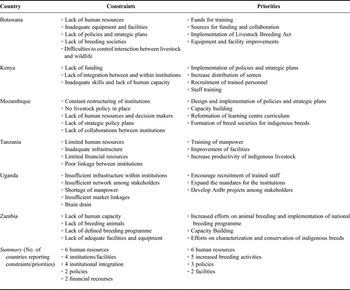
Table 5 shows the unranked main constraints and priorities as reported by the country representatives during the 2009 workshop and in interviews. All countries reported that shortage of trained and skilled personnel in AnBr is the single biggest constraint to development and implementation of AnGR improvement programmes. Lack of facilities, weak interactions and linkages between and within different institutions or constant institutional reorganization were also reported as important constraints in four of the countries. Lack of breeding policies and/or definitions of breeding objectives are frequently reported as key constraints. Some countries also report insufficient funding for breeding activities as an important constraint.
Constraints and priorities reported for development of AnGR in each country.

Increased emphasis on capacity building at all levels and recruitment of trained staff was prioritized by all countries followed by the needs for establishing various breeding activities. Formulation and implementation of breeding policies are highly prioritized in several countries, especially following the 2007 adoption of the Global Plan of Action on Animal Genetic Resources and the Interlaken Declaration.
Higher education, capacity building and institutional collaboration – keys to improvement of infrastructure
In developing and implementing sustainable breeding programmes it is important that key principles are considered and best practices adhered to. Addition and application of more advanced strategies may be made as infrastructure and industry develops. Rewe et al. (Reference Rewe, Herold, Kahi and Valle Zárate2009) emphasized the involvement of livestock keepers by forming breed societies or breeder groups at community level for livestock recording and breeding, as they inevitably are the breeders and producers. Feedback information from recording schemes to the livestock keepers must be communicated promptly to allow improved herd management and keep their interest. Mobile telephone communication tools, if smartly used, may provide practical and important ways of data capture and for giving feedback to farmers. The data need to be correct, appropriately analysed, stored and retrieved to produce value-added information for farmer's use. To develop such programmes there is a great need for well-trained staff and capacity building of all actors in the chain. The gap is obviously big between best practice known and what is practised in all countries of the study.
All countries report that shortage of skilled personnel in animal breeding is a big constraint for development. The analysis made in this study confirms this, thus emphasizing the need for more people trained in animal breeding in order to develop AnGR for sustainable use. Without adequately trained people in charge of possible AnBr activities, it will be difficult to formulate relevant breeding policies, breeding objectives, livestock recording or evaluation systems of livestock.
The country with most Ph.D. holders, Kenya, has more advanced breeding programme activities than any of the other countries. Also Uganda and Tanzania have several Ph.D. holders, and typically these three countries, and Botswana supported by South Africa, have livestock breeding policies available or drafts in process. Countries lacking Ph.D. holders and university training in animal breeding have the least developed activities related to animal breeding. Thus, there is a clear relationship between efforts in higher education and research on issues related to AnGR and the advancement of livestock breeding policies and animal breeding programmes for sustainable use of AnGR.
Obviously more animal breeders need to be trained, retrained, motivated and empowered to initiate and run breeding and conservation programmes. However, very little emphasis is put specifically on university training to reach an advanced level of competence. One way that has shown demonstrable success is to have common university/higher education training within a region in the field of animal breeding (Wooliams et al., Reference Wooliams, Berg, Mäki-Tanila, Meuwissen and Fimland2005). In this way the limited infrastructural and human resources could be shared in a better way and a higher level of expertise could be financed and used to effectively harness the regional resources more sustainably.
The need for more advanced university training is even more critical now given the big wave of focusing more on molecular genetics without better understanding and application of both quantitative and molecular genetics. Implementation of livestock identification and recording schemes for collection and genetic analysis of phenotypic data for genetic improvement is a prerequisite for almost any use of molecular information. Countries with least developed animal breeding courses in their academic programmes are bound to produce fewer qualified people with animal breeding skills. This is consequently reflected in the entire country's livestock breeding status and opportunities for future developments; this applies equally to the improvement of local breeds and controlled upgrading and crossbreeding programmes.
Insufficient collaboration between and within institutions is seen as one of the most serious constraints in most countries. In fact, a change in mindset among people responsible for various institutions and organizations related to animal improvement is a necessity. Some countries have necessary policies and institutions in place, but they lack the ownership by the farmers to effectively meet their demands of tools for livestock improvement and implementation of the policies. The need to support forming of, or empowering existing, farmers' or breeders' organizations must be emphasized. The farmers are the real actors finally selecting available tools and individual animals for livestock breeding.
Emphasis on policies is brought up as a priority for development support in several countries. Policies are necessary, but even more important are allocation of resources and actions to implement the policies and reaching out to farmers. Again a shift in mindset and better use of existing resources by closely integrated activities would improve the opportunities for efficient development of breeding programmes.
Considering the weaknesses shown in this study regarding institutions to support development of the sustainable use of AnGR, and constraints and priorities expressed by the countries represented, increased efforts on animal breeding education at M.Sc. and Ph.D. level appears essential. Capacity building to further empower earlier trained scientists, staff and officers in charge of practical livestock development programmes is equally important. ILRI and FAO have developed relevant training materials for this purpose including guidelines on development of policy, breeding and conservation programmes, and on scientific, technical and evidence-based aspects of AnGR management (FAO, 2009b, 2010, 2011, 2012a, 2012c; Ojango et al., Reference Ojango, Malmfors, Mwai and Philipsson2011). FAO guidelines on animal identification, performance recording and traceability are being developed.
Conclusions
This study shows that by far the most serious constraint for the development of sustainable animal breeding programmes in the countries studied is the shortage of skilled personnel in animal breeding at all levels and in all types of institutions. More university training and capacity building in animal breeding is needed. The paper argues that to support sustainable use of AnGR it is important to have clear national policies and institutions that are appropriately mandated. Institutions need to be linked to each other to effectively execute the activities needed for the country to succeed in livestock breeding. Such activities need to be clearly documented. Development of livestock recording schemes, including innovative methods for communication, is seen as a critical investment for development of sustainable breeding programmes. For any improvement strategy to be successful farmers' involvement at all stages is necessary and their organizations need to be empowered.
Acknowledgements
Financial support for this study was provided by the Food and Agriculture Organization of the United Nations (FAO), International Livestock Research Institute (ILRI) and Swedish University of Agricultural Sciences (SLU), which is gratefully acknowledged. We would also like to thank all institutions visited and people interviewed, especially to Ministry of Agriculture, Department of Agriculture Research, Department of Animal Production and Botswana Agriculture Union in Botswana; to Ministry of Livestock Development including research centres, Kenya Agriculture Research Institute, Central Artificial Insemination Station, Kenya Stud Book, Dairy Recording Services of Kenya and Egerton University in Kenya; to Ministry of Agriculture, National Directorate of Veterinary Services, National Directorate of Animal Science and Department of Research on Animal Production and Health at the National Agriculture Research Institute including research stations, Reproduction Station of Mozambique, University of Eduardo Mondlane in Mozambique; National Livestock Research Centre, Sokoine University, National Artificial Insemination Centre in Tanzania; National Animal Genetic Resources Centre and Databank and Makerere University in Uganda; and Department of Livestock at Ministry of Agriculture and Livestock including research centres, National Artificial Insemination Services, Mulaikwa Breeding Centre, University of Zambia, Zambia National Farmer Union and National Herd Book Society in Zambia for generously providing us with pertinent information for this study.
Statement of interest
No conflict of interest.
Appendix
Organogram of institutions related to animal genetic resources in Botswana, Kenya, Mozambique and Uganda. A solid line shows high level of interaction and a dotted line shows some degree of interaction. Institutions in circular shape are farmer-owned.