In recent years much attention has been devoted to the non-native molluscs found in the Mediterranean Sea. Their number has been rising especially during the last fifty years both by natural migration and by man's more or less assisted introduction. These species have been revised in several papers (Gofas & Zenetos, Reference Gofas and Zenetos2003; Zenetos et al., Reference Zenetos, Gofas, Russo, Templado and Briand2004, Reference Zenetos, Cinar, Pancucci-Papadopoulou, Harmelin, Furnari, Andaloro, Bellou, Streftaris and Zibrowius2005; Mienis, 2004; Delongueville & Scaillet, Reference Delongueville and Scaillet2007).
In these papers the supposed non-native species are grouped according to their adaptation to the new environment and their theoretical origin, so they are labelled as ‘established’, ‘casual’, ‘questionable’, ‘excluded’, ‘cryptogenic’, ‘invasive’ (Zenetos et al., Reference Zenetos, Cinar, Pancucci-Papadopoulou, Harmelin, Furnari, Andaloro, Bellou, Streftaris and Zibrowius2005), or by similar terms. The inclusion of a species in these classes may change with time due to new findings, or may be different for different authors.
The present paper reports on the finding of the Rissoid mollusc Alvania dorbignyi (Audouin, Reference Audouin and Savigny1826), a species of debated origin, on the northern coast of Tunisia. This species was found by examining ~500 g shell grit sample, picked up by a diver off Tabarka (Figure 1), north-western Tunisia, at 25 m depth, during August 2007. This sample consisted of coarse sediment, with particle size exceeding 1 mm; it was picked from small detritus areas embedded in a rocky bottom (P. Trillo, personal communication).
Map of northern Tunisia indicating the location of the sampling site (triangle).

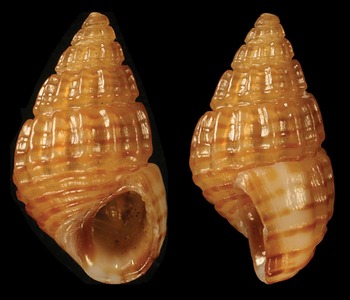
In this sample 26 empty shells were found on the whole, which were assigned to Alvania dorbignyi (Figure 2). These seemed fairly fresh, only a bit rolled. In the same sample some other Alvania were found, i.e. Alvania lineata Risso, 1826; Alvania discors (Allan, 1818) and Alvania mamillata Risso, 1826, all of them in a lesser quantity than Alvania dorbignyi.
Shell of Alvania dorbignyi from Tabarka. Shell height 4.2 mm.

The shells of Alvania dorbignyi found here show the same constant morphological characters as the ones from the Israeli coast: a sculpture of broad, low, raised and rounded axial folds which are not continued on the shell base, and of spiral cords as broad as the intervals between them, an ovate aperture with cutting outer lip, thickened by a varix just after its edge; the colour is buff with dark brown lines running along the spiral cords. The aperture shows two brown stains, the one on the columella and the other on the abapical part of the outer lip.
Alvania dorbignyi closely resembles forms assigned to Alvania lineata, which also have continuous brown lines on the spiral cords, but have more raised axial folds which continue on the shell base.
Alvania dorbignyi in the Mediterranean is known from the Israeli coast (Nordsieck, Reference Nordsieck1972) and from Cyprus (Bogi et al., Reference Bogi, Cianfanelli and Talenti1988; Cecalupo & Quadri, Reference Cecalupo and Quadri1996), but is absent in the Maltese Islands (Cachia et al., Reference Cachia, Mifsud and Sammut1996, Reference Cachia, Mifsud and Sammut2001, 2004) and up to now in Tunisian waters (Enzenross & Enzenross, Reference Enzenross and Enzenross2001): Tabarka is just one of the sampled stations reported in this paper.
DISCUSSION
Audouin (Reference Audouin and Savigny1826) based his Alvania dorbignyi on a figure in Savigny (Reference Savigny1817). Its presence in the Mediterranean was reported for the first time by Nordsieck (Reference Nordsieck1972), which considered the species to be of Red Sea origin. This hypothesis was rejected by Mienis (Reference Mienis1985), who considered the species to be native to the Mediterranean Sea, observing that Savigny's tables contained Red Sea as well as Mediterranean species and that no other species of Alvania is known from the Red Sea, while the centre of radiation for the genus seems to rest in the Mediterranean; he added that only Moazzo (Reference Moazzo1939) recorded some specimens from the Gulf of Suez.
Gofas & Zenetos (Reference Gofas and Zenetos2003) labelled the species as ‘cryptogenic’, a term introduced by Carlton (Reference Carlton1996) to list species with no definite evidence of their native or introduced status, but they gave a probable Indo-Pacific origin. Zenetos et al. (Reference Zenetos, Gofas, Russo, Templado and Briand2004) presented the species as an established lessepsian migrant, stating however, that the problem of its origin was yet unsettled. Mienis (Reference Mienis2005) rejected this choice again, clinching the arguments he had used in 1985 by observing that this species or any other Alvania is not mentioned in the recent checklist of Red Sea molluscs (Dekker & Orlin, Reference Dekker and Orlin2000). Zenetos et al. (Reference Zenetos, Cinar, Pancucci-Papadopoulou, Harmelin, Furnari, Andaloro, Bellou, Streftaris and Zibrowius2005) confirmed its assignment to the group of established species, while Delongueville & Scaillet (Reference Delongueville and Scaillet2007) presented the whole matter without suggesting any new hypothesis.
The finding of A. dorbigny off Tabarka probably represents an extension of the species range, known only from the Israeli coast and Cyprus until now, but the interpretation is not simple. The lack of intermediate findings between the Levant Sea and the Tabarka ones may be explained with the fact that the area between Tunisia and Egypt has not received the same attention from malacologists as other parts of the Mediterranean Sea. A careful search for this species along the coasts between the Levant Sea and the Tunisian ones is therefore needed to provide a firm conclusion.