Background
Most mental health service users say they would like to work (Se-SURG, Reference Secker and Gelling2006). In the UK, mental health services are directed by government guidance to support service users in finding desired paid work (Department of Health, 2009, 2011) and voluntary work or education (Department of Health, 2006). Trials of supported employment suggest that about 60% of those motivated to find work can be helped into paid employment (Crowther et al. Reference Crowther, Marshall, Bond and Huxley2001; Burns et al. Reference Burns, Catty, Becker, Drake, Fioritti, Knapp, Lauber, Rössler, Tomov, van Busschbach, White and Wiersma2007; Bond et al. Reference Bond, Drake and Becker2008). However, paid work is unlikely to be achievable for all (Strickler et al. Reference Strickler, Whitley, Becker and Drake2009). Many service users experience doubt and ambivalence about seeking open market employment (Honey, Reference Honey2004; Marwaha & Johnson, Reference Marwaha and Johnson2005). Welfare benefit systems can limit rewards or produce disincentives from taking up paid work: these barriers are particularly marked in the UK system (Leff & Warner, Reference Leff and Warner2006). A range of international studies reporting employment rates in those with severe mental health problems suggest that employment levels rarely exceed 30% and have been reported to be as low as 4% (Marwaha & Johnson, Reference Marwaha and Johnson2004).
Work history and educational attainment have been consistently identified in the literature as associated with paid employment: a meta-analysis of predominantly American studies additionally identified youth, Caucasian ethnicity and not having a diagnosis of schizophrenia as predictors of employment among mental health service users (Wewiorski & Fabian, Reference Wewiorski and Fabian2004). Evidence regarding associations between employment and symptom severity or other clinical characteristics is more equivocal (Marwaha & Johnson, Reference Marwaha and Johnson2004; Catty et al. Reference Catty, Lissouba, White, Becker, Drake, Fioritti, Knapp, Lauber, Rossler, Tomov, van Busschbach, Wiersma and Burns2008; Campbell et al. Reference Campbell, Bond, Drake, McHugo and Xie2010). Definitions of employment however are inconsistent between studies, which often exclude part-time or unpaid work from reported outcomes. A significant gap in the literature is regarding the extent to which service users are doing unpaid vocational activity (voluntary work, training or study) and how far they resemble those in paid work. Establishing and comparing the factors associated with these different types of work in those with mental health problems may be important in understanding barriers to vocational activity, vocational pathways for service users and any inequities in access to paid and unpaid work.
This study describes all vocational activity in a sample of Community Mental Health Team (CMHT) service users. It aims to address a gap in knowledge by identifying and comparing factors independently associated with being in paid and unpaid vocational activity, rather than no vocational activity.
Methods
Setting
Data were collected from seven CMHTs, each being the main secondary mental health service within its catchment area for adults with severe and enduring mental health problems. The services were located in two ethnically diverse, inner London boroughs within a single overall management structure (a National Health Service Mental Health Trust). Although containing some areas of considerable affluence, both boroughs have high levels of deprivation, falling within the most deprived quartile for employment and overall deprivation in the most recent UK government tally (Department of Communities and Local Government, 2011). Nationally, 72.5% of the working age population were in paid employment, with an unemployment rate of 7.9% at the time that data collection for this study occurred (Office for National Statistics, 2009).
The mental health services in our study did not offer a supported employment service providing high-fidelity Individual Placement and Support, the most evidence-based form of vocational help (Bond et al. Reference Bond, Drake and Becker2008). A variety of forms of employment support were available to service users, including voluntary sector employment support services, a Clubhouse sheltered employment service and disability advisors within government employment agencies or associated services.
Sample
Data presented in this paper were collected at the baseline stage of an ongoing implementation study of a supported employment programme. Ethical and local approvals were obtained to collect anonymised data about service users’ characteristics and vocational status without seeking their consent, allowing data for a complete cohort of service users to be obtained. We sought information regarding all service users who had an allocated mental health professional in the team acting as their care coordinator, reflecting a perceived need for a higher level of care and support than can be provided through occasional appointments with an out-patient psychiatrist.
Procedures
Data for participants’ characteristics and work status at a set baseline date were collected 6 months retrospectively in each team by researchers. The baseline date for all teams was within the latter half of 2009. Three data sources were used: (a) electronic patient records; (b) interviews with care coordinators within the participating teams; (c) interviews and reference to case records of employment specialists working within the teams (in the five teams in which a dedicated employment service was provided). In the event of conflicting data, the care coordinator was asked to confirm the information. Care coordinators typically saw service users every 1–3 weeks, with their daily activities a common focus for these contacts.
Measures
Participants’ work status was coded as: (a) in open market employment; (b) in paid, sheltered work, (c) in non-sheltered, Permitted Work (a UK scheme, similar to those in a number of northern European countries, whereby people with mental or physical disabilities can be paid for working limited hours while retaining welfare benefits; Department of Work and Pensions, 2012); (d) doing unpaid voluntary work; (e) in education or training; or (f) not in any vocational activity. For people recorded as doing any vocational activity, additional information was sought regarding hours worked or studied per week, the job or course title, place of work or study and a brief description of the nature of vocational activity.
Details of participants’ socio-demographic characteristics, social circumstances, work history and their use of mental health services were also collected. Care coordinators were asked to rate whether they thought their client was capable of open market, paid employment at the baseline date.
Participants’ employment was categorized using Standard Occupational Classification 2010 (SOC10) categories (Office for National Statistics, 2010). The academic level of study or training was also reported. SOC10 categorizations were made by one author (B.L.E.) and discussed with a second author (S.M.) in cases with any ambiguity.
Analysis
Different types of vocational activity were recoded into three categories: in any paid work; in unpaid voluntary work, training or study; or in no vocational activity. Two other variables were collapsed into broader categories to facilitate data analysis. Care coordinators initially rated participants’ drug or alcohol use using item three from the Health of the Nation Outcome Scale (HoNOS) (Wing et al. Reference Wing, Beevor, Curtis, Park, Hadden and Burns1998): these data were grouped as ‘no problem’ score 0 or 1, ‘moderately problematic’ score of 2 and ‘very problematic’ score of 3 or 4. Participants’ ethnicity was initially recorded in 16 categories used by the UK national census (Office for National Statistics, 2001): all categories containing fewer than 5% of our sample were then combined within the broader ethnic groups used by the national census, as presented in Table 1.
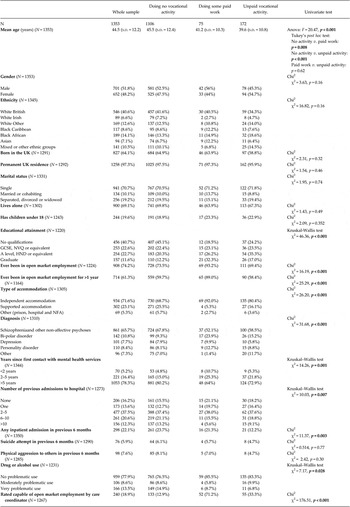
Characteristics of CMHT service users, categorized by employment status
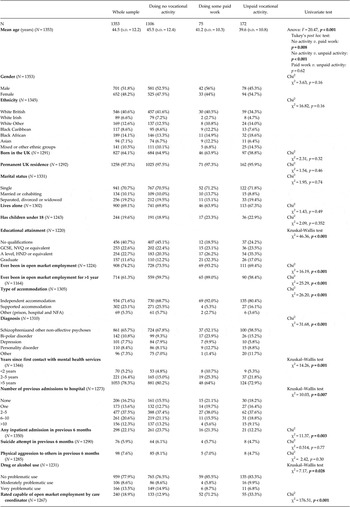
Descriptive and bivariate analyses were undertaken using SPSS for Windows version 17. The characteristics of service users in each vocational category and the proportion of those within each vocational category rated by a clinician as capable of paid work were assessed. Comparisons of participants’ characteristics were conducted for the three groups: (a) in paid work; (b) in unpaid vocational activity; and (c) no vocational activity. Basic demographic data (age, gender and ethnicity) and any variable significant in any of the bivariate comparisons at p < 0.1 level were then selected for inclusion in a multivariate analysis.
Multivariate analyses were conducted using Stata version 10 for Windows. Less than 5% of the data were missing overall, but exclusion of all cases with any missing data would nonetheless have resulted in substantial loss of data from regression analyses. To avoid this, we used multiple imputation, which repeatedly fills in the missing data based on values of other variables and a missing at random assumption (Little & Rubin, Reference Little and Rubin2002). Imputed data sets are analysed separately and the results are combined in a way that adjusts standard errors for uncertainty about the missing values (Schafer, Reference Schafer1997). We generated five imputed data sets using the ice command in Stata (Royston, Reference Royston2004), and used the imputed data in the subsequent regression using the micombine command.
A multinomial logistic regression was carried out with work status (paid work, unpaid vocational activity and no vocational activity) as the dependent variable. Independent variables were entered in blocks: first, major demographic characteristics; second, work history and educational attainment; third, variables describing current social circumstances, clinical status and service use.
Results
Data, including employment status, were obtained for 1353 (97.8%) of the 1384 people who met the study inclusion criteria.
Demographic characteristics
Participants had a mean age of 45 years and just over half (51.8%) were male. A total of 40.6% were White British, with Black African being the next most numerous ethnic groups (14.1%). Just under two-thirds of participants were UK born (64.1%); most (69.1%) lived alone. Over 40% of participants (40.7%) had no educational qualification; 11.6% were graduates. A majority (61.3%) had sustained open market employment for at least a year at some point in their lives. Nearly two-thirds of the sample (65.7%) had a diagnosis of schizophrenia or other non-affective psychosis and 10.8% were diagnosed with bipolar disorder. Most (78.3%) had been in contact with mental health services for more than 5 years. Over 20% (22.1%) had been in hospital during the 6 months prior to the study baseline and 22.1% had a moderate or severe drug or alcohol problem. The characteristics of study participants and the characteristics of those in each vocational group (paid work, unpaid vocational activity or no vocational activity) are reported fully in Table 1.
Vocational activity
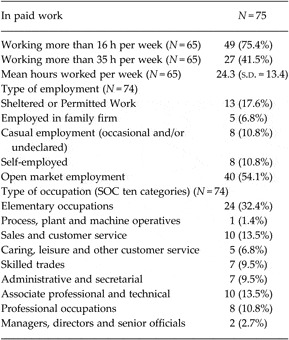
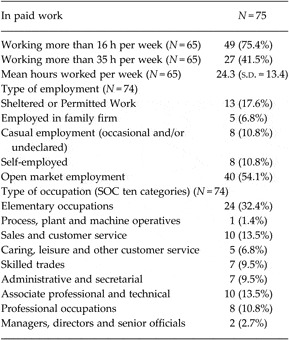
Overall, 172 participants (12.7%) were in unpaid work, training or study, and 75 (5.5%) were in paid work; 1106 (81.7%) participants were not involved in any vocational activity. The nature of paid work undertaken is shown in Table 2. People in paid work were engaged in a broad range of occupations. Most (58.5%) worked part-time and just over half (54.1%) were in regular employment acquired through a competitive open market process (rather than in occasional, casual work, family firms, sheltered work or Permitted Work for people with disabilities). Thirteen participants were in paid work roles, specifically designed to accommodate people with disabilities; these comprised seven people in Permitted Work and six in paid, sheltered work schemes.
Paid work among CMHT service users
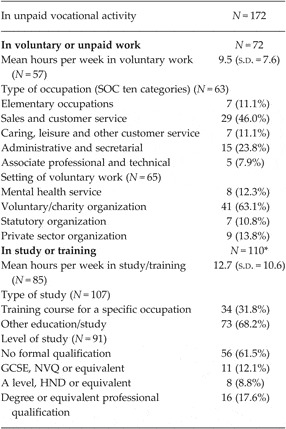
The nature of unpaid vocational activity undertaken is shown in Table 3. The range of occupations for people in voluntary work was comparatively narrow, with over two-thirds (69.8%) involved in retail or administrative occupations, commonly working in not-for-profit shops. A minority of those in education or training were involved in training for a specific occupation (31.8%) or for an academic or professional qualification (38.5%). The most common types of education undertaken were English language or basic computer skills classes.
Unpaid vocational activity among CMHT service users
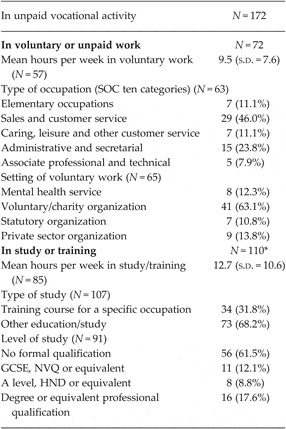
*Ten people were doing voluntary work and study or training
Bivariate tests of associations between employment status and other study variables are presented in Table 1. A difference between groups at a significance level of p < 0.1 was found for the following variables: age, educational attainment, previous work history, type of accommodation, years since first contact with mental health service, number of previous hospital admissions, inpatient admission in the previous 6 months and drug or alcohol use.
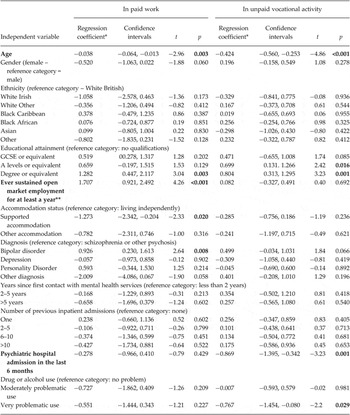
Table 4 presents a multinomial logistic regression of factors associated with work status. Younger age and higher educational attainment (degree level) were independently associated with being in paid work and with doing other vocational activity, compared with doing no vocational activity. Having ever sustained paid work for at least a year, not living in supported accommodation and having a diagnosis of bipolar disorder were also associated with doing paid work. People doing unpaid vocational activity were less likely than those doing no activity to have had a hospital admission in the last 6 months and to have a severe drug or alcohol problem.
Multivariate comparison of factors associated with being in paid work or unpaid vocational activity compared to no vocational activity: results from a multinomial logistic regression
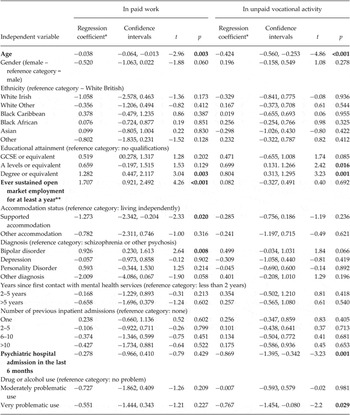
*Negative score = negative association with being in vocational activity rather than no activity
**Both work history variables – ever had open market employment and ever sustained open market employment for at least a year – were significant in bivariate comparisons: the former, which unlike the latter was not significant when entered into the regression model in the second block of variables, was excluded from the final step of the regression, to avoid including two closely related variables in the final model
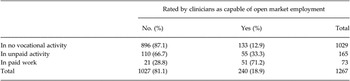
Ratings of whether service users were capable of open market employment were obtained from involved clinicians for 1267 service users. Table 5 reports the proportion of service users within each vocational category rated capable of open market employment by clinicians.
Clinicians’ assessment of service users’ capacity for paid work
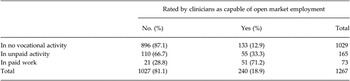
Overall, 240 (18.9%) were rated by clinicians as capable of open market employment. Only 22.9% of those rated capable were in paid work. More than half (55.4%) of those rated capable of open-market, paid work by clinicians were not engaged in any vocational activity.
Discussion
Main findings
Rates of vocational activity
Despite our broad definition of paid work, in our study the proportion of service users in paid employment (5.5%) was at the low end of the range of 4–27% suggested previously (Marwaha & Johnson, Reference Marwaha and Johnson2004) and similar to figures from a study of service users with a diagnosis of schizophrenia from the same catchment area conducted 8 years previously (Marwaha et al. Reference Marwaha, Johnson, Bebbington, Stafford, Angermeyer, Brugha, Azorin, Kilian, Hansen and Toumi2007). This suggests the downward trend in UK rates of employment among mental health service users identified a decade ago (Perkins & Rinaldi, Reference Perkins and Rinaldi2002) may not have improved, despite local and national policies focused on employment for this group. However, we found that more service users were doing some form of unpaid work, training or study than paid work (12.7% v. 5.5%), with similar numbers doing paid and voluntary work (5.5% v. 5.3%).
Mental health staff in our study rated 18.9% of their clients as capable of open market employment, somewhat lower than a recent UK study of community mental health professionals’ attitudes (Marwaha et al. Reference Marwaha, Balachandra and Johnson2009), but still much higher than the numbers who were actually in work. Our findings that 81.7% of CMHT service users were doing no vocational activity at all, including the majority (55.4%) of those rated capable of open market employment, therefore suggests a large mismatch regarding levels of vocational activity between clinicians’ already modest expectations, policy aspirations to increase access to work for people with mental health problems (Department of Health, 2011) and the reality for those receiving services from the CMHTs studied.
Nature of vocational activity
The jobs held by people in paid work included all categories of the SOC10 typology (Office for National Statistics, 2010). Although nearly half the people doing paid work in our cohort had basic school-leaving or no qualifications, less than a third were employed in jobs classed as elementary occupations by SOC10 categorization (Office for National Statistics, 2010). These results therefore do not suggest that CMHT service users in paid work were disproportionately engaged in unskilled, low-paid jobs. Most people (58.5%) in paid work were working part-time, compared with 26.5% of the national workforce (Office for National Statistics, 2009). Part-time work thus appears to be more attainable or attractive for many mental health service users in comparison with the general population.
The range of voluntary jobs service users were engaged in was strikingly narrower than the range of paid employment, with nearly half of all voluntary jobs being in sales/customer service. For example, 35% of those doing voluntary work were retail assistants in not-for-profit shops. The types of voluntary vocational roles accessed by service users may therefore not reflect their full range of skills and interests. A possible explanation for this finding is that providers of vocational services may have long-standing relationships with particular charity companies. Thus, the voluntary work mental health service users do may reflect the nature of provision rather than individual vocational needs and preferences.
Study or training which service users were engaged in was also typically not specifically related to a particular job or an obvious vocational pathway (for 68.2% of participants in study or training). This, coupled with the apparently narrow range of voluntary work roles, may be one reason why pre-vocational training has been found to be of limited effectiveness in helping mental health service users move into paid work (Bond et al. Reference Bond, Drake and Becker2008).
Associations with paid and unpaid vocational activity
The factors associated with being in paid work in our study cohort were consistent with several previous studies (Mowbray et al. Reference Mowbray, Bybee, Harris and McCrohan1995; Goldberg et al. Reference Goldberg, Lucksted, McNary, Gold, Dixon and Lehman2001; Wewiorski & Fabian, Reference Wewiorski and Fabian2004) in which demographic characteristics and work experience were more strongly associated with work status than clinical and service use characteristics. Unlike a meta-analysis of predominantly US studies (Wewiorski & Fabian, Reference Wewiorski and Fabian2004), but consistent with a recent European study (Catty et al. Reference Catty, Lissouba, White, Becker, Drake, Fioritti, Knapp, Lauber, Rossler, Tomov, van Busschbach, Wiersma and Burns2008), our results did not show any association between ethnicity and employment status. This could suggest minority ethnic status to be less of a barrier to employment for people with mental health problems in Europe compared with North America.
Previous reviews (Marwaha & Johnson, Reference Marwaha and Johnson2004; Wewiorski & Fabian, Reference Wewiorski and Fabian2004) have found that having a diagnosis other than schizophrenia is associated with better work outcomes. We found more specifically that a diagnosis of bipolar disorder was associated with being in paid work. This is notable on two counts: first, because, although household surveys suggest that those with bipolar disorder have higher rates of work than those with schizophrenia (Waghorn et al. Reference Waghorn, Chant and Jaeger2007), investigations of this in samples from secondary care are scarce; and second because a recent literature review suggests inter-episode morbidity in bipolar disorder is severely disabling (Sanchez-Moreno et al. Reference Sanchez-Moreno, Martinez-Aran, Tabarés-Seisdedos, Torrent, Vieta and Ayuso-Mateos2009), with persistence of affective symptoms (Furukawa et al. Reference Furukawa, Konno, Morinobu, Harai, Kitamura and Takahashi2000) and medical co-morbidity (Dittmann et al. Reference Dittmann, Biedermann, Grunze, Hummel, Schärer, Kleindienst, Forsthoff, Matzner, Walser and Walden2002) common. Our findings suggest that, nevertheless, the level of disability is not as severe as for people with a diagnosis of schizophrenia, in terms of engagement in vocational activity.
The similarities in our sample between those engaged in paid work and in unpaid vocational activities are consistent with a study of people with first-episode psychosis (Turner et al. Reference Turner, Browne, Clarke, Gervin, Larkin, Waddington and O'Callaghan2009). Thus, findings do not suggest that a stepped recovery pathway to open employment is typical, with more disabled service users embarking on unpaid activities and then moving on to paid work as they stabilize clinically; other determinants of why people are engaged in unpaid rather than paid work need to be established. The clearest difference in our study between those in paid and unpaid vocational activity was whether they had ever worked and had sustained paid work for at least a year. This may reflect both the importance for finding work of being able to demonstrate previous employment and the effect of previous work experience on people's vocational aspirations.
Limitations
Three limitations to this study can be identified. First, we relied on reports from mental health professionals, directly and via electronic records. This enabled us to obtain data on almost the entire population of service users in two large catchment areas. However, the absence of any self-report data may have led to some types of work such as undeclared work not being reported.
Second, the data were gathered 6 months retrospectively. This led to service users who were discharged from or admitted to the service in the period between the study baseline and data collection dates being excluded from the sample, reducing its representativeness of all CMHT service users. As with any retrospective data, possible confounding factors may not have been accounted for.
Third, the results from this study reflect vocational activity among mental health service users in two diverse, inner-city London boroughs with high levels of deprivation alongside some areas of extreme wealth: their generalizability across the UK is unknown.
Research implications
Lack of confidence in their ability to find or sustain work and benefits-related financial disincentives have been frequently found as barriers for mental health service users in seeking paid work (Secker et al. Reference Secker, Grove and Seebohm2001; Honey, Reference Honey2004; Marwaha & Johnson, Reference Marwaha and Johnson2005; SE-SURG, Reference Secker and Gelling2006). In our study, the low rates of service users in paid work, the low rates of work among those rated capable of work by clinicians and the lack of clear clinical differences between those in paid, unpaid or no vocational activity all suggest these barriers may apply for our study population.
Three areas for future research could help understand our findings and identify more precisely barriers to employment for people for mental health problems and how they might be reduced.
What rates of employment can be achieved by mental health service users in normal clinical settings?
The low rates of paid employment in our study were found in the absence of a high-fidelity supported employment programme. This raises the question of what proportion of mental health service users might be helped to achieve paid employment. Trials of Individual Placement and Support employment services have found employment rates of about 60% can be achieved for selected samples of service users; however, Burns et al. (2007) found less willingness to take up IPS in countries with obvious benefits traps associated with working, while Howard and colleagues (Howard et al. Reference Howard, Heslin, Leese, McCrone, Rice, Jarrett, Spokes, Huxley and Thornicroft2010) have argued that the inclusion criterion for many trials of employment support services, that participants want competitive employment, may mask lack of motivation to work among many service users. A naturalistic investigation of a high-quality supported employment service is required to demonstrate what rates of vocational activity may be achievable throughout a community mental health service.
The functions of unpaid vocational activity for mental health service users
Our finding that those doing paid and unpaid vocational activity are not vastly different suggests that many of those in voluntary work study or training might be capable of paid work. The extent to which service users are choosing unpaid activity in preference to paid work and the reasons for this are therefore important to understand. Our study does not establish to what extent those in unpaid activity see voluntary work or study as a desired goal in itself, valued for latent functions such as greater self-esteem and social contact (Jahoda et al. Reference Jahoda, Lazarsfeld and Zeisl1933), or as a substitute for or stepping stone to desired paid work. It does not establish to what extent the limited range of voluntary work undertaken by service users meets their needs and aspirations. Qualitative interviews with service users could usefully explore motivations and wishes for unpaid vocational activity, to help assess the extent of need for support with unpaid vocational activity and to inform efforts to increase access to a range of voluntary work which meets service users’ skills and interests. A study of pathways between vocational activity and paid work could help identify types of unpaid vocational activity which may lead to paid work for those who want it.
The nature of welfare-related disincentives to work
Permitted Work (Department of Work and Pensions, 2012) is a major UK government scheme with equivalents in northern Europe which targets people receiving incapacity-based benefits. It is designed to alleviate barriers to people with disabilities undertaking any paid work by allowing them to work up to limited weekly earnings and hour thresholds without affecting receipt of welfare benefits. The low take-up of Permitted Work (Department of Work and Pensions, 2012) among service users of secondary mental health services found in our study requires corroboration from future studies. Welfare-related barriers and disincentives to paid work may be complex. Regarding Permitted Work, Seebohm & Scott (Reference Seebohm and Scott2004) identified as potential problems: the permitted levels of earnings (for some, only £20 per week) may at times be too low to incentivize people, where higher levels of earnings are permitted (up to £95 per week), effects on secondary benefits such as housing allowances may reduce the attractiveness of the scheme; service users may fear triggering a new assessment of their capacity for work by the benefits agency, they may also fear consequent withdrawal of benefits in the future. The UK government requirement for claimants of incapacity-based benefits to report all voluntary work to benefits agencies (Department of Work and Pensions, 2012) may similarly deter people from taking up voluntary work. Lack of awareness among service users or clinicians may also have limited take-up of Permitted Work. An in-depth understanding is required of service users’ and clinicians’ knowledge and beliefs regarding welfare arrangements for incapacity-related benefits, to help identify the most pertinent real and perceived welfare-related barriers to employment for mental health service users and inform efforts to mitigate these barriers. Evaluation of the impact for people with severe and enduring mental health problems of changes to welfare benefits systems and schemes to reduce welfare-related barriers to employment are also required.
Implications for policy and practice
Our study found very low rates of employment and vocational activity among CMHT service users, compared with previous surveys (Marwaha & Johnson, Reference Marwaha and Johnson2004), rates of employment achieved in studies of supported employment (Bond et al. Reference Bond, Drake and Becker2008) and local rates of unemployment (Office for National Statistics, 2009) This suggests that CMHTs should provide resources for and prioritize vocational support for service users to help achieve a key goal for mental health services (Department of Health, 2002, 2006) and broader UK (Department of Health, 2011) and European (European Commission, 2008) public policy of improving access to employment for people with mental health problems.
The low-take up of Permitted Work and low employment rates in our study suggest disincentives to paid work in the UK welfare system may remain substantial despite current initiatives to mitigate them. Seebohm & Scott (Reference Seebohm and Scott2004) provide a set of recommendations which remain pertinent for how financial disincentives to paid work could be reduced by raising earnings thresholds and reducing the impact of earnings on secondary benefits. There is a need to monitor the effect of tax and welfare policies for people with severe mental health problems, if the government's stated aims of increasing access to employment for people with mental health problems and reducing costs associated with low productivity are to be met (Department of Health, 2011).
In addition to a focus on paid work, for those who are unable or unwilling to find competitive employment, there is a need for mental health services to help increase awareness of and access to a wider range of unpaid vocational activity than is currently available, which can meet people's skills and interests. In the UK, CMHTs have been guided to do this by the government (Department of Health, 2006) and help finding rewarding unpaid work or study may be especially important in a time of economic hardship when paid work is harder to achieve.
Acknowledgements
The authors are grateful to the staff of Community Mental Health Teams (CMHTs) in Camden and Islington NHS Foundation Trust, the St James House Jobs In Mind service and the Mental Health Research Network North London Hub for their help with collecting data for this study.
Conflict of interest
This paper presents independent research funded by the National Institute for Health Research (NIHR) under its Research for Patient Benefit (RfPB) Programme (Grant Reference Number PB-PG-1207-15143). The views expressed are those of the author(s) and not necessarily those of the NHS, the NIHR or the Department of Health.