Introduction
The Alps are recognized as one of the major hotspots of biodiversity in Europe. Specifically, they host different species belonging to Galliformes order, and among them the rock partridge (Alectoris graeca saxatilis), the black grouse (Tetrao tetrix tetrix) and the rock ptarmigan (Lagopus muta helveticus). These three species are listed in the Directive 2009/147/EC of the European Parliament for the conservation of wild birds in Europe (European Parliament and European Council, 2009). Moreover, according to the National Red Data Book of Italy, both rock partridge and rock ptarmigan are classified as ‘vulnerable’, whereas the black grouse as ‘least concern’ (Rondinini et al., Reference Rondinini, Battistoni, Peronace and Teofili2013). More in general, the wild Galliformes population in some areas of the Alps has globally reduced in the last years (Giordano et al., Reference Giordano, Ficetto and Tizzani2017). Considering the critical status of conservation of some species, a correct management of these populations is of pivotal importance. Several factors are negatively affecting wild Galliformes population density, including habitat loss and degradation (Pearce-Higgins et al., Reference Pearce-Higgins, Grant, Robinson and Haysom2007; Ludwig et al., Reference Ludwig, Storch and Graf2009; Signorell et al., Reference Signorell, Wirthner, Patthey, Schranz, Rotelli and Arlettaz2010). Some studies have also highlighted the harmful effects of climate changes on alpine environments (Anfodillo, Reference Anfodillo2007; Tinner and Vescovi, Reference Tinner and Vescovi2007), and some typical alpine fauna, such as the rock ptarmigan, living between 1800 and 3000 meters above sea level (a.s.l) with fresh north-facing slopes (Lasagna, Reference Lasagna2009), has been proved to be particularly sensitive to climate changes (Watson and Moss, Reference Watson and Moss2004).
In the context of wildlife conservation, there is a great interest to assess the role of pathogens in influencing population dynamics (Smith et al., Reference Smith, Sax and Lafferty2006; Delogu et al., Reference Delogu, Ghetti, Gugiatti, Cotti, Piredda, Frasnelli and De Marco2013). This is partially due to the fact that the number of pathogens to which wildlife is exposed has recently increased, for several reasons. In particular for wild Galliformes there is an increased risk of disease transmission as a consequence of the restocking of games species (Gortazar et al., Reference Gortazar, Diez-Delgado, Barasona, Vicente, De La Fuente and Boadella2014). Every year the red partridge, the ring neck pheasant and other wild species are introduced for hunting purposes in the Italian Alps (Regione Piemonte, 2018). These game animals, not always raised with adequate hygienic and sanitary conditions, can potentially shed pathogens in the environment, which might be hazardous for wildlife population. Based on scientific literature in fact, different factors make captive-born animals particularly susceptible to infectious diseases (Lafferty and Gerber, Reference Lafferty and Gerber2002). For this reason, they can potentially have heavy parasite loads that can be transmitted to wild populations (Power and Mitchell, Reference Power and Mitchell2004).
Taking into account that pathogens might have a negative impact on welfare and population dynamics (Hudson, Reference Hudson1986; Holmstad et al., Reference Holmstad, Hudson and Skorping2005; Citterio et al., Reference Citterio, Caslini, Milani, Sala, Ferrari and Lanfranchi2006), the studies on the parasite fauna hosted by endangered species can provide a better understanding of such interactions (Formenti et al., Reference Formenti, Viganò, Rotelli, Ferrari, Cerutti and Lanfranchi2013). However, the health status of wild Galliformes populations is poorly known. This is in partly due to the complexity of sampling animals in the alpine environments, to the low density of targeted species and to the few ongoing projects focusing on health issues of Galliformes.
With the objective of improving the knowledge on wild Galliformes population pathogens, we evaluated the helminth community parasitizing the rock partridge, the black grouse and the rock ptarmigan in the Italian Alps.
Material and methods
Sample collection
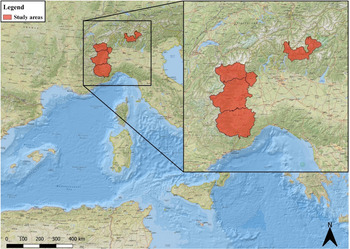
During the hunting seasons (October–November) 2008 to 2015, 77 rock patridge, 83 black grouse and 26 rock ptarmigans were collected in six different hunting grounds in the Italian Alps. Specifically, the following districts were investigated: Comprensorio alpino Sondrio (C.A. Sondrio), Aosta Valley, Comprensorio Alpino Biella Valley (C.A. BI1), Comprensorio Alpino Lanzo Valleys (C.A. TO4), Comprensorio Alpino Varaita Valley (C.A. CN2) and Comprensorio Alpino Maira Valley (C.A. CN3). This work has been carried out in accordance with the hunting activity laid down by regional laws (Regione Piemonte, 2018). Figure 1 shows the provinces sampled during the study. The sample composition, divided by species and district, is presented in Table 1.
Italian provinces where the study was undertaken.

Number of animals sampled, divided per species and hunting district

Parasitological analysis
Gastrointestinal tracts were examined and processed. Parasite collection was done with the support of a stereomicroscope. The identification was carried out by consulting the available identification keys (Skrjabin, Reference Skrjabin1954; Khalil et al., Reference Khalil, Jones and Bray1994). Nematodes were stored in 70% ethanol while cestodes were fixed in AFA solution (acetic acid 3%, formaldehyde 15%, alcohol 82% at 50°). Cestodes identification at genera and species levels was not possible due to the non-optimal conservation of the samples.
Statistical analysis
Prevalence (positive/total animals), abundance (number parasites/total animals) and intensity (number parasites/positive animals) were computed for each parasite in each host species and hunting district. The ‘number of parasites’ refers to the number of individuals found for each parasite taxa. Prevalence data were compared using the Fisher's exact test, frequency distribution of parasites intensity and abundance using the Kruskal–Wallis test (Rozsa et al., Reference Rozsa, Reiczigel and Majoros2000). Considering the unbalanced sample size for some areas, Aosta Valley and Sondrio samples were excluded from the statistical comparison, while Varaita and Maira Valleys were aggregated in a unique sample area, as for geographic location they can be considered as a part of a common population sharing the same risk factors. In the case of significant difference between groups, pairwise comparisons with correction for multiple testing were computed between groups (Benjamini and Hochberg, Reference Benjamini and Hochberg1995). Rock ptarmigan samples were excluded from the statistical analysis as no parasite was detected in this species.
Nematode distribution can be highly influenced by environmental variable (Sanchis-Monsonís et al., Reference Sanchis-Monsonís, Fanelli, Tizzani and Martínez-Carrasco2019), considering that they can influence the survival of infective stages in the environment. With the purpose to better understand the geographic distribution of nematodes, the influence of environmental factors on parasite presence was evaluated through a generalized linear model (GLM). Taking into account that a low prevalence value might lead to a loss in accuracy and precision of risk estimates (Doerken et al., Reference Doerken, Avalos, Lagarde and Schumacher2019), the GLM model was applied on A. compar only, because it was the only parasite with an adequate number of presence data (72 geo-referenced records). Spatial analysis was carried out with QGIS software version 3.6 (QGIS Development Team, 2017). Environmental covariates were computed considering a buffer area around the sampled location, using species specific home ranges according to the available literature: 686 meters radius for the black grouse (Storch, Reference Storch1994) and 829 meters radius for the rock partridge (Asters, 2012). Covariates were log transformed and tested for multicollinearity through a VIF approach (Heiberger, Reference Heiberger2018). The ones whose VIF was greater than 5 were excluded from the analysis. The most parsimonious models were selected computing the Akaike Information Criterion (AIC) (Akaike, Reference Akaike, Petrov and Csaki1973). Model performance was assessed by computing the area under the curve value (AUC). All statistical analyses were performed using R (R Core Team, 2018). GLM was built using a glmulti package (Calcagno, Reference Calcagno2019). Table 2 shows the environmental variables used, a brief description and the original source.
Overall listing of variables taken into account in the study

a Variables with collinearity (VIF > 5).
Results
Parasitological analysis
Seventy-five out of 186 animals hosted gastrointestinal helminths (prevalence: 40.3%). Parasites were found in 42 black grouse out of 83 (prevalence: 50.6%) and 33 rock partridges out of 77 (prevalence: 42.8%) whereas no worm was detected in the rock ptarmigan. Three different parasites were identified; Ascaridia compar, Capillaria caudinflata and cestodes. Parasites were mostly found in the small intestine (40%) and cecum (13.7%), while the gizzard was parasitized in only three cases (1.9%).
Analysis by host species
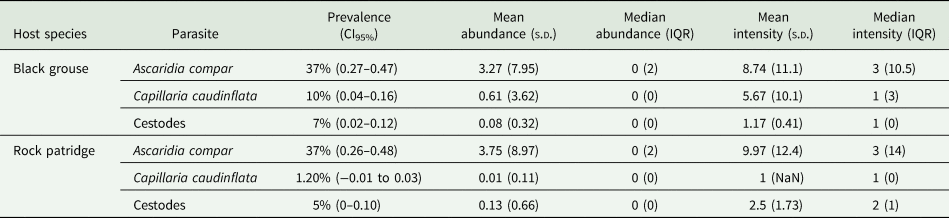
A. compar was recorded with the highest prevalence in both species (37%), while C. caudinflata was more prevalent in the black grouse (10%) than in the rock partridge (1.2%). Finally, cestodes prevalence was similar for both species (7% in black grouse and 5% in rock partridge). Prevalence, abundance and intensity for each parasite and in each host species are presented in Table 3.
Prevalence, abundance and intensity for each helminth and host species

The Fisher test shows that the proportion of birds infested by C. caudinflata was significantly different between host species (P = 0.017). No significant difference was found for the remaining parasites groups. In accordance with the Kruskal–Wallis test, the frequency distributions of C. caudinflata abundance indicate that also the level of infection is significantly different between the two host species (P = 0.02).
No difference was detected for the abundance of the other parasite and in general no difference was highlighted for parasite intensity.
Analysis by hunting district
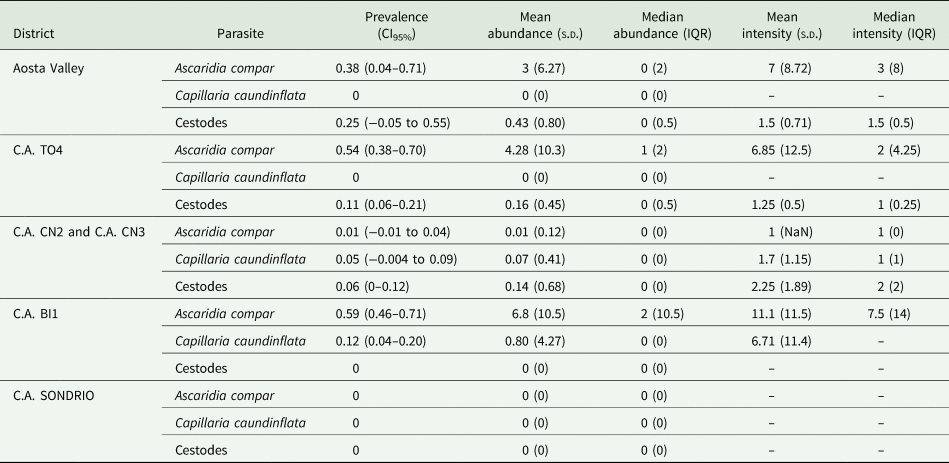
A clear spatial aggregation of the parasites has been found. A. compar was found mainly in Biella (59%) and Lanzo Valleys (54%). Biella Valley shows also the highest prevalence of C. caudinflata infestation (12%). Cestodes were the only parasite not showing a specific geographic distribution of prevalence. Table 4 shows the prevalence, abundance and intensity values for each parasite in each hunting district. Considering the small sample size in Aosta and Sondrio district, the differences detected in these two hunting districts have not to be considered for statistical comparison but just for descriptive purposes, as the different sampling intensities could reduce the robustness of the analysis.
Prevalence, abundance and intensity for each helminth in each hunting district

Significant differences for prevalence among the areas were found only for A. compar Biella and Lanzo Valleys prevalence was in fact significantly higher than the hunting district of Maira and Varaita Valleys together. Detailed information on area comparison and statistical differences for the relevant hunting districts are provided in the supplementary material.
The Kruskal–Wallis test showed significant differences for A. compar abundance; Biella valley and Lanzo Valley were significantly higher than Maira and Varaita Valleys together.
Finally, cestodes abundance was significantly higher in Lanzo Valleys compared to Biella Valley.
Generalized linear model for A. compar infestation
The reduced GLM model for A. compar (AIC = 53.7) included latitude and aspect (western exposition) as independent variables. The only significant factor retained in the model was the latitude (P = 0.002). The estimated odds ratio of latitude (OR = 52.4) highlights that there is a risk of parasite infestation in animals living at a higher latitude in our study areas. The model fitted the data very well (AUC = 0.91), and the amount of deviance accounted was 0.42.
Discussion
This paper provides important information on the parasite community of wild Galliformes in the Italian Alps. Despite the objective difficulties in sampling wild animals in the alpine environment, this study was able to include a sample of 186 wild Galliformes, collected in six different hunting areas from 2009 to 2015. Apart from the relevant number of animals that have been sampled, another important aspect of the paper is the description of the parasite community in three different species with different biology, ecological needs, conservation status and population densities. Only three helminths were detected in the black grouse and rock partridge, whereas no gastrointestinal parasite was found in the rock ptarmigan. The epidemiological indexes of prevalence, intensity and distribution highlighted differences among infected species and sampled areas. In particular, the most infected hunting districts were localized in the northern part of the study areas, and C. caudinflata showed a specific host predilection for the black grouse. The presence of a spatial aggregation of some parasite species has been also confirmed by the results of the GLM model.
The low parasite richness recorded in this work is in accordance with previous studies carried out in Eastern Italian Alps (Viganò et al., Reference Viganò, Formenti, Ferrari, Cerruti and Lafranchi2012a, Reference Viganò, Formenti, Ferrari, Cerruti and Lafranchi2012b; Formenti et al., Reference Formenti, Viganò, Rotelli, Ferrari, Cerutti and Lanfranchi2013). It is particularly worthy to highlight the complete absence of parasite in the rock partridge, living at high altitude, in areas with more extreme climatic conditions that probably do not allow the development of parasite cycles. On the contrary, some parasites extensively detected in previous studies like Heterakis gallinarum (in the rock patridge) (Florio and Gamba, Reference Florio and Gamba1993; Milani, Reference Milani2010; Viganò et al., Reference Viganò, Formenti, Ferrari, Cerruti and Lafranchi2012b; Viganò and Giacomelli, Reference Viganò and Giacomelli2014), were not detected in our survey. The absence of this parasite might be due to either a reduction of the host population density, which is no longer able to maintain the parasite cycle, or to a host-parasite equilibrium reached in the ecosystem. In a context of low host density, the parasite fitness can in fact declines with a lower ability to infest next generations and a potential local extinction in a long-term perspective.
Compared with similar surveys carried out in northern European countries, the parasite richness found in our study is significantly lower. Several parasite species found in northern Europe have never been recorded on the Alpine Galliformes. These include Heterakis bonasae (Kalla et al., Reference Kalla, Dimmick and Patton1997), Trycostrongilus tenuis (Holmstad et al., Reference Holmstad, Hudson and Skorping2005) and Syngamus trachea (Wissler and Halvorsen, Reference Wissler and Halvorsen1977). A possible explanation to these findings may be provided by the work of Altzier et al. (Reference Altizer, Nunn and Lindenfors2007). These authors in fact have demonstrated how an isolated and low-density host population might have fewer parasites. Hence Alpine Galliformes may harbour fewer parasite species, as a consequence of restricted and isolated geographical ranges. This is particularly true for species like the rock ptarmigan that is a glacial relict, whose population remained isolated at the end of the last glaciation.
Regarding the prevalence of the parasite in the other two host species, A. compar was detected in the black grouse at lower prevalence (37%) in comparison with other studies (62.3–82.4%) (Viganò et al., Reference Viganò, Formenti, Ferrari, Cerruti and Lafranchi2012a), as well as C. caudinflata (10 vs 48.4–79.3%) (Viganò et al., Reference Viganò, Formenti, Ferrari, Cerruti and Lafranchi2012a). On the contrary, in rock patridge, A. compar prevalence (37%) was three times higher than the one found in Viganò et al. (Reference Viganò, Formenti, Ferrari, Cerruti and Lafranchi2012b), while C. caudinflata prevalence was lower (1.2 vs 19.2%) (Viganò et al., Reference Viganò, Formenti, Ferrari, Cerruti and Lafranchi2012b).
Despite there were no statistically significant differences in prevalence among the areas, C. caudinflata was found mainly in Biella Valley, providing evidence of a heterogeneous sanitary status of the different alpine populations.
Additionally, Capillaria shows a clear host preference: 9 over 83 black grouse were found parasitized vs 1 over 77 rock partridge. This difference might be due to the fact that the parasite host-specificity increases with higher host densities (Forbes et al., Reference Forbes, Morrill and Schellinck2017). In the Italian Alps in fact, the black grouse is the wild Galliformes with the highest population density (Giordano et al., Reference Giordano, Ficetto and Tizzani2017). Moreover, considering that Capillaria have an indirect cycle, with earthworms as an intermediate host, the different risk of infestation can also be due to different feeding behaviour and diet of the two host species. The black grouse in fact feed more on earthworms while the rock partridge on insects. Yet data on C. caudinflata infestation in wild Galliformes are relatively limited, this worm has been recorded in a wide range of bird species causing severe enteritis and anaemia leading to poor general conditions and weight loss even in the case of mild infestation (Villanúa et al., Reference Villanúa, Casas, Viñuela, Gortázar, García De La Morena and Morales2007, Pinto et al., Reference Pinto, Brener, Tortelly, Caldas Menezes and Muniz-Pereira2008, McCain, Reference McCain2015). The impact of this parasite on black grouse population dynamics should be then further evaluated.
Host specificity has not been recorded in the case of Ascaridia or Cestodes which have been found to equally infest black grouse and rock partridge.
In addition to density and diet preferences, other specific variables related to behaviour, phenology and nest structure can influence the predisposition to parasitism. Indeed, the quality of being a competent host for parasites depends on host-specific variation in parasite reproductive success (Stokke et al., Reference Stokke, Ratikainen, Moksnes, Røskaft, Schulze-Hagen, Leech, Møller and Fossøy2018). However, more studies about parasites of Galliformes on the Alps are needed to better evaluate the factors explaining this variation in host selection.
As regards A. compar infestation, the prevalence, abundance and intensity values found in the hunting districts in the northern part of the study area (Lanzo and Biella Valleys) were significantly higher than in the southern part. This different degree of parasitism is probably due to different climatic conditions influencing the development and survival of both eggs, larvae and intermediate hosts of the parasites.
The spatial variation of parasitism degree might also reflect the sanitary management and sanitary status of game birds released in the different hunting districts. Restocking with farmed game birds, above all for red-legged partridge and ring-necked pheasant, is a practice still quite common in Italy. Specific articles of the Regional laws (Regione Piemonte, 2018) do not allow to release animals in the areas where alpine Galliformes lives; however, these interdictions are not always fully respected. Game birds are kept in aviaries were proper hygienic conditions cannot be maintained, thus infestation by parasites are likely (Stadler and Carpenter, Reference Stadler and Carpenter1996). Moreover, sanitary check before releasing the animals is always lacking. Once released, these animals can shed their parasites in the environment which becomes a potential source of infestation for free-ranging wild birds. This might be an additional problem for wild Galliformes conservation (Tompkins et al., Reference Tompkins, Carver, Jones, Krkos and Skerratt2015). A study carried out in Spain have clearly demonstrated that areas where restocking is a common practice, the sanitary status of the wild Galliformes can significantly deteriorate (Villanúa et al., Reference Villanúa, Pérez-Rodríguez, Casas, Alzaga, Acevedo, Viñuela and Gortázar2008). Under this perspective, the sanitary status of the different areas could be considered an indirect index of the quality of the wildlife management activity carried out in the different hunting districts.
In addition, various environmental risk factors might play an important role in parasite infestation. The GLM model built for Ascaridia compar, highlighted that, among all the environmental factors assessed, latitude was the only one with a clear influence on parasite distribution. Latitude in this case can be seen as a proxy of the climatic and environmental conditions required for the development of free-living stages of nematodes. These parameters in fact, can vary according to the latitude. In particular according to climatic data from the Regional Agency for the protection of the environment (ARPA Piedmont (2019) – http://www.arpa.piemonte.it/, accessed August 2019) the northern hunting districts are characterized by annual average precipitation values higher than the southern ones, thus creating more favourable condition for parasites development (humidity and dense vegetation cover). Latitude, as factor explaining parasite distribution and parasite richness has been found also in other works, modelling the spatial distribution of parasite, at local (Sanchis-Monsonís et al., Reference Sanchis-Monsonís, Fanelli, Tizzani and Martínez-Carrasco2019) and regional scale (Nunn et al., Reference Nunn, Altizer, Sechrest and Cunningham2005).
Conclusion
This work increases the limited knowledge on the sanitary status of Galliformes in the Alps. Our results show that the level of parasitic infestation in the black grouse and rock partridge varies across the study areas. This insight is of interest considering that the parasite load might affect the conservation of endangered population. On the other hand, our sample was not homogeneously distributed across the whole study area and an increase in the number of animals sampled from some hunting districts would help to clarify further the host and environmental requirements of the parasites. Further epidemiological studies about parasite species and their impact on wild Galliformes populations are needed to correctly plan conservation measures, considering that some parasite can have a huge direct (mortality) or indirect (reduce population fitness) effect on the population level.
Supplementary material
The supplementary material for this article can be found at https://doi.org/10.1017/S003118201900177X.
Financial support
This research received no specific grant from any funding agency, commercial or not-for-profit sectors.
Conflicts of interest
None.
Ethical standards
This work has been carried out in accordance with the hunting activity laid down by regional laws (Regione Piemonte, 2018).