INTRODUCTION
The Mediterranean Sea represents an interesting and special part of the Atlantic–Mediterranean region with tropical and warm temperate waters, mainly in summer and in the inshore areas (Ekman, Reference Ekman1953; Briggs, Reference Briggs1974). Moreover, it supports an intense maritime traffic, aquaculture activities and it has been connected with the Red Sea (Indo-Pacific region) across the Suez Canal that has facilitated the progressive introduction of a high number of alien species (Por, Reference Por1978; Zibrowius, Reference Zibrowius1991, Reference Zibrowius2002; Boudouresque, Reference Boudouresque, Sandlund, Scheil and Viken1999; Galil, Reference Galil2000, Reference Galil2007; Boero, Reference Boero2002; Streftaris et al., Reference Streftaris, Zenetos and Papathanassiou2005; Zenetos et al., Reference Zenetos, Çinar, Pancucci-Papadopoulou, Harmelin, Furnari, Andaloro, Bellou, Streftaris and Zibrowius2005, Reference Zenetos, Gofas, Verlaque, Çinar, Garcia Raso, Bianchi, Morri, Azzurro, Bilecenoglu, Froglia, Siokou, Violanti, Sfriso, San Martin, Giangrande, Katağan, Ballesteros, Ramos-Esplá, Mastrototaro, Ocaña, Zingone, Gambi and Streftaris2010). Among the alien species, the ascidians are particularly abundant in some areas (i.e. harbour environment) and the maritime traffic is one of the principal introduction vectors for these species (Millar, Reference Millar1971; Monniot & Monniot, Reference Monniot and Monniot1983; Monniot et al., Reference Monniot, Monniot and Laboute1991; Lambert, Reference Lambert, Sawada, Yokosawa and Lambert2001).
The species of Pyuridae are solitary ascidians with hard tunics (particularly the genera Herdmania, Microcosmus and Pyura) and they are widely spread around the world, mainly in tropical and subtropical waters (Van Name, Reference Van Name1945; Kott, Reference Kott1985, Reference Kott2002; Monniot et al., Reference Monniot, Monniot, Griffiths and Schleyer2001; Lambert, Reference Lambert2002; Monniot, Reference Monniot2002). Two alien species of Microcosmus (M. squamiger Michaelsen, 1927 and M. exasperatus Heller, 1878) have been reported in the Mediterranean Sea. These species have very similar external and internal morphological characters, and therefore their specimens have been occasionally misidentified in the Mediterranean Sea. The small siphonal spines appear to be the more useful characteristic to distinguish these species (Kott, Reference Kott1985; Monniot, Reference Monniot2002). Microcosmos squamiger widely spreads in the western Mediterranean basin, whereas M. exasperatus has been only reported from some areas in the eastern Mediterranean (Turón et al., Reference Turón, Nishikawa and Rius2007; Izquierdo-Muñoz et al., Reference Izquierdo-Muñoz, Díaz-Valdés and Ramos-Esplá2009). New records of M. exasperatus confirm its presence in the Gulf of Gabès (Méliane, 1998) and extend its geographical distribution to the Aegean Sea. The discontinuity in the actual geographical distribution of M. exasperatus and the historical records of both species (with M. squamiger) are analysed and discussed.
MATERIALS AND METHODS
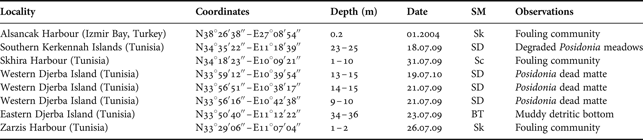
Specimens of Microcosmus exasperatus were sampled (Table 1) from some localities in the Gulf of Gabès (south of Tunisia) and the Alsancak Harbour (Izmir Bay, Turkey). The Tunisian specimens (N = 37) were collected during the project ‘Biodiversity of the Gulf of Gabès (Tunisia)' by SCUBA/snorkel diving inside harbours (0–12 m depth), and by sledge-dredge (10–25 m depth) and bottom trawling (>25 m depth) on degraded Posidonia oceanica (Linnaeus) Delile, 1813 meadows and muddy detritic bottoms. One specimen from Izmir was collected on the mussel Mytilus galloprovincialis Lamarck, 1819 by scraping off an area of 400 cm−2 (Çinar et al., Reference Çinar, Katagan, Koçak, Öztürk, Ergen, Kocatas, Önen, Kirkim, Bakir, Kurt, Dagli, Açik, Dogan and Özcan2008). Previously, two specimens from Beirut airport piers (collection date: Reference Zibrowius2002, by H. Zibrowius) were identified by one of us (A.A.R.E.).
Sampled stations of Microcosmus exasperatus in the Mediterrranean Sea.

SM, sampling method; SD, sledge-dredge; BT, bottom trawl; Sc, SCUBA diving; Sk, snorkelling.
The identification was made according to Kott (Reference Kott1985). The siphonal spines were extracted from the inhalant siphon and observed by dissecting microscope. Some scanning electron microscopy pictures were taken, after covering the dry spinules with gold. The material is deposited at the Institute National des Sciences et Technologies de la Mer (Salammbô, Tunisia), the Marine Research Centre of Santa Pola (University of Alicante, Spain: codes GG200901-07, GG201001-03 and AH200401) and the Museum of Faculty of Fisheries (Ege University, Turkey).
RESULTS AND DISCUSSION
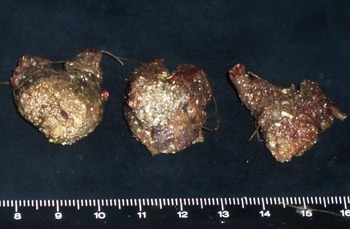
All specimens have a globular and irregular shape with the siphons, more or less prominent (Figure 1); the colour is brown, and some individuals have small epibionts (i.e. rhodophytes, foraminifers and serpulids) on the tunic. The smallest specimen (12 mm long) was found in Alsancak Harbour (January); and the sizes of the Tunisian specimens ranged between 15 and 35 mm (July). The siphonal spines (Figure 2) are curved (‘shark-fin like', Kott, Reference Kott1985) and about 50 µm in length. The gonads of the smaller specimen were not fully developed; whereas the specimens from the Gulf of Gabès had well-developed gonads.
Microcosmus exasperatus from south of Kerkennah (Tunisia) sampled by dredge, 23–25 m depth on dead Posidonia oceanica matte.

Siphonal spines of Microcosmus exasperatus from Alsancak Harbour. Scale bars: 50 µm.

The individuals were not aggregated, and only small groups of 3–5 specimens were observed on dead Posidonia oceanica rhizomes. Some of the specimens were sampled on artificial substrata (concrete piers and harbours) in shallow waters (0–10 m depth), others on benthic habitats drastically influenced by trawling (Posidonia meadows and muddy detritic bottoms). In the degraded P. oceanica meadows (9–25 m depth), some shoots have still alive leafs, but the majority are dead matte with the alien bivalve Pinctada radiata (Leach, 1814). In muddy detritic bottoms (34–36 m depth), the ochrophyte Arthrocladia villosa (Hudson) Duby, 1830 and some rhodoliths are present. In the previous studies (Méliane, Reference Méliane2002; Bitar et al., Reference Bitar, Ocaña and Ramos-Esplá2007; Shenkar, Reference Shenkar2008; Izquierdo-Muñoz et al., Reference Izquierdo-Muñoz, Díaz-Valdés and Ramos-Esplá2009; Shenkar & Loya, Reference Shenkar and Loya2009), specimens of Microcosmus exasperatus were also collected mainly on artificial substrates (concrete reefs, piers, harbours and plastic nets).
This opportunistic species colonized altered or degraded communities, often forming monospecific aggregations (Rius et al., Reference Rius, Pineda and Turón2009). Although, M. exasperatus was observed in natural shallow rocky habitats in Israel (Shenkar & Loya, Reference Shenkar and Loya2009), the community was impoverished with the dominance of the calcareous red algae (Amphiroa, Jania, Corallina, Lithophyllum and Neogoniolithon), due to the high herbivorous pressure (Siganus spp., Sparisoma cretense (Linnaeus, 1758), Conomurex persicus (Swainson, 1821)). The area was also degraded by bottom trawling.
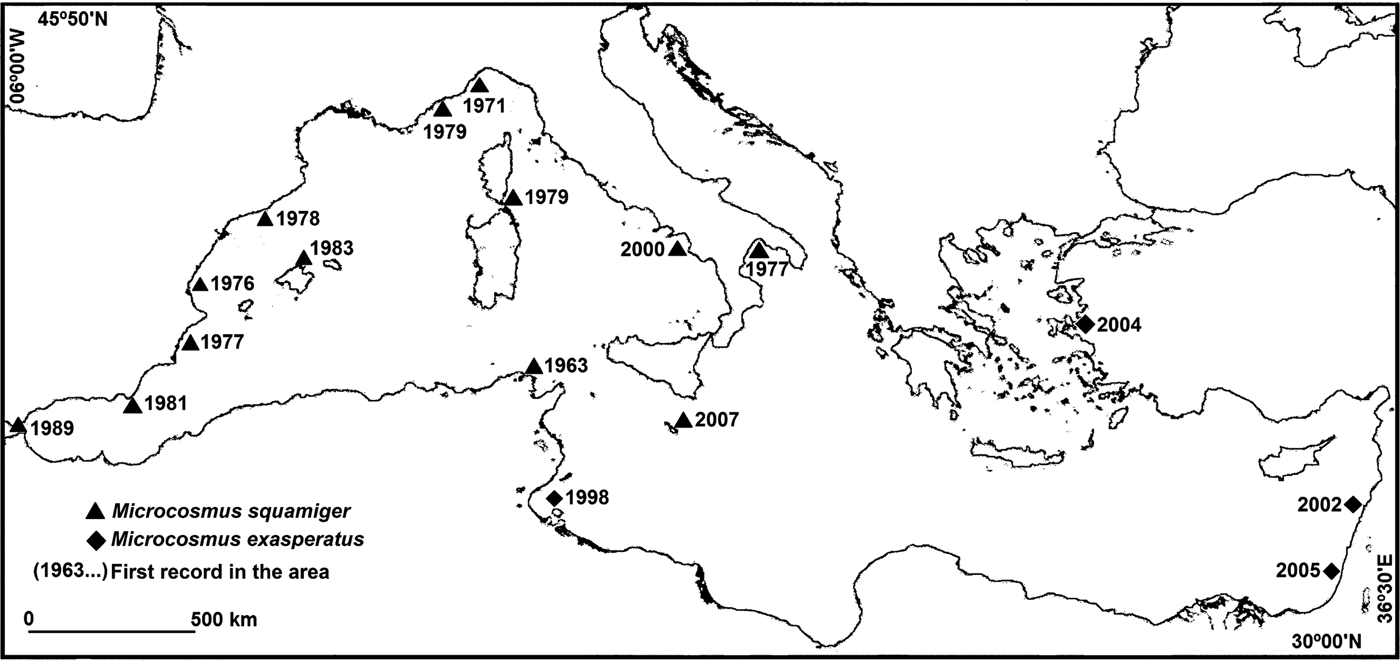
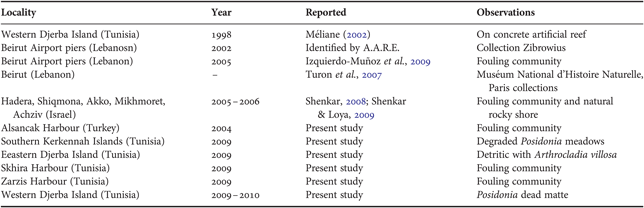
Microscomus exasperatus, was first recorded from Djerba Island (south of Tunisia) in 1998 (Méliane, Reference Méliane2002), and then it was observed on the coasts of Lebanon and Israel (Bitar et al., Reference Bitar, Ocaña and Ramos-Esplá2007; Turón et al., Reference Turón, Nishikawa and Rius2007; Shenkar, Reference Shenkar2008; Izquierdo-Muñoz et al., Reference Izquierdo-Muñoz, Díaz-Valdés and Ramos-Esplá2009; Shenkar & Loya, Reference Shenkar and Loya2009) in the eastern Mediterranean (Table 2). With regards to M. squamiger, it was first reported from northern Tunisia (identified as M. exasperatus) in 1962 (Monniot, Reference Monniot1981). Afterwards, M. squamiger was observed around the western Mediterranean and the Atlantic adjacent waters (Turón, Reference Turón1987; Ramos-Esplá, Reference Ramos-Esplá1988; Ramos-Esplá et al., Reference Ramos-Esplá, Buencuerpo, Vázquez and Lafargue1993; Naranjo, Reference Naranjo1995; Mastrototaro & Dappiano, Reference Mastrototaro and Dappiano2005; Turón et al., Reference Turón, Nishikawa and Rius2007), and the northern part of the Ionian Sea (Monniot, Reference Monniot1981; Mastrototaro et al., Reference Mastrototaro, Petrocelli, Cecere and Matarrese2004; Izquierdo-Muñoz et al., Reference Izquierdo-Muñoz, Díaz-Valdés and Ramos-Esplá2009) (Figure 3).
Geographical distribution of the Microcosmus squamiger (triangles) and M. exasperatus (rhombus) in the Mediterranean Sea, with the first record/year of the species (from different sources; see text).

Records of Microcosmus exasperatus from the Mediterranean Sea.
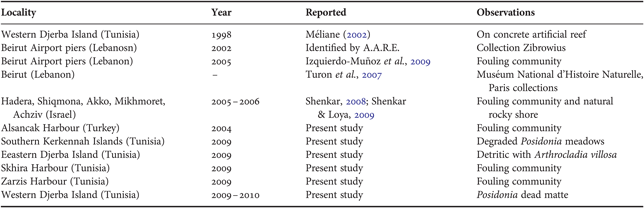
The distribution of M. exasperatus in the eastern Mediterranean basin (Figure 3) appears to be discontinuous, occurring in three areas (Gulf of Gabès, Levantine coasts and eastern Aegean Sea). The occurrence of this species along the Mediterranean coast of Israel and southern Lebanon (airport piers of Beirut) is more or less continuous (Shenkar & Loya, Reference Shenkar and Loya2009), but not in northern Lebanon, as this species has not been observed in natural habitats (e.g. Ras Chekka and Anfeth; A.A.R.E., personal observation). On the other hand, it seems to be isolated at the location in the eastern Aegean Sea (Izmir Bay), as it was not found in previous studies performed along the Turkish coast (Çinar et al., Reference Çinar, Bilecenoglu, Öztürk and Can2006, Reference Çinar, Bilecenoglu, Öztürk, Katağan, Yokeş, Aysel, Dağlı, Açık, Özcan and Erdoğan2011).
At present, no M. exasperatus record has been made from the northern-central Ionian and western Aegean areas (Italy, Greece, Malta and eastern Tunisia). The introduction vector for the spread of this species within the Mediterranean Sea could have been by the maritime traffic through commercial harbours between the Gulf of Gabès and Izmir Bay (Skhira and Zarzis in Tunisia and Alsancak in Turkey). It is the first time that an alien ascidian (M. exasperatus) has been reported from the Turkish coast of the Aegean Sea. In the previous studies (Çinar et al., Reference Çinar, Bilecenoglu, Öztürk and Can2006, Reference Çinar, Bilecenoglu, Öztürk, Katağan, Yokeş, Aysel, Dağlı, Açık, Özcan and Erdoğan2011), three alien ascidians (Phallusia nigra Savigny, 1816, Symplegma brakenhielmi (Michaelsen, 1904) and Herdmania momus (Savigny, 1816)) were reported from the Levantine coast of Turkey. Kondilatos et al. (Reference Kondilatos, Corsini-Foka and Pancucci-Papadopoulou2010) and Thessalou et al. (Reference Thessalou, Aydogan, Bekas, Bilge, Boyaci, Brunelli, Circosta, Crocetta, Durucan, Erdem, Ergolavou, Filiz, Fois, Gouva, Kapiris, Katsanevakis, Kljajic, Konstantinidis, Konstantinou, Koutsogiannopoulos, Lamon, Macic, Mazzette, Meloni, Mureddu, Paschos, Perdikaris, Piras, Poursanidis, Ramos-Esplá, Rosso, Sordino, Sperone, Sterioti, Taskin, Toscano, Tripepi, Tsiakkiros and Zenetos2012) also observed P. nigra on the south-eastern coast of Rhodes and the Peristera Island in Greece, respectively.
Comparing the present distributions of the two alien Microcosmus in the Mediterranean Sea, it appears that their geographical areas are not overlapping and the colonization of M. exasperatus seems to be more recent than M. squamiger (Figure 3). Microcosmus squamiger occurs in the western Mediterranean and the northern part of the Ionian Sea, whereas M. exasperatus has become well established in the eastern Mediterranean basin (Levantine Sea) and the Gulf of Gabès (southern Ionian Sea). These findings might indicate that two different routes of colonizations are possible: one from the Atlantic through the Strait of Gibraltar (for M. squamiger); and another from the Indo-Pacific region through the Suez Canal (for M. exasperatus). The historical record might also suggest that the initial establishments of both species took place in the central Mediterranean, and that they have successfully expanded their distributional ranges to the western and eastern parts of the Mediterranean. This kind of spread might have been mediated by maritime traffic and/or current regimes in the area. Furthermore, different ecological conditions between the eastern and western Mediterranean basins (Pérès, Reference Pérès1967) could have affected their distributional patterns.
No discernible negative effect of M. exasperatus on the ecosystem and economy has been reported from the area so far. It is possible that this species could create problems in prevailing ecosystems and man-made structures, like other invasive ascidian species (see Lambert, Reference Lambert2007). However, the ecological and distributional features of this species in the area should be investigated and monitored to assess its possible impacts on the Mediterranean ecosystems.
ACKNOWLEDGEMENTS
The authors thank Helmut Zibrowius for collecting the ascidians samples from the CEDRE project in Lebanon; Ghazi Bitar, Maite Vázquez, Carlos Valle and Oscar Ocaña for their assistance in the field work; and two anonymous referees for their useful suggestions.
FINANCIAL SUPPORT
This work was partly supported by the Scientific Research Projects of Ege University (Project number: 03 SUF 005).