INTRODUCTION
If the establishment and maintenance of social identities underlie sociolinguistic differences, as Chambers (2003:274) asserts, then attempts to explain such differences should begin with attempts to deconstruct these social identities. The focus of the present study is on the interdependence of language and place identity. By investigating practices of categorization, self-making and “othering” within the locality under investigation, as well as investigating shifting orientations of the speakers, the present study analyzes strategies used by speakers to define and delimit their sense of self and to contrast themselves with others in terms of the region in which they live and in terms of the accent that they have. In doing so, this article demonstrates the correspondence among changing patterns of linguistic use, speaker comment, and the shifting sociogeographic status of the locality under investigation – Middlesbrough, in the North East of England.
On a local level, Middlesbrough has something of a border-town status and, as such, is a locality in which regional identity construction is particularly fluid and complex. Middlesbrough, as well as yielding a hitherto unresearched urban variety of British English (henceforth BrE), offers an ideal test site for a study of the language/identity nexus. In an article in a British national newspaper, Middlesbrough was described thus:
It is pretty much a place between places. It's not on the way to anywhere, it's not quite in Yorkshire, and in fact a lot of people don't know where it is. It is a forgotten part of Britain with no identity. (The Sunday Times, 5 March 2000).
In a more favorable light, the Middlesbrough Official Guide (Public Relations 1997:16) describes the urban center as a “gateway to two regions.” Situated some 38 miles (61 km) south of Newcastle, the dominant urban center of Tyneside and the North East of England, and around 50 miles (80 km) north of York in Yorkshire, Middlesbrough lies in something of a transition zone between the extreme south of the North East and the extreme north of Yorkshire. The transitional nature of the geographical location of Middlesbrough, with its sense of being neither wholly in one region nor the other, has meant that the place identity of the urban center is not deep-rooted and firmly felt by either inhabitants or outsiders, as is often the case for localities on the peripheries of regions and nations. The linguistic variation revealed over apparent time in the present study is thus considered in light of the regional identity constructions and shifting orientations of the speakers.
The article begins with consideration of the theoretical and contextual background that situate the study, focusing on language ideology and social/community identity. Analysis of phonological variables of interest, the stop series (p t k), is presented, followed by analysis of speaker comment. Speakers' perceptions and comments on language and social categorization are then used to gain insight into the motivation for the linguistic variation uncovered.
THEORETICAL BACKGROUND
Language ideology
The concept of language ideology covers a vast area (see Woolard 1992), but pertinent to the present discussion is the neutral value of the term and Silverstein's definition, “sets of beliefs about language articulated by users as a rationalization or justification of perceived language structure and use” (1979:193). Irvine & Gal (2000:37) argue that the ideological aspects of linguistic differentiation emerge as a consequence of attempts by individuals to formulate understandings of linguistic variation that can be mapped onto significant people, events, and activities. Importantly, as Milroy (2000:9) notes, people, events, and activities viewed as significant will vary among communities. Furthermore, they may vary within communities as changes in reactions to the salience of locations can alter and attitudes toward salient social groups can shift, as is the case in the locality under investigation.
Silverstein 1992, 2003 views ideology as a system for making sense of the indexicality inherent in language – in other words, how language forms index speakers' social identities. This indexicality can be ranked into different orders of generality. First-order indexicality involves an association or correlation, often assumed in much sociolinguistic work, of a linguistic form with some socially meaningful category. Such correlations may not be noticed by speakers but may be observed by analysts. As such, first-order indexicals are analogous to “indicators” in Labov's (1972:178–80) taxonomy of the kinds of social meaning linguistic forms can carry. Second-order indexicality occurs when speakers use first-order correlations to “do social work,” which can be interpretive or performative (Johnstone et al. 2006:83). Such second-order indexicality can involve overt or covert awareness and discussion of basic first-order indexicality, and ideology can be identified through metalinguistic discourse and can become visible in style shifting in careful speech, hypercorrections, and hyperdialectisms (Milroy 2001).
Features that begin to be noticed by speakers and that begin to have social meaning associated with them – concerning, for example, region or class – can be seen as corresponding to “markers” in Labov's categorization (1972:178–80). Language ideologies thus entail the selective association of a linguistic form with some meaningful social group. Such groups are socially positioned and emerge from specific local and social circumstances (Milroy 2003). Furthermore, speakers are able to reallocate forms to index locally relevant identities. This may occur when the groups are in contact, as Woolard & Schieffelin (1994:62) argue: “Communities not only evaluate but may appropriate some part of the linguistic resources of groups with whom they are in contact and in tension, refiguring and incorporating linguistic structures in ways that reveal linguistic and social ideologies.”
Within a language ideology framework, speakers' own comments about language and other social phenomena are used as a means of interpreting and understanding linguistic variation in the community, thus allowing insight into social psychological motivations for sociolinguistic differences that may be otherwise inaccessible to the analyst. Such comments are not treated as irrelevant or unreliable, as is often the case in much variationist work.1
%1 See Anderson & Milroy 1999 and Dyer 2000, 2002 for recent variationist research that uses a language ideology framework expressly to interpret findings and motivations for linguistic change.
An ideological analysis treats social categories as locally created by social actors and discoverable by analysis, rather than as a given. Consequently, an ideologically oriented account of language variation and change treats members of speech communities as agents, rather than as automatons caught up ineluctably in an abstract sociolinguistic system. (Milroy 2004:7).
From this perspective, it can be argued that the speech community itself is one such locally created social category that can be examined and not simply imposed on a sample of speakers.
Social and community identity
Social identity is a concept that pervades disciplines investigating human behavior, both individual and collective. The body of ideas that became known as “social identity theory” (coined by Turner & Brown 1978) has its roots in Henri Tajfel's early work on categorization and social perception, and has at its core the idea that an individual is motivated to maintain a distinct and positive social identity. Social identity is seen as “a person's definition of self in terms of some social group membership with the associated value connotations and emotional significance” (Turner 1999:8). In intergroup contexts, people strive for positive distinctiveness for the group, and the evaluation of ingroup membership entails the requirement that relevant ingroups compare favorably with relevant outgroups: “Social comparisons between groups which are relevant to an evaluation of one's social identity produce pressures for intergroup differentiation to achieve a positive self-evaluation in terms of that identity” (Turner 1999:8).
Other people are conceptually categorized or grouped according to perceived similarities between group members and perceived differences from members of other putative groups along one or more relevant dimensions. Language may be considered one such dimension. This approach, in a way, is reflected in Le Page & Tabouret-Keller's (1985:181) view of linguistic behavior as “a series of acts of identity” during which “the individual creates for himself the patterns of his linguistic behaviour so as to resemble those of the group or groups with which from time to time he wishes to be identified, or so as to be unlike those from whom he wishes to be distinguished.” Investigation of the accent or dialect groups to which speakers perceive themselves to belong and those to which they compare themselves may allow insight into speakers' self-categorization in terms of language and social or community identity, or what we might term the locally constructed speech community.
Furthermore, this locally constructed community identity is not necessarily fixed in time or space. Unlike ethnographic studies of variation (e.g., Eckert 2000) or studies of discourse about variation (e.g., Johnstone & Baumgardt 2004), in most dialectological and variationist research, place is viewed in objective, physical terms and is largely unexamined (see Britain 2002, Johnstone 2004). The psychological reality of place is not fixed, however, but is socially constructed and can shift. How people orient to place, particularly in terms of region, is central to an understanding of the community identity they perceive:
Regions have come to be seen as meaningful places, which individuals construct, as well as select, as reference points. Identification with a region is identification with one kind of “imagined community.” (Johnstone 2004:69)
Although the notion of community is to an extent “imagined” (Anderson 1991), or “symbolically constructed” (Cohen 1985), whether speakers from the same locality would identify the same “community” is an important question to be considered.
Despite this locally constructed or “imagined” aspect of communities, there remain social realities, such as political boundaries, that contribute significantly to where psychological boundaries are drawn. We turn next to a consideration of the local, social situation that affects the regional identities, orientations, and meaningful social groups perceived by the speakers in the present study.
Local background
Middlesbrough lies on the south bank of the River Tees in the North East of England. With a population of almost 140,000, Middlesbrough is by far the most densely populated urban center of the industrial conurbation along the mouth of the river.
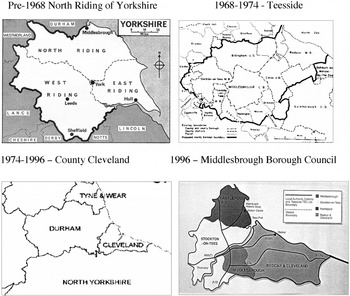
When compared with other cities in the North of England, the history of Middlesbrough as an urban center is a relatively short one and can be dated back to 1830, when the arrival of the railway prompted Middlesbrough's emergence as the world's first railway town. This relatively short history, combined with the fact that Yorkshire and Tyneside have strong local identities relative to other counties in England, adds to the lack of a deep-rooted sense of identity in the town. However, a large part of the more recent fluidity in terms of identity construction can be attributed to the repeated redrawing of local administrative boundaries in the region (see Figure 1).

Changing local administrative boundaries.
Traditionally, the River Tees divided the conurbation, with urban centers north of the river being situated in County Durham and those on the south bank, including Middlesbrough, forming part of the North Riding of Yorkshire. The conurbation was brought together in 1968 and given a political identity of its own in terms of local government with the formation of Teesside. This political identity was then changed when the region was expanded in 1974 with the formation of County Cleveland. It was changed again when the conurbation was once more divided in 1996 with the formation of four separate borough councils, each being regarded as a county in its own right. However, “for cultural and ceremonial purposes” the old boundary along the River Tees has been reinstated, and Hartlepool and Stockton-on-Tees, which lie on the north bank of the river, have links with County Durham, while Middlesbrough and Redcar & Cleveland, on the south bank, are associated with Yorkshire (Moorsom 1996:22). Within a period of approximately 30 years, then, in terms of local government, Middlesbrough has been assigned four separate political identities.
Over approximately the same time scale, an additional shift in orientation can be observed in terms of popular culture as the conurbation on both the north and south banks of the River Tees has become increasingly associated with the North East of England and increasingly dissociated from Yorkshire. Since independent regional television groupings were formed in 1959, Middlesbrough has been included in the Tyne2
The River Tyne passes through the conurbation centered around Newcastle and Gateshead and marks the pre-1974 border between County Durham to the south and Northumberland to the north.
From a linguistic point of view, the situation is similar. In terms of traditional dialectology, the River Tees is often considered a boundary. Indeed, Harold Orton, when working on the Linguistic atlas of England (1978), reportedly insisted that an isogloss following the River Tees be drawn (the Tees being the only river to have an isogloss follow it) because he knew it to be a boundary between Durham and Yorkshire (Clive Upton, p.c.). However, in modern dialect groupings, both Trudgill (1990) and Wells (1982) group Teesside with Tyneside in the “north-east” or “far north,” respectively, with Trudgill (1990:77) claiming:
No one from Middlesbrough would mistake a Tynesider for someone from Middlesbrough – but the accents are sufficiently similar to be grouped together, and sufficiently different from those of other areas. Londoners, for instance, might mistakenly think that Middlesbrough speakers were from Newcastle, but they would be much less likely to think that they were from, say, Sheffield.3
Sheffield is a city with a population of more than 500,000, lying 82 miles (132 km) to the south of Middlesbrough and situated in South Yorkshire.
Middlesbrough English (MbE) can be seen to lie between two regional accent types of BrE that are relatively easily identified: that of Geordie, to the north, which is the accent of Newcastle and Tyneside, and that of Yorkshire, to the south. Such a position also adds to the transitional character of the area and often makes outsiders' precise identification of the accent difficult. The misidentification of the accent, usually as Geordie, is a matter to which we shall return.
The geographical location of the conurbation around the River Tees, the location of Middlesbrough in relation to the river, and the repeated redrawing of administrative boundaries in the area all contribute to its transitional character both geographically and dialectally. Added to this, the recent shift northward in the orientation of Middlesbrough make it an ideal test site for a study in convergent and divergent linguistic trends and their relation with speakers' sense of identities in terms of perceived ingroups in opposition to perceived outgroups.
DESIGN OF THE STUDY
Fieldwork sample
The data presented were taken from a sample of 32 speakers from Middlesbrough who form a socioeconomically homogeneous group (speakers' self-assessment of their socioeconomic status as “working class” is kept constant). The self-assessment of socioeconomic status was supplemented with information on housing, level of educational attainment, and occupation.4
Example occupations of adult members of the sample include steelworker, boilermaker, chemical works laborer, tanker driver, factory worker, sewing machinist, auxiliary nurse, housewife, and unemployed.
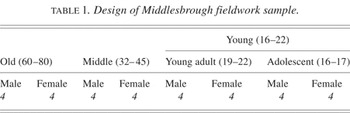
Age was taken as a variable in the study, with four age groups identified (see Table 1). Young adults and adolescents, being almost chronologically contiguous, can be taken as a combined group of young speakers, giving old, middle, and young groups of speakers. Gender was also taken as a variable in the study. In order to investigate in detail aspects of claimed and imposed identities and perceptions of language variation among informants, the numbers of speakers per cell was kept to four. Such a sample size offers the potential to obtain detailed attitudinal information from informants in order that claims made by the study may more confidently be said to reflect local meaning.
Data elicitation
The Middlesbrough study was the first to employ a method of data elicitation designed for use in a large-scale study of variation in BrE, the Survey of Regional English (SuRE) (for full discussion of the method of data elicitation see Llamas 1999, 2001). The basic intention of the SuRE project is to create a computer-held database from a planned network of localities throughout Britain of systematically sampled material that is analyzable on three levels of variability – phonological, grammatical, and lexical.
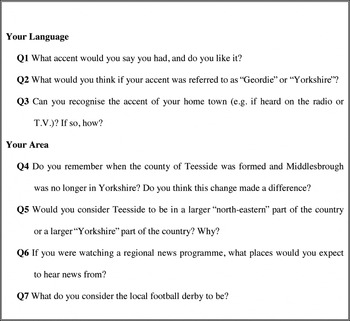
Part of the interview involves an Identification Questionnaire (IdQ) that elicits information on informants' attitudes toward their language – that is, it seeks to obtain instantiations of second-order indexicality – and attitudes toward their area, that is, their local orientations and categorizations of ingroups and relevant outgroups. Figure 2 presents questions from the IdQ of interest to this article, the responses to which are discussed after consideration of linguistic data. The data elicitation method thus allows for the elicitation of samples of informal speech from which a quantitative analysis of language use can be undertaken, while simultaneously allowing for a qualitative analysis of attitudinal data.

Example questions from Identification Questionnaire.
LINGUISTIC FINDINGS
Linguistic variables
All three plosives, (p), (t) and (k), can be realized with fully released variants, glottalled variants,

, or glottalized forms (also referred to as glottal reinforcement) (usually transcribed as a double articulation,

,

,

or

,

,

). Glottalization refers to “glottal masking of the oral plosive burst” (Wells 1982:374), or “oral closure reinforced by a glottal closure” (Gimson 1989:159). Giegerich (1992:220) describes the phenomenon thus: “In syllable final voiceless stops the bilabial, alveolar or velar closure is accompanied – often slightly preceded – by glottal closure, so that a glottal stop

is co-articulated with the [p t k] articulation.” Recent acoustic analysis of glottalized variants of (t), however, has revealed a more complex picture (see Docherty & Foulkes 1999), and in terms of a description of glottalization, acoustic analysis has led to the suggestion of

as an accurate transcription (Foulkes et al. 1999:7; Watt & Allen 2003:268), given the predominance of full or partial voicing and the lack of visual evidence of a glottal stop. Despite the somewhat arbitrary nature of the choice of terminology and transcription, then, for the purposes of this paper the term glottalization will be used to refer to the phenomenon, with tokens transcribed as

,

,

.
Glottalization of word-medial (p t k) is frequently reported in the literature as a characteristic feature of Newcastle and Tyneside English (Wells 1982, Milroy et al. 1994, Docherty et al. 1997, Watt & Milroy 1999, Watt & Allen 2003). It is also found in Durham5
Durham is a city with a population of 87,000, lying some 39 miles (63 km) south of Newcastle and 20 miles (32 km) north of Middlesbrough.
Use of the glottal stop for (t) is widely distributed in urban areas of Britain. The spread of (t)-glottalling is seen as a fairly recent phenomenon, the extent of its dissemination leading Trudgill (1999:136) to describe it as “one of the most dramatic, widespread and rapid changes to have occurred in British English in recent times.” It is traditionally a stigmatized feature that is, according to Wells (1982:35), “widely regarded as ugly and also a lazy sound.” A comparable amount of (t)-glottalling in both MbE and Tyneside English (TE) may be expected, given that the spread of

for (t) is pan-British and does not originate necessarily from the South of England; London and Glasgow/Edinburgh are considered “dual epicenters” (Kerswill & Williams 1997:245). Therefore, the extent of the use of glottalling in both localities is also to be compared.
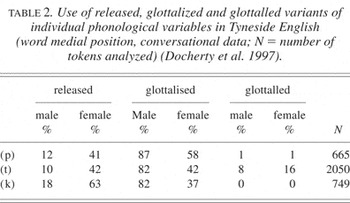
In the informal speech data, as close as possible to 30 tokens per speaker for all three variables (p t k) in word-medial intervocalic position (e.g., paper, later, shaker) were sought and subjected to auditory analysis and chi-squared tests. Word list data of the variables in the same linguistic environment are also included. Findings were compared with those from the study of TE carried out by Docherty et al. (1997) (see Table 2). Before analyzing the data in terms of correlation with speaker profiles, I consider a comparison of variant usage of the individual phonological variables in the two localities.
Individual phonological variables
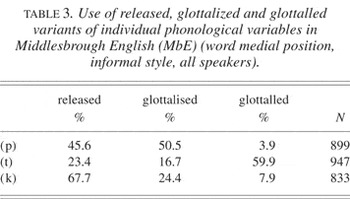
Although glottalization affects all three stops in Tyneside, glottalling was essentially found to affect only (t) (see Table 2). In the Middlesbrough data (see Table 3),

is found in all three variables to some extent, and although a comparable amount of (t)-glottalling may have been expected in the two localities, in the Middlesbrough data,

is found to be the preferred realization of (t) for the whole sample of speakers, unlike the relatively low use found in TE. Differences are likewise revealed in the use of glottalized variants. The higher susceptibility of (p) than of (t) or (k) to glottalization is found in both varieties. However, although

is the preferred variant of (p) in the Middlesbrough data, its combined use appears substantially lower than that found in Tyneside, as is the case also for use of

and

.
We turn next to age and gender variation for the individual variables in MbE. General trends will be shown in the variation by age, followed by discussion of age and gender patterning in informal and word list style in each variable.
Sociolinguistic profiling of (p t k)
(p)
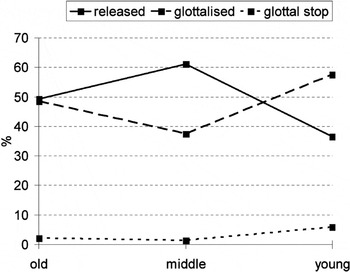
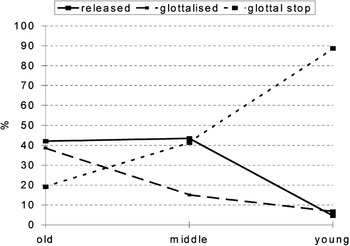
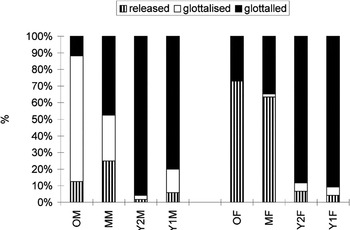
Figure 3 presents variant use of (p) by age, using the combined scores of the two young speaker age groups. Percentage scores, therefore, are given for old, middle, and young speaker groups. The data indicate an increase in the use of

; across apparent time, which may suggest a degree of convergence toward varieties found farther north, and a decrease in the use of [p], which indicates a degree of divergence away from the standard variant, which is also the form found in Yorkshire. Figure 4 presents the four age groups (old, middle, young adult, and adolescent) broken down by gender.
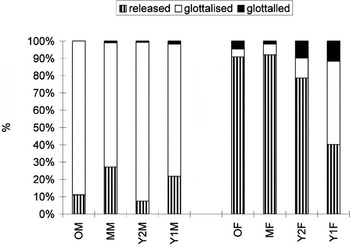
6Along the abscissa of all bar charts, the eight speaker groups are represented thus: old male (OM), middle male (MM), young adult male (Y2M), adolescent male (Y1M), old female (OF), middle female (MF), young adult female (Y2F), adolescent female (Y1F).

Distribution of variants of (p) by age.

Distribution of variants of (p) by age and gender.

is clearly the preferred variant of male speakers, with all male groups' use being over 70%. Young adult males reveal the highest use of

, which, at over 90%, is effectively categorical in sociolinguistic terms. Overall, the male speakers reveal relatively little variation over age, with use of the preferred male variant,

, being comparable to the Tyneside male score of 87%, and unlike what might be the expected pattern in Yorkshire, wherein glottalized (p) is not a characteristic feature.
Not only is a marked gender difference in the distribution of variants of (p) apparent, but there is also a much higher degree of variation across age in the female data compared with the male data. Old and middle female speakers show an almost categorical use of [p]. The younger females, however, demonstrate a considerable increase in use of

. Furthermore, a significant increase in use of

is observed in the adolescents' speech compared with the young adults' (p << 0.001). Although the female adolescent use of

is significantly lower than their male counterparts (p << 0.001), their usage stands in contrast with the other female usage, and this suggests that the female adolescents are at the vanguard of this convergent trend in the variable (p).
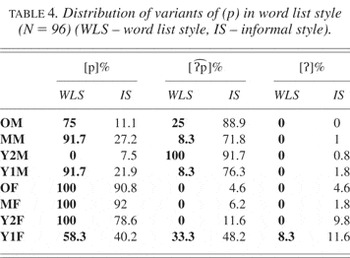
In word list style (see Table 4), the majority of speakers use [p], demonstrating a style shift to the standard variant in the more careful speech style, suggesting a social awareness of

as a linguistic marker. Interestingly, the two groups who demonstrate the highest use of

within their gender in the informal speech style also demonstrate the highest use in word list style.
(t)
Figure 5 plots variant usage of (t) across apparent time. Again, young speakers' scores are combined, giving the three age groups of old, middle and young. The increased use of

for (t) reveals a change in apparent time that is in line with its general spread throughout varieties of BrE. The extent of its use is in contrast to that found in the Tyneside data, however.

Distribution of variants of (t) by age.
In terms of the male scores, Figure 6 illustrates that use of

rises steadily and sharply from old to young speakers, peaking at a virtually categorical 95.8% in the young adults, but then, interestingly, a significant decline is revealed among the adolescents as compared with the young adults (p << 0.001).

Distribution of variants of (t) by age and gender.
A similar increase in use of

is found in the female data, with usage reaching over 90% among adolescents. The old female speakers also reveal substantial use of

, however. The young female speakers also demonstrate a sudden, albeit slight, increase in the use of

, with both the young adults and the adolescents showing 5% use. Although incidence is low, it is in contrast with complete rejection by older females.
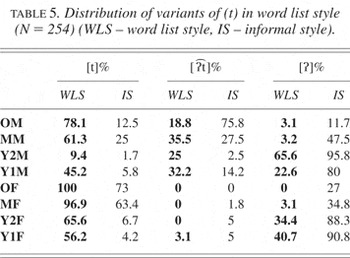
Considerably more variation is in evidence in word list style for (t) (see Table 5) than was found in that for (p), with use of

revealed in all groups except the old female group. Despite this, [t] is still the preferred variant for all but one speaker group. We thus see a style shift that suggests social awareness of

as a linguistic marker.
(k)
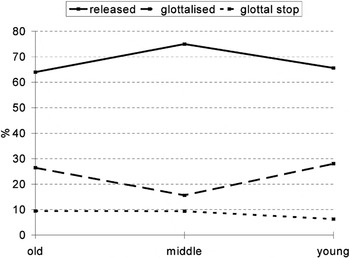
A degree of variation across age in variant usage of (k) is revealed (see Figure 7), although it is not as marked as that seen for (p) or (t). Over two-thirds of the tokens in all age groups are accounted for by [k], with the middle group exhibiting the highest use. Use of the glottalized variant demonstrates a pattern similar to that found for (p), with the highest incidence being found in the speech of the young, although the difference is marginal. Across ages, incidence of

for (k) is small but persistent.

Distribution of variants of (k) by age.
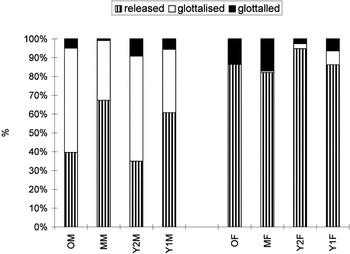
In the male data (see Figure 8), old speakers show a preference for

. As with

, use of

rises to its highest point in the young adult group, and then declines in the speech of the adolescent males. Use of [k] is fairly high among all males.

Distribution of variants of (k) by age and gender.
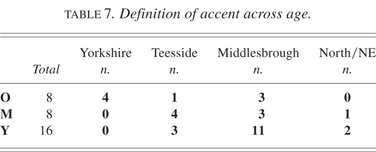
Definition of accent across age.

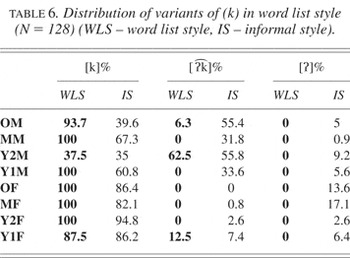
Distribution of variants of (k) in word list style (N = 128) (WLS – word list style, IS – informal style).

Distribution of variants of (t) in word list style (N = 254) (WLS – word list style, IS – informal style).

Distribution of variants of (p) in word list style (N = 96) (WLS – word list style, IS – informal style).

Use of released, glottalized and glottalled variants of individual phonological variables in Middlesbrough English (MbE) (word medial position, informal style, all speakers).

Use of released, glottalized and glottalled variants of individual phonological variables in Tyneside English (word medial position, conversational data; N = number of tokens analyzed) (Docherty et al. 1997).

Design of Middlesbrough fieldwork sample.

In the female data, we see the same gender difference in variant usage as found in (p) and among the older speakers in (t). In all age groups the preferred variant is [k], which is significantly higher than the male usage (p << 0.001), and never falls below a high incidence of over 80%. There is also the familiar pattern of an increase in the use of the glottalized form among young speakers, which was found for both (p) and (t). Use of

is slight compared with the young male use, but it is seen in comparison with its almost total rejection by old and middle females.
7Interestingly, [x] realizations of (k), such as knackered

, were found among young speakers. This is a feature associated with Merseyside (Newbrook 1999, Wells 1982). Its use in MbE is currently being investigated (see Jones & Llamas 2003 for preliminary analysis of fricated pre-aspirated stops).
Considerably less variation is revealed in the word list data for (k) than for the other variables (see Table 6), with five of the eight speaker groups demonstrating categorical use of [k]. Again, the style shift in evidence in the majority of speakers suggests a degree of social awareness of the glottalized form.
Linguistic data: Convergence and divergence
In all three variables, use of glottalized realizations has been demonstrated among young speakers. They appear to be stable sociolinguistic variants for (p) and (k) for male speakers, but in the speech of the females we see data that suggest change in progress. This is most notable in the variable (p), but use of glottalized forms is in evidence, albeit to a marginal degree, in all three variables, perhaps indicating an incipient change in (t) and (k). Although glottalized variants are not new to MbE, they are in a sense new to the female speakers in the environment under investigation: the older female speakers of the sample reject

,

and

virtually categorically. The adoption of the forms by the young females may demonstrate convergence toward male speech wherein the glottalized forms are firmly established. The overall increase in use by the young speakers, however, suggests a degree of convergence of MbE with speech of farther north, where use of the glottalized forms was found to be higher. This is combined with the fact that there appears to be an increase in short-term contact between the localities as a result of improved roads and public transport systems.
8In response to one of the questions from the Identification Questionnaire concerning day trips to other localities, 10 of the 16 young speakers in the sample claimed that Newcastle would be their usual destination, as compared with four of the eight speakers from the middle group and one of the eight speakers from the old group.
The decreasing use of the released variants, particularly of (p) and (t), indicates a degree of divergence that can be seen not only as divergence from the standard BrE unmarked variant, but also as divergence from realizations found farther south in Yorkshire wherein glottalized forms are not a characteristic feature.
In use of the glottal stop, we note an increasing use suggested for (p) and a persistent use suggested for (k). Use of

for (t) in the data, however, has increased to such a degree that it is used almost categorically by young speakers. In the increased use of

, we see, in the speech of the young females, divergence from [t] (the preferred variant of old females), and in the speech of the young males, divergence from

(the preferred variant of old males). The young speakers have converged on a variant that has leveled out the gender variation evident among older speakers. Given the widespread and well-documented increase in the use of

for (t) throughout varieties of BrE, the increase in use in MbE is not altogether surprising, although the considerably higher use in MbE compared with TE is. Linguistic patterns revealed, then, present an interesting picture of convergence and divergence in the variety under investigation, and in order to interpret such patterns we turn to examination of attitudinal information elicited through informants' responses to the questions in the Identification Questionnaire (IdQ) of the interview, which will provide insight into the local knowledge that speakers operate with when constructing and projecting their sociolinguistic identities.
ATTITUDINAL FINDINGS
Self and other: Definition and delimitation
Question 1 from Figure 2, “What accent would you say you had, and do you like it?”, seeks to establish contrastive-self definition in terms of what label informants claim, or what ingroup informants perceive in terms of accent. This seemingly straightforward question proved revealing. Variation in responses was demonstrated in all groups of speakers. However, the majority response of each age group tallied exactly with the history of the shifting identity of Middlesbrough (see Table 7).
Among older speakers, the most frequently given response is “Yorkshire.” Most older speakers qualified their response by stressing that it was not a “broad Yorkshire” accent. This, combined with responses such as “I would call it Yorkshire because I was born in Yorkshire,” suggest that accent can be defined by geographical place regardless of whether it conforms to the speaker's perception of the accent in question. The most frequently given response of the middle-aged speakers is “Teesside,” further emphasizing the importance of geographical place in terms of definition of accent, while among the combined young speakers the most frequently given response is “Middlesbrough.” This suggests that speakers react to changing political boundaries of the area in which they live, and if such boundaries change, so may the way inhabitants perceive themselves. This may result in changes to the ingroups that speakers perceive, and also to the salience of relevant outgroups to which they compare themselves.
Additionally, the way speakers define and delimit their accents is central to the locally constructed speech community. The self-definitions people choose to apply to themselves can reflect shared orientations. In claiming to have a Yorkshire accent, speakers from the old group are demonstrating a shared orientation toward Yorkshire. Similarly, speakers from the middle group demonstrate a shared orientation toward Teesside, while young speakers display a shared orientation toward Middlesbrough.
In response to the question of identifying MbE (Q3, Figure 2), of the eight older speakers, seven claimed the ability to recognize the accent, with all of the females answering in the affirmative. Similarly, among the middle group seven of the eight claimed to be able to recognize their accent. However, in the middle group the female speakers were more tentative in their replies and tended to qualify their answers, for example:

Among the young speakers only 10 of the 16 informants answered in the affirmative. This is interesting in view of the fact that 11 of the 16 young speakers claimed that they would define their accent as “Middlesbrough.” Five of the six young speakers claiming not to be able to identify a Middlesbrough accent were female (three adolescents and two young adults). Furthermore, two of the female speakers who responded in the negative gave as the reason for their inability the similarity of the accent to Geordie. Thus, among female speakers, we see a shift in the perception of the accent from one that is readily identifiable to one that is becoming indistinct from the accent of Tyneside.
In terms of defining and delimiting the larger region of which Middlesbrough is perceived to be a part, insight can be drawn from opinions as to where regional news should reach, as elicited by Q6 of Figure 2. In responses, apart from locations within the Tees conurbation, the most frequently mentioned place is Newcastle, which is cited by 29 of the 32 informants, with many informants also claiming a Newcastle bias in the regional news. The next most frequently mentioned place is Sunderland, cited by 17 informants, which lies 13 miles (21 km) south of Newcastle and 25 miles (40 km) north of Middlesbrough. Only occasional features are felt to come from locations south of Middlesbrough, for example York. Locations in the northwest, such as Carlisle and Cumbria, are also very occasionally mentioned, but with qualifications such as “I don't feel any affinity with Carlisle but I do with Newcastle.” The larger region that Middlesbrough is part of in terms of media groupings, then, looks northward and most particularly toward a region that includes the city of Newcastle.
The sense of being in a northeastern region is further demonstrated by responses to question 5 from Figure 2: whether informants would consider Middlesbrough to be in a larger “North Eastern” part of the country or a larger “Yorkshire” part of the country. This question prompted all informants to answer “North Eastern.” Even older speakers who considered Yorkshire to be part of their identity gave responses such as:

Some of the younger informants had never considered the proximity of Yorkshire, so the suggestion of classing Middlesbrough with Yorkshire in a geographical sense appeared illogical. Responses such as the following make manifest the irrelevance of Yorkshire to the speakers' sense of identity construction:

Ingroups and outgroups
Lying between two relatively easily identified varieties of BrE, MbE is not a variety that is readily identifiable by an outsider, as noted earlier. Therefore, as well as eliciting information on speakers' definitions and identification of their own accent, reactions to a perceived misidentification as “Geordie” or “Yorkshire” were elicited from informants through question 2 of Figure 2. In all cohorts the most frequently given response was that greater offense would be caused by a perceived misidentification as “Geordie,” with only five of the 32 claiming otherwise. Additionally, almost all informants claimed to have experienced being misidentified as a Geordie, yet only two recalled having been referred to as Yorkshire speakers. Responses to this question range from feelings of mild dissatisfaction with being identified as Geordie to pronounced anger and irritation. Interestingly, reasons for the aversion to a “Geordie” label appeared to vary across age.
Virtually all of the old speakers (7 of 8) claimed that a “Geordie” misidentification would be objectionable. However, as the majority of old speakers claimed an ingroup status as “Yorkshire,” many expressed incomprehension at the frequent reference to “Geordie.” Furthermore, some speakers equated regional identity with national identity with responses such as:

The middle group had the highest number of informants stating a preference for the “Geordie” identification as opposed to “Yorkshire” (3 of 8). Positive feelings toward Yorkshire were still in evidence among some speakers from the middle group, however.

The large majority of speakers from the combined young group (13 of 16) claimed that a “Geordie” identification would be objectionable. Most young speakers claimed to have experienced the perceived misidentification, with one adolescent male even claiming to have been mistaken for a Geordie by a group of speakers from Sunderland (a city situated considerably closer to Newcastle than Middlesbrough), perhaps also indicating the growing similarity of MbE with TE. Additionally, many professed a strong aversion to the Geordie accent. Some young informants expressed surprise at the notion of being mistaken for Yorkshire speakers, as it did not seem a realistic possibility.
Thus, we see outgroup derogation in the varying reactions to the perceived misidentification of the speakers. This is mostly directed at the perceived outgroup of “Geordie.” Such derogation is instrumental in promoting a positive self-image: “The potential consequences of outgroup derogation seems to be functional: for those who value the identity in question, derogation of the threatening outgroup can serve collective self-esteem restoration purposes” (Branscombe et al. 1999:48).
Further outgroup derogation is demonstrated through speakers' responses to question 7 of Figure 2, which reveal that rivalry, particularly football rivalry, is frequently cited as a reason for the hostility toward Geordies among the young speakers. Such rivalry suggests a relationship, and where no rivalry is felt, no connection can be seen to be felt. No sense of rivalry toward football teams from Yorkshire is expressed by young speakers. Speakers from the old and middle groups often express their allegiance to Yorkshire in terms of cricket, and the former eligibility to play for Yorkshire Cricket Club is seen as a valid and emotive reason for wanting Middlesbrough to be connected to Yorkshire. The increasing popularity of football may also have had a part to play in the shifting allegiance and sense of identity, as the importance of sport in popular culture appears central to many informants' sense of self and of defining “other.” Additionally, the view that an urban center becomes prominent nationally when it has a football team in the Premier League in England is expressed repeatedly by speakers. The fact that Middlesbrough Football Club has had a high profile in the media since 1994, with the arrival of internationally renowned personalities at the club, is commented on frequently by informants and may also have contributed to the growing confidence of the young people in the status of Middlesbrough as a place in its own right on a national scale.
We also see evidence for the changing saliences of relevant outgroups to which the ingroup is favorably compared. Responses to question 4 in Figure 2, concerning the formation of Teesside and the removal of Middlesbrough from North Yorkshire, are illuminating in this respect. By far the majority of the older speakers expressed regret at no longer being part of the Ridings of Yorkshire, with responses such as:

In aligning themselves with Yorkshire, some of the older speakers see themselves in direct opposition to locations further north; for example:

A small majority of speakers from the middle group suggested that the conurbation north and south of the Tees should be united and not divided by the river. Three of the eight claimed that Middlesbrough should return to Yorkshire, however. Among the middle group of speakers there was considerable expression of a lack of identity; for example:

In the combined young group, a greater majority of speakers believed that the conurbation should not be divided (13 of 16). Two young speakers expressed the opinion that Middlesbrough should have city status. Only one young speaker expressed a desire to be in Yorkshire, whilst some were unaware of any historical association with Yorkshire and so appeared confused by the line of discussion.
Responses, then, correspond to the fact that speakers from the old group have spent the majority of their lives in Middlesbrough, Yorkshire; the middle group's lifetime has seen constant changes of identity; and the young speakers have no memory, or in some cases no knowledge, of the Yorkshire political identity. Such life experiences appear to have an impact on the ingroups that speakers perceive and the relevant outgroups to which these ingroups are compared.
The attitudinal information presented, then, reveals:
- Clear generational differences in linguistic orientation in Middlesbrough.
- Clear generational differences in self-image in terms of what accent speakers perceive themselves to have – the locally constructed speech community varies with age and appears to be affected by changes in political divisions.
- A lack of overtly positive identification with the dominant center of gravity of the North East, Newcastle.
- The irrelevance of Yorkshire to the identity construction of younger speakers.
- An increase in the perception of Middlesbrough as a place with its own identity.
CORRELATIONS AND INTERPRETATIONS
The shifting of Middlesbrough from an orientation toward Yorkshire to one toward the North East, given the sociopolitical situation, correlates neatly with the higher level of use among young speakers of the glottalized form of (p), a characteristic feature of the North East. This increase brings use of the form in MbE closer to that found in TE, wherein a higher usage is reported. We may hypothesize, then, that this represents a convergent linguistic trend motivated by young speakers' positive identification with varieties of the North East, and most particularly with that of Newcastle as the dominant center of gravity in the region. However, the changes in reactions to salience of locations and the shifting orientations of the speakers across age, as revealed through self-definition, suggest a shift not from Yorkshire to the North East but from Yorkshire to Middlesbrough. Furthermore, although MbE is perceived as indistinct from other North Eastern accents by some young informants, the accent and dialect of the dominant urban center of the North East, Geordie, is not evaluated positively by speakers. Although

is reported in the literature as a salient feature of North Eastern varieties, the form is well established in MbE also, being used to a high degree by male speakers. The glottalized variant of (p) can therefore be seen as indexical of MbE as well as of North Eastern varieties. We thus see a focusing of linguistic choices and convergence onto a Middlesbrough form, which coincides with the rise in profile of Middlesbrough as a place with its own identity in terms of local administrative boundaries and in terms of perception of its prominence on a national scale.
The increased use in MbE of the glottal stop for (t) is not shared by speakers of TE. The pan-British spread of (t)-glottalling is rapid and widespread, and a national change in which TE appears to be falling behind. Its increase in Middlesbrough thus represents divergence from TE, and its expansion occurs at the expense of the North Eastern variant available for (t),

. This increased use of the glottal stop for (t) sees Middlesbrough youth participating in a national trend and serves to differentiate the accent from that of Tyneside. As the Yorkshire orientation has all but disappeared for young speakers, with no links with the region recognized, the remaining options available can be seen to be the national standard, or overt nonstandards. Standardization as a sociolinguistic force would be unexpected in this context. The glottal stop, then, as the national nonstandard, competes with and wins out over the other variant, the glottalized form of (t), which is found to a high degree in the Tyneside data.
Both these trends indicate convergence of the speech of young males and young females. Such convergence levels out the gender differentiation evident among the older speakers in the sample (and evident also in the Tyneside data). The outcome of the changes affecting the voiceless stops suggests that, on balance, Middlesbrough is becoming a more internally consistent and focused accent. These convergent and divergent trends uncovered in the voiceless stops in MbE are concurrent with an increased confidence expressed by young speakers in the status of Middlesbrough both in terms of its accent and in terms of it as a “place.” For the young speakers, Middlesbrough is not part of a larger Yorkshire region, as it is for the old speakers, nor is it a place without an identity, as it is for the middle speakers. Rather, for the young speakers of the sample the identity of the urban center is simply Middlesbrough. A strategy of localism appears to be being utilized by the young speakers of the study to construct their place identity, and one way of indexing this identity linguistically may be by demonstrating a higher level of use of glottalization of (p) and a higher level of glottalling of (t).
CONCLUSIONS
This article has presented results from a broadly variationist account of the Northern English town of Middlesbrough. Convergent and divergent linguistic trends have been uncovered in the stop series (p t k) that appear to correlate neatly with the shifting orientation and place identity of the town, which straddles various local boundaries and has been subject to numerous changes in political identity in recent years. The study has also incorporated metalinguistic commentary from the speakers to ascertain the effects of the shifting orientation and political identities of the urban center on the identities and self-images of the speakers.
I have attempted to demonstrate that knowledge of how speakers define themselves and contrast themselves with others, and of how speakers perceive and react to language variation, provides a more reliable and a more insightful basis on which to position explanatory accounts of motivations for convergent and divergent linguistic trends. Although claims may still be speculative, by attempting to access speakers' local knowledge, orientations, and attitudes toward language variation, we reduce to some extent the risk of second-guessing speakers' motivations for their variable linguistic behavior.