Congenital heart disease (CHD) represents a group of malformations of the heart present at birth that significantly contributes to infant mortality and morbidity.Reference Wren, Richmond and Donaldson1, Reference Hoffman and Kaplan2 In recent years, major improvements in the medical care for children with CHD have occurred,Reference Engel and Kochilas3–Reference Sizarov and Boudjemline6 which have led to increased survival rates.Reference Holland, Myers and Woods7, Reference Khairy, Ionescu-Ittu, Mackie, Abrahamowicz, Pilote and Marelli8 Consequently, there is growing interest in studying long-term morbidity and quality of life of these patients.Reference Bouma and Mulder9, Reference Ntiloudi, Giannakoulas, Parcharidou, Panagiotidis, Gatzoulis and Karvounis10 Children with CHD have been shown to display mild to moderate delays in motor, cognitive, and language developments after cardiac surgery.Reference Gaynor, Stopp and Wypij11–Reference Latal17 The aetiology of these developmental delays is complexReference McQuillen and Miller18 with possible important contributing causes from intrauterine and pre-operative oxygenation and perfusion of the central nervous system,Reference Rollins19 peri-operative factors (i.e., duration of cardiopulmonary bypass and use of hypothermia),20 and factors of the post-operative course (i.e., duration of ventilation and possible ischemic stroke events).Reference Dimitropoulos, McQuillen and Sethi21 Moreover, children with cyanotic heart defects have been found to have worse developmental outcomes compared to children with acyanotic heart defects.Reference Hovels-Gurich, Konrad and Skorzenski22, Reference Hovels-Gurich, Bauer and Schnitker23 In addition to the medical aspects related to the heart defect, patient-related variables seem to play a crucial role in the child’s development. Variables such as gender, lower birth weight, presence of phenotypical anomalies and genetic syndromes, as well as parental educational status, and ethnicity have been shown to contribute approximately 30% of the developmental variance in these children.Reference Gaynor, Stopp and Wypij11, Reference Gaynor, Wernovsky and Jarvik24 A life threatening complication impacting brain oxygenation and therefore development is cardiac arrest with subsequent cardiopulmonary resuscitation, which occurs in approximately 4.5% of children with CHD before or after cardiac surgery.Reference Gupta, Wilcox and Noel25 In surviving patients, pronounced neurological deficits are frequently observed and are associated with serum biomarkers such as neuron-specific enolase or the S100ß protein, as well as duration of cardiopulmonary resuscitation.Reference Matos, Watson and Nadkarni26, Reference Kramer, Miera, Berger and Schmitt27
Importantly, most studies investigating the development of children with CHD and/or after cardiopulmonary resuscitation are cross-sectional and only a few studies have observed the longitudinal development of these children longitudinally during the first years of life. The Boston Circulatory Arrest study is the first landmark in the longitudinal evaluation of children with transposition of the great arteries, reporting developmental deficits from early life to school age.Reference McGrath, Wypij, Rappaport, Newburger and Bellinger28 Another study showed stable cognitive and language scores in 34 children with uni-ventricular and 65 children with biventricular physiology in the first 3 years of life, with improving motor scores over time.Reference Mussatto, Hoffmann and Hoffman29 More studies are warranted to add to these insights in order to work towards a comprehensive model of developmental delays in this population. As our hospital is one of the largest European centres where children with CHD are treated, we developed the Long-term EArly DEvelopment Research (LEADER) project to investigate the development of children with CHD and/or after cardiopulmonary resuscitation longitudinally, taking into account both medical- and patient-related variables. Our long-term goal is to create a clinical research unit within our institution and to increase knowledge of the developmental dynamics, risk, and protective factors in children with CHD, with the ultimate goal of improving developmental outcome in individuals with CHD. We present the conception of the LEADER project by outlining the research methodology of the first set of studies focusing on the development of children with CHD at our clinic. Furthermore, we underline the feasibility of the LEADER-CHD study protocol by reporting the preliminary results of the first 20 enrolled patients.
Materials and methods
Conception of the clinical research unit
We created an interdisciplinary research team consisting of paediatric cardiologists, psychologists, and study nurses. The research team focuses on planning and implementing a series of studies on the cognitive, language, and motor developments in children with CHD. So far, we implemented a set of three studies: In the LEADER-REA Pilot study, we assessed infants after resuscitation, with the primary goal of evaluating the feasibility of the 3rd Edition of the Bayley Scales of Infant Development (BSID-III).Reference Bayley30 As a secondary goal, we explored the developmental status in infants after cardiopulmonary resuscitation. The results have recently been publishedReference Ferentzi, Pfitzer, Rosenthal, Berger, Schmitt and Kramer31. In the ongoing longitudinal LEADER-CPR study, we assess children after cardiopulmonary resuscitation, with the primary goal of investigating biomarkers of cerebral injury as predictors for long-term developmental outcomes. In the ongoing longitudinal LEADER-CHD study, we include children with selected cyanotic heart defects (transposition of the great arteries and tetralogy of Fallot) and one acyanotic heart defect (ventricular septal defect), and investigate their development during the first 3 years of life. In this study, we focus on medical factors and patient-related variables as predictors for the cognitive, language, and motor developments. All studies have been approved by the institutional ethics committee (decision no. EA2/118/12, EA2/122/16, and EA2/134/16). Both prospective trials were registered with the German Clinical Trials Register (DRKS-ID: DRKS00013639 and DRKS00011006). A detailed protocol for the LEADER–CHD study has been published.Reference Ferentzi, Pfitzer, Rosenthal, Berger and Schmitt32 Implementation of all three studies was thoroughly prepared, with a briefing of all medical staff members, formalised recruitment, and inclusion procedures, as well as personal care for each interested and/or participating family. Through this approach, we were able to reach each family that met the inclusion and exclusion criteria for participation.
Patients and study design of the LEADER studies
LEADER-REA pilot study
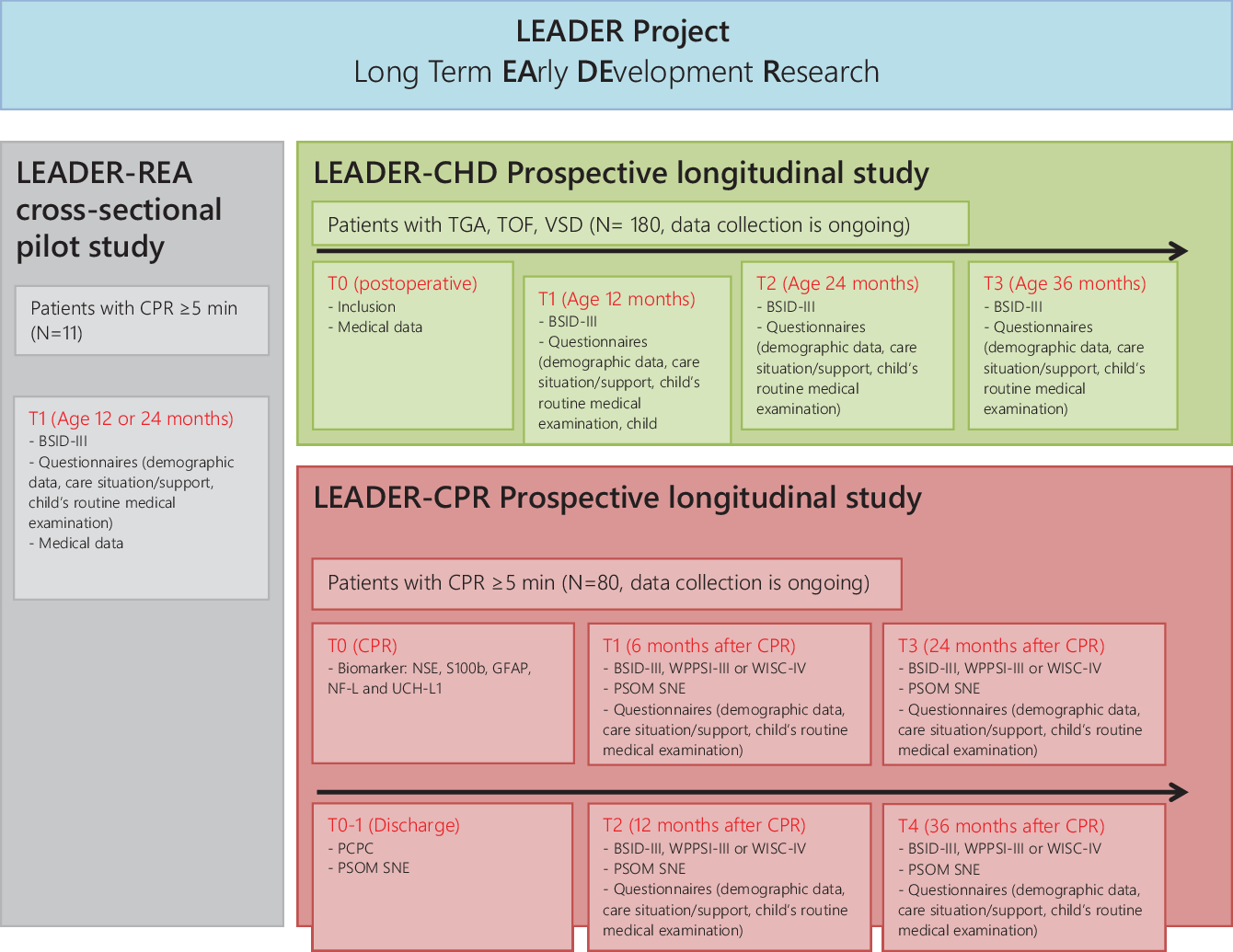
In the LEADER-REA Pilot study, we included infants who underwent cardiopulmonary resuscitation with a duration ≥5 minutes during the period from 2015 to 2016. Patients were excluded if their parents were not native German speakers or if the child had a (suspected) diagnosis of genetic syndrome or phenotypic anomaly. We conducted a developmental assessment in 11 children at ages 12 months (n = 4) or 24 months (n = 7), depending on age at recruitment (Figure 1).
Study design of the LEADER studies. BSID-III = Bayley Scales of Infant Development 3rd Edition , GFAP = glial fibrillary acidic protein, NSE = neuronspecific enolase, NF-L = Neurofilament light polypeptide, PCPC = Pediatric cerebral performance category scale, PSOM Pediatric Stroke Outcome Measure Short Neuro Exam TGA = Transposition of the great arteries, TOF = Tetralogie of Fallot, UCH-L1 = Ubiquitin carboxy-terminal hydrolase L1, VSD = Ventrikularseptaldefect, WPPS-III = Wechsler Preschool and Primary Scale of Intelligence 3d Edition, WISC-IV = Wechsler Intelligence Scale for Children.

LEADER-CPR study
In the ongoing longitudinal LEADER-CPR study, we will enrol 80 children between 0 and 16 years of age who underwent cardiopulmonary resuscitation with a duration ≥5 minutes. Exclusion criteria are non-native German-speaking parents, documented pre-existing neurodevelopmental deficits, known or suspected genetic syndromes associated with cognitive/motor deficits, or a history of maternal drug/alcohol abuse/dependence. Patients are assessed at event-dependent time points with age-appropriate developmental tests (BSID-IIIReference Bayley30 or Wechsler ScalesReference Wechsler33, Reference Wechsler34) at 6, 12, 24, and 36 months after cardiopulmonary resuscitation. A central aspect of the design is the assessment of serum biomarkers for cerebral injury (neuron-specific enolase; S100b protein; glial fibrillary acidic protein; neurofilament-light chain; and ubiquitin carboxy-terminal hydrolase L1) as predictors of developmental outcome after paediatric cardiac arrest. The biomarkers will be measured directly after, as well as 24, 48, and 72 hours after cardiopulmonary resuscitation (Figure 1).
LEADER-CHD study
In the ongoing LEADER-CHD study, we will enrol 180 children undergoing corrective surgery for transposition of the great arteries, tetralogy of Fallot, or ventricular septal defect before the age of 10 months at our institution. Inclusion criteria are diagnosis of transposition of the great arteries, tetralogy of Fallot, or ventricular septal defect, and corrective surgery before or at 10 months of age. Exclusion criteria are non-native German-speaking parents, genetic syndromes (except for microdeletion syndrome 22Q11), or phenotypic anomalies associated with cognitive/motor developmental deficits (e.g., trisomy 21), birth weight under 2.5 kg, gestational age of less than 37 weeks, history of maternal drug/alcohol abuse/dependence, or cardiopulmonary resuscitation ≥5 minutes before the age of 12 months.
Patients are assessed with the BSID-III at the age of 12, 24, and 36 months. We would like to highlight the free-play video observation at age 12 months to assess the quality of the interaction between primary caregiver and child as predictor for development. The video observation is coded by two independent raters using the Emotional Availability Scales,Reference Biringen and Easterbrooks35 which describe the quality of the interaction on several dimensions: sensitivity, structuring, intrusion, and hostility of the primary caregiver, as well as child responsivity and child inclusion from the primary caregiver (Figure 1).
Patient recruitment
LEADER-REA pilot study
We reviewed our institutional database for eligible patients, and families of children meeting the in- and exclusion criteria were contacted by telephone for enrolment by the attending physician. If interested in participation, families received both oral and written study information via telephone and mail, respectively. If willing to participate, an informed consent was obtained at the beginning of the first appointment. Compensation for travel cost was provided.
LEADER-CPR study
Parents of eligible study patients are recruited after cardiopulmonary resuscitation by the attending physician. If interested in participation, they receive oral and written study information in person. If willing to participate, an informed consent is obtained and an appointment for the first assessment is made after discharge from hospital. Compensation for travel costs is provided.
LEADER-CHD study
For the longitudinal LEADER-CHD study, parents of eligible study patients are recruited by the attending physician during or after their child’s hospital stay for corrective surgery. If interested in participation, they receive oral and written study information in person (if recruited during hospital stay) or via telephone and mail (if recruited after hospital stay). If willing to participate, an informed consent is obtained during the hospital stay or at the beginning of the first appointment. Compensation for travel costs is provided.
Primary outcome measures
Bayley Scales of Infant Development, 3rd Edition
The BSID-III is a well-established developmental assessment tool with a German normative sample of N = 878, for children between the ages of 16 days and 42 months and 15 days. During this test, the child has to solve different tasks with ascending difficulty in a playful manner. It is comprised of five subtests (fine and gross motor skills, receptive and expressive language, and cognition), which are scaled to a mean score of 10 with a standard deviation of 3. The subtests can be summarised into three composite scores (cognitive, language, and motor scales), which are scaled to a mean of 100 with a standard deviation of 15. Consistent with the standard deviation cut-off points, scores of 85–114 reflect average development, scores of 70–84 reflect below-average development, scores of 55–69 reflect distinctly below-average development, and scores below 54 reflect extremely below-average development.
Wechsler Scales of Intelligence
In the LEADER-CPR study, children of ages 3.5–7.0 years will be assessed using the Wechsler Preschool and Primary Scale of Intelligence, 4rd Edition (WPPSI-IV)Reference Wechsler33 and children of ages 7.1–16.0 years with the Wechsler Intelligence Scale for Children, 5th Edition (WISC-V).Reference Wechsler34 If developmental delays are expected for a certain patient, the WPPSI-IV will be used beyond age 7.0 years to avoid a potential floor effect. Both tests have been scaled to a German normative sample of N = 895 (WPPSI-IV) and N = 1087 (WISC-V) children, respectively. During both the WPPSI-IV and WISC-V, the child solves different test items with ascending difficulty. Each tests are comprised of 15 different subtests (10 primary subtests, 5 secondary subtests), which can be summarised into 5 primary indices (verbal comprehension, visual spatial index, fluid reasoning, working memory, and processing speed), and 3–5 secondary indices (depending on patient age, e.g., vocabulary acquisition or general ability), as well as a total score. The primary and secondary subtests are scaled to a mean score of 10 and standard deviation of 3. The primary and secondary indices, as well as total score, are scaled to a mean of 100 with a standard deviation of 15.
Statistical analysis
LEADER-REA pilot study
Due to this small sample size and the exploratory nature of the study, we limited the analysis to descriptive statistics.
LEADER-CPR study
We will describe frequency and severity of developmental delays at 6, 12, 24, and 36 months after cardiopulmonary resuscitation. As cardiopulmonary resuscitation in children is fortunately a relatively rare occurrence, the sample size will be limited. We will strive to include 80 patients, approximately half of which are expected to be lost to follow up (drop out, death), resulting in 40 complete data sets. Exploratory analyses will be conducted for the analysis of biomarkers as predictors for cognitive development per measurement time point and across time, as well as for medical- and person-related variables.
LEADER-CHD study
We will describe the frequency and severity of developmental delays at 12, 24, and 36 months of age. For power calculation and planned analyses we refer to the published study protocol.Reference Ferentzi, Pfitzer, Rosenthal, Berger and Schmitt32 Accordingly, we strive to enrol 180 infants after corrective surgery. Here, we present preliminary results of the first 20 patients, which we limit to descriptive analyses because of the small patient cohort and in order to avoid inflation bias (or p-hacking, seeReference Head, Holman, Lanfear, Kahn and Jennions36). Analyses were conducted with IBM SPSS Statistics 23 (Armonk, New York, United States of America). Graphs were prepared with Microsoft Excel 2010, for Windows (Microsoft Cooperation, Washington, United States of America).
Results
Study implementation
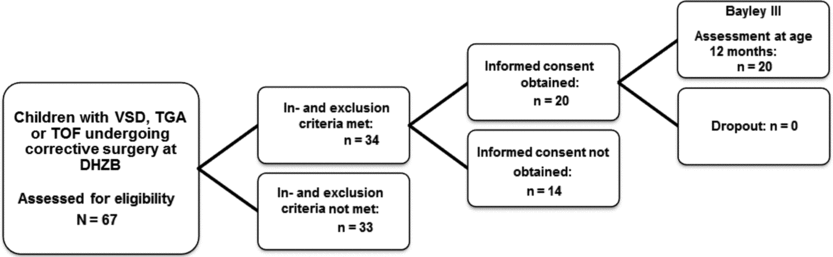
So far, there were no complications in the implementation process, which may necessitate adaptations in the study design. Due to the standardised patient inclusion process, we were able to screen all of our patients for eligibility and, if inclusion and exclusion criteria are met, to contact the families for participation. This way, we were able to minimise any selection bias. In the LEADER-REA Pilot study, we were able to include 12 of 20 eligible patients (60%) with 1 patient dropping out during the first session. Families were not included because of refused consent (n = 3), no contact (e.g., new address unknown, n = 2), and neurological impairments too severe for standardised assessment (n = 3). In the LEADER-CPR study, so far all patients eligible for participation were included (n = 18), while 6 patients did not survive to the first assessment and 3 patients missed the first assessment 6 months after cardiopulmonary resuscitation because of a prolonged stay in the hospital. In the LEADER-CHD study, we were so far able to obtain a satisfactory inclusion rate of 59% of eligible patients. A decline of participation (in the LEADER-CHD study in 14 out of 34 families, see Fig 2) was in most cases due to practical reasons (e.g., did not live in Berlin).
Flow chart of inclusion process in the LEADER-CHD study. DHZB = Deutsches Herzzentrum Berlin; TGA = transposition of the great arteries; TOF = tetralogy of Fallot; VSD = ventricular septal defect.

Developmental evaluation tool
The acceptance of the setting and assessment procedures is good. So far, all parents in all studies filled out the questionnaires pertaining to socio-demographic status, as well as post-acute rehabilitation care and utilisation of support services. On average, the developmental assessments took 1.5–2 hours, depending on the cooperation and performance of the child, while each appointment took approximately 2–2.5 hours in total. All parents decided to be debriefed about the test results.
Results of the first 20 patients of the LEADER-CHD study
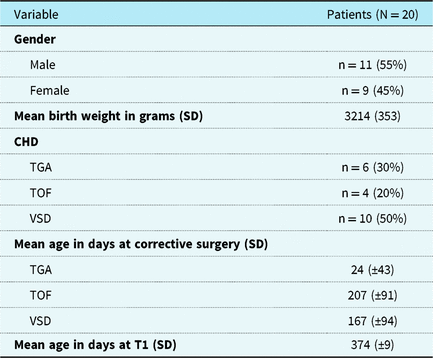
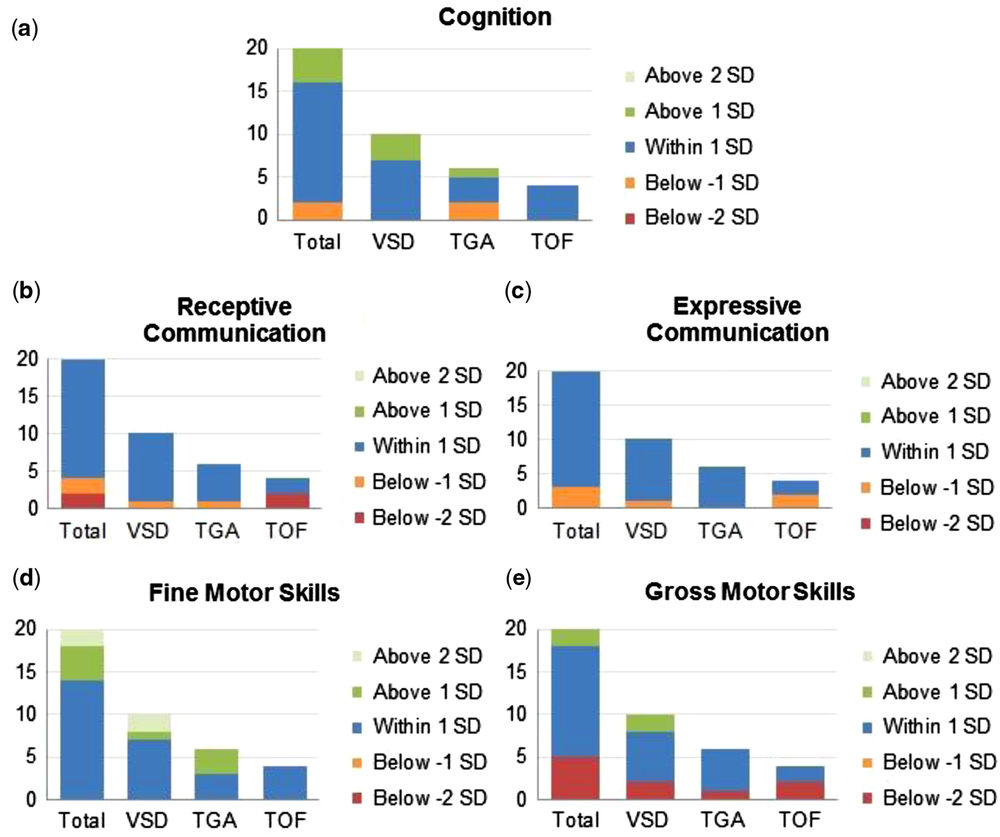
For the results of the LEADER-REA Pilot study, we refer to the recently published articleReference Ferentzi, Pfitzer, Rosenthal, Berger, Schmitt and Kramer31. For a preliminary analysis of the LEADER-CHD study, we hereby present data from the first 20 study patients assessed at the age of 12 months. Table 1 summarises demographic information and medical data. On average, no severe deficits of overall cognitive, motor, and language developments in children with transposition of the great arteries, tetralogy of Fallot, or ventricular septal defect were observed in our first 20 patients. On a subtest level, a pattern of strengths and impairments emerged, with patients scoring from 2/3 to 1 SD lower on the gross motor scale and receptive communication scale than the normative sample, and scoring from 1/3 to 2/3 SD higher on the fine motor scale. Developmental delays were so far most pronounced in the tetralogy of Fallot subgroup (see Fig 3). An overview of frequencies of developmental delays of more than 1 SD below the normative mean in all three CHD groups is depicted in Figure 3.
Medical data of study participants

SD = standard deviation; TGA = transposition of the great arteries; TOF = tetralogy of Fallot; VSD = ventricular septal defect.
Medical data of patients with VSD (n = 10), TGA (n = 6), and TOF (n = 4) at T1 (study time point at the age of 12 months).TGA patients with (n = 2) and without VSD (n = 4) were analysed as one group.
Frequencies of BSID-III subtest scores at the age of 12 months. Frequencies of patients per BSID-III subtest with scores within 1 SD above and below the mean, below −1 SD and above 1 SD. Data are presented for the total group (n = 20) and for the subgroups of patients with VSD (n = 10), TGA (n = 6), and TOF (n = 4). Scores within 1 SD below and above the mean correspond to a subtest score of 7–13. Scores below −1 SD correspond to a subtest score of 4–6. Scores of above 1 SD correspond to a subtest score of 14–16, with a mean of 10 and SD of 3 in the normative sample. SD = standard deviation; TGA = transposition of the great arteries; TOF = tetralogy of Fallot; VSD = ventricular septal defect.

Discussion
Feasibility of the study conception and assessment procedure
The implementation of the study series ran off smoothly. We did not encounter complications in the implementation process, which may necessitate adaptations in the study design. In all three studies, we so far obtained so far satisfactory inclusion rates, which are comparable to other longitudinal studies.Reference Teague, Youssef and Macdonald37 By offering compensation for travel costs and by accommodating the families’ wishes in arranging appointments, we were able to lower the threshold for participation. Above that, interest in participation might be high due to the nature of those studies, as parents can opt to be debriefed about the results of the developmental assessment. The low attrition rate therefore might highlight the need for information about their child’s development, but also point towards generally high acceptance of our study procedures.
Preliminary data on developmental outcome
To date, there are only a limited number of prospective studies that systematically investigate the developmental outcome of children following cardiopulmonary resuscitation and/or open-heart surgery. In a systematic review, Snookes et al present an overview of studies on motor and cognitive outcomes after cardiac surgery.Reference Snookes, Gunn and Eldridge12 In line with the results of our LEADER-CHD study, they found that patients at about 1 year of age are at higher risk for motor development delay than for cognitive disability.Reference Snookes, Gunn and Eldridge12 According to Latal and colleagues, many children, even those who had only one surgical procedure, show relatively larger deficits in motor scores than in cognitive scores, particularly during the first year of life.Reference Latal17 Clinical signs of generalised muscular hypotonia are reported to be associated with this observation, and the authors argue that the socioeconomic environment critically influences the children’s development.Reference Limperopoulos, Majnemer, Shevell, Rosenblatt, Rohlicek and Tchervenkov38 For our LEADER-CHD study, we have so far recruited only a limited number of study patients and only conducted descriptive analyses. Accordingly, differences observed are not tested for statistical significance and results should be cautiously interpreted.
In the literature, there has been a debate on the publication of preliminary study results or results of pilot studies.Reference Friedman39, Reference Leon, Davis and Kraemer40 Despite the fact that these study results are not based on robust and complex statistical analysis, many authors advocate publication as, “science and medicine advance best when new study designs and findings are shared easily and fast”.Reference Friedman39 It is important that the study report includes appropriate admonitions and that the reader is aware of the limitations and is not misled by these results. As there is a research gap in long-term developmental research in patients with CHD, our aim is to share our progress on project conception to establish a clinical research unit and to support this with the first study results to improve research in this field.
Conclusion
Infants with CHD and/or after cardiopulmonary resuscitation are at risk for developmental delay. Therefore, routine developmental follow-up care for this population needs to be established, with regular developmental assessments after cardiac surgery/cardiopulmonary resuscitation and individual developmental support. High-quality research in this area is important in order to establish a sound evidence base, with the ultimate goal of health insurance coverage for preventive and intervention programmes. By establishing a clinical research unit, we want to contribute to gaining scientific knowledge in this area. Our long-term goal is to routinely follow up with all children after cardiac surgery in our clinic at regular intervals. Our LEADER project consists of three realisable studies as a first step towards systematic longitudinal research in this population. Further studies focusing on uni-ventricular physiologies and children with CHD beyond the age of 3 years are currently planned.
Acknowledgements
C.P. and L-M.R. are participants in the BIH Charité Junior Clinician Scientist Program funded by the Charité – Universitätsmedizin Berlin and the Berlin Institute of Health. The authors thank Dr Giang Tong and Anne Wölffel-Gale for their editorial assistance, Anke Olsson for her support in coordinating the study, and the Kompetenznetz Angeborene Herzfehler e.V./Nationales Register für Angeborene Herzfehler e.V. for providing the use of their infrastructure.
Financial support
This work was supported by kinderherzen – Fördergemeinschaft Deutsche Kinderherzzentren e.V., Germany.
Conflicts of interest
None.
Ethical standards
The authors assert that all procedures contributing to this work comply with the ethical standards of the relevant national guidelines on human experimentation in Germany and with the Helsinki Declaration of 1975, as revised in 2008, and has been approved by the institutional committees (ethics committee of the Charité -Universitaetsmedizin Berlin).