Introduction
Social support improves outcomes across a broad range of mental and physical health conditions, through multiple cognitive and affective pathways (e.g. Alloway & Bebbington, Reference Alloway and Bebbington1987; Thoits, Reference Thoits2011; Ditzen & Heinrichs, Reference Ditzen and Heinrichs2013; Weaver & Weaver, Reference Weaver and Weaver2013). In psychosis, lower levels of social support predict increased delusional ideation in the general population, the emergence of frank symptoms of psychosis, and poorer outcomes over time (e.g. Norman et al. Reference Norman, Malla, Manchanda, Harricharan, Takhar and Northcott2005, Reference Norman, Windell, Manchanda, Harricharan and Northcott2012; O'Brien et al. Reference O'Brien, Gordon, Bearden, Lopez, Kopelowicz and Cannon2006, Reference O'Brien, Zinberg, Bearden, Lopez, Kopelowicz, Daley and Cannon2008, Reference O'Brien, Zinberg, Ho, Rudd, Kopelowicz, Daley, Bearden and Cannon2009; Freeman et al. Reference Freeman, Pugh, Vorontsova, Antley and Slater2010; Schlosser et al. Reference Schlosser, Zinberg, Loewy, Casey-Cannon, O'Brien, Bearden, Vinogradov and Cannon2010; Riggio & Kwong, Reference Riggio and Kwong2011; Saha et al. Reference Saha, Scott, Varghese and McGrath2012; Gayer-Anderson & Morgan, Reference Gayer-Anderson and Morgan2013; Tempier et al. Reference Tempier, Balbuena, Lepnurm and Craig2013). However, social networks are reduced for people with psychosis, and most social support derives from contact with family members and informal caregivers, making these relationships a particular focus of interest (Lester et al. Reference Lester, Marshall, Jones, Fowler, Amos, Khan and Birchwood2011; Gayer-Anderson & Morgan, Reference Gayer-Anderson and Morgan2013). Garety et al. (Reference Garety, Fowler, Freeman, Bebbington, Dunn and Kuipers2008) have reported a positive effect of close contact with an informal caregiver on outcomes following a course of individual cognitive behavioural therapy for psychosis. The finding suggests a synergistic effect of social support and individual psychological intervention, which, if better understood, has the potential to inform improvements to therapies and enhance outcomes. Investigation of the mechanisms underlying the interaction is therefore warranted.
Sündermann et al. (Reference Sündermann, Onwumere, Bebbington and Kuipers2013) have suggested that, in psychosis, the final elements in the links between social support and outcome comprise the cognitive and emotional processes believed to drive the development and maintenance of psychotic symptoms. These are the same mechanisms that are targeted in individual cognitive therapy for psychosis (e.g. Garety et al. Reference Garety, Bebbington, Fowler, Freeman and Kuipers2007). Consideration of the factors associated with change following CBTp may therefore highlight candidate mechanisms for the synergistic effects of caregiver contact. Inconsistent, or poorly replicated, associations with outcome following CBTp have been found for symptom severity, gender, delusional conviction, general intelligence, insight and the tendency to Jump to Conclusions (Johns et al. in press; So et al. Reference So, Freeman, Dunn, Kapur, Kuipers, Bebbington, Fowler and Garety2012; Schrank et al. Reference Schrank, Amering, Grant Hay, Weber and Sibitz2013; van Baars et al. Reference van Baars, Wierdsma, Hengeveld and Mulder2013). Positive attitudes towards medication and higher levels of adherence reliably improve outcomes (e.g. Mohamed et al. Reference Mohamed, Rosenheck, McEvoy, Swartz, Stroup and Lieberman2009). Of the hypothesised underlying cognitive mechanisms, only delusional belief flexibility has been consistently associated with improved outcomes (Garety et al. Reference Garety, Fowler, Kuipers, Freeman, Dunn, Bebbington, Hadley and Jones1997; Waller et al. Reference Waller, Freeman, Jolley, Dunn and Garety2011; So et al. Reference So, Freeman, Dunn, Kapur, Kuipers, Bebbington, Fowler and Garety2012). Delusional belief flexibility comprises the capacity to consider the possibility of being mistaken, to entertain alternative explanations, and to modify the delusion in the face of disconfirming evidence. It is independent of delusional conviction and severity, as both conviction and severity may be influenced by other affective and cognitive processes (So et al. Reference So, Freeman, Dunn, Kapur, Kuipers, Bebbington, Fowler and Garety2012). In cognitive models of psychosis, delusional belief flexibility is hypothesised to be influenced by a lack of social support, as this limits the opportunities for discussion, feedback and exposure to alternative views, both during the development of the delusional idea, and following each successive piece of supporting evidence as the delusion persists (e.g. Garety et al. Reference Garety, Bebbington, Fowler, Freeman and Kuipers2007; Freeman et al. Reference Freeman, Pugh, Vorontsova, Antley and Slater2010).
Supportive caregiving relationships may thus exert part of their positive influence in psychosis by providing these opportunities to increase delusional belief flexibility, thereby facilitating the helpful changes in appraisals that are the targets of cognitive therapy. This may be one explanation for the greater effectiveness of CBTp in people with caregivers (Garety et al. Reference Garety, Fowler, Freeman, Bebbington, Dunn and Kuipers2008). However, differences in delusional belief flexibility have never been examined in relation to caregiving relationships.
Aims of the study
In the current study we investigated the association between supportive caregiving relationships and delusional belief flexibility in people with psychosis. Specifically, we hypothesised that the presence of a caregiving relationship would be associated with higher levels of delusional belief flexibility, and that people with supportive caregiving relationships in particular would have higher levels of delusional belief flexibility.
We also hypothesised that these associations would not arise from differences in other potential predictors of outcome between caregiver groups, or associations of flexibility with other outcome predictors.
Further, in order to investigate the possibility that people who were flexible were simply easier to get along with, and therefore more likely to maintain supportive contact with caregivers, we compared general interpersonal functioning between caregiver and flexibility groups, and controlled for this in our analyses.
Material & methods
Participants
Participants were recruited for the Psychological Prevention of Relapse in Psychosis (PRP) Trial (ISRCTN83557988; Garety et al. Reference Garety, Fowler, Freeman, Bebbington, Dunn and Kuipers2008). The PRP Trial was a UK multi-centre randomised controlled trial of cognitive behaviour therapy and family intervention for psychosis, based in four National Health Service Trusts in London and East Anglia. Full ethical approval was obtained prior to the onset of the study (South East REC ref. 01/1/14). Inclusion criteria for the PRP trial were: a current diagnosis of non-affective psychosis (ICD, World Health Organization, 1992a ); aged 18–65 years; a second or subsequent episode of psychosis starting not more than 3 months before consent to enter the trial; and, at the time of first meeting, at least one positive psychotic symptom that was rated 3 (moderate severity) or more on the PANSS. Exclusion criteria were: a primary diagnosis of alcohol or substance dependence, organic syndrome or learning disability; a command of English insufficient to engage in psychological therapy; and unstable residential arrangements. For the current study, participants were required to have completed at least one of the measures of delusional belief flexibility in the assessment battery, and therefore also to have a delusional belief. In the PRP trial, caregivers were defined as adults in an informal caring role, either living with participants, or spending at least 10 h each week in face to face contact with them. Caring was broadly defined as providing any kind of practical or emotional support; neither the participant nor the caregiver needed to consider their relationship to be a ‘caregiving’ relationship. If patients had no caregiver under this definition, they were assigned to the ‘No Caregiver’ subgroup (63% of participants). The presence of a caregiver and frequency of contact was ascertained by participant report, through medical records and by discussion with the care team. More than two thirds of identified caregivers (82 of 113 in total; 56 of 80 in the current study) also consented to complete assessments of the quality of their relationship with the participant, leaving 24 caregivers unrated with respect to relationship quality.
Measures
In addition to the specific variables of interest, clinical and demographic variables previously associated with outcome, either generally (age, ethnicity, IQ, length of illness, insight, medication level and adherence), or in trials of CBTp (gender, symptom severity, delusional conviction, Jumping to Conclusions data-gathering bias), were selected from the baseline battery completed as part of the PRP trial.
Clinical and demographic data were taken from the medical record (age, gender, self-reported ethnicity, illness length in years, medication level in chlorpromazine equivalents (High: 400+ mg; Medium: 200–400 mg; Low: <200 mg). Medication adherence was assessed by the first four items of the Medication Adherence Rating Scale (MARS, adapted by Fialko et al. Reference Fialko, Garety, Kuipers, Dunn, Bebbington, Fowler and Freeman2008). Diagnoses were established with the Schedules for Clinical Assessment in Neuropsychiatry (SCAN, World Health Organization, 1992b ), undertaken by trained research assessors. The Global Assessment of Relational Functioning (GARF, APA, 1994) was used to assess the individual's general interpersonal functioning. It assesses levels of Problem Solving, Organisation and Emotional Climate in any relational unit (i.e. not just with caregivers), from 100 (good functioning) to 0 (no functioning). The Quick Test (Ammons & Ammons, Reference Ammons and Ammons1962) provided an estimate of current IQ.
The Positive and Negative Syndrome Scale (PANSS, Kay et al. Reference Kay, Fiszbein and Opler1987) was rated using information obtained in the SCAN interview. It is a 30-item instrument comprising three subscales assessing positive (7 items), negative (7 items) and affective (‘general’; 16 items) symptomatology. Each item is rated on a scale of severity from 1 (absent) to 7 (extreme), over the last 72 h. The total scale range is from 30–210. Inter-rater reliability for the PANSS in the PRP trial was high (intraclass correlation coefficients of 0.92, 0.98 and 0.92 for the respective scales). Delusional conviction was additionally rated using a single 5-point scale (0 = low to 4 = high) taken from the Psychotic Symptom Rating Scales – Delusions Subscale (PSYRATS, Haddock et al. Reference Haddock, McCarron, Tarrier and Faragher1999).
The mean of the first three items (Awareness of Mental Disorder, Awareness of the Achieved Effects of Medication, Awareness of the Social Consequences of Mental Disorder) of the Scale to assess Unawareness of Mental Disorder (SUMD, Amador et al. Reference Amador, Strauss, Yale, Flaum, Endicott and Gorman1993) was used to measure insight in the current study. Each was rated on a scale from 1–5, with a higher score representing least awareness. The scale has been shown to have good psychometric properties and good internal reliability (Watson et al. Reference Watson, Garety, Weinman, Dunn, Bebbington, Fowler, Freeman and Kuipers2006).
Delusional Belief Flexibility (BF) was assessed using three items from the Maudsley Assessment of Delusions (MADS, Wessely et al. Reference Wessely, Buchanan, Reed, Cutting, Everitt, Garety and Taylor1993). The MADS has good inter-rater reliability and moderate test-retest reliability (Taylor et al. Reference Taylor, Garety, Buchanan, Reed, Wessely, Ray, Dunn, Grubin, Monahan and Steadman1994). To assess the Possibility of being Mistaken, participants were asked whether, thinking about it now, there was any possibility that they were mistaken in their delusional belief. An affirmative or hesitant response was coded as flexible. For Reaction to Hypothetical Contradiction, an imagined scenario was presented which potentially contradicted the delusional belief: a flexible response required a shift in conviction or serious consideration of the scenario as potentially disconfirmatory evidence; an inflexible response was scored when the scenario was immediately rejected or accounted for within the person's belief system. The assessment of alternative Explanations of Experiences (Freeman et al. Reference Freeman, Garety, Fowler, Kuipers, Bebbington and Dunn2004) involves listing the evidence cited for the belief and asking if there was any possible explanation (even one which the person did not believe very much) which could account for all the evidence, apart from the delusional explanation. Being able to generate at least one alternative was coded as a flexible response. Previous studies have demonstrated that the three items form a unitary factor of delusional Belief Flexibility (BF, So et al. Reference So, Freeman, Dunn, Kapur, Kuipers, Bebbington, Fowler and Garety2012). For this study, a dichotomous variable was therefore created, classifying participants as ‘Inflexible’ (no flexibility in delusional thinking on any component) or ‘Flexible’ (flexibility in delusional thinking on at least one component).
Jumping to Conclusions (JTC) was assessed using three versions of the Probabilistic Reasoning ‘Beads’ Tasks (Garety et al. Reference Garety, Freeman, Jolley, Dunn, Bebbington, Fowler, Kuipers and Dudley2005). Two neutral versions utilised coloured beads in an 85:15 (orange & black) or 60:40 (red & blue) ratio. In the third, ‘salient’, task, participants were shown positive and negative words in a 60:40 ratio, ostensibly drawn from a survey of 100 people describing an individual. For each task, the number of items to decision (‘data-gathering’) was recorded; 2 or fewer was categorised as ‘jumping to conclusions’ (JTC). Each task included a memory aid, in which the previous beads or words drawn were shown. Previous studies have shown high correlations between the tasks and argued for a unitary factor and the superiority of the categorical measure (So et al. Reference So, Freeman, Dunn, Kapur, Kuipers, Bebbington, Fowler and Garety2012). For this study we therefore created a single dichotomous rating of ‘JTC’ (decision after fewer than three draws on any task) or ‘No JTC’ (decision after three or more beads on all tasks).
The Camberwell Family Interview (CFI, Vaughn & Leff, Reference Vaughn and Leff1976) was administered by research workers trained to reliability by Dr Christine Vaughn to assess caregivers' levels of expressed emotion (EE). Interviewers asked caregivers about their interaction with the patient. The interview covered relationships, arguments, time spent together, symptoms and role functioning. EE ratings were based not only on the content of speech but also on prosodic variables such as pitch, speed and tone, and were completed by raters blind to the hypotheses being tested in this study. Caregivers making 6 or more critical comments, displaying any degree of hostility or scoring three or more on the emotional over-involvement scale were defined as ‘High EE’.
Statistical analysis
Analyses were carried out using the statistical package SPSS for Windows (Version 20, IBM, 2011). The association of delusional BF with caregiving relationships was investigated using binary logistic regression. The initial analysis used the dichotomy caregiver/no caregiver as an independent variable, in order to assess the association of the presence of a caregiving relationship with BF. We then substituted a four-level independent variable (no carer, low EE, high EE, carer un-rated) to assess the association of relationship quality with BF. Each sequence of analyses involved a first block without the inclusion of the other potential predictors of outcome, a second block controlling for other hypothesised outcome predictors and the demographic variables associated with caregiver group or with BF, and a third block including, additionally, general interpersonal functioning (GARF). Post-hoc single sample Chi-squared tests were employed to identify the odds which deviated from expected distributions. ANOVA and χ2 analyses were used to investigate differences in demographic and clinical variables (including GARF scores) between caregiving and delusional BF groups. Ethnicity, age, length of illness, positive and negative symptoms, insight, and delusional conviction differed between caregiver groups or BF groups at p < 0.05 or beyond, and were therefore included in the analyses. Gender, medication level and adherence, JTC, general/affective symptoms, and illness severity (Total PANSS) did not differ between caregiver group or with BF and were not, therefore, controlled for.
Results
Clinical and demographic characteristics
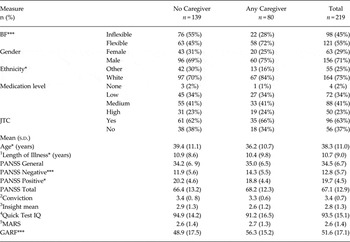
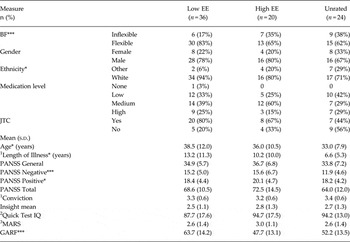
Seventy-three percent of the total PRP trial sample met the inclusion criteria for the current study (completion of at least one delusional BF measure, n = 219). Diagnoses were Schizophrenia (F20, n = 184), Schizoaffective disorder (F25, n = 33) and Delusional Disorder (F22, n = 2). Eighty patients of the 219 eligible for this study had a caregiver (36%). Of these, 56 had caregivers who completed the CFI (36 rated Low EE; 20 rated High EE). Patient demographic and clinical characteristics, and differences between caregiver groups, are shown in Table 1.
Belief Flexibility and other clinical and demographic variables associated with outcome by Caregiver contact

n's vary because of non-completion of some measures by participants; 1n's 135, 79, 214; 2n's 136, 79, 215; 3n's 136, 80, 216; 4n's 107, 63, 170; 5n's 128, 76, 204. KEY: BF = Delusional Belief Flexibility; Medication level (CPZ equivalent) Low = 0–200 mg; Medium = 200–400 mg; High = 400 + mg; JTC = Jumping to conclusions; PANSS = Positive & Negative Syndrome Scale; MARS = Medication Adherence Rating Scale; GARF = Global Assessment of Relational Functioning. *p ≤ 0.05; ***p ≤ 0.001
Hypothesis 1: the presence of a caregiver will be associated with higher levels of delusional belief flexibility
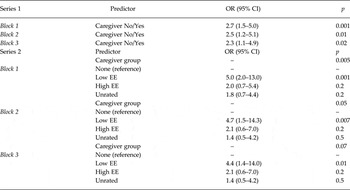
Binary logistic regression showed a clear and strong relationship between Caregiver group and delusional belief flexibility. Patients with caregivers were almost three times as likely to show flexibility as those without (Table 2). The OR was very slightly reduced by controlling for confounding variables, but remained significant. As expected, GARF scores were higher both for those with a caregiver (Table 1), and for those who were flexible (Flexible mean: 54.5 (s.d. 17.3); Inflexible mean: 48.0 (s.d. 16.1), F = 8.0, p = 0.005), but even when controlling for this general association with interpersonal functioning, the specific association of the presence of a caregiver and delusional BF remained significant, with an OR of just over two. Post-hoc Chi-squared tests indicated that the deviant proportions related to inflexibility within the caregiver group (28% inflexible, p < 0.001) and having a caregiver within the inflexible group (22%, p < 0.0001). Flexible participants, despite their superior interpersonal functioning were no more likely to have retained contact with a caregiver than not (48% with a caregiver; p > 0.6), and nor were those without a caregiver less likely to be flexible than inflexible (45% flexible, p > 0.2).
Belief Flexibility and other clinical and demographic variables associated with outcome by Caregiver group (n = 219)

n's vary because of non-completion of some measures by participants; 1n's 35,20, 24; 2n's 30, 15, 18; 3n's 34, 19, 23.
KEY: BF = Delusional Belief Flexibility; Medication level (CPZ equivalent) Low = 0–200 mg; Medium = 200–400 mg; High = 400 + mg; JTC = Jumping to conclusions; PANSS = Positive & Negative Syndrome Scale; MARS = Medication Adherence Rating Scale; GARF = Global Assessment of Relational Functioning. *p ≤ 0.05; ***p ≤ 0.001
Hypothesis 2: the presence of a supportive caregiver will be particularly associated with higher levels of delusional belief flexibility
The second set of analyses demonstrated that the difference in flexibility between caregiving groups was particularly pronounced for the Low EE group, who were five times as likely to be flexible than patients in the No Caregiver group. However, high EE carers were still twice as likely to be flexible (Table 3). These associations remained essentially unchanged after controlling for demographic and clinical variables, and for GARF score.
Logistic regression analysis of the effect of contact with a caregiver and Expressed Emotion on delusional Belief Flexibility

KEY: BF = Delusional Belief Flexibility; CI = Confidence Interval; OR = Odds Ratio; Block 1: Uncontrolled results; Block 2: Controlling for Age, Ethnicity, Length of Illness, Positive & Negative symptoms, Insight, Delusional Conviction; Block 3: Controlling for relational functioning.
Discussion
We set out to test the association between delusional belief flexibility and informal caregiving relationships in a large group of people with delusions and schizophrenia spectrum psychosis. Delusional belief flexibility is one of the main predictors of outcome in cognitive therapy for psychosis, and may be facilitated by supportive social contacts. Informal caregivers are an important source of social support for people with psychosis. We hypothesised that the promotion of delusional belief flexibility could be a mechanism underlying the positive impact of contact with an informal caregiver on clinical outcomes, specifically following cognitive behavioural therapy, but also more generally. We found that participants with caregivers were almost three times more likely to be flexible in relation to their delusional beliefs. We also found that, although flexibility was greater in all caregiving relationships, the effect was particularly pronounced in the context of low EE interactions. Participants with low EE caregivers were five times as likely to be flexible, suggesting that caregivers with this characteristic may be particularly beneficial. The odds ratios associated with high EE carers, and with carers who were not available for assessment, were both around two, but were not significant. Our findings support the hypothesis that the enhancement of belief flexibility through supportive social interaction is a candidate cognitive mechanism for the facilitative effect of caregiving relationships in those receiving psychological interventions (Garety et al. Reference Garety, Fowler, Freeman, Bebbington, Dunn and Kuipers2008), and possibly for the protective effects of social support in psychosis more generally.
The findings were not accounted for by differences in the other variables found to predict outcome in CBTp or by other potential confounding variables, which were either unrelated to caregiver relationships and cognitive biases, or controlled for in the analyses. The Jumping to Conclusions data gathering bias (JTC), although hypothesised to be associated with outcome, did not differ between caregiver groups. This is congruent with a cognitive model: there is no clear cognitive mechanism by which social support might impact on the tendency to JTC, and thus no difference should be expected in those with and without caregivers. The lack of influence of JTC is also consistent with the recent reports of So et al. (Reference So, Garety, Peters and Kapur2010, Reference So, Freeman, Dunn, Kapur, Kuipers, Bebbington, Fowler and Garety2012), which suggest that JTC may have both state and trait characteristics, operating at least in part as a more static, vulnerability marker, and thus may not change reliably over time.
Belief flexibility and having a caregiver were both associated with general relational functioning, but this did not account for their relationship with each other. Overall, flexible participants were no more likely to have a caregiver than not, and those without caregivers were no more likely to be inflexible than to be flexible. Quality of the caregiving relationship has previously been demonstrated to be influenced primarily by caregiver factors, and patients' general psychopathology, rather than by patient levels of specific cognitive biases or positive symptoms (Onwumere et al. Reference Onwumere, Kuipers, Bebbington, Dunn, Freeman, Fowler and Garety2009; Tomlinson et al. Reference Tomlinson, Onwumere and Kuipers2013). This implies that our findings are not solely the result of flexible individuals being easier to get along with, or having generally better quality relationships.
The association between belief flexibility and supportive relationships with caregivers is predicted by cognitive models of psychosis and of the role of social support. The deleterious effects of social isolation are hypothesised to operate at least partly by reducing access to alternative perspectives and new information. For people with psychosis, informal caregivers are often the main source of social support other than mental health services, and a supportive relationship with a caregiver is likely to involve a normalising perspective on everyday events and perhaps even some specific discussion or checking of ongoing unusual experiences, thereby increasing belief flexibility (e.g. George et al. Reference George, Bandopadhay and Cowan2005). Our findings suggest that, in psychosis, in addition to the practical and emotional support that informal caregivers provide, the impact of caregiver relationships on clinical outcomes may be additionally mediated by cognitive processes.
Limitations
The primary limitation of the study is its cross-sectional nature. Inference in relation to cause and the direction of causality must be tentative. Although previous literature has not reported this, it remains possible that those who are flexible are more likely to be able to preserve supportive relations with caregivers, rather than the relationship promoting flexibility. While controlling for general relational functioning scores goes some way to refuting this possibility, and supports a specific cognitive impact of the relationship, the GARF is a crude measure, and may not adequately capture key elements of being ‘easier to get along with’. Further, although we controlled for a broad range of clinical and demographic variables hypothesised to predict outcome, we were unable to control for some relevant potential confounders, such as socio-economic status. As participants were taking part in a randomised controlled trial, with specific inclusion criteria, it is possible that they are not representative of people with delusions in routine services. Finally, it is possible that the findings do not represent a general effect of social support, but rather a specific caregiver effect. A carefully selected sample would be required to control for this, as the majority of informal social support for people with psychosis derives from caregiving relationships.
Clinical implications
Family interventions in psychosis focus on improving relationships by promoting patients and caregivers listening to each other, trying to solve problems productively, and understanding each other's perspectives, while processing emotional distress (Kuipers et al. Reference Kuipers, Onwumere and Bebbington2010; Onwumere et al. Reference Onwumere, Kuipers, Bebbington, Dunn, Freeman, Fowler and Garety2011). A specific focus on talking about delusions with other family members, and how this impacts on patient belief flexibility, might be a useful addition when delusions are a prominent part of the clinical picture. Individual interventions may be enhanced by the collaborative involvement of supportive members of a person's social network with a specific focus on enhancing belief flexibility. In order to test whether these interventions are impacting on belief flexibility, longitudinal assessments of belief flexibility over an extended baseline and during the course of therapy would be required, with randomised allocation to either intervention or to a non-intervention control group.
Conclusion
The study provides evidence of an association between supportive caregiving relationships and delusional belief flexibility, illustrating a potential cognitive pathway for the positive impact of social support. As such, it is a demonstration of how external environmental influences may shape the internal processes that underlie the development and exacerbation of psychotic symptoms.
Acknowledgements
We wish to thank the patients taking part in the trial and the participating teams in the four NHS Trusts – South London & Maudsley NHS Foundation Trust, North East London NHS Foundation Trust, Camden & Islington NHS Foundation Trust, Norfolk & Waveney Mental Health NHS Foundation Trust.
Financial Support
This work was supported by a programme grant (No. 062452) and a project grant (No. 085396) from the Wellcome Trust. PG & EK were part funded by the Department of Health via the National Institute for Health Research (NIHR) Specialist Biomedical Research Centre for Mental Health award to South London and Maudsley NHS Foundation Trust (SLaM) and the Institute of Psychiatry at King's College, London. DF is supported by an MRC Senior Clinical Research Fellowship.
Conflict of Interest
None.
Ethical Standards
The authors assert that all procedures contributing to this work comply with the ethical standards of the relevant national and institutional committees on human experimentation and with the Helsinki Declaration of 1975, as revised in 2008.