





Impact statement
This pictorial presents a replicable, low-equipment and low-cost workshop that engages novices with biodesign through the theme of living artefacts and embodied making, alongside an empirically created vocabulary map that highlights key themes within and adjacent to the field of biodesign.
Introduction
As an interdisciplinary field that bridges creative and scientific practices, the aim of biodesign is to integrate living components or ecosystems into the design process (Myers Reference Myers2019). Many current biodesign projects utilise microorganisms such as yeasts, bacteria, algae and mycelium to grow materials and products up to a desired point, after which biological activity is intentionally arrested, leaving behind non-living bio-based materials. Coined as “Growing Design,” this approach to biodesign is common among designers in the field and leads to materials and products that, at the point where they are used by the consumer, are no longer alive and therefore unable to change and adapt (Camere and Karana Reference Camere and Karana2017). Growing Design remains an important concept within the biodesign field and built the foundation for another concept named “Living Artefacts,” which explores “livingness” as an inherent material quality: biologically, ecologically and sensorially (Karana et al. Reference Karana, Barati and Giaccardi2020; Kim et al. Reference Kim, Zhou, Groutars, Karana, Lockton, Lenzi, Hekkert, Oak, Sábada and Lloyd2022). Instead of solely using microorganisms as a means to produce bio-based materials, their livingness becomes the main material quality, fostering new properties such as growth, adaptability and responsiveness.
Once materials and products are understood as inherently alive, there are numerous new potentials and challenges to consider, which can be difficult to grasp and articulate but deserve to be investigated. As an inherently interdisciplinary field that bridges sciences and design, biodesign becomes a difficult space to occupy for practitioners: not only do traditional scientific methods often clash with design experimentation, there also is a lack of adequate spaces to conduct research in (Myers Reference Myers2019; Wightman and Pirone Reference Wightman and Pirone2019). Beyond this, in “Designing living artefacts: Opportunities and challenges for biodesign” Kim et al. explain that a common sentiment that emerged from discussions about biodesign and living artefacts was that the research in the field was often too confined within labspaces (Reference Kim, Zhou, Groutars, Karana, Lockton, Lenzi, Hekkert, Oak, Sábada and Lloyd2022).
Tools such as speculative narratives are important devices within the field of biodesign to make room for creative explorations and fostering reflectivity (Dunne and Raby Reference Dunne and Raby2013; Grimaldi et al. Reference Grimaldi, Fokkinga and Ocnarescu2013; Myers Reference Myers2019; Pataranutaporn et al. Reference Pataranutaporn, Ingalls and Finn2018).
Välk et al. point out the importance for narratives to be visualised as an important aspect of their capability to communicate complex processes (Reference Välk, Chen, Kalossaka, Kim, Mougenot, Pschetz, Ramirez-Figueroa, Sayuti, Sommer, Bruyns and Wei2022). Material Tinkering is a useful way in which even laymen can experiment with biomaterials and give shape to their ideas in a secure yet playful way, allowing designers to be in touch with their senses in the process (Parisi et al. Reference Parisi, Rognoli and Sonneveld2017; Pollini Reference Pollini2024).
Through Donna Haraway’s concept of sympoiesis (“making with”), living artefacts can be seen as relational processes, instead of mere objects, entanglements unfolding between organisms, materials, designers and environments (Reference Haraway2016). In an attempt to use sympoiesis as a tool to examine biodesign and the notion of living artefacts, a research-through-design approach grounded in embodied practice was used (Groth and Nimkulrat Reference Groth and Nimkulrat2024).
The “living collage workshop,” which will be presented here, was developed to facilitate creative collaborative making processes and discussions. Based on common artistic collage practice, the workshop was adapted to better suit the field of biodesign through the use of agar petri dishes as the backbone for the collages, allowing them to become “living artefacts” that grow and change over time. In this context, the collages act as boundary objects to facilitate and capture ideas and conversations (Star and Griesemer Reference Star and Griesemer1989). Beyond this, the creation process of the collages as well as subsequent discussions support embodied meaning-making that emerges through participant interactions (Nathues et al. Reference Nathues, van Vuuren, Endedijk and Wenzel2025).
One of the main driving forces behind this project was to create a workshop concept that would allow participants with little to no knowledge of biodesign and a lack of proper equipment to immerse themselves in the topic and collectively reflect on it. The workshop and subsequent collective discussion were a result of a PhD course at OsloMet in Norway. They were implemented in the fall of 2025 with a group of 8 participants consisting of PhD students and associate professors with various professional backgrounds.
Method
The overarching goal of the workshop was to make the process of working with biodesign more experienceable and accessible for people from various backgrounds who had not previously engaged with the topic. The physical workshop entailed several components related to embodied making practice (Groth and Nimkulrat Reference Groth and Nimkulrat2024). These are detailed in the following section.
The Living Collage workshop was documented through observation, field notes and photography by the author of this paper and was later used as a tool to facilitate a group discussion about living artefacts and biodesign. While the author of this paper acted solely as a facilitator during the physical workshop, the role later shifted towards active contribution during the discussion phase. The entire discussion was captured using an audio recording device and later transcribed. Hereafter, the transcript was manually coded through an inductive semantic thematic analysis, with the resulting themes subsequently contextualised in relation to existing biodesign literature (Braun and Clarke Reference Braun and Clarke2006).
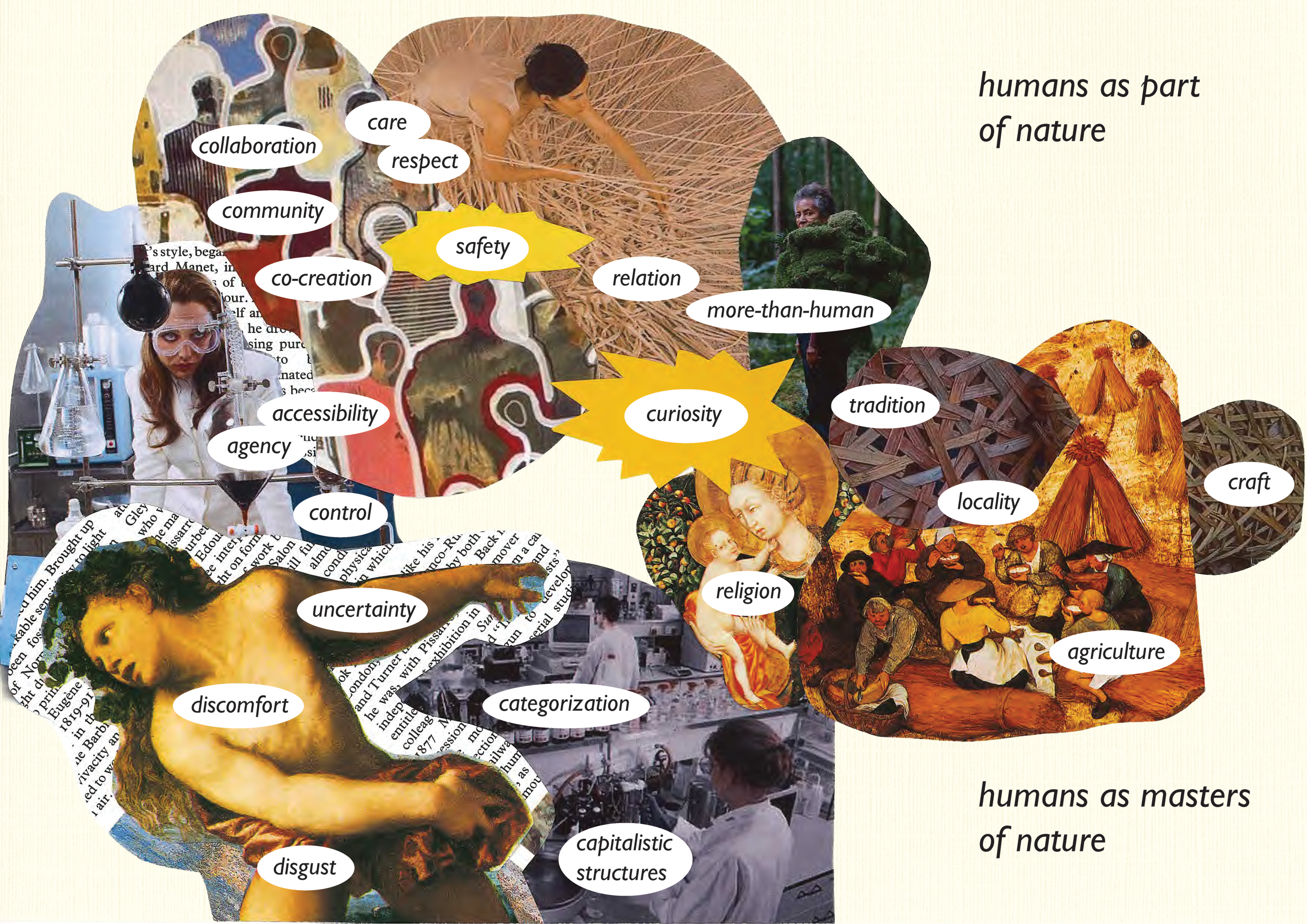
In reflection on the workshop and collective discussion, the map of emerging key terms was developed by the author, capturing both explicitly and implicitly mentioned topics (Figure 11). Following Donna Haraway’s concept of sympoiesis, the terms are not intended to be depicted cleanly and separately but rather as entangled and alive: layering on top of one another, bleeding into each other and relating (Reference Haraway2016).
As a qualitative, exploratory study, the workshop was conducted with a limited number of participants (n = 8), prioritising depth of engagement and collaboration between participants over aiming for generalisable conclusions. The study therefore functions as a situated inquiry into how livingness within biodesign is perceived.
The living collage workshop
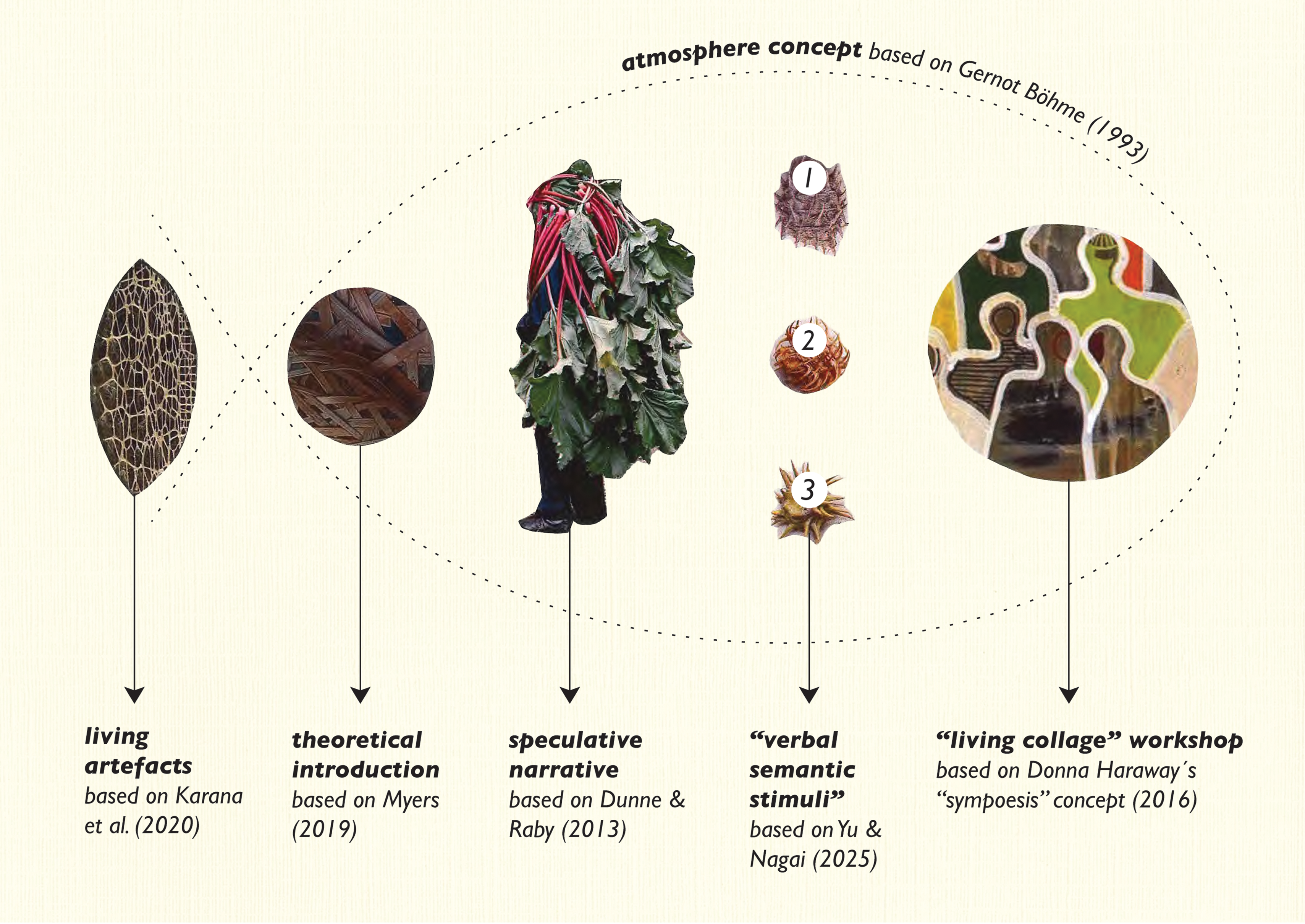
This section details the framing and development of the living collage workshop (Figure 1).
Visualised framework for the Living Collage workshop.

Living artefacts & the concept of atmosphere
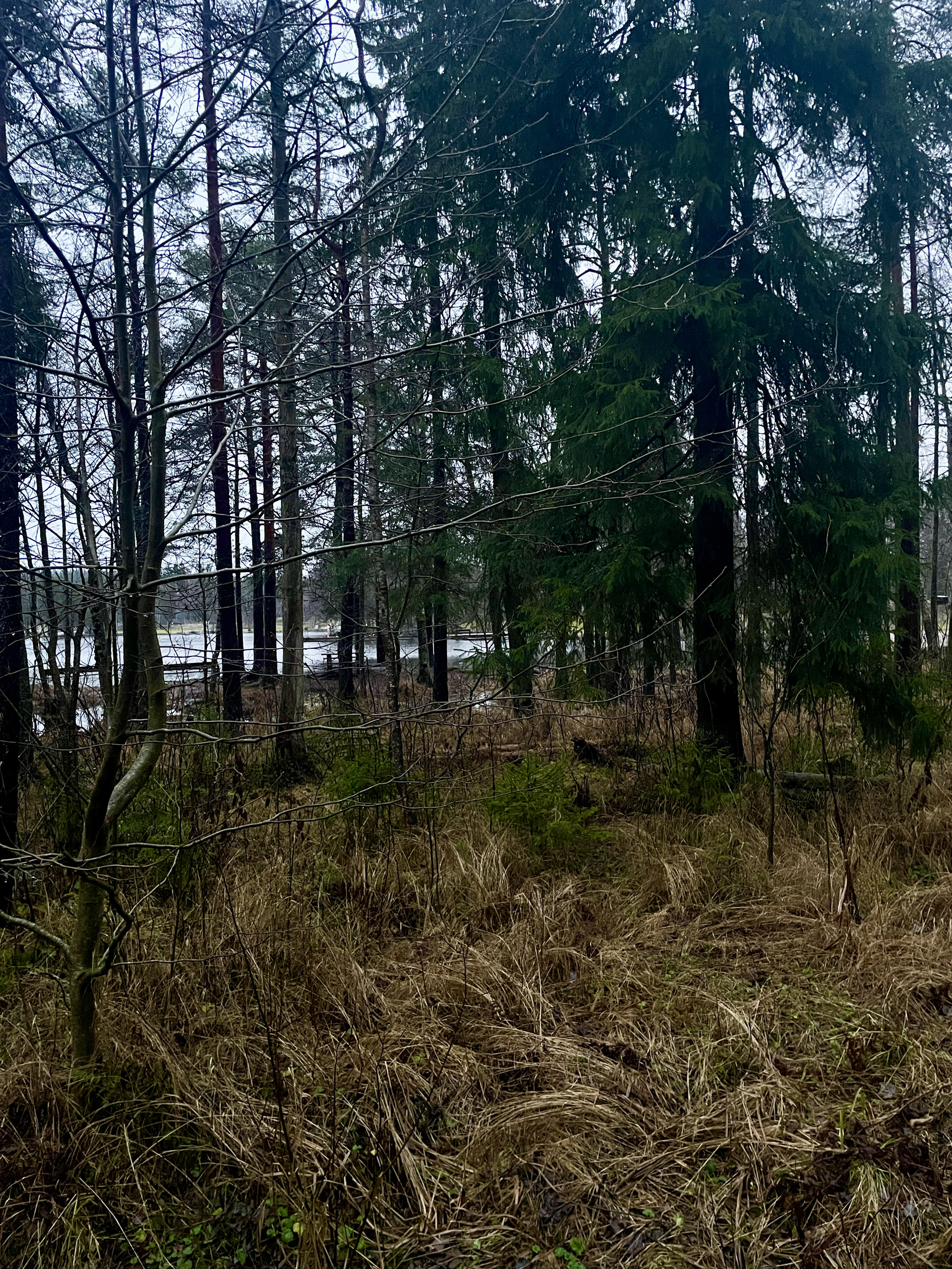
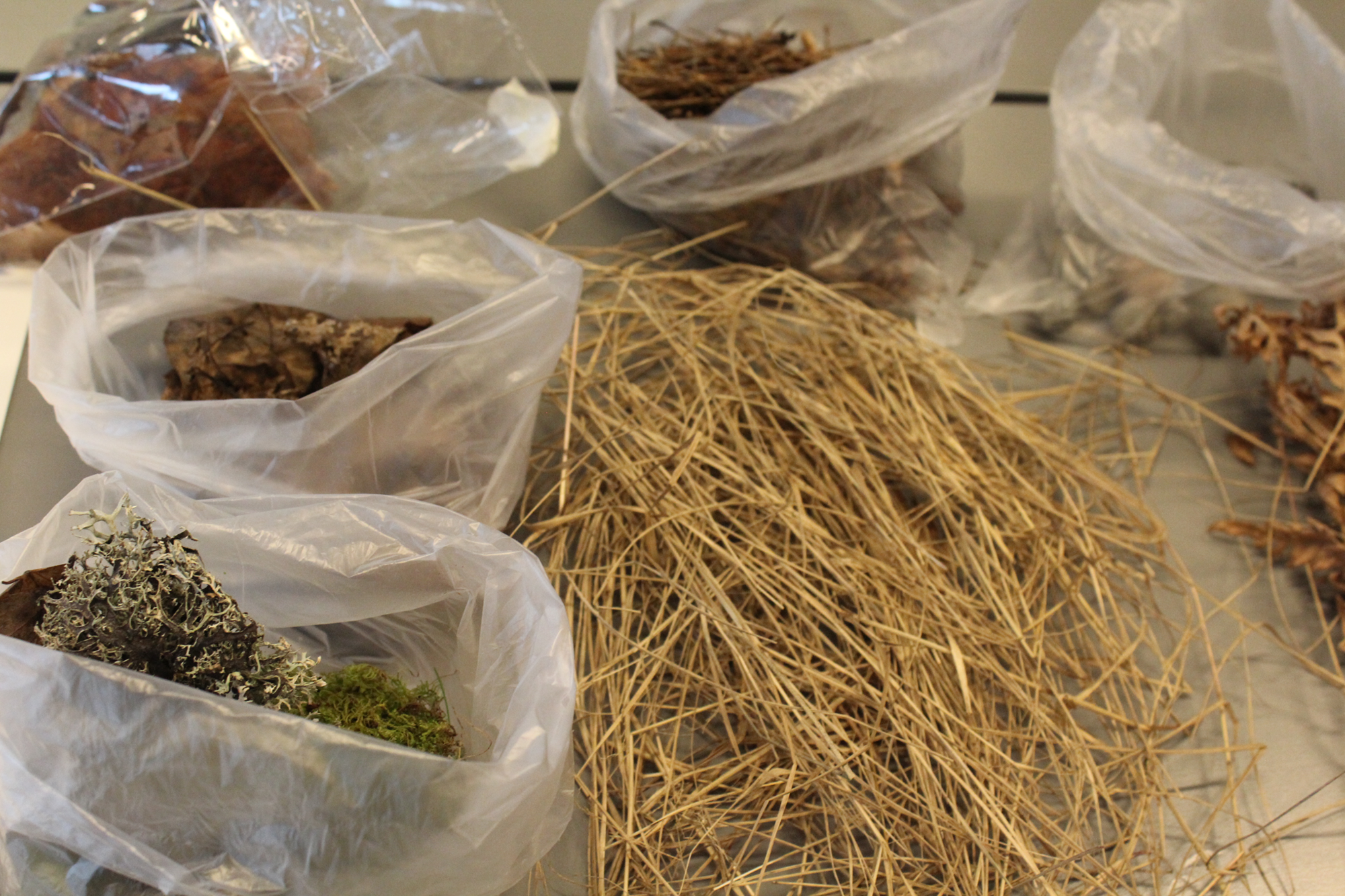
One of the main inspirations behind the workshop concept was the term “living artefacts” and the notion that materials in the field of biodesign are more than mere resources, highlighting issues of care, ethics and multispecies relations, which in turn ask design practices to shift from controlling matter to making with it (Karana et al. Reference Karana, Barati and Giaccardi2020). In order to aid in creating a setting in which participants would be immersed in working with something alive and changing, the concept of “atmosphere” was utilised (Böhme Reference Böhme1993). Böhme argues for a shift from the traditional aesthetics that revolved around the judgement of art to how things appear and feel in space. According to Böhme, atmospheres extend beyond art into other fields like design, architecture and advertising and can deliberately be created. Within the proposed workshop, atmosphere becomes a tool to “set the stage” for an open exploration of livingness by translating the atmosphere of working with living organisms into the space of an ordinary classroom through speculative storytelling, sensory engagement (haptically, visually, olfactory, auditory) and making processes, which will be detailed in the following sections. Alongside the Petri dish, whose thick agar layer carried the feel and smell of working in a lab, participants were provided with traditional collage material such as printed images and newspaper clippings. Furthermore, they were provided with tweezers and inoculation loops, as well as watercolours and inks and a variety of natural materials such as wood bark, moss, lichen and dried grasses, which were collected from Sognsvann, a local lake and forest area in Oslo, anchoring the making process locally and seasonally and contributing to the overall atmosphere of the workshop (Figures 2 and 3).
Sognsvann, local area where natural materials for the workshop were collected.

Organic collage materials.

Theoretical introduction
The workshop began with a brief theoretical introduction to the field of biodesign, following William Myers definition of the term, which describes biodesign as the integral incorporation of living components like bacteria, mycelium and yeasts into the design process (Myers Reference Myers2019). The introduction session concluded by showing examples of common biodesign projects, such as acoustic tiles made out of mycelium and bacterially dyed fabrics and expanding Myers definition into the concept of living artefacts. Enabling participants to understand the basis of biodesign to the same degree ensured an equal starting point in the workshop phase.
The speculative narrative
As a bridge between the theoretical introduction and the following embodied making practice, a speculative story titled “The living wardrobe,” written by the author of this paper, was read aloud to the participants. Describing a brief scene between the owner of a living garment and the garment itself, the story is meant to be evocative and allow participants to immerse themselves in the atmosphere of the living collage workshop. With a background in fashion and textile design, the author intentionally chose a garment as the living product, as garments directly interact with the wearer’s skin and therefore evoke a personal connection and strong imagery. To further enhance this feeling, the story is written from the viewpoint of the listener, encouraging further immersion into the story.
Beyond this, the story was inspired by an artwork titled “Victimless Leather” created by Eduard Kac and Ionat Zurr, which was shown in the book “Speculative Everything” by Fiona Dunne and Anthony Raby, along with similar projects, each of them harnessing the potential of speculative design to open up conversations and envision possible futures (Reference Dunne and Raby2013). In a creative and educational setting, speculative narratives like these can offer starting points into imagining different worlds than ours and trigger critical thinking and deep reflection, especially through the making of artefacts that directly result from the speculation (Cordova et al. Reference Cordova, David and Rezayan2025). The fictional story reads as follows:
“Low nutrition, item 1009” flashes on the screen of your smartwatch. Concerned, you briskly walk over to the see-through cabinet that you set up in the corner of your small kitchen. The first rays of sunlight softly pass through its transparent skin. You open it. Cold, white clouds of fog escape and pour over the wooden floors, releasing an earthy, woody scent, like a forest after rainfall. Up on the glossy shelf in the bottom corner, a bundle of fibres is resting, tightly curled up. Pulsing.
A strange feeling of wonder and curiosity rises inside your chest as you gaze upon it. Only three months ago, the ball of fibres had been nothing more than a seed you planted and cared for, its progress observed day by day – crouched in front of the cabinet, face pressed flush against its glass doors, breathing in and out completely in sync with its slight movements.
In awe, you carefully stroke the soft, hair-like fibres, and the moss-green ball unfurls. Slowly. Like the leaves of a fern. As the ball fully unfolds, your skin prickles with excitement, realising that it will soon have grown to its final size: a garment that perfectly matches you. Eighty-nine per cent of the growth process is completed. At one hundred percent, your garment will have reached its final size, and you can start wearing it, being with it. This does not mean that you can simply take it out of its growth habitat and stop tending to it; quite the opposite. You will need to take good care of it.
Item 1009, or “mossling,” as you started calling it, needs to be kept alive and healthy so that it can sustain itself and adapt in the ways it was designed for – growing thicker in winter for warmth and comfort, while shedding fibres deliberately during spring and summer, becoming light and airy. In theory, with good care practices, this item could accompany you through every climate, every year and every chapter of your life. Whether it really will is up to you.
You reach towards the back of the cabinet. Tubes wind through nutrient tanks; sensors nest in the corners; LED panels project spectrums of light across each surface. Everything is slightly moist, covered in condensation. You struggle to open the lid of a slippery container to add more liquid nutrition, but eventually you manage. The screen on your watch blinks green, signalling that everything is well taken care of now. A sigh of relief escapes you.”
(Otersen Reference Otersen2026: 145)Verbal semantic stimuli
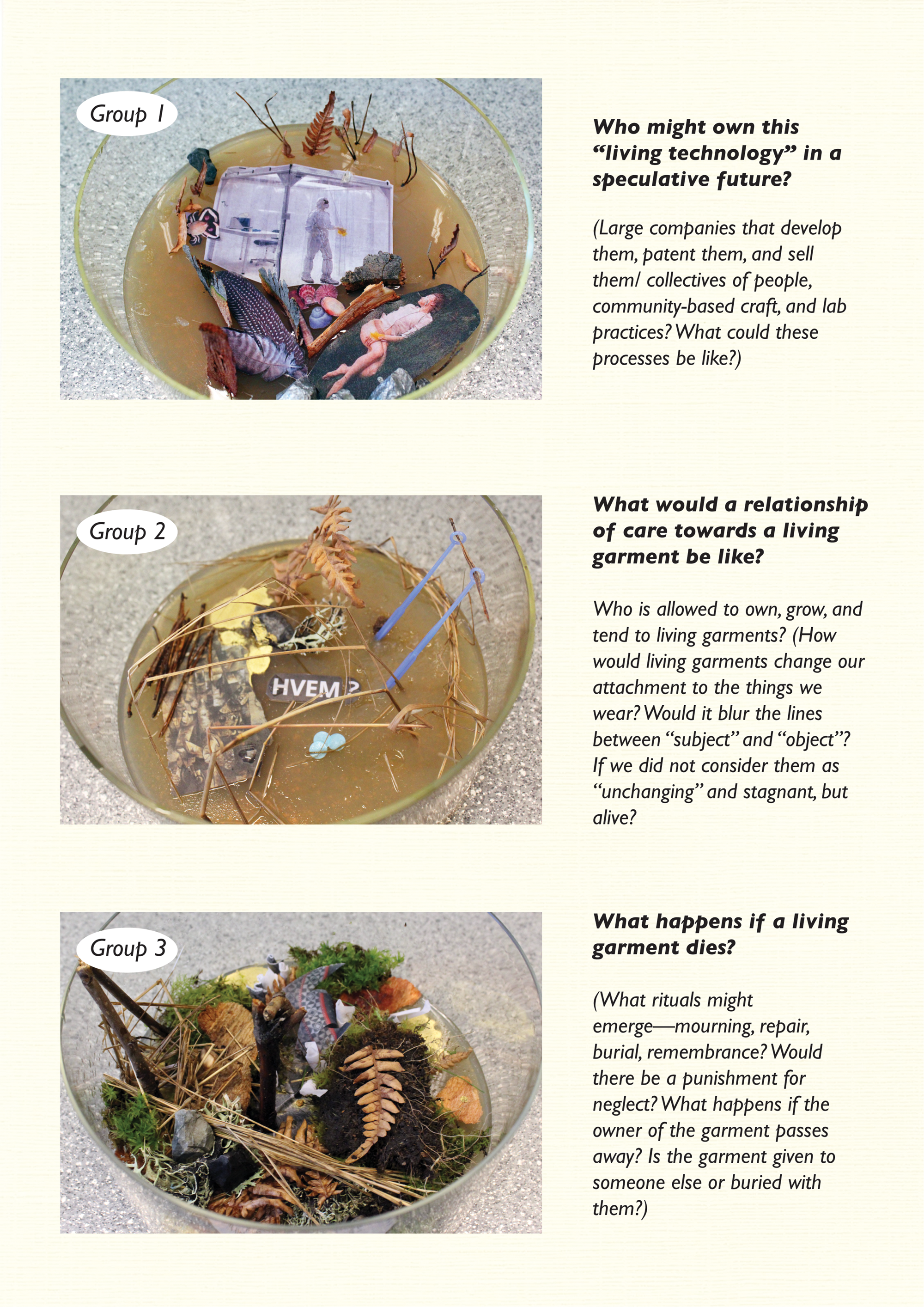
After listening to the speculative story, participants were divided into groups and selected one of three written notes. Each note posed an overarching question addressing a particular dimension of the living garment described in the narrative, including ownership of living technologies, practices of care and the death of the artefact. Accompanied by open-ended prompts designed to support reflection, the notes functioned as verbal semantic stimuli that encouraged creative thinking (Yu and Nagai Reference Yu and Nagai2025) (Figure 5).
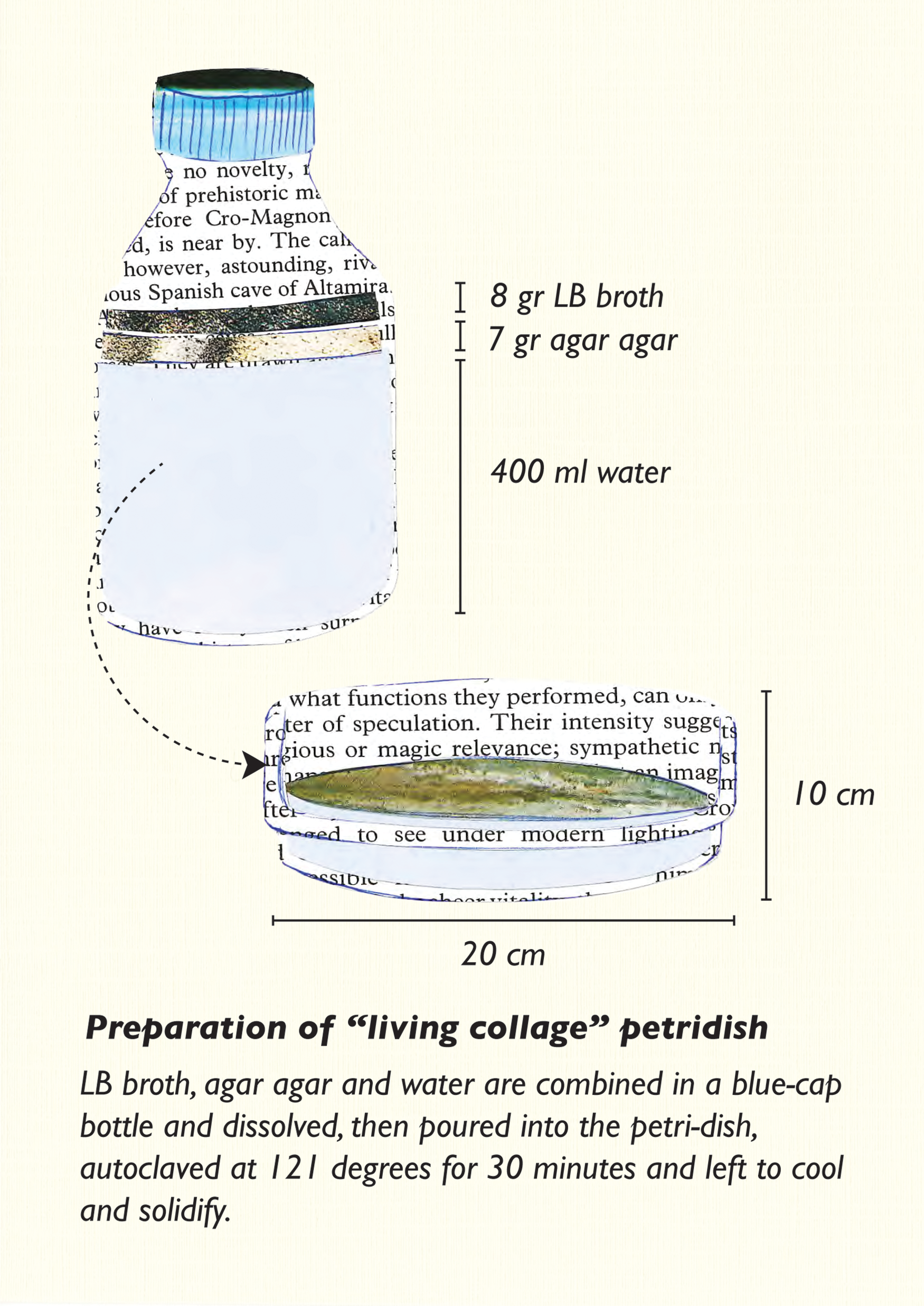
Instructions on how to create agar plates for the workshop.

Verbal semantic Stimuli and finished living collages.

The co-creation of living artefacts
During this part of the workshop, the groups created living artefacts in the form of collages, with the aim of investigating the question of their chosen note. Based on the concept of sympoiesis, which describes how knowledge is not created by single authors but rather emerges through ongoing relationships between humans and non-humans, the groups build up Living Collages in dialogue with one another (Haraway Reference Haraway2016).
The Living Collage approach was developed for this workshop by adapting the artistic method of collage to activate several senses and carry the atmosphere of a lab through creating enlarged versions of Petri dishes with an agar layer as a base for the collages. As such, the Living Collage approach is framed here as an embodied practice, in which the collaborative creation of artefacts becomes a way of thinking and deeply reflecting on the topic of livingness as a material quality (Groth and Nimkulrat Reference Groth and Nimkulrat2024). Within this context, it is also important to mention the impact of aesthetics on the making practice. “Aesthetics” is a broad term that can be interpreted in many ways, but in this pictorial, it relates to Yuriko Saito’s understanding of the concept in the sense that the aesthetics of artefacts inform attitudes, which guide actions and have a ripple effect on how we perceive the world and interact with it (Reference Saito2017). As the aesthetics of the Living Collage that the participants are creating is novel to them and involves new scents, tactility and challenges, this would aid in facilitating new and innovative thoughts.
By creating enlarged versions of Petri dishes with a layer of agar and bacteria growth medium, participants were able to smell and get in touch with a lab feeling without being inside a lab space (Figure 4). The activity reverses usual ways of working inside a lab by specifically encouraging the participants to “contaminate” the agar with bacteria from their body, from the paper cuttings and the natural materials. This way of working intentionally and unintentionally introduces various bacteria into the medium, which makes the collages come “alive” and change over time, making them a living piece of art that can only marginally be controlled in itself, drawing parallels to the theme of the workshop.
Workshop observations
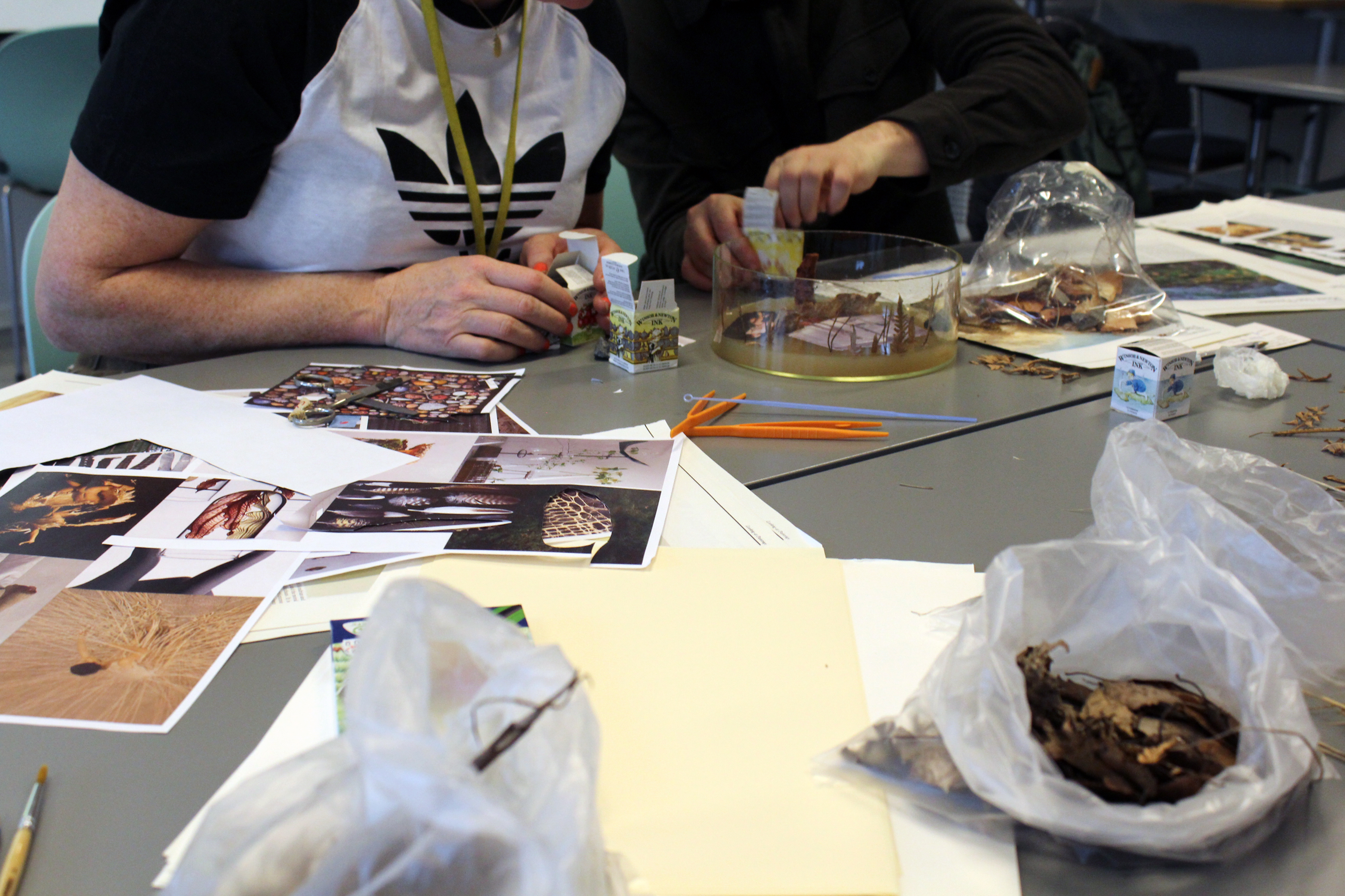
At the beginning of the making session, all participants had animated discussions with their group members about the verbal semantic stimuli they received and debated how to translate them into their collage. Hereafter, they started gathering materials and cutting up images while talking to each other and finding out how to visualise their narrative. At first, participants were hesitant to begin working on top of the agar and commented on its unusual smell and feel. Initially cautious, they slowly began poking the surface of the agar layer and stacking pictures and other items upright into it, penetrating the surface rather than simply laying them flat.
Hereafter, the collages progressed rapidly, with each participant contributing to the overall creation in tandem with their groupmates, building on each other’s ideas (Figure 6). There was a strong sense of exploration and playfulness reminiscent of the “Material Tinkering” practice, coined by Parisi et al. (Reference Parisi, Rognoli and Sonneveld2017). One group decided to use part of the tools (inoculation loops, plastic tweezers) as part of their creation, deliberately adding man-made materials into their collage, and used the inoculation loops to stroke many different surfaces and body parts to transfer to their collage. Another group mainly worked with images, adding some natural materials to the agar base and using the inoculation loops to add some of their skin bacteria to their creation. The last group worked mainly with natural materials like bark, sticks and moss and added a few images, resulting in a collage that resembled a terrarium, revealing very little of the agar base.
Participants working with various materials to create their living collage.

Quickly, little “worlds” were built, each made with different components, ideas and techniques, resulting from the participants’ collaborative making practice: between each other, the organic materials and the microorganisms from the participants’ skin, shoes and other surfaces. Throughout the workshop, the atmosphere remained animated, curious and energetic. Participants asked how to use certain tools, inquired about the composition of the agar base and wanted to know more about which bacteria would potentially grow and when they would first become visible. Furthermore, they inquired about seeing their collages when they started changing and when growth processes would become visible.
Descriptions of living artefacts
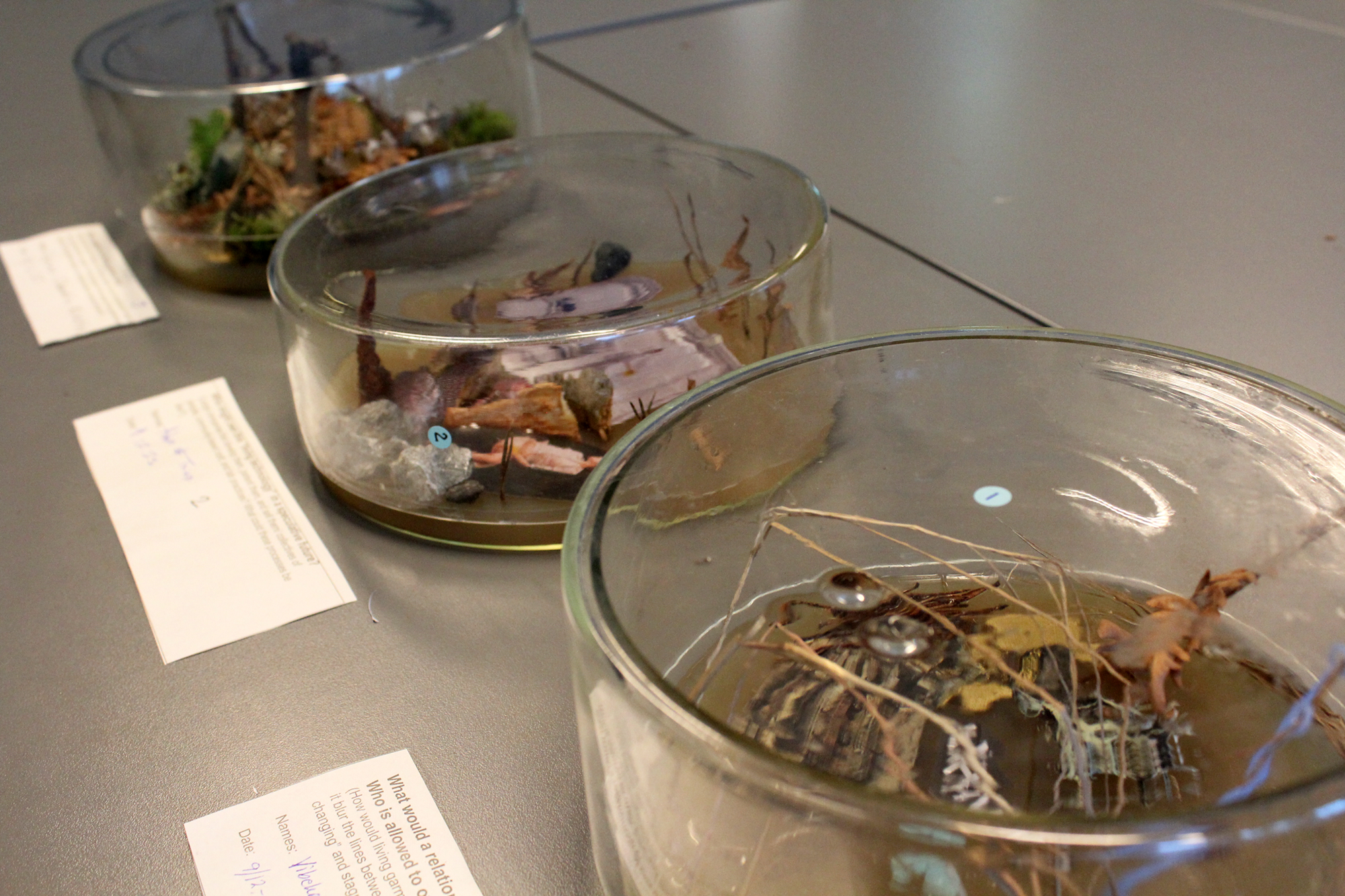
After the creation process concluded, each group was asked to present their living artefact along with their thoughts and interpretations of the verbal semantic stimuli they received (Figure 7).
Finished “Living Collages”, photographed right after the workshop concluded.

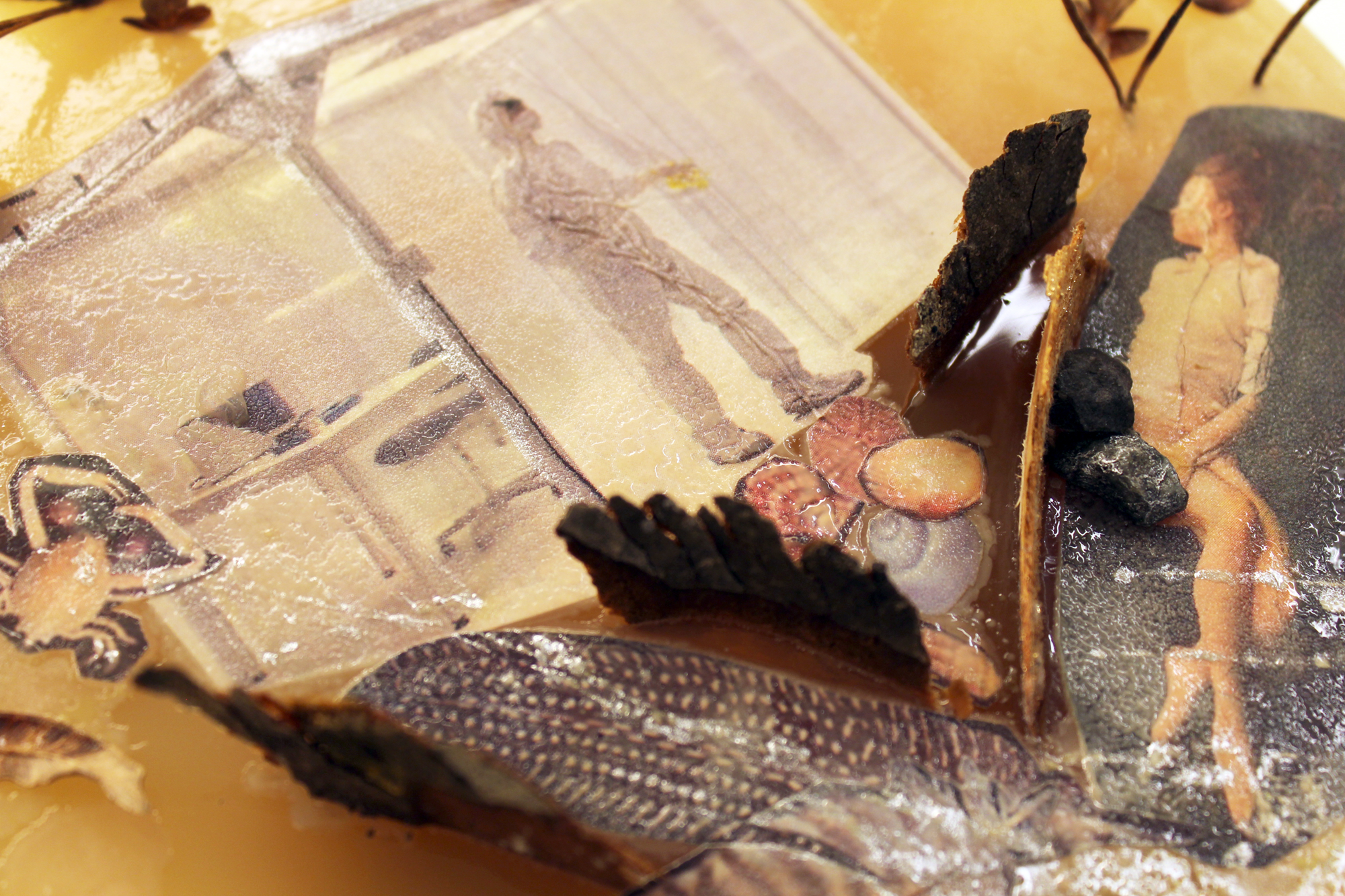
The group that worked on the prompt “Who might own this ‘living technology’ in a speculative future?”explained that after discussing different possible business models for the “living garment technology,” they ended up with a rather dystopian scenario where big companies would hold patents for the seeds of living garments and send the nutrition to keep the garment alive in the post (Figure 8). They, however, also made room in their discussion for considering modes of ownership outside the capitalist system and mentioned how nutrients could be produced locally through breweries or other forms of home fermentation. They compared the possibilities to agricultural practices and asked themselves what a bioregional approach to producing living garments could be like, mentioning that the garments would have to be adapted to the area in which they would be grown and living. When speaking about their living collage, they said: “We left a lot of space open for the bacteria to finish the piece, so that we didn’t determine all of it.”
The living Collage group 1 created, photographed 1 week after the workshop concluded, showing visible growth of microorganisms from the participants’ skin microbiome around the cut-out images.

Figure 8. Long description
Panel A: A collage featuring an image of a person standing in a room with various objects. Panel B: A collage featuring an image of a person in a seated position. Panel C: A collage featuring an image of a person in a standing position. Each panel shows visible growth of microorganisms around the cut-outs, indicating the presence of participants’ skin microbiome.
The group that worked on the prompt “What would a relationship of care towards a living garment be like? Who is allowed to own, grow and tend to living garments?”explained that the starting point for their collage was thinking about existing garments that are already cared for, like the Norwegian traditional costume “Bunad (Figure 9).” One group member further explained: “I think what’s interesting is where each of us might have very different reasons why we inoculate this culture from different sources other than from what is already existing in the materials, like she swabbed her skin and you did your ears, while I did the sole of my shoes. So it will be surprising to find out what it turns out to be in 7 days.”
The living Collage group 2 created, photographed 1 week after the workshop concluded, showing growth of multiple organisms.

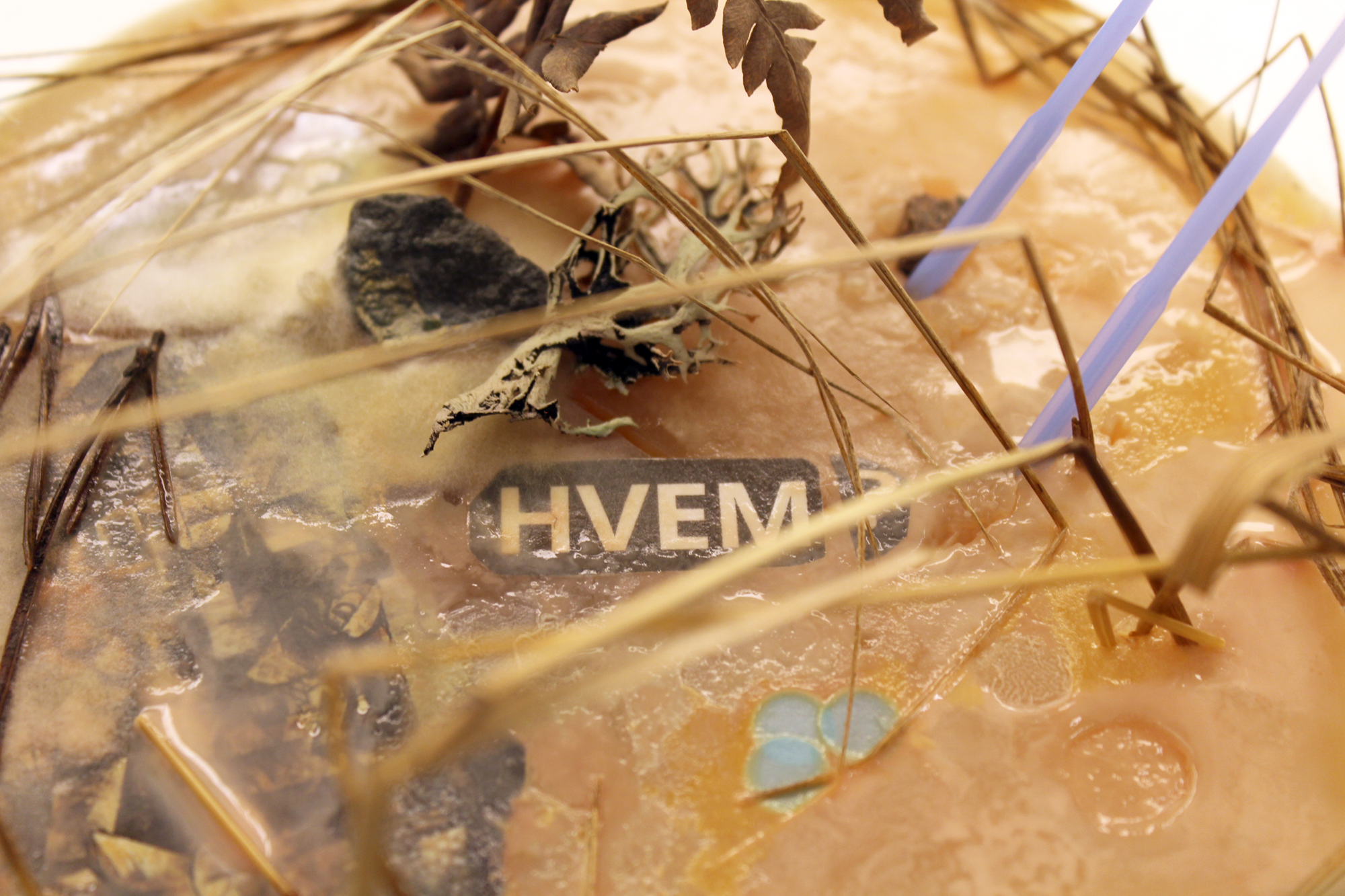
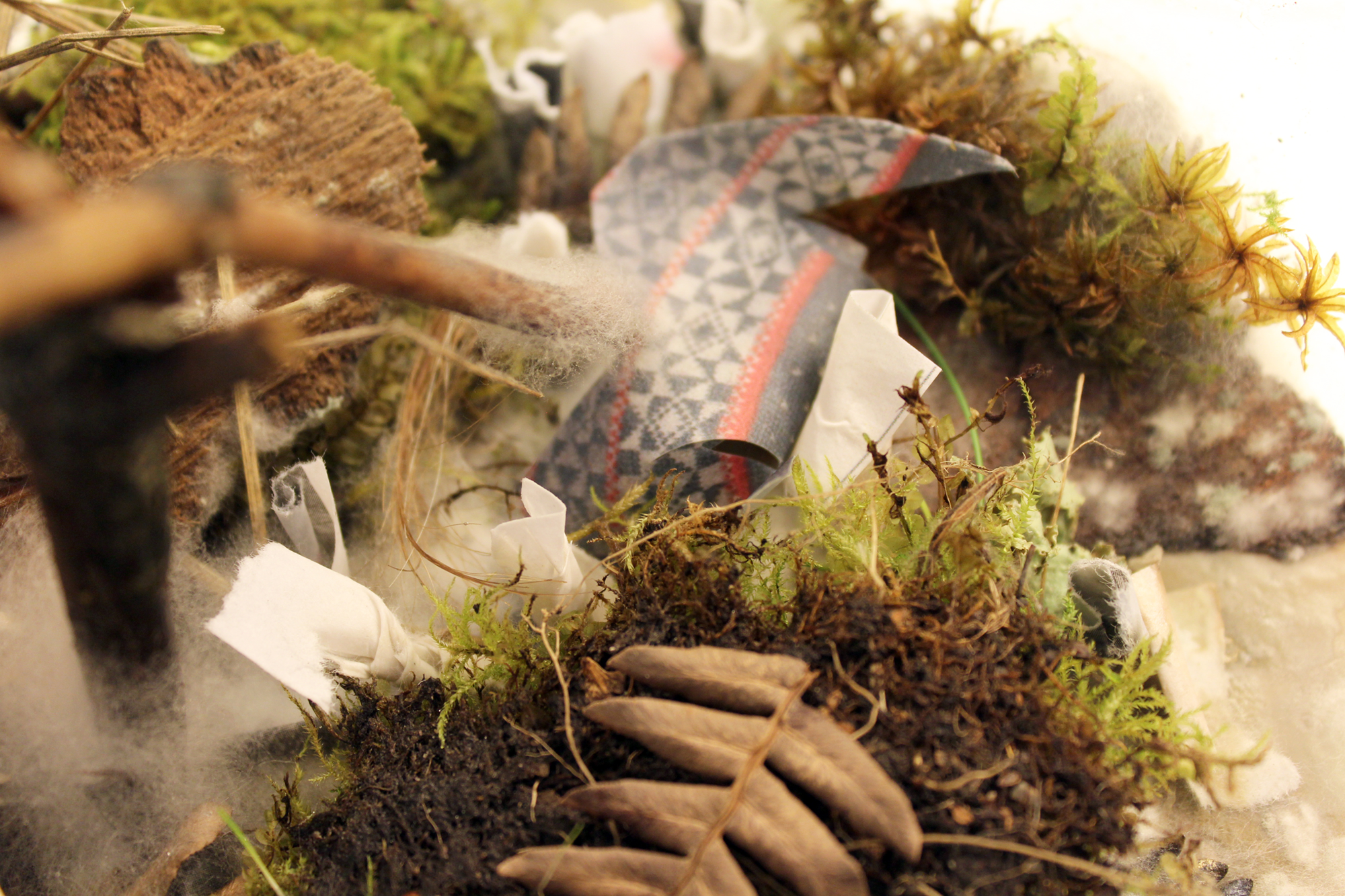
Finally, the group that took on the question “What happens if a living garment dies?” explained that they discussed that the burial of the living garment would be a respectful way of parting with it, while also allowing new life to grow from it in the future. They compared their approach to a Viking tradition, where people, objects and animals were buried together. Their collage used many of the organic materials provided, such as moss, tree bark and lichen, covering the entire surface of the Petri dish and turning it into a three-dimensional version of a burial mound (Figure 10).
The living Collage group 3 created, photographed 1 week after the workshop concluded, showing the decay of the organic materials the group introduced into the Petri dish.

Discussion
A key element that emerged during the group discussion, was ethical discourse and responsibility, particularly around biosafety, containment and the overall ecological impact of living garments (Figure 11). In light of ethics within biodesign, the question of ownership of technology was raised, and one participant commented, “I think even if capitalism will beat you to it, there’s some good in knowing, in understanding, in being aware of the process, being able to replicate the process, being critical of another process than the ones you know yourself.” This topic emerged as a continuation of the living collage created by group one, in which they debated capitalist modes of production versus smaller-scale local and community-based approaches, a tension that is often reflected in biodesign literature. In her thesis “Redeeming Making? Biodesign and the Hope for Better Production,” Katherine Pfeiffer conducted a 19-month-long ethnographic study with biodesigners in the UK and found that biodesigners struggle to scale up their projects, as scaling up clashes with the inherent values of biodesign that call for slowness, collaboration and a multispecies process that questions extractionism (Reference Pfeiffer2023). However, as Ginsberg and Chieza, who have both worked intensively with biodesign, point out, a systemic shift in the way materials are produced is needed; otherwise, biodesign cannot meaningfully contribute to a sustainable transformation of the industry (Reference Ginsberg and Chieza2018). Ethics remained an important aspect throughout the discussion and revealed strong connections to the concept of agency. As the participant quote above alludes to, there is agency in knowledge and in understanding new technologies. This is an area where biocommunities, designers and artists can strongly contribute to the field of biodesign. Recently, David Sun Kong, leader of the community synthetic biology course “How to Grow (Almost) Anything” at the Massachusetts Institute of Technology, wrote about the importance of trust within technological innovation (Reference Kong2025). According to Sun Kong, the feeling of trust acts as a necessary counterweight to Western scientific approaches that dominantly rely on accurate measurements and quantifiability.
Map of emerging key terms from the group discussion.

When describing their collages, two out of three groups directly addressed their interaction with other species and reflected on these considerations. For example, they described deliberately giving organisms space to develop or expressed curiosity about how their collages would evolve over time. This can be related to what Karana et al. term “living aesthetics,” in which the changes of living materials are anticipated by their makers and constitute a key aspect of the living artefact concept (Reference Karana, Barati and Giaccardi2020). Participants collecting microbes from their own skin and embedding them in the collages also created a deeply personal connection to their artworks. Even though the last group did not explicitly address their consideration of embedding living matter into their collage, the way they used the provided organic materials and reflected on a burial tradition for the death of the living garment demonstrates a deep level of engagement with the workshop concept and respect for living artefacts within the speculative future scenario. This relates to the concept of “mutualistic care,” which was also introduced by Karana et al. within the living artefact framework (Reference Karana, Barati and Giaccardi2020).
The second group’s connection to the Norwegian traditional costume “Bunad” in relation to care practices ties biofabrication processes back to traditional craft and making practices, which aligns with core concepts present in Growing Design (Camere and Karana Reference Camere and Karana2017). Similarly, the relation of biodesign to agricultural and home fermentation practices within the context of this workshop is reminiscent of Carole Collet’s description of the Designer Cultivator, who collaborates with nature to create materials and products (Reference Collet2020). Locality became an important factor, as participants expressed concern for the environments surrounding their living artefacts and understood that, in order to remain alive, these artefacts would need to be designed and adapted to specific local conditions. Furthermore, participants reflected on the connection between the utopia of living garments and the garments we already own, understanding the speculation as a metaphor. Living garments shifted textiles from objects to relationships, foregrounding care, slowness and long-term attention. “Care” is an important concept within more-than-human design and has been extensively explored in relation to collective responsibility, deliberate slowness, an understanding of the different temporalities of species and a sense of connection (de La Bellacasa Reference de La Bellacasa2017; Haraway and Endy Reference Haraway and Endy2019; Karana et al. Reference Karana, Barati and Giaccardi2020; Tronto and Parra Jounou Reference Tronto and Parra Jounou2024).
“Uncertainty” was another key theme that emerged during the discussion. Participants explained that working with living collages was challenging because they did not know how the bacterial cultures they introduced to their work would change over time. Even though some participants expressed curiosity by stroking different parts of their skin and various surfaces, leaving room for the unexpected to grow, others desired a stronger sense of control. One participant expressed the desire to redo the workshop after observing how their living collage would change in order to gain a stronger handle on the final creative outcome. There was, however, also an understanding that making with living systems required letting go of control to a certain degree and that uncertainty was inherent to this practice, making it something participants needed to accept. This aligns with a challenge within biodesign identified by Kim et al. who point out that the ways living artefacts change cannot be entirely predicted (Reference Kim, Zhou, Groutars, Karana, Lockton, Lenzi, Hekkert, Oak, Sábada and Lloyd2022). In their paper, they formulate that one of the guiding principles for future biodesign practices should be “Design for Multispecies Co-habitation.” Overall, there is a strong connection to the “more-than-human” design paradigm and concepts of the “post-anthropocene” in this part of the discussion (Giaccardi and Redström Reference Giaccardi and Redström2020; Rognoli et al. Reference Rognoli, Pollini, Alessandrini, Camocini and Vergani2021). It reflects the struggle of decentring human desires when working alongside other organisms.
In the same vein, the term disgust emerged during the discussion. The concept of living materials evoked fascination but also strong discomfort. One participant linked the idea of a living garment to the symbiotic culture of bacteria and yeast of a kombucha brew, stating, “They are a bit scary and slimy and a living creature that you can imagine creeping out of a jar. (…) With garments, when you have a living organism on your body, a link to an alien, there’s this sort of I don’t know, abject. Rejection. Disgust. The concept of the abject. The sort of bodily unwanted that shouldn’t be there.” The explicit expression of disgust by this participant links back to aspects of speculative design, in which the discomfort certain ideas cause aids in the effectiveness of fictive scenarios (Dunne and Raby Reference Dunne and Raby2013).
This sentiment also connects to more-than-human design, highlighting the discomfort that can emerge when the boundaries between what is human and what is considered nature continue to blur.
The resulting divide between “humans as part of nature” versus “humans as masters of nature” remained a continuous underlying theme throughout the discussion. It was reminiscent of Alice Payne’s article “Fashion Futuring in the Anthropocene,” in which she discusses the terms “Promethean” and “Soterian” (Reference Payne2019). While Prometheans, based on Prometheus, the god who gave fire to humans, stand for humanity’s dominance over nature and the use of technology to govern it, Soterians, based on Soteria, the Greek goddess of safety, remain suspicious of unnatural technological solutions and the separation of humans from nature. These categories become meaningful within biodesign discourse as we navigate more-than-human futures, species entanglements and what they mean for how humans interact with nature moving forward.
Reflection
Overall, the “Living Collage” workshop enabled participants to collectively create meaning, each collage visually capturing their response to themes in biodesign and encouraged deep reflection on the notion of living artefacts. This could be observed in the way they engaged with the workshop task and how this engagement carried over into the collective discussion afterwards.
During the discussion, participants were able to reflect on their making practice and identified relevant themes and their relation in the field of biodesign. The workshop can therefore be used as a valuable method for working with biodesign outside of a lab setting and with participants who are new to the topic. However, I believe that the qualitative nature of the workshop was a key element in its success, encouraging deep exploration and communication. I do not believe that the concept would work as well, if it was scaled up too drastically. If it was repeated with a larger group of participants I would recommend that the group sizes stay small, between 3 and 4 participants per group.
Some of the topics that came up during the discussion were provided through the framing of the workshop and the verbal semantic stimuli such as the term care and capitalistic versus community structures, however I find that these provided important starting points for novices within biodesign to stimulate the imaginary creation of artefacts and letting the participants unfold further concepts from there. If the workshop was to be repeated with experienced biodesigners, I would design the stimuli to be more open for deeper insights.
Furthermore, it would also be interesting to repeat the workshop with a group of bachelor’s or master’s students instead of PhD students and academic staff, to understand how they would interpret the workshop and which discussions it would provoke. Within the framing of this workshop, a follow-up workshop, in which participants could observe their living collages after one week to see how they had grown and changed, was beyond the scope of the PhD course and is planned as future work. This could be another interesting aspect to investigate, as a continuation of the making workshop, because it holds the potential to expand on the discussion.
Finally, as the workshop was locally and seasonally anchored through the use of several local natural materials, it would be interesting to host the same or a similar workshop in a different country with different local resources to understand how this change would affect the outcomes and themes of discussion.
Data availability statement
Not applicable to this pictorial.
Acknowledgements
I am grateful for the guidance of my supervisor Astrid Maria Heimer, as well as the leaders of the PhD course “Aesthetics of Innovation” Trine Krigsvoll Haagensen and Kristin Bergaust. I would also like to thank all workshop participants for their engaged contributions and openness to the topic.
Author contributions
The author designed the case study as part of a PhD course titled “Aesthetics of Innovation” with guidance of Trine Krigsvoll Haagensen and Kristin Bergaust, developed and facilitated the Living Collage workshop, collected, transcribed and analysed the data, wrote the manuscript and created all figures.
Financial support
This work was supported by the author’s PhD budget at OsloMet. The funder had no role in the study design, data collection and analysis, decision to submit or preparation of the manuscript.
Competing interests
None.
Ethical standards
The research meets all ethical guidelines, including adherence to the legal requirements of the study country.
Declaration of generative AI and AI-assisted technologies in the writing process
During the preparation of this work, the author used the SIKT AI tool in order to proofread the manuscript text. After using this tool, the author reviewed and edited the content as needed and takes full responsibility for the content of the publication. All figures were made without the use of AI.

 Open access

