INTRODUCTION
The catsharks (Elasmobranchii: Carcharhiniformes: Scyliorhinidae) represent the most speciose shark family with 120+ valid species recognized globally (updated from Compagno, Reference Compagno, Fowler, Cavanagh, Camhi, Burgess, Cailliet, Fordham, Simpfendorfer and Musick2005). While the family is global in occurrence, many species have limited distributions. The Australasian region has a high degree of endemism, with 34 scyliorhinid species recorded from Australian waters (Compagno et al., Reference Compagno, Dando and Fowler2005; Last & Stevens, Reference Last and Stevens2009). Despite their diversity, the family remains poorly-known, with limited to no biological or ecological information available for the vast majority of species. Apart from published studies on the common inshore draughtboard shark Cephaloscyllium laticeps (Duméril, 1853) of southern Australia (Awruch et al., Reference Awruch, Pankhurst, Frusher and Stevens2008, Reference Awruch, Pankhurst, Frusher and Stevens2009), and some limited reports on sizes at sexual maturity (Last & Stevens, Reference Last and Stevens2009), information on the reproductive biology of Australian scyliorhinid sharks is lacking.
The demersal elasmobranch fauna of the outer continental shelf and upper slope off southern Queensland (eastern Australia) includes three poorly-known Australian endemic catsharks: grey spotted catshark Asymbolus analis (Ogilby, 1885) (eastern Australia from southern Queensland to Victoria; 25–200 m depth); orange spotted catshark Asymbolus rubiginosus Last, Gomon & Gledhill, in Last, 1999 (eastern Australia from southern Queensland to Tasmania; 25–540 m depth); and Australian sawtail shark Figaro boardmani (Whitley, 1928) (eastern, southern and western Australia from southern Queensland to Western Australia including Tasmania; 130–640 m depth) (Last et al., Reference Last, Gomon, Gledhill and Last1999; Kyne et al., Reference Kyne, Johnson, Courtney and Bennett2005; Last & Stevens, Reference Last and Stevens2009; present study). Kyne et al. (Reference Kyne, Johnson, Courtney and Bennett2005) provided some basic information on reproduction in A. analis, but this was based on only five dissected mature females.
These three catshark species are discarded bycatch of the Queensland East Coast Trawl Fishery (QECTF), a multi-species benthic commercial fishery targeting prawns (Penaeidae) and scallops (Pectinidae). Off southern Queensland, the large eastern king prawn Penaeus plebejus is fished on the outer continental shelf in a seasonal (generally between May and August) ‘deepwater’ fishery in depths of 90–300 m. Catshark specimens were primarily collected from the trawl grounds of this deepwater sector of the QECTF (though some specimens were collected from a shallower water sector of the QECTF, where catshark bycatch is irregular) in order to address knowledge gaps in their basic biology. This paper presents preliminary information on the reproductive biology (sex-ratios, size at maturity, reproductive mode, reproductive seasonality and ovarian fecundity) of A. analis, A. rubiginosus and F. boardmani from southern Queensland.
MATERIALS AND METHODS
Specimens were collected between March 2001 and February 2004 from the mid to outer continental shelf (depths of 78–168 m) off southern Queensland, Australia (26°31′–27°49′S 153°31′–153°50′E) (Table 1). The vast majority of specimens were collected from a highly seasonal sector of the Queensland trawl fishery; the fishery generally operates between May and August. Outside of these months, vessels fish waters shallower than about 90 m depth and catshark by catch is minimal. This limited both the number of specimens available for examination and the months/seasons in which specimens were collected. Therefore, the vast majority of specimens were collected from only a few months, mostly in winter, with almost no sampling conducted in summer (with only one specimen collected in summer from the shallow water sector of the fishery) (Table 1). Data from specimens of A. analis (N = 5 females) examined by Kyne et al. (Reference Kyne, Johnson, Courtney and Bennett2005) were incorporated into the full dataset for that species presented here. Collection was by commercial otter-board trawlers fitted with three 2-seam Florida Flyer nets (net body mesh size 50.8 mm, codend mesh size 44.5 or 47.6 mm) with headrope lengths of 12.8 or 22.0 m. Catsharks were snap-frozen at sea.
Summary of months of collection, location, depth, sample size, size-range and mass-range for scyliorhinid sharks captured off southern Queensland from the trawl grounds of the Queensland East Coast Trawl Fishery.

N, number; SD, standard deviation.
Total length (TL), the distance from the tip of the snout to the distant margin of the caudal fin was measured on the ventral surface to the nearest millimetre. Mass was measured to the nearest gram. Maturity stages were assessed for males and females (Ellis & Shackley, Reference Ellis and Shackley1997; Ebert et al., Reference Ebert, Compagno and Cowley2006). Males were classed as immature (if they possessed short, uncalcified claspers, undeveloped testes), adolescent (claspers extended but uncalcified, developing testes) or mature (calcified and elongated claspers, testes developed and lobular, epididymides highly coiled). Females were classed as immature (undeveloped ovaries, undifferentiated oviducal glands, thin uteri), adolescent (incompletely developed ovaries with only small white follicles ≤4 mm diameter, incompletely developed oviducal glands, slightly expanded uteri) or mature (developed ovaries with yellow vitellogenic follicles ≥5 mm diameter, fully developed oviducal glands, uteri and egg cases may be present).
Reproductive systems were removed and testes and ovaries (both with attached epigonal tissues) were weighed to the nearest decigram. Inner clasper length (CL) was measured in males to the nearest millimetre, from the point of insertion of the pelvic fin to the posterior tip of the longest clasper. To examine the onset of maturity (possible only in A. analis), the relationships between testes mass (TM) and TL and between CL and TL were examined for males, and between ovary mass (OM) and TL for females. Gonadosomatic index (GSI) was calculated as (gonad mass/body mass)*100, and where possible, compared between seasons. Average oviducal gland width (OGW) was calculated in mature females, and where possible, compared between seasons. Follicle diameter was measured to the nearest millimetre and vitellogenic follicles (i.e. follicles ≥5 mm diameter) counted in the single functional ovary of mature females to determine ovarian fecundity. Maximum follicle diameter (MFD) of all individual mature females was compared between seasons. The relationship between the number of vitellogenic follicles and TL was examined using linear regression. The uteri of females were inspected for egg cases, which were counted if present. The proportion of mature females carrying egg cases was compared between seasons (possible only in A. rubiginosus).
Given low monthly sample sizes, samples were grouped by season (austral: summer, December–February; autumn, March–May; winter, June–August; spring, September–November) to determine any seasonal trends in reproductive cycles. Significance was set at P < 0.05. Statistical tests were performed using one-way analysis of variance (ANOVA), paired t-tests, and where data were non-normal and could not be normalized, the Mann–Whitney rank-sum test was used. The sex-ratio of the sample of each species was analysed using a Chi-square (χ2)-test.
RESULTS
One hundred and seventy-eight catsharks were collected (Table 1) (two A. analis and 11 F. boardmani were lodged in museum collections and thus were not available for internal dissection).
Grey spotted catshark Asymbolus analis (Ogilby, 1885)
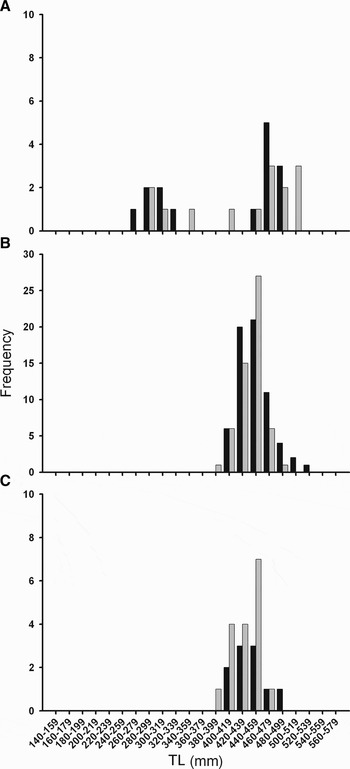
Twenty-nine A. analis specimens were collected (Table 1). The length–frequency distribution of the specimens collected is shown in Figure 1A. The sex-ratio of 1.00:0.93 (female:male) did not differ significantly from 1:1 (χ2, df = 1, P = 0.85).
Total length (TL)–frequency histogram for female (black bars) and male (grey bars): (A) Asymbolus analis; (B) Asymbolus rubiginosus; (C) Figaro boardmani. Note the different scales of the y-axis.

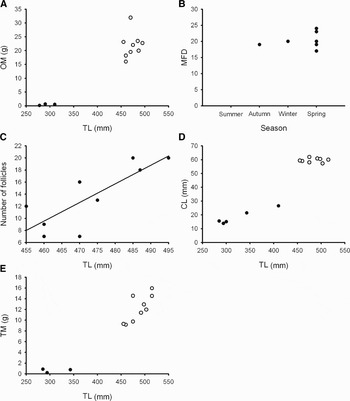
The largest immature female was 310 mm TL and the smallest mature female was 455 mm TL. The relationship between TL and OM is shown in Figure 2A. Immature and adult individuals are easily separable on the graph; however, a lack of samples in between the largest immature female and the smallest mature female precludes an accurate assessment of the size at which OM increases rapidly with the onset of maturation (adolescent females were not observed) (Figure 2A). The majority of mature females sampled were collected during spring (N = 7), with only a single mature female collected in each of autumn and winter, and none in summer. This limited the assessment of trends in female reproductive seasonality. Maximum follicle diameter observed was 24 mm, and all mature females for which the ovaries could be examined contained follicles ≥17 mm diameter (N = 9); as such, large-sized follicles were observed in all months and seasons sampled (Figure 2B). There was a significant relationship between the number of vitellogenic follicles (those ≥5 mm diameter) and TL (in mm) in mature females (follicle number = 0.3084TL – 132.2966, N = 9, r2 = 0.66, P < 0.008) (Figure 2C). The number of follicles per mature female ranged from 7–20. Of nine mature females examined, one (487 mm TL) captured in spring was carrying two egg cases, one in each uterus, with a second batch of egg cases coming through the oviducal glands. The MFD in this gravid female was 20 mm.
Reproductive biology of female (A–C) and male (D–F) Asymbolus analis. (A) Relationship between total length (TL) and ovary mass (OM) for immature (closed circles) and mature (open circles) female A. analis; (B) maximum follicle diameter (MFD) versus season for female A. analis; (C) relationship between TL and the number of follicles for female A. analis; (D) relationship between TL and clasper length (CL) for immature (closed circles) and mature (open circles) male A. analis; (E) relationship between TL and testes mass (TM) for immature (closed circles) and mature (open circles) male A. analis.

The largest immature male was 410 mm TL and the smallest mature male was 455 mm TL. The relationship between TL and CL is shown in Figure 2D, and the relationship between TL and TM in Figure 2E. Inner clasper length averaged 5.6% (range 4.7–6.5%) of TL in immature males (N = 5) and 12.3% (range 11.4–13.1%) of TL in mature males (N = 9). Mature males were sampled, and GSI calculated, during all seasons, but low sample sizes (summer, N = 1, GSI = 2.92; autumn, N = 5, GSI = 2.75–4.06; winter, N = 2, GSI = 3.63–3.77; spring, N = 1, GSI = 3.02) limited the assessment of reproductive seasonality.
Orange spotted catshark Asymbolus rubiginosus Last, Gomon & Gledhill, in Last, 1999
One hundred and twenty-two A. rubiginosus specimens were collected (Table 1). The length–frequency distribution of the specimens collected is shown in Figure 1B. The sex-ratio of 1.00:0.86 (female:male) did not differ significantly from 1:1 (χ2, df = 1, P = 0.41).
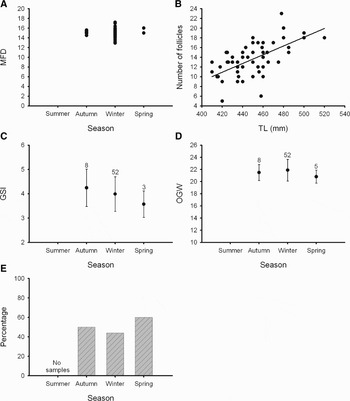
No immature or adolescent female specimens were collected. The smallest mature female was 410 mm TL. Mature females were collected during autumn, winter and spring (although sample size was far greater in winter). Maximum follicle diameter observed was 17.2 mm. Large-sized follicles were observed in all months and seasons sampled with overlap in MFDs between all seasons (autumn, 14.5–15.6 mm, N = 8; winter, 12.9–17.2 mm, N = 47; spring, 15.0–16.0 mm, N = 2) (Figure 3A). There was a significant relationship between the number of vitellogenic follicles (those ≥5 mm diameter) and TL (in mm) in mature females (follicle number = 0.0900TL – 26.8819, N = 57, r2 = 0.37, P < 0.0001) (Figure 3B). The number of follicles per mature female ranged from 5–23. There was no significant difference in female GSI between seasons (ANOVA, N = 63, F2,60 = 1.026, P = 0.37) (Figure 3C). There was no significant difference in average oviducal gland width between seasons (ANOVA, N = 65, F2,62 = 0.994, P = 0.38) (Figure 3D). Of 65 mature females examined, 35 (410–520 mm TL) were carrying egg cases. The proportion of females carrying egg cases was highest in spring (60%), intermediate in autumn (50%) and lowest in winter (44%) (Figure 3E). Of those females carrying egg cases, 14.3% had a single egg case in the left uterus, while the remainder carried a single egg case in each uterus. In those females carrying only a single egg case, the right uterus was expanded, suggesting that egg-laying had recently taken place. There was no significant difference in MFD between those females carrying egg cases and those that were not (t-test, N = 57, P = 0.95). There was no significant difference in GSI between those females carrying egg cases and those that were not (t-test, N = 63, P = 0.15).
Reproductive biology of female Asymbolus rubiginosus. (A) Maximum follicle diameter (MFD) versus season for female A. rubiginosus; (B) relationship between total length (TL) and the number of follicles for female A. rubiginosus; (C) gonadosomatic index (GSI) (mean ± SD) versus season for female A. rubiginosus; (D) average oviducal gland width (OGW) (mean ± SD) versus season for female A. rubiginosus; (E) percentage of female A. rubiginosus carrying egg cases by season. Sample size shown above error bars.

A male measuring 380 mm TL was immature and a male measuring 407 mm TL was adolescent. Two males were mature at 405 mm TL, as were all males ≥410 mm TL. Inner CL was 8.3% of TL in the immature male, 11.5% of TL in the adolescent male and averaged 12.1% (range 11.3–13.0%) of TL in mature males (N = 54). Mature males were collected during autumn and winter only. There was no significant difference in the GSI of mature males between these two seasons (Mann–Whitney rank-sum test, N = 54, P = 0.68).
Australian sawtail shark Figaro boardmani (Whitley, 1928)
Twenty-seven F. boardmani specimens were collected (Table 1). The length–frequency distribution of specimens collected is shown in Figure 1C. The sex-ratio of 0.59:1.00 (female:male) did not differ significantly from 1:1 (χ2, df = 1, P = 0.18).
No immature or adolescent female specimens were collected. The smallest mature female collected was 402 mm TL. All females sampled were collected during winter (N = 10), which precluded any assessment of trends in female reproductive seasonality. Maximum follicle diameter observed was 19 mm, and all mature females for which the ovaries could be examined contained follicles ≥16 mm diameter (N = 5). The number of follicles per mature female ranged from 9–13. Of five mature females examined internally, four (402–440 mm TL) captured in winter were carrying egg cases; one with an egg case in each uterus and three with an egg case in only one uterus. The MFD in these gravid females was 16–19 mm.
No immature male specimens were collected. The smallest mature male collected was 398 mm TL. Inner CL averaged 10.2% (range 9.3–11.3%) of TL in mature males (N = 17). All males sampled were collected during winter (N = 17), which precluded any assessment of trends in male reproductive seasonality.
DISCUSSION
Very few small-sized or immature catsharks were caught in the demersal trawl fishery from which specimens were collected for this study; no immature F. boardmani, no immature female A. rubiginosus, only two immature male A. rubiginosus and only a few immature A. analis were collected. The lack of small A. rubiginosus and F. boardmani collected does not appear to be explained by gear selectivity. Net body mesh sizes used were ~50 mm, and small-sized A. analis (from 278 mm TL) were captured. Additionally, many smaller teleost species were readily sampled (see Courtney et al., Reference Courtney, Haddy, Campbell, Roy, Tonks, Gaddes, Chilcott, O'Neill, Brown, McLennan, Jebreen, van der Geest, Rose, Kistle, Turnbull, Kyne, Bennett and Taylor2007). Many elasmobranchs segregate by size, occupying different bathymetric zones and this includes catsharks, for example Izak catshark Holohalaelurus regani (Gilchrist, 1922) (Richardson et al., Reference Richardson, Maharaj, Compagno, Leslie, Ebert and Gibbons2000) and in parts of its range, blackmouth catshark Galeus melastomus Bonaparte, 1810 (see Capapé et al., Reference Capapé, Guélorget, Vergne and Reynaud2008). Figaro boardmani is primarily a deeper water species (130–640 m) and it is possible that smaller individuals occupy deeper water than adults, which in the present study were collected from depths of 130–165 m. It is possible that smaller A. rubiginosus also occur primarily in deeper waters; both the immature and adolescent males were collected at depths close to the limit sampled (167 and 155 m, respectively), while adults were collected at 78–168 m. However, the range of depths sampled here was too narrow to make any definitive statement on the relationship between size and depth in A. rubiginosus. There was no evidence of sexual segregation within the three species, with observed sex-ratios not differing significantly from 1:1.
Off southern Queensland, A. analis males appear to mature at between 410 and 455 mm TL, and females at under or about 455 mm TL. Previous estimates of male A. analis maturity have included 520 mm TL (Last & Stevens, Reference Last and Stevens1994) and 460 mm TL (Kyne et al., Reference Kyne, Johnson, Courtney and Bennett2005; Last & Stevens, Reference Last and Stevens2009). The smallest mature female A. rubiginosus sampled was 410 mm TL, while Last & Stevens (Reference Last and Stevens2009) list maturity at about 360 mm TL. Although Last et al. (Reference Last, Gomon, Gledhill and Last1999) report that male A. rubiginosus mature at about 344 mm TL (no location given), a review of their paratype series shows that all males examined up to a size of 396 mm TL were immature (specimens from central to southern New South Wales). This is consistent with maturity in Queensland waters at sizes >380 mm TL. Size at maturity for F. boardmani could not be determined because no immature individuals were sampled. Mature females and males have previously been reported at 430 and 400 mm TL, respectively (Last & Stevens, Reference Last and Stevens2009).
The catsharks are the sole elasmobranch family to display both oviparity and viviparity (see Kyne & Simpfendorfer, Reference Kyne, Simpfendorfer, Carrier, Musick and Heithaus2010). The majority of species for which the reproductive mode has been confirmed are oviparous, although the reproductive mode of several species remains unknown (Ebert et al., Reference Ebert, Compagno and Cowley2006). Among the oviparous catsharks, both single oviparity and multiple oviparity have been documented. Single oviparity is defined by Francis (Reference Francis2006) (modified from Nakaya, Reference Nakaya1975) as ‘a single egg case is carried per uterus, and then deposited on the seabed at an early developmental stage’, and multiple oviparity as ‘multiple egg cases are retained in each uterus, and the embryos develop to an advanced stage before the eggs are deposited on the seabed’. Only single oviparity has been recorded in the genera Apristurus, Bythaelurus, Parmaturus and Scyliorhinus, and only multiple oviparity in Halaelurus, but both single and multiple oviparity occur in Galeus (Cross, Reference Cross1988; Compagno et al., Reference Compagno, Dando and Fowler2005; Ebert et al., Reference Ebert, Compagno and Cowley2006; Francis, Reference Francis2006). It appears that the genus Asymbolus displays single oviparity; both A. analis and A. rubiginosus were found to carry only one egg case in each uterus at a time. The Gulf catshark Asymbolus vincenti (Zietz, 1908), the only species of Asymbolus catshark for which there has been previously documented gravid females, also displayed single oviparity (Compagno et al., Reference Compagno, Dando and Fowler2005). Figaro boardmani is also confirmed here as a single oviparous species.
Several indicators suggest that Asymbolus catsharks may be reproductively active year-round off southern Queensland. Large-sized follicles were observed in all months in which mature female A. analis (March, July, September and October) and mature female A. rubiginosus (May, July, August, September and October) were sampled. Furthermore, there were no differences apparent in gonadosomatic index or oviducal gland width between seasons for A. rubigniosus. These observations suggest that these species may have extended reproductive seasons, similar to that reported for other scyliorhinid sharks (e.g. Horie & Tanaka, Reference Horie and Tanaka2000; Richardson et al., Reference Richardson, Maharaj, Compagno, Leslie, Ebert and Gibbons2000; Ebert et al., Reference Ebert, Compagno and Cowley2006; Capapé et al., Reference Capapé, Guélorget, Vergne and Reynaud2008; Awruch et al., Reference Awruch, Pankhurst, Frusher and Stevens2009). In H. regani off South Africa, there was no evidence of seasonality in the reproductive output of females (Richardson et al., Reference Richardson, Maharaj, Compagno, Leslie, Ebert and Gibbons2000). Similarly, female G. melastomus have been observed to be reproductively active year round across the species' range (see Capapé et al., Reference Capapé, Guélorget, Vergne and Reynaud2008). In contrast, some catsharks such as filetail catshark Parmaturus xaniurus (Gilbert, 1892) have defined reproductive seasons, with a peak in the proportion of gravid females from July to September (Flammang et al., Reference Flammang, Ebert and Cailliet2008).
Reproductively active males have also been noted year-round in some catsharks, including in G. melastomus (Costa et al., Reference Costa, Erzini and Borges2005) and C. laticeps (Awruch et al., Reference Awruch, Pankhurst, Frusher and Stevens2009). From the very limited data available for the two species of Asymbolus catsharks in the current study, there was no evidence that the male gonadosomatic index varied between seasons, although a more rigorous seasonal sampling protocol would be needed to resolve the reproductive periodicity of males of these species.
Even though significant patterns of reproductive seasonality may not occur in catsharks, there are often seasonal peaks in egg production (Cross, Reference Cross1988; Horie & Tanaka, Reference Horie and Tanaka2000; Richardson et al., Reference Richardson, Maharaj, Compagno, Leslie, Ebert and Gibbons2000; Costa et al., Reference Costa, Erzini and Borges2005; Ebert et al., Reference Ebert, Compagno and Cowley2006; Francis, Reference Francis2006; Flammang et al., Reference Flammang, Ebert and Cailliet2008; Awruch et al., Reference Awruch, Pankhurst, Frusher and Stevens2009). Distinct seasonal peaks have been shown for G. melastomus off southern Portugal (Costa et al., Reference Costa, Erzini and Borges2005) and brown catshark Apristurus brunneus (Gilbert, 1892) in the eastern North Pacific (Cross, Reference Cross1988; Flammang et al., Reference Flammang, Ebert and Cailliet2008). Although egg-laying took place throughout the year by C. laticeps in southern Australian waters, Awruch et al. (Reference Awruch, Pankhurst, Frusher and Stevens2009) observed a peak laying period between January and June. While the proportion of A. rubiginosus females carrying egg cases off southern Queensland was similar across seasons sampled, it was highest in spring (60%), intermediate in autumn (50%) and lowest in winter (44%) (there were no specimens collected during summer). It is therefore possible that, despite being reproductively active year-round, A. rubiginosus shows some seasonal variation in reproductive output.
Estimates of fecundity for oviparous catsharks are difficult to obtain if detailed data on the extent of the egg-laying season and egg-laying rates are absent. While egg-laying may be protracted across the year, peaks in production complicate estimates of annual fecundity. High fecundity was suggested for H. regani by Richardson et al. (Reference Richardson, Maharaj, Compagno, Leslie, Ebert and Gibbons2000) based on the large proportion of mature females carrying egg cases and a continuous reproductive cycle. In captivity, the chain dogfish Scyliorhinus retifer (Garman, 1881) was observed to lay pairs of egg cases at intervals of 14.1–16.7 days, resulting in an annual production of 44–52 egg cases (Castro et al., Reference Castro, Bubucis and Overstrom1988). Several estimates of annual reproductive output are available for the small-spotted catshark Scyliorhinus canicula (Linnaeus, 1758): 29–62 egg cases per year (Ellis & Shackley, Reference Ellis and Shackley1997), 48–86 per year (Mellinger, Reference Mellinger1983) and 45–190 per year (Capapé et al., Reference Capapé, Tomasini and Bouchereau1991). Capapé et al. (Reference Capapé, Guélorget, Vergne and Reynaud2008) estimated a maximum of 97–193 per year for G. melastomus. Unfortunately, such estimates are not available for the species studied here and counts of the number of vitellogenic ovarian follicles can only serve as a proxy for calculating reproductive output. These counts ranged from 7 to 20 in A. analis, 5 to 23 in A. rubiginosus and 9 to 13 in F. boardmani. Significant relationships were observed between maternal size and the number of vitellogenic follicles in A. analis and A. rubiginosus, suggesting higher potential reproductive output in larger females. The relationship between fecundity and ovarian follicle number needs to be explored more widely in oviparous species to assist in the interpretation of limited data sets from difficult to sample or naturally rare species.
Despite their diversity, there are few biological data available on Australian scyliorhinid sharks; indeed these species are some of the most poorly known of the Australian shark fauna. The results of the present study should be treated as preliminary and interpreted with caution, as grouping samples by season may mask smaller-scale (e.g. monthly) temporal trends, as well as inter-annual variation. These trends are difficult to assess in species such as A. analis, A. rubiginosus and F. boardmani off southern Queensland where sampling is restricted by the limited operating season of the commercial fishery in which the species are encountered.
ACKNOWLEDGEMENTS
The authors thank the commercial fishers who assisted with fish collection, in particular Peter Gaddes, Phil Pearson and Mark Welbeloved. Thanks are also extended to Matthew Campbell, Keith Chilcott and Mark Tonks of the Southern Fisheries Centre for assistance in the field and in processing specimens, to Tracey Scott-Holland for assistance in the laboratory, and to Micha Jackson for comments on the manuscript. Specimens were collected under Queensland Fisheries Service General Fisheries Permits PRM02360D, PRM02030C and PRM03951I. Collection of material was funded by the Fisheries Research and Development Corporation as part of a broader research project (FRDC 2000/170). P.K. was funded by an Australian Postgraduate Award.