





Introduction
In parliamentary democracies, coalition formation is crucial in translating electoral results into governmental representation and, subsequently, policy implementation. Understanding the factors that determine which coalitions form is thus of interest to both scholars and the public. Traditionally, coalition formation analyses focus on the ideological leanings of coalition parties, predicting that coalitions between ideologically proximate partners will form (see, e.g., De Swaan Reference De Swaan1973). However, such classical theories do not help us understand how coalitions form between ideologically incompatible parties (e.g., Frey, López-Moctezuma and Montero Reference Frey, López-Moctezuma and Montero2021). Thus, identifying the reasons for the formation of unorthodox government alliances is essential.
Against this backdrop, a remarkable development in Swedish local government warrants note. This is a multiparty setting traditionally characterised by two blocs of parties competing for power, and for a long time, the Social Democratic Party and the Moderate Party (the conservative party) were the main rivals in this political landscape. From 1979 until the 2018 general election, they were Sweden’s two largest parties and the biggest within the left and centre-right bloc. Election after election, the competing candidates for Prime Minister came from these two parties. Moreover, experts, voters, national politicians, and local councillors have consistently positioned the two parties very far apart on the left-right continuum (e.g., Karlsson and Gilljam Reference Karlsson, Gilljam, Karlsson and Gilljam2014b; Oscarsson and Svensson Reference Oscarsson and Svensson2020; Jolly, Bakker, Hooghe et al. Reference Jolly, Bakker, Hooghe, Marks, Polk, Rovny, Steenbergen and Vachudova2022).Footnote 1 With the exception of the Assembly Government established during World War II, it has been inconceivable that Social Democrats and Moderates would formally cooperate in a national coalition government. Moreover, the phenomenon of Social Democrats and Moderates teaming up in ruling local government coalitions has been viewed as a peculiar and exotic event. However, after the 2010 election, a trend emerged, beginning with a few cases of unorthodox coalitions. After the 2022 election, the two parties now form coalitions in almost one-fifth of Sweden’s 290 municipalities.
From both a political-historical and a theoretical perspective, the development is puzzling. It constitutes a radical shift in how the historical rivals have viewed and dealt with one another. Moreover, it runs counter to influential theories of coalition building that emphasise ideological proximity. A common, intuitive explanation for why such seemingly ‘unnatural’ alliances arise points to the so-called cordon sanitaire logic: traditional rivals may join forces not because they have grown ideologically closer, but because they share an interest in excluding a third, stigmatised actor from power – a ‘pariah’ party. Indeed, in European contexts, as well as in Sweden, mainstream parties have occasionally cooperated across the left–right divide to isolate the radical right (see e.g., Backlund Reference Backlund2023). The strategic calculus underlying such arrangements is embedded in broader structural shifts: across Western Europe, mainstream centre-left and centre-right parties have experienced long-term electoral decline, while radical right challengers have gained ground (e.g., Mudde Reference Mudde2013). Sweden is no exception to this broader trend, with the success of the radical-right Sweden Democrats in national, regional and local elections. The cordon sanitaire explanation thus provides a compelling story of strategic necessity and moral boundary-setting. Nevertheless, while this mechanism might explain some cases of unorthodox coalition building, it does not help us understand broader temporal and spatial patterns. We do not question that parties sometimes unite against pariah challengers, but we strive to better understand why they do so in some cases and not in others.
Our aim is thus to contribute to understanding why unorthodox coalitions form. We hypothesise that a critical part of the answer lies in ‘spatial diffusion’, and we focus on testing a ‘diffusion of innovation’ argument: that unorthodox coalitions – like the one between the Social Democrats and the Moderates in Swedish local government – tend to cluster geographically. Theoretically, we suggest that it is easier for parties to break normative barriers and cooperate with a party historically seen as an archenemy when they observe sister parties in nearby municipalities doing the same. More specifically, we suggest that some key mechanisms enable the spatial diffusion of unorthodox coalitions. First, when national party leadership does not sanction such pioneering coalitions, local party leaders may read this as tacit permission to cooperate with traditional opponents. Second, local party leaders may learn that voters do not punish such coalitions, reducing perceived electoral risk. Third, regionally clustered informal political networks spread the word that these coalitions work in practice. Each of the three mechanisms reduces uncertainty and may contribute to spatial diffusion.
Drawing on complementary log-log regression models applied to a panel dataset of coalitions formed across eight consecutive elections (1994–2022) in all 290 Swedish municipalities, we find that coalitions involving the Social Democrats and the Moderates indeed tend to cluster geographically. They are more likely to emerge in administrative regions where such coalitions already existed in the previous electoral term. Although the precise mechanisms underlying this association are difficult to isolate, the pattern supports our central argument that spatial diffusion dynamics help shape unorthodox coalition formation. These findings suggest that coalition formation is a socially embedded process of spatial learning, offering a new account of how political cooperation evolves across space.
Theoretical framework
The literature on coalition formation
In parliamentary democracies, where single-party majorities have become increasingly rare, coalition governments are necessary after elections (Müller and Strøm Reference Müller and Strøm1999). Early theories of coalition formation conceptualised parties as primarily office-seeking entities (see, e.g., Riker Reference Riker1962). In line with the work of Downs (Reference Downs1957), parties are assumed to act to attain the income, status, prestige, and power associated with being in office. However, contemporary scholarship recognises that parties balance multiple objectives beyond these goals, namely maximising votes, gaining office, and implementing their preferred policy, often making complex trade-offs among them (Müller and Strøm Reference Müller and Strøm1999).
The foundational work in coalition theory emerged from game-theoretic models. Importantly, Von Neumann and Morgenstern (Reference Von Neumann and Morgenstern1953) introduced the concept of ‘minimal winning coalitions’. Such coalitions include only parties essential for maintaining a majority. They are characterised by the fact that if any single party abandons the coalition, it loses its majority status because it ceases to control a majority of seats in the legislature (Bäck Reference Bäck2003). This ensures efficiency in resource distribution while maintaining coalition stability. The constant-sum nature of coalition politics means that every bit of this prize won by one actor must be lost by another (Laver and Schofield Reference Laver and Schofield1998). This makes minimal winning arrangements rational choices for political parties. Building on this framework, Riker (Reference Riker1962) refined the theory. His minimum winning coalition principle holds that coalitions will form with the fewest seats necessary to command a majority, thereby maximising each member’s benefits.
Later, Leiserson (Reference Leiserson1968) contributed a bargaining-based perspective to the minimal winning-assertion, proposing that coalitions with the fewest parties will likely form due to reduced transaction costs, arguing that the fewer parties involved in bargaining, the fewer coordination complexities arise. His bargaining proposition emphasises that the fewer parties involved in government formation, the easier it is to reach an agreement and, hence, to form a government coalition.
Notably, these pioneering coalition theories were blind to policy. They consistently predicted minimal winning coalitions, explicitly excluding minority and oversized governments. While these early theories offer elegant explanations for coalition formation, empirical testing has revealed their limited predictive power. According to Laver and Schofield (Reference Laver and Schofield1998), minimal winning theory – the most successful of these early approaches – correctly predicted outcomes in only about 40% of cases in post-war Western European countries. More contemporary tests have fared even worse (e.g., Martin and Stevenson Reference Martin and Stevenson2001). The reason is straightforward: an exclusive focus on office-seeking behaviour overlooks other motivations that drive political parties, such as policy objectives or strategic electoral positioning. In short, early coalition theory failed to account for the contextual factors that shape coalition decisions.
The poor predictive performance of purely office-seeking theories led researchers to incorporate policy considerations into coalition models. Axelrod (Reference Axelrod1970) offered an early corrective with his minimal connected winning theory, predicting that coalitions would form along a policy dimension – meaning member parties must be ideologically contiguous. It must also be minimal winning, though surplus parties may be included to maintain ideological coherence. Building on this, De Swaan (Reference De Swaan1973) argued that policy considerations are foremost in the minds of political actors. His ‘closed minimal range theory’ predicts that the minimal connected winning coalition with the smallest ideological range will form. Both theories rest on the premise that parties care about implementing their preferred policies, something that, of course, becomes harder when coalition partners are ideologically distant.
The emergence of populist and anti-establishment parties has disrupted traditional patterns of coalition formation (Best Reference Best2013). Sometimes, mainstream parties have responded with strategic adaptations, sometimes forming ideologically diverse coalitions to isolate these new political actors that are seen as ‘pariah’ parties (e.g., De Lange Reference De Lange2012). Research on pariah-party exclusion reveals how the ‘ostracism’ of specific parties creates coalition constraints that extend far beyond policy incompatibilities (Downs Reference Downs2001). Previous research shows that mainstream parties frequently employ explicit anti-pacts or establish a cordon sanitaire to systematically exclude right-wing populist parties from coalition negotiations (Strøm, Budge and Laver Reference Strøm, Budge and Laver1994; Geys, Heyndels and Vermeir Reference Geys, Heyndels and Vermeir2006; De Lange Reference De Lange2012; Akkerman, de Lange and Rooduijn Reference Akkerman, de Lange and Rooduijn2016).
This cordon sanitaire strategy has been observed in Sweden, where traditional rivals such as the Social Democrats and the Moderates have occasionally formed coalitions to exclude the right-wing populist Sweden Democrats from power (Loxbo Reference Loxbo2010; Backlund Reference Backlund2020, Reference Backlund2023; Leander Reference Leander2024). The presence of pariah parties – and mainstream parties’ incentives to exclude them – has been put forward as the primary explanation for why some unorthodox coalitions form. As Backlund (Reference Backlund2020, Reference Backlund2023) stresses, this dynamic produced ideologically diverse coalitions at the local level, including between the Social Democrats and Moderates, driven by the strategic calculus of avoiding the reputational costs of collaborating with the Sweden Democrats.
The role of diffusion mechanisms in coalition formation
We contribute to the literature on coalition formation by emphasising the role of diffusion mechanisms in explaining the emergence of unorthodox coalitions. Spatial diffusion mechanisms have received little attention in this literature, despite the fact that subnational coalition formation, where such mechanisms may arguably be consequential, has attracted considerable scholarly interest (see e.g., Bäck Reference Bäck2003; Skjæveland, Serritzlew and Blom-Hansen Reference Skjæveland, Serritzlew and Blom-Hansen2007; Deschouwer Reference Deschouwer2009; Bäck, Debus and Müller Reference Bäck, Debus and Müller2013; Gross and Debus Reference Gross and Debus2018; Backlund Reference Backlund2023; Leander Reference Leander2024).
Our theoretical argument rests on three assumptions about why certain coalitions form. First, we treat ‘unorthodox’ coalitions – in the Swedish case, those involving Social Democrats and Moderates – as ‘innovations’. Second, individuals make decisions under uncertainty; they are imperfectly informed about the consequences of their actions. Third, actors are heterogeneous: some need little information before acting, while others require greater certainty and will wait until enough others in their social environment have made similar moves. These assumptions suggest that an individual’s propensity to ‘innovate’ – here, to form an unorthodox coalition – hinges on two parameters (cf. Hedström Reference Hedström1994: 1161f): the individual’s own characteristics (particularly how much information they need before acting) and the behaviour of others in their social system (how many have already chosen, or are considering, this unorthodox strategy).
To say that individuals’ actions are interdependent is, of course, intuitive. Rational choice theory has always assumed that decision-makers form expectations about what other actors will do before taking action. Our argument, however, differs slightly from the standard game-theoretic one. We not only emphasise that expectations about others’ future actions influence decisions, but also that actors are strongly influenced by what others in their social environment have previously done or openly discussed. Social processes of this kind are typically labelled ‘diffusion processes’, which Strang (Reference Strang1991: 325) describes as ‘any process by which the prior adoption of a trait or practice [or strategy] in a population changes the probability of adoption for the remaining non-adopters’. When an actor pioneers by adopting an unorthodox strategy at an earlier point in time, it increases the likelihood that others in the same social system will follow.
Diffusion-type arguments have been identified across a range of subnational political outcomes in multiple national settings. Recent work shows that the proximity and visibility of mosques shapes support for far-right parties and nativist policy positions in Swiss municipalities (Valli, Gravelle, Nai et al. Reference Valli, Gravelle, Nai, Medeiros, Murri and Eugster2025), and that geographic proximity drives the spread of climate policy adoption across U.S. cities (An, Butz, Cha et al. Reference An, Butz, Cha and Mitchell2023). In the Swedish context, local party formation has spread through the emergence of party entrepreneurs in neighbouring municipalities (Erlingsson Reference Erlingsson2008), and spatial analyses of election data reveal clear geographic interdependence in both party support and turnout – consistent with social learning and information spillover across adjacent areas (Michaud, Mäkinen, Szilva et al. Reference Michaud, Mäkinen, Szilva and Frisk2021). Taken together, these findings suggest that geographically structured learning is a recurring feature of subnational political behaviour and a plausible mechanism for unorthodox coalition formation.
Diffusion processes become more intelligible when we consider the phenomenon of ‘imitation’. Most individuals are influenced by it in their daily lives. The risks that friends, neighbours, colleagues, or strangers take, and the consequences they face as pioneers of unorthodox practices, signal to others in the social system which practices are appropriate or inappropriate, successful or unsuccessful. Early adopters thus pass on valuable information about a practice to those around them. Friedman and Hechter (Reference Friedman and Hechter1988: 215) invoke this mechanism when examining how available information shapes the strategies actors choose. They ask us to consider two individuals facing identical structural constraints but behaving very differently and stress the importance of information in explaining outcomes:
We can account for this by saying either that they have different preferences or that they have different information about the consequences of their action. To claim that behaviour is explicable by reference to different preferences is tautological […] The second explanation is more satisfying: the amount of information that agents have can affect behaviour independently of constraints or preferences. It may well be that information is the crucial intervening variable in all rational choice explanations.
The supply of available information shapes whether actors pursue a potentially costly political strategy or avoid it. The information actors have about the costs, benefits, and likely success of a course of action determines whether that strategy spreads. Other people’s experiences are thus a crucial source of such information (Hedström Reference Hedström1994: 1163), reducing uncertainty about the link between adopting a practice and its consequences and telling us whether certain strategies lead to desired outcomes or to unforeseen adverse side effects.
Granovetter (Reference Granovetter1978) makes a similar point. Some individuals are willing to make important, risky decisions with little information. These can be considered ‘true’ entrepreneurs or ‘pioneers’. Others must ensure that their investments in certain strategies will lead to the desired outcomes. They act only after gathering a relatively large amount of information. Compared to ‘true’ entrepreneurs or pioneers, these individuals can be understood as ‘mimicking’ entrepreneurs or simply as ‘followers’. Nonetheless, individuals differ in their thresholds for how much information they need and how much uncertainty they are willing to accept before embarking on a costly political strategy, such as deciding to cooperate with an ideologically incompatible historical political nemesis.
Against this background, a theoretical argument can be formulated to explain why we should expect a diffusion pattern in unorthodox coalitions. The relatively new strategy of forming coalitions that include both Social Democrats and Moderates may have become increasingly popular because mimicking coalition entrepreneurs, more or less consciously, were inspired by the early adopters of true coalition entrepreneurs from earlier periods. Thus, an unorthodox coalition formation at ‘time t’ increases the probability of unorthodox coalition formation at ‘time t + 1’ (see e.g., Myers Reference Myers1997: 97).
Access to relevant information is thus a key variable when investigating the merit of the argument about imitation mechanisms. A key premise is that information is disseminated through social networks and that the strategies our network chooses inspire us to act. As Myers (Reference Myers1997: 97) points out, it is reasonable to assume that social networks are geographically concentrated. Such assumptions point in a particular direction: the decision to form an unorthodox coalition between parties in certain systems (e.g., between Social Democrats and Moderates in the municipalities) is likely to be ‘contagious’ over shorter geographical distances. Drawing on this argument, we thus hypothesise that,
H1: Geographic proximity to political systems with existing unorthodox coalitions increases the probability of unorthodox coalition formation, reflecting contagion effects and diffusion processes.
The main theoretical argument that we make thus suggests that it may be easier for parties to break normative barriers for cooperating with a party that has historically been seen as an archenemy, representing a different ideological ‘side’, when parties observe that similar decisions are made by other local branches of one’s political party in geographically proximate political systems.
What kind of learning, then, might produce such diffusion? Three mechanisms stand out. First, local party leaders may observe that national party leadership has not sanctioned earlier unorthodox coalitions elsewhere in the region – a signal that cooperation with a traditional opponent is no longer politically taboo. Second, actors learn that voters do not punish parties for joining such coalitions, reducing perceived political risk. Third, through regional party networks and informal contacts, politicians hear that these coalitions work well in practice – that interpersonal relations are manageable and governance proceeds smoothly. Each form of learning reduces uncertainty, makes imitation more attractive, and may thus explain spatial diffusion. Building on the diffusion literature, two distinct pathways are worth distinguishing: hierarchical diffusion, in which innovations spread through organisational networks and structures, and contagious diffusion, in which spread occurs through direct geographic contact between adjacent units (e.g., Strang and Soule Reference Strang and Soule1998). Both pathways are plausible in our setting, and we test them separately. This contagious–hierarchical distinction has recently proven analytically productive in European local politics: studying turnout across nearly 3,000 Slovak municipalities, Maškarinec (Reference Maškarinec2024) finds that contagious diffusion between directly adjacent units is weak and quickly attenuates with distance – a pattern we likewise observe for direct border adjacency below.
The institutional setting
Swedish local government
Swedish regional and local government is organised in two tiers below the state level: meso-level regions (formerly known as landsting) and local-level municipalities (Swedish: kommuner). Between 1952 and 1978, the number of municipalities was dramatically reduced from approximately 2,500 to 277. Today, after 13 municipal break-ups, Sweden consists of 290 municipalities. The size of Swedish municipalities varies considerably, ranging from approximately 2,300 inhabitants in the smallest to over one million in the largest, the city of Stockholm. The average-sized municipality has approximately 30,000 inhabitants, while the median municipality has around 15,000 inhabitants.
Municipalities are an important political arena in Sweden, as the central government has decentralised a broad range of essential responsibilities to them. The tasks have been of such importance that commentators have described them as the ‘executors of the state’s reform policies’ and the ‘welfare state’s dogsbodies’ (Erlingsson Reference Erlingsson2022). Today, municipalities are responsible for providing social services, elderly care, preschool education, and primary and secondary education. Moreover, they provide water and sewer services, parks and recreation, and cultural policies, including libraries. Municipal expenditures account for roughly 20% of Sweden’s annual GDP, and they employ approximately 900,000 individuals.
In addition to their critical assignments, the autonomy of local authorities vis-à-vis the Swedish state has been gauged as comparatively high (e.g., Madell and Lidström Reference Madell, Lidström, Brezovnik, Hoffman and Kostrubiec2021). Unsurprisingly, Sweden ranks highly in terms of autonomy and decentralisation among countries (e.g., Ladner, Keuffer and Bastianen Reference Ladner, Keuffer and Bastianen2021). Thus, Swedish municipalities are responsible for important welfare policy areas and have considerable discretion over decisions within their respective territories. This means that electoral outcomes and local politics matter, making the outcomes of coalition-building processes important.Footnote 2
All Swedish municipalities have a local council – Kommunfullmäktige – roughly equivalent to the national parliament and, under the Local Government Act, formally the supreme decision-making body. The council is elected every four years through multi-member party-list proportional elections: voters cast a ballot for a party list (with an optional preference vote for an individual candidate), and seats are allocated proportionally using the modified Sainte-Laguë method, subject to a low electoral threshold of 2–3%.Footnote 3 All municipalities also have a formal executive committee – Kommunstyrelsen – which manages and coordinates the municipal bureaucracy, prepares and implements council decisions, and proposes the annual budget.
The council appoints the executive board, and the composition of all boards and committees is determined by proportional representation. Almost without exception, this means that all parties on the council are also represented on the executive board and the committees.Footnote 4 De jure, then, Swedish municipalities are assembly governments.
In practice, however, several peculiarities make them de facto more parliamentary in character than the law prescribes. Since the 1970s, an informal system has evolved in which a party – or, increasingly, a coalition of parties – manoeuvres to secure enough council votes to appoint all committee chairs, including the chair of the executive board, who serves as the municipality’s chief political leader. As Bäck (Reference Bäck2003) argues, control over this group of committee chairs constitutes a de facto executive, making the system akin to a parliamentary one. Yet it rests on informal practice rather than legal statute, and since municipalities are formally assembly governments, there are no legal guidelines for forming or dissolving ruling majorities. This has led scholars to describe the arrangement as a ‘quasi-parliamentary system’ – a hybrid between assembly and parliamentary government.
Changing party system conditions for local coalition formation
A brief description of the changing conditions for forming coalitions in Swedish local government is necessary, as the local party systems have undergone fundamental transformations over the past few decades. Compared to earlier periods, forming ruling coalitions is far from straightforward. For a long time, Sweden’s party system was a textbook example of Lipset and Rokkan’s ‘frozen’ party systems, that is, election after election, the same five parties (The Left party, The Social Democrats, The Centre Party, The Liberals, and The Conservative Moderate party) were represented in the Riksdag, whose electoral support was also relatively stable (Lipset and Rokkan Reference Lipset, Rokkan, Lipset and Rokkan1967). Party loyalty held a firm hold over voters; hence, voting behaviour and voters splitting the ticket between different parties in the national and local elections were rare. Thus, in large part, local party systems resembled the national party system.
Today’s situation is different. Compared with the situation in the 1970s, several new parties have emerged and become competitive in the national arena (The Greens, The Christian Democrats, and the radical right Sweden Democrats). These are, of course, often represented in local governments as well. As in several other countries, so-called genuinely local parties have been established in many municipalities (e.g., Wallman Lundåsen and Erlingsson Reference Wallman Lundåsen and Erlingsson2023). In addition, voters have become far less loyal to individual parties, which means they more often switch parties between elections or vote for different parties for the municipality and parliament, that is, so-called ‘split-ticket’ voting (Berg, Erlingsson and Oscarsson Reference Berg, Erlingsson, Oscarsson, Andersson, Rönnerstrand, Öhberg and Bergström2019). Even among voters who do not split their vote, results indicate that voters make independent choices for different political levels (Lidström Reference Lidström2021).
Since the 2010 elections, eight parties have been represented in the Riksdag following the Sweden Democrats’ entry into parliament. The picture at the local level is considerably more varied. Municipalities differ in which parties hold council seats, their relative sizes, and prevailing patterns of cooperation – and the national party system is often a poor guide to local political dynamics. Each municipality has its own distinct party system. Today, more than 60% of municipalities have at least eight parties represented in the council (Erlingsson, Karlsson, Ohrvall et al. Reference Erlingsson, Karlsson, Ohrvall and Wide2025). This party system fragmentation is notable given that most councils are relatively small: only the largest municipalities have assemblies exceeding 61 members, and many councils are considerably smaller, a trend reinforced by a 2014 legal change that allowed municipalities – within pre-defined boundaries – to reduce council size (Government Bill 2013/14: 5, 19f)
The formation of unorthodox coalitions in Swedish local government
We begin by validating our central premise: that coalitions between Social Democrats (S) and Moderates (M) were once rare but have become increasingly common. Figure 1 illustrates the types of governments formed in Swedish municipalities between 1994 and 2022, revealing two broad trends. Single-party rule has declined sharply, from 103 municipalities in 1994 to just 16 in 2022. Centre-left coalitions have followed a similar trajectory – 176 municipalities had centre-left rule in 1994; by 2022, that figure had fallen to 36. Over the same period, cross-bloc coalitions involving parties from both left and right – including S–M coalitions – grew from 54 to 145 municipalities
Number of municipalities for each coalition type.
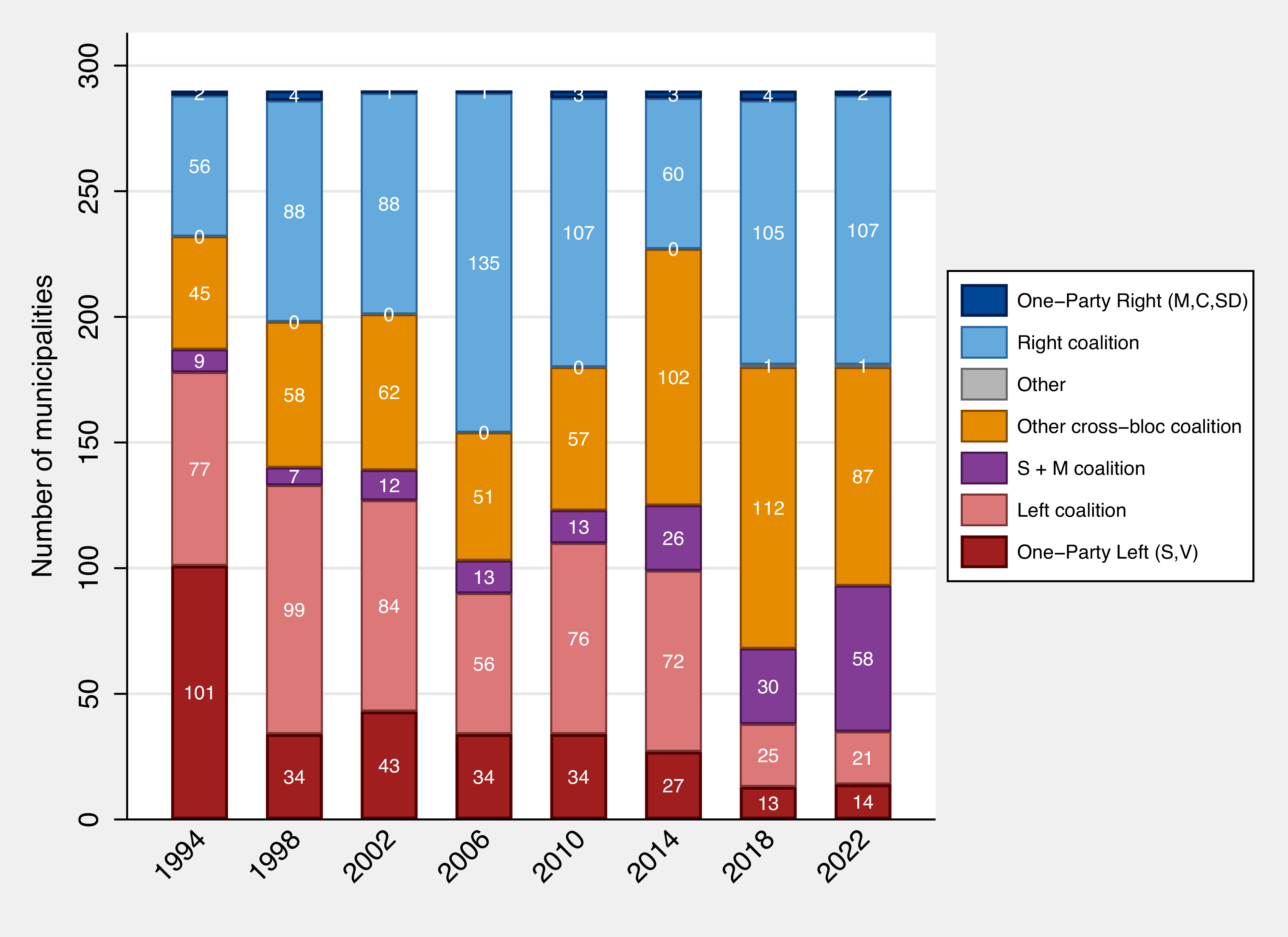
Figure 1. Long description
A stacked bar graph compares the number of municipalities for each coalition type from 1994 to 2022. The horizontal axis represents the years 1994, 1998, 2002, 2006, 2010, 2014, 2018, and 2022. The vertical axis represents the number of municipalities, ranging from 0 to 300. Each bar is divided into segments representing different coalition types: One-Party Right (M, C, SD), Right coalition, Other, Crossbloc, Grand Coalition (S+M), Left coalition, and One-Party Left (S, V). The color scheme includes dark blue for One-Party Right, light blue for Right coalition, gray for Other, orange for Crossbloc, purple for Grand Coalition, pink for Left coalition, and red for One-Party Left. Notable trends include a decrease in One-Party Left municipalities over time and an increase in Crossbloc municipalities. Specific values for each coalition type are visible within each bar for the respective years.
The cross-bloc phenomenon initially primarily involved the Social Democrats forming a coalition with one of the smaller centre-right parties, or the Moderates forming a coalition with centre-right parties and the Green Party. The unorthodox coalition of Social Democrats and Moderates accounted for only 13 (or fewer) of the cross-bloc coalitions between the 1994 and 2010 elections. That said, the number of municipalities where this unorthodox coalition operates has increased dramatically since the 2014 election. Following the 2022 election, the parties formed cross-bloc coalitions in almost 60 of the 145 municipalities. Why have such unorthodox coalitions between the Social Democrats and the Moderates become more common in the municipalities in recent years? We believe that part of the answer lies in the diffusion argument outlined above, which we evaluate below.
Data and methods
Research design and main datasets
We test the ‘diffusion of innovation’ argument using data on coalition formation in Swedish local government. As Bäck (Reference Bäck2003) argues, focusing empirically on a single country allows us to study many coalition formations while holding key variables constant, i.e., a quasi-experimental setting that controls for potential confounds without explicitly modelling them.
We hypothesise that proximity to municipalities with existing unorthodox coalitions increases the probability of similar coalition formation. To test this, we examine whether municipalities located in the same administrative region, i.e., county, as established unorthodox coalitions are more likely to follow suit. We use municipal-level data on coalition formations from the Swedish Association of Local Authorities and Regions (SALAR 2024), complemented by data from Statistics Sweden on socioeconomic and demographic factors as well as election results (n.d.). Our dataset covers all 290 Swedish municipalities across eight election cycles from 1994 to 2022, with one observation per municipality per election year. We also draw on the Swedish Local and Regional Council Survey (KOLFU, Karlsson and Gilljam Reference Karlsson and Gilljam2014a; Karlsson Reference Karlsson2017) for data on party ideological positions. Finally, data on shared municipal borders (contiguity) were collected from the Quality of Government Institute’s public dataset on Swedish municipalities (Dahlström and Tyrberg Reference Dahlström and Tyrberg2016). The panel structure allows us to account for both temporal and cross-sectional variation while analysing diffusion mechanisms and controlling for relevant structural factors – yielding a balanced panel of 290 municipalities observed across eight election cycles.Footnote 5
Main dependent and independent variables
The outcome of interest is the formation of an unorthodox coalition between the Social Democrats and the Moderates following a local election. We constructed the variable using data from the Swedish Association of Local Authorities and Regions (SALAR 2024) and a review of the newspaper Dagens Samhälle. It is coded 1 if the Social Democrats and Moderates formed a ruling coalition – whether alone or alongside additional parties – and 0 otherwise.
Our main independent variable is the S + M coalition in the same region – a binary indicator of whether at least one municipality within the same administrative region (county) had such a coalition during the previous electoral term. Rather than capturing purely geographical proximity, it approximates social proximity: Swedish national parties are almost universally organised at the regional level, encompassing all local branches, meaning that local party elites network primarily within their own administrative region. This approach reflects a broader methodological point: that spatial proximity in political analysis is most meaningful when it captures substantive social and political interdependence rather than geographic coincidence alone (Beck, Gleditsch and Beardsley Reference Beck, Gleditsch and Beardsley2006). Thus, theoretically, networking within the region has the potential to reflect a ‘hierarchical diffusion’ operating through shared party structures. An alternative operationalisation defines proximity strictly by shared municipal borders, aligning more closely with diffusion through intermunicipal social networks and collaboration – such models are also estimated. Spatial-interaction approaches across the full set of Swedish municipalities have an established empirical pedigree (e.g., Östh, Reggiani and Nijkamp Reference Östh, Reggiani and Nijkamp2018), though our interest is in social-organisational rather than transport-based proximity.
Another key modelling decision (see more below) concerns the timing of spatial effects: whether to emphasise diffusion from previous electoral terms or concurrent developments within the same term. Our main specifications rely on prior-term diffusion, as this aligns more closely with theoretical expectations about how coalition strategies diffuse over time through learning and political signalling. Nevertheless, to assess the robustness of our findings, models incorporating same-term spatial indicators are included in a separate set of specifications presented later in the results section.
Control variables
We include a wide range of theoretically salient control variables to control for coalition-specific and municipality-level factors known to influence the likelihood of coalition building, drawing on prior literature (e.g., Martin and Stevenson Reference Martin and Stevenson2001; Bäck Reference Bäck2003; Kayser, Orlowski and Rehmert Reference Kayser, Orlowski and Rehmert2023).
Importantly, we add a control for ideological distance within a coalition by drawing on survey items assessing local councillors’ self-assessed policy positions. The measure of ideological division that we create is based on data from the 2008, 2012, and 2017 waves of the Swedish Local and Regional Council Survey (KOLFU), which surveys all elected politicians in Sweden’s 290 municipal councils (Karlsson and Gilljam Reference Karlsson and Gilljam2014a; Gilljam, Karlsson and Sundell Reference Gilljam, Karlsson and Sundell2015; Karlsson Reference Karlsson2017). KOLFU allows us to create variables of ideological distance between parties along a left-right dimension for each municipality. To create variables for ideological distance, we calculate the difference in ideological positions between the Moderate Party and the Social Democratic Party for each municipality. The ideological positions are measured on a 0–10 Likert scale. Hence, the theoretical maximum value of this variable is 10, although in practice the observed range is 3.5–8.5.Footnote 6
For electoral terms not covered by a KOLFU survey wave, we impute ideological distance using the last value carried forward: the most recently observed estimate is applied to subsequent terms, and the earliest available observation is extended backwards to cover the period prior to the first survey wave. Since missingness is a function of survey timing rather than missing at random, full multiple imputation is not warranted. Following imputation, the variable is available for all observations.
To account for the complexity of the local party system, we include the effective number of parties (ENP) represented in the municipal council, following Laakso and Taagepera (Reference Laakso and Taagepera1979). Unlike a simple party count, ENP weights parties by their relative seat shares – distinguishing between councils dominated by two large parties from those with many roughly equal ones. A higher ENP may increase the likelihood of unorthodox coalition formations as greater fragmentation creates broader coalition-building pressures (e.g., Volden and Carrubba Reference Volden and Carrubba2004). We also control for the combined vote share of the Social Democrats and the Moderates, since greater joint electoral strength reduces the need for additional coalition partners and may make an S–M majority more feasible. The Sweden Democrats’ vote share is included to capture the potential role of a ‘pariah’ party in encouraging broad mainstream coalitions (e.g., De Lange Reference De Lange2012), while the vote share of other parties accounts for electoral fragmentation and the influence of local or non-traditional actors. Finally, drawing on Leiserson’s (Reference Leiserson1968) bargaining proposition, we include an indicator for whether the governing coalition constituted the unique minimal winning coalition, defined as the smallest majority coalition possible given the distribution of seats, with no equally small alternative. This measure captures the logic of minimising bargaining costs by limiting the number of coalition partners, which may affect the attractiveness of unorthodox alliances.
Since it could be argued that unorthodox coalition formations may be more prevalant in smaller municipalities or rural areas, we include the natural logarithm of population size as a control. To control for socioeconomic factors that may influence coalition dynamics, we include the municipal-level mean disposable income as an independent variable. Higher income levels may correlate with political preferences and stability, which in turn may affect the likelihood of unorthodox coalition formations.
Statistical model
To examine the conditions under which municipalities form coalitions between the Social Democrats and the Moderates (S + M coalitions), we estimate a series of complementary log-log regression models. The dependent variable is a binary indicator coded 1 if the municipality formed such a coalition in a given year and 0 otherwise. We employ complementary log-log regression rather than standard logistic regression as our main model, because the dependent variable is rare, with S + M coalitions occurring in approximately 7% of municipality-election observations. Unlike logistic regression, which assumes a symmetric link function, complementary log-log regression uses an asymmetric link function that rises steeply at low probabilities and flattens at higher probabilities. Complementary log-log regression is therefore more appropriate for modelling binary outcomes in which positive events are uncommon. Nonetheless, we also estimate ordinary logit models as a robustness test, and the two setups yield substantively identical results, as we demonstrate in the robustness section. We estimate complementary log-log regression with standard errors clustered at the municipal level to account for within-unit correlation across years. Control variables include structural and political characteristics commonly associated with coalition dynamics, such as the effective number of parties in the municipal council, prior history of S + M collaboration, the presence of other coalition types, ideological distance between the Social Democrats and the Moderates, population size (log-transformed), and average income. We estimate the following model:
 $$cloglog\left( {P\left( {{Y_{it}}=1} \right)} \right)={\beta _0}+ {\beta _1}\;{\rm{SMRegio}}{{\rm{n}}_{it - 1}}+{\beta _2}{X_{it}}+{\beta _3}{Z_{it}}+{\varepsilon _{it}}$$
Where Y it is an indicator equal to 1 if municipality i forms an S + M coalition in year t, and 0 otherwise; SMRegion it−1 is an indicator equal to 1 if at least one other municipality in the same county forms an S–M coalition in year t−1; X it is a vector of institutional and political variables (e.g., ENP in the council, previous S + M collaborations); Z it is a set of socioeconomic control variables (e.g., log population, average income); and ϵ it is the error term.
As a robustness check, we also estimate an alternative specification that includes a lagged dependent variable (Y it−1), resulting in the equation below:
 $$cloglog\left( {P\left( {{Y_{it}}= 1} \right)} \right)= {\beta _y}{Y_{it - 1}}+{\beta _0}+ {\beta _1}\;{\rm{SMRegio}}{{\rm{n}}_{it - 1}}+{\beta _2}{X_{it}}+{\beta _3}{Z_{it}}+{\varepsilon _{it}}$$
As an alternative specification, we also estimated models similar to Equations (1) and (2) but with the independent variable capturing spatial proximity in the form of an S + M coalition among direct municipal neighbours. Taken together, these two set-ups will allow us to examine whether organisational or geographical proximity is the most relevant mechanism for diffusion.
In addition, we estimate specifications analogous to Equations (1) and (2) in which the spatial indicator is measured contemporaneously rather than with a one-term lag, allowing us to assess whether there are diffusion patterns for which coalition formation in neighbouring municipalities occurs within the same electoral term. Contemporaneous diffusion may indicate that politicians in the same region communicate during coalition negotiations and that shared political pressures and signals simultaneously make similar solutions attractive.
Empirical results
Descriptive analysis of geographical clustering of unorthodox coalitions
To gain an initial intuitive sense that there might be something to the argument about the spatial diffusion of unorthodox coalitions, we first examine maps of Swedish municipalities during the eight election cycles that constitute our study period (1994–2022). Each map indicates which municipalities got an ‘unorthodox’ coalition that included at least the Social Democrats and the Moderates. Such an initial eyeballing visualises potential clusters and thus provides hints on whether our formulated hypotheses have preliminary potential. We maintain that even a preliminary inspection of Figure 2 offers no basis for dismissing our argument ex ante. At least, there seem to be regional clusters of coalition-dense areas, and new coalitions tend to emerge both in proximity to earlier unorthodox coalitions and adjacent to other coalitions forming at the same time.
Geographical distribution of social democrat-moderate coalitions in 1994–2022.

Main models: Time lag with respect to the previous electoral term
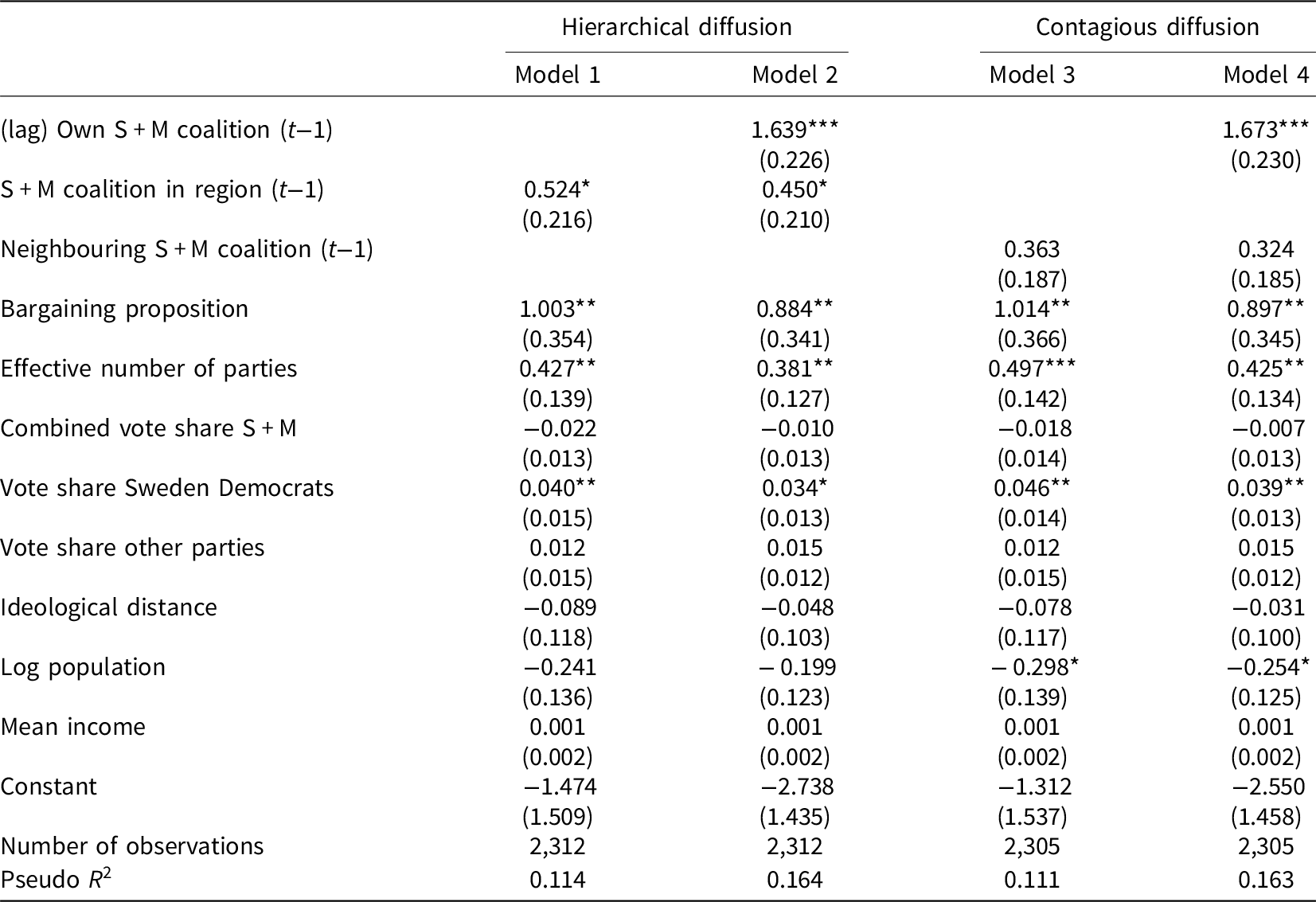
Table 1 reports results from four complementary log-log regression models estimating the probability that a Social Democratic–Moderate (S + M) coalition is formed following a local election. The models are organised to directly contrast two theoretically distinct diffusion mechanisms. Models 1 and 2 test the hierarchical diffusion mechanism, with the key independent variable a binary indicator for whether at least one municipality in the same administrative region had an S + M coalition during the previous electoral term. Models 3 and 4 test the contagious diffusion mechanism, in which the key independent variable instead captures whether at least one direct municipal neighbour had such a coalition in the preceding term. For each mechanism, we estimate one model without a lagged dependent variable (Models 1 and 3) and one with a lagged dependent variable (Models 2 and 4). The inclusion of the lagged variable is motivated by the tendency for coalition structures to persist over time due to strategic alignment and organisational continuity. However, from an econometric standpoint, this approach may be problematic since the lagged dependent variable may correlate with unobserved heterogeneity (cf. Nickell Reference Nickell1981). Hence, we estimate models both with and without the lag and find that the main results are consistent across specifications.
Main complementary log-log regression results with time lag

Table 1. Long description
The table presents results from four complementary log-log regression models estimating the probability of forming a Social Democratic-Moderate (S+M) coalition after local elections. The table has 15 rows and 8 columns. Column headers are: (lag) Own S+M coalition (t-1), S+M coalition in region (t-1), Neighbouring S+M coalition (t-1), Bargaining proposition, Effective number of parties, Combined vote share S+M, Vote share Sweden Democrats, Vote share other parties, Ideological distance, Log population, Mean income, Constant, Number of observations, and Pseudo R2. Row labels are Model 1, Model 2, Model 3, and Model 4. Each cell contains numerical values and standard errors in parentheses. The table contrasts hierarchical diffusion (Models 1 and 2) with contagious diffusion (Models 3 and 4), including models with and without a lagged dependent variable.
Note: Unstandardised coefficients; clustered standard errors within parentheses. Significance: *p < 0.05; **p < 0.01; ***p < 0.001.
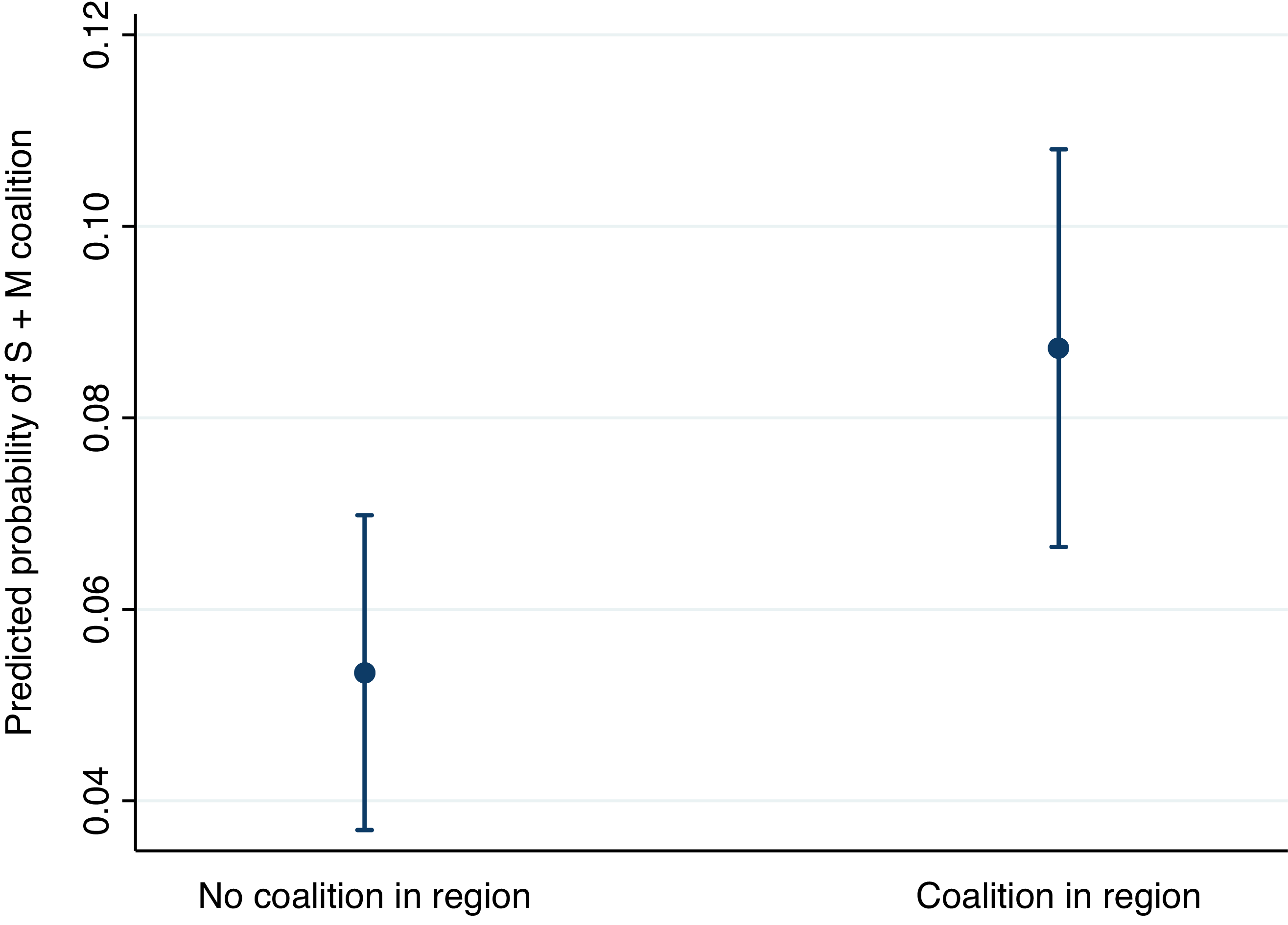
The results reveal a clear asymmetry between the two mechanisms. The regional indicator in Models 1 and 2 is positive and statistically significant for both specifications, indicating that municipalities are more likely to form an S + M coalition when such arrangements were previously present in the surrounding regional environment. As illustrated by Figure 3, the marginal effect (based on Model 1) of regional exposure is substantial: having an S + M coalition in the same region during the previous electoral term is estimated to increase the probability of such a coalition by 3.4 percentage points (from 5.3 to 8.7%). This pattern is consistent with hierarchical diffusion operating through shared county-level party organisational structures. By contrast, the direct neighbour coefficients in Models 3 and 4 are insignificant at the 5% level, thus not supporting contagious diffusion through direct border adjacency.
Average predicted probability of a Social Democrat-Moderate coalition, by whether such a coalition existed elsewhere in the region during the previous term.

From a theoretical perspective, this finding aligns with expectations that political actors at the local level are not isolated decision-makers. Rather, they are embedded within the specific political context of their regional fields, where precedent and example shape strategic considerations. A previous-term S + M coalition within the same regional political environment may serve as a proof of concept, lowering the perceived risks or signalling ideological feasibility to actors in nearby municipalities. The result may also reflect informal learning, coordination, or the influence of regional party leadership, particularly when party organisations operate across multiple municipalities.
From Table 1, we can also see that the likelihood of unorthodox coalitions between the Social Democrats and the Moderates increases with the effective number of parties in the municipal council. Theoretically, this is expected, as greater fragmentation of local councils makes it mathematically harder to form majorities with traditional coalitions. The combined vote share of the Social Democrats and the Moderates enters with a negative sign, consistent with the intuition that S + M cooperation becomes more attractive when the two parties are jointly weaker, but the coefficient does not reach statistical significance, and we therefore read it only as a tendency. More notable is the vote share of the Sweden Democrats, which is positive and statistically significant across all models. Higher local support for the Sweden Democrats is thus associated with a greater probability of an S + M coalition, in line with the common expectation that the rise of a challenger party kept outside coalition bargaining by the established parties pushes government and opposition toward broader cooperation. By contrast, the combined vote share of other parties, including genuinely local parties, shows no significant association with the outcome. Finally, as expected, the bargaining proposition variable is highly significant across all models. This suggests that it is a robust predictor of S + M coalition formation, consistently indicating that favourable bargaining conditions, typically associated with fewer potential coalition partners, increase the likelihood of such cooperation.
Alternative specification: concurrent spatial patterns
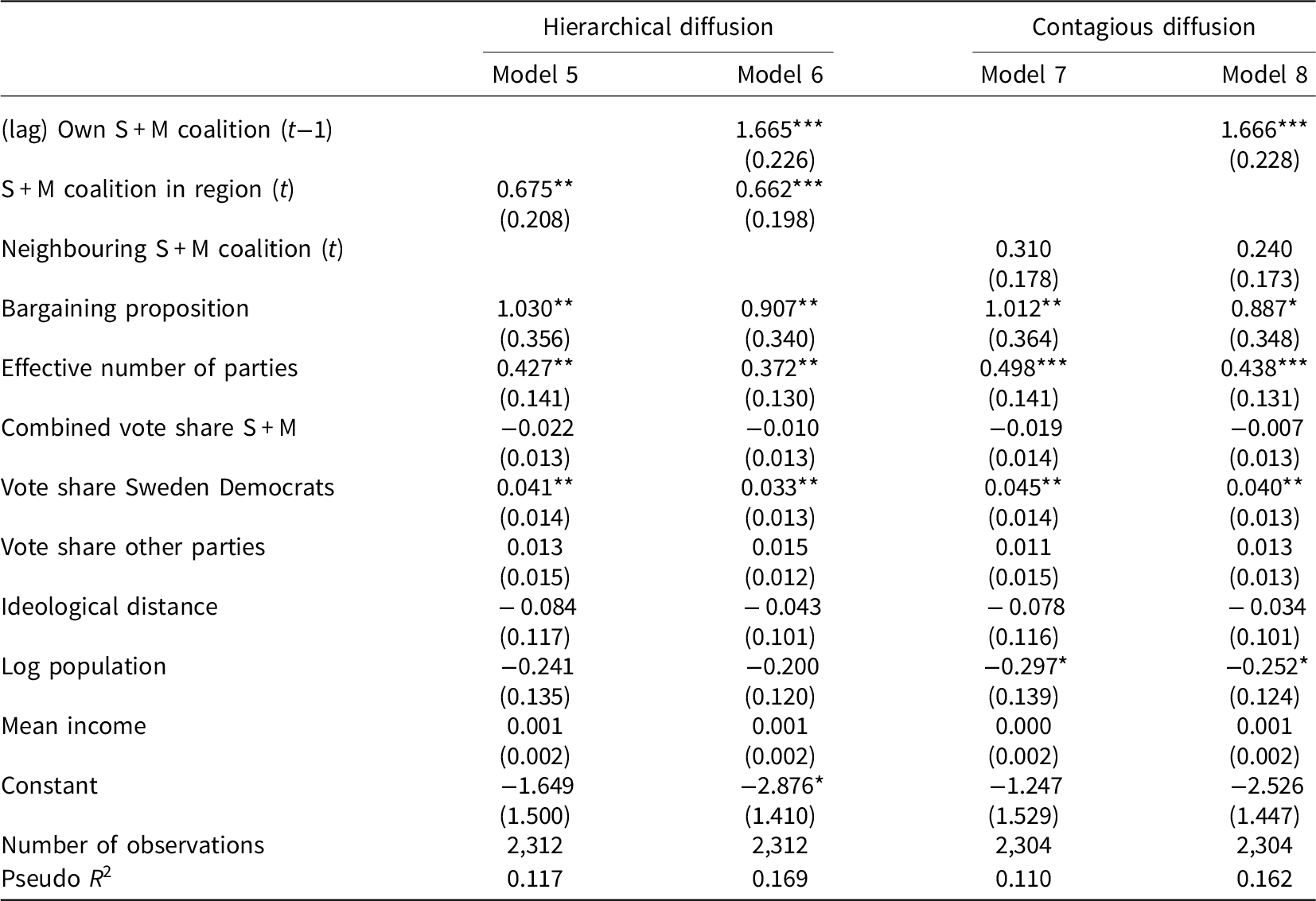
While the lagged specifications in Table 1 are the most theoretically motivated, diffusion need not operate only through sequential imitation or learning. Politicians from the same region may consult each other during coalition negotiations, and shared political signals may push several municipalities toward similar solutions simultaneously – a form of contemporaneous rather than sequential diffusion. Against this backdrop, Table 2 presents alternative specifications that explore whether S + M coalition formation is also shaped by concurrent spatial patterns, that is, whether municipalities are more likely to form such a coalition if at least one municipality in the same region does so in the same electoral term. The key independent variable, S + M coalition in a municipality in the region (same term), captures this contemporaneous spatial dependence. Models 5–8 in Table 2 mirror Models 1–4 in Table 1, with the sole difference that the spatial indicator now reflects coalitions formed in the current rather than the previous electoral term.
Complementary log-log regression model capturing concurrent spatial patterns

Table 2. Long description
The table presents data on hierarchical diffusion and contagious diffusion models for coalition formations, with four models: Model 5, Model 6, Model 7, and Model 8. Each model includes several variables such as lag Own S+M coalition, S+M coalition in region, neighbouring S+M coalition, bargaining proposition, effective number of parties, combined vote share S+M, vote share Sweden Democrats, vote share other parties, ideological distance, log population, mean income, and constant. The table has 15 rows and 8 columns. Row 1: (lag) Own S+M coalition (t-1), 1.665***, (0.226), 1.666***, (0.228). Row 2: S+M coalition in region (t), 0.675**, (0.208), 0.662***, (0.198), 0.310, (0.178), 0.240, (0.173). Row 3: Neighbouring S+M coalition (t), 1.030**, (0.356), 0.907**, (0.340), 1.012**, (0.364), 0.887*, (0.348). Row 4: Bargaining proposition, 0.427**, (0.141), 0.372**, (0.130), 0.498***, (0.141), 0.438***, (0.131). Row 5: Effective number of parties, -0.022, (0.013), -0.010, (0.013), -0.019, (0.014), -0.007, (0.013). Row 6: Combined vote share S+M, 0.041**, (0.014), 0.033**, (0.013), 0.045**, (0.014), 0.040**, (0.013). Row 7: Vote share Sweden Democrats, 0.013, (0.015), 0.015, (0.012), 0.011, (0.015), 0.013, (0.013). Row 8: Vote share other parties, -0.084, (0.117), -0.043, (0.101), -0.078, (0.116), -0.034, (0.101). Row 9: Ideological distance, -0.241, (0.135), -0.200, (0.120), -0.297*, (0.139), -0.252*, (0.124). Row 10: Log population, 0.001, (0.002), 0.001, (0.002), 0.000, (0.002), 0.001, (0.002). Row 11: Mean income, -1.649, (1.500), -2.876*, (1.410), -1.247, (1.529), -2.526, (1.447). Row 12: Constant, 2,312, 2,312, 2,304, 2,304. Row 13: Number of observations, 0.117, 0.169, 0.110, 0.162. Row 14: Pseudo R squared.
Note: Unstandardised coefficients; clustered standard errors within parentheses. Significance: *p < 0.05; **p < 0.01; ***p < 0.001.
In Models 5–6, the coefficient for the S + M coalition in the same region (same term) is positive and significant at the 1% level, confirming that our main finding holds whether the spatial indicator is lagged or concurrent. While sequential diffusion between electoral terms is theoretically more compelling, this result suggests that S + M politicians in the same region likely share information and consult each other during coalition negotiations and that shared political pressures lead municipalities to converge on similar solutions simultaneously.
In contrast, the directly adjacent concurrent coefficients are insignificant in Models 7 and 8, consistent with the pattern in the lagged specifications in Models 3 and 4, further underscoring stronger evidence for hierarchical diffusion than for contagious diffusion.
Additional specifications and robustness checks
The main findings reported in Table 1 are robust to a broad range of alternative specifications. The regional diffusion remains positive and statistically significant when estimated using standard logit, Firth logit, and rare-events logit models. It also holds under alternative operationalisations of the key explanatory variable, including centroid-to-centroid distance and the proportion of municipalities in the region governed by an S + M coalition. By contrast, a simple count of regional coalitions is not significant, indicating that it is the relative rather than the absolute frequency of regional coalitions that matters. The effect also persists in multilevel models with random intercepts for municipalities and electoral years. Finally, interaction analyses suggest that the effect is concentrated at the point of initial adoption rather than being driven by the persistence of existing coalitions. A summary of these robustness checks is provided in Appendix A, with full results reported in the remainder of the Online Appendix.
Concluding discussion
We have examined why long-standing political adversaries may choose to govern together, focusing on the striking rise of coalitions between the Social Democrats and the Moderate Party in Swedish municipalities. While previous research on coalition formation has largely explained government composition through ideological proximity, office- or policy-seeking motivations, and strategic exclusion of ´pariah’ parties, it has rarely considered how coalition strategies can spread across space through processes of imitation and learning. This neglect of spatial interdependence constitutes a gap in the existing literature.
We addressed this gap by introducing a diffusion-of-innovation perspective to the study of coalition formation. Theoretically, we argue that cooperation between ideological opponents can diffuse geographically as parties observe and learn from similar experiments in proximate political systems. This framework highlights how normative barriers to ‘sleeping with the enemy’ may erode not only through national political dynamics or institutional incentives but also through informational and legitimacy spillovers across municipalities in the same region. In doing so, we extend coalition theory beyond its traditional focus on ideological and institutional determinants, showing that coalition decisions are also socially and spatially embedded.
Empirically, our analysis strongly supports this argument. Using panel data covering eight local election cycles (1994–2022), we find that municipalities are significantly more likely to form Social Democrat–Moderate coalitions when such arrangements have previously existed within the same administrative region. This pattern persists after accounting for relevant political, institutional, and socioeconomic factors, suggesting that spatial learning and imitation are key drivers of coalition innovation. The finding is robust across estimators and operationalisations of spatial proximity, including binary indicators, centroid-to-centroid distance measures, and proportional regional measures. The diffusion effect holds for both lagged and contemporaneous regional indicators, suggesting that coalition signals spread through regional party networks both in real time and on the basis of prior experience – supporting the diffusion-of-innovation framework we proposed.
Interestingly, we find only weak evidence for diffusion between directly neighbouring municipalities. The pattern we observe is more consistent with hierarchical diffusion – whereby coalition signals travel through, for example, regional party networks – than with contagious diffusion driven by direct geographic contiguity. The weaker border-sharing effect suggests that physical adjacency is a less important channel than regional political structures and shared organisational networks in transmitting coalition norms across the local political landscape.
Our study makes two distinct contributions to the coalition formation literature. First, it broadens the theoretical foundations of coalition research by integrating spatial diffusion into the explanation of coalition choice. Whereas existing theories typically treat government formation as a discrete strategic event shaped by ideological proximity, office payoffs, or pariah exclusion, our analysis demonstrates that coalition strategies can also spread through processes of local observation and learning. In doing so, we reveal that coalition-making is also a social process embedded in geographically structured networks of observation and learning. Second, by identifying evidence of spatial diffusion in unorthodox coalition building, we show that the diffusion-of-innovation framework can complement the cordon sanitaire hypothesis. The cordon sanitaire logic explains why ideological adversaries may occasionally unite to block a pariah party – but it cannot explain why such alliances cluster geographically or proliferate across electoral cycles. Our results demonstrate that unorthodox coalitions emerge not merely from strategic exclusion but from accumulated local learning: parties observe that cooperation with a historical rival carries limited reputational or electoral costs and that such arrangements can function effectively. This insight reorients the analytical lens from episodic strategic bargaining to dynamic processes of political innovation.
An alternative interpretation of increasing cooperation between S + M is important to address: the GAL-TAN scale. It has received increasing attention in recent literature and captures value-based conflicts over issues such as immigration, multiculturalism, and globalisation. One might hypothesise that the rise of S–M coalitions reflects a convergence between the two parties on this cultural dimension, particularly given that the Social Democrats have adopted more restrictive positions on immigration in recent years (Aylott and Bolin Reference Aylott and Bolin2019). That said, several considerations lead us to remain sceptical of this interpretation. First, expert survey data from the Chapel Hill Expert Survey show that while the Social Democrats occupy a centrist position on the GAL-TAN scale (5.5 on a 0–10 scale), the Moderates are positioned considerably further toward the TAN pole (7.1), yielding a distance that, while somewhat smaller than on the economic left-right dimension, remains substantial (Svensson Reference Svensson, Andersson, Rönnerstrand, Öhberg and Bergström2019). Second, research on the Swedish party system suggests that the GAL-TAN dimension is less independent from the left-right dimension in Sweden than in neighbouring countries such as Denmark and Finland, and that voter self-placements on left-right issues and immigration attitudes have become increasingly correlated over time, indicating that GAL-TAN conflicts may ultimately be absorbed into the dominant left-right dimension rather than constituting a separate axis of competition (Lindvall, Martinsson and Oscarsson Reference Lindvall, Martinsson and Oscarsson2020). Third, and most importantly for our purposes, even if we accept that some convergence on GAL-TAN issues drives the formation of some S–M coalitions, this does not explain why such coalitions cluster geographically.
Lastly, our study’s limitations point to fruitful avenues for future research. Our design cannot directly disentangle which type of learning mechanism drives diffusion – whether informational learning, normative emulation, or organisational coordination within regional party networks. Nor can it fully capture the micro-level interactions that underlie these processes. Future research should therefore probe these mechanisms more closely, for instance, through qualitative interviews, comparative case studies, or experimental approaches that examine how party actors update their beliefs and expectations about cooperating with traditional opponents. Moreover, while our single-country focus allows tight institutional control, comparative extensions would clarify whether similar contagion dynamics operate in other multilevel or fragmented party systems. Additionally, a key challenge in diffusion studies is distinguishing true interdependence from spurious correlation due to common external shocks (Gilardi Reference Gilardi2010). While our inclusion of time trends and regional controls partially addresses this concern, we cannot entirely rule out that regional economic or political shocks drive both the spatial and temporal clustering we observe. Future research could exploit quasi-experimental variation, such as narrow election outcomes that quasi-randomly determine coalition possibilities, to identify causal effects on diffusion (cf. Shipan and Volden Reference Shipan and Volden2008).
More broadly, Sweden offers analytical leverage because it combines a multiparty system with historically entrenched bloc politics and high municipal autonomy – a configuration that makes the diffusion of unorthodox coalitions both possible and observable. We argue that the spatial learning mechanism we identify presupposes three conditions: local discretion over coalition choice, shared organisational or informational channels through which neighbouring precedents become visible, and sufficient governing compatibility between parties for cross-bloc cooperation to be practically viable even if ideologically costly. Where local autonomy is constrained by central mandates, where party organisation is purely national with no regional tier, the contagion dynamic we identify should be far less pronounced. These scope conditions suggest that comparable dynamics may operate in other multiparty systems with proportional representation and meaningful subnational self-government – most plausibly in the other Nordic democracies and the Netherlands, systems that share the combination of proportional representation, substantial municipal autonomy, and multilevel party organisation that our scope conditions identify as necessary – but also in federal and regionalised systems elsewhere in Western Europe where local coalitions are negotiated relatively more independently of national alliance patterns.
In sum, by integrating spatial diffusion and learning into coalition theory, this study moves beyond classical and defensive explanations of ‘strange bedfellows’, offering a dynamic account of how political cooperation evolves, spreads, and may ultimately become normalised across space.
Supplementary material
The supplementary material for this article can be found at https://doi.org/10.1017/S1475676526101741.
Data availability statement
The data and replication files for this paper are publicly available on the EJPR website.
Acknowledgements
The authors would like to thank the participants at the workshop ‘Local Governments in Times of Transition’, Lund University, 20-21 October, 2025, for constructive comments. We also thank Jonas Lindahl, Umeå University, for generous advice on the data and analyses.
Competing interests
The authors declare no conflicts of interest.
Use of AI
The authors used Claude (Sonnet 4.5, Anthropic, claude.ai) during the revision process to assist with reviewing and cross-checking the manuscript against reviewer comments and with copyediting consistency as well as cross-checking references vis-á-vis the main text. Claude (Sonnet 4.5, Anthropic, claude.ai) was also used to cross-check result tables in the main document and the Online Appendix against raw Stata model output. All substantive intellectual content, analytical decisions, and final text remain the sole responsibility of the authors.




 Open access

