1. Introduction
The position of object (and adverbial) clitic pronouns remains one of the most problematic areas of Old Occitan (OOc) syntax (Mériz Reference Mériz1978: 145; Wanner Reference Wanner2010). This paper addresses one specific clause type in which the behavior of these clitics is apparently variable: affirmative main declaratives that contain an overt preverbal subject (nominal or pronominal). In this context, henceforth an SV declarative, clitics (in bold) can be either preverbal, as in (1a), or postverbal, as in (1b).Footnote [2]
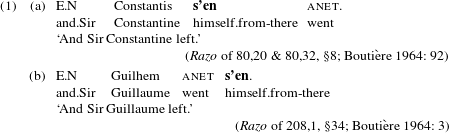
In this paper, I challenge the view that this variation is random (e.g., Mériz Reference Mériz1978: 173). I posit that the subjects in (1a, b) represent distinct syntactic structures and that (1b) is pragmatically marked. I discuss the underlying clausal architecture of both variants, appealing to recent work on the clausal left periphery (e.g., Benincà Reference Benincà, Zanuttini, Campos, Herburger and Portner2006, Ledgeway Reference Ledgeway2010, Haegeman Reference Haegeman2012, Mathieu Reference Mathieu and Arteaga2013). Data from the complete troubadour biographies (Boutière Reference Boutière1964) and the Vida of Saint Douceline (Gout Reference Gout1927) uphold the claim that (1b) represents one of several possible realizations of left-dislocated (LD) subjects in OOc, and that the primary function of LD subjects in OOc is to shift topic.
The development of these claims proceeds as follows: Section 2 presents an overview of clitic position in OOc. Section 3 discusses word-order issues in main declaratives, including verb-second (V2) phenomena, verb-third (V ${\geqslant}$3) orders, the clausal left periphery, the optional saturation of the preverbal position, and the position of clitics. In Section 4, I demonstrate that OOc possessed multiple syntactic positions that could host preverbal subjects. Section 5 discusses information structure and discourse organization. Section 6 presents empirical data, and results appear in Section 7. Section 8 contains discussion, and conclusions are offered in Section 9.
2. Object (and adverbial) clitics in Old Occitan
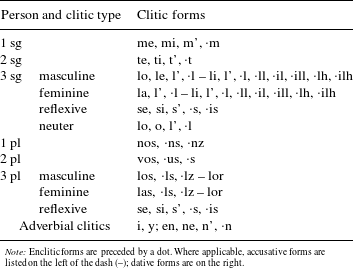
Like the other medieval Romance languages, OOc developed both tonic (strong, disjoint) and clitic (atonic, weak) object pronouns, reflexes of the Latin demonstrative and personal pronouns. Only the clitic series is of concern here; the most frequent forms, including elided forms and common orthographic variants, appear in Table 1 (Anglade Reference Anglade1921: 245–248; Hamlin, Ricketts & Hathaway Reference Hamlin, Ricketts and Hathaway1967: 29–30; Lafont Reference Lafont1967: 105; Smith & Bergin Reference Smith and Bergin1984: 107–110; Paden Reference Paden1998: 302; Romieu & Bianchi Reference Romieu and Bianchi2002a: 43–44; Hinzelin Reference Hinzelin2007: 147).
Object clitics in Old Occitan.
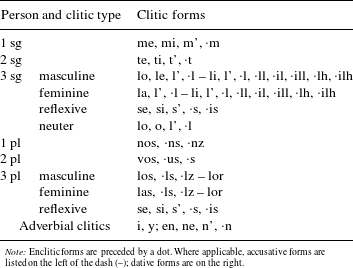
Note: Enclitic forms are preceded by a dot. Where applicable, accusative forms are listed on the left of the dash (–); dative forms are on the right.
In finite clauses, clitics in OOc are adjacent to the verb (Skårup Reference Skårup1997: 45; Romieu & Bianchi Reference Romieu and Bianchi2002a: 127).Footnote [3] In most finite contexts, clitic position is regular and governed by a traditional understanding of the Tobler–Mussafia Law (Tobler Reference Tobler1875, Mussafia Reference Mussafia1886). Thus, clitics in OOc cannot begin a sentence and must be postverbal if no tonic constituent (XP) precedes the verb (Mériz Reference Mériz1978: 154; Smith & Bergin Reference Smith and Bergin1984: 114; Romieu & Bianchi Reference Romieu and Bianchi2002a: 130, 163). For example, in (verb-initial) positive imperatives, total interrogatives, and stand-alone verb-first (V1) declaratives, clitics are typically postverbal (Mériz Reference Mériz1978: 154; Smith & Bergin Reference Smith and Bergin1984: 234; Jensen Reference Jensen1986: 110–111; Kunert Reference Kunert2003: 196; Hinzelin Reference Hinzelin2007: 205, 207, 224). In most clause types that contain a preverbal XP, clitics are preverbal, in accordance with the Tobler–Mussafia Law. When preverbal negation is present, clitics are preverbal in any clause type (Mériz Reference Mériz1978: 157–158; Jensen Reference Jensen1986: 112; Skårup Reference Skårup1997: 45). In subordinates, clitics are usually preverbal (Ramsden Reference Ramsden1963: 73, 92–93; Mériz Reference Mériz1978: 158, 161; Hinzelin Reference Hinzelin2007: 58; Skårup Reference Skårup1997: 45), although Mériz (Reference Mériz1978: 159, 162) and Skårup (Reference Skårup1997: 45) cite postverbal cases. In partial interrogatives (with a preverbal wh-word), clitics are preverbal (Mériz Reference Mériz1978: 158). On the other hand, the position of clitics in certain other finite contexts presents sufficient variation to preclude facile generalizations. In a subjectless coordinate clause with  $e$ ‘and’, for example, clitics are variably preverbal or postverbal (Mériz Reference Mériz1978: 289, 296; Romieu & Bianchi Reference Romieu and Bianchi2002b: 124).
This paper focuses on another finite context in which clitics are variably preverbal or postverbal – namely, SV declaratives, as in (1a, b). Syntactically, (1a, b) form an apparent minimal pair: Both contain an overt preverbal third-person singular nominal subject and the same third-person singular form of s’en anar ‘to leave’. Only the position of the clitics (reflexive se ‘himself’ and en ‘from there’) differs: (1a) presents preverbal clitics (Subject–Object clitic–Verb, henceforth S–Ocl–V), whereas (1b) presents postverbal clitics (S–V–Ocl).
Previous research has sought to identify the default position of clitics in SV declaratives. Some authors identify the default position as preverbal; as Smith & Bergin (Reference Smith and Bergin1984: 113) note, ‘usually the indirect and direct object and neuter pronouns immediately precede the verb’. Smith & Bergin (Reference Smith and Bergin1984: 236) note further that ‘object pronouns usually come right before the verb except in a number of specific circumstances’, although the postverbal circumstances enumerated do not include S–V–Ocl declaratives like (1b). For Romieu & Bianchi (Reference Romieu and Bianchi2002a: 130) clitics are preverbal when there is a preverbal subject; examples like (1b) are not presented. Mériz (Reference Mériz1978: 170–171) finds the preverbal position to be most common but acknowledges numerous examples of postposition. In contrast, other scholars have argued for postposition as a general rule in OOc: Hamlin et al. (Reference Hamlin, Ricketts and Hathaway1967: 34) note that ‘personal pronouns (even when atonic) and reflexive pronouns frequently follow the verb of which they are a complement’ (see also Lafont Reference Lafont1967: 415).
Empirically, S–Ocl–V is more frequent than S–V–Ocl. Mériz (Reference Mériz1978: 174) found S–V–Ocl to be rare in extensive corpus data. Hinzelin (Reference Hinzelin2007, also Reference Hinzelin and Latry2009), who examined legal charters from the 11th to the 14th centuries, does not report specifically on SV declaratives, but his data from unmarked affirmative main declaratives (the types subsumed under his type Ix, see Hinzelin Reference Hinzelin2007: 34) show S–Ocl–V to be the most common. However, Hinzelin finds regional variation: S–V–Ocl accounts for only 18.5% (5/27) of cases in charters from Provence (pages 149, 154) and 24% (3/12) of cases in charters from Languedoc (page 163). However, in charters from Rouergue, S–V–Ocl represents 57% (31/54) of the data (page 158). In the present study, as reported subsequently, S–Ocl–V is more frequent than S–V–Ocl. In the biographies, S–V–Ocl amounts to only 11.3% of SV declaratives; in Douceline the proportion rises to 26%. However, as I will argue in Section 8, directly comparing rates of S–Ocl–V to S–V–Ocl is conceptually flawed.
In this paper, I suggest that the position of object and adverbial clitics in SV declaratives, and specifically the distribution of S–V–Ocl, has remained elusive because previous accounts have (i) treated SV declaratives as representing single, unified clausal architecture and (ii) considered the variation in clitic position to be random. For example, Mériz (Reference Mériz1978: 173) ‘discern[s] no pattern at all governing the choice of one position over the other after the subject of the verb’ and characterizes the variation as ‘apparently random’ (page 174). Hinzelin (Reference Hinzelin2007: 190, 204–205, 217) adopts a similar view, arguing that postposition is optional and that both S–Ocl–V and S–V–Ocl represent unmarked clause types. The underlying structures that Hinzelin assumes for these orders will be discussed in Section 4. Hinzelin (Reference Hinzelin2007: 232) concludes that postposed clitics occur as a result of dialect-internal variation.
In contrast, I will propose that the variation between S–Ocl–V and S–V–Ocl is principled and represents two distinct syntactic structures. In particular, I will claim that S–V–Ocl is pragmatically marked and fulfills certain discourse-pragmatic conditions. As a corollary, I assume that, in the context of SV declaratives, S–Ocl–V is a pragmatically unmarked option.Footnote [4] Two observations lend prima facie support to these claims. First, S–Ocl–V is globally far more frequent than S–V–Ocl, and the skewed proportions alone belie truly random variation. Second, postverbal clitics are lost in most contexts, including SV declaratives, sometime during or after the 14th century (Posner Reference Posner1996: 171). In Hinzelin’s (Reference Hinzelin2007) data, postposition is in sharp decline in all contexts except affirmative imperatives in the 15th century. Crucially, these changes affected not only OOc, but the Romance languages generally (see Ramsden Reference Ramsden1963: 128–129).
3. Main declarative word-order phenomena in Old Occitan and Medieval Romance
To demonstrate that OOc possessed (at least) two distinct syntactic positions capable of hosting preverbal subjects, I first discuss the clausal architecture of OOc and medieval Romance. This section (i) analyzes OOc as a V2 language, (ii) discusses V1 and V ${\geqslant}$3 declaratives, and (iii) discusses Tobler–Mussafia effects and the clausal left periphery.
3.1 Verb second
Old Occitan exhibited properties of a V2 grammar, as did the other medieval Romance languages (Roberts Reference Roberts1993: 6; Posner Reference Posner1996: 249; Salvi Reference Salvi2000: 666; Benincà Reference Benincà, Zanuttini, Campos, Herburger and Portner2006: 61). Of these languages, Old French provides the most intuitive case of V2, in that the verb in main declaratives is typically the second XP (Herman Reference Herman1954: 362; Marchello-Nizia Reference Marchello-Nizia1985: 77; Adams Reference Adams1987: 5; Vance Reference Vance1997: 38), as in modern Germanic V2 (Holmberg Reference Holmberg2015: 343).Footnote [5] Despite the somewhat freer word order that the other medieval Romance languages evince in main declaratives, they nonetheless present characteristic features of V2, and have been analyzed as such: for dialects of Old Italian, see Bocchi (Reference Bocchi, Zaccarello and Tomasin2004: 151), Poletto (Reference Poletto, Batllori, Hernanz, Picallo and Roca2005: 227), or Ledgeway (Reference Ledgeway2008: 437: 438); for Spanish, see Fontana (Reference Fontana1993: 52) or Poole (Reference Poole2006: 190). Old Occitan has likewise been analyzed as V2 (Lafont Reference Lafont1967: 442; Smith & Bergin Reference Smith and Bergin1984: 237; Vanelli, Renzi & Benincà Reference Vanelli, Renzi and Benincà1985; Paden Reference Paden1998: 228; Kunert Reference Kunert2003: 207; Benincà Reference Benincà, Zanuttini, Campos, Herburger and Portner2006; Vance, Donaldson & Steiner Reference Vance, Donaldson, Steiner, Colina, Olarrea and Maria Carvalho2010: 313; pace Sitaridou Reference Sitaridou, Pusch, Kabatek and Raible2005: 373). A salient property of a V2 grammar is that, in main declaratives, the subject occurs postverbally when another XP precedes the verb. For Vance (Reference Vance1997: 43), this is ‘the distinctive mark of all V2 languages’, and this exact feature is a ‘fundamental trait of OOc syntax’ according to Jensen (Jensen Reference Jensen1994: 362; also Jensen Reference Jensen1986: 388–390; Romieu & Bianchi Reference Romieu and Bianchi2002a: 164; Kunert Reference Kunert2003: 199). Example (2) is typical:

Although the verb often appears (descriptively) as the second XP in a main declarative, in the generative perspective, the V2 property is a formal syntactic or structural requirement (Ledgeway Reference Ledgeway2008: 446n.; Roberts Reference Roberts and Gallego2012; Holmberg Reference Holmberg2015: 376), rather than a constraint on the surface word order (Roberts Reference Roberts and Gallego2012: 421). Specifically, in a V2 language, generativists largely agree that the finite verb in main declaratives raises from its base position to a (low) functional head in the C-domain (Rizzi Reference Rizzi and Haegeman1997: 328n.; Ledgeway Reference Ledgeway2008: 446n.; Haegeman Reference Haegeman2012: 109; Holmberg Reference Holmberg2015). Disagreement remains, however, as to which functional head this is, and the landing site of the finite verb may vary across V2 languages (Roberts Reference Roberts and Gallego2012: 417).Footnote [6] A second structural property is that the specifier position of this head is filled by a raised XP (Vance Reference Vance1997: 18; Holmberg Reference Holmberg2015: 375), but this property is not absolute. As Ledgeway (Reference Ledgeway2008: 446n.) notes:

That is, although the finite verb raises to a head in C, the specifier position of this head may or may not be filled (see also Holmberg Reference Holmberg2015: 353, 376).
Most generative accounts of medieval Romance adopt some version of the analysis just sketched. With some variations, this approach underlies Adams (Reference Adams1987), Roberts (Reference Roberts1993), Lemieux & Dupuis (Reference Lemieux, Dupuis, Battye and Roberts1995), Vance (Reference Vance1997), Poletto (Reference Poletto, Batllori, Hernanz, Picallo and Roca2005), Benincà (Reference Benincà, Zanuttini, Campos, Herburger and Portner2006), and Vance et al. (Reference Vance, Donaldson, Steiner, Colina, Olarrea and Maria Carvalho2010: 303), among others. The clausal architecture for main declaratives given in (3) is based on Adams (Reference Adams1987: 8); this architecture will be refined in Section 3.2 below.

In light of (3), the V2 declarative in (2) possesses the following clausal architecture:

With Vanelli et al. (Reference Vanelli, Renzi and Benincà1985: 168–169; see also Roberts Reference Roberts1993: 95), I assume that the verb donet ‘gives’ has raised from its base position in VP to C0 and that the direct object mal cosselh ‘bad counsel’ has raised to SpecCP. The movement of these two XPs explains from a structural perspective the postverbal position of the subject, which is blocked from raising to SpecCP because this position is already filled. Otherwise, however, if no XP raises to SpecCP, the subject is free to do so, yielding surface SV order, as in (5). The V2 grammar of OOc thus licenses both preverbal and postverbal subjects in main declaratives.

Because the present paper focuses on SV declaratives, I mention without further elaboration that subjects can be null in OOc, in both main and embedded clauses (Hamlin et al. Reference Hamlin, Ricketts and Hathaway1967: 33; Smith & Bergin Reference Smith and Bergin1984: 111; Jensen Reference Jensen1986: 86–88; Romieu & Bianchi Reference Romieu and Bianchi2002a: 128; Reference Romieu and Bianchi2002b: 35).
3.2 Verb-third orders and the clausal left periphery
The model in (5) above accounts for the large proportion of medieval Romance main declaratives that are descriptively V2. As formulated, however, it is ill equipped to address V ${\geqslant}$3 declaratives, in which the verb appears as the third (or higher) XP. Like the other medieval Romance languages, OOc evinces V
 ${\geqslant}$3 declaratives, as in (6) and (7).Footnote [7]
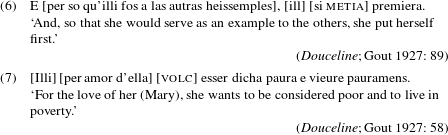
In (6), the verb is preceded by a tensed subordinate (per so qu’…‘so that…’) and the subject ill ‘she’. In (7), both illi ‘she’ and a prepositional phrase (per amor d’ella ‘for the love of her’) precede the verb. For V ${\geqslant}$3 examples in other medieval Romance languages, see Benincà (Reference Benincà, Zanuttini, Campos, Herburger and Portner2006: 69–70) or Mathieu (Reference Mathieu and Arteaga2013: 345).
Partially in response to V ${\geqslant}$3 data, Skårup (Reference Skårup1975) argued that medieval Romance possessed more than one preverbal position and posited an extraposition zone, for XPs that occur to the left of the declarative as traditionally defined (page 179) but that are in some way affiliated with the declarative (page 416). More recent work follows Rizzi (Reference Rizzi and Haegeman1997) in assuming a multi-layered CP domain that constitutes the left periphery of the clause (e.g., Benincà Reference Benincà, Zanuttini, Campos, Herburger and Portner2006, Ledgeway Reference Ledgeway2010, Haegeman Reference Haegeman2012, Mathieu Reference Mathieu and Arteaga2013). In this approach, CP contains numerous functional projections, subject to various ordering constraints. The clausal architecture adopted for OOc in the present study is that of Benincà (Reference Benincà, Zanuttini, Campos, Herburger and Portner2006: 55), chosen because it was conceived specifically on the basis of medieval Romance data and because my analysis will draw on Benincà’s (Reference Benincà, Zanuttini, Campos, Herburger and Portner2006) insights regarding clitic placement. Benincà’s (Reference Benincà, Zanuttini, Campos, Herburger and Portner2006) model appears in its simplest form in (8); for similar approaches to Old French, see Labelle (Reference Labelle2007) and Mathieu (Reference Mathieu and Arteaga2013).

In Benincà’s model, the Focus projections comprise the leftward edge of the main declarative as traditionally defined: Focus0 is the equivalent of Adams’ (Reference Adams1987) C0 or (in philological terms) the second position. Likewise, SpecFocus supersedes SpecCP to denote the traditional first position.Footnote [9] For Benincà (Reference Benincà, Zanuttini, Campos, Herburger and Portner2006: 67), the landing site of the finite verb in the medieval Romance V2 system is a C head in Focus (i.e., Focus0). Whereas the clausal architecture in (3) posits only a single preverbal position, the model in (8) with its expanded left periphery readily accounts for V ${\geqslant}$3 declaratives. If, as generative analyses argue, the fundamental property of the V2 grammar involves verb raising to a functional head in the C domain (e.g., to Focus0) and (frequently) raising of an XP to the specifier of that head (e.g., SpecFocus), rather than the descriptively V2 surface orders that often result (Benincà Reference Benincà, Zanuttini, Campos, Herburger and Portner2006: 70), then the V2 property, when coupled with a richly articulated left periphery, should unproblematically generate V
 ${\geqslant}$3 orders. As a further corollary, XPs to the left of SpecFocus, when present, do not ‘count’ for V2 purposes (Salvi Reference Salvi2000: 667; Rouveret Reference Rouveret2004: 190; Labelle Reference Labelle2007: 303; Ledgeway Reference Ledgeway2008: 466; Mathieu Reference Mathieu and Arteaga2013: 341). As Holmberg (Reference Holmberg2015: 347) writes in his crosslinguistic discussion of V2:

In other words, material in TopicP and FrameP projections is syntactically (if not pragmatically) optional in the sense that it does not satisfy any formal requirement related to the V2 property. V ${\geqslant}$3 declaratives are then V2 declaratives that contain additional XPs base-generated, or externally merged, to the left of SpecFocus.
3.3 Saturation of SpecFocus
In the OOc V2 grammar, saturation of SpecFocus is not obligatory (Mériz Reference Mériz1978: 154; Skårup Reference Skårup1997: 46; Kunert Reference Kunert2003: 196; Hinzelin Reference Hinzelin2007: 172). As a result, V1 declaratives are licit – as in other medieval Romance languages (Benincà Reference Benincà, Zanuttini, Campos, Herburger and Portner2006: 67–68) – with the structure in (9).Footnote [10]

In Old French, stand-alone (i.e., non-coordinated) V1 declaratives disappeared after about 1200, when saturation of SpecFocus became obligatory (Foulet Reference Foulet1928: 320; Skårup Reference Skårup1975: 291, 300; Rouveret Reference Rouveret2004: 200–201). By contrast, in OOc, SpecFocus could remain unsaturated throughout the period of interest here, and Hinzelin (Reference Hinzelin2007: 172) finds V1 declaratives as late as 1480.Footnote [11] Moreover, OOc allowed V1 declaratives more frequently than Old French (Skårup Reference Skårup1997: 46).
3.4 Tobler–Mussafia effects
The position of object and adverbial clitics in medieval Romance generally obeys the Tobler–Mussafia Law (Tobler Reference Tobler1875, Mussafia Reference Mussafia1886), according to which clitics cannot occur in absolute initial position. Thus, if the verb (to which the clitics are strictly adjacent) is preceded by a XP, clitics appear preverbally. On the other hand, if no XP precedes the verb, then clitics are postverbal.
Tobler–Mussafia effects are illustrated in the following examples, which contrast a V2 declarative (10) with a V1 declarative (11). In the V2 declarative, the XP aquisti vertutz ‘this virtue’ precedes the verb enclinava ‘inclined’, and the clitic l’ ‘her’ is preverbal. By contrast, in (11) no XP precedes the verb fez ‘has’, and the clitic lo ‘him’ is postverbal.
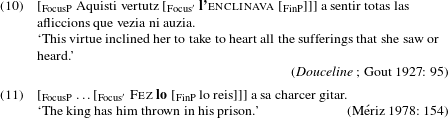
In Benincà’s (Reference Benincà, Zanuttini, Campos, Herburger and Portner2006: 69) interpretation of the Tobler–Mussafia Law, the position of clitics depends on the saturation or non-saturation of SpecFocus. When SpecFocus contains a XP, clitics – if present – are preverbal. On the other hand, if SpecFocus is empty, clitics are postverbal.Footnote [12]Footnote [13] Linking the position of clitics to the saturation of SpecFocus has the advantage over the traditional formulation of the Tobler–Mussafia Law, in that it accounts for S–V–Ocl examples, like (1b) above, in which clitics are postverbal despite a preverbal XP that is seemingly adjacent to the verb.
As a further illustration, consider the case of quant ‘when’ subordinate clauses that immediately precede main declaratives in Old French. As Donaldson (Reference Donaldson2012; see also Skårup Reference Skårup1975, Benincà Reference Benincà, Zanuttini, Campos, Herburger and Portner2006) documents, these initial quant-clauses (and most other initial subordinate clauses as well) occupy a left-peripheral Frame position of the main declarative in Old French. As a result, SpecFocus is available to host another XP, frequently the adverb si. Terminological differences aside, there is widespread consensus that si occupies SpecFocus (Fleischman Reference Fleischman1991: 263; Ferraresi & Goldbach Reference Ferraresi and Goldbach2002: 11; Bocchi Reference Bocchi, Zaccarello and Tomasin2004: 154; Rouveret Reference Rouveret2004: 220; Poletto Reference Poletto, Batllori, Hernanz, Picallo and Roca2005: 224; Benincà Reference Benincà, Zanuttini, Campos, Herburger and Portner2006: 75), as in (12):

In early Old French (before 1200), however, saturation of SpecFocus was not yet obligatory (Rouveret Reference Rouveret2004: 200–201), and configurations like (13) are attested.

In (13), the clitic li ‘to/from him’ is postverbal, revealing that SpecFocus is empty. Despite its surface proximity to the verb tolz ‘takes’, the initial quant-clause cannot be underlyingly adjacent to the verb. Rather, it occupies FrameP, as in (12). Unlike in (12), however, SpecFocus is empty in (13), and the clitic is postverbal as a result.
An analogous situation arises in OOc. As Vance et al. (Reference Vance, Donaldson, Steiner, Colina, Olarrea and Maria Carvalho2010: 316) found, initial cant ‘when’ subordinate clauses are overwhelmingly left-peripheral in OOc. Just as in early Old French, examples in which SpecFocus is saturated occur alongside examples in which SpecFocus remains empty, and the position of clitics in the declarative changes predictably, witness (14) and (15).
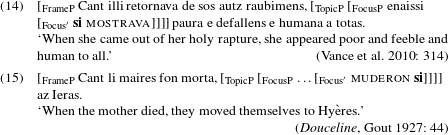
The same approach yields fruitful results when applied to S–Ocl–V and S–V–Ocl.
4. Multiple positions available for preverbal subjects
I propose that preverbal subjects in OOc affirmative SV declaratives occupy one of two distinct positions: In the unmarked case, the subject occupies SpecFocus, syntactically adjacent to the verb in Focus0. I will refer to this default case as a conventional (preverbal) subject. In the pragmatically marked case, the preverbal subject occupies a TopicP position, to the left of SpecFocus and hence not adjacent to the verb (regardless of the eventual surface order). The spirit of this proposal is not new, as Skårup (Reference Skårup1975: 396–397) posited (leftward) extraposed subjects in OOc and Old French (see also Skårup Reference Skårup1997: 46).
The present analysis treats left-peripheral subjects as instances of subject LD, following work on both historical and contemporary Romance (e.g., Lambrecht Reference Lambrecht1981, Ashby Reference Ashby1988, Anagnostopoulou Reference Anagnostopoulou, Anagnostopoulou, van Riemsdijk and Zwarts1997, Marchello-Nizia Reference Marchello-Nizia1998, Cardinaletti Reference Cardinaletti and Rizzi2004, Frascarelli Reference Frascarelli2007, Labelle Reference Labelle2007, Mathieu Reference Mathieu and Arteaga2013). From these studies emerge two relevant observations. The first, broad but crucial, is the presence of multiple positions capable of hosting preverbal subjects. The second is a consensus that LD subjects occupy a TopicP position (Rizzi Reference Rizzi and Haegeman1997: 324; Benincà Reference Benincà, Zanuttini, Campos, Herburger and Portner2006: 58; Frascarelli Reference Frascarelli2007: 693; Labelle Reference Labelle2007: 303) in the languages under discussion.
As a first step, I will show that OOc possesses LD subjects. Importantly, in the following examples, SpecFocus is overtly saturated, and the subject is visibly to the left of SpecFocus. That OOc possesses conventional preverbal subjects (in SpecFocus) is evident from examples (1a) and (10) above, where no XP intervenes between the subject and the verb, and clitics are preverbal.
In the biographies, sequences of subject + adverb si + verb (S–si–V) are particularly common in declaratives (Jensen Reference Jensen1972: 25). If si occupies SpecFocus as claimed, then it follows that a subject to the left of si is left-peripheral or left-dislocated. Accepted theory places it in a TopicP projection, as in (16).

Left-dislocated subjects followed by si can also be pronominal:Footnote [14]

Left-dislocated subjects can also be reprised by a preverbal subject pronoun (Sp), rather than si:

Both the LD subject and the clause-internal resumptive element may be subject pronouns:

I take these examples as evidence that OOc licenses subjects to the left of SpecFocus, and that both conventional and LD subjects are possible in main declaratives.Footnote [15] Regardless of eventual discourse-pragmatic differences, these two types of preverbal subject are structurally distinct, a difference that has not always been understood or acknowledged. For example, Hamlin et al. (Reference Hamlin, Ricketts and Hathaway1967: 73n.1) and Paden (Reference Paden1998: 228) treat si in S–si–V as a clitic that co-occurs with the verb, with the subject in SpecFocus.Footnote [16] Instead, drawing on Benincà (Reference Benincà, Zanuttini, Campos, Herburger and Portner2006), I propose the following structures for SV declaratives: Conventional preverbal subjects have the representation in (20a), whose terminology supersedes that of (5), and LD subjects that in (20b):

As shown in Section 3.3 above, OOc allows SpecFocus to remain empty. With this in mind, the minimal pair of SV declaratives in (1a, b) can be represented as in (21a, b). In the interests of syntactic accuracy, the elided sequence  $E.N$ ‘and Sir’ of the original is (artificially) separated in (21a, b) into its components
 $E$ ‘and’ and En ‘Sir’.
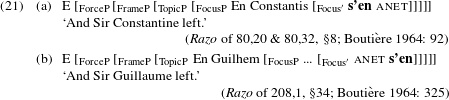
Adopting Benincá’s (Reference Benincà, Zanuttini, Campos, Herburger and Portner2006) claim that the position of clitics depends on the saturation of SpecFocus, the subject En Constantis ‘Sir Constantine’ in (21a) occupies SpecFocus, and the clitics are preverbal; this is a conventional preverbal subject. By contrast, in (21b), the subject occupies a TopicP position in the left periphery, so it is an LD subject. SpecFocus is empty, however, and as a result, the clitics are postverbal. The subject in (21b) is thus covertly left-dislocated: Although superficially next to the verb in the surface structure, it is crucially not underlyingly adjacent the verb.
Although Skårup (Reference Skårup1975) proposed multiple preverbal positions in OOc, the idea has gained little currency in subsequent work on OOc syntax. Mériz (Reference Mériz1978), for example, does not cite Skårup, and neither do recent manuals or reference works (e.g., Smith & Bergin Reference Smith and Bergin1984, Paden Reference Paden1998, Romieu & Bianchi Reference Romieu and Bianchi2002a, Reference Romieu and Bianchib). Vance (Reference Vance2011) posits multiple preverbal positions, but Hinzelin (Reference Hinzelin2007: 118) rejects Skårup’s analysis on the grounds that it flouts the conventional (i.e., linear, pre-Benincà) understanding of the Tobler–Mussafia Law, although Hinzelin alludes to the possibility of LD in OOc, as discussed in Section 5.3. Instead, Hinzelin (Reference Hinzelin2007: 204–205, 221) posits that a single position – SpecFocus – hosts subjects in SV declaratives, regardless of whether clitics are preverbal or postverbal. Furthermore, Hinzelin considers both S–Ocl–V and S–V–Ocl to be unmarked and attributes variation between them to regional differences.
However, Hinzelin (Reference Hinzelin2007: 118n.) raises a valid critique of an approach à la Skårup (Reference Skårup1975) that posits multiple positions for preverbal subjects: Without a principled justification for choosing one structure over the other, it is circular to claim that the subject occupies the left periphery in S–V–Ocl sequences but SpecFocus in S–Ocl–V cases.
5. Information structure
5.1 Topic and focus
To resolve this difficulty, I turn to information structure, and particularly the notion of topic. Following Reinhart (Reference Reinhart1981: 54), the topic is what an utterance is about. Similarly, Lambrecht (Reference Lambrecht1994: 131) writes:

Topics are generally already known and readily accessible to the discourse participants, usually because they have been mentioned previously in the discourse. Focus information, in contrast, is new information predicated about the topic; it is the comment made about the topic. Focus is the unpredictable, unanticipated information that moves the discourse forward (Firbas Reference Firbas1964: 270; Lambrecht Reference Lambrecht1994: 213), and most assertions contain both topic and focus (i.e., topic–comment).Footnote [17]
5.1.1 Sentence topics and discourse topics
Following van Dijk (Reference van Dijk1976), Reinhart (Reference Reinhart1981), Givón (Reference Givón1983), and Lambrecht (Reference Lambrecht1994), I distinguish between two types of topic – sentence topic (ST) and discourse topic (DT) – on the basis of their prominence in the discourse, that is, how long they remain topical. In previous research, the longevity of topics has been measured in sentences. For Reinhart (Reference Reinhart1981: 54), STs remain topical only within the confines of a single sentence (matrix clause).Footnote [18] In contrast, a DT ‘[designates] a topic expression whose referent is pragmatically salient beyond the limit of a single sentence’ (Lambrecht Reference Lambrecht1994: 117; see also van Dijk Reference van Dijk1976: 50; Reinhart Reference Reinhart1981: 54). To return to Reinhart’s (Reference Reinhart1981) notion of aboutness, a DT is what a stretch of discourse (comprised of multiple sentences) is about. Unlike an ST, whose longevity as a topic is quite restricted, a DT creates topical or thematic continuity, serving as a leitmotif of a thematic paragraph (Givón Reference Givón1983: 8). In addition, the DT is usually the participant ‘most crucially involved in the action sequence’ of the thematic paragraph (Givón Reference Givón1983: 8; see also Lambrecht Reference Lambrecht1994: 117). In the present study, a DT is defined as a referent that remains topical across two or more contiguous main declaratives.
Although a thematic paragraph is globally about a certain DT, other discourse referents may appear within this thematic paragraph, and these referents sometimes become STs. As van Dijk (Reference van Dijk1976: 53) emphasizes, however, such STs are ‘momentaneous’ and are usually related to the larger DT; they serve as comments on the larger DT without changing it. Nevertheless, the presence of topics other than the DT within the thematic paragraph creates potential interference or competition between topics (Givón Reference Givón1983: 11, 14).Footnote [19]
5.2 Topic marking
Discourse-pragmatic notions like topic and focus can be marked grammatically to make an utterance easier for a hearer to comprehend (e.g., Lambrecht Reference Lambrecht1994: 3). Crosslinguistic research has revealed both that the grammatical subject usually represents the topic of the utterance (Reinhart Reference Reinhart1981: 62) and that LDs are typically topics (Ashby Reference Ashby1988: 212; Prince Reference Prince and Kamio1997: 124; Lambrecht Reference Lambrecht, Haspelmath, König, Oesterreicher and Raible2001: 1072). It ensues that subjects are the most frequently left-dislocated XPs (Lambrecht Reference Lambrecht, Haspelmath, König, Oesterreicher and Raible2001: 1054).
Within the general description of topics, more specialized functions can be identified. Here, I follow Frascarelli & Hinterhölzl (Reference Frascarelli, Hinterhölzl, Schwabe and Winkler2007: 87), who distinguish between aboutness topics, contrastive topics, and familiar topics; in particular I will retain Frascarelli & Hinterhölzl’s further opposition between shifting topics and continuing topics. Frascarelli & Hinterhölzl’s definition of aboutness topics adheres to Reinhart (Reference Reinhart1981) and Lambrecht (Reference Lambrecht1994). With respect to discourse organization, Frascarelli & Hinterhölzl (Reference Frascarelli, Hinterhölzl, Schwabe and Winkler2007: 89) note that many aboutness topics possess the function of shifting topics, in that they encode a referent that is ‘newly introduced, newly changed or newly returned to’ (Givón Reference Givón1983: 9). That is, a shifting topic (which is always an aboutness topic) signals a rupture with the previous topic by orienting the discourse toward a new topic. A contrastive topic ‘induces alternatives which have no impact on the focus value and creates oppositional pairs with respect to other topics’ (Frascarelli & Hinterhölzl Reference Frascarelli, Hinterhölzl, Schwabe and Winkler2007: 88). Finally, familiar topics involve referents that are already accessible in the discourse, and familiar topics sometimes represent continuations of the already established DT (pages 88, 95), in which case they are continuing topics. Both shifting topics and continuous topics qualify as aboutness topics (page 111), but whereas shifting topics signal a rupture in topic, continuing topics extend the existing topic.
5.3 Information structure in Old Occitan
Previous studies of OOc syntax have not linked discourse structure to clitic position. Ramsden (Reference Ramsden1963) examined the nature of the preverbal constituent to explain clitic position, but although he looked beyond grammatical categories in an effort to capture ‘the whole sense of the utterance’ and the strength of the ‘union of verb and preceding element’ (page 38), his analysis did not extend beyond individual phrases to encompass the surrounding discourse. Similarly, both Skårup (Reference Skårup1975, Reference Skårup1997) and Mériz (Reference Mériz1978) focused on individual phrases devoid of discourse context. Although Combettes (Reference Combettes1971) and Kunert (Reference Kunert2003) examined OOc from an information-structural perspective, neither examined LD subjects or specifically addressed the position of clitics in SV declaratives, and in fact, Combettes (Reference Combettes1971: 298, 299, 301) subsumed S–si–V sequences under SV. Hinzelin (Reference Hinzelin2007) invoked information structure (e.g., pages 149, 202–203, 232), but only in passing, and without considering how it interfaces with syntactic structure. For example, Hinzelin’s data from early OOc charters provide three occurrences of the sequence nominal direct object + verb + clitic(s), with postverbal clitics. Although Hinzelin (Reference Hinzelin2007: 149–150) analyzed these examples as topic constructions and instances of (clitic) LD, they are absent from the formal syntactic analysis (pages 217–230), and the syntactic representation of LDs is not made explicit. Hinzelin (Reference Hinzelin2007) analyzed no further examples from his OOc data as LD (see pages 154–172). Importantly, although the same early charters (Rouergue region) evince examples of S–V–Ocl, Hinzelin analyzed these not as topic or LD structures but rather as unmarked SV declaratives (pages 204–205). As I argue in Section 7 below, however, S–V–Ocl marks topic in the present data (and perhaps in the Rouergue charters as well; see Section 8).
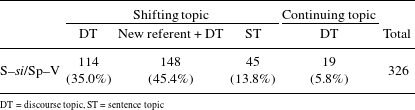
Data from visibly left-dislocated subjects in the OOc biographies demonstrate the link between LD subjects and topic marking. This section synopsizes the results of Donaldson (Reference Donaldsonto appear), based on 326 tokens from the biographies in which the presence of one (or more) XPs between the subject and the verb shows visibly that the subject is left-dislocated. In these data, the most common configuration is NP S–si–V ( $n$ = 296); in addition, there are 20 tokens of Sp–si–V, eight tokens of NP S–Sp–V, and two tokens of Sp–Sp–V. With few exceptions, these LD subjects represent shifting topics. As seen in Table 2, 35.0% elevate
Discourse function: Occurrences and discourse functions of S–si–V and S–Sp–V in the biographies.
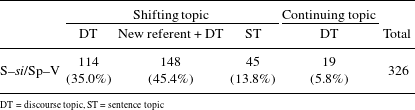
DT = discourse topic, ST = sentence topic
a known referent to the status of DT, and another 45.4% fulfill a dual function of introducing a new referent to the discourse and simultaneously marking it as the DT.Footnote [20] A smaller portion of the LDs (13.8%) represents shifting topics that establish an ST. Finally, a small number (5.8%) represent continuing topics, in that they clarify or confirm the existing DT, often in the presence of other referents potentially competing for topichood.
Thus, 94.2% of these data (307/326) contain shifting topics. Within this subset of the data, LD subjects preferentially mark DTs as opposed to STs: Of the 307 tokens of shifting topics, 85.3% (262/307) establish a DT. The following extract illustrates how S–si–V LDs function as shifting topics. (I have introduced internal section divisions, shown in brackets, and the relevant LDs are underlined.)

After the narrator’s introduction in [1], the S–si–V at the beginning of [2] establishes Sir Raimon de Miraval as the DT. Sir Raimon remains the topic throughout [2], in which we learn of his love for la Loba (‘she-wolf’), a woman from the region of Carcassès whose background is sketched. At the beginning of [3], a S–si–V shifts to a new DT, la Loba. All the new information proffered in [3] and [4] is about la Loba: her desire for recognition, her numerous suitors (named as purely collateral information), and that songs have been written about her. By contrast, in [5], the DT shifts back to Sir Raimon, signaled by the S–si–V at the beginning of [5].
The distribution of visibly left-dislocated subjects (S–si–V, S–Sp–V) in the biographies confirms their status as a pragmatically marked word order whose primary function is that of a shifting topic, usually to a DT. The data also confirm Fleischman’s (Reference Fleischman1991: 265) claim that si divides an utterance into a topic and comment as well as Kunert’s (Reference Kunert2003: 207) observation that OOc phrases usually possess a topic–comment structure (also Combettes Reference Combettes1971: 297). Given the tight association between LD and topic marking, the discourse-pragmatic function of S–si–V corroborates analyses of medieval Romance that have considered S–si–V to be LD on primarily structural (i.e., purely syntactic) grounds, including Marchello-Nizia (Reference Marchello-Nizia1985: 169), Fleischman (Reference Fleischman1991: 261), Vance (Reference Vance1997: 61), and Ferraresi & Goldbach (Reference Ferraresi and Goldbach2002: 17).
This section gave the rationale for positing multiple preverbal positions available to host subjects in OOc, on the basis of examples in which SpecFocus is overtly saturated and the left-peripheral nature of the preceding subject is visible (i.e., S–si–V, S–Sp–V). In the biographies, these sequences fulfill a particular discourse-pragmatic function, that of a shifting topic. In most cases, the sequence establishes a DT, either by using an already known discourse referent or by introducing a new discourse referent that is immediately topical. In Section 7, this analysis will be extended to the distinction between S–Ocl–V and S–V–Ocl main declaratives.
6. Data
The data come from complete analyses of the entire body of OOc troubadour biographies as well as the Vida of Saint Douceline. The biographies were composed in the 13th and 14th centuries (Boutière Reference Boutière1964: viii; Jensen Reference Jensen1972: 22), and Douceline dates from the early 14th century (Henrichsen Reference Henrichsen1955: 186; Garay & Jeay Reference Garay and Jeay2001: 14). The biographies are in prose, although they regularly cite short extracts of verse works; these verse extracts were excluded. Douceline is entirely in prose.Footnote [21]
Considerable dialectal variation existed within the OOc zone (Bec Reference Bec1963: 34–58), and few if any OOc texts are dialectally pure (Lafont Reference Lafont1967: 23; Smith & Bergin Reference Smith and Bergin1984: 4). The emergence of a stable written koiné sometime after 1100 (Bec Reference Bec1963: 69; Smith & Bergin Reference Smith and Bergin1984: 4) did not preclude inconsistencies in morphology and pronunciation (Lafont Reference Lafont1967: 23–24). Although the language of the biographies reveals Italian influences, especially in morphology and spelling (Boutière Reference Boutière1964: x; see also Henrichsen Reference Henrichsen1955), it is accepted that the authors were native OOc speakers (Schutz Reference Schutz1938: 232; Boutière Reference Boutière1964: x). Importantly, given the relative paucity of OOc prose (Henrichsen Reference Henrichsen1955: 12), the biographies constitute the largest extant body of OOc literary prose (Schutz Reference Schutz1938: 225) and form a literary genre with considerable linguistic and literary consistency (Boutière Reference Boutière1964: viii). Rohlfs (Reference Rohlfs1970: 45) considers them ‘splendid examples of Provençal prose’, and selections of the biographies appear in most anthologies and manuals on OOc.
The biographies and Douceline were searched for all instances of affirmative SV declaratives that contained object or adverbial clitics (preverbal or postverbal). Only affirmative declaratives were retained because clitics are systematically preverbal in the presence of a preverbal negator. All overtly left-dislocated subjects (i.e., those reprised by si or an Sp) were also excluded; these data are discussed in Donaldson (Reference Donaldsonto appear). Finally, SV declaratives devoid of clitics were excluded, as the absence of object renders uncertain the position of the subject. All tokens were coded for type of subject and the position of clitics. In addition, all the tokens of S–V–Ocl were coded for discourse function (shifting topic vs. continuing topic; ST vs. DT; focus). As mentioned, only referents that remained topical across at least two contiguous main declaratives qualified as DTs. As a control measure, the first 100 tokens of S–Ocl–V from each text were coded for the discourse function of the subject referent.
7. Results
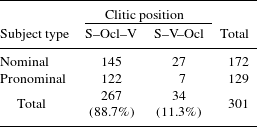
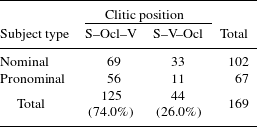
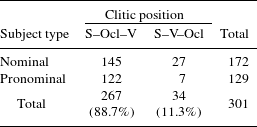
The biographies yielded 301 tokens of SV declaratives with clitics, and Douceline yielded 169; the data concerning clitic position appear in Tables 3 and 4.
Overall frequency of preverbal and postverbal object clitics in SV declaratives: Biographies.
Overall frequency of preverbal and postverbal object clitics in SV declaratives: Douceline.
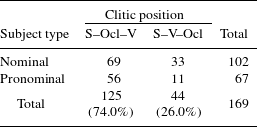
In the biographies and Douceline alike, S–Ocl–V is more frequent than S–V–Ocl, but S–V–Ocl appears productive in these texts. Both types of subject (nominal and pronominal) occur with both possible clitic positions (preverbal and postverbal). Nominal subjects are more common, as they are in these data more generally.
7.1 Discourse functions
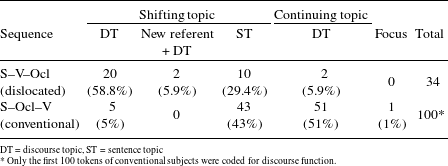
If S–Ocl–V and S–V–Ocl represent distinct clausal architectures and fulfill different discourse-pragmatic functions, as I hypothesize, then their distribution should vary according to discourse function. Specifically, I claim that subjects in S–V–Ocl are dislocated and, like S–si–V and S–Sp–V, represent shifting topics. The data support this hypothesis. The biographies contain 34 tokens of S–V–Ocl, and all encode topic (Table 5). Specifically, 94.1% of the S–V–Ocl data are shifting topics, and the remaining 5.9% serve as continuing topics. Predictably, none of the LD subjects can be construed as focus information. Looking only at the LD subject shifting topic data, in 68.8% of the cases (22/32 tokens), the subject is established as a DT, either by selecting an existing discourse referent or by introducing a new one. The remaining 31.3% of the cases (10/32 tokens) of shifting topics create an ST, distinct from the topic of the previous main declarative, but which ultimately does not supersede the existing DT. The dominant function of S–V–Ocl sequences in the biographies is thus as a shifting topic, often to a new DT.
Discourse functions of S–V–Ocl and S–Ocl–V: Biographies.
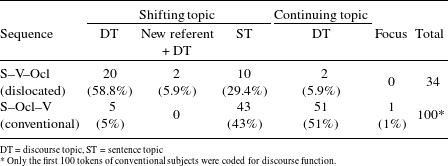
DT = discourse topic, ST = sentence topic
* Only the first 100 tokens of conventional subjects were coded for discourse function.
The data from conventional subjects reveal a different picture. In the 100 tokens of S–Ocl–V whose discourse function was coded, 48% represent shifting topics, 51% represent continuing topics, and a single token contains focus information (Table 5). Comparing the results from LD and conventional subjects in the biographies reveals a significant difference in the correspondence between discourse-pragmatic function (shifting vs. continuing topics) and sentence form (LD vs. conventional subjects), χ2 (2,  $N$ = 4) = 20.12,
 $p<.0001$. However, another major difference exists within the shifting topics: Although both LD and conventional subjects can serve as shifting topics, LD subject shifting topics most frequently establish DTs (68.8%), as seen previously, whereas conventional subject shifting topics rarely establish DTs (10.4%; 5/48 tokens). In fact, when conventional subjects serve as shifting topics, it is overwhelmingly to establish an ST (89.6%; 43/48 tokens). Within the data for shifting topics, the distribution of DTs and STs differs significantly between LD and conventional subjects, χ2 (2,
 $N$ = 4) = 26.67,
 $p<.0001$. Globally, then, whereas LD subjects most often signal a shift of (discourse) topic in the biographies, conventional subjects maintain the existing DT, either by introducing an ST (whose topicality is only momentary) or by restating the existing DT, usually in the presence of other referents that could potentially be misconstrued as topics.
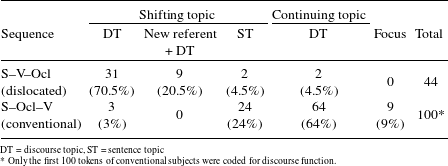
Similar and even more strongly pronounced patterns obtain in Douceline (Table 6). Of the 44 tokens of S–V–Ocl, 95.5% represent shifting topics, and only 4.5% represent continuing topics; none of the tokens can be construed as focus. Within the S–V–Ocl shifting topics, 95.2% (40/42 tokens) establish a new DT; only 4.8% (2/42 tokens) establish STs. As in the biographies, the predominant function of S–V–Ocl is to shift to a new (discourse) topic.
Discourse functions of S–V–Ocl and S–Ocl–V: Douceline.
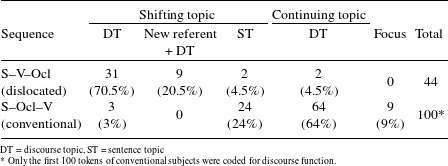
DT = discourse topic, ST = sentence topic
* Only the first 100 tokens of conventional subjects were coded for discourse function.
The data from conventional subjects in Douceline again reveal striking similarities with the biographies. Of the 100 S–Ocl–V tokens analyzed, 27% represent shifting topics, 64% represent continuing topics, and 9% represent focus. As in the biographies, the correspondence between discourse-pragmatic function (shifting vs. continuing topics) and sentence form (LD vs. conventional subjects) is significantly different, χ2 (2,  $N$ = 4) = 48.77,
 $p<.0001$. Again, within the data from shifting topics, the proportions of DTs to STs differ significantly according to subject type (LD vs. conventional), χ2 (2,
 $N$ = 4) = 46.01,
 $p<.0001$. As in the biographies, S–V–Ocl in Douceline usually shifts to a new DT, whereas S–Ocl–V maintains the existing DT.
7.2 Illustration of shifting topic to establish new discourse topic
The passage in (23) illustrates how S–V–Ocl functions as a shifting topic to signal a new DT; the passage is an extract from a razo that purports to explain a poem by Guillem de Balaun.
At the beginning of the extract, Lady Guillelma is the DT. In the previous discourse, she has been wronged and humiliated by Sir Guillem. In [1], Lady Guillelma agrees to pardon Sir Guillem, but at a price. In [2], she stipulates to Bernard d’Andusa – a messenger – that Sir Guillem is to pull out a fingernail and bring it to her. In [3], Bernard d’Andusa communicates this condition to Sir Guillem. Bernarz d’Andusa, no more than an ST here, appears as a conventional subject; the larger discourse is not about Bernard. In [4], an LD subject shifts the DT to Sir Guillem: In the sequence E el fo ⋅n lo plus legres hom del mon, the clitic en ‘of it’ is postverbal with respect to the verb fo ‘was’, indicating that the subject pronoun el ‘he’ is left-dislocated. In the rest of the passage, the DT remains Sir Guillem: In [5] he removes his fingernail, per Lady Guillelma’s conditions, and in [6] he returns to her.
7.3 Illustration of new discourse referent introduction
Like S–si–V dislocations, S–V–Ocl can introduce into the discourse a new referent and simultaneously mark a shift of topic to this new referent, as in (24):
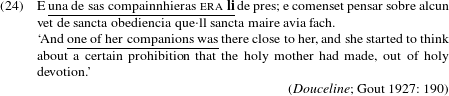
In (24), una de sas compainnhieras ‘one of her companions’ is a new referent, although it is inferable from the preceding discourse; this referent remains the topic of the immediately following discourse.
7.4 Illustration of continuing topic
Conventional subjects, by contrast, generally extend the existing DT, either by encoding an ST, as in section [3] of (23), or by functioning as a continuing topic, as in (25), extracted from the razo of 80,34, about a poem by Bertran de Born.
In the discourse preceding [1], Sir Bertran has learned of the political intrigue between King Richard and a number of barons in the southwest of France. Bertran, who is disliked by these barons, is happy to learn of this news in [1]. Bertan is the DT of the entire extract, although in [2], we learn – via Bertran’s thoughts – of King Richard’s losses to the barons. In [3], Bertran writes a poem (sirventes) to incite King Richard into war with the barons. In [4], the subject pronoun el ‘he’ of the cant ‘when’ clause refers to Bertran. Likewise, in [5], the conventional subject pronoun el ‘he’ of the SV declarative again refers to Bertran; here, the S–Ocl–V acts as a continuing topic. From a purely information-structural perspective, this subject appears redundant, as OOc often evinces null subjects when the subject has not changed from that of preceding utterances (see Hamlin et al. Reference Hamlin, Ricketts and Hathaway1967: 33; Smith & Bergin Reference Smith and Bergin1984: 111; Jensen Reference Jensen1986: 86–88; Romieu & Bianchi Reference Romieu and Bianchi2002a: 128; Reference Romieu and Bianchi2002b: 35). That is, if the declarative in [5] contained a null subject, the reader would presumably have no difficulty identifying Bertran as the referent of the subject. This example typifies how a large portion of the conventional subjects are used in the biographies and Douceline (Tables 5 and 6 above). Elsewhere, as discussed, conventional subjects mark STs, whose referent is almost always easily recoverable from previous discourse (unlike DTs, whose referents can be new to the discourse).
8. Discussion
The present analysis accounts for the variable position of object and adverbial clitics in OOc SV declaratives by positing that preverbal subjects can occur in (at least) two distinct syntactic positions, depending on discourse-pragmatic conditions. From a purely syntactic point of view, this approach builds on Skårup (Reference Skårup1975) and draws on models of a richly articulated clausal left periphery (Rizzi Reference Rizzi and Haegeman1997), in particular that of Benincà (Reference Benincà, Zanuttini, Campos, Herburger and Portner2006). I follow Benincà (Reference Benincà, Zanuttini, Campos, Herburger and Portner2006), who claims that the position of clitics depends on whether SpecFocus is overtly saturated. Applied to the present data, this means that preverbal clitics result from the fact that the subject occupies SpecFocus, whereas postverbal clitics arise when two conditions obtain: (i) the subject occupies a TopicP in the left periphery and (ii) SpecFocus remains unsaturated. Thus, despite surface similarities, the subjects in S–Ocl–V (1a) and S–V–Ocl (1b) occupy different positions.
The position of preverbal subjects is not random, nor does it need to be stipulated on a (circular) case-by-case basis. Rather, the choice of a conventional versus LD subject depends on the discourse-pragmatic role of the referent placed in subject position. By relating the syntax of an individual phrase to the larger discourse context, the present study reveals consistent information-structural differences between conventional and LD subjects. The data show that LD subjects most often act as shifting topics and usually establish a new DT, in contradistinction to conventional subjects, which maintain the existing DT, either by shifting to a momentary ST or by acting as a continuing topic.
As a pragmatically marked word order, subject LD was probably an expressive option rather than a strict grammatical requirement in OOc. First, the functions of LD and conventional subjects overlap to some degree in these data. For example, although infrequent, a few tokens of conventional subjects appear to encode changes in DT and introduce new referents into the discourse. Similarly, although STs typically appear as conventional subjects, LD subjects can also encode STs, and both LD and conventional subjects can serve as continuing topics. In addition, LD subjects constitute only one strategy among others to manage information structure; for example, changes in DT can also be accomplished via postverbal subjects, as can new referent introductions (Kunert Reference Kunert2003: 203). Furthermore, the syntactic marking of information structure sometimes depends on text genre and other variables (van Reenen & Schøsler Reference van Reenen and Schøsler1992).
Inherent limitations arise when working with historical data. Some definitions of topic, for example, reference the ‘mental states of speakers and hearers’ (Lambrecht Reference Lambrecht1994: 1), insofar as a speaker constructs utterances and stretches of discourse based on assumptions regarding what the hearer knows, does not know, and is likely to successfully infer (Reinhart Reference Reinhart1981: 59). For historical data, such information is clearly inaccessible. For practical reasons, in the present study, DTs are distinguished from STs on the basis of duration, as measured in main declaratives. Such a criterion may not entirely capture the importance that the medieval author accorded to a given referent, and some instances of subject LD classified as STs in the present analysis may have, in the mind of the author, represented DTs worthy of heightened prominence.
Turning to syntactic structure, analyzing S–V–Ocl as covert subject LD entails that it is a variant of S–si–V and S–Sp–V. The fact that overt and covert subject LD accomplish the same discourse-pragmatic functions corroborates the claim. I propose that the same underlying clausal architecture, which places left-peripheral subjects in TopicP, can yield at least the three distinct surface realizations in (26a–c).Footnote [22]
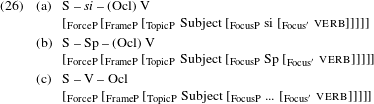
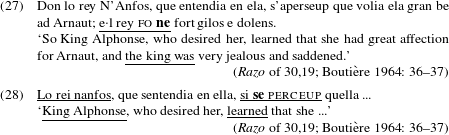
The claim that (26a–c) represent surface variants of a single underlying architecture is supported by at least one instance of manuscript variation in the biographies.Footnote [23] The variants in (27) and (28) represent the same passage, and they form a near minimal pair, with an alternation between S–V–Ocl in (27) and S–si–Ocl–V in (28). In both cases (underlined), the NPs referring to the king are topicalized.
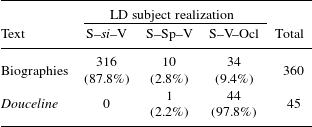
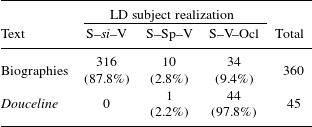
Previous research has found S–V–Ocl to be infrequent compared to S–Ocl–V (Mériz Reference Mériz1978, Hinzelin Reference Hinzelin2007). However, I argue that this type of direct comparison is flawed, in that it compares two separate clausal architectures and assumes – tacitly at least – that the two architectures occur, or should occur, in equal proportions. Rather, the crucial observation is that the frequency of S–V–Ocl depends both on how frequently a text left-dislocates preverbal subjects and, more importantly, on how LD subjects are realized. In the biographies and Douceline, LD subjects are not rare. The biographies contain 316 tokens of S–si–V, 10 S–Sp–V, and 34 S–V–Ocl for a total of 360 SV declaratives with LD subjects (Table 7). For comparison, the biographies contain 267 tokens of S–Ocl–V (with a conventional subject in SpecFocus). Even when one factors in SV declaratives that do not contain clitics, LD subjects cannot be considered rare.Footnote [24] As a configuration of LD subject, however, S–V–Ocl accounts for only 9.4% of the data from the biographies and is thus a relatively infrequent realization of LD. In Douceline, however, a different picture emerges. This text contains 44 tokens of S–V–Ocl but only a single token of S–Sp–V. More surprising yet, S–si–V is entirely absent in Douceline, whereas this is the preferred realization of subject LD in the biographies.
Realization of left-dislocated subjects.
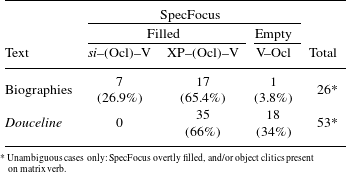
I hypothesize that the variable realization of subject LD is partly due to how SpecFocus is treated in the grammar of a given OOc text, and that this behavior of SpecFocus evinces intertextual variation, reflecting either the idiolects of individual authors or, as discussed subsequently in this section, regional syntactic variation. Pursuing this claim, the grammar of Douceline differs from that of the biographies by more freely allowing SpecFocus to remain empty, an observation that explains the preference for visible LD in the biographies and for covert LD in Douceline. Further support comes from the behavior of subordinate clauses that immediately precede a main declarative. Here, I focus on initial cant/quant ‘when’ clauses. In OOc, as in Old French, initial cant-clauses that immediately precede a main declarative almost always occupy a position in the left periphery rather than SpecFocus of the main declarative (Vance et al. Reference Vance, Donaldson, Steiner, Colina, Olarrea and Maria Carvalho2010, Donaldson Reference Donaldson2012).Footnote [25] The biographies contain 26 tokens of an initial cant-clause that immediately precedes a main declarative. In 25 of the 26 tokens, SpecFocus of the main declarative is overtly saturated (as in 14), as detailed in Table 8. In these examples, clitics are uniformly preverbal when present. In the single remaining example, shown in (29), SpecFocus is empty, and the clitic is predictably postverbal; this example mirrors the Old French example in (13) and the OOc example in (15).
Saturation of SpecFocus after initial cant ‘when’ subordinate clauses.
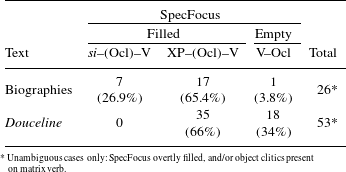
* Unambiguous cases only: SpecFocus overtly filled, and/or object clitics present on matrix verb.

In Douceline, however, examples like (29) in which SpecFocus is empty are more frequent, accounting for 34% of the data (Table 8). As anticipated, clitics are postverbal in these examples. In the remaining examples, SpecFocus hosts the subject of the declarative or a non-subject XP, as in (14). Recall that Douceline contains no examples of subject LD constructed with si. Crucially for my argument, none of the initial cant-clauses are followed by si in Douceline. Thus, whereas the grammar of the biographies frequently fills SpecFocus with si after an LD subject or an initial cant-clause, Douceline leaves SpecFocus empty in these same contexts, with the resulting effects on the placement of clitics. These same tendencies are almost certainly responsible for differences in stand-alone V1 declaratives as well (i.e., those not introduced by a coordinating conjunction). Whereas Douceline contains 44 tokens of a stand-alone V1 declarative (in which SpecFocus is empty), the entire set of biographies yields only four. Finally, evidence from Old French corroborates the view that the grammar of SpecFocus underlies the different realization of subject LD in the biographies and Douceline, as well as the behavior of quant/cant-clause + main declarative sequences and V1 declaratives. In early Old French, saturation of SpecFocus was not obligatory (Foulet Reference Foulet1928: 320; Skårup Reference Skårup1975: 291, 300; Rouveret Reference Rouveret2004: 200–201; Simonenko & Hirschbühler Reference Simonenko, Hirschbühler and Dufresne2012); V1 declaratives (where SpecFocus is empty) were attested, and so were sequences of quant-clause–V–Ocl like (13). Between about 1160 and 1200, however, SpecFocus came to be obligatorily saturated. As a result, V1 declaratives were lost (Simonenko & Hirschbühler Reference Simonenko, Hirschbühler and Dufresne2012), as were sequences like (13), as shown in Donaldson (Reference Donaldson2012). Following this change, SpecFocus frequently hosted si and other semantically weak adverbs (Foulet Reference Foulet1928: 302–303; Herman Reference Herman1954: 85; Marchello-Nizia Reference Marchello-Nizia1985: 199–200).
I can only speculate at this juncture about what underlies the different treatment of SpecFocus in the biographies and Douceline. The close dating of the texts (late 13th for the biographies, very early 14th for Douceline) points to factors other than diachronic change. Regional variation likely plays a role. On this topic, an anonymous JL referee mentions data from early OOc legal charters from the Rouergue regions (Brunel Reference Brunel1926, Reference Brunel1952), discussed in Hinzelin (Reference Hinzelin2007: 157–162; also Hinzelin Reference Hinzelin and Latry2009: 74). The referee asserts that the Rouergue data ‘presumably show real regional variation’ that the present analysis cannot account for. Although limitations of space preclude a full investigation of the Rouergue charters, a preliminary information-structural analysis leads me to disagree. The Rouergue data are of interest because Hinzelin (Reference Hinzelin2007: 161) finds postverbal clitics to be more frequent than preverbal clitics in affirmative SV declaratives, unlike in charters from other regions, where preverbal clitics predominate. However, the information-structural properties of most of Hinzelin’s (Reference Hinzelin2007: 158–160) examples with postverbal clitics conform to the predictions of my proposal. In particular, in five of the eight tokens, the leftmost XP represents a shifting topic, either to a new discourse referent or to a currently inactive referent; this XP is then followed by matrix V+Ocl. Another two tokens involve matrix V+Ocl immediately following an initial subordinate, mirroring the structure of (14) and (29).Footnote [26] In all these cases, if the initial XP occupies a left-peripheral position (here, a TopicP or a FrameP), as I argue, and SpecFocus is empty (i.e., no other XP intervenes between the left-peripheral XP and the matrix verb), then postverbal clitics are expected. Only a single token (example (22) in Hinzelin Reference Hinzelin2007: 159) runs counter to these predictions; I leave this question as well as a more complete information-structural analysis of the charter data to future research.
To return to the question of regional variation, I argue that the relevant syntactic property involves the ability or inability to leave SpecFocus unsaturated. Rates of preverbal versus postverbal clitics in matrix clauses will then be a secondary result of the interaction between the presence or absence of left-peripheral XPs (e.g., shifting topics or initial subordinates) and the concomitant saturation or non-saturation of SpecFocus. Thus, in texts whose grammar requires SpecFocus to be overtly saturated in matrix declaratives, clitics will be preverbal whether or not any XPs are present in the left periphery. On the other hand, in texts whose grammar allows SpecFocus to remain unsaturated in matrix declaratives, if the initial XP or XPs occupy left-peripheral positions, and SpecFocus remains unsaturated, clitics will be postverbal when present. In other words, in my view, the correct measure of regional variation lies not in raw percentages of preverbal versus postverbal clitics but rather in how the grammar of a given text treats SpecFocus and, as a result, whether that grammar preferentially realizes left-dislocated shifting topics as (26a, b) or (26c). If this reasoning is correct, the fact that Douceline and the Rouergue charters evince relatively robust rates of postverbal clitics in matrix declaratives follows from the fact that SpecFocus can remain empty, and that there are numerous instances of left-dislocated shifting topics (and/or initial subordinate clauses) in matrix declaratives with unsaturated SpecFocus.Footnote [27]
I leave open the question as to why the grammars of different texts vary in their treatment of SpecFocus. Henrichsen (Reference Henrichsen1955) speculated that the biographies contained syntactic influences from Italian, perhaps due to an OOc-speaking author’s prolonged contact with Italian (Henrichsen Reference Henrichsen1955: 117) or from later copyists (Boutière Reference Boutière1964: xi; Lafont Reference Lafont1967: 24). Old Italian texts employ si quite frequently (see e.g., Bocchi Reference Bocchi, Zaccarello and Tomasin2004, Poletto Reference Poletto, Batllori, Hernanz, Picallo and Roca2005, Ledgeway Reference Ledgeway2008), including in S–si–V, but further work is necessary to pinpoint an Italian influence in the present case, especially given the frequency of si in Old French, which also enjoyed close contact with OOc. On the other hand, Old Catalan and Old Spanish, culturally and geographically close to much of the OOc zone, evince S–V–Ocl (Ramsden Reference Ramsden1963: 79, 163–164), although it remains to be seen if those languages pattern according to the discourse-pragmatic conditions described here. Text genre may be another factor, as van Reenen & Schøsler (Reference van Reenen and Schøsler1992) documented for Old French, and stylistic factors may also come into play.
9. Conclusion
This paper analyzed the position of object and adverbial clitics in OOc affirmative SV declaratives. I claim that postverbal clitics arise from the combination of an LD subject and empty SpecFocus, drawing on Benincà’s (Reference Benincà, Zanuttini, Campos, Herburger and Portner2006) work on the clausal left periphery in medieval Romance and the relationship between saturation of SpecFocus and the position of clitics. The present proposal assumes multiple preverbal positions capable of hosting a subject in OOc declaratives. I place LD subjects in a left-peripheral TopicP, although it should be noted that the present data do not permit as fine-grained an analysis as in Frascarelli & Hinterhölzl (Reference Frascarelli, Hinterhölzl, Schwabe and Winkler2007: 97), who distinguish three discrete positions within TopicP (partially on the basis of prosody). Multiple surface realizations of LD subjects are available in OOc, with variation both within and across texts, but these different instantiations share the primary discourse-pragmatic function of shifting topic. The different discourse functions observed for conventional versus LD subjects justifies their analysis as syntactically and pragmatically distinct, and the position of clitics – far from being random – follows from the position of the subject and the saturation (or not) of SpecFocus. The analysis departs from Mériz (Reference Mériz1978) and Hinzelin (Reference Hinzelin2007), who treat preverbal subjects as a unified class occupying (in Hinzelin’s analysis) a unique position (SpecFocus).
Further research is needed to determine to what extent comparable results obtain in other OOc texts and, eventually, in other medieval Romance varieties that used S–V–Ocl productively. Similarly, an analysis of left-peripheral objects may shed further light on the left periphery in OOc, and further examinations of the interactions between information structure and syntax are warranted for OOc more generally, following Combettes (Reference Combettes1971) and Kunert (Reference Kunert2003). Finally, the present analysis is purely synchronic, and a diachronic investigation of how syntactic information structure marking is affected by the eventual loss of V2 in Occitan (and along with it the loss of S–V–Ocl) remains a topic for future work.