Disciplines define higher education. Disciplines classify undergraduate and graduate students, form the basis for administrative structures in colleges, delineate one’s realm of expertise within the professoriate, and are understood as connection points to various labor-market categories.
Given their centrality, it makes sense that disciplinary organizations would have a crucial role in organizing and holding together the constituents that comprise and generate meaning for a given field. In the field of political science, the American Political Science Association (APSA) self-identifies as the “leading professional organization for the study of political science.” APSA “brings together political scientists from all fields of inquiry, regions, and occupational endeavors within and outside academe to deepen our understanding of politics, democracy, and citizenship throughout the world” (APSA 2020).
In 2015, APSA created a Committee on the Status of Community Colleges in the Profession based on a recommendation from an ad hoc report published that year.Footnote 1 Community colleges are two-year public institutions that focus on lower-division coursework, career and workforce development, lifelong learning opportunities, and alternative pathways to higher education. The ad hoc report was a formal and initial inquiry into evaluating the relationship between community college faculty in political science and APSA. With the qualification that their data were likely inaccurate, the ad hoc committee pointed out that whereas community college students comprise almost 50% of the undergraduate population in the United States, (at that time) community college faculty comprised approximately 1% of APSA membership. Given this chasm between the organizational mission and the reality as illustrated in membership patterns, once formally constituted, the Status Committee immediately identified the need to solicit additional knowledge about community college faculty in political science.
In a comprehensive study of scholarly learning across institution types, Baker, Terosky, and Martinez (Reference Baker, Terosky and Martinez2017) noted that “community college faculty are significantly understudied” and that “there remains a gap in our understanding of the community college professoriate.” Based on Anna Neumann’s definition (as quoted in Baker, Terosky, and Martinez Reference Baker, Terosky and Martinez2017) of scholarly learning as faculty members’ “engagement with a subject that means a great deal to them or to which they have committed themselves deeply throughout their lives,” Baker, Terosky, and Martinez (Reference Baker, Terosky and Martinez2017) contend that community college faculty are commonly misrepresented as working outside of the sphere of scholarly learning when, in fact, their commitment to teaching is central to it.
At the time of this writing, approximately 28% of all higher education faculty work in a two-year institution but comprise—by best current estimates provided by the organization—between 1% and 2% of APSA membership. At its formation in 2016, the Status Committee wanted to understand how community college political science faculty characterize their place within the field of political science. The committee reached out to the American Sociological Association (ASA), which had established a similar committee in 2012 and had conducted a national survey in 2014. The ASA graciously allowed us to model our survey on theirs.
The political science version of the survey was administered by APSA via Qualtrics between March 26 and May 2, 2018. APSA staff manually compiled email contact information for faculty who teach political science at community colleges in every state by using national lists of community colleges and then searching the website of each institution to identify both full- and part-time faculty. The survey was sent to 2,634 community college faculty; 311 individuals responded but only 265 fully completed the survey, resulting in a response rate of 11.3%. The data reported in this article are based on those completed surveys (Osorio, Parker, and Richards Reference Osorio, Parker and Richards2021). Respondents were asked to answer the questions posed using information based on their 2018 experiences at the institution associated with the email address where they were sent the survey. Along with demographic information, the survey included questions about their employment status and conditions, access to professionalization activities and outreach by APSA, teaching experiences, and perception of the role of community college faculty.
This article introduces members of the political science community to the experiences of community college faculty. Demographic information is provided to contextualize these experiences. Although we draw comparisons and contrasts between community college and four-year faculty, our intent is to summarize the access and needs of community college faculty as they relate to professional development and to characterize their professional identity based on the survey results. In the article titled “A Call to APSA Part 2: Bring in Community College Faculty” in this issue, we make a series of recommendations to APSA based on our analysis of the experience of community college faculty within the discipline.
DEMOGRAPHIC DATA
This section highlights information gathered in the survey. However, it is important to note that this survey likely is not representative because the response rates are far below what is needed to run representative surveys. This may reflect the lack of familiarity and engagement that community college faculty have with APSA, as well as the tenuous relationship that some two-year faculty have with the organization. Given that 50% of respondents have tenure status, we also believe that the survey underrepresents those faculty members who work at multiple community colleges.
As Finley and Kinslow (Reference Finley and Kinslow2016) noted, “It can be difficult to generalize about community college faculty since they are probably more diverse in several ways than faculty at four-year institutions.” Nationally, community college faculty are more likely to have a master’s degree as their highest degree compared to their four-year counterparts. Community colleges are more likely to have gender parity than at four-year institutions (Snyder, de Brey, and Dillow Reference Snyder, de Brey and Dillow2019), and data show that two-year colleges are not more ethnically diverse than public four-year institutions. According to 2017 data from the National Center for Education Statistics, 29.9% of facultyFootnote 2 at four-year, private, for-profit institutions were nonwhite,Footnote 3 23.1% at four-year public institutions were nonwhite, and 21.1% at two-year public colleges were nonwhite (Snyder, de Brey, and Dillow Reference Snyder, de Brey and Dillow2019).
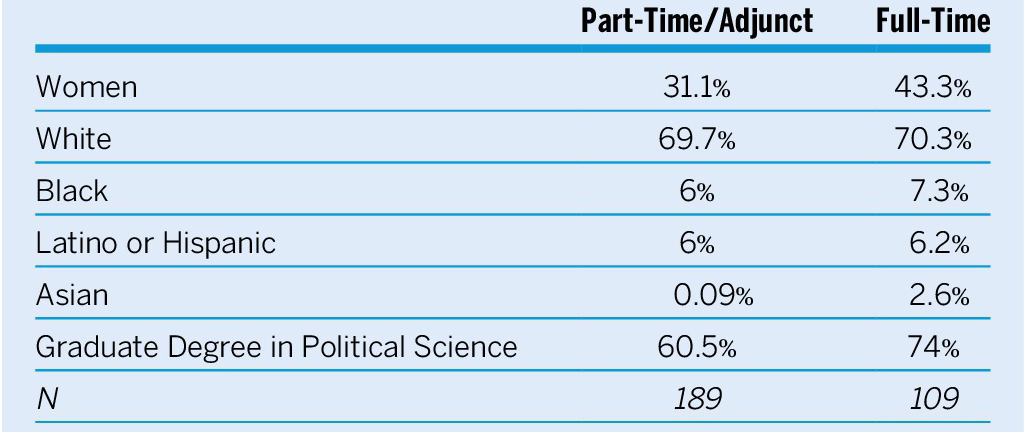
Our survey found similar patterns, as shown in table 1. Among full-time faculty, 70% were white, 6% identified as Latino or Hispanic, and 7% identified as Black or African American. Asian Americans comprised only 2% of full-time faculty respondents. This pattern replicated in the part-time (also known as adjunct or contingent) faculty, with 70% of respondents identifying as white; 43% full-time and 31% part-time faculty identified as women.
Demographic Breakdown of Full-Time and Part-Time Community College Faculty

Community colleges serve a range of student and community needs, including lower-division college courses for transfer students, career education and retraining programs, noncredit programs (e.g., precollegiate skills, ESL courses, and trade certificates), and general-interest courses for the public.
Community colleges serve a range of student and community needs, including lower-division college courses for transfer students, career education and retraining programs, noncredit programs (e.g., precollegiate skills, ESL courses, and trade certificates), and general-interest courses for the public.
The survey results align with national trends regarding full- and part-time faculty. For example, according to Provasnik and Planty (Reference Provasnik and Planty2008), “Unlike their colleagues at four-year institutions, a majority of faculty at community colleges hold part-time appointments. In fall 2003, two thirds of faculty at community colleges were employed part time (over 240,000 faculty), and one third were employed full time (approximately 121,000 faculty). In comparison, at public four-year institutions, 28 percent of faculty were employed part time that year, while at private four-year institutions, 42 percent were employed part time.” This trend is increasing and it impacts community college faculty more severely—especially as enrollment declined due to the pandemic. According to a US Government Accountability Report (2017), “[c]ontingent faculty—those employed outside of the tenure track—made up about 70 percent of postsecondary instructional positions nationwide…data from three selected states show that contingent faculty teach about 45 to 54 percent of all courses at four-year public institutions, and higher proportions at two-year public institutions.”
As higher educational institutions—particularly community colleges—continue to face both increasing enrollment and decreasing funding, adjunct faculty are hired to accommodate enrollment increases and are let go when enrollment decreases. Thus, for two-year institutions, adjunct faculty are cheap labor with few protections; many cobble together a living from multiple part-time appointments. Whereas slightly less than 50% of faculty positions at master’s and baccalaureate institutions are part time, more than 65% at two-year institutions are part time. These part-time teaching positions tend to be the least secure and the worst remunerated in higher education, with low per-course pay and few benefits. Faculty in these positions typically are hired by the term and paid for only the hours they spend in the classroom, not for time spent meeting with students, evaluating student work, and class planning and preparation. They often lack access to basic tools including offices, computers, and photocopying services, and they can be hired on the spur of the moment with little time to prepare—sometimes after a semester has already begun (American Association of University Professors 2018).
The disparity between the number of full- and part-time faculty is particularly apparent when reviewing salaries for different types of faculty: 31% of part-time respondents and 77.5% of full-time faculty earn more than 55% from their community college employment; 18.9% of full-time faculty earn more than $100,000 compared to 53% of part-time faculty who earn less than $30,000.Footnote 4
ACCESS TO PROFESSIONAL DEVELOPMENT
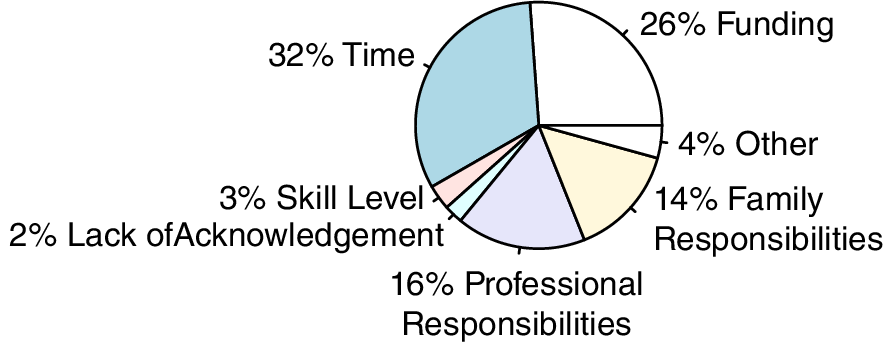
Research shows that faculty value and want to participate in discipline-specific professional development (Hott and Tietjen-Smith Reference Hott and Tietjen-Smith2018; Maxwell and Kazlauskas Reference Maxwell and Kazlauskas1992). “Although teaching is the primary job responsibility for community college faculty, they still advise students, serve on departmental and institutional committees, participate in division duties, undertake professional development, and sometimes engage in community service” (Levin et al. Reference Levin, Walker, Haberler and Jackson-Boothby2013). Although many community colleges expect faculty to engage in professional development, most do not require involvement with disciplinary associations, publications, and presentations. In general, community colleges focus on professional development related to pedagogy, using a broad non-discipline-specific approach. However, the need of community college faculty for a disciplinary approach to teaching and research is not well supported. APSA survey respondents cited several obstacles to this professional development, as outlined in figure 1.
Obstacles to Professional Development

A significant tension that community colleges experience is how to prioritize many competing professional-development interests (Murray Reference Murray2002). Community colleges often operate under much stricter mandates than their four-year counterparts in terms of legislative mandates, resulting in the conflating of “professional development” with obligatory compliance-oriented tasks.Footnote 5 With significantly less funding, these more traditional professional-development opportunities are almost impossible to support institutionally for full-time faculty and much less for adjunct faculty. It is not uncommon for community college faculty to receive no funding to participate in professional-development opportunities that are not associated with or facilitated by their institution. Approximately 60% of community colleges are located in rural areas, and there appears to be differences in the professional-development goals for rural compared to suburban and urban colleges (Eddy Reference Eddy2007). To summarize, many competing pressures face community colleges in general in terms of determining how to prioritize limited resources of time and funding, as indicated in survey results for political science faculty.
COMMUNITY COLLEGE FACULTY PERCEIVE THEMSELVES AS TEACHERS
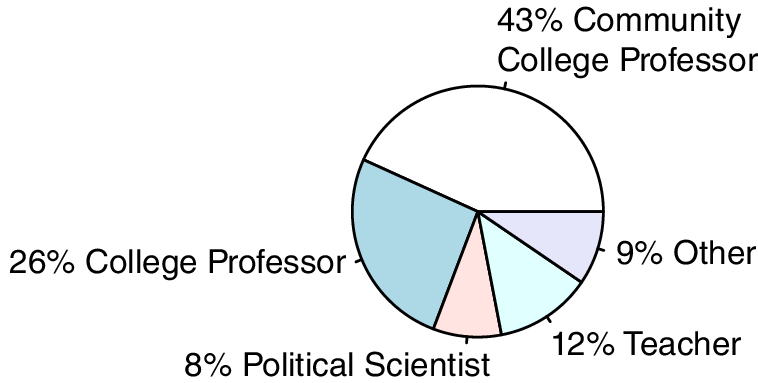
Political scientists teaching at community colleges primarily identify as professors or teachers. As shown in figure 2, 73.5% of survey respondents agreed or strongly agreed with the statement, “I prefer political science teaching over political science research.” In open-ended responses, respondents mentioned the opportunity to teach or a passion for teaching as a primary reason for why they chose to pursue employment at a community college. This speaks to the mission of community colleges as a place where teaching a diverse student body is paramount.
Professional Identity

In open-ended responses, respondents mentioned the opportunity to teach or a passion for teaching as a primary reason for why they chose to pursue employment at a community college.
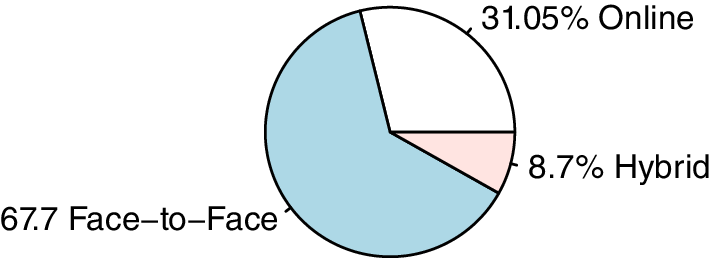
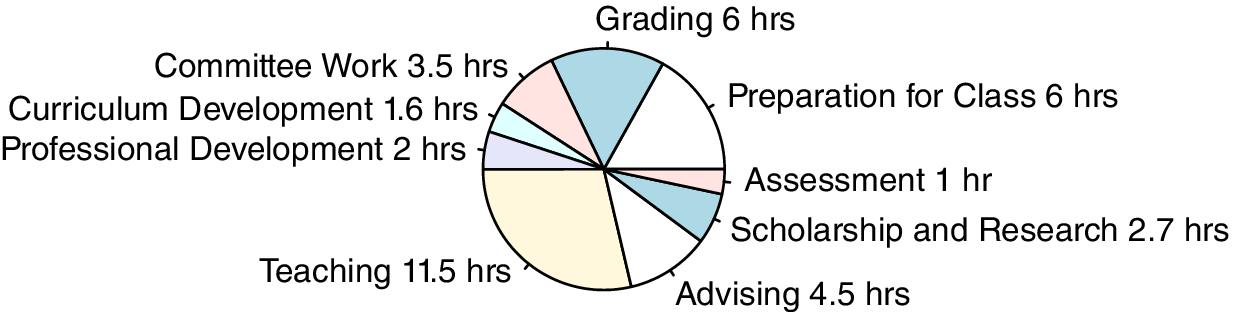
Community college faculty teach much more than their counterparts at other institutions, teaching twice or three times more hours a week than those at four-year teaching or research universities (Rifkin Reference Rifkin2000). Community college faculty reported teaching mostly in person; however, even before the pandemic, they also taught using other formats, as shown in figure 3. Furthermore, teaching comprises most of what community college faculty do, as indicated in a 2008 report, “The primary activity of almost 90% of faculty at community colleges is teaching, with virtually no faculty devoted primarily to research” (Provasnik and Planty Reference Provasnik and Planty2008). Respondents in our survey reported spending most of their time teaching or preparing for teaching. Their self-reported time spent on professional activities is shown in figure 4.
Class Format

Means of Hours Spent Per Week

Despite the heavy teaching and service demands on community college faculty, some find time to devote to out-of-classroom scholarly activities: 40% stated that “they are currently engaged in scholarly work that they expect to lead to a publication, exhibit, or performance, and 20% say they have received a grant or special funding support for research in the last three years” (Huber Reference Huber1998, 25).
Faculty at community colleges also are able to balance professional and family life because a community college is perceived as a place where the work–life balance is family friendly, as well as where those interested in teaching but who do not have and/or do not want to pursue a PhD can find a career in higher education. Survey respondents in particular indicated that community colleges are viewed as more family friendly especially for women. Many respondents indicated that they chose a career at a community college because (1) a PhD was not required, and (2) with some exceptions, there was no expectation that faculty maintain an active research and publishing agenda. This does not mean that community college faculty do not publish; however, only 5% of our survey respondents indicated that scholarship is part of their job-performance evaluation criteria. As one respondent stated, “Others in the field do not always prefer to acknowledge work done by those of us at community colleges—we may not do research very often because it’s not publish or perish where we work, but when we choose to do research, it’s because we love it and are passionate about it—it matters.”
Many survey respondents indicated that they were a graduate of a community college and expressed that the ability to work with this population of students—who are more focused on learning because they often are paying for their own education; are older and sometimes returning students; and are more diverse in terms of age, ethnicity, military status, and first generation—is an appealing feature of a community college position. In fact, the American Association of Community Colleges (2020) identified that in 2018, 29% of students attending community college were first generation, 15% were single parents, and 5% were veterans. Furthermore, 62% of all full-time students at community colleges work (i.e., 21% full time and 41% part time) and 72% of part-time students at community colleges work (i.e., 38% full time and 34% part time) (American Association of Community Colleges 2020). Teaching underrepresented and nontraditional student populations is the primary reason cited by survey respondents for why they find their job most satisfying. As one survey respondent explained:
I enjoy introducing students to political science concepts and applications. I like when they experience a hearing or local meeting and see that this is doable. I enjoy when they realize that, with a little background research, they can hold their own in a civil conversation about politics, even if they prefer to walk away. I appreciate when those who “hate politics” begin to find their voices. I believe in our mission of providing an excellent and affordable education and believe that, for many of our students, it can be the first entry into academics or their second chance.
Teaching underrepresented and nontraditional student populations is the primary reason cited by survey respondents for why they find their job most satisfying.
Another respondent shared similar feelings, highlighting the benefits of community college teaching: “I love teaching and bringing my students into an environment that fosters an understanding of how the field of political science affects their daily lives. I also enjoy the small class sizes as it allows for more one-on-one attention and gives more opportunities to facilitate discussion.”
However, many faculty also indicated that they took a job at a community college because it was available where they lived. This may speak more broadly to the nature of the current academic job market in which the number of available jobs is decreasing, and not all political science graduates have the ability to move for a job.
Almost 92% of respondents indicated that they definitely or probably will teach at their current community college until retirement. This indicates that community college faculty view their job as a career. This perception, however, seems to apply only to faculty in a full-time position with some degree of job security due to either tenure (or tenure-track) or a reasonable expectation that their contract will be renewed for the next academic year. For part-time faculty, “community college faculty” was not their primary identity because they also were employed by myriad other employers, including four-year institutions, high schools, government, private industry, and self-employment. It is interesting that 38% of part-time faculty also were employed by four-year institutions, which invites a broader discussion about the use of part-time faculty and the nature of the academic job market.
Of our survey respondents, 66.4% agreed or strongly agreed with the statement that they feel underpaid given their level of education and experience. This may be reflective of the larger societal view of community colleges as “lesser-than” institutions, as well as the high level of training, expertise, and education of community college faculty.
For respondents who indicated that they will not teach at a community college until retirement, the primary reasons given were the opportunity for better pay and the opportunity to teach upper-division courses. A challenge for community college faculty is the repetitive nature of introductory courses with little opportunity to teach specialty courses. Although this reason to leave applied to only five respondents, we believe that it is a dilemma that many community college faculty experience in their career.
Overall, 73.5% of survey respondents agreed or strongly agreed with the statement, “If I had it to do over again, I would still teach at a community college.” This quote captures the way that faculty at a two-year school perceive themselves and their job at this type of institution: as both political scientists and teachers and as worthwhile and fulfilling. This view that two-year faculty have of themselves and their institution—as a place where political scientists can and do build careers—is important for APSA and its membership to recognize as they consider organizational changes to better enable the association to reach out to and incorporate community college faculty into our national disciplinary association. Specific recommendations for how best to accomplish this are offered in “A Call to APSA Part 2: Bring in Community College Faculty” in this issue.
ACKNOWLEDGMENTS
The authors thank Peter Bowman, Elsa Dias, Cammy Shay, and Tressa Tabares for their work on the Committee on the Status of Community Colleges in the Profession to initiate a survey of community college political scientists and for their helpful comments on this article. We also thank Tanya Schwartz for her assistance in collecting the data and Jennifer Hochschild for establishing the Status Committee during her tenure as APSA President.
DATA AVAILABILITY STATEMENT
Research documentation and data that support the findings of this study are openly available at the PS: Political Science & Politics Harvard Dataverse at https://doi.org/10.7910/DVN/BTUDQT.