

Introduction
Many recent studies in sociophonetic perception (Drager & Kirtley Reference Drager and Kirtley2016; McGowan Reference McGowan2016; Nycz Reference Nycz2016) and in sociolinguistics and linguistic anthropology (Babel Reference Babel2016c; Choksi & Meek Reference Choksi and Meek2016; Zimman Reference Zimman2016) have investigated language users’ awareness of sociolinguistic variables. These studies clearly use different methodological approaches, but what is less clear is whether these differences in methodology reflect a deeper, theoretical difference in how researchers conceive of the phenomenon under investigation; whether researchers mean the same thing when they talk about perception, and beyond that, whether they are measuring the same thing when they attempt to analyze it.
While research into sociophonetic perception relies on experimental tasks that examine perception while it is occurring, much of the wider sociolinguistics literature has examined awareness of variation primarily through interviews and explicit comments about language use, in which the question of what the listener has perceived is interrogated only after perception is completed.Footnote 1 We combine a sociophonetic experiment with a follow-up interview to examine language users’ perceptions of a salient sociolinguistic variable—vowel quality, which, in central Bolivia, indexes identification as either a Quechua- or Spanish-dominant speaker. In the experimental task, we first investigated listeners’ responses to the perception of synthetic vowel continua when the recorded Spanish-speaking voice they listened to was described to them as either a Spanish-dominant or a Quechua-dominant speaker. We subsequently changed the explicit identification of the speaker while using a different set of stimuli with the same vowel continuum. Following each guise, we asked participants about what they heard when they listened to the two purported speakers in the experimental session. In reality, listeners heard the same person's voice in both guises. We found that the results typically described in the phonetics and sociophonetics literature as low-level—the phonetic perception, as measured by listeners’ behavioral responses—were different from, and sometimes contradicted by, the so-called high-level results—the conscious social perception of the voices, as elicited in the interviews.
Our results suggest that the types of perception speakers experience should be modeled, theoretically and methodologically, with at least two levels of awareness. The present study suggests that experimental results on perception of sociolinguistic variables from the sociophonetic perception literature are complementary, but not identical, to explicit commentary that participants give about these variables. Sociolinguists and sociophoneticians must attend to theoretical models that demonstrate that perception is spread across multiple cognitive systems and is present at multiple levels of awareness (Campbell-Kibler Reference Campbell-Kibler2016; Squires Reference Squires2016; D'Onofrio Reference D'Onofrio2018) and that the way we, as researchers, conceptualize awareness influences not only the questions we can ask but the answers we are able to find.
Approaches to awareness: Sociophonetic perception
The study of sociophonetic perception inherits from a long epistemological tradition within phonetics and psychoacoustics that assumes, with much empirical support (Beddor Reference Beddor, Heine and Narrog2015), that the phenomenon of speech perception occurs largely below the level of conscious awareness. In this tradition, the term speech perception itself refers to listeners’ use of acoustic cues to perceive individual speech sounds and the relationships between them. Perception, in this sense, is distinct from word recognition, and neither process was traditionally understood to involve social information (although c.f. Ladefoged & Broadbent Reference Ladefoged and Broadbent1957). If some aspect of a speech perception or word recognition experiment might be available to listeners’ conscious awareness, this should be controlled for, masked with filler trials, implemented as a between-subjects design, or at least shown to oppose, rather than support, the main argument. A major contribution of recent work in sociophonetic perception has been exploring the influence of social information on the perception of speech sounds and words (Drager Reference Drager2010; Docherty & Foulkes Reference Docherty and Foulkes2014). This literature inherits the (typically unstated) assumption that this information is unavailable to listeners’ introspection so that social information ‘effectively primes’ speech perception (e.g. Hay, Nolan, & Drager Reference Hay, Nolan and Drager2006).
We can trace one thread of this research by looking at work on the perception of social information in English voiceless sibilant fricatives. May (Reference May1976), working firmly within a phonetic tradition that tended to deemphasize the contribution of social information, found that listeners take vocal tract size into account (again, below the level of conscious awareness) when perceiving the difference between the fricatives [s] and [ʃ]. In general, [s] produces a higher-frequency noise than [ʃ], but there is no invariant acoustic cue that distinguishes these fricatives. Instead, listeners must, in May's view, normalize the acoustic signal based on perceived vocal tract size—accepting lower frequencies as [s] for a larger vocal tract and correspondingly higher frequencies as [ʃ] when the vocal tract is smaller. Whalen (Reference Whalen1991) extended this research to demonstrate that listeners are sensitive not only to the noise difference between [s] and [ʃ] but also the formant transitions that connect these fricatives to adjacent vowels.
Strand & Johnson (Reference Strand, Johnson and Gibbon1996) continued in this phonetic tradition, demonstrating that perception of items on an [s]–[ʃ] continuum is at once gradient and highly speaker-specific. Importantly, Strand & Johnson explicitly connect fricative perception to social perception by demonstrating that being shown a male or female face can shift listeners’ perception of the [s]–[ʃ] boundary. Not only is there no invariant acoustic cue to fricative place, but listeners’ perception of place depends upon the perceived identity of the talker—an influence that, again, appears to operate below the level of conscious awareness. Listeners’ gradient judgements of gendered speech problematize the categorical gender differences one might have assumed from earlier work such as May, and require a more nuanced, empirical investigation of how speaker gender is perceived. Many studies have followed Strand & Johnson in challenging similarly simplified views of the influence of social category on phonetic perception, including sexual orientation (Campbell-Kibler Reference Campbell-Kibler2011; Mack & Munson Reference Mack and Munson2012), being perceived as a native speaker (Gnevsheva Reference Gnevsheva2017), and importantly for the present work regional variation (D'Onofrio Reference D'Onofrio2015). Still, a common assumption that seems to underlie these investigations is that the influence of these social categories on speech perception operates below the level of conscious awareness while the signal is being processed.
Of course, not all work in sociophonetic perception clearly assumes that perception occurs below the level of conscious awareness. There are some examples of linguistic features that function as salient markers of social categories. Drager (Reference Drager2009) reported that girls in a New Zealand high school were able to use phonetic cues in the pragmatically flexible word like to accurately determine where a given speaker ate her lunch. Hall-Lew, Coppock, & Starr (Reference Hall-Lew, Coppock and Starr2010) analyzed Americans’ productions of the second vowel in Iraq and found that speakers producing a low front vowel tended to support the US role in the Iraq war while those producing a low back vowel tended to oppose it. These cases demonstrate a link between speaker attitudes and the production and perception of sociophonetic markers in particular lexical items. Finally, individuals’ conscious awareness of salient phonetic markers of social category can override auditory input, but does so below the level of conscious awareness. For example, listeners in Detroit who participated in a matched guise vowel identification experiment by Niedzielski (Reference Niedzielski1999) more accurately perceived Canadian Raising in the [aʊ] diphthong when they believed the voice of a fellow Michigan speaker to be Canadian than when they believed the speaker to be from Michigan. Similarly, Munson (Reference Munson2007) has demonstrated that general stereotypes about gay speech as ‘imprecise’ or ‘lisped’ do not correlate with the hyperarticulation observed in actual speech.
Approaches to awareness: Sociolinguistics and linguistic anthropology
By contrast, approaches to awareness in the traditions of sociolinguistics and linguistic anthropology have tended to focus on features that are explicitly available to speakers for discussion or otherwise separable from the listening event itself. This tendency may be due to methodological conventions but is also influenced by the way researchers conceptualize awareness. In the field of linguistic anthropology, scholars have approached awareness through metalanguage, the way that people talk about language and linguistic representation (Mannheim Reference Mannheim1986; Lucy Reference Lucy1993; Coupland & Jaworski Reference Coupland, Jaworski, Jaworski, Coupland and Galasisnski2004) or through language ideologies, which examines the political, economic, and historical dimensions of ideas about language (Silverstein Reference Silverstein, Clyne, Hanks and Hofbauer1979; Woolard Reference Woolard, Schieffelin, Woolard and Kroskrity1998; Irvine & Gal Reference Irvine, Gal and Kroskrity2000). Related work has explored folk linguistics and perceptual dialectology, examining the way that nonlinguists understand sociolinguistic variation (Niedzielski & Preston Reference Niedzielski and Preston2003). All of these approaches share an interest in the way that speakers understand language as embedded in larger social structures of power, hegemony, and social control (for recent perspectives, see Babel Reference Babel2016c; Zimman Reference Zimman2016; Calder Reference Calder2019). These approaches rely on people's explicit evaluations, thoughts, opinions, or sometimes actions to demonstrate the links between systems of power and prestige and languages or linguistic features.
However, researchers in this tradition have also demonstrated that the features that people are able to explicitly discuss are not the only dimension of awareness. Silverstein (Reference Silverstein1981) argues that metapragmatic awareness is based on cognitive-semiotic characteristics of language; that awareness is the result of language-internal qualities that can enhance or impede awareness, as well as interactional and relational factors that make particular features more or less salient. Likewise, research in folk linguistics has argued that awareness operates on a number of different scales or qualities. Preston (Reference Preston1996:41) divides awareness into a series of continua: available/unavailable, detailed/global, accurate/inaccurate, and full control/no control. Preston adds a number of social factors that are key to bringing linguistic features to the level of awareness—most notably, correctness, a dimension that has deep roots in sociolinguistic research (e.g. Labov Reference Labov1972, Reference Labov2006). This observation has been reinforced by recent research in linguistic anthropology that examines the role of social objects such as orthography in bringing particular features to the level of awareness (Ahmad Reference Ahmad2011; Jaffe, Androutsopoulos, Sebba, & Johnson Reference Jaffe, Androutsopoulos, Sebba and Johnson2012; Hillewaert Reference Hillewaert2015; Choksi & Meek Reference Choksi and Meek2016).
When people discuss the meaning of socially salient variables, there are clear effects of context, particularly stereotypes about geographical regions, that affect the way these variables are interpreted (Campbell-Kibler Reference Campbell-Kibler2009; Carmichael Reference Carmichael2016). However, there is little consensus on the cognitive mechanisms behind these effects. While Labov and colleagues have argued that there is a sociolinguistic ‘monitor’ that operates in parallel to linguistic processing (Labov, Ash, Ravindranath, Weldon, Baranowski, & Nagy Reference Labov, Ash, Ravindranath, Weldon, Baranowski and Nagy2011), similar studies have emphasized the role of social salience in linguistic processing (Levon & Fox Reference Levon and Fox2014), and scholars have questioned the separate nature of the sociolinguistic monitor, particularly in light of recent sociophonetic research (Campbell-Kibler Reference Campbell-Kibler2016). What these studies do show is the importance of social context in the way that people produce and interpret language.
Researchers in linguistic anthropology, sociolinguistics, and sociophonetics have approached the topic of awareness not only from different methodological approaches but from fundamentally different theoretical perspectives as well. While linguistic anthropologists and sociolinguists have examined the nature of awareness from the point of view of language users, examining the ties between perceptions of language and larger social and political structures, sociophoneticians have demonstrated links between particular phonetic variables and social categories at an implicit level. As these fields draw into closer dialogue, it becomes essential to ask to what extent we are studying the same phenomenon under the label of perception and how different assumptions about the role and importance of awareness can lead to apparently contradictory results.
Background
This study investigates perceptions of Spanish and Quechua speakers in the context of a contact zone between these two languages and their speakers in central Bolivia. In the town in which this research took place, Saipina, there is a numerically and socially dominant group of Spanish-dominant speakers, called castellanistas ‘Spanish-speakers’, as well as a large population of Quechua-dominant bilinguals, called quechuistas ‘Quechua-speakers’. While these category labels are in common circulation, the lines between these groups are, in practice, blurry and often contested, and linguistic ability and performance are factors that are often discussed or parodied when evaluating claims to group membership. Regional origin and language ability are often conflated in these discourses (see Babel Reference Babel2010, Reference Babel2018).
In addition to the stable populations of resident Spanish-dominant and Quechua-dominant speakers in Saipina, there is a continuous process of migration from small towns in the Quechua-dominant western highlands towards the urban center of Santa Cruz in the Spanish-dominant eastern lowlands. The area where this study was carried out falls at a middle point in this migration process, and attracts short- and long-term migrants because of a strong agricultural economy.
The relevant social categories that we examine are Spanish-dominant speaker from Santa Cruz, an eastern lowland city, and Quechua-dominant speaker from Cochabamba, a western highland city. Santa Cruz is known as a monolingual Spanish-speaking area, while Cochabamba is known as a bilingual Quechua-Spanish speaking area. This language/place identification covers highly sociolinguistically salient territory. For residents of Saipina, neither of these categories correspond to ‘local’ speakers; however, because of migration patterns, all participants can be assumed to have experience with actual speakers who fit these categories, as well as access to the circulation of social and linguistic stereotypes about the kind of speaker who fits these categories (Babel Reference Babel2014).
The linguistic features in this study involve differences between the Spanish and the Quechua vowel systems. Spanish has a five-vowel system, including /a/, /e/, /i/, /o/, and /u/. Quechua, by contrast, has three vowel phonemes, /ɪ/, /æ/, and /ʊ/, with allophonic [e], [a], and [o] following ejectives and the uvular consonants /q/, /q’/, and /qh/ (Pasquale Reference Pasquale2009). Therefore, when Quechua-dominant speakers target /e/ and /o/ sounds in Spanish, they often produce vowels in the neighborhood of /ɪ/ and /ʊ/, which Spanish-speakers interpret as /i/ and /u/. This phenomenon is known as motosidad in the academic literature and is highly metapragmatically salient, giving rise to hypercorrections, which are also parodied (Arrizabalaga Reference Arrizabalaga2006; O'Rourke Reference O'Rourke2010; Zavala Reference Zavala2011).Footnote 2
Babel has conducted fieldwork in this area since the early 2000s and has an extensive network of contacts, which she used to recruit participants. She is familiar with local norms of language use and speaks the local dialect of Spanish at a near-native level. She and local consultants reviewed all questions and experimental stimuli for appropriateness prior to any data collection.
Methods
The study was carried out using both a structured interview frame and a two-part AXB pyschoacoustic task. Twenty-one participants were recruited through Babel's relatives and acquaintances during fieldwork in Bolivia in June–July 2012. The session was prefaced by a short explanation about the goals of the research, followed by a series of demographic and interview questions, and ended with a set of practice trials. When participants were comfortable with the task, the experimenter, Babel, administered the first AXB task, with a break at the midpoint. After completing the first part of the AXB task, the participants responded to a series of questions about the speaker they heard. They then completed the second half of the AXB task, again with a break at the midpoint. They finished with another series of questions about the second speaker. Participants were thanked and compensated with a phone card.
Participants
All participants were fluent adult speakers of Bolivian Spanish who had experience interacting with both Spanish-dominant and Quechua-dominant speakers. As can be seen in Table 1, participants were of various ages (nineteen to fifty-seven years, average age thirty-four, standard deviation eleven years), levels of education (from essentially no formal education to a professional degree), and language backgrounds. Eight participants reported at least some ability to speak Quechua while six of these reported speaking the language daily. One participant had some familiarity with Aymara, though she was not a native speaker and did not use the language on a daily basis. Fourteen of the participants were female; seven were male. No participants reported any known hearing difficulty.
Responses to initial interview questions.

Auditory stimuli
The target stimuli for the AXB task were four CV1CV continua with V1 synthesized across eleven equal steps between two Spanish vowel target recordings. The targets were extracted from a set of [e]–[i] and [o]–[u] minimal pairs that were recorded prior to fieldwork in a sound-attenuated booth at the Ohio State University. The speaker was a Bolivian woman in her late twenties, residing in Columbus, OH at the time of the recording. She was a native of Cochabamba, and while her mother was a Quechua-speaker, she herself spoke little Quechua. She was well educated and, according to an informal poll of native speakers from Bolivia, her voice sounded relatively neutral in terms of social markers—not-old, not-young, not-highly-educated, not-uneducated, not-Eastern and not-Western. While she sounded distinctly Bolivian, she was not noticeably ‘local’-sounding for the area in which the research was conducted.
Front [e]–[i] and back [o]–[u] vowel continua were synthesized from V1 in recordings of the Spanish words pisa/pesa, pica/peca, moda/muda, and soda/suda. Target vowels at each end of the continua were chosen to match for F0, duration, intensity, and formant trajectories to ensure that resulting continua were as identical as physically possible, but (with the exception of intensity) were not digitally manipulated to enhance similarity. Between these two endpoints, eleven equidistant steps were synthesized along, primarily,Footnote 3 an F1 formant continuum. Synthesis was implemented by isolating and splicing V1 from the recorded words and summing these audio signals, via Praat script, at varying intensity ratios: 10:0, 9:1, 8:2, and so on. End points were therefore the original, unmodified recordings while the sixth member of the continuum was precisely equal parts [e] and [i] or [o] and [u], respectively. These synthesized vowel targets were then spliced back into their consonantal frames to create the target recordings for the AXB task. Due to listeners’ sensitivity to coarticulatory information (Whalen Reference Whalen1984) and ability of both listeners (Lahiri & Marslen-Wilson Reference Lahiri and Marslen-Wilson1991; Beddor, McGowan, Boland, Coetzee, & Brasher Reference Beddor, McGowan, Boland, Coetzee and Brasher2013) and listeners turned speakers (Beddor, Coetzee, Styler, McGowan, & Boland Reference Beddor, Coetzee, Styler, McGowan; and Boland2018) to use coarticulatory information in real time, two separate vowel continua were synthesized for each of the word frames: [p_sa], [p_ka], [m_ða], and [s_ða].
A total of four separate continua were synthesized, with two continua created from recordings of each vowel and word-frame type. These additional continua were created so that ‘same’ auditory comparisons between the A/B and X stimulus would be between two acoustically distinct items rather than between two physically identical sound files. All stimuli were spliced, even the endpoints, to ensure that no comparison was ever made between spliced and unspliced stimuli. One coarticulatory confound in these stimuli that was not controlled for was vowel-to-vowel coarticulation between the synthesized V1 and the V2 schwa. Listeners can use perseverative coarticulatory information on V2 to recover the place of an ambiguous V1 (Beddor, Harnsberger, & Lindemann Reference Beddor, Harnsberger; and Lindemann2002). Listener judgments across the continuum should therefore tend to be drawn to the end of the continuum from which the V1 in the spliced word frame originated. As this effect should be uniform across our stimuli and should not interfere with the experimental manipulation, we accepted this as an acceptable level of acoustic mismatch within the stimuli.
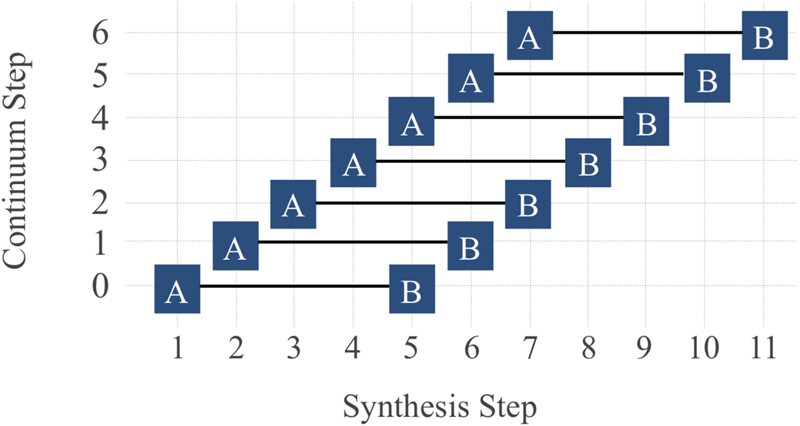
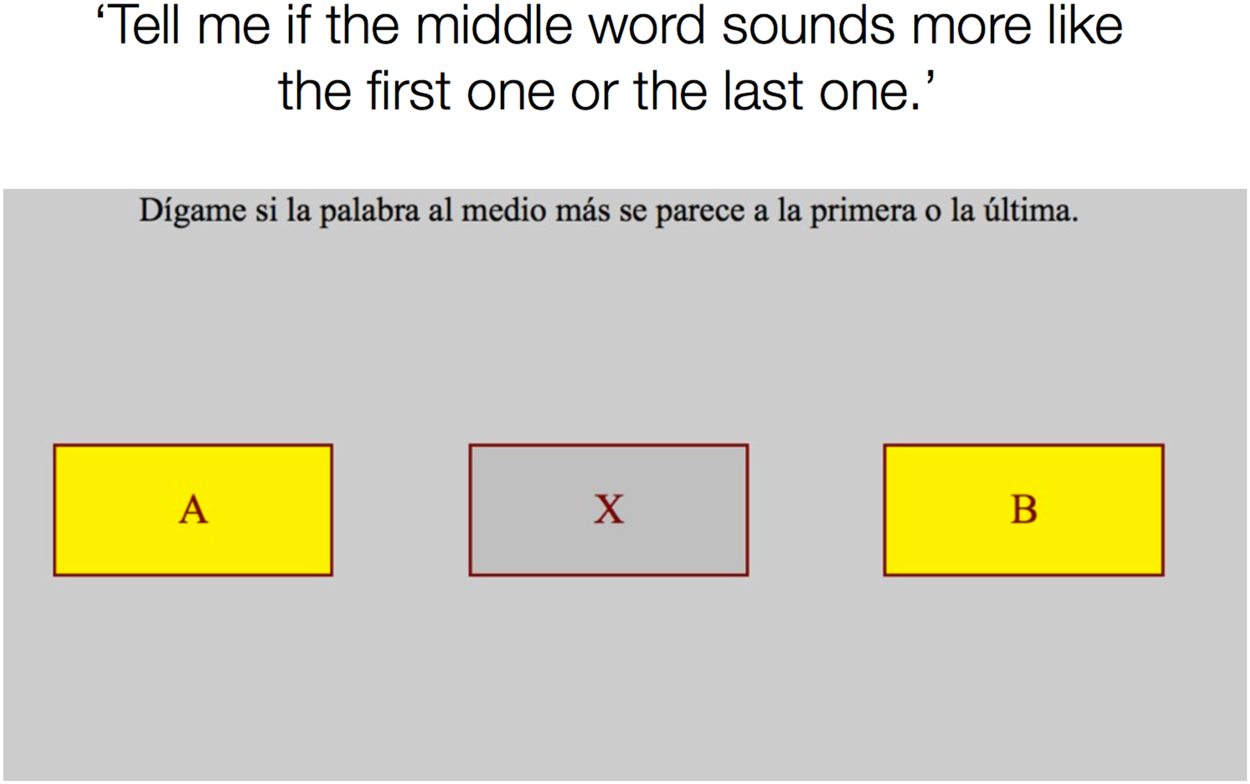
A trial consisted of hearing two different auditory stimuli, A and B, and then a third stimulus, X, drawn from the same synthesis level as one of the first two. As shown in Figure 1, the AB pair always differed by four continuum points for a total of seven possible pairs for each set of words. Combining each AB pair with an Xa or an Xb created fourteen pairings and twenty-eight AXB triplets after balancing for AB and BA presentation orders. The listeners’ task, as shown in Figure 2, was to decide if the middle (X) item sounded more like stimulus A or more like stimulus B. Each block contained stimuli from two of the word pairs (one each from [e]–[i] words and [o]–[u] words) for fifty-six possible triplets.
Schematic view of AB stimulus pairings. Each synthesis step represents an equidistant step between vowel endpoints [e]–[i] or [o]–[u]. Each continuum step represents a pairing of two synthesis steps to create an AB pair.

Sample stimulus presentation screen from the AXB task.

Procedure
Participants were tested individually in a single session. The local contact who recruited the participant(s) escorted them, and often their children and other family members, to the experimenter's house. In the ideal case, the escort entertained the children and family members in one room, while the participant and experimenter sat at the computer in an adjoining room with the door closed. When the participant or their family members were uncomfortable being alone with the experimenter in the adjoining room, they were told they were free to join the participant and Babel in the room (this was documented in detailed field notes).Footnote 4 At the beginning of the experiment, the experimenter discussed the aims of the project and obtained informed consent. Then she turned on the recorder and recorded the answers to the following demographic questions, listed in (1) below.
(1) Please give me your full name.
How old are you?
Where were you born?
How long have you lived in Saipina?
Have you ever lived elsewhere? Where and for how long?
Do you speak Quechua? If so, do you use the language daily?
Participants were seated next to the experimenter at a MacBook Pro laptop computer. Up to this point, the participant could see the experimenter typing their answers into the spreadsheet. After this, the experimenter turned away from the spreadsheet and addressed them directly, while she asked them the following three questions, given in (2) below.
(2) Can you tell by the way people talk whether they speak Quechua or not? That is,
can you identify a native Quechua speaker just by the way they talk?
Do you think there's a difference in the way people talk in Cochabamba and Santa Cruz?
Which city do you think people in Saipina sound more like?
These questions were asked prior to the presentation of the AXB task to ensure that the participant was focusing on language differences and the target social categories, identification as a language speaker, and regional origin.
At that point, the experimenter turned off the recorder and opened up the Praat script. She explained to the participant that they would hear three words, and they should tell her which one was the same as the second repetition—which two words formed a pair. Participants were shown the graphical interface on the computer. Participants wore Sony MDR-7506 circumaural, closed-back headphones, which the experimenter helped them to adjust so they were comfortable. Then the participants completed an eight item practice block.
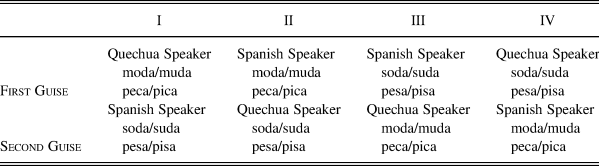
Participants were presented with four word pairs: peca/pica, soda/suda, pesa/pisa, and moda/muda in one of two guises. Half of the participants were initially told that they were about to hear recordings of a person from Santa Cruz who was a native Spanish speaker, and the other half were told that they were about to hear a recording of a person from Cochabamba who was a native Quechua speaker (but who would speak Spanish in the recording). Each presentation type, shown in Table 2, consists of both a Quechua speaker guise block and a Spanish speaker guise block; the order of these guise blocks was balanced across participants. Within each guise, participants heard both a front vowel synthetic continuum (e.g. peca/pica) and a back vowel synthetic continuum (e.g. moda/muda). Participants assigned to presentation type I, for example, heard moda/muda and peca/pica in a Quechua speaker guise first followed by soda/suda and pesa/pisa in a Spanish speaker guise. Trials were presented in pseudorandom order and were not blocked by continuum.
Participants were randomly assigned to one of four presentation types (I–IV). Presentation types were balanced across participants for guise presentation order and synthesized continua.

Participants heard two pairs of synthesized triplets for each vowel continuum (front and back). Each participant responded to 112 trials per guise. They were allowed to rest whenever they wanted, but there were also visual prompts after every twenty-eight trials that asked them whether they wanted a break and a short enforced break at the halfway point. There was a great deal of variation in how much and how long people wanted to rest. The experimenter and participant chatted during these breaks.
After participants finished the first guise, the experimenter turned the recorder back on and asked them the following three questions, listed in (3).
(3) What words did you hear?
Were any of them clearer than the others?
When you listen to this person, do you think she has studied [is educated] or not?Footnote 5
The second guise presentation was identical to the first, with the exception that the continua were changed and the purported social identification of the speaker was switched as depicted in the lower half of Table 2. After this second guise, participants were asked the same three questions plus one more.
(4) Did you hear any difference between this person and the first person we listened to? (if necessary, prompt: “The Quechua/Spanish speaker?”)
Afterwards participants were thanked, given their incentive and a sheet with contact information, and released.
While it can be assumed that college students in developed countries have extensive experience using a laptop and feel very comfortable using technology, this is not the case in rural Bolivia. Access to education and technology is graded by age, social class, and gender, and laptops are a luxury item that at the time was not commonly available to most people in this community. Twelve of the participants had some post-secondary education (three teachers, two nurses, two accountants, an agronomist, a finance student, a seminary student, a pastry chef, and a doctor). However, there were at least two participants who had great difficulty reading and writing. The other participants’ level of education ranged from a few years of formal education to a high school diploma. Since computers were not widely used in rural Bolivia at this time, even the most educated participants probably did not use a computer on a daily basis, though they may have seen them and used them occasionally. Several of the participants had never used headphones before, and none of them had participated in an experiment of this type. Given this level of novel experience, and the desire to maintain as uniform an experience as possible across participants, the experimenter recorded participants’ verbal or gestural responses using the computer touchpad rather than asking participants to use the equipment themselves. While waiting for the participants’ responses, she positioned the mouse exactly between the A and the B selections so as not to influence their responses. Since the participants wore closed-back, circumaural headphones, the experimenter could not hear the stimuli.
Measures and predictions
Participants’ discrimination decisions, as reported to the experimenter, were recorded by the Praat script. The dependent variable was accuracy of the participants’ categorical responses. Note that accuracy here is the term of art but also something of a misnomer; it is not, in any sense, inaccurate for a listener to perceive vowels as suggested by his or her native linguistic competence. Rather, we use accuracy from an instrumental standpoint to gauge whether listeners’ patterns of vowel perception can be altered by presenting the same vowels as belonging to different speaker guises.
We predicted that an expectation of Quechua-accented Spanish, which is characterized by overlapping e/i and o/u vowel qualities, would result in a flatter, less categorical, line when plotted as a discrimination function; reflecting listeners’ ability to distinguish vowel categories within the continua. On the contrary, expectation of a native Spanish-dominant speaker, with five canonical vowel qualities, would show clearer category distinctions and a steeper slope in the discrimination functions for each listener.
Furthermore, we predict that changing guises within a subject—presenting first one guise and then, after a short break, the other—should either cause this same shift in discrimination functions or should be rejected by the participant altogether. The latter possibility is why this type of within-subject guise manipulation is typically avoided in matched guise experiments. Experimenters assume that participants will become aware of the guise manipulation and provide responses that are difficult to interpret. The present study takes this possibility as an opportunity to investigate levels of awareness. We test this assumption directly and use this manipulation to examine the differences in implicit and explicit responses from our participants.
Results
Experimental results: Initial guise
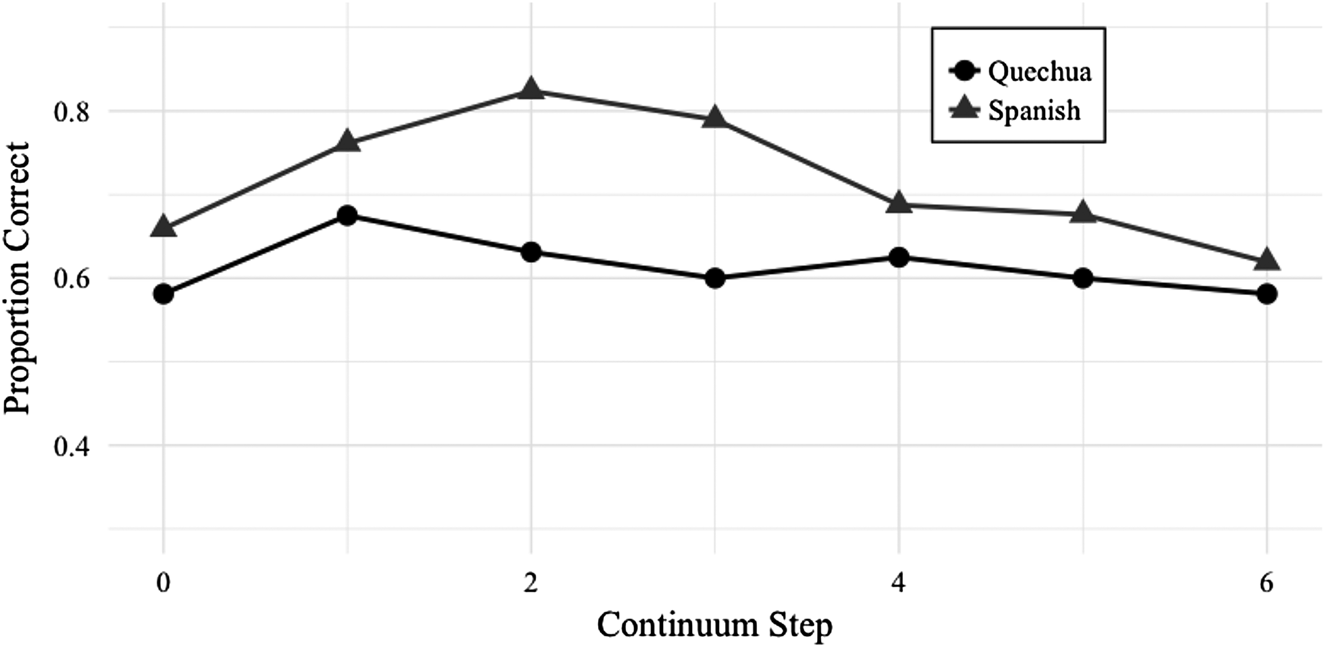
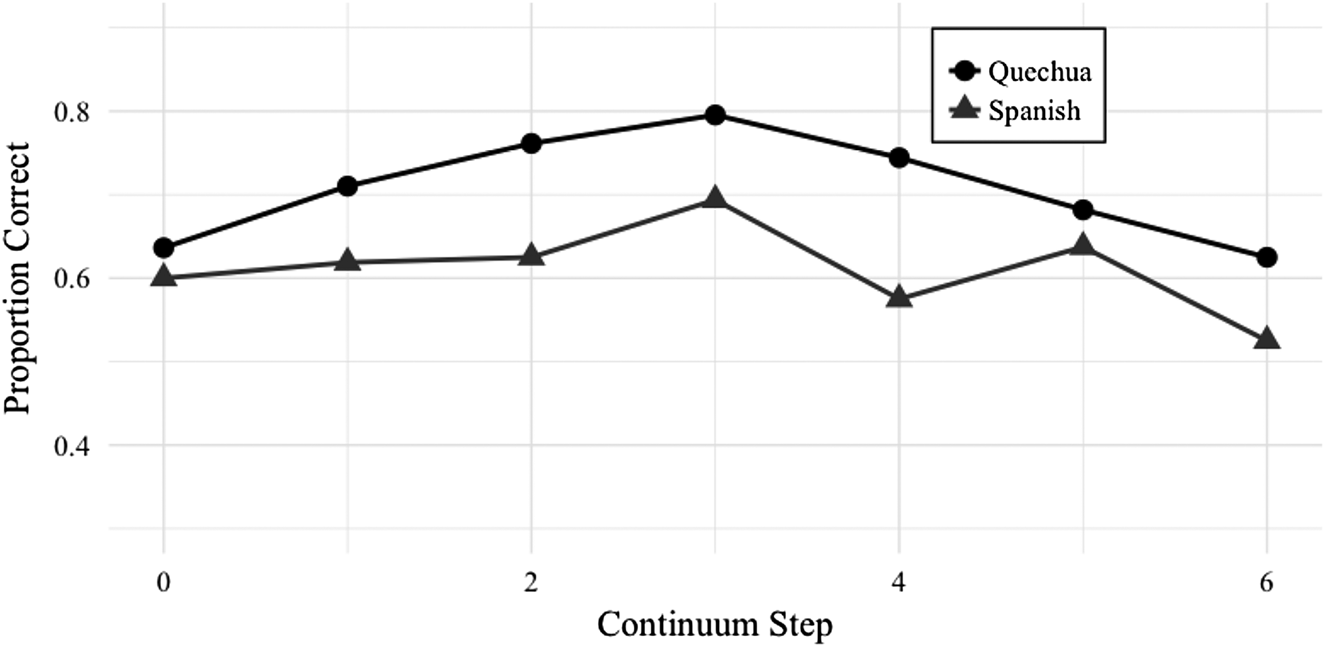
In an AXB task, discrimination accuracy is measured as the ability for listeners to discern the matching A or B pair for a given X sound file. Looking first at the initial guise presentation, listeners in the Spanish guise condition discriminated the matched pair on 71.7% of trials compared to 61.4% for Quechua guise listeners and this difference is significant (Welch's t(2282.1) = 5.3227; p < 0.001). There was no significant difference in discrimination accuracy between the /e/–/i/ and /o/–/u/ continua. This difference in discrimination accuracy suggests that the guise manipulation had some effect on perception and is consistent with our predictions. However, the true test of our predictions depends on whether listeners in the two guises show evidence of differences in the existence and placement of category boundaries. Figure 3 presents discrimination accuracy at each step of the synthesized continua. This plot combines all responses by all participants for both continua in the initial guise presentation. Step 0, at the far left of the plot represents comparisons with the most /i/ like and the most /o/ like steps on the synthesized continuum. Step 6 represents comparisons with the most /e/ and /u/ like synthesized tokens. A correct response for step 0, for example, means that the listener considered that an A token from step 0 of the continuum was different from an X token from step 4 when compared with a different B token also from step 4. The expected pattern of results in this paradigm is more accurate discrimination across category boundaries and less accurate discrimination within categories. Accuracy within the Quechua-dominant condition (circles) is relatively flat across the continua. In contrast, accuracy within the Spanish-dominant condition (triangles) shows the familiar continuous curve that sets vowel discrimination apart from categorical consonant perception in AXB tasks (Fry, Abramson, Eimas, & Liberman, Reference Fry, Abramson, Eimas; and Liberman1962; Pisoni Reference Pisoni1975). This curve suggests that listeners in the Spanish-dominant condition discern separate vowel qualities at the ends of the continua with a category boundary somewhere in the middle while listeners in the Quechua-dominant condition perceive either no category boundary or fuzzy, overlapping vowel quality categories.
Initial guise presentation. Proportion correct discrimination responses for Quechua and Spanish guises at each step of the synthesized continua.

We performed a mixed effects logistic regression, using R (R Core Team 2016) and lme4 (Bates, Maechler, Bolker, & Walker Reference Bates, Maechler, Bolker and Walker2015) of the relationship between discrimination accuracy and speaker guise. The dependent variable was Accuracy. The included fixed effects were Guise and Continuum Step with an interaction term. As random effects, we included intercepts for both listener and stimulus pairing. Factors were sum coded to allow interpretation of lower-order effects as main rather than simple effects. This model supports an intuitive visual inspection of Figure 3. There is a main effect of Guise (β = 0.941; t = 3.081; p < 0.001) as previously demonstrated via Welch's t. The interaction of Guise and Continuum Step is also significant (β = −0.081; z = −2.475; p < 0.05) but no main effect of Continuum Step alone (β = −0.054; z = −1.537; p = 0.124).
For this initial guise presentation, both our general prediction of a difference in listener expectations for the Quechua and Spanish guise and our specific prediction about the nature of those expectations are supported by these data. This finding is consistent with many previous results in the sociophonetic perception literature (e.g. Niedzielski Reference Niedzielski1999; Hay, Warren, & Drager Reference Hay, Warren and Drager2006; McGowan Reference McGowan2015) and adds support to the standard interpretation given in that literature that social information can alter and override listeners’ use of phonetic detail. When a listener was told to expect to hear a Spanish-dominant speaker from Santa Cruz in the first block, their responses indicated that they held a clearer distinction between the vowel pairs. Conversely, when they were told to expect to hear a Quechua-dominant speaker from Cochabamba in the first block, their responses indicated a less clear distinction between the vowel pairs.
Experimental results: Second guise
As in the analysis of the initial guise presentation in the first block, there was a significant effect of guise on discrimination accuracy. Reversing the outcome of the first guise block, however, listeners who heard the Quechua guise second were more accurate (70.8%), and listeners who heard the Spanish guise second were less accurate (61.1%), and this difference is again significant (Welch's t(2288) = 4.9769; p < 0.001). These numbers are virtually identical to the accuracy numbers obtained by the same listeners for the opposite guise in the preceding block. As with the initial guise presentation, there was no significant difference in discrimination accuracy between the /e/–/i/ and /o/–/u/ continua.
As shown in Figure 4 the initial perceptions established by the initial guise in the first experimental block did not appear to change uniformly for both guises when participants were told to expect to hear a different speaker in the second block. Listeners who were told to expect a Spanish speaker in the first block display the same pattern of responses when told, in the second block, to expect a Quechua speaker. Listeners who were less accurate when told to expect a Quechua speaker remain less accurate when told to expect a Spanish speaker. This visual inspection is supported by a second mixed effects logistic regression; there are main effects of Guise (β = −0.8072; z = −2.953; p < 0.01) and Continuum Step (β = −0.08755; z = −2.159; p < 0.05). The interaction of Guise and Continuum Step in block two just misses significance at the standard 0.05 α level (β = 0.06219; z = 0.03197; p = 0.05179).
Second guise presentation. Proportion correct discrimination responses for Quechua and Spanish guises at each step of the synthesized continua.

Discussion
Experimental results
One clear conclusion we can draw from this experiment is that listeners in the first guise behave as if they believe the social manipulation. This belief has consequences at the level of perception, beneath conscious awareness, typically assumed by phonetics and sociophonetics researchers. Participants’ social knowledge about speakers changes their low-level phonetic expectations and consequently their approach to the task of listening. In this respect the present work can be seen as an extension of much existing sociophonetic research that has shown similar capacities for listeners to shift their expectations about the voice of the talker (e.g. Niedzielski Reference Niedzielski1999; Hay et al. Reference Hay, Nolan and Drager2006). Moreover, listeners in this study shifted their perceptual expectations in ways that quite closely mirror the vowel variation common among Quechua-dominant speakers in the region. It is clear from the speakers’ responses that they do use the social information that they were given in interpreting the words they hear in a recording. Overall, in the first guise presentation, participants showed clearer, more categorical boundaries when they were told they would hear a Spanish speaker, and less clear boundaries when they were told they would hear a Quechua speaker. This suggests listeners have an expectation of a linkage between social group and phonetic behavior.
Unlike previous work, however, the present experiment tested what would happen when the social information the participants were given was revised mid-experiment. These manipulations are typically between, rather than within, subjects because listeners might refuse to believe the manipulation and/or become aware of a mismatch between voice and purported identity. Within an empirical tradition that seeks to understand perception below conscious awareness, this manipulation is likely to result in undesirably aware participants. As explored further in the interview analysis, however, this is not the general pattern we observed in these participants.
The within-subjects change of the purported speaker guise allows us to ask whether a change in the explicit information held by the listener results in a corresponding shift in low-level perception of phonetic detail. The answer to this question is clearly, ‘no’. While results of the AXB perception task and the higher-level interview questions in the first guise reveal a successful manipulation of expectations, these results diverge in the second guise. Low-level perception of fine phonetic detail is consistent with manipulated belief in the first guise but is not altered by the subsequent guise. This result supports work by Kraljic, Samuel, & Brennan (Reference Kraljic, Samuel and Brennan2008), demonstrating that at a phonetic level, first impressions are disproportionately important for perception tasks.
Interview results
The interview results focused on the responses to the interview questions after the first and second guise. First, we examined whether interviewees perceived a difference between the Spanish guise and the Quechua guise at an explicit level (in response to the question “Did you hear any difference between this person and the first person we listened to?”). A trained research assistant evaluated participant responses and evaluated their responses for three qualities: specific comments, detailed evidence, and patterns among respondents. The research assistant's analysis indicated that eleven participants stated unambiguously that there was a difference between the two guises, supported by specific and detailed evidence. Five participants stated that they did not hear a difference between the guises or were unable to provide specific, detailed evidence. Four participants were uncertain or gave insufficient answers. One participant's interview was incomplete due to technical issues with the recording.
The research assistant also evaluated the possibility that participants were responding ‘yes’ to questions about the difference between guises in order to avoid contradicting Babel, who had told them explicitly that they would hear two different people. The research assistant found that there were consistent patterns in the linguistic and social features reported by respondents, and that the evidence that participants gave to describe their perception of different speakers was specific and detailed enough to support the assumption that they were responding truthfully. This coincides with Babel's assessment that participants were responding in good faith and to the best of their ability.
Additional details emerged in the participants’ responses to the question about education (“When you listen to this person, do you think she has studied [is educated]?”). Seventeen participants said unambiguously that they thought that the Spanish guise was educated. Two said they were not sure and one said she had a “mid-level” education (that is, had finished high school but probably not college). Fourteen participants said unambiguously that they thought that the Quechua guise was educated. Four said that they did not think she had studied, one was not sure, and one said she had a “primary or secondary” education.
Even those responses that were ambiguous followed the same general pattern. The consultant who stated that the Quechua speaker had a “primary or secondary education” also said that the Spanish-speaker had a “mid-level” education. When the experimenter asked some follow-up questions, the consultant explained that she thought the Spanish-speaker had probably finished high school. Though she later stated that the two speakers were “about the same” and had “very little difference” between them, her answers initially followed the same pattern as those of the other speakers.Footnote 6
Some of the differences were very clear, such as the following comments.
(5) a. Participant 16
Quechua: “I don't know… I see her as a person who has studied through fourth grade or so.”
Spanish: “I think [she has studied] because she speaks clearly.”
b. Participant 3
“[The Spanish guise] let you understand what she said better. And [the Quechua guise] very little.”
Some showed some doubt on the part of the consultant, as in (6).
(6) a. Participant 8
“There was a little (difference)…the [Quechua guise] I had a hard time understanding, but maybe it's because I was getting used to it… the [Spanish guise] was clearer.”
b. Participant 5
“The [Quechua guise] was more accentuated.”
“As if she were trying to pronounce the /u/ and the /o/ at the same time.”
c. Participant 20
“The tone was clearer [in the Spanish guise]. Different. She made more of a difference [between the words]. [The Quechua guise] was more muffled. [The Spanish guise] was clearer. Her voice carried better.”
Others linked language abilities to urbanization, as in (7).
(7) Participant 22
Spanish: “The words she says are very clear.”
Quechua: “Seems like she's from the city.”
Another consultant, a native Quechua speaker who taught Quechua in the schools, had the following comments about the speakers that she heard.
(8) Participant 19
Quechua: “I don't think [she has studied]. She's probably studied some but only to a certain point. She hasn't finished everything.” … “I think she has studied, to be able to determine all those things.” (That is, to be able to produce the words she heard in the task.)
Spanish: “I think yes. She makes the difference [between word pairs].”
Although this participant ultimately decided that both conditions are educated, she went through more discussion and doubt when evaluating the Quechua speaker.
Another consultant, also a Quechua speaker, had the following comments, given in (9) below.
(9) Participant 21
Quechua: “[I think she has studied] because she has a difference in her speech. Someone who hasn't studied talks another way.”
Spanish: “She must be from Santa Cruz. Someone from Cochabamba speaks differently. Someone from Santa Cruz speaks a little clearer… In Santa Cruz they speak clearer, because it's legitimate Spanish.”
“Peca…is altered vocabulary. Someone from Potosi or Cochabamba, sometimes they mess up and say ‘peca’ insetad of ‘pica’.”
For this consultant, the Quechua-speaker must have studied in order to achieve her apparent level of competence, while the Spanish-speaker “speaks clearer” because it's “legitimate Spanish”.Footnote 7
The interview responses clearly demonstrate that more than half of the consultants heard a difference between the two guises and were able to comment on it at an explicit level. These discussions of difference between Spanish-dominant and Quechua-dominant guises reveal the influence of cultural stereotypes regarding the type of speaker who is likely to be educated and the way that this education is framed by participants. Given that the voice they heard was a Spanish-dominant speaker who holds an advanced professional degree, it is meaningful that most participants assumed that the Quechua-dominant guise was less educated, and that they framed their comments in ways that downplayed her linguistic ability by evaluating her speech as “muffled”, “unclear”, “altered”, “accentuated”, and difficult to understand. In contrast, the Spanish-dominant guise was consistently described as “clear”, “legitimate”, and easy to understand. When the Quechua-dominant guise was described as educated and urban, it was in order to justify her (apparently atypical) clarity of speech. As Participant 21 put it, the Quechua-dominant guise “must have studied” in order to achieve her level of speech, while the Spanish-speaker simply spoke “legitimate” Spanish. The participants’ detailed discussion of the qualities that participants associated with the two guises make these comments a revealing source of data on language ideologies and social groups. The stereotypes of Quechua-speakers that surface in these comments are widely held in the community, and they represent stereotypes that Quechua-dominant speakers are likely to encounter (see e.g. Howard Reference Howard2007; Babel Reference Babel2018). People who are identified as Quechua-dominant are assumed to be less educated than Spanish-dominant speakers, regardless of what they may actually sound like. As has been widely shown in the US (Baugh Reference Baugh2003; Rickford & King Reference Rickford and King2016; Rosa & Flores Reference Rosa and Flores2017), these perceptions have material consequences for individuals who belong to groups that are on the short end of an unequal power scale.
Conclusion
The main goal of this study was to investigate the influence of social information on linguistic perception at an implicit and an explicit level. The participants in the study responded differently to a recorded voice when they believed the speaker to be a Quechua-dominant speaker versus a Spanish-dominant speaker, despite the fact that the voice itself remained the same. As has been found in previous work, social information changes linguistic perception, even when the input remains the same. It is interesting and noteworthy that this result holds among participants who are speakers of a contact dialect of rural Bolivian Spanish just as it does among the typical university ‘subject pool’ population used in laboratory experimentation—largely white, monolingual, middle-class undergraduates in English-speaking countries.
Our participants’ perceptions of the speaker changed at both an implicit and an explicit level when social identification was manipulated. Participants described the Quechua-dominant guise as muffled, unclear, or difficult to understand, while they described the Spanish-dominant guise as educated, clear, and a legitimate speaker of Spanish. A close examination of narrative responses to the interview questions revealed consistent, patterned evaluations of the speaker that cast the Quechua-dominant guise as less fluent and less educated than the Spanish-dominant guise.
In response to the experimental stimuli, participants who were presented with the Spanish-dominant guise first showed a clearer, more distinct differentiation between vowel pairs than did participants who were presented with the Quechua-dominant guise first. The latter group showed a flatter curve with less consistent differentiation between vowel pairs, a result that would be consistent with their experience with and stereotypes of Quechua-speakers as ‘mixing up’ their vowels. In this first guise, experimental and narrative responses showed similar patterns.
Unlike previous experimental studies, in this study participants were presented with both guises in a single session, one presentation following the other. Some participants were told that they heard a Spanish-dominant speaker first, and then a Quechua-dominant speaker, while other participants were told that they heard a Quechua-dominant speaker first, then a Spanish-dominant speaker. This methodological innovation revealed that implicit and explicit types of evaluation diverged in the second part of the task, and sheds light on a routine part of everyday interaction: adjusting our expectations based on new social information about an interlocutor. Qualitatively, the majority of participants stated that they heard a difference between the two speakers (in reality, the same speaker in different guises). They discussed these differences in terms that clearly reflected broader societal stereotypes about Quechua-speakers. However, in the experimental results, participants tended to continue to respond to the task as they had in the first guise. Participants who were presented with the Spanish-dominant guise continued to respond to the task in a way that showed clear category boundaries between vowel pairs, even when they believed they were listening to a Quechua-dominant speaker. Participants who were presented with the Quechua-dominant guise first continued to respond with unclear category boundaries at the beginning of the second guise presentation, even when they believed that they were listening to Spanish-dominant speaker.
These results demonstrate that participants perceived sociolinguistic information differently at implicit and explicit levels, and lend empirical support to theoretical frameworks that suggest that there are different ‘levels’ or qualities of awareness (e.g. Babel Reference Babel2016b; Preston Reference Preston2016; Squires Reference Squires2016; D'Onofrio Reference D'Onofrio2018). The results of our study show that qualitative measures of sociolinguistic awareness obtained through interviews and in conversation diverge from experimental measures of sociolinguistic awareness obtained through perception tasks. This result suggests that speakers react differently to the experimental stimuli at a relatively automatic level than they do in explicit metalinguistic commentary, and is consonant with psychological literature indicating that there is more than one type and level of perception and, in all probability, different types of processing systems involved in the social perception of speakers (Campbell-Kibler Reference Campbell-Kibler2016; Squires Reference Squires2016).
There may be more subtle differences at play within subfields as well. An important question raised by this work is whether the results of a late vowel identification task, where decisions are made long after the listening event has completed (e.g. Niedzielski Reference Niedzielski1999; Hay et al. Reference Hay, Warren and Drager2006) is measuring the same implicit ‘perception’ that is measured in, for example, Strand & Johnson (Reference Strand, Johnson and Gibbon1996); we anticipate, based on our results, that it is not and that further investigation will reveal that these judgments operate at the same level as our participants’ explicit metalinguistic commentary.
In recent work, sociophoneticians, sociolinguists, and linguistic anthropologists have converged on a set of questions regarding the role of awareness and control in linking social and structural aspects of language (Babel Reference Babel2016a). While the questions that researchers in different subfields are investigating are similar, their methods are quite different. While linguistic anthropologists often focus on explicit metapragmatic evaluation of linguistic features (Meek Reference Meek2006; Babel Reference Babel2016c; Carmichael Reference Carmichael2016; Zimman Reference Zimman2016), sociophoneticians have focused on perceptual tasks that measure implicit responses to particular linguistic stimuli (Sumner, Kim, King, & McGowan Reference Sumner, Kim, King; and McGowan2014; Drager & Kirtley Reference Drager and Kirtley2016; McGowan Reference McGowan2016). This study uses qualitative, quantitative, and experimental methods in order to investigate the role of differing levels of awareness of the links between social and structural aspects of language.
The terms implicit and explicit are useful placeholders in order to distinguish between the types or qualities of awareness that we elicited in this study, but are themselves likely too broad to capture the full nuances of our linguistic awareness. Awareness also encompasses the knowledge that allows people to style-shift, using different variables in different contexts (e.g. Labov Reference Labov1972; Rickford & McNair-Knox Reference Rickford, McNair-Knox, Biber and Finegan1994; Schilling-Estes Reference Schilling-Estes1998), and that allows us to use language to place ourselves and others in social groups through identity practice (e.g. Bucholtz & Hall Reference Bucholtz and Hall2005; Mendoza-Denton Reference Mendoza-Denton2008; Bucholtz Reference Bucholtz2010). These processes are complex and subtle and are likely informed by many different modes of awareness.
The present study uses experimental, quantitative, and qualitative methods in order to evaluate the relationship between qualitative and experimental approaches and to investigate the links between different ‘levels’ of awareness. At both an explicit and an implicit level, our understanding of language is informed by the beliefs that we hold about social groups. This finding holds for speakers of a contact dialect of Spanish in rural Bolivia just as it does for white, middle-class college students. However, our implicit and explicit reactions to language do not always line up perfectly. The results of this study demonstrate that what people perceive, as measured by experimental tasks, is not necessarily what they believe they hear, as reported in metapragmatic narrative responses to interview prompts. Multiple methodological approaches must be employed in order to fully understand the way that we perceive language through the lens of social knowledge.