INTRODUCTION
Because endemic infections seldom show obvious signs of disease in their wild hosts, many (zoonotic) viral infections are considered to be relatively benign to their natural hosts (Shellam, 1994; Sandvik et al. 1998; Vapalahti et al. 2003). Natural subclinical infections have been shown, however, to have significant adverse effects on their hosts on a population level through reduced fecundity (Feore et al. 1997). The increased allocation of resources to virus-specific immune defence, and changes in the infected host tissue also make virus-infected hosts susceptible to secondary bacterial and fungal infections (Cushion, 2004). Natural infectious agents can also affect the outcome of virus infections (Chowaniec, Wescott and Congdon, 1972). The competition of multiple parasites for energy and nutrient resources of the host may be energetically costly (Sheldon and Verhulst, 1996), thus decreasing the amount of energy available for other functions. The adverse effects of natural subclinical infections are likely to be important especially in long-lived species because the cost of parasitism may accumulate over the years. In relatively short-lived species, like rodents, the cost of parasitism may also be exacerbated by past infections because the time-frame for delaying reproduction is short. As part of our research on the ecology of rodent-borne viral zoonoses, we are collecting information on concurrent virus and parasite infections in natural rodent hosts.
Pneumocystis organisms represent atypical fungi with ubiquitous distribution, and pulmonary tropism, showing a specificity for a given mammalian host species (Cushion, 2004). The species name Pneumocystis carinii was previously used for all organisms of this genus but due to the recent recognition of several Pneumocystis species, this name is presently used to refer to 1 of the 2 species found in rats (Cushion, 2004). Of the host species used in the present study, Sorex araneus is known to have a specific Pneumocystis species (Peters et al. 1994; Bishop et al. 1997). Wild mice from the United States contain Pneumocystis murina, a species found also in laboratory mice (Keely et al. 2004). DNA sequence analysis also suggests that there are different Pneumocystis strains in mice (Keely et al. 2004). The association of these microorganisms especially with immunosuppressed hosts is highlighted in the fulminant Pneumocystis jirovecii infections in AIDS patients (Cushion, 2004).
Three species of wild mice (Apodemus flavicollis, Apodemus agrarius, Micromys minutus) and the common shrew, Sorex araneus, were chosen as host animals for this study. The occurrence of Pneumocystis organisms in wild mice in Finland varies considerably depending on the species, site, and season (Laakkonen, 1998). Common shrews have a high prevalence of Pneumocystis in all sites and seasons in Finland, with the peak prevalence occurring in late autumn (Laakkonen, 1998; Laakkonen et al. 1999). There is no previous information on the viral infections of wild mice, or of shrews from Finland. The aim of the present study was to test whether Pneumocystis infections of these small mammals are associated with hanta-, pox-, and arenavirus seropositivity of the host. Hantaviruses (family Bunyaviridae, genus Hantavirus) and arenaviruses (family Arenaviridae, genus Arenavirus) are enveloped negative-stranded RNA viruses each associated with a particular rodent host species. Four hantaviruses, Puumala (PUUV), Dobrava (DOBV), Saaremaa (SAAV) and Seoul (SEOV) are known from rodents in Europe (Vapalahti et al. 2003). The only arenavirus reported from Europe so far is lymphocytic choriomeningitis virus (LCMV). Its major rodent host is the common house mouse, Mus musculus (Lledó et al. 2003). Poxviruses (family Poxviridae, genus Orthopoxvirus), are large DNA viruses found in a wide range of vertebrates (Chantrey et al. 1999).
MATERIALS AND METHODS
Host animals
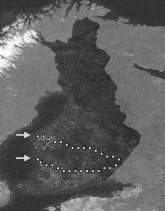
The animals were trapped as part of our long-term study consisting of 2 transect lines crossing southern and central Finland (Fig. 1). Animals (Table 1) were caught during a 2-day trapping session per site in October 2001. Because the population densities of mice were exceptionally high in 2001, especially in the easternmost sites, even rarely caught species (A. agrarius, M. minutus) were obtained in large numbers. Snap-trapped animals were preserved in dry ice in the field, and stored at −20 °C until dissection in the laboratory. At necropsy, the species, sex, and reproductive condition of the animal were recorded, and the animal was macroscopically examined for parasites and anomalies.

Fig. 1. A map of Finland showing the transect lines of the trapping sites. The material for the present study was collected mainly from the eastern sites where all 3 mice species occurred.

Parasite screening
Parts of the right cranial and medial lobes of lungs were fixed in 10% neutral-buffered formalin for the preparation of standard histological sections (Laakkonen and Soveri, 1995). These were stained with haematoxylin-eosin for screening of abnormalities in the lung tissue, and Gomori's Methenamine Silver (GMS) stain for detection of cyst forms of Pneumocystis in lung tissue (Grocott, 1955). Morphologically, the cysts (4 μm in diameter) are oval, and demonstrate a ‘parenthesis’-like thickening of the cyst wall. With every batch of specimens processed, a slide containing lung sections from a Pneumocystis carinii infected laboratory rat was included as a positive control. Because only the cyst forms of Pneumocystis are visible in the GMS-stained sections, and because Pneumocystis organisms are often difficult to identify if only a few fungal organisms are visible, a sample was considered negative unless at least 5 identifiable cysts were visible (Laakkonen and Soveri, 1995).
Serological screening of virus antibodies
The heart was placed in a sterile vial containing 100 μl of PBS, and stored at −20 °C until the diluted blood was analysed by immunofluorescence assay (IFA). The reactivity of the PBS-diluted blood samples obtained from the heart to hantaviruses were tested with PUUV-(Puumala virus) or SAAV (Saaremaa virus)-IFA (for shrews and mice, respectively), to cowpoxviruses with CPXV (Cowpoxvirus)-IFA and to arenaviruses with LCMV (Lymphocytic choriomeningitis virus)-IFA. PUUV (Sotkamo strain) and SAAV (Saaremaa strain), CPXV, and LCMV (Armstrong strain; kindly obtained from Sirkka Vene, SIIDC, Stockholm, Sweden)-infected Vero E6 cells were detached with trypsin, mixed with uninfected Vero E6 cells (in a ratio of 1[ratio ]3), washed with PBS, spotted on IFA slides, air-dried, and fixed with acetone as described earlier (Hedman, Vaheri and Brummer-Korvenkontio, 1991). The slides were stored at −70 °C until use.
The PBS-diluted blood samples were incubated on the virus-infected Vero cell slides in a moist chamber at +37 °C for 30 min, after which the slides were washed 3 times with PBS and once with distilled water. FITC-anti-mouse IgG conjugate (DAKO A/S, Copenhagen, Denmark) diluted 1[ratio ]30 in PBS was added and incubated at +37 °C for 30 min. After that the slides were washed 3 times with PBS and once with distilled water, air-dried, mounted and covered with a cover-slip, and studied using a fluorescence microscope. Seropositive human serum was used as a positive control for the PUUV-, SAAV-, and CPXV-IFA; and LCMV mouse monoclonal antibody (Progen, Heidelberg) for the LCMV-IFA.
Statistical analyses
The presence of viral antibodies, and that of Pneumocystis cysts were recorded as a binary response (present/absent) for each animal. These were analysed by association test (Fisher's Exact Test), which was also used to compare differences in prevalence between sexes (Statistix® for Windows, Analytical Software, Tallahassee, FL).
RESULTS
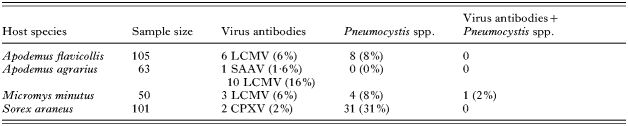
All examined animals were non-breeding (subadults), born during the previous summer 2001, and appeared normal on gross pathological examination. One A. agrarius was hantavirus (SAAV) seropositive, and 2 S. araneus were cowpox (CPXV) positive (Table 1). Arenavirus antibodies (LCMV) were found in all 3 mice species but not in shrews. There was no difference in virus antibody prevalence (CPXV for shrews, and LCMV for mice) between sexes in any species (not shown). Cyst forms of Pneumocystis spp. were visible in all species except A. agrarius (Table 1). There was no difference in Pneumocystis prevalence between sexes in any species (not shown). All Pneumocystis infections were mild (<20 cysts/histological section) with no visible histopathological changes associated with the cysts.
Concurrent presence of LCMV-antibodies and cyst forms of Pneumocystis were detected only in 1 rodent (M. minutus). There was no significant association between virus antibodies (CPXV in shrews, and LCMV in mice) and cyst forms of Pneumocystis in any of the species (Fisher's exact tests; P=1·00 for A. flavicollis, P=0·22 for M. minutus, and P=0·57 for S. araneus). In A. agrarius, the absence of Pneumocystis infections prevented statistical determination of possible virus-parasite associations.
Of other lung parasites, adiaspores of a fungus, Emmonsia sp., were detected in 1 Apodemus flavicollis also infected with Pneumocystis cysts. A granuloma and inflammatory cells surrounded the adiaspore. One A. flavicollis and 1 M. minutus had unknown fungal spores (<1 μm in diameter) in bronchioles. The site of the spores indicates that these may be due to accidental inhalation of non-parasitic fungi.
DISCUSSION
We found no evidence of any association between Pneumocystis and arena-, hanta-, and poxvirus antibodies in wild mice and shrews in Finland. The prevalence of the tested virus antibodies and/or Pneumocystis spp. were so low (<10%) in all host species that it is unlikely that any associations would be detectable even with higher sample sizes. As found in previous studies (Laakkonen, 1998), the prevalence of Pneumocystis was high in common shrews (Table 1). In humans, healthy adults have been shown to act as temporary carrier host of Pneumocystis jirovecii organisms (Medrano, Montes-Cano and Conde, 2005). Similarly, shrews may also act as carrier host to their Pneumocystis species with no relation to any other pathogen. Screening based on the detection of parasite DNA (Palmer et al. 2000), also indicates that the prevalence of P. carinii is likely to be higher than that found in microscopical screening of cyst forms. Several studies have shown (Laakkonen et al. 1995; Palmer et al. 2000) considerable differences between Pneumocystis infections in various host species, underlining the caution needed when comparing the nature of the infection in different host species.
Besides the low prevalence of viral antibodies in all host species, several other factors need to be considered when assessing the apparent lack of association between the parasite and the virus antibodies. As the animals in this study were born during the previous summer, and caught in late autumn, it is likely that they had been infected already during the summer. Serological tests are not ideal for epizootiological studies because they provide a history of infection, and it is not known whether a seropositive animal was recently infected and shedding the virus, or whether the animal had recovered from any effects of the virus (Roths, Smith and Sidman 1993; Cavanagh et al. 2003). Hantavirus infection in rodents, for example, is chronic but poxvirus infections last only about 2 weeks in wild rodents. Since shrews are not related to rodents, the commercial (rodent) conjugates used for virus screening might not be optimal for shrews (see, however, Tryland et al. 1998). Of the hantaviruses present in insectivores, only Thottapalayam virus has been reported from Suncus murinus in Asia (Carey et al. 1971).
The present study was carried out during late fall when animals are no longer reproducing. Virus infections might make natural hosts more susceptible to secondary infections during the breeding season when a substantial amount of energy is used for reproduction. Protein malnutrition and social stress (Pena-Cruz, Reiss and McIntosh, 1989; Teo, Price and Papadimitriou, 1991), on the other hand, should have a pronounced effect on host condition during the host density peak in late autumn. Also, the peak prevalence of Pneumocystis is in late fall, and the transmission of viruses should be high during host density peaks in autumn. It should be noted that prevalence of Pneumocystis infections in S. araneus remains constantly high regardless of host density (Laakkonen et al. 1999).
Concurrent virus and parasite infections have been studied in the house mouse (Singleton et al. 1993), but the association between virus antibodies and Pneumocystis infection has not previously been studied in wild small mammals (for domestic animals, see Sukura, Laakkonen and Rudbäck, 1997). In previous studies on S. araneus, no significant relation was found between the occurrence of Pneumocystis cysts and intestinal macro- and microparasites (Laakkonen et al. 1993; Laakkonen, 1995).
The present study represents the first screening of wild mice and common shrews for hanta-, pox- and arenavirus antibodies in Finland. Further attempts to characterize the hantavirus infection in A. agrarius were unsuccessful. In the absence of virus isolation, the virus that elicited the antibody response, cannot be fully identified. Of the hantavirus occurring in mice, Dobrava and Saaremaa viruses are carried by Apodemus flavicollis and Apodemus agrarius, respectively, mainly in south-eastern and eastern-central Europe at low prevalence (Vapalahti et al. 2003).
Serological surveys in many parts of Europe have produced evidence of poxvirus infection in voles and in Apodemus sylvaticus with peak prevalence in autumn (Sandvik et al. 1998; Chantrey et al. 1999). In contrast, no seropositive mice were found in the present study. Serological screening of voles from the same study sites indicates that there is significant spatial variation in the cowpox virus prevalence (Pelkonen et al. 2003). The finding of 2 cowpox seropositive S. araneus (Table 1) is the first record of this virus in shrews from Finland. Prior to the present study, CPXV DNA has been reported from the lungs of 13% of Sorex araneus from Norway (Sandvik et al. 1998) but IFA-tested shrews have been negative (Tryland et al. 1998).
Besides the house mouse, Mus musculus, there is little information on the arenaviruses of wild rodents in Europe (Lledó et al. 2003). Our recent serosurveys have shown a low prevalence of antibody positivity against (unknown) arenaviruses in several rodent species at many locations (our unpublished data). In the present study, seropositive individuals were found in all 3 mice species but not in shrews. So far, attempts to isolate and characterize the arenaviruses found in rodents in Finland have been unsuccessful.
In contrast to our previous screening of A. agrarius (Laakkonen, 1998), Pneumocystis infections were not found in this host species in the present study. Of the other lung parasites found, emmonsiosis is relatively common in Apodemus mice but rare in Sorex shrews (Hubálek, 1999; Laakkonen et al. 1999). Meront forms of Hepatozoon, which are common in some vole species in Finland and elsewhere (Laakkonen et al. 2001), were not found in mice or shrews in the present or in our previous studies (Laakkonen et al. 1999, 2001).
In general, concurrent infection is one of the ways that viral infections can have an indirect but a significant negative effect on their hosts. Considering the multitude of potential pathogens occurring in wild animal populations, or as environmental forms in the microhabitats of these hosts, such interactions are likely to be common. Because of the considerable interspecific differences in the occurrence and susceptibility of host species to various microorganisms (for example to Pneumocystis spp., Laakkonen, 1998), the detection of such interactions requires detailed knowledge of the parasite assemblage of the host species, and the transmission routes and infection sites of the viral infections. Further research is also needed to determine whether ubiquitous parasites, such as Pneumocystis, make the host more susceptible to viral infections.
Our research was financially supported by grants from the Academy of Finland, the Finnish Cultural Foundation, and EU grant QLK2-CT-2002-01358. This publication has been partially funded under the EU 6th Framework Program (GOCE-CT-2003-010284 EDEN) and is officially catalogued by the EDEN Steering Committee as EDEN 0002. Its content does not represent the official position of the European Commission and is entirely the responsibility of the authors.