1. Introduction
Despite a recent surge of philosophical interest in attention, there remain deep and enduring disagreements about what sort of thing attention really is.Footnote 1 Wayne Wu (Reference Wu2014), in response to this problem, has helpfully proposed that we should identify a merely sufficient condition for attention that everyone—or at least a significant portion of the community—could agree on. He identifies, in particular, a sufficient condition for perceptual attention rather than every kind of attention.Footnote 2 According to Wu, using information from a personal-level perceptual representation of an object in order to guide the performance of an experimental task is sufficient for perceptual attention to that same object.Footnote 3 He bases this sufficient condition on an analysis of how psychologists study perceptual attention. In his view, analysing their experimental designs shows that his sufficient condition is something that they endorse.
Having a sufficient condition for all the varieties of attention would allow us, as a community of researchers, to ask and answer questions about perceptual attention without needing to make divisive metaphysical commitments about its nature at the outset of any given investigation. This is an appealing goal that should be of interest to anyone who studies perceptual attention or some of the phenomena that attention is arguably closely linked with, such as agency and consciousness.Footnote 4
This paper moves us toward having that more general sufficient condition on hand by taking two steps—bringing intellectual attention into the conversation and addressing a challenge that Sebastian Watzl (Reference Watzl, Mole, Smithies and Wu2011a, Reference Watzl2017) has raised for Wu’s style of account, according to which the account of attention is significantly out of line with ordinary intuitions about attention.
In the view that I develop, only some of the uses of information from personal-level representations of objects to guide the performance of a task are sufficient for intellectual or perceptual attention: the uses of information that are for the sake of guiding the performance of an agent’s primary tasks rather than that agent’s secondary tasks. I use the notion of “cognitive resources” and a “task-relevant set” of cognitive resources to explain the distinction between primary and secondary tasks. Cognitive resources are mental resources that agents can bring to bear in the performance of tasks. The task-relevant set of cognitive resources for a task are the cognitive resources that an agent could gainfully allocate to the performance of the task. A task is primary for an agent if that individual allocates all or most of the resources in the task-relevant set to the performance of the task. I discuss these concepts, and the evidence that they underlie scientific inferences about attention, in fuller depth in the second section of the paper.Footnote 5
2 Intellectual attention
According to Wu, when a subject uses information from a personal-level perceptual representation of X to guide performance of an experimental task, what that subject is doing is sufficient for perceptual attention to X (Wu Reference Wu2014, 80–82). In that sufficient condition, “personal level” plays an important role by ensuring that the uses of information that are sufficient for attention are personal-level uses of information. Personal-level information and processes are information available to—and performed by—agents rather than information that is available to a mere part of an agent, or a process that is performed by a mere part of an agent (I take this specific way of understanding the distinction from Wu Reference Wu2014, 13; see Dennett Reference Dennett1969 for an earlier discussion of the distinction).Footnote 6
Paradigmatic personal-level phenomena include things such as deliberating and acting, and paradigmatic subpersonal phenomena include things such as the regulation of cerebral blood flow. Intuitively, attention and the uses of information that are sufficient for attention seem like personal-level phenomena. For instance, using information from a visual representation of an apple to guide the grasping of an apple itself seems personal level. Moreover, it seems sufficient for attention, which also seems personal level. Both of those seem to be more like deliberating and acting than like the regulation of cerebral blood flow.
Watzl (Reference Watzl2017) has recently offered substantial arguments, which go beyond my intuitive point above, in favour of the contention that attention should be categorized as a personal-level phenomenon rather than a subpersonal phenomenon (although Watzl argues that we should use the term “subject” rather than “person”). Watzl argues that at the subpersonal level, the neural realizations of attention are diverse enough that attempts to identify what attention consists in at the subpersonal level will fail (Reference Watzl2017, 27–34).
In fact, there is relatively wide agreement among contemporary metaphysicians of attention that attention seems to be located at the level of agents or persons rather than at the level of parts of agents or parts of persons. Despite their varying disagreements about how to analyse attention, Mole (Reference Mole2011), Smithies (Reference Smithies, Mole, Smithies and Wu2011), Jennings (Reference Jennings2012), Wu (Reference Wu2014), and Watzl (Reference Watzl2017), for instance, all share the commitment that attention is a personal-level mental phenomenon. Burge, before the appearance of those works that focus on the nature of attention in particular, also made the point that attention seems like a personal-level phenomenon (Reference Burge2010, 372; his specific way of articulating this was to say that directing the attention is something we attribute to “individuals”).
The view that I defend in this paper differs from Wu’s sufficient condition in two ways: first, it refers to intellectual attention rather than perceptual attention; and second, it invokes the notion of a primary task. Unlike Wu, I do not think that any kind of use of information to guide the performance of a task is sufficient for attention. With respect to the view that I argue for in this paper, a wide range of scientists studying intellectual attention using the n-back paradigm, the retro-cue paradigm, and the refreshing paradigm all believe that when a subject uses information from a cognitive representation of X to guide the performance of a primary task, what that subject is doing is sufficient for intellectual attention to X. Going forward, I will sometimes call this “my sufficient condition” or “the sufficient condition for intellectual attention.”
Before I go on, there are two important notes to make about the idea of a “cognitive representation” and a “primary task”.
In this paper, by “cognitive” I mean “stimulus-independent” (see Burge Reference Burge2010, 378; Beck Reference Beck2012, 586; and Beck Reference Beck2017 for discussions of this demarcation between the perceptual and the cognitive). On this way of thinking, stimulus-independent mental representations do not require active causal links with the objects that they are about in order to continue to exist. So, for example, a visual representation of an apple is stimulus-dependent, while a representation of an apple in memory is stimulus-independent.Footnote 7 Seeing an apple requires an active causal link with some nearby apple. Consequently, the representations involved in that seeing are stimulus-dependent. By contrast, thinking about an apple that one saw yesterday does not require such an active link with that apple. Consequently, the representations involved in that thinking are stimulus-independent.
Second, as I mentioned in the introduction, shifting from “experimental task” to “primary task” marks a significant disagreement between Wu and me about how scientists study attention. Wu believes, roughly, that scientists studying attention believe that as long as a subject is using information to guide a task performance, that subject is attending. But I will argue that a closer analysis of the practice of science shows that scientists have a more careful view, according to which the manner in which the task was performed should enter into our considerations. Specifically, I will argue that scientists treat uses of information that subserve “primary tasks” as sufficient for attention, and that primary tasks are tasks that subjects are taking seriously through allocating all or most of the relevant cognitive resources to the performance of the task. The idea of a primary task is explained in more depth below.
2.a The empirical support
First, I will provide a partial account of how Wu motivates acceptance of his sufficient condition for perceptual attention. Then, I will give the argument for accepting my sufficient condition for intellectual attention.
Wu’s argument for accepting his sufficient condition for perceptual attention is that it seems to be implicitly presupposed by many psychologists when they come to conclusions about perceptual attention—and that explicitly endorsing the sufficient condition that psychologists implicitly presuppose would be a good idea (Wu Reference Wu2014, 38–39).
The latter claim is where the most interesting argumentative work is being done. What motivates this claim is, I take it, that one obvious route to finding a relatively uncontroversial sufficient condition for attention is to identify a sufficient condition for attention that a large group of theorists already accept. Part of what motivates the former claim is Wu’s analysis of the inferences that psychologists make when studying perceptual attention in three research paradigms: dichotic listening, visual search, and spatial cueing. In short, an acceptance of his sufficient condition seems to underlie many of the inferences these psychologists make when they move from observations of behaviour to conclusions about the distribution of participants’ perceptual attention.
But, even more importantly, Wu’s thought is that such a method of justification for their inferences provides a unifying explanation of the inferences of psychologists who work in several different research paradigms. Unifying explanations of this kind are valuable because they reveal that—although these psychologists might, on the surface, appear to use the word “attention” in different ways—a large group of them is actually using the word in the same way when they come to conclusions about attention (see Wu Reference Wu2014, 270–271). Endorsing such a theory of attention, therefore, goes along with being able to explain why we have good reason to resist the claim that the scientific study of attention is relatively disunified.
In the rest of this section, I will first explain how Wu argues that psychologists working on visual search seem to endorse his sufficient condition. Then, I will explain how work in a variety of experimental paradigms motivates the empirical sufficient condition for intellectual attention.
In the visual search paradigm, participants are instructed to press a button as soon as they see a prespecified “target” object on a computer screen that is also displaying some “distractor” objects (here I follow Wu’s summary of the paradigm; see Wu Reference Wu2014, 19–21). Psychologists seem to take these subjects’ responses, via button pressing, as evidence that the subjects have perceptually attended to the target objects. Wu takes this to be a sign that the psychologists implicitly endorse his sufficient condition, because the subjects who perform the task seem as though they are using information from perceptual representations of target objects to guide the performance of their task of button pushing. According to the sufficient condition for perceptual attention, such a use of information is sufficient for perceptual attention to the target objects (Wu Reference Wu2014, 38–39).
We can now move to the empirical support for the claim that psychologists implicitly endorse my sufficient condition. I will discuss the inferences made by psychologists working in the “refreshing paradigm,” the “retro-cue paradigm,” and the “n-back paradigm.” I will argue, like Wu, that it seems as though an implicit acceptance of the sufficient condition would justify the inferences some psychologists make about attention on the basis of the observed behaviours of their subjects. The posit that they implicitly accept the sufficient condition for intellectual attention, therefore, provides a unifying explanation of what justifies the conclusions that this diverse set of psychologists comes to about intellectual attention.
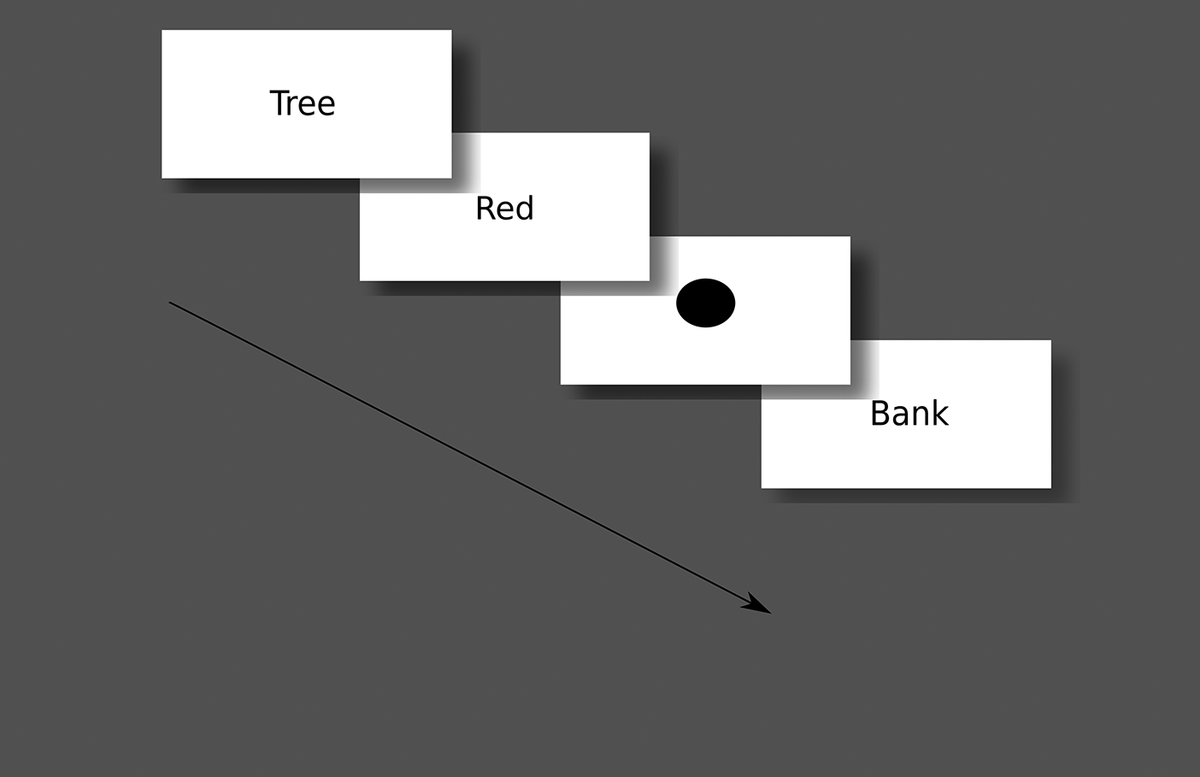
In a simple version of the refreshing paradigm, participants are exposed to a series of slides displaying words one at a time, interspersed with the occasional slide that displays a single black dot. They are instructed to (a) read aloud the words on the slides and (b) think of (“refresh”) and say the previous word when they are exposed to a black dot. Figure 1 shows what a series of slides in the refreshing paradigm looks like.
The Refreshing Paradigm.

Psychologists seem to think that, when subjects respond to the black dots by saying the previous word that they were exposed to during the experiment, they have intellectually attended to the previous word that they saw.Footnote 8 The sufficient condition for intellectual attention clearly provides one explanation for the way in which that thought could be justified. In this paradigm, it seems that participants must have used information from cognitive representations of the previous word they saw to guide their performance of the “respond to a black dot” task. According to the sufficient condition, if they also treated this task as primary, that is sufficient for intellectual attention to the previous words they saw.Footnote 9 My argument that, in general, psychologists only analyse the tasks of participants who treat experimental tasks as primary is in the following section of the paper.
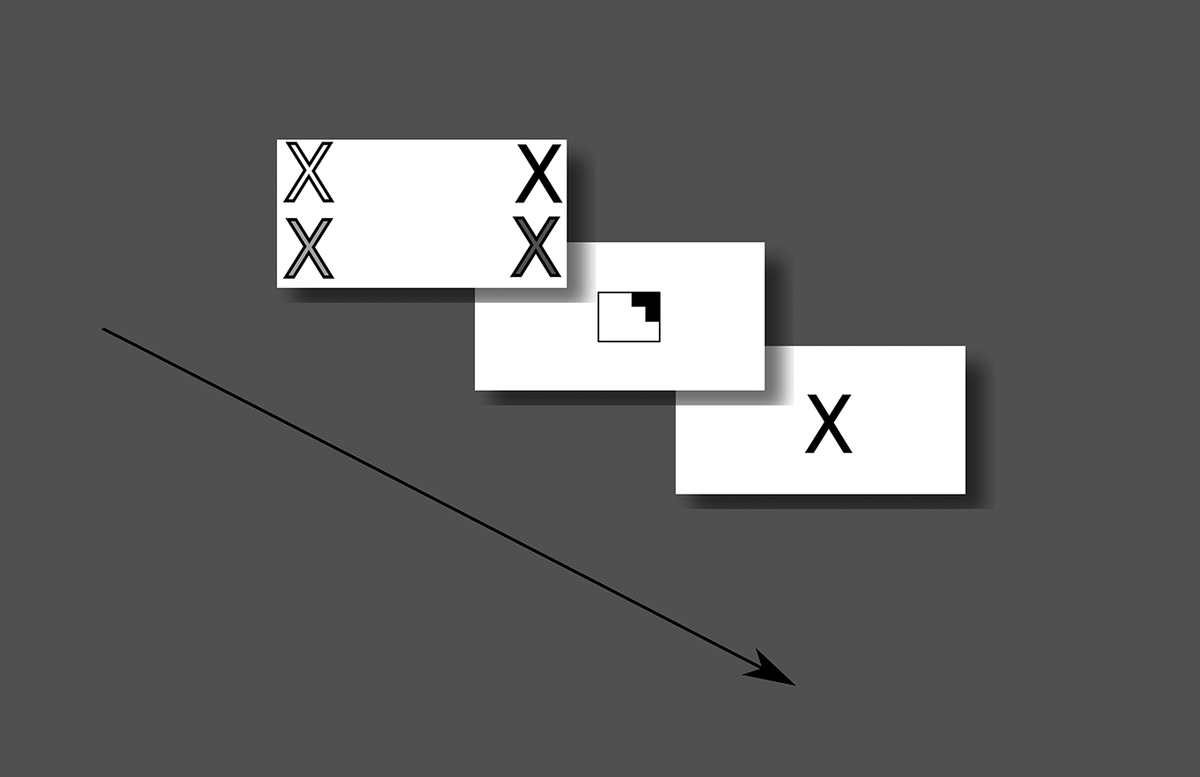
Secondly, in a simple version of the retro-cue paradigm, participants see a slide with four Xs of different colours on each slide, each in a different corner of the slide. The participants then see a slide that has either a cue that points to where one of the Xs used to be (call this the informative condition) or a neutral cue that points in all four directions (call this the neutral condition). Then, on the final slide, a coloured X is presented. Participants press a button indicating whether an X of that colour had been present on the initial slide. Figure 2 shows an example of what a series of slides from the informative condition of retro-cue paradigm looks like.
The Retro-Cue Paradigm.

In this paradigm, it turns out that participants respond more quickly in the informative condition than in the neutral condition. Psychologists seem to take this to be evidence that the participants attended to the cued X in response to the cues.Footnote 10 The sufficient condition for intellectual attention, again, provides one justificatory route from the participants’ observed behaviours to the psychologists’ conclusions. It seems that participants, in responding to a cue, must have used information from a cognitive representation of the initial slide to guide their performance of the “make sure to remember the cued X” task (a subtask in the overall task of “responding correctly to the query that will eventually come”). By the sufficient condition, if they were also treating this task as primary, that is sufficient for intellectual attention to the cued region of the initial slide.
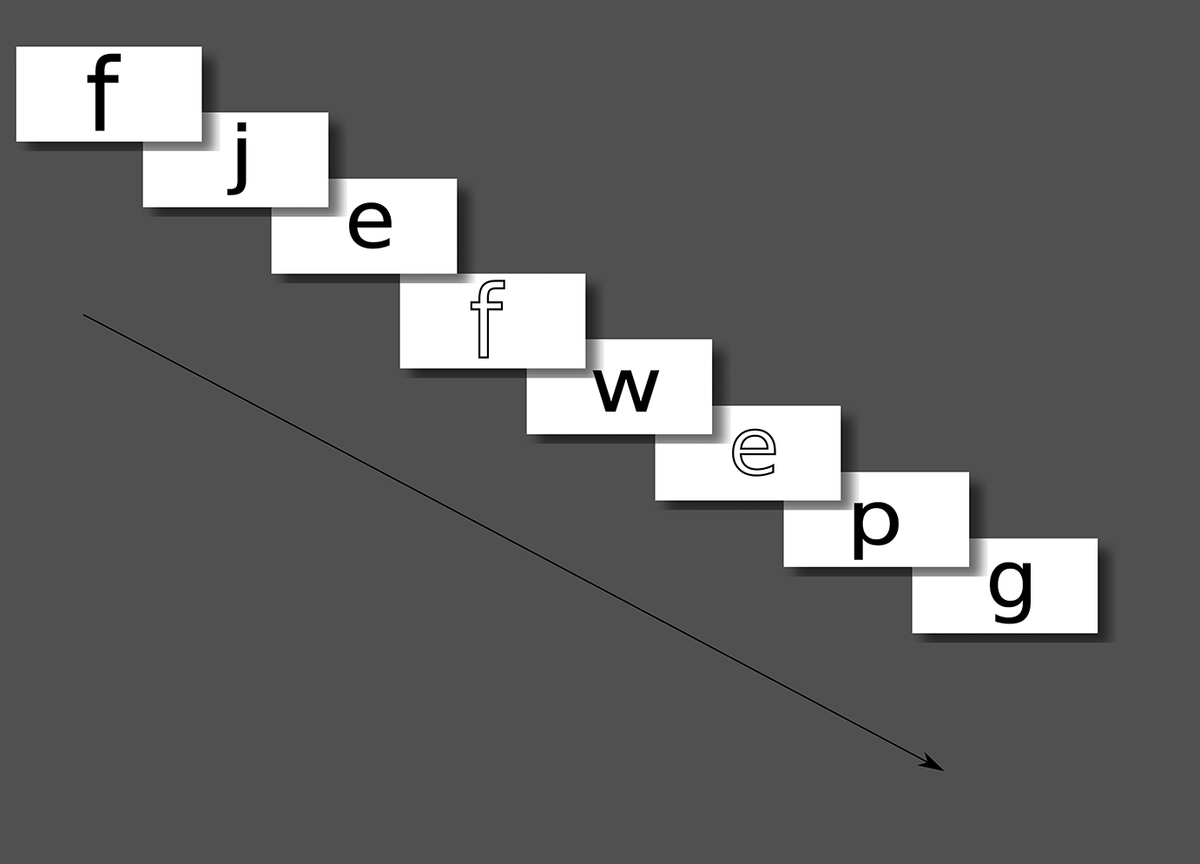
Lastly, consider the n-back paradigm. Participants in the n-back paradigm see a series of letters one by one. The task is to press a button when the n-th back letter in the series is identical to the letter that they are currently viewing (call such a letter a “target letter”). The set of slides below is an example from the 3-back condition. For expository purposes, the “target letters” are outlined rather than solid. The idea is that a participant looking at any of the outlined letters ought to press a button to indicate their awareness that the outlined letters are identical to the letters on the third slide back (Figure 3).
The n-Back Paradigm.

Participants complete the n-back task more rapidly and accurately in the 1-back condition than in the other conditions. Many psychologists explain this discrepancy between reaction times by saying that in the 1-back condition, participants can respond as quickly as they do because they were already attending to the previously seen 1-back letter, and they can immediately compare it to the currently seen letter. In contrast, for participants in the 2-or-more-back condition, some additional processing of some sort (e.g., retrieval from memory) must go on before they can attend to a previously seen letter so as to compare it to a currently seen letter.Footnote 11
Again, the sufficient condition for intellectual attention shows us how the observed behaviours of the participants can be used to justify the psychologists’ conclusions. It seems that participants in the 1-back task must have used information from their cognitive representations of previously seen letters to complete the “respond to 1-back target letters” task. Similarly, it seems that participants in other versions of the task must have used information in just the same way after doing some extra work first (on the view of many psychologists working with the n-back paradigm, this extra work is bringing the letters to mind or remembering them). By the sufficient condition, if the participants were also treating their tasks as primary, those two ways of responding to target letters are both sufficient for intellectual attention to target letters.
The sufficient condition for intellectual attention, therefore, appears to be endorsed by a wide variety of psychologists working in a variety of research paradigms. Moreover, the sufficient condition gives a unifying explanation of these psychologists’ conclusions—that is, it allows us to say that these psychologists are all actually talking about the same phenomenon, despite outward variation in the details of what they have to say about what “attention” means. This is a compelling pair of reasons to endorse the sufficient condition for intellectual attention.Footnote 12
That said, the evidence above is compatible with two theses about intellectual attention rather than just the thesis I intend to defend in this paper: one according to which scientists believe that any use of information from a cognitive representation to guide the performance of a task is sufficient for intellectual attention, and another according to which scientists believe that the use of information from cognitive representations to guide performance is sufficient for intellectual attention only when the performance is performance of a primary task. The latter sufficient condition is the topic of this paper. In the next section, I argue that a closer analysis of the practice of the study of attention reveals that scientists endorse this latter idea.Footnote 13
3. Varieties of selection
Sebastian Watzl has argued that selecting an object, in general, seems insufficient for attention, so we should not try to explain attention in term of selection for action (Watzl Reference Watzl, Mole, Smithies and Wu2011a, 154–155). I agree with his first move, but I think that his observation should cause us to refine my sufficient condition for intellectual attention rather than abandon it. In this section and the next I will explain how to do so.
According to Watzl, it seems that we can attend to a conversation, and during that conversation, pick up a cup and take a sip from it, while never attending to the cup. Similarly, it seems possible that while we attend to a conversation, we might think about the cup, but we could manage to do so without the cup actually engaging our attention—the thinking might have occurred merely at the “back” of our mind. But picking up the cup, and thinking about the cup, do require using information from a personal-level representation of the cup to guide the performance of a task. Consequently, my sufficient condition for intellectual attention and Wu’s sufficient condition for perceptual attention say that both of those uses of information to guide the performance of a task are sufficient for attention. In general, endorsing the sufficient conditions comes along with a difficulty in explaining what it could be to perform a task without, in so doing, attending to some object.
It is possible to argue that Watzl’s counterexamples should not actually motivate us to change our theory of attention. One method of replying to counterexamples such as these is to say that the sufficient condition for intellectual attention is driven by the practice of science, and not whatever intuitions about attention the folk might be unfortunate enough to have. In this way of thinking, Watzl’s cases only show us that a consequence of the best theory of attention is that we should try to revise some of our intuitions about attention.
But this should seem like a misguided method of reply, as long as one pays careful enough attention to the science. Alan Allport, a psychologist that Wu credits with being one of the first adherents of the view that attention is tightly connected with selection for action, would probably agree with Watzl’s basic critical claim.Footnote 14 Allport believes, for instance, that when you reach for an apple, you might only attend to the apple, even though you might use information from other perceptual representations to help guide your task performance (Allport Reference Allport, Heuer and Sanders1987, 396–397). This fact at least complicates the claim that deference to the practice of science gives us a reason to resist refining the sufficient conditions. Indeed, what it suggests is that a closer analysis of the practice of science will reveal that what scientists actually endorse is a refined version of the sufficient conditions.
And it does seem independently plausible to suggest that there is an inattentive mode of cognition. To illustrate this point, consider Christopher Mole’s description of a devoted but tired scholar:
His reading of the book before him is prompted by genuine interest, but having spent the whole day trying to ignore the pangs of hunger, the children in the next room, and the radio that is playing downstairs, he is no longer able to concentrate. His reading is prompted by interest, but it is not attentive.
(Mole Reference Mole2011, 48–49)Mole’s description of this case seems apt: there seems to be an inattentive mode of thought as well as an attentive mode of thought, and the scholar is failing to engage in the attentive mode of thought.
How, then, should we square this information with the fact that the psychologists I discussed in the second section of this paper seemed to endorse the unrefined sufficient condition for intellectual attention? In my view, they believe that selecting objects to guide the performance of tasks that we take seriously are sufficient for attention, while other varieties of selection are insufficient for attention. Here is some representative textual evidence:
Participants were instructed to respond within 300 ms of the tone. They were informed that responses longer than 300 ms were too long and that responses faster than 120 ms were anticipations.
(McElree Reference McElree2001, p. 822)Items were presented at a 2.5-s rate (2 s on, 0.5-s interitem interval), and response times were collected via voice key. Responses were recorded on audiotape; trials in which the voice key was triggered by erroneous responses, coughs, or other extraneous sounds were discarded.
(Johnson et al. Reference Johnson, Reeder, Raye and Mitchell2002, 4)These notes about their practices of discarding data are present in almost every study of McElree’s and Johnson’s that makes use of the refreshing paradigm or the n-back paradigm. In general, Johnson and her colleagues are not interested in studying incorrect task performances, and McElree and his colleagues are not interested in task performances that take longer than 300 ms.
What seems to explain this practice is that these psychologists were not interested in studying task completions of participants who were not taking the task very seriously. Why might they be interested only in the task completions that participants took seriously? A natural explanation is that these psychologists presupposed that uses of information to guide the performance of a task that a participant was not taking seriously would be insufficient for attention. Johnson’s thought seems to be that the refreshing task is so easy that if one got it wrong one could not have been doing it attentively, while McElree’s and Wagers’s thought seems to be that if one takes longer than 300ms to respond to their tasks, then one is not doing it attentively.Footnote 15
This fact about how these scientists discard data also shows us what is mistaken about a move that Wu makes while developing his sufficient condition for perceptual attention into a complete account of the metaphysics of attention—a move that I mentioned in the introduction above. When, in an early formulation of his sufficient condition for perceptual attention, Wu argues for dropping the word “experimental” from the phrase “experimental task” he says:
It seems unduly narrow, however, to restrict the notion of a task in the sufficient condition to these specific experimental paradigms. After all, in performing these tasks, subjects do the sorts of things they do all the time: they say things, look, listen, and produce responsive movements. While psychologists have focused on a specific set of tasks in investigating attention, there is nothing special about the tasks that give psychologists special access to attention.
(Wu Reference Wu2014, 83–84)The problem with that line of thought is that experimental tasks are special, but not by virtue of being a particular kind of task, such as listening to something or looking for something. The thing that is special about experimental tasks is the manner in which they are performed. They are performed in a serious manner, not a slapdash manner.
Psychologists who study attention set up experimental tasks and analyse them in such a way that the participants tend to take their tasks seriously, and these psychologists strive to analyse only the behaviour of participants who take their tasks seriously. When they analyse the task performances that they are interested in, they seem to behave as though task completion is sufficient for attention, but that is because—in advance— they have curated the set of task completions that they are analysing and discussing. That is why simply dropping the word “experimental” from one of the sufficient conditions for attention would be a mistake.
What all of this suggests is that we should amend the sufficient condition for intellectual attention by instead saying that when participants use information from a cognitive representation to guide the performance of a task that they are taking seriously, then they are intellectually attending to the object that the representation is about. In the next section of the paper, I will explain, in less casual terms, what we should mean by “taking a task seriously.”
3.1 Primary and secondary tasks
In what follows, I will adopt Christopher Mole’s conception of “task,” which aims to be a “regimentation of common-sense usage rather than … an innovation” (Mole Reference Mole2011, 52). Here is how Mole introduces the concept of a task:
A subject’s “tasks,” as these are to be understood here, are the things that the subject is in the business of doing and that she is active with. To specify the tasks in which an agent is engaged, we adopt the agent’s point of view on her own activities. Normal human tasks are things such as making a cup of tea, following a conversation, or looking for the car keys. They are activities with natural descriptions of a sort that the subject would typically accept as a description of her goal….”What task is this agent performing?,” when asked outside the lab, may admit of many answers, some of which are only vaguely true. (Mole Reference Mole2011, 52).
The problem cases that we have discussed so far have all involved agents engaged in various kinds of tasks, such as following a conversation, picking up a cup, thinking about a cup, thinking about a letter, and thinking about a word. These are all what Mole called “normal human tasks.” And when we adopt the point of view of the subjects in Watzl’s thought experiments—or in the psychologists’ actual experiments—we can come to conclusions about what tasks the subjects seem to be engaged in.
Another aspect of Mole’s account of tasks is that agents can allocate various amounts of their cognitive resources to the tasks that they perform (Mole Reference Mole2011, 53). For Mole, cognitive resources are personal-level mental states or processes, such as visual states or ideas, rather than subpersonal mental states, such as a representation of hormone levels in the pituitary gland. Consider, for example, the task of sneaking across a room without being seen by the people inside it. There are various cognitive resources that an agent might be able to bring to bear on the performance of that task—for example, visual awareness of obstacles in the room or ideas about how to distract the people inside of the room.
We can use Mole’s idea that people can allocate varying amounts of cognitive resources to the performance of a task in elucidating what it is to take a task seriously. Just as it is ordinary to explain a person’s behaviour through saying that they are engaged in a particular task, it is ordinary to explain a person’s behaviour in virtue of the fact that he or she is engaged in an important (or “primary”) task and a less important (or “secondary”) task. Here is a more precise way of getting at the idea of “primary” and “secondary” tasks. For an agent A and a task T:
(i) Call the cognitive resources that A could gainfully allocate to the performance of T the “task-relevant cognitive resources for T.” If A allocates all or most of the task-relevant cognitive resources for T to the performance of T, then T is a primary task for A.
(ii) If A is performing T, but T is not a primary task for A, then T is a secondary task for A.
Here is an example that will help demonstrate how this analysis works. Suppose that for A, the task-relevant cognitive resources for summing 1 + 1 are 10% of A’s total cognitive resources, and that the task-relevant cognitive resources for playing the clarinet are 50% of A’s total cognitive resources, and that the task-relevant cognitive resources for summing 1 + 1 are a proper subset of the task-relevant cognitive resources for planning what to have for dinner, then these are some verdicts that my analysis would make about A’s potential ways of allocating cognitive resources to these two tasks:
(i) A could allocate 10% of the task-relevant set for summing 1 + 1 to the task of summing 1 + 1, and 10% of the task-relevant set for playing the clarinet to playing the clarinet, and in so doing make both tasks secondary tasks.
(ii) A could allocate 90% of the task-relevant set for summing 1 + 1 to the task of summing 1 + 1, and 90% of the task relevant set for playing the clarinet to playing the clarinet, and in so doing make both tasks primary tasks.
(iii) A could allocate 90% of the task-relevant set for summing 1 + 1 to the task of summing 1 + 1, and 10% of the task-relevant set for playing the clarinet to playing the clarinet, and in so doing make both the former task a primary task, and the latter task a secondary task.
(iv) A could allocate 10% of the task-relevant set for summing 1 + 1 to the task of summing 1 + 1, and 90% of the task relevant set for playing the clarinet to playing the clarinet, and in so doing make the former task a secondary task, and the latter task a primary task.
The distinction between primary tasks and secondary tasks puts us in a position to fully appreciate my sufficient condition for intellectual attention, according to which uses of information that are for the sake of a primary task are the uses of information that are sufficient for attention:
Sufficient Condition for Intellectual Attention: Subject S intellectually attends to X if S cognitively selects X to guide performance of some primary task.
I think that this sufficient condition does a good job of capturing our intuitions about attention. Consider the intuitions about attention that we have when we consider the four cases above:
(i) A could allocate 10% of the task-relevant set for summing 1 + 1 to the task of summing 1 + 1, and 10% of the task-relevant set for playing the clarinet to playing the clarinet, and in so doing, make both tasks secondary tasks. As a consequence, A’s performance of both tasks is slapdash. In so doing, A’s uses of information to guide the performances of both tasks seem insufficient for attention. (And as long as we assume that A is not engaged in any other tasks across this span of time, then A had no primary tasks across this span of time.)
(ii) A could allocate 90% of the task-relevant set for summing 1 + 1 to the task of summing 1 + 1, and 90% of the task relevant set for playing the clarinet to playing the clarinet, and in so doing make both tasks primary tasks at the same time. As a consequence, A’s performance of both tasks is excellent. In so doing, all of A’s uses of information to guide the performances of either task seem sufficient for attention.
(iii) A could allocate 90% of the task-relevant set for summing 1 + 1 to the task of summing 1 + 1, and 10% of the task-relevant set for playing the clarinet to playing the clarinet, and in so doing, make both the former task a primary task, and the latter task a secondary task. As a consequence, A’s performance of the former task is excellent, and her performance of the latter task is slapdash. In so doing, A’s uses of information to guide the performance of the former task seem sufficient for attention, and her uses of information to guide the performance of the latter task seem insufficient for attention.
(iv) A could allocate 10% of the task-relevant set for summing 1 + 1 to the task of summing 1 + 1, and 90% of the task-relevant set for playing the clarinet to playing the clarinet, and in so doing make the former task a secondary task, and the latter task a primary task. In so doing, A’s uses of information to guide the performance of the former task seem insufficient for attention, and her uses of information to guide the performance of the latter task seem sufficient for attention.
The fact that my sufficient condition does a good job of capturing our intuitions about attention is a reason that speaks in favour of endorsing it.Footnote 16 In addition, my sufficient condition is motivated by the way that Johnson et al., McElree, and Wagers seem to understand intellectual attention. Furthermore, this sufficient condition does not face the intuitive problems brought up by Watzl (Reference Wu2011a, Reference Watzl2017), as I am about to argue.Footnote 17
Before continuing, here is an important note about the role that cognitive resources play in my theory of attention. My claim is that when we make tasks primary for ourselves, we are attending—and that what makes a task primary is the way we have allocated cognitive resources to that task. This claim is about the metaphysics of attention rather than the epistemology of attention, and it does not imply that we should typically base our conclusions about whether a subject has attended on the basis of evidence that directly concerns the distribution of cognitive resources. Usually, it makes sense to try to figure out whether people are making a task primary and attending through analysing the qualities of their task performances rather than through analysing their distribution of cognitive resources. This is just what psychologists do, as I argued above. Philosophers of mind who adopt my theory of attention should do the same.
Here is an example of how to do that based on Barbara Montero’s recent analysis of chess playing while summing numbers (Montero Reference Montero2019). She describes an informal experiment she ran, in which master-ranked chess players played “lightning” chess (in which players make their moves very quickly) against other master-ranked opponents. Crucially, just one player per game had to sum numbers. Summing single-digit numbers did not seem to have a significant impact on their performance, whereas summing double-digit numbers seemed to worsen their performance significantly.
Here is how Montero describes the report of one player, after he performed the more difficult version of the experiment:
He performed the addition correctly—though at one point pausing for around five seconds before giving an answer—but he lost the game and was not at all pleased with his performance. In response to my question “How do you feel you did?” he replied: “What do you mean, how do I feel? How do you think I feel? I’m playing an IM [international master] while adding double-digit numbers. I’ll tell you how I feel: I’m going to go back to the cabin right now and slit my wrists.” … his perception was that adding the numbers significantly interfered with his performance.
(Montero Reference Montero2019, 388)Here, the chess player is complaining that he could not perform at his best because summing the double-digit numbers prevented him from doing so (unlike summing the single-digit numbers). My account of attention says that on account of his good performance in the single-digit condition, we can conclude that the chess player was making chess playing primary for himself and therefore attending to chess playing. This is an example of a judgment about attention we can make that does not rely on the direct observation and individuation of cognitive resources.
4. Solving Watzl’s problem
In his challenge to selection-for-action theories of attention, Watzl presented two cases where a subject was engaged in two tasks at the same time, in which the subject seemed to be using information to guide the performance of both tasks yet not really attending to the object involved in one of the tasks. The first case was being engrossed in a conversation while picking up a cup without attending to the cup; the second was being engrossed in a conversation while thinking about a cup without attending to that cup.
We are now in a position to appreciate that Watzl’s problem cases are underdescribed. He tells us that the subject succeeded in simultaneously following the conversation and picking up the cup, and succeeded in simultaneously following the conversation and thinking about the cup. But he did not specify the manner in which the subject allocated cognitive resources to those two tasks, and differences in that manner of allocation can lead to very different intuitive verdicts about how the subject deployed attention—intuitive verdicts that my refined sufficient condition for intellectual attention helps us straightforwardly predict.
Imagine, for example, that the task-relevant set of cognitive resources for picking up the cup or thinking about the cup comprised 20% of the subject’s total cognitive resources, and that the task-relevant set of cognitive resources for following the conversation comprised 90% of the subject’s total cognitive resources, and that 10% of the subject’s total cognitive resources were elements of both of those task-relevant sets. Imagine further that the subject allocated 100% of the task-relevant set for following the conversation to following the conversation and 50% of the task-relevant set for thinking about the cup or picking up the cup to either of those two tasks.
The refined sufficient condition for intellectual attention, unlike the unrefined sufficient condition, does not identify the uses of information to guide the performance of the thinking about the cup as sufficient for attention.Footnote 18 An analogously modified version of Wu’s sufficient condition for perceptual attention predicts that the uses of information to guide the performance of picking up the cup would not be sufficient for attention. Therefore, this is the kind of resource allocation that seems to underlie Watzl’s intuitive verdict about the case.
But it is worth pointing out that things could have gone differently in such a dual-tasking case. Imagine, for example, that the task-relevant set of cognitive resources for picking up the cup or thinking about the cup comprised 10% of the subject’s total cognitive resources, and that the task-relevant set of cognitive resources for following the conversation comprised 90% of the subject’s total cognitive resources, and—most crucially—that there was no overlap between the task-relevant sets of cognitive resources.
In this sort of case, the subject could have allocated 100% of the task-relevant cognitive resources for both tasks to her performances of both those tasks. And in this sort of case, we have the intuition that the subject’s uses of information to guide the performances of both tasks are sufficient for attention, because in this case, the subject is dual-tasking just as well as she single-tasks. So, refining the sufficient condition solves Watzl’s problem. If a subject is engrossed in a conversation but is making some thought about a cup a secondary task, the refined sufficient condition does not predict that her uses of information in service of that latter task are sufficient for intellectual attention (because it remains silent on such cases).
5. Additional objections from Watzl
One of the main contributions of this paper was to respond to the objection of Watzl (Reference Watzl, Mole, Smithies and Wu2011a, Reference Watzl2017) that using information to guide the performance of a task does not seem sufficient for attention. Watzl (Reference Watzl2017) raises further objections for the idea that we should explain attention in terms of selection for action—that is, in terms of using information to guide the performance of a primary task (here, I give my way of thinking of selection, which is narrower than Wu’s). There is no space here to address all of Watzl’s further objections, but we can close with seeing what is wrong with two of the briefer ones—one about the temporal shape of attention, and one about degreed attention.Footnote 19 My way of addressing the temporal shape of attention is available to any selection-for-action theorist given that the temporal-shape objection rests on a misinterpretation of the term “selection.” My way of addressing degreed attention is particular to my way of understanding selection, in terms of using information to guide primary tasks rather than secondary tasks.
Watzl’s argument about temporal shape goes roughly like this: Attention and selection have different temporal shapes. Attention is an ongoing, uncountable process, whereas selection is a dated event. Therefore, we cannot explain attention in terms of selection (Watzl Reference Watzl2017, 111). This argument fails because it trades on an ordinary understanding of selection rather than selection as it is defined by selection-for-action theorists. I consider selection to be “using information from a personal-level representation to guide the performance of a primary task,” and Wu also construes selection in terms of persons using information. In this way of thinking, using information is an ongoing, uncountable process, just as attention is. The problematic commitment that Watzl attributes to the selection-for-action theorist is not a commitment that the selection-for-action theorist ever had.
Watzl also claims that degreed attention poses a challenge to the selection-for-action theorists: “Selection does not seem to come in degrees. Either you are selecting something or you are not; you are not selecting one thing more than another” (Watzl Reference Watzl2017, 112). In my view, if we wish to use “attention” in a degreed way rather than an all-or-nothing way, we can answer the question “To what degree did the agent attend to that object?” through citing the degree to which the subject made the relevant task performance a primary task performance for herself. If, for example, a subject allocates 20% of the cognitive resources in the task-relevant set to the performance of a task, we could say that, in using information from various objects to perform the task, the subject attended to those objects to a low degree. If, by contrast, the subject allocates 100% of the cognitive resources in the task-relevant set to the performance of the task, we can say that the subject attended to the relevant objects to a high degree. This method of reply is available to me rather than other selection-for-action theorists because I use the concept of a task-relevant set of cognitive resources to help explain attention.
6. Conclusion
In this paper, I have accomplished a few interrelated goals through arguing that using information from a cognitive representation to guide the performance of a primary task is sufficient for intellectual attention.Footnote 20 First, my discussion helps bring intellectual attention into view as a philosophical phenomenon; in recent years, most sustained philosophical work on attention has been on perceptual attention. Second, I have put theorists in a position to defend the idea that there is unity in the scientific study of attention. Third, I have given theorists such as Wu, who explain attention in terms of selection for action, the resources to reply to critics such as Watzl, who claim that such accounts are too broad.
Acknowledgments.
Thanks to Dominic Alford-Duguid, Nate Charlow, Zachary Irving, Jorge Morales, Diana Raffman, Gurpreet Rattan, William Seager, Sonia Sedivy, and Wayne Wu for comments on versions of this paper. Thanks also to two anonymous referees for their comments.
Mark Fortney is a Lecturer in Philosophy at the University of Toronto at Scarborough. Most of his work is about the internal, reflective, or intellectual part of the mind.