Background
In July 2019, four people died and more than 150 were injured owing to multiple lightning strikes at the massif Giewont (Polish Tatra Mountains,1895m above sea level). The summit dome and the area within a 100-m radius were hit by at least three ground discharges up to 153.8kA within approximately 40 minutes. Most victims were injured by the flow of current through their bodies. Shockwave injuries and very rarely reported explosive injuries were found in several cases.
A case report of a patient who suffered numerous mixed injuries caused by a lightning strike, including blast penetrating injury caused by a lightning-strike-induced explosion, is presented here.
Case Presentation
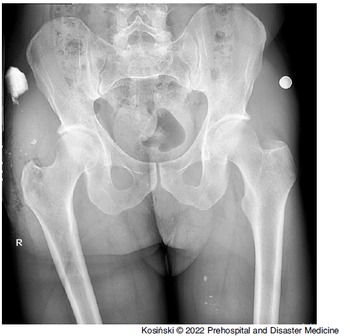
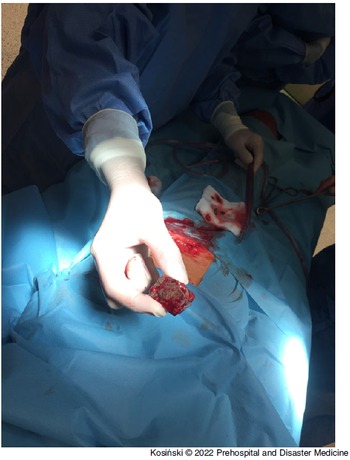
A 45-year-old male was admitted to the Accident and Emergency (A&E) department with injuries caused by a lightning strike. Despite the sustained injuries, the patient could walk unaided to the first aid point along with his wife and son. He was taken to the hospital by Emergency Medical Services (EMS) and was tagged red category at triage. On physical examination, the patient had a Glasgow Coma Scale (GCS) of 15 without respiratory distress. He was hemodynamically stable (blood pressure: 140/80mmHg) with a heart rate of 80bpm, patent airway, a respiratory rate of 18 breaths/minute, normal bilateral breath sounds, and a saturation of 96% on room air. Routine electrocardiography showed no signs of cardiac arrhythmia or ischemia. On physical examination, numerous deep lacerations of both hips and thighs were observed with rock fragments visibly embedded in the wounds (Figure 1). In addition, the lower limbs presented with thermal burns IIa/IIb (superficial partial/deep partial). The torso displayed so-called Lichtenberg figures. Furthermore, neuropraxia of the right peroneal nerve and bilateral tinnitus were detected on neurological examination. Laboratory tests revealed an elevated creatine phosphokinase level (1122U/L). A head computed tomography scan was performed and no intracranial trauma was observed. The x-ray showed rock debris in the soft tissues (Figure 2). Preliminary surgical treatment of the wounds was performed in the A&E. Superficial fragments of rock debris were removed from both thighs and hips. The patient was admitted to the Department of Surgery where antibiotic therapy was implemented and daily wound care was performed. On Day 4, surgical removal of large rock fragments from deep areas of the right hip and right lower leg was performed. Fluoroscopy and ultrasonography were used intraoperatively. The patient was discharged on Day 20. The written informed consent of the patient was obtained for publication of this report.
X-Ray of the Buttock Area.
Note: A piece of rock measuring 51×34mm laterally from the right iliac crest, numerous splinters (up to 10×6mm) above the larger trochanter and (up to 5mm) in the soft tissues of the right thigh, a splinter measuring 12×9mm in size in the lateral part of the right lower leg, and small splinters (up to 6mm) in the medial part of the left thigh and perineum area.

Rock Fragment Extracted from the Body.

Discussion
The classification of lightning-related injuries includes seven mechanisms. Five of them describe the consequences of a flow of electric current through the body. Reference Ritenour, Morton and McManus1 The sixth mechanism involves blast injuries (barotrauma) caused by an explosion of air around a lightning channel. Reference Blumenthal2 The seventh mechanism was proposed by van Waes, et al and can be described as a penetrating blast injury caused by a lightning-strike-induced explosion of a nearby structure. Reference van Waes, van de Woestijne and Halm3,Reference Blumenthal4
In the present case, the patient presented mixed injuries related to both current flow and explosion (rock fragments). Descriptions of similar injuries are rare. Blumenthal, et al have found small, pointed wounds on the lower limbs of fatally struck victims. The injury-causing material came from craters torn from pavement slabs. Reference Blumenthal4 Similar injuries were encountered in some victims of this incident. According to a study by van Waes, et al, a fragment of copper wire was carried away by a shock wave and crashed into the victim’s chest. Reference van Waes, van de Woestijne and Halm3
Although electrothermal phenomena can explain most injuries observed in victims of lightning strikes, some are probably attributed to other causes. The injuries described are similar to those seen in individuals exposed to a bomb explosion and indicate direct and indirect transmission of the detonation shock wave. A lightning strike causes air to explode around the lightning channel and creates a cylindrical shock wave with a pressure of approximately 1000kPa. A nearby strike causes a blast wave to create barotrauma to the hollow viscus of the body. The mechanism of penetrating injuries has not been comprehensively elucidated. If a high-intensity current flows in an enclosed space, the heated air cannot expand freely and exerts pressure on the cavity walls. The larger the cavity, the less overpressure, as only a part of the air in the large cavity will be heated. Reference Blumenthal2 Lightning exhibits characteristics of a so-called current source, not a voltage source; hence, the resistance of the current flow path does not reduce the value of the current. With the flow of current to the rocks, a significant amount of Joule heat can be emitted, given that limestone has a high specific resistance. Heavy rain preceding a series of discharges causes significant moisture accumulation in the crevices. It’s believed that the rapid evaporation of water enclosed in rock crevices was the main force underlying the explosive destruction of rocks. A similar mechanism was responsible for the explosion of a lonely rock in 1993, which scattered approximately 2.5m3 of rock material over a distance of up to 150m after a lightning strike. Debris moving at a high speed on flat tracks can cause serious damage to surrounding buildings and vegetation. Reference Bąk, Cabaj and Haczewski5
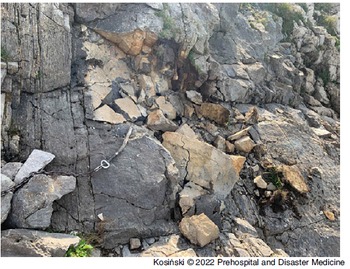
Approximately 15 discharges annually strike the massif Giewont with an average of 25 storm days. On descend and entrance trails, iron chains (via ferrata) are present to facilitate climbing. In the present report, the victim was found approximately 100m below the summit dome during the lightning strike and approximately 5m below the explosion site of the rock in which the fixing anchor was placed (Figure 3). It’s speculated that the lightning struck at the summit area and the current moved along the chain. This concept is confirmed by thermal damage to the chain along the entire length with the melting of the links and welding of anchors fixed to the ground.
The Explosion Site.

Conclusion
Blast penetrating injuries caused by lightning strikes remain extremely rare. The present case report proves that secondary missile injuries should be considered and excluded in all patients struck by lightning, particularly when occurring in rocky terrain. The diagnosis and treatment of such injuries can be difficult and require special preparation.
Conflicts of interest
The authors declare none.
Author Contributions
All authors have made substantial contributions to drafting the case report or revisiting it critically for important intellectual content. All authors read and approved the final manuscript.
Acknowledgements
The authors would like to thank Mrs. Maria Król and Mr. Ryszard Suski from Tatra National Park for their comprehensive substantive help and photographic material provided.