Introduction
The annual bluegrass weevil (ABW), Listronotus maculicollis Kirby, is a major pest of short-mown turfgrass areas on golf courses (fairways, tees, approaches, collars, greens) in the Mid-Atlantic and Northeast regions of the USA and in the southern parts of Quebec and Ontario in Eastern Canada (Vittum, Reference Vittum, Brandenburg and Freeman2012). A combination of high turfgrass quality expectations and a dearth of effective management alternatives often lead to overuse of synthetic insecticides for ABW management (Vittum, Reference Vittum, Brandenburg and Freeman2012), which in turn has led and continues to lead to development of pyrethroid resistance (Ramoutar et al., Reference Ramoutar, Alm and Cowles2009a ). Because resistance is at least in part based on enhanced enzymatic detoxification (Ramoutar et al., Reference Ramoutar, Cowles and Alm2009b ; OSK, unpublished data), a rather non-specific resistance mechanism, reduced efficacy against pyrethroid resistant ABW populations has also been observed for insecticides from chemical classes other than pyrethroids (Koppenhöfer et al., Reference Koppenhöfer, Alm, Cowles, McGraw, Swier and Vittum2012). The present situation is clearly not sustainable and begs for the development of effective management alternatives.
ABW overwinters in the adult stage in sheltered areas on golf courses. From late March to late April, adults migrate to the short mown turf areas where they feed and mate. Adults predominately feed on the grass leaf blades and do not cause any significant damage (OSK, personal observations). Mated females chew notches into the grass stem and deposit eggs either singly or in small batches in the stem or between the leaf sheaths. The young larvae are stem-borers, feeding inside of the grass stem causing moderate damage. Severe damage occurs when older larvae (fourth and fifth instar) start feeding externally on the grass crowns. If uncontrolled, high density larval populations can destroy large areas of turfgrass. Most of the damage is usually reported in areas with high percent of annual bluegrass, Poa annua L., although damage to creeping bentgrass, Agrostis stolonifera L., has been reported by superintendents and United States Golf Association agronomists (A. Moeller & D. Oatis, personal communication).
Poa annua is the preferred and most suitable host of ABW (Kostromytska & Koppenhöfer, Reference Kostromytska and Koppenhöfer2014). Limited experimental evidence suggests that P. annua is more susceptible to ABW feeding if compared with other grasses. Previous studies suggest that pure A. stolonifera (cv. unknown) stands are more tolerant to ABW larval feeding than mixed stands of P. annua and A. stolonifera (McGraw & Koppenhöfer, Reference McGraw and Koppenhöfer2009). Moreover, in greenhouse pot studies and field microplot studies P. annua was more susceptible to ABW larval feeding than A. stolonifera; variation in the susceptibility to ABW was also documented among bentgrass species and cultivars (Kostromytska & Koppenhöfer, Reference Kostromytska and Koppenhöfer2014).
Host plant resistance is one of the most promising alternatives to synthetic insecticides for ABW management. Suppressing P. annua in favor of more tolerant/resistant grasses should be the best way to reduce problems with ABW. A good understanding of ABW host plant interactions and grass responses to ABW feeding pressure is crucial for the implementation of host plant resistance in ABW management. We recently demonstrated that the three species of bentgrasses available for use on golf courses (creeping bentgrass, A. stolonifera, colonial bentgrass, A. capillaris L. and velvet bentgrass, A. canina L.) are inferior hosts for ABW. In comparison with P. annua, these bentgrasses were less attractive for oviposition, and larvae reared on bentgrasses developed slower and weighed less (Kostromytska & Koppenhöfer, Reference Kostromytska and Koppenhöfer2014). This study was suggestive of higher tolerance to ABW feeding in bentgrasses than in P. annua; however, only one ABW adult density was introduced in the grass pots for oviposition, which resulted in the different larval densities in different grass species, thus making comparison of tolerance among species difficult. Even though evidence of non-preference and antibiosis was demonstrated, more studies are needed to determine and compare tolerance of the grasses to ABW and the grass characteristics, which contribute to their resistance.
The goal of this study was to clarify ABW host plant interactions and evaluate existing bentgrass cultivars for tolerance to ABW in comparison with P. annua, a known suitable and susceptible host. Our focus was to investigate grass responses to different ABW larval and adult densities and investigate potential mechanisms contributing to differences in tolerance such as the silicon and fiber content of the grass tissue.
Materials and methods
Insects
ABW adults were collected from overwintering sites on a golf course (Pine Brook Golf Course, Manalapan, NJ, USA). They were sexed and kept in 840 ml plastic containers filled with moist (5% w/w) sand for 2–6 months in an incubator (10 h light at 6°C:14 h dark at 4°C). The sand had been air-dried and pasteurized (3 h at 72°C) before use. Prior to bioassays, adults were extracted and kept in groups of 60 in ventilated clear plastic containers on moist sand in an incubator (14 h light at 21°C:10 h dark at 14°C). They were provided with black cutworm, Agrotis ipsilon (Hufnagel), diet (Bio-Serv, Frenchtown, NJ, USA) supplemented with organic wheat sprouts as food.
Plant material
In all experiments, the performance of older and newer cultivars of three bentgrass species was compared with P. annua as the most suitable and susceptible ABW host (Kostromytska & Koppenhöfer, Reference Kostromytska and Koppenhöfer2014). Four cultivars of A. stolonifera, the most widely used bentgrass species on golf courses, were included in the study: ‘L-93’ and ‘Penncross’ (older cultivars, previously reported as susceptible to ABW (Rothwell, Reference Rothwell2003)) and ‘007’ and ‘Declaration‘(newer high-quality cultivars with improved resistance to dollar spot disease, Sclerotinia homoeocarpa F.T. Bennett). Two cultivars of A. capillaris were included, a species that is less common on golf courses and generally better adapted to warmer summer climates: ‘Tiger II’ (better known) and ‘Capri’ (newer, better quality, improved resistance to brown patch disease, Rhizoctonia solani Kühn). Two cultivars of A. canina, the finest textured and highest density bentgrass species, were tested: ‘Greenwich’ and ‘Villa’. Seeds were obtained from the Rutgers Turfgrass Breeding Program.
For two experiments (with larvae and with adults) bentgrasses were seeded directly into the pots at rates recommended by Seed Research of Oregon (2008) (A. stolonifera, 6.25 g m−2; A. capillaris, 8.75 g m−2; A. canina, 4.75 g m−2) and grown in the greenhouse for 2 months prior to use. For one experiment, conducted in March–April 2013, bentgrasses were grown from plugs taken using a standard golf hole cutter (10.8 cm diameter) from a nursery area at Rutgers Horticultural Farm 2 that had been seeded at a rate of 5 g m−2 in September, 2011. For all experiments, P. annua was grown from plugs (10.8 cm diameter) taken from uniform established fields with no history of ABW infestations at Rutgers Horticultural Farm 2. Both bentgrass nursery and P. annua fields were mown 2x per week at 1.3 cm height. Bentgrass and P. annua plugs were pressure washed free of soil and grown in the greenhouse for at least 3 weeks before experiments.
Grass maintenance and greenhouse conditions
All grasses were grown in the greenhouse on a mix of pasteurized (3 h at 70°C) sandy loam (61% sand, 27% silt, 12% clay; 2.3% organic matter, pH 5.9) and pasteurized play sand (3:1 ratio) in 540 ml deli-cups (Fabri-Kal®, Kalamazoo, MI, USA) with drainage holes. Day/night temperatures were set at 25/19°C and natural light was supplemented with 400 W high-pressure sodium lamps when intensity fell below 600 mmol m−2. Plants were fertilized weekly (20–20–20 NPK, The Scotts Miracle Gro Co., Marysville, OH, USA), watered as necessary and clipped 2x per week (1.3 cm height).
Greenhouse larval rearing
To create oviposition arenas, four evenly spaced holes (2.5 × 6.5 cm2) were cut in the walls of plastic food containers (840 ml Fabri-Kal®, Kalamazoo) 1 cm below the top edge and covered with fiberglass mosquito mesh (1.6 × 1.4 mm2 openings; Pfifer, Tuscaloosa, AL, USA) to ensure air flow and adequate grass quality during the oviposition. Containers were covered with screened lids (same mesh as above).
Pots with high-quality grass were selected from the propagated grasses and repotted into the oviposition arena and adults were introduced onto the surface of the grass. Containers were left in the greenhouse for specified time periods and watered if necessary.
Larvae were reared on P. annua grown from plugs (see the Plant material section). ABW adults were caged in the pots for 1 week before they were removed by submerging the turf pots in lukewarm water for 15 min, which floats the adults to the surface. After adult removal, pots were left in the greenhouse for additional 2 weeks for larvae to develop. Pots were destructively examined and recovered larvae were used in the experiments on the same day.
Grass damage and quality assessment
To determine percent damage, a glass Petri dish (9 cm diameter) marked with a grid (1 × 1 cm2) was placed over the turf cores and the number of squares with visible damage determined. Then, the number of cells with damage was divided by the total number of the cells (60) and multiplied by 100. Grass color, density (visual estimate of number of shoots per area) and overall quality (cumulative estimate, which indicates overall quality of turf) were visually rated weekly on a scale of 1–9 based on National Turfgrass Evaluation Program (NTEP) guidelines of turfgrass evaluation with 9 being the best and 1 being the poorest (Morris & Shearman Reference Morris and Shearman1998). Specifically, brown/yellow color was considered as 1 and dark green as 9. Most dense grass in the individual pots was rated as 9 for density. Overall quality was ranked as 9 if pot had ideal, outstanding quality turfgrass and 1 being poorest or dead.
Effect of adult density and duration of oviposition on final ABW larval densities and grass damage in P. annua
To determine P. annua responses to different ABW densities and durations of adult feeding and oviposition and to correlate adult density and length of the oviposition (i.e. number of days females were allowed to oviposit) with subsequent larval densities, a greenhouse experiment was conducted in February 2012. At the beginning of the experiment, three densities of adults (4, 8 and 12 male–female pairs per pot) were released in pots with P. annua for 3, 6 or 12 days. Each treatment combination (density × duration of oviposition) and a control (uninfested pots) had a total of 12 replicates (four experimental runs with three replications each).
After adult removal by submersion of pots in lukewarm water, the grass was left in the greenhouse for larvae to develop until 3 weeks after adults had been introduced. Grass quality and damage was evaluated weekly (see the Grass damage and quality assessment subsection). After the 3-week evaluation, the ABW stages were extracted, larval stages determined (head capsule width) and counted. First, the grass and soil from each pot were destructively searched for ABW stages. Then the material was submerged in saturated table salt solution, which causes young larvae to come out of the plant material and floats any remaining stages to the solution's surface.
Responses of P. annua and selected Agrostis spp. to ABW larval feeding
Six cultivars of bentgrass (creeping: ‘L-93’, ‘Penncross’, ‘Declaration’ and ‘007’; colonial ‘Capri’ and velvet ‘Villa’) and P. annua were established in the greenhouse as described previously (see the Plant material section). ABW larvae reared on P. annua in the greenhouse (see above) were placed onto the surface of the turf cores at densities of 0, 6, 12 and 24 larvae (third and fourth instars at 1:1 ratio) per pot. After releasing the larvae, pots were kept in the greenhouse and maintained as described above (see the Grass maintenance and greenhouse conditions subsection). Percent turf damage was evaluated 7 and 14 days after release (see the Grass damage and quality assessment subsection). After the 14-day rating, the number of ABW stages present in the turf was determined by manual examination followed by submersion in saturated table salt solution.
Tolerance of bentgrass cultivars to cumulative damage caused by ABW adults and young and late larvae
All eight bentgrass cultivars (Plant material section) and P. annua were exposed to three ABW adult densities (0, 3, 6 and 12 male–female pairs per pot) for 1 week in the greenhouse before the adults were extracted. Then the pots left in the greenhouse for an additional 4 weeks. Grass quality and percent damage were assessed (see the Grass damage and quality assessment subsection) immediately before adult release, 24 h after adult removal, and 2, 3, 4 and 5 weeks after adult release (six observations in total). After the last evaluation the turf was destructively searched and submerged in saturated salt solution to extract any remaining ABW stages. Two experiments were conducted using the same methods except that in one experiment, conducted in February–March, 2013, bentgrasses were grown from seed in the greenhouse (~2 months old) and in the other, conducted in March–April, 2013, bentgrass were grown from plugs taken from previously established field plots (see the Plant material section). For each experiment, there were three containers per turf type × adult density combination in each of three experimental runs (total nine replicates per combination).
Leaf and stem tissue fiber and silicon content analysis
At the end of the tolerance experiments, all plant tissue above 5 mm from the ground was cut, placed in paper bags, air dried and then dried in an oven at 60°C for 72 h. Each sample was weighed, then grinded and sifted through a #20 (0.841 mm openings) sieve and placed into coin envelops until further processing.
After weighing, samples of grass tissue from the control and infested pots of each cultivar were selected for the cell wall content analysis to determine amount of neutral detergent fiber (NDF: entire fiber fracture, including cellulose, hemicelluloses and lignin), acid detergent fiber (ADF: cellulose and lignin) and acid detergent lignin (ADL). Grinded samples were dried at 70°C for 72 h in an oven before further procedures to remove excess moisture and processed according to the Ankom FND20 recipe, using prescribed materials and procedure.
For the determination of silicon content of plant materials by classical gravimetric techniques, grinded and dried samples were sent to the University of Florida Analytical Research Laboratory.
Statistical analysis
All statistical analyses were performed using SAS 9.3 software (SAS Institute, 2008). In the experiment with only P. annua as a host plant, the effects of adult densities and duration of oviposition (number of days females were caged in the pots) and their interaction on numbers of recovered larvae and reproductive output of females were determined by fitting the generalized linear model (Proc Genmod,) assuming Poisson distribution (with correction for over dispersion). Reproductive output of the individual female was calculated by dividing the total number of larvae recovered by the number of females per pot. Analysis was followed by least-squares (LS) means multiple comparisons with Tukey α level adjustment. Further, multiple regression analysis was used to determine significance of larval density, adult density and duration of oviposition as predictors of the final damage ratings.
Effect of grass cultivars and larval density on percent damage over time (2 weeks) was determined using repeated measure analysis of variance (RM-ANOVA, GLM procedure, SAS Institute) with time as repeated factor. The main effects and interaction effect of the grass cultivars and larval density at each time point (7 and 14 days after larval introduction) was determined by conducting follow-up univariate analyses of variance. Specific differences among cultivars were determined by following with LS means multiple comparisons with Tukey adjustment. Regression analysis was used to determine the significance of surviving larvae densities as a predictor of the final damage ratings among cultivars. Differences among cultivars in percent of surviving larvae were determined using analysis of variance (GLM procedure).
RM–ANOVA (GLM procedure) was used to determine cumulative effects of adult feeding and oviposition and larval feeding on grass quality and visual damage over time. Differences among specific means were determined by multiple comparisons of LS means with Tukey adjustment.
Results
Effect of adult density and duration of oviposition on ABW larval densities in P. annua
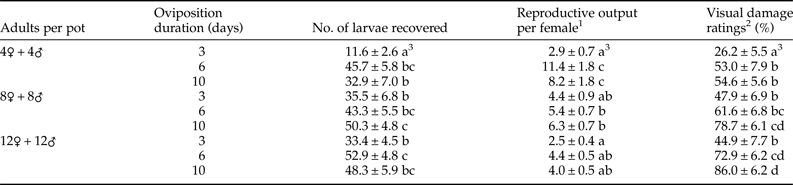
The number of larvae recovered from P. annua pots significantly depended on adult densities (χ2 = 18.9; d.f. = 2; P < 0.01) and duration of oviposition (χ2 = 29.3; d.f. = 2; P < 0.01), but there was a significant interaction of these factors (χ2 = 12.1; d.f. = 4; P = 0.02).The overall pattern was similar for the 4- and 12-adult pair densities. Comparisons of LS means revealed that the number of recovered larvae tended to increase with higher adult density if oviposition duration increased from 3 to 6 days. But no differences were observed at each of these adult densities between 6- and 10-days oviposition. With eight adult pairs were introduced, differences were observed between 3- and 10-days oviposition.
The lowest number of larvae overall was recovered at lowest adult density (four pairs) after the shortest oviposition duration (3 days) (table 1). For none of the oviposition durations did larval counts differ significantly between the 8- and 12-pair densities. After 3 and 10 days of oviposition, larval counts were the lowest with four pairs but did not differ between eight and 12 pairs; but after 6 days, no differences were observed between densities.
Effect of Listronotus maculicollis adult density and duration of oviposition on the larval counts, female reproductive outputs and visual damage rating 3 weeks after release of the adults in a greenhouse experiment with Poa annua as a host plant.

1 Reproductive output calculated by dividing total number of larvae recovered by number of females introduced per pot.
2 Final damage rating corrected for imperfections observed in the control pots.
3 Means followed by the same letter did not differ significantly (α = 0.05).
The reproduction output per female was also affected by adult density (χ2 = 16.7; d.f. = 2; P < 0.01) and duration of oviposition (χ2 = 26.2; d.f. = 2; P < 0.01), but these factors interacted significantly (χ2 = 14.3; d.f. = 4; P < 0.01). Post-hoc mean comparisons revealed that output per female increased significantly from 3 days to 6 and 10 days of oviposition with four pairs but not with eight and 12 pairs (table 1). Output per female was not affected by density after 3 days of oviposition, but after 6 and 10 days was lower with 8 and 12 pairs than with 4 pairs.
Final grass damage ratings increased with higher adult density (χ2 = 20.4; d.f. = 2; P < 0.01) and longer oviposition duration (χ2 = 39.1; d.f. = 2; P < 0.01); there was no interaction between these factors (table 1). Multiple regression analysis was used to determine significance of larval density, adult density and oviposition duration as predictors of on the final damage ratings. Each of the predictor variables had a significant (P < 0.01) partial effect on final damage. The three-predictor model accounted for 65% of variation of final damage (F = 68.5; d.f. = 3, 107; P < 0.01). Larval density was the strongest predictor by itself explaining 56% of final larval density variability.
ABW adult density and oviposition duration significantly affected final damage ratings (control corrected) taken at the end of the experiment (χ2 = 20.4; d.f. = 2; P < 0.01 and χ2 = 39.1; d.f. = 2; P < 0.01, respectively). In the pots into which no adults had been released, damage ratings (i.e. imperfections in the grass) were <10% and did not differ significantly among oviposition durations. The most severe damage was observed in the pots where 12 adult pairs were caged for longest time (on average 86.0 ± 6.2%) (table 1). The lowest damage was observed in the pots where three adult pairs were caged for 3 days. Multiple regression analysis was used to determine significance of larval density, adult density and duration of oviposition as predictors of on the final damage ratings. Each of the predictor variable had a significant (P < 0.01) partial effect on final damage. The three predictors model accounted for 65% of variation of final damage (F = 68.5; d.f. = 3, 107; P < 0.01). Larval density was the strongest predictor.
Responses of P. annua and selected Agrostis spp. to ABW larval feeding
Repeated measure analysis demonstrated that grass damage increased over time for the duration of the experiment (F = 121.32; d.f. = 1, 140; P < 0.01). Moreover, across the time points in both experiments grass damage was significantly affected by grass cultivars (F = 3.08; d.f. = 6, 140; P = 0.01) and larval density (F = 13.88; d.f. = 3, 80; P < 0.01). There were no significant interactions between larval density and grass type.
Control pots with no larvae had low damage ratings, not exceeding 5 and 10% if evaluated after 7 and 14 days, respectively (fig. 1). In addition, damage ratings in control pots did not differ among cultivars, which confirmed that greenhouse conditions alone were not detrimental to growth of any of the tested cultivars.
Percent damage (±SE) caused by Listronotus maculicollis larval feeding (0, 6, 12 and 24 larvae per pot) on Poa annua and selected bentgrass cultivars 7 (A) and 14 (B) days after introduction of larvae into the pots in a greenhouse experiment. Means marked with the same lower case letter did not differ significantly between cultivars within larval density (α = 0.05). Means marked with the same capital letter were not statistically different between larval densities within cultivar.

At the lowest larval density (six larvae per pot or 766 per m2), all tested grasses had low to moderate damage ratings at 7 days (2–13%) and 14 days (5–23%) and there were no significant differences among cultivars (fig. 1) even though the relative damage followed a similar overall pattern among cultivars as at higher larval densities. None of the grasses sustained significantly higher damage at the 7 or 14 day rating compared with the controls (fig. 1).
At 12 larvae per pot (1533 larvae m−2), P. annua had the highest damage ratings after 7 days (28%) and 14 (42%) days (fig. 1). Only the damage ratings for cv. ‘Capri’ after 7 days and cvs. ‘Capri’ and ‘Villa’ after 14 days did not differ significantly from the P. annua ratings. Compared with the control, significant damage was sustained only by P. annua after 7 days, and by P. annua and bentgrass cvs. ‘L93’, ‘Declaration’, ‘Capri’ and ‘Villa’ after 14 days.
At the highest larval density (24 larvae per pot or 3067 per m2), P. annua had more damage than all bentgrasses after 7 (51%) and 14 (62%) days. Bentgrass damage ratings ranged 8–30% after 7 days and 18–43% after 14 days (fig. 1). Compared with the controls, significant damage was observed in cvs. ‘Capri’ (28%) and ‘Villa’ (28%) after 7 days and in all bentgrasses (23–43%) except cv. ‘007’ (18%) after 14 days. Significant difference among bentgrasses were only observed at the highest larval density with less damage observed in cv. ‘007’ than cv. ‘Capri’ after 7 days and less in cv. ‘007’ than cvs. ‘Capri’ and ‘Villa’ after 14 days.
Overall, bentgrasses were more tolerant of ABW feeding than P. annua. In P. annua, damage became apparent after 7 days at higher densities and reached 64% at 24 larvae per pot after 14 days. In contrast, it took the highest larval density and 14 days to express damage in creeping bentgrasses. Cultivars ‘Capri’ and ‘Villa’ seem to be the least tolerant among bentgrasses.
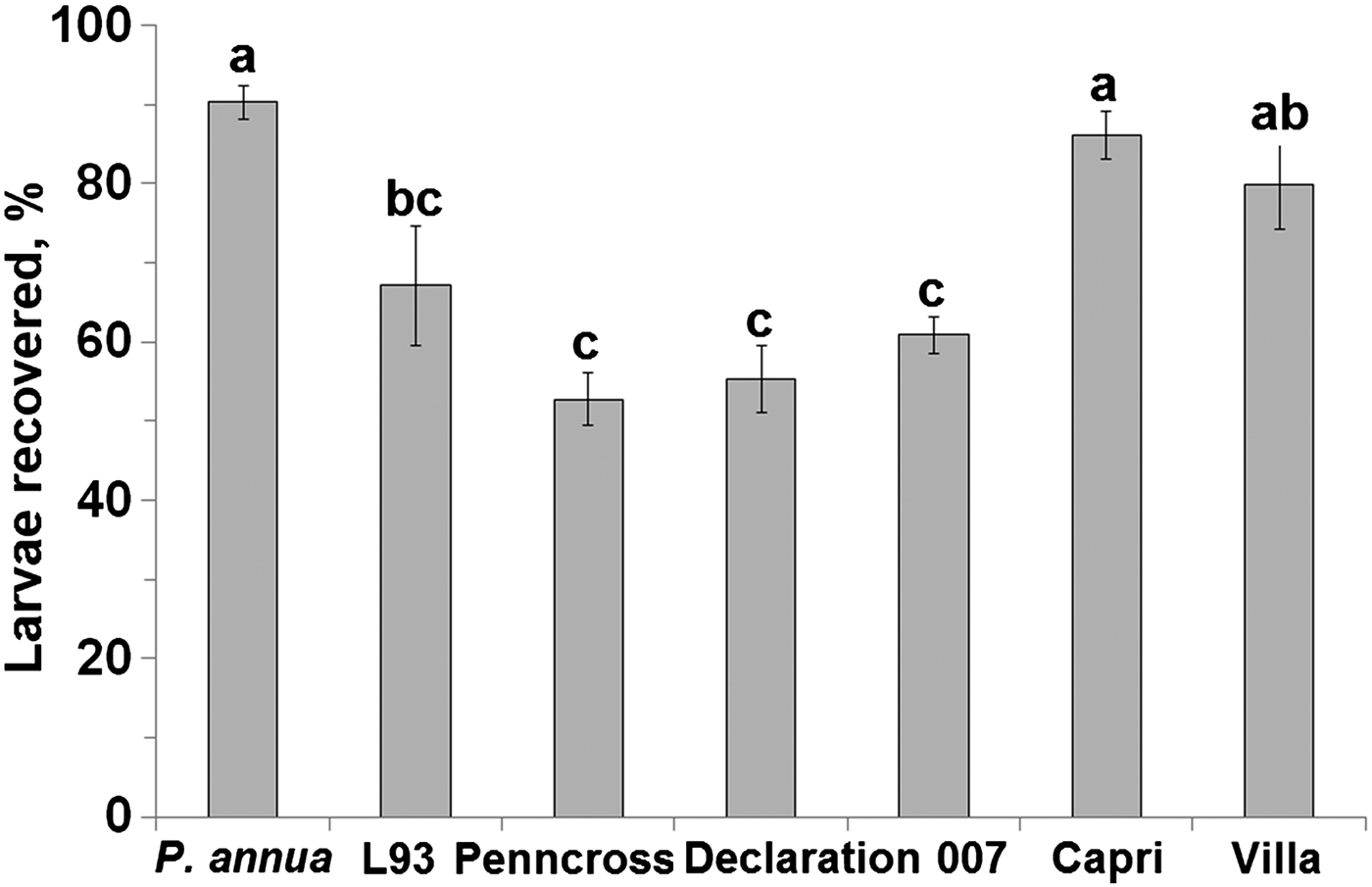
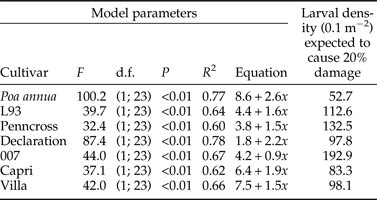
Larval survival evaluated at the end of the experiment (14 DAT) differed among grasses (fig. 2) (F = 12.65; d.f. = 6, 125; P < 0.01). Higher larval survival was observed in P. annua and cvs. ‘Capri’ and ‘Villa’ than in cvs. ‘Penncross’, ‘Declaration’ and ‘007’. Survival in cv. ‘L-93’ did not differ from either group. Different survival rates could have contributed to the variability of the damage ratings. Number of surviving larvae was a significant predictor for most of the cultivars tested (P < 0.01, R 2 ≥ 0.6, table 2). Our data model predicts that bentgrasses generally can tolerate 2–3 times higher densities of ABW larvae than P. annua before sustaining the same damage level (20%) (table 2).
Percent (±SE) of Listronotus maculicollis larvae recovered in each grass cultivar tested after 14 days in greenhouse tolerance experiment. Means marked with same letter are not statistically different (α = 0.05).

Regression analysis of damage rating and number of Listronotus maculicollis larvae recovered 14 days after introduction.

Tolerance of bentgrass cultivars to cumulative damage caused by ABW adults, young and late larvae
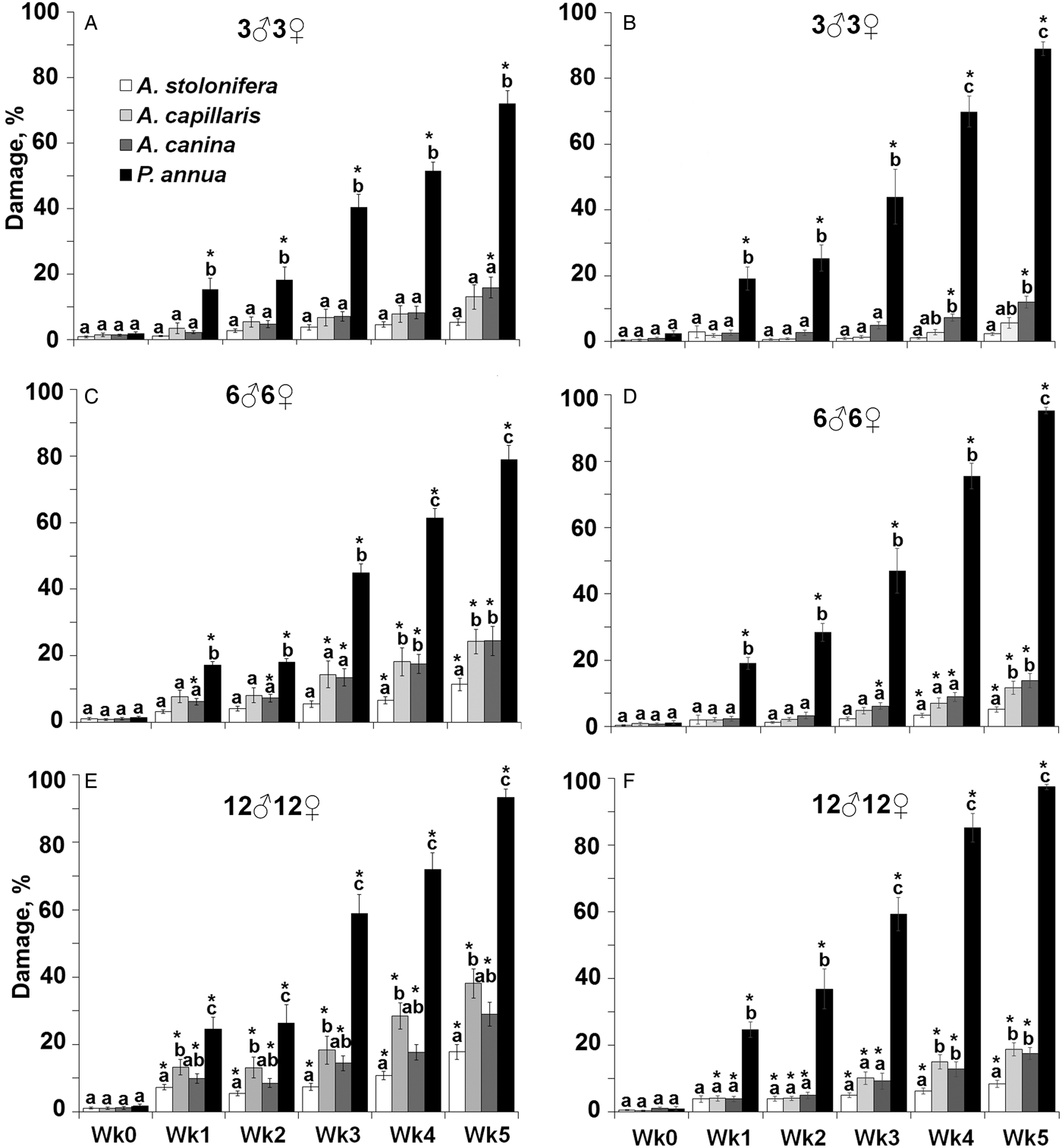
Repeated measure analysis showed that there were significant changes in grass damage over time for the experiment with greenhouse-seeded grasses (F = 509.1, d.f. = 4, 1232; P < 0.01) and the experiment using field-established grasses (F = 961.6, d.f. = 4, 1232, P < 0.01). Moreover, across the time points in both experiments grass damage was significantly affected by grass species (F ≥ 87.6; d.f. = 12, 1232; P < 0.001) or cultivar (F ≥ 33.7; d.f. = 32, 1232; P < 0.001) and adult density (F ≥ 62.9; d.f. = 12, 1232; P < 0.001). However, adult density interacted significantly with grass species (F ≥ 9.4; d.f. = 36, 1232; P < 0.001) and cultivar (F ≥ 4.1; d.f. = 96, 1232; P < 0.001). The follow-up univariate ANOVAs showed that in both experiments at each time point (not including initial evaluation, week 0) grass damage was significantly affected by grass species (F ≥ 34.3; d.f. = 3, 323; P < 0.001) or cultivar (F ≥ 4.3; d.f. = 8, 323; P < 0.001) and adult density (F ≥ 25.3; d.f. = 3, 323; P < 0.001), but also that adult density interacted at each time point with grass species (F ≥ 3.9; d.f. = 9, 323; P < 0.001) and cultivar (F ≥ 1.8; d.f. = 24, 323; P ≤ 0.01). The significant interaction of time with grass species (or cultivar) and adult density suggests that the damage rating of the tested grasses at different densities changed overtime differently under feeding pressure of ABW adults and larvae (fig. 3).
Effect of Listronotus maculicollis adult density on visual damage (%) observed in different grass species during 5 weeks in a greenhouse experiments with greenhouse-seeded (2-month old) grass (A, C, E) and field established grass (B, D, F). Adults were allowed to lay eggs in the pots during the first week and then removed. Means marked with the same letters do not differ statistically among grass species within observation date (α = 0.05). Asterisk indicates that damage was significantly higher than for the same grass at beginning of experiment (Wk0).

Because the different cultivars of the three bentgrass species followed the same pattern as the respective bentgrass species and to simplify the presentation of data, in the following we only present the data by species. At the beginning of the experiment, right before adults were introduced for 1 week, no differences in grass damage were observed among the pots assigned to the different adult densities and with different grass species in both experiments (fig. 3). Moreover, in both experiments damage ratings in the control pots (without adults) did not exceed 5% in P. annua pots and 3% in Agrostis spp. pots, did not significantly differ among grass species and did not change significantly over time irrespective of grass species. Thus, the grasses were of equal quality in the beginning of the experiment and greenhouse conditions did not significantly influence grass condition.
Poa annua was the most susceptible grass species. Even at the lowest density (three pairs per pot) damage became noticeable already 1 week after adult introduction (16 and 19% for experiments with greenhouse-seeded and field-established grass, respectively). By the end of the experiments, P. annua damage levels at three pairs per pot averaged 72 and 89% for seeded and field-established grass, respectively, which was significantly higher than any other grass species tested (fig. 3A, B). In contrast, damage in A. stolonifera and A. capillaris was not significantly different from the initial evaluation in the pots at any time, reaching only 5 and 2% (experiments with greenhouse-seeded and field established grass, respectively) with A. stolonifera and 13 and 6% with A. capillaris at 5 weeks after adult introduction. Compared with the initial evaluation, A. canina was significantly damaged after 4 weeks (10% greenhouse-seeded grass and 7% field established grass), and by the end of the experiment its damage level reached 16 and 12%, respectively (fig. 3A, B).
At the higher adult densities P. annua was severely damaged after 5 weeks (fig. 3C, D). In the P. annua pots with 6 and 12 adult pairs damage reached 79 and 93%, respectively, with greenhouse-seeded grass. With field-established grass, comparable damage was observed already after 4 weeks (76 and 85%), and after 5 weeks damage levels reached 95 and 98%, respectively. Among bentgrass species, A. stolonifera was consistently the most tolerant in both experiments. Even after 5 weeks, it sustained only 11 and 5% damage, with six pairs per pot and 18 and 8 % damage with 12 pairs with greenhouse-seeded and field-established grass, respectively. Agrostis capillaris and A. canina tended to be more susceptible, but the ranking varied between the two experiments. With greenhouse-seeded grass, A. capillaris overall seemed to be less tolerant than A. canina. In the experiment with field-established grass, A. canina tended to be the most susceptible. However, in both experiments, A. canina and A. capillaris never differed significantly from each other. Differences in damage among bentgrass species were significant only at the higher densities and/or in the last 2 weeks of the experiments.
Dry grass stem and leaf tissues, measured at the final evaluation differed significantly among grasses both with greenhouse-seeded and field-established grasses (F ≥ 24.51, d.f. = 3, 353, P < 0.001). Overall, dry weight was significantly reduced in the pots where adults were introduced for all grass species except A. canina (F ≥ 8.17; d.f. = 3, 353; P < 0.001) (fig. 4A). Consistent reductions in dry weights were observed at the higher adult densities. Both with greenhouse-seeded and field-established grasses, dry weight varied significantly among grass species (F ≥ 10. 9; d.f. = 3, 242; P < 0.01) and cultivars (F ≥ 8.8; d.f. = 8, 242; P < 0.01), but adult densities had no significant effect (F ≤ 2.38; d.f. = 2, 242; P ≥ 0.09). The most reduction in dry weight was observed for P. annua (43 and 35%). The least reduction was observed in A. canina (1%) with greenhouse-seeded grasses and in A. stolonifera (7%) with field-established grasses.
Effect of initial Listronotus maculicollis adult densities on dry weight (g) of plant and stem tissues of different grass species (A, C) and cultivars (B, D) in a greenhouse experiment 5 weeks after adults had been introduced for 1 week. The grasses had been grown from seed in the greenhouse (A, B) or where grown from plugs taken from established field plots (C, D).

In both experiments, number of larvae recovered per pot and damage ratings were significantly affected by grass species (F ≥ 96.27; d.f. = 3, 323; P < 0.01) and adult density (F ≥ 108.6, d.f. = 3, 323; P < 0.01) (fig. 5A, B), but these factors interacted significantly (F ≥ 14.87, d.f. = 9, 323; P < 0.01). For both experiments P. annua had the highest number of recovered larvae at each initial adult density tested. No significant differences in larval numbers were detected among bentgrasses in the experiment with greenhouse-seeded grass (fig. 5A). In the experiment with the field established grass, A. canina had higher larval densities than A. stolonifera at lower adult densities (three and six pairs) (fig. 5B). At the highest adult densities (12 pairs) more life stages were recovered from A. capillaris than from A. stolonifera pots.
Number (±SE) of Listronotus maculicollis life stages recovered in each grass species tested after 5 weeks in the experiments with greenhouse-seeded (A) and field-established grass (B). Means marked with same capital letters are not statistically different (α = 0.05) among grass species within adult density. Means marked with same lower case letters do not differ among different adult densities within grass species.

Larval numbers recovered after 5 weeks was the strongest predictor of the final damage ratings for most of the grasses (r > 0.70, P < 0.01), except A. stolonifera.
Silicon and fiber analyses
NDF (including entire fiber fracture: cellulose, hemicelluloses and lignin), ADF (cellulose and lignin) and ADL contents were higher in greenhouse-seeded than field-established grass (F = 12.4; d.f. = 1118; P < 0.01). Therefore, differences among the grass species, cultivars and treatments were determined in two separate analyses for greenhouse-seeded and field-established grass. MANOVA (SAS Institute) demonstrated a significant effect of grass species on the dependent variables NDF, ADF, ADL for both greenhouse-seeded (Wilk's λ = 5.3; d.f. = 9, 119; P < 0.01) and field-established grass (λ = 6.9; d.f. = 9122; P < 0.01).
For greenhouse-seeded grass, further univariate analysis conducted for each dependent variable revealed no significant differences in NDF among grass species and absence/presence of infestation. ADF and ADL also did not differ among grass species in the uninfested grasses (fig. 6). In the infested grasses, ADF and ADL were higher in P. annua than all bentgrasses (F = 13.6; d.f. = 3, 58; P < 0.01).
Fiber content in Poa annua and three bentgrass species. The grasses had been grown from seed in the greenhouse (A–C) or where grown from plugs taken from field plots (D–F). NDF, neutral detergent fiber; ADF, acid detergent fiber; ADL, acid detergent lignin. Capital and lower case letters indicate significant differences among grass species for not infested pots (control) and pots infested with Listronotus maculicollis, respectively.

With field-established grass, NDF was affected by grass species (F = 8.2; d.f. = 3, 59; P < 0.01) and presence/absence of ABW infestation (F = 7.7; d.f. = 1, 59; P < 0.01), but the factors interacted significantly (F = 3.4; d.f. = 3, 59; P < 0.01). Without infestation, A. canina had higher NDF than P. annua and A. stolonifera (fig. 6). With infestation, no differences in NDF among grasses were observed. For ADF, an effect of grass species (F = 3.4; d.f. = 3, 59; P = 0.03) but not of infestation (F = 2.94; d.f. = 1, 59; P = 0.09) was observed, but both factors interacted significantly (F = 4.1; d.f. = 3, 59; P = 0.01). Thus, without infestation A. canina had significantly higher ADF content than P. annua; with infestation P. annua had higher ADF than all bentgrasses. For ADL, grass species (F = 6.0; d.f. = 3, 59; P < 0.01) but not infestation (F = 0.8; d.f. = 1, 59; P = 0.38) had a significant effect; the factors did not interact (F = 1.6; d.f. = 1, 59; P = 0.20). Poa annua had higher ADL content than A. stolonifera and A. capillaris (fig. 6).
Similarly to fiber content, silicon concentration in the leaf and stem tissues significantly varied among grass species (F = 10.9; d.f. = 3, 53; P < 0.01) and cultivars (F = 5.2; d.f. = 3, 53; P < 0.01). Among species, A. stolonifera had the lowest silicon concentration. The newer A. stolonifera cultivars ‘Declaration’ and ‘007’ had silicon concentration lower than P. annua and A. canina cvs. ‘Greenwich’ and ‘Villa’. The older A. stolonifera cv. ‘L93’ had lower silicon content than the two A. canina cvs., which did not correlate with the numbers of larval stages recovered in the tested grasses (Pearson correlation R = 0.19; n = 54; P = 0.17).
Discussion
Our study clearly demonstrated high susceptibility of P. annua to ABW feeding and relative tolerance of all bentgrass species tested compared with P. annua. Extreme damage caused by ABW in the field is likely the result of a combination of both high attractiveness of P. annua as a host (Kostromytska & Koppenhöfer, Reference Kostromytska and Koppenhöfer2014) and very low tolerance to ABW feeding. We observed not only differences in the severity of the damage between P. annua and bentgrasses, but also in the onset of the visual damage. In bentgrasses damage progressed gradually and never reached the level observed in P. annua by the end of the experiment (up to 97%). In P. annua, severe damage was obvious even at the time coinciding with the presence of young larvae. Even though the recovery potential of grasses was not addressed in our study, it is important to consider when recommending a grass species for P. annua replacement or overseeding. Our empirical observations under greenhouse conditions with a limited number of replicates suggest that bentgrasses can recover from severe ABW damage, whereas P. annua never recovers.
Differences in tolerance (and recovery potential) can at least partially be explained by the different growth habits of the tested grasses. Poa annua is an opportunistic plant and spreads by seed; therefore, most of its resources are invested in seed production. Moreover, P. annua is a bunch grass and does not produce stolons or rhizomes. In contrast, A. stolonifera, the most tolerant out of all the grass species tested here, is highly stoloniferous with a vigorous spreading habit, which contributes to its ability to recover quickly after damage (Weibel et al., Reference Weibel, Lawson, Dickson, Clark, Murphy, Clarke, Meyer and Bonos2010). Agrostis capillaris, which was relatively susceptible to ABW feeding in our study, has a more upright and less aggressive spreading habit compared with A. stolonifera (Weibel et al., Reference Weibel, Lawson, Dickson, Clark, Murphy, Clarke, Meyer and Bonos2010). Agrostis canina, which had variable performance in our experiments, creates the most dense turf, has moderate spreading vigor (intermediate between A. stolonifera and A. capillaris) and produces short stolons and upright tillers (Weibel et al., Reference Weibel, Lawson, Dickson, Clark, Murphy, Clarke, Meyer and Bonos2010).
As a highly susceptible host, P. annua is a limited resource for ABW larvae. In the greenhouse experiments, the optimal density for reproductive output of individual females was the lowest density of four pair per pot and 6 days for oviposition. Increasing adult density significantly decreased reproductive output. Whether high density influenced female oviposition behavior or larval survival was not clear from the experimental setup. According to Cameron (Reference Cameron1970), small (first and second instar) and medium (third and fourth instar) larvae are very motile and move from tiller to tiller after consumption of the previous one. In fact, examining soil plugs from the infested area showed that 84% of medium size larvae and 72% of small larvae were found outside the stem (in the thatch, between stems or near the surface) (Cameron, Reference Cameron1970). Similar larval behavior was observed during our experiments with small and medium size larvae often found on the soil surface or even the sides of the pots. Larval dispersal behavior from the severely damaged P. annua areas to neighboring bentgrass might to some extent explain field reports of ABW damage to bentgrasses. Results of our experiments demonstrated that more larvae survive on bentgrass if introduced later in their development. Thus, differences between P. annua and A. stolonifera in number of larvae recovered were up to 1.7-fold when third and fourth instars were introduced but 4- to 6-fold when females were introduced.
Results of our experiments confirm that even though the best predictor for visual damage is larval density, adult activities (feeding and oviposition) might contribute to the overall damage. In the experiments with P. annua as a host, the highest damage ratings were observed at higher adult densities introduced for longer amounts of time even though larval densities did not further increase beyond 6 days of oviposition and four pairs per pot. In addition, in the experiment where larvae were introduced, the overall final damage was lower than in the experiments where cumulative effects of adults, young and late larvae were observed. At higher densities (12 pairs per pot), damage for all tested grass species was observed 1 week after adult removal. At lower densities the effect of the adult feeding and oviposition was observed only in P. annua. However, in the field adult densities would rarely reach even the lowest densities tested in our experiments over several days. Therefore, grass damage caused by adults probably only rarely becomes visible and should be limited to P. annua.
Silicon deposition is one of the important characteristics of plants in the family Poaceae. Silicon accumulation has various functions in this family, such as mechanical stability, disease, insect and herbivore resistance, drought resistance, facilitation of light interception and alleviation of problems caused by deficiency or excess of nutrient (reviewed by Motomura et al., Reference Motomura, Fujii and Suzuki2006). Specifically for turfgrasses silicon fertilization was reported to improve wear tolerance, overall quality, heat stress tolerance, disease resistance, photosynthetic capacity, growth and establishment, and root propagation (Gussack et al., Reference Gussack, Petrovic and Rossi1998; Schmidt et al., Reference Schmidt, Zhang and Chalmers1999; Datnoff, Reference Datnoff2005). No clear effect of silicon on insect feeding and survival was demonstrated. In laboratory studies adding silicon and fiber into insect diet did not affect southern armyworm, Spodoptera eridania (Cramer), survival, growth or wear of the mandibles, although consumption rates were increased in the study (Peterson et al., Reference Peterson, Scriber and Coors1988). Studies with grass plants and caterpillars as test subjects demonstrated no effect on pest survival and growth, but proved that warm and cool season turfgrasses can accumulate silicon in their tissues (Korndörfer et al., Reference Korndörfer, Cherry and Nagata2004; Redmond & Potter, Reference Redmond and Potter2006). However, Barker (Reference Barker1989) studying pasture grass characteristics, which affect feeding intensity and oviposition of the Argentine stem weevil, Listronotus bonariensis Kuschel, discovered that constitutive content of fiber (hemicelluloses, cellulose and lignin) was a significant predictor of feeding intensity. Density of the intercostal silicon deposition was a strong predictor of number of eggs deposited in the grass stems. Silicon fertilization also significantly affected L. bonariensis feeding and oviposition.
In the current study, only constitutive concentrations of silicon and fiber in plant tissue were studied to explain possible mechanism of grass resistance and tolerance. The fiber content of A. canina was the highest among bentgrasses. Our previous study demonstrated that A. canina was the least suitable for oviposition (Kostromytska & Koppenhöfer, Reference Kostromytska and Koppenhöfer2014) among A. stolonifera, A. capillaris and P. annua in no-choice tests and less preferred than A. stolonifera in choice tests, which suggest that fiber content is possible mechanism of non-preference. However, overall concentrations of insoluble fiber in the tested bentgrasses were not significantly different from the concentration observed in P. annua. In the experiment using field-established grasses, we observed a higher concentration of fiber in the infested pots compared to uninfested pots, which suggest that P. annua may accumulate fiber as a defense mechanism in response to larval feeding. But given the high final larval density observed in P. annua, increased fiber content provides poor protection against ABW. Similarly, silicon concentration did not only not correlate with the larval density, but grasses which tended to be more resistant and tolerant had lower silicon concentrations than P. annua, suggesting that silicon concentration even if induced is not an important mechanism of resistance to ABW in bentgrass.
In conclusion, our findings demonstrated that bentgrasses are more tolerant than P. annua to injury caused by ABW infestations, with A. stolonifera being the most tolerant. Our data model predicts that bentgrasses generally can tolerate 2–3 times higher densities of ABW larvae than P. annua before sustaining the same damage level (20%). In addition, the current study suggests that economic thresholds differ among grass species. Together with our previous findings that bentgrasses, especially A. stolonifera, are inferior host for ABW (Kostromytska & Koppenhöfer, Reference Kostromytska and Koppenhöfer2014) these results clearly show that A. stolonifera is the best grass species for the implementation of host plant resistance in ABW management.
Acknowledgements
We appreciate the technical assistance of Eugene Fuzy, Sylwia and Wlodek Lapkiewicz, and the staff of Rutgers Horticulture Farm 2. We are grateful for expertise and assistance provided by Dr. Stacy Bonos with grass propagation and maintenance. This research was supported by grants from the Golf Course Superintendents Assn. of America and supporting Chapters (GCSA of New Jersey, Hudson Valley GCSA, Keystone AGCS, Long Island GCSA, Metropolitan GCSAA, New Jersey Turfgrass Assn., Pocono Turfgrass Assn.), the US Golf Assn., the O.J. Noer Research Foundation, the Tri State Turf Research Foundation, New York State Turfgrass Assn. and the Rutgers Center for Turfgrass Science.