Introduction
In a companion paper in this issue, we discussed the effectiveness of psychosocial treatments of the behavioral symptoms of dementia (O'Connor et al., Reference O'Connor, Ames, Gardner and King2009). This article focuses instead on the effectiveness of psychosocial treatments of psychological symptoms of dementia. For the purpose of review, these symptoms include anxiety, depression, social withdrawal, apathy, irritability, delusions and hallucinations but not insomnia. Experimental strategies to improve sleep (e.g. bright light therapy) follow a biological paradigm and fall outside our psychosocial remit. In the interests of brevity, some material presented in the earlier paper is not repeated here. The articles are therefore best read together.
Psychological disturbances are common. In the large North American Cardiovascular Health Study, the Neuropsychiatric Inventory was rated by caregivers of people with dementia to determine their frequency and severity of symptoms within the past month. Scores of four or more out of a maximum of 20 points were held to be clinically significant. On this basis, rates of disturbance were as follows: apathy 27%, depression 16%, delusions 11%, anxiety 10% and hallucinations 5% (Lyketsos et al., Reference Lyketsos, Lopez, Jones, Fitzpatrick, Breitner and DeKosky2002).
Unlike behavior symptoms which increase in frequency as dementia advances, psychological symptoms peak mostly in the middle stages of dementing disorders. In the Cache County study, for example, delusions of any degree of frequency and severity were noted in 27% of community residents with moderate dementia and 19% of those with severe dementia. Rates for depression were 32% and 19% respectively (Lyketsos et al., Reference Lyketsos, Steinberg, Tschanz, Norten, Steffens and Breitner2000). Since people with severe dementia cannot easily articulate their internal experiences, it is likely that many symptoms escape the detection even of experienced clinicians.
There is evidence, albeit conflicting, from numerous randomized controlled trials (RCTs) that antipsychotic medications have modest effectiveness in treating the delusions and hallucinations associated with dementia, while co-morbid major depression may respond favorably to antidepressants (Herrmann and Lanctôt, Reference Herrmann and Lanctôt2007; Jeste et al., Reference Jeste2008). Both groups of medications are used widely for these indications in clinical practice (Greve and O'Connor, Reference Greve and O'Connor2005). It is not desirable, however, to treat fearfulness, dysphoria, irritability and other “negative” affects just with psychotropic medications, all of which work variably and can have adverse effects. It makes more sense to address some of the causes of psychological distress, namely boredom, loneliness, loss of intimacy, diminished self-esteem, curtailed opportunities for meaningful activity, over-stimulation and the like (Cohen-Mansfield, Reference Cohen-Mansfield2001). So-called psychosocial therapies might therefore prove helpful in treating mild and even severe affective and psychotic symptoms.
Our systematic review assists in this process by addressing three questions: (i) Are the benefits of psychosocial treatments of the psychological symptoms of dementia just the result of the care and attention that follow from participation in a clinical trial? (ii) Do treatments reduce the frequency and/or severity of psychological symptoms to a degree that matters to patients, families and caregivers? and (iii) Does one treatment work better than another?
Previous reviewers agreed that studies of so-called psychosocial treatments are often too small, loosely designed and poorly reported to warrant clear conclusions (Opie et al., Reference Opie, Rosewarne and O'Connor1999; Cohen-Mansfield, Reference Cohen-Mansfield2001; Livingston et al., Reference Livingston, Johnston, Katona, Paton and Lyketsos2005). To counter this, only papers that met specified quality standards are outlined here with the object of guiding clinicians and carers to robustly supported evidence.
Methods
This review was compiled in line with Australian National Health and Medical Research Council standards (NH&MRC, 2000). English language reports published or in press by February 2008 concerning experimental, psychosocially-oriented treatments of dementia's psychological symptoms were sought via: (i) searches of Medline, CINAHL, PsycInfo and Cochrane databases, (ii) checks of references in earlier reviews and monographs, and (iii) approaches to nearly 60 recently published authors in this area.
We sought either randomized controlled trials (RCTs) or pre-test versus post-test (repeated measures) studies. To qualify for inclusion, all participants must have had dementia. Clinically significant affective symptoms were not required on the grounds that levels of anxiety and depression can be improved even when participants fail to meet criteria for diagnoses of co-morbid anxiety or depressive disorders.
Studies were included only if a treatment was compared with another treatment and/or an “attention control” condition. Life in many care settings is so unstimulating that personal attention of any kind may relieve anxiety and agitation (Garland et al., Reference Garland, Beer, Eppingstall and O'Connor2007). Control conditions should therefore provide equivalent attention and diversion to confirm that an intervention confers some special benefit.
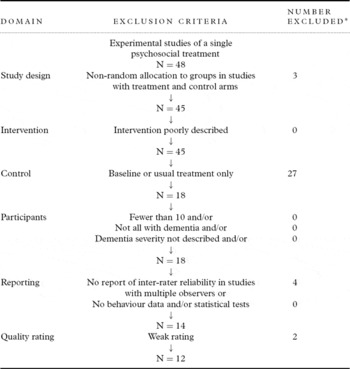
Other requirements, adapted from standard research checklists (e.g. Altman et al., Reference Altman, Schulz, Moher, Egger and Davidoff2001), comprised (i) random allocation in the case of studies with distinct treatment and control arms; (ii) sufficient information about a study's methods to permit replication; (iii) a total of 10 or more participants; (iv) the use of psychological outcome measures; and (v) some statistical analysis (Table 1).
Process of selecting studies for review

*Some studies were excluded for more than one reason.
Finally, given the importance of minimizing observer bias, we stipulated that outcome measures must have been collected by persons blinded either to treatment allocation or to the study's aims. Alternatively, when the nature of the intervention rendered blinding impracticable, measures must have been generated either by a single individual (e.g. a family caregiver) or by multiple individuals with high inter-rater reliability.
Most of our requirements were straightforward. Only a couple required much judgment (e.g. the adequacy of information regarding methodology) but, to reduce concerns of bias, nine of the 51 (18%) seemingly eligible papers were coded on the 10 key selection criteria listed in Table 1 by a second blinded assessor. Agreement rates were high at 95.6%.
As an additional check on quality, papers were graded using a checklist devised by Forbes (Reference Forbes1998) in an earlier systematic review of behavioral treatments in dementia. The scale addresses study design, participation and retention rates, measurement issues and statistical analysis, and has an algorithm to generate ratings of “strong”, “moderate”, “weak” and “poor”. It follows standard pathways but makes allowance for repeated measure designs and non-blinded observers in contrast to other scales. Only RCTs can qualify as “strong”. Two papers rated as “poor” were excluded.
Effect sizes based on mean differences and standard deviations were calculated for studies that reported sufficient information (Rosnow and Rosenthal, Reference Rosnow and Rosenthal1996). For randomized studies, the effect size was the difference between the treatment mean and the attention control mean divided by an estimate of standard deviation pooled from both groups. Baseline means were incorporated if available. We considered an effect size of 0.2 to be small, 0.5 moderate and 0.8 large (Cohen, Reference Cohen1988).
Results
Of the 48 studies we considered in detail, only 12 met all requirements (a list of excluded papers and reasons is available on request). Ten of the 12 came from the U.S.A., with one from Britain and another from Sweden. Eight were either RCTs, or nested RCTs in which nursing homes (rather than residents) were randomized. Four used repeated measures (RM) designs. Five studies added crossover between conditions to maximize validity and efficiency. Repeated measures studies with randomized cross-over are labeled here as randomized crossover trials (RXT). Participant numbers were typically small (mean 63.8, range 20–127) with the majority living in nursing homes or on long-stay hospital wards. Six of the 12 reports also addressed behavioral symptoms and qualified for inclusion in the preceding paper.
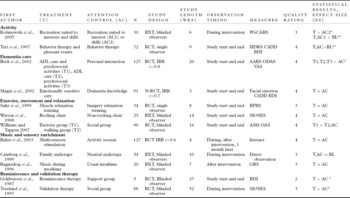
Primary interventions included studies of music, person-centered care, physical activity, simulated family presence, recreation, relaxation, reminiscence therapy, sensory enrichment and validation therapy. Additional details are provided in Table 2. No papers on aromatherapy, pet therapy, reality orientation or low stimulus environments met our specifications and so we can make no further comment on them. This is a regrettable but anticipated consequence of our selective process. No studies addressed the treatment of delusions or hallucinations.
Details of selected studies

AARS = Apparent Affect Rating Scale; AC = attention control; AMS = Alzheimer's Mood Scale; BDI = Beck Depression Inventory; BL = baseline/usual care; BPRS = Brief Psychiatric Rating Scale; CSDD = Cornell Scale for Depression in Dementia; GBS = Gottfries-Bråne-Steen scale; HDRS = Hamilton Depression Rating Scale; IRR = interrater reliability; MOSES = Multidimensional Observation Scale for Elderly Subjects; N-RCT = non-randomized controlled trial; OAS = Observed Affect Scale; ODAS = Observable Displays of Affect Scale; PGCARS = Philadelphia Geriatric Center Affect Rating Scale; RCT = randomized controlled trial; RM = repeated measures, RXT = repeated measures with randomized cross-over; T = treatment; VAS = Visual Analogue Scales.
Quality ratings: 4 = strong, 3 = moderate, 2 = weak. r = correlation coefficient. *p<0.05, **p<0.01, ***p<0.001, NS = not significant.
Using Forbes' (Reference Forbes1998) quality rating scale, six of the 12 studies were rated as “strong”, five as “moderate” and one as “weak”. The one “weak” study lost points because of high attrition rates in an ambitious 12-month study (Toseland et al., Reference Toseland, Diehl, Freeman, Manzanares, Naleppa and McCallion1997).
Treatments proved more effective than attention control conditions or another treatment, to a statistically significant degree, in only six of the 12 studies. Effect sizes could be computed only for three. For clarity of presentation, interventions have been grouped into six somewhat arbitrary groups.
Activity and recreation
Kolanowski et al. (Reference Kolanowski, Litaker and Buettner2005) anticipated that personalized recreational activities can improve quality of life, mood and behavior. To test this hypothesis, they measured affect and behavior while 30 behaviorally symptomatic nursing home residents participated in repeated 20-minute recreational activities suited to: (i) their former interests; (ii) their current skill levels; and (iii) a combination of interests and skills. Blinded observers watched videotapes of sessions and estimated what proportion of the 20-minute session evinced three positive affects (pleasure, interest and contentment) and three negative ones (anger, anxiety and depression) using the Philadelphia Geriatric Centre Affect Rating Scale (PGCARS). Positive affects were evident significantly more often in the interest plus skills condition than the skills only condition (p = 0.02), giving a moderate effect size of 0.54.
Beck et al. (Reference Beck2002) randomized 143 nursing home residents with dementia and a current behavioral disturbance to one of five conditions. In one group, specially hired nursing assistants worked with residents for 45–60 minutes each day over 12 weeks, approaching activities of daily living (ADLs) in ways that maximized residents' autonomy, for example by breaking tasks into manageable components. Assistants in another group applied standardized psychosocial activity modules designed to promote self-esteem and expression. A typical module offered art, rhythm and touch. Yet another group received both interventions together for 90 minutes daily. The control conditions entailed either one-to-one interactions chosen by residents themselves or “usual care”. Ratings were derived from videotaped recordings by observers blinded to the study's objectives who applied the Apparent Affect Rating Scale (AARS), the Observable Displays of Affect Scale (ODAS) and the Positive and Negative Visual Analogue Scales (VAS). These showed more contentment and interest in all the intervention groups compared with the attention control group (p<0.05) but no one group proved superior to another.
Carer education
Two studies encouraged family and professional caregivers to lift the mood of people with dementia by calibrating care delivery to the recipients' needs and feelings. In an RCT by Teri et al. (Reference Teri, Logsdon, Uomoto and McCurry1997), the caregivers of 72 community resident people with dementia and co-morbid minor or major depressive disorder were randomly allocated to two training groups, each meeting for an hour a week on nine occasions. One group was coached in a behavioral approach to challenging behaviors with a focus on identifying and avoiding triggers. The other group received additional training in planning and implementing pleasant events and positive interactions for both parties. Outcome measures, completed by caregivers before and after training, included the Hamilton Depression Rating Scale (HDRS), the Cornell Scale for Depression in Dementia (CSDD) and the Beck Depression Inventory (BDI). Both treatment groups performed significantly better than a “usual care” group but neither group had a better outcome than the other.
In similar vein, Magai et al. (Reference Magai, Cohen and Gomberg2002) taught nursing home caregivers to attend constructively to cues to distress and agitation in residents with dementia. In a nested-RCT, staff in selected homes received 10 hour-long experiential teaching sessions on dementia's emotional consequences, non-verbal pointers to distress, and the need for constructive responses. Staff members in control homes were trained just in dementia assessment, evaluation and management with limited emotional emphasis. Attendance levels were high at 90% but compliance with training was not checked. A third group formed a wait-list control. Blinded observers rated the 91 residents' facial expressions of affect during semi-structured interviews at entry and three weeks later and completed both the CSDD and the Brief Symptom Inventory (BSI) of anxiety and depression based on interviews with care staff. There were no clear treatment effects on any of these measures.
Exercise, movement and relaxation
Physical exercise lifts mood in younger, cognitively intact people and might therefore be helpful in cognitively impaired older people too. To test this possibility, Williams and Tappen (Reference Williams and Tappen2007) compared a program of strength, balance and flexibility exercises with a supervised walking group and a social conversation control group. Ninety nursing home residents, all with Alzheimer's disease, were randomly allocated to one of three groups that met for 15 minutes a day initially, increasing to 30 minutes later. Exercises included knee bends, toe rises and side-stepping as well as walking. In the walking group, participants walked at their usual speed with support and rests as required. Members of the conversation group engaged in casual discussion of topics of mutual interest. Positive and negative affects were rated by blinded observers using the Alzheimer's Mood Scale (AMS) and the Observed Affect Scale (OAS) before and after the program. Ten weeks later, positive affect as measured by the OAS was 15% higher in the exercise group than the walking group and 9% higher than the conversation group (p<0.05). Negative affect scores on the AMS were 12% lower in the exercise group than the walking group and 21% lower than the conversation group (p<0.05). There were no significant differences for OAS negative affects or AMS positive affects.
Repetitive, rhythmic movements are widely held to be soothing and rocking chairs are familiar to many older people. Watson et al. (Reference Watson, Wells and Cox1998) tested their effectiveness in a repeated measures study in which 25 residents of a dementia special care unit were crossed randomly between six weeks of daily one-hour periods in a specially designed rocking chair (if residents agreed) and six weeks in an immobilized chair, with a two-week “washout” period between. The chairs proved popular. Blinded observers completed the Multidimensional Observation Scale for Elderly Subjects (MOSES) by interviewing care assistants at baseline and after each condition. No significant differences emerged.
Progressive muscle relaxation training was tested as a treatment of psychological disturbance in an RCT with 34 community-resident dementia sufferers whose carers reported a problematic behavior (Suhr et al., Reference Suhr, Anderson and Tranel1999). Muscle relaxation was selected because it relies on procedural (or motor) memory which is better preserved in Alzheimer's disease than verbal memory. To test its effectiveness, weekly muscle relaxation training sessions were compared with an individualized imaginal relaxation technique that relied more on verbal skills. The number of sessions was tailored to participants' needs and caregivers completed the Brief Psychiatric Rating Scale (BPRS) which rates anxiety, depression, hostility and the like at the start and end of the program. At two-month follow-up, scores fell in both groups with no significant difference between them.
Simulated family presence
Visits to nursing homes by family members provide comfort in stressful situations but are quickly forgotten by people with dementia. Simulated family presence therapy seeks to fill this void by having relatives make audiotapes of scripted “telephone conversations” about cherished memories from earlier life. The scripts tap remote memory, one of residents' few remaining strengths, and are edited to maximize response. Camberg et al. (Reference Camberg1999) used a repeated measures design to compare simulated presence audiotapes with recorded readings from a newspaper. Staff played the tapes in random order via headphones at least twice daily at times when the 54 selected nursing home residents were either agitated or socially withdrawn. Researchers then monitored behaviors using PGCARS and a Withdrawal Visual Analogue Scale (WVAS) over a four-week period for each condition, but not necessarily while tapes were playing. Despite setbacks (tapes were played inconsistently by staff and behaviors arose less frequently than expected), some participants responded well. Taken overall, though, there were no differences in scores between the treatment, placebo and “usual care” conditions.
Music and sensory enrichment
Multi-sensory stimulation (formerly known as Snoezelen) aims to counter the tedium endemic in residential facilities by means of visual, auditory, olfactory and tactile stimuli that participants help generate themselves in a warm, trusting atmosphere with an attendant carer (Baker et al., Reference Baker2003). A typical stimulation room provides taped music, aroma, bubble tubes, fiber-optic sprays and moving shapes projected across walls. Baker et al. (Reference Baker2003) compared eight, 30-minute sensory stimulation sessions with directed activities like card games and quizzes. When 127 moderately or severely demented day care attendees and residents of psychogeriatric wards were randomly assigned to one or other condition, neither treatment changed staff ratings on a scale of contentment, anxiety and alertness during or after sessions.
Finally, Ragneskog et al. (Reference Ragneskog, Bråne, Karlsson and Kihlgren1996) played three types of music (soft melodious tunes, 1930s jazz and modern pop songs) for two weeks each while 20 residents of a psychogeriatric nursing home ward ate their dinner. When a blinded researcher monitored behavior immediately afterwards using a Scandinavian psychiatric scale (GBS), ratings of irritability fell from levels during a final “no music” control condition by 44% with soothing music, 22% with 1930s jazz and 11% with modern pop songs (p<0.05). Ratings of depression fell by 73% with soothing music, 27% with 1930s jazz and by 53% with modern pop songs (p<0.05). In addition, staff served more food while music was playing and residents ate a little more. Taking ratings of irritability, depression and fear together, the mean effect size for soothing music was substantial at 0.75 (range 0.67–0.86). Mean effect sizes were 0.34 (range 0.13–0.51) for 1930s jazz and 0.44 (range 0.29–0.54) for pop songs.
Reminiscence and validation therapies
Validation therapy seeks to engage dementia sufferers in a warm, empathic interaction. Toseland et al. (Reference Toseland, Diehl, Freeman, Manzanares, Naleppa and McCallion1997) randomly assigned 88 nursing home residents with dementia and challenging behavior to four 30-minute validation group sessions each week for a year, or to “social contact” groups, or “usual care”. A quarter of participants failed to complete this lengthy trial. Validation sessions were relatively structured with a greeting, hand holding, singing, reminiscence and refreshments. Session leaders aimed to respond to participants' implicit communications by means of simple, concrete words spoken in clear, low tones. Social contact groups, by contrast, followed a manual of standard activities for people with dementia. Based on MOSES ratings, participants in the validation therapy group showed no significant reduction in depression, irritability or social withdrawal. The depression (but not irritability or withdrawal) scores of those in the social contact group worsened as the year progressed (p<0.05), giving a moderate effect size in favor of validation therapy of 0.50.
Reminiscence therapy taps long-term memories with the object of confirming personal identity and bolstering self esteem in a group setting. Goldwasser et al. (Reference Goldwasser, Auerbach and Harkins1987) tested its effectiveness in an RCT with 27 nursing home residents with dementia who were allocated to a 30-minute reminiscence session twice weekly for five weeks, or to a support group that focused solely on present or future events, or to “usual care”. The reminiscence sessions encouraged expression of key events and experiences like family relationships, schooling and celebrations. Blinded observers administered the Beck Depression Inventory (BDI) before and after the program. Multivariate statistical analysis found no significant treatment effects and only a modest treatment by time interaction in favor of reminiscence therapy (p = 0.05).
Discussion
Two earlier systematic reviews of psychosocial treatments scrutinized papers meeting pre-determined standards, though not as rigorous as ours. Ayalon et al. (Reference Ayalon, Gum, Feliciano and Arean2006), in a review of three RCTs and six RM studies, concluded that family education reduced irritability and depressive ideation in nursing home residents with dementia while Vervaik et al. (Reference Verkaik, Van Weert and Francke2005) found evidence in favor of behavior therapy, music, reality orientation and validation therapy but little or no support for art therapy, gentle care, multi-sensory stimulation, psychomotor therapy and skills training.
We chose a more focused approach to address three questions: Are the benefits of psychosocial treatments of psychological symptoms in people with dementia just the result of the non-specific care and attention implicit in any research activity? Are these changes in symptoms clinically relevant? And how does one treatment compare with another? This entailed selecting papers that met rigorous methodological criteria, while making allowance for the difficulties that bedevil psychosocial research (limited funding, small sample sizes, variable clinical presentations and a lack of blinding to treatment conditions). A need for rigor was tempered, therefore, by an appreciation of the obstacles facing investigators.
Since empathic, attentive human interaction reduces anxiety and agitation, it is perhaps not surprising that psychosocial treatments proved no more effective than another treatment or an attention control condition in seven of the 12 studies considered here. Selecting papers in this way reduces the likelihood that seemingly positive findings are due just to placebo effects, regression to the mean, experimental bias or statistical error. Admittedly, real differences in outcome might have been missed where small numbers of participants resulted in low statistical power. The mean number of participants in the 13 “negative” studies was 60, a modest figure in contrast to most drug trials. Size was not the overriding factor, however, since the five “positive” studies had even fewer participants with a mean of 45.
Among studies in which one condition proved better than another, only three gave enough data to generate effect sizes. While these were actually quite substantial, they applied just to positive and not negative affects in the paper by Kolanowski et al., Reference Kolanowski, Litaker and Buettner2005) and just to depression and not irritability or social withdrawal in the paper by Toseland et al. (Reference Toseland, Diehl, Freeman, Manzanares, Naleppa and McCallion1997).
Treatments
Six of the 12 studies considered here were captured in our previous paper. Four of the six proved “negative” for both behavioral and psychological symptoms (Baker et al., Reference Baker2003; Camberg et al., Reference Camberg1999; Ragneskog et al., Reference Ragneskog, Bråne, Karlsson and Kihlgren1996; Suhr et al., Reference Suhr, Anderson and Tranel1999) while two worked better for psychological than behavioral symptoms (Kolanowski et al., Reference Kolanowski, Litaker and Buettner2005; Toseland et al., Reference Toseland, Diehl, Freeman, Manzanares, Naleppa and McCallion1997).
It seemed intuitively likely that the anxiety and distress experienced by many people with dementia would respond favorably to recreational activities geared to former interests, skills and backgrounds. As it happened, recreational therapy geared to participants' interests and skills worked only marginally better in promoting positive affect than therapy geared just to skills (Kolanowski et al., Reference Kolanowski, Litaker and Buettner2005). The combined focus on interest and skills also resulted in slightly greater “time on task” and participation ratings. It was surprising, too, that the behavior training with an added focus on promoting pleasant activities offered by Teri et al. (Reference Teri, Logsdon, Uomoto and McCurry1997) worked no better at changing baseline measures of depression than behavior training alone, though both behavior training and pleasant events education also lifted caregivers' moods. The latter study was weakened, perhaps, by a reliance on two data points, nine weeks apart. In the former study, where modest but still significant differences emerged between treatment and control conditions, affect and mood were rated in real time, using videotapes of treatment sessions. Since affect and engagement are variable by nature, clinically important changes might be missed if observations are too far distant from treatment delivery.
Nursing care practices adapted to residents' functional and emotional needs proved no more effective than an attention control condition in lifting participants' affect in an ambitious study by Beck et al. (Reference Beck2002), who contrasted personalized ADL care and diversional therapy, separately and together, with one-to-one interaction and “usual care”. Affect scores were low from the outset, however, with little room for improvement. This was disappointing since the authors had recruited nursing home residents with disruptive behaviors who might reasonably have been expected to show sufficient “negative affects” to warrant intervention. Reasons for this disjunction between behavior and affect, and its implications for research methodology, are discussed later.
Of the three studies of exercise, movement and relaxation, only the one by Williams and Tappen (Reference Williams and Tappen2007) found that one treatment (a gentle, comprehensive exercise program) worked better at reducing psychological symptoms than another treatment (walking) and the attention control condition of social interaction. Neither muscle relaxation training (Suhr et al., Reference Suhr, Anderson and Tranel1999) nor rocking chairs (Watson et al., Reference Watson, Wells and Cox1998) out-performed their respective control conditions of imaginal relaxation and non-rocking chairs respectively. Notwithstanding this, caregivers in the former study enjoyed helping with relaxation training while many participants in the latter one went back to the chairs at other times, or tried to, and the time they spent rocking correlated weakly with an improvement in mood and a reduction in use of analgesic medications. While post hoc analyses like these pose the risk that statistically significant differences will arise just by chance, reliance on a single outcome measure also risks missing real therapeutic benefits. Future researchers should therefore choose a suite of clinically relevant outcome measures (e.g. behavior, affect, mood, medication use, caregiver stress) to maximize the value of their endeavors.
Music therapy stood out as an effective treatment of behavioral symptoms of dementia, especially when tailored to reflect participants' previous tastes (O'Connor et al., Reference O'Connor, Ames, Gardner and King2009). In the only music study also to consider psychological symptoms, nursing home residents were exposed to a range of musical styles, all of which reduced irritability, fear and depression more than “usual mealtimes”. Music certainly warrants further scrutiny as a treatment of both behavioral and psychological symptoms of dementia. In contrast, multi-sensory stimulation proved no more effective in treating psychological symptoms than it did in treating behavioral ones and some people with dementia are disturbed by its random lights, sounds and shapes (O'Connor et al., Reference O'Connor, Ames, Gardner and King2009).
Validation and reminiscence therapies both performed better than control conditions, albeit to modest degrees. There was a complex interplay between treatment and time conditions in the study of reminiscence therapy by Goldwasser et al. (Reference Goldwasser, Auerbach and Harkins1987) and significant differences emerged on some sub-scales but not others in the study of validation therapy by Toseland et al. (Reference Toseland, Diehl, Freeman, Manzanares, Naleppa and McCallion1997). In the latter study, behavioral symptoms improved more in the social contact group than the validation group, suggesting that this treatment has limited applicability.
Conclusions
Carer education, music, physical exercise, recreation, and validation therapy reduced psychological symptoms better than attention control conditions but the level of evidence is hardly compelling. All five treatments were supported by studies with robust designs (RCTs or RXTs) that rated as “moderate” or “strong” on the Forbes quality scale but none had moderate or high statistical precision (p<0.01) and none to our knowledge has been replicated.
This is not to say that that they (or indeed any of the treatments presented here) are ineffective. It means only that their benefits cannot be attributed confidently to a unique therapeutic modality. Most treatments entailed some measure of human contact, either directly or indirectly, between people with dementia and their family members or care attendants. It is possible that life for many people with dementia is so unstimulating that any novel, enjoyable interaction boosts their mental well-being. These placebo effects can be put to good use. If activities or interventions are safe, acceptable and affordable, carers can apply them as they please. Since many such “treatments” are available, we propose that clinicians and carers resort first to those supported by a modicum of evidence.
We were not surprised that only 12 studies concerning psychological symptoms of dementia met our rigorous quality criteria compared with 25 studies of behavioral symptoms (O'Connor et al., Reference O'Connor, Ames, Gardner and King2009). Pacing, calling out, aggression and other overt behavioral symptoms present such a challenge to carers that great efforts have been made to identify effective pharmacological and psychosocial treatments. Depression and apathy, by contrast, are less likely to come to attention. In addition, antidepressant and antipsychotic medications have clearer roles in treating severe, persistent co-morbid major depression, delusions and hallucinations (Herrmann and Lanctôt, Reference Herrmann and Lanctôt2007; Jeste et al., Reference Jeste2008). Psychosocial remedies of psychological symptoms of dementia have attracted much less interest but are no less worthy of attention in the pursuit of humanistic strategies to lift the morale and promote the quality of life of people with dementia.
Quantitative research is handicapped by the difficulty of measuring affects like anxiety, depression and apathy in participants whose capacity to report their own internal experience is compromised. Investigators have relied instead on scales like the Alzheimer's Mood Scale, Apparent Affect Scale, Observed Affect Scale, Observable Displays of Affect Scale, Philadelphia Geriatric Center Affect Rating Scale and the Positive and Negative Visual Analogue Scales that rate affect based on facial expression, vocal inflection, gesture, posture and behavior, all of which are blunted to varying degrees by dementia, psychotropic medications and physical incapacity. Most investigators attached importance to training raters and checking inter-observer reliability. Some also videotaped participants during treatments so that ratings could be checked and re-checked as needed (Beck et al., Reference Beck2002; Kolanowski et al., Reference Kolanowski, Litaker and Buettner2005). The fact that so many scales are in use suggests that none has a compelling advantage over another. It will be helpful, though, to compare them on key parameters (face validity, reliability, sensitivity to change and ease of use) to help researchers select the instrument most appropriate to their needs or to design something better if none proves adequate.
If ratings of anxiety, depression and the like are low from the outset, studies will lack power to demonstrate that a treatment works significantly better than a control condition or another treatment. Because the scales employed in the studies outlined here are so varied, and so little psychometric information is available, we cannot deduce which, if any, of the studies were compromised by persistently low scores. All but three investigators selected participants with documented depression or challenging behaviors which mitigates this risk and we recommend strongly that future researchers do likewise. It might also be helpful to implement treatments at times or in situations when participants are most likely to demonstrate target psychological or behavioral symptoms.
In seven of the 12 selected studies, investigators rated symptoms weeks or months apart in the hope that repeated exposures to a treatment would consolidate benefits. This approach is most likely too ambitious. We noted in our previous paper that the benefits of treatments of the behavioral symptoms of dementia defrayed quickly with time (O'Connor et al., Reference O'Connor, Ames, Gardner and King2009). The same most probably applies with psychological symptoms too. Measures like the Hamilton Anxiety and Depression scales, and even the Cornell Scale for Depression and Dementia, which rate affective and vegetative symptoms over periods of weeks, might not be well suited to research in this area. We recommend therefore that investigators focus instead (or additionally) on short-term outcome measures, notwithstanding our limited knowledge of their psychometric properties and relative strengths and weaknesses. If treatments work just for hours or days rather than months at a time, there is little value in extending studies over lengthy periods of time with the attendant risk of attrition due to illness, injury or death.
From a methodological perspective, advances in this field of research will include: (i) a requirement that study participants demonstrate one or more psychological symptoms, to a specified degree and for a specified time; (ii) deploying treatments in time-frames and settings when symptoms are most evident; (iii) reporting refusal rates and drop-outs; (iv) tailoring treatments where practicable to participants' backgrounds and interests; (v) reporting multiple outcomes for participants as well as caregivers; and (vi) outlining treatments' costs, convenience and post-study take-up rates.
It is clear that psychological symptoms are difficult to treat, irrespective of approach, and that non-specific placebo effects explain a proportion of the benefits seen. The same applies equally to pharmacological treatments. This area of study is new; the evidence base is limited, and research methods require further refinement. Notwithstanding this, there is some evidence from a small number of studies that certain psychosocial treatments work better than plausible placebo conditions. These findings warrant replication using better focused methods.
Conflict of interest declaration
David Ames, a co-author of this paper, is also Editor of International Psychogeriatrics; the paper was therefore reviewed independently and at arm's length via the office of the Deputy Editor.
Description of authors' roles
Daniel O'Connor devised the review, selected and condensed material, and wrote the paper with support by David Ames. Betina Gardner checked material and co-rated papers. Madeleine King computed effect sizes.
Acknowledgments
This review was funded by the University of New South Wales Dementia Collaborative Research Centre under the Commonwealth Government's ‘Dementia – a National Health Priority’ initiative.