Introduction
The Law Commission has described the decision about whether or not to create a criminal offence as ‘a law-creating step of great (arguably, of something approaching constitutional) significance’.Footnote 1 A substantial body of work considers the appropriate content of the criminal law and attempts to find a set of workable criteria that can be used to make criminalisation decisions.Footnote 2 What has received less attention is the process by which criminal offences are created. Where this is mentioned at all, it tends to be assumed that proposals to create offences are voted on by Parliament before they become law.Footnote 3 Indeed, it has even been suggested that the decision to criminalise is so serious that it should require a parliamentary ‘supermajority’.Footnote 4
In this paper, we demonstrate that in reality the majority of criminal offences are created not in statutes, but in secondary legislation that is often not subject to a parliamentary vote at all.Footnote 5 What is more, the majority of offences created in this way carry heavy maximum penalties.Footnote 6 The mass creation of criminal offences in secondary legislation presents at the very least a challenge to the democratic legitimacy of the criminal law and, due to the limited scrutiny it receives in comparison to primary legislation, raises concerns about the extent to which it conforms to important principles, such as accessibility and fair notice, and proportionality of penalty. This also presents a challenge to the orthodox position in criminal law scholarship, which (as proposals for ‘supermajorities’ indicate) frequently treats criminalisation as a solemn decision of the legislature when, in reality, it is a rather more routine, even administrative, action. In this paper, building on previous work tracking the creation of criminal offences by legislation,Footnote 7 we assess the democratic legitimacy of criminalisation by means of delegated legislation. We argue that creating offences in delegated legislation is problematic in this respect and that parliamentary approval should be required for serious offences (with seriousness being defined by the maximum term of imprisonment that can be imposed). It would, for reasons of available parliamentary time, be impractical to do this for all criminal offences, and we argue that that direct participation in the legislative process via consultation can act as an alternative (or additional) legitimating principle. This does, however, require that the consultation process complies with certain basic minimum requirements. The Administrative Procedure Act 1946, which regulates the making of secondary legislation in the US, would be a good starting point for developing these.
1. The creation of criminal offences in secondary legislation
(a) The criminal offences research
The findings presented in this paper stem from a research project tracking the creation of criminal offences in selected periods from the 1950s until the present day. The project was motivated by the political debate in the UK over the (allegedly) excessive creation of offences – the Labour Government elected in 1997 was, notably, accused of creating them at a rate of around one per day,Footnote 8 and the Coalition Government created a ‘gateway’ mechanism for the specific purpose of reviewing all proposals for the creation of criminal offences.Footnote 9 Our research examined four sample time periods. In the first three, we looked at the first 12 months following the election of a new government and in the fourth at a single calendar year.Footnote 10 We reviewed all Acts of Parliament that received Royal Assent, and all statutory instruments that were made, in order to identify every criminal offence created therein. The exercise was not straightforward – especially given that criminal offences are mostly found in legislation that is not obviously identified as criminalFootnote 11 – and we have discussed elsewhere the methodological challenges that we encountered.Footnote 12 These aside, what this exercise demonstrated was two-fold. First, the figures quoted in political debates were, if anything, significant under-estimates. Secondly, the creation of large numbers of criminal offences is not a new phenomenon. Successive governments since the 1950s have created criminal offences at a far higher rate than had been previously assumed. So, for example, 1235 criminal offences applicable to England and Wales were created by the New Labour Government in the first 12 months following their election. The number created by the Coalition Government in their first 12 months in office was lower, at 634, but this still far exceeded the ‘one offence for every day in government’ claim.Footnote 14
(b) How were all these criminal offences created?
One might wonder how Parliament coped with creating offences in such large numbers. The simple answer is that it did not, as the vast majority were created in secondary legislation. This is clear from Table 1, which displays the mode of creation of the criminal offences in each of our sample periods.
Mode of creation of criminal offences

As Table 1 indicates, in every single 12-month period we examined,Footnote 15 the vast majority of criminal offences were created in statutory instruments. This was especially notable in 1997–1998 when, of the 1395 criminal offences that were created,Footnote 16 1377 (99%) were in statutory instruments, but the general pattern is replicated across each one of the sample time periods.
It might be assumed that the use of statutory instruments to create criminal offences would be limited to those attracting relatively minor penalties, but this is not the case. Table 2 displays the maximum penalty on conviction for the offences created. In every time period we examined, a sizeable number of offences created by statutory instrument were potentially punishable by imprisonment. The deprivation of liberty is obviously a severe sanction, but almost as significant is that in each period, a sizeable number of offences created by statutory instrument were punishable by an unlimited fine.
Maximum penalty on conviction for offences created by statutory instrument

Further evidence of the seriousness of these offences is shown in Table 3,Footnote 17 which focuses solely on the offences created by statutory instrument where the maximum penalty available upon conviction was imprisonment. As Table 3 shows, in every sample period a considerable number of offences with maximum penalties of two or more years’ imprisonment were created in statutory instruments. One period that stands out in this respect is 1951–1952 where 483 offences with a maximum penalty of two years’ imprisonment were created by statutory instrument – 91% of all imprisonable offences created in this way – although this can in part be attributed to a particularly over-broad method of drafting used at the time.Footnote 18 Even in the more recent sample periods, though, the offences created by statutory instrument were highly punitive. In 2010–2011, 133 offences were created by statutory instrument that had a maximum penalty of five years’ imprisonment.Footnote 19 In the 2014 sample there were 390 criminal offences created by statutory instrument with a maximum penalty of two years’ imprisonment and 57 with a maximum penalty greater than this (two at five years’, 50 at seven years’ and five at ten years’ imprisonment respectively).
Maximum penalty for imprisonable offences created by statutory instrument

The fact that so many criminal offences were created by statutory instrument in the UK and that so many were accompanied by high maximum penalties was an unexpected finding of our research. In Criminal Liability in Regulatory Contexts, the Law Commission expressed concern that it is ‘far too easy’Footnote 20 to create criminal offences via secondary legislation, but cited only one example of an imprisonable offence created in this way.Footnote 21 Our research demonstrates that delegated legislation is, in fact, the method by which the vast majority of criminal offences are created in the UK. Aside from the Law Commission's report, however, this issue sits in the shadows, barely noticed or subjected to critical scrutiny.Footnote 22
One reason why this issue has received so little attention may be that most offences created by statutory instrument are not offences of general application. Rather, they are special capacity offencesFootnote 23 – offences directed towards those operating in a specific role. So, for example, in the 2010–2011 sample, only 11% of the offences created in that 12-month period were targeted at the public at large. The remainder were either explicitly or implicitly targeted at persons engaging in a specialist activity, most commonly those operating in the course of a particular business.Footnote 24 The figures were similar for the other time periods.Footnote 25
This does not mean that these offences should escape scrutiny. The possible consequences for those convicted – even if they are operating in the course of a business or other specialist activity – are still very serious. Conviction carries with it considerable stigma and has collateral consequences beyond any sentence imposed.Footnote 26 It might be assumed that for many special capacity offences, it is a legal entity rather than an individual that would be the target of any prosecution. Our own data suggests, however, that many of these offences clearly envisage individual liability, being targeted at, for example, the ‘master of a ship’ or other type of role.Footnote 27 Even where liability is imposed on a legal entity, the collateral consequences of conviction can still be severe in terms of reputation and resulting loss of business.Footnote 28 It should also be noted that the majority of businesses targeted by the offences are not large ones who can afford in-house legal teams or specialist legal advice. Many will be small family run businesses or sole traders (liable, in any event, to prosecution as individuals).Footnote 29
Another reason why the offences created in secondary legislation have escaped scrutiny may be that they are rarely prosecuted, as regulators use the threat of prosecution as a means to secure compliance, prosecuting only as a last resort.Footnote 30 Even if prosecutions are rare, however, the creation of these offences still imposes compliance costs, whether financial or in the form of restrictions on freedom of action. Nor should the significance of an offence be dismissed simply because it is rarely prosecuted; even if prosecutions are rare there is a danger that they are arbitrary, causing substantial injustice to those who are prosecuted and convicted.Footnote 31
The creation of criminal offences in statutory instruments raises two interrelated questions: principled questions of democratic legitimacy and practical questions of quality, given the limited scrutiny secondary legislation receives. In order to address these questions, however, it is necessary first to consider the process by which statutory instruments are made.
2. How are statutory instruments made?
The process by which primary legislation is made is relatively well understood. In the UK Parliament, Bills are given a first and second reading in either the Commons or the Lords before passing to the Committee stage where they are scrutinised line by line by the appropriate Public Bill Committee (or Committees) which produces a comprehensive report. Amendments may be tabled before the final Bill is voted on. If the Bill started in the Commons, the process is then repeated in the Lords and vice versa. In the Scottish Parliament, the process is similar but in the absence of a second chamber Committees play a more extensive role, normally scrutinising the general principles (at stage 1) and then the detail of the draft Bill (at stage 2) before the Bill is voted on by Parliament. In both Parliaments there is normally plenty of opportunity for detailed scrutiny of the legislation concerned.Footnote 32
It is the opportunity for detailed scrutiny that is vastly reduced when law is made by secondary legislation. As Page observes, ‘[t]he whole point of delegated legislation is that Parliament does not have to look at it closely’.Footnote 33 There are a number of different types of secondary legislation but our focus here is on statutory instruments (SIs). An SIFootnote 34 can only be made if the power to make it is provided for in a statute (referred to here as an ‘enabling’ Act). The enabling Act sets out the scope of that power (typically a power given to a government minister to make regulations for a specific purpose) and specifies the procedure that must be used to make the regulations concerned.
There are two main procedures under which SIs can be made: negative resolution procedure (NRP) and affirmative resolution procedure (ARP).Footnote 35 NRP is more common – in the context of the UK Parliament it has been estimated that it is used for around 1100 SIs per year.Footnote 36 ARP is reserved for ‘the most important delegations of power’Footnote 37 and is used in Westminster for around 200 instruments per year.Footnote 38 In the context of the Scottish Parliament, there is some evidence that ARP is used to make a higher proportion of SSIs than it is to make SIs in Westminster, but NRP is still the most commonly used procedure.Footnote 39
Under NRP, no parliamentary vote is required for the SI to become law. The SI is made by the government department concerned and laid before Parliament.Footnote 40 Unless there is a motion to annul (known as a prayer) within 40 days it will be passed.Footnote 41 A similar procedure operates in the Scottish Parliament.Footnote 42
Once an SI has been laid, it is considered by two Committees, both of which meet weekly in order to ensure that scrutiny takes place within the 40 days praying time.Footnote 43 The Joint Committee on Statutory Instruments (JCSI)Footnote 44 examines whether the SI has been made in accordance with the powers set out in the enabling Act.Footnote 45 It can also draw attention to an SI on any other grounds that do not impinge on the merits or the policy behind it. Such grounds include that it imposes a tax; that it is made in pursuance of any enactment containing specific provisions excluding it from challenge in the courts; or that it appears to have retrospective effect.Footnote 46 As of the 2014–2015 parliamentary session, the JCSI has also been empowered to report an SI specifically on the ground that it has supporting material that is inadequate to explain the policy intention or that it has been subject to an inadequate consultation process.Footnote 47 In Scotland technical scrutiny is undertaken by the Delegated Powers and Law Reform Committee (DPLRC),Footnote 48 which can draw the attention of the Scottish Parliament to an SSI on grounds broadly similar to those of the JCSI,Footnote 49 although it differs from the JCSI in that its business is conducted in public.Footnote 50
The JCSI (or the Scottish DPLRC) cannot examine the merits of the SI, but some scrutiny is carried out in Westminster by the Secondary Legislation Scrutiny Committee (SLSC),Footnote 51 which considers the ‘policy implications’ of SIs. It can draw the attention of MPs to an instrument on the basis that, inter alia, ‘it is politically or legally important or gives rise to issues of public policy likely to be of interest to the House’, ‘it may inappropriately implement European Union legislation’, or ‘it may imperfectly achieve its policy objectives’.Footnote 52 In Scotland there is no merits committee specifically charged with examining SSIs, but scrutiny is undertaken by the standing committee under which the subject matter of the SSI falls.Footnote 53
Although the fact of their existence may act as an indirect control on government power,Footnote 54 none of the Committees discussed above have any direct powers. If they feel that an instrument is problematic, all that they can do is flag this up as a concern. It is then incumbent on an MPFootnote 55 to put forward a motion to annul.Footnote 56 Such motions are very rareFootnote 57 and even where they do happen, it is often the case that no time for debate is made available.Footnote 58 In the UK Parliament, the last time that a motion to annul was successful was in 2000, when the House of Lords rejected the Greater London Authority Elections Rules.Footnote 59 The House of Commons last annulled an SI in 1979.Footnote 60
This has led many – including those who have served on the Committees as MPsFootnote 61 or as ClerksFootnote 62 – to criticise NRP as lacking any effective mechanism for scrutiny.Footnote 63 The 40-day praying time has been said to be far too short,Footnote 64 especially as no account is taken of any time during which Parliament is dissolved or prorogued, or during which both Houses are adjourned for more than four days.Footnote 65 This is particularly problematic, as the instrument is not scrutinised by the relevant Committees until it has been laid before Parliament, which means that it is very difficult for the Committees to produce reports in time for them to influence debate.Footnote 66
ARP might be seen as an improvement on NRP in that it does at least require a positive parliamentary vote for the SI to become law. Under ARP, an instrument is either laid in draft and cannot be made unless the draft is approved by both Houses, or it is laid after making but cannot come into force unless it is approved.Footnote 67 Instruments made under ARP are subject to the scrutiny of the JCSI and the SLSC in the same way as those made under NRP but in addition all SIs made under ARP are referred to a Delegated Legislation Committee (DLC), a committee that is set up specifically to debate the instrument in question.Footnote 68 A DLC cannot, however, vote for or against the SI – at the conclusion of the debate it can report only that it has ‘considered’ the instrument – and debates cannot last for more than an hour and a half.Footnote 69 The SI then proceeds to a parliamentary vote. Except in extremely rare instances where the enabling Act provides otherwise,Footnote 70 an SI cannot be amended or adapted by either House – the instrument is either approved or it is not.Footnote 71 ARP procedure in Scotland is similar.Footnote 72
Aside from the (limited) examination of SIs that takes place once they have been made, there are two other points at which some independent control can be exerted. First, all proposals to delegate powers contained within primary legislation are examined by a House of Lords Select Committee, the Delegated Powers and Regulatory Reform Committee (DPRRC), which can report draft Bills if they contain inappropriate delegations of power or if they provide for inappropriate procedures to make delegated legislation (such as the use of NRP for a significant matter).Footnote 73 The same function is performed in Scotland by the DPLRC.Footnote 74 Both committees do pay particular attention to the power to create criminal offencesFootnote 75 and have, for example, acted to prevent the delegation of the power to create criminal offences with unlimited penalties.Footnote 76 Like the other committees dealing with delegated legislation, however, they have no direct power and can only report matters of concern back to the government (in the hope that it will amend the Bill) or to MPs or MSPs.Footnote 77
Secondly, there is some opportunity for judicial control over SIs once they have been made. An instrument can be declared ultra vires if it goes beyond the powers set out in the enabling Act, or on the basis of irrationality or incompatibility with the Human Rights Act 1998,Footnote 78 but successful challenges are rare.Footnote 79 An instrument can also be declared invalid if it has not been made in accordance with the process set out in the enabling legislation, but again instances where instruments have been successfully challenged on this basis are rareFootnote 80 and procedural errors do not necessarily lead to the instrument being quashed.Footnote 81
3. Democratic legitimacy
(a) What is required?
The first question we consider is the degree to which the creation of criminal offences in secondary legislation is democratically legitimate. Legitimacy is a complex concept that has come to mean different things in different contextsFootnote 82 (or even within the same context – legitimacy to a legal theory scholar is likely to mean something rather different to, say, a public law scholar). We are concerned here not with the legitimacy of a governing regime,Footnote 83 but with the legitimacy of particular legal rules made under a regime that we assume, for the purposes of this paper, is a legitimate one. Our concern is specifically with democratic legitimacy, namely the requirement that a particular law must be tied in some way to the will of the people, democratically expressed.Footnote 84 This is not by any means the only way in which one might approach the question of legitimacy. Democratic legitimacy is primarily a procedural concept – it is concerned with the input (direct or indirect) that citizens have into the law-making process – but one might also conceive of legitimacy in other ways, such as the substantive justice of the measure concernedFootnote 85 or its effectiveness in promoting welfare in practice.Footnote 86 We focus on democratic legitimacy here because it is particularly contentious when law is created in secondary legislation.Footnote 87
The most obvious method of conferring democratic legitimacy is a parliamentary vote, whereby the legislation has secured the support of a majority of the people's elected representatives.Footnote 88 This is not, however, the only way in which democratic legitimacy might be conferred. Indeed, a parliamentary vote might be seen as an imperfect route to democratic legitimacy of a particular legal measure, as voters have no direct input into how their elected representative votes on a particular matter.Footnote 89
An alternative to democratic legitimation by Parliament is legitimation by direct participation in the legislative process.Footnote 90 In practice, this is most likely to be achieved through consultation with relevant interest groups and others potentially affected by the legislation, as is required for delegated law-making in the US.Footnote 91 A participatory route to legitimacy has much to commend it.Footnote 92 It provides an opportunity for those affected by the legislation to directly influence its content, something that can only be achieved indirectly where democratic legitimacy by parliamentary vote is concerned.Footnote 93 It is, however, not without its dangers. A consultation might not reach all of those affected by the legislation.Footnote 94 Even if it does, organisations or individuals may not have the time or necessary skills to respond and, even if they do, opportunities to exert influence are not equal and strong interest groups may exert disproportionate influence.Footnote 95 Even a wide consultation does not necessarily equate to genuine participation, which requires something more than simply inviting comment, however wide that invitation is extended. At the very least, it requires that the views of those affected by the law are accorded genuine weight and objections are properly considered and responded to.
(b) The democratic legitimacy of criminal law made by statutory instruments
How, then, do the criminal offence creating SIs fare on the two main measures of democratic legitimacy: parliamentary legitimacy and participatory legitimacy? To address this question, we look in more detail at the 2010–2011 and 2014 samples in terms of three factors: the procedure by which the SIs were made (which would have been determined by the enabling legislation); whether the enabling legislation contained any other controls on the power of Ministers (specifically by creating a duty to consult or placing limits on the applicable penalties); and the extent to which consultation took place in practice.
(i) The procedure used to make the instrument
The criminal offences in the 2010–2011 sample were created by 87 different statutory instruments.Footnote 96 Of these, 19 were made under ARP and 68 under NRP. In the 2014 sample, the offences were created by 98 separate statutory instruments,Footnote 97 18 of which were created using ARP and 80 using NRP. As we have already seen, there is no requirement for a parliamentary vote when an instrument is made under NRP and none of the instruments in our samples were the subject of a motion to annul, so the instruments made under NRP became law without any democratic legitimacy bestowed on them by Parliament other than indirectly via the enabling Act. While it might be argued that this is democratically legitimate, in the sense that Parliament has voted to allow law making to be delegated in this way, this is a very narrow concept of legitimacy which requires nothing more than following a legally valid process and where the connection between the parliamentary vote and the resulting criminal measure becomes very remote.
(ii) The maximum penalty permitted
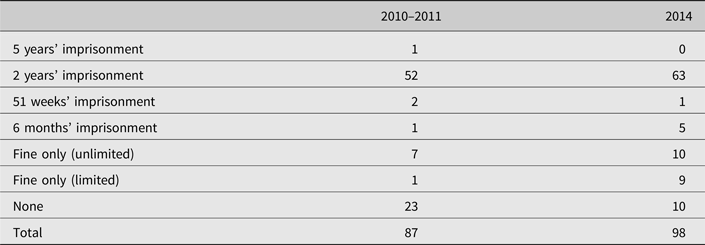
In terms of sanctions, both the DPRRC (in Westminster) and the DPLRC (in Scotland) have made it clear that it should be for Parliament to determine the maximum penalty for offences created by statutory instrument.Footnote 98 For 64 of the 87 SIs in the 2010–2011 sample, limits were placed in the relevant enabling legislation on the maximum penalties that could apply. For 23 of the SIs, however, there were no such limits. Even for the 67 SIs that were subject to limits, these were not especially restrictive, as Table 4 shows.
Maximum penalty specified in enabling legislation (number of SIs)

In the 2010–2011 sample, in 52 instances, the enabling legislation still allowed for offences to be created with a maximum penalty of two years’ imprisonment.Footnote 99 In one instance,Footnote 100 the enabling legislation allowed for offences to be created with a maximum penalty of up to five years’ imprisonment.Footnote 101 Where Parliament provided for maximum penalties, the resulting regulations always utilised the maximum penalty concerned. This meant that a significant number of offences were created under NRP with a maximum penalty of five years’Footnote 102 or two years’ imprisonment.Footnote 103
Matters improved somewhat in the 2014 sample, where limits were placed on maximum penalties in 88 of the 98 instruments. That still left 10 instruments that were not limited in this way and, as for the 2010–2011 sample, the ‘limits’ in the remainder still allowed for the creation of offences in a sizeable number of cases with maximum sentences of two years’ imprisonment or an unlimited fine.
(iii) A statutory duty to consult?
Of the 87 instruments in the 2010–2011 sample, 54 were subject to a legal duty to consult on the instrument while it was still in draft. Of the 98 instruments in the 2014 sample, the equivalent figure was 43. For many of the SIs concerned, the duty to consult arose because they related to food production and under EU law consultation is always required for regulations made in this area.Footnote 104 In other instances the duty to consult stemmed from the enabling legislation, although the scope of the duty varied somewhat. So, for example, the Merchant Shipping Act 1995 provides only that, when regulations are made under its auspices,Footnote 105 ‘it shall be the duty of the Secretary of State … before he gives effect to the proposal, to consult such persons in the United Kingdom (if any) as he considers will be affected by the proposal’.Footnote 106 In comparison, the more specific duty contained in the Clean Air Act 1993Footnote 107 provides that the Secretary of State must consult ‘(a) such persons appearing to him to represent manufacturers and users of motor vehicles; (b) such persons appearing to him to represent the producers and users of fuel for motor vehicles; and (c) such persons appearing to him to be conversant with problems of air pollution’.Footnote 108 Sometimes the enabling legislation also set out the procedure that should be followed in the consultation.Footnote 109
(iv) Consultation in practice
As noted above, the government was subject to a legal duty to consult in relation to 54 of the SIs in the 2010–2011 sample and 43 of the SIs in the 2014 sample. In all of these instances it is clear from the relevant Explanatory Memorandum to the SIs that consultation did take place prior to the instrument being made.Footnote 110
That leaves 33 SIs in the 2010–2011 sample and 55 in the 2014 sample that were not subject to a statutory duty to consult. Some of these (four in the 2010–2011 sample and 11 in the 2014 sample) were made under ARP, and would have been the subject of a parliamentary vote, which perhaps makes this less of a pressing concern. For the remainder, the absence of a legal duty to consult did not necessarily mean that there was no consultation process in practice – in fact for a sizeable number of the SIs concerned (ten of the 2010–2011 sample and 27 of the 2014 sample) there was.Footnote 111
This still left a number of SIs across the two samples that were made under NRP and were not consulted on while in draft. Most were regulations giving effect to decisions of the UN Security Council.Footnote 112 Aside from these, there were five instruments in the 2010–2011 sample and three in the 2014 sample that were made under NRP and where no consultation on a draft order appears to have taken place.Footnote 113 For one there was an earlier consultation around the general policy principles.Footnote 114 For another the government made reference in its explanatory memorandum to the consultation that had taken place around the enabling Act.Footnote 115 For another the government reported that it had discussed the need for the legislation in the course of regular meetings it held with industry representatives and stated that the group supported the need for the Order in question.Footnote 116 For another the government reported that ‘discussion’ with representative stakeholder bodies had taken place.Footnote 117
As the JCSI has observed,Footnote 118 the fact that a consultation took place does not tell the whole story. As noted earlier,Footnote 119 the consultation might not reach those affected, consultees might not have the time or skills to respond and even if they do, this does not guarantee that any concerns will be given serious consideration. Some of the consultations in our sample were clearly extensive and led to changes to the draft regulations. One example is the Timeshare, Holiday Products, Resale and Exchange Contracts Regulations 2010, which created 14 offences, all subject to a maximum penalty of an unlimited fine.Footnote 120 A lengthy consultation document containing a draft of the proposed regulations was sent to individual companies and to trader and consumer groups who were felt by the government to have a particular interest in the legislation. It was also placed on the Department for Business, Innovation and Skills website and notices were put in the national and trade press.Footnote 121 A deadline of 12 weeks was set for responsesFootnote 122 and 23 responses were received.Footnote 123 As a result, some changes were made to the draft Regulations,Footnote 124 including the abandonment of some of the proposed criminal offences.Footnote 125
Not all of the SIs in our sample were subject to such an extensive consultation. Low response rates appeared to be a problem – the consultation over the Seal Products Regulations 2010, for example, attracted only six responses.Footnote 126 The consultation on the Products Containing Meat etc Regulations (Northern Ireland) 2014 attracted none at all.Footnote 127 This may, of course, indicate that those affected by the instrument in question were happy with the proposed legislation,Footnote 128 but it may equally mean that the consultation did not reach its target audience or that consultees were unable to respond. The government's account of the consultation process was also very sparse at times, meaning that it was difficult to assess the degree of support for particular proposals or whether any negative responses had been considered and responded to.Footnote 129
(v) What does all this tell us about democratic legitimacy?
In assessing the democratic legitimacy of the criminal offences in our sample, it should perhaps be said that legitimacy ‘is not an all or nothing affair’,Footnote 130 but rather a matter of degree.Footnote 131 With this in mind, the 21 SIs that were made under ARP are the least problematic in legitimacy terms, as they were subject to a parliamentary vote.Footnote 132 Those made under NRP are more problematic. There was some parliamentary control in that for at least some of them Parliament set out maximum penalties for the offences concerned (although, as discussed above, this did not always happen and even where it did the maximum penalty concerned was still a substantial term of imprisonment). A more productive route for finding democratic legitimacy here may, however, be through participatory legitimacy. Almost all of the instruments made under NRP did involve some degree of consultation with affected interests. Questions remain, however, over the degree of legitimacy this bestowed, as the mere fact that a consultation took place does not necessarily mean that there was an opportunity for genuine participation by those affected.Footnote 133
4. The issue of scrutiny
Setting aside the question of democratic legitimacy, a further issue is whether statutory instruments containing criminal offences receive adequate scrutiny, especially when made by NRP. The two issues are not unrelated – the process of scrutiny is one that might be undertaken either by MPs, as democratic representatives, or by affected interest groups, via the process of consultation. Legislative scrutiny is an important part of the law-making process in any context but where the legislation in question is creating criminal offences, it is of heightened significance. Criminal liability is ‘the strongest formal censure that society can inflict’.Footnote 134 As we have noted,Footnote 135 quite aside from any deprivation of liberty (or other penalty) that may result, the collateral impact that a criminal conviction can have on the life of an individual or the reputation of a corporation can be far-reaching. This is one reason why criminal liability should be imposed only where the law conforms to certain principles. In the present context, we focus on two principles in particular.Footnote 136 The first is the principle of accessibility and fair notice, which dictates that it is clear in advance to those targeted by a provision exactly what conduct is criminal.Footnote 137 This is especially important, given that the defence of ignorance of the law is so restrictive as to be almost non-existent.Footnote 138 The second is the principle of proportionality of sentence – the requirement that the penalty on conviction should be proportionate to the seriousness of the breach concerned.Footnote 139
In terms of these two principles, there were many instruments in our sample that performed well. It is certainly not the case that all SIs that create criminal offences are poorly drafted or contain disproportionate maximum penalties. There were, however, a number that left a lot to be desired in one or both of these respects. One example is the Water Environment (Controlled Activities) (Scotland) Regulations 2011 (the Water Regulations), created under section 20(1) of the Water Environment and Water Services (Scotland) Act 2003 (the Water Act). These Regulations create 130 criminal offences, all subject to a maximum penalty of five years’ imprisonment (or an unlimited fine).Footnote 140 The Water Regulations perform well in terms of accessibility. For the most part, they explain in great detail exactly what must be done if criminal liability is to be avoided.Footnote 141 They perform less well in terms of proportionality. Regulation 44(2) provides that a person convicted on indictment of any of the 130 offences contained in the Regulations is liable to a maximum penalty of five years’ imprisonment.Footnote 142 Some of the offences are clearly extremely serious and a maximum penalty of this magnitude is not inappropriate. So, for example, one of the prohibited activities is the discharge of water from a surface water drainage system that contains trade effluent or sewage or that otherwise results in the pollution of the water environment.Footnote 143 In other instances, however, it is less clear that proportionate penalties are being applied. The Regulations also prohibit, for example, the operation of a weir that impedes the free passage of salmon or sea troutFootnote 144 and the placing of a boulder in a river that has a length, breadth or height greater than 10% of the channel width.Footnote 145 It is not immediately apparent that these offences are of the same magnitude as the direct discharge of sewage into the water environment. The Water Regulations also contain a number of offences of failure to provide information to officials, all of which are strict liability,Footnote 146 and all of which are also potentially subject to the five year maximum penalty. Bear in mind here that the Law Commission, in Criminal Liability in Regulatory Contexts, recommended that a failure to provide information or other assistance should not be a criminal offence at all unless it was intentional or reckless.Footnote 147 The approach taken in the Water Regulations is despite their being made under ARP and subject to consultation whilst in draft.Footnote 148
Another example is the Materials and Articles in Contact with Food (England) Regulations 2010 (the Contact with Food Regulations), which created 26 offences using the power contained in the Food Safety Act 1990.Footnote 149 The Regulations were made under NRP but were consulted on while in draft.Footnote 150 In terms of the accessibility of the provision, the Regulations are far from ideal. The offence creating provisions are contained in a number of different sections of the legislation. Regulation 13 deems breaches of the duties set out in regulations 8, 10 and 11 to be a criminal offence. Regulation 8 is relatively straightforward.Footnote 151 Regulation 10, however, provides that ‘no person may manufacture any regenerated cellulose film intended to come into contact with food using any substance or group of substances other than the substances named or described in Annex II’. Regulation 10(2) states that ‘Annex II’ is a reference to ‘Annex II to Directive 2007/42/EC’, thus requiring the reader to cross-refer to a European Directive. Regulation 10(4) prohibits the manufacture of any coating to film using any substance other than one listed in Annex II, III or IV to another Directive (this time Directive 2002/72/EC) except where such manufacture complies with the ‘requirements, restrictions and specifications contained in those Annexes and in the 2009 Regulations’. The reader then has to move to the interpretation section of the Contact with Food Regulations to discover that ‘the 2009 Regulations’ means the Plastic Materials and Articles in Contact with Food (England) Regulations 2009. Section 11 also contains provisions that cross-refer to Directive 2002/72/EC and the 2009 Regulations.
Regulations 4, 5 and 6 contain entirely separate offence provisions. Regulation 4 provides that breach of certain specified provisions of another EU Regulation (Regulation 1935/2004) is an offence. Regulation 1935/2004 spans 13 pages of small font type and itself cross-refers to two further European Directives (Directive 89/107/EEC and Directive 2000/13/EC). Regulation 5 provides that breach of another EU Regulation (Regulation 2023/2006) is an offence, as does regulation 6 (Regulation 450/2009). Regulation 450/2009 makes a number of references to ‘the Community list’ which, it is stated in the preamble, is ‘a list of authorised substances that may be used in active and intelligent components’ but there is no indication of where this list might be found.
In terms of the applicable penalties, the Contact with Food Regulations look, on the face of it, like a more considered set of provisions, in that the drafters have separated out different offences as meriting maximum penalties of different magnitude. So regulation 13(1)(b) provides that intentionally obstructing or failing to provide assistance or information to a person acting in the execution of the Regulations is an offence and regulation 13(2)(b) demarcates this as a less serious offence than breaches of the substantive duties, with a maximum penalty of three months’ imprisonment (compared to two years). No such distinction is made, however, in relation to the EU legislation referred to in the Contact with Food Regulations, breach of which is also an offence, despite the fact that it contains duties of assistance and information provision similar to those in regulation 13(1)(b). So, for example, Article 12 of Regulation 450/2009 provides that ‘appropriate documentation to demonstrate that the active and intelligent materials and articles and the components intended for the manufacturing of those materials and articles comply with the requirements of this Regulation shall be made available by the business operator to the national competent authorities on request’. Under regulation 6 of the 2010 Regulations, breach of this article is an offence subject to a maximum penalty of two years’ imprisonment. Similar information provision duties are contained in other parts of Regulation 450/2009Footnote 152 and in the other EU legislationFootnote 153 to which the 2010 Regulations refer and these too attract a maximum penalty of two years’ imprisonment.
A further example is the Animal By-Products (Enforcement) (England) Regulations 2011 (the By-Products Regulations). These were made under powers contained in the Agriculture Act 1970Footnote 154 and the European Communities Act 1972 and created 36 criminal offences. While they were made under NRP, they were the subject of a consultation while in draft.Footnote 155 To discover precisely what activity is a criminal offence, it is necessary to start at regulation 17(1), which provides that ‘a person who fails to comply with an animal by-product requirement commits an offence’. Regulation 17(2) states that ‘animal by-product requirement’ means ‘any requirement in Column 2 of Schedule 1 to the By-Products Regulations as read with the provisions in Column 3 to that Schedule’. Columns 2 and 3 in Schedule 1 do not themselves shed any light on the nature of the prohibited conduct. Instead they list 23 articles of ‘the EU Control Regulation’ each of which should be read with various provisions of ‘the EU Implementing Regulation’. It is then necessary to turn to the interpretation section of the By-Products Regulations (regulation 2) to discover that the EU Control Regulation means Regulation EC No 1069/2009 and that the EU Implementing Regulation means Commission Regulation EU No 142/2011. To discover what conduct is actually prohibited, it is necessary to seek out both items of European legislation. The EU Control Regulation contains 33 pages of small font type and some of the offence-creating Articles themselves cross-refer to other European legislation.Footnote 156 In terms of proportionality, the By-Products Regulations are also problematic. Regulation 20 provides for a blanket maximum penalty upon conviction on indictment of two years’ imprisonment. This applies to substantive breaches of the Regulations just as it does to offences of failing to provide information or assistance.Footnote 157
It should be stressed again that not all of the SIs we examined performed poorly in terms of clarity and proportionality in sentencing.Footnote 158 Those discussed above, however, were not the only instruments that were problematic in these terms. They were selected for discussion because they all carry heavy maximum penalties, but there were numerous examples of instruments with less severe penalties that were equally problematic.Footnote 159 These problems existed despite the presence of the SI Committees and despite the instruments concerned being the subject of consultation exercises.
5. Options for change
Thus far, we have demonstrated that substantial numbers of criminal offences, often with heavy maximum penalties, are created in the UK in delegated legislation. This is potentially problematic both in terms of the democratic legitimacy of the criminal law thus created and in terms of its clarity and proportionality. With respect to the former, such legitimacy might be bestowed by parliamentary vote (as in the case under ARP procedure) or by direct participation in the legislative process via consultation. The majority of the SIs we looked at were either made under ARP or were subject to a consultation process (although there were a small minority of instruments where neither of these was the case). That said, it was not always obvious that the consultation process was particularly thorough or well documented and if this is to be the basis upon which democratic legitimacy is bestowed, it leaves something to be desired. With respect to the content of the legislation, while many of the criminal offences defined in the SIs in our sample were very well drafted, there were a number of examples where criminal offences were confusingly defined, where apparently disproportionate maximum penalties were attached to some offences, or even where it was difficult to establish without very careful reading of the provisions exactly what conduct had been criminalised.
If these issues are to be addressed, there are a number of different ways forward, which could be deployed as alternatives or in combination. Each is discussed in turn.
(a) Limiting delegation
One possibility is to prevent the power to create criminal offences being delegated at all and require all criminal offences to be contained in primary legislation, and voted on by Parliament, as was proposed by the Law Commission in Criminal Offences in Regulatory Contexts.Footnote 160 This would address any concerns that direct consultation is an inadequate method of securing democratic legitimacy, either in theory or in practice. It would also improve the degree of scrutiny that the legislation receives, with the result that problems with clarity or proportionality of penalty are more likely to be identified prior to the legislation coming into force. That is not to say, of course, that primary legislation is always of high quality.Footnote 161 Although difficulties of clarity are often exacerbated by the relatively technical matter of secondary legislation, there are plenty of examples of primary legislation containing criminal law provisions that leave much to be desired in terms of the quality of their drafting.Footnote 162 The scrutiny that primary legislation receives compared to delegated legislationFootnote 163 means, however, that problematic issues are far more likely to be identified and addressed in the former than the latter.
The Law Commission's proposal attracted some support in consultation responsesFootnote 164 but it was also pointed out that this would be wholly impractical as there would be insufficient parliamentary time to pass all the legislation that creates criminal offences.Footnote 165 The Law Commission's recommendation does need to be considered in the context of its other proposals, including the increased use of civil penalties to replace relatively minor criminal offences,Footnote 166 so the problem of parliamentary time might not be insurmountable. Given the sheer number of offence-creating SIs in our sample,Footnote 167 however, it would require a radical – and not uncontroversialFootnote 168 – shift to the use of civil penalties in place of criminal offences to even begin to be feasible.
A less radical option would be to stipulate that the power to create serious criminal offences cannot be delegated, leaving the possibility that relatively minor offences could still be created in secondary legislation.Footnote 169 This is precisely the system that exists in France, where there is a constitutional principle that the power to create serious offences cannot be delegated.Footnote 170 A similar principle exists in Germany.Footnote 171 One difficulty in the UK context would be how to determine what is a serious offence. In France this is straightforward, given the three-tier classification of offences into crimes, délits and contraventions.Footnote 172 It is only contraventions (which cannot be punished by imprisonmentFootnote 173) that can be made in secondary legislation – crimes and délits must be created in primary legislation.Footnote 174
In none of the UK jurisdictions does a formal system for classifying the seriousness of offences exist, but a line could be drawn on the basis of the magnitude of the penalty concerned. So it would be possible, for example, to mandate that all imprisonable offences be created in primary legislation or that all offences with a penalty of more than one or two years’ imprisonment must be made in primary legislation. As we saw earlier, some enabling legislation already places limits of this nature. Such an approach is a pragmatic one: it does not involve a claim that length of potential imprisonment is the only factor relevant to legitimacy, and it might in some instances be inappropriate to use subordinate legislation where (for example) conviction was likely to be unusually stigmatic or have serious effects on an individual's life separate from stigma or imprisonment, such as by disqualifying a person from particular activities. Any such issues would have to be considered on a case-by-case basis (and could be taken account of by the relevant parliamentary committees), but a rule based on a maximum term of imprisonment provides a bright-line rule that can easily be applied in practice. The difficulty would be in determining where to draw that line. If it is drawn too high (say at two years’ imprisonment), it will have little effect (or may simply result in Ministers creating offences with penalties just below the maximum). If it is drawn too low, it may mean that Parliament cannot cope with all the legislation that would now have to proceed through the primary legislation making process.
If secondary legislation is retained as a way of creating criminal offences – either for all offences or only for relatively minor ones – another option could be to mandate that ARP must be always used.Footnote 175 As we saw earlier, some of the enabling Acts in our sample did just this, providing that ARP must be used to make any regulations that created criminal offences (or increased the penalties for existing offences).Footnote 176 Secondary legislation does have advantages – it can be passed rapidly when there is a need to react quickly to events or where the law needs to be regularly changed or updatedFootnote 177 – and the use of ARP would mean that the resulting criminal offences are voted on by Parliament. ARP does, however, leave much to be desired in terms of the opportunity for scrutiny and – if necessary – amendment during the law-making process and it is clear from our sample that its use did not prevent poor quality legislation from becoming law.Footnote 178
(b) Participation through consultation
A final way forward – which might be deployed in combination with other changes or as a standalone option – is to rely on participation as a route to democratic legitimacy and scrutiny of legislative content. Where a criminal offence is created in an instrument made by NRP, consultation is essential for democratic legitimacy, but there is a good argument for requiring this for all legislation that creates criminal offences, in order that the parliamentary scrutiny inherent in ARP and primary legislation can be effective and properly informed. What is important here is not simply that a consultation exercise takes place (as it did for almost all of the SIs in our sample), but that it is of sufficient quality in terms of, for example, its reach and the timeframe for responses, and that responses received (especially where they do not support the proposals) are given adequate consideration. It is worth noting again that consultation did not prevent the accessibility and proportionality problems identified earlier.
There are two main checks that already exist on the quality of consultation. One is the UK government's Consultation Principles,Footnote 179 which apply to all government consultations, including those relating to SIs. Under these guidelines, consultations should, inter alia, be targeted at appropriate groups; they should last for a proportionate amount of time, taking into account the nature and impact of the proposal; responses should be published within 12 weeks of the close of the consultation (or an explanation should be provided as to why this was not possible); and information should be provided about how many responses were received, the nature of these responses and how these have informed the policy (or here the SI) in question. Aside from the 12-week publication deadline, however, the guidelines lack any real specificity and are only guidelines. There is no sanction if they are not complied with.
The second check exists via the Committee system. As we have already noted,Footnote 180 as a direct result of concerns it had repeatedly expressed about the quality of consultations accompanying SIs, the JCSI was, from parliamentary session 2014–2015, given a new term of reference to draw attention to instruments that had been subject to inadequate consultation. In the latest version of its guidance, the JCSI specifically states that it:Footnote 181
considers that proper consultation is a crucial part of the process of getting an instrument right before it is laid. As the House cannot amend secondary legislation, it is important that each instrument should have been exposed to those who will be affected by its provisions and its suitability reviewed in the light of their reactions before it is laid before Parliament.
The Explanatory Memorandum accompanying a statutory instrument, the JCSI continues, should:Footnote 182
set out who was consulted, over what period and how many people responded. There should be some analysis of the key points raised in responses and a short justification of why the department did or did not make changes to its policy in the light of the opinions expressed.
This does not mean, though, that any instrument that has not been the subject of a proper consultation process will be annulled. As noted earlier, the JCSI (and its Scottish equivalent) can only draw attention to an instrument. It is then reliant on a successful motion to annul (or on the government voluntarily withdrawing the SI), something that happens very rarely. The fact that the JCSI has signalled its intention to scrutinise the consultation process might still mean that government departments are more likely to ensure that adequate consultation with affected interests does take place. There is little evidence, however, that the existence of the new reporting ground has prevented poor quality consultation. In a report written at the end of the first parliamentary session after the new reporting ground came into operation,Footnote 183 the JCSI noted that there were still ‘too many examples where an important policy development has been preceded by a poorly conceived consultation exercise’.Footnote 184 It had, as of January 2015, reported five instruments on the basis of inadequate consultationFootnote 185 and had also noted problems in the consultation process in relation to instruments reported under other grounds.Footnote 186 The problems noted included very short timeframes (often only a matter of a few weeks and on a number of occasions – including an instrument that related to schools – over the summer holiday period),Footnote 187 confusing presentation of proposals,Footnote 188 not consulting widely enough,Footnote 189 failing to mention opposition to proposals in the Explanatory Memorandum to the SI,Footnote 190 proceeding with an instrument despite significant opposition,Footnote 191 and in one case holding no consultation at all on the basis that there was no time to do so.Footnote 192
It is difficulties such as these that have led some to argue that the UK jurisdictions should adopt something akin to the Administrative Procedure Act 1946 (APA) that regulates the making of secondary legislation in the US.Footnote 193 In the US delegated legislation is most commonly made not by government departments but by independent regulatory bodies,Footnote 194 but in doing so they must comply with, inter alia, the requirement for consultation in section 4 of the APA.Footnote 195 This requires an agency to give notice of the terms of any proposed new rules,Footnote 196 to afford interested parties an opportunity to participate in the rule making by making written or oral submissions and to consider all relevant submissions received,Footnote 197 and to allow at least 30 days between publication of a rule and its effective date.Footnote 198 Perhaps more significantly, the courts have added substance to the rules as set out in the APA. Agencies must fairly present the substance of the rules, disclose the methodology and supporting studies behind them, disclose any additional factual information that comes to light during the rulemaking process and explain alternatives that were rejected.Footnote 199 Failure to comply sets up the possibility of a successful judicial review of the resulting legislation if the consultation was not carried out in accordance with procedure.Footnote 200 Regulating the consultation process in this way will not, of course, necessarily result in full participation by those potentially affected by offence creating regulations.Footnote 201 It would, however, constitute an improvement on the present situation in the UK where the available evidence suggests that the quality of consultation is highly variable.Footnote 202
Conclusion
In the preceding analysis, we have demonstrated that the creation of criminal offences is largely a matter of administrative action (in the form of delegated legislation) rather than a parliamentary decision and that substantial numbers of criminal offences that carry heavy maximum penalties are being created in delegated legislation. This presents a challenge to the orthodox position in criminal law scholarship, which treats criminalisation as a solemn matter for the legislature, and where debate has focused primarily on the criteria that should be used to determine the content of the criminal law and on the principles – such as fair notice and proportionality of sentence – to which such offences should conform. This scholarship is immensely valuable, but the process by which criminal offences are created should also be given critical attention.
The extensive creation of criminal offences by delegated legislation raises an important question, which is how such criminalisation is to be regarded as democratically legitimate, if it is not voted on by Parliament. Such democratic legitimacy might be secured through the implementation of effective consultation processes, but we question whether this is sufficient in respect of offences which carry (sometimes lengthy) periods of imprisonment as a maximum penalty. While Parliament clearly cannot be constrained from delegating the power to create imprisonable offences if it so desires, it would be desirable, as a matter of practice, to apply a principle that serious criminal offences should only be created by primary legislation, with seriousness being defined by reference to the maximum sentence of imprisonment applicable on conviction. Exactly where the threshold should be drawn is a matter for further debate – but it is important that it is drawn at a level that is neither ineffective nor places too heavy a burden on parliamentary capacity.
For less serious offences, however, democratic legitimacy is still a concern. The stigma of a criminal conviction is potentially very serious, and the collateral consequences (for individuals and corporations) can be very severe, even where the direct penalty imposed is relatively minor. The importance of the consultation processes in legitimating secondary legislation that creates criminal offences must be sufficiently recognised and consultation – if it is to do the work of legitimating the criminal law – must be taken seriously and done properly. While recent developments in this area are promising, the problems identified in the JCSI's 2015 report indicate that there is still work to be done in ensuring that full and proper consultation is carried out in all cases where criminal offences are created by delegated legislation. One way forward could be to adopt in the UK jurisdictions something akin to the Administrative Procedure Act 1946 to regulate criminal law making in delegated legislation, by imposing a blanket legal requirement of consultation and by setting out procedural and reporting criteria which must be met in terms of, for example, the timeframe for responses and the regard that must be given to any opposition expressed.
Together, these measures – requiring parliamentary approval for the creation of serious criminal offences and mandating a proper consultation process for the remainder – would address the concerns we have articulated about the democratic legitimacy of creating criminal offences via delegated legislation. They may also have a positive effect on the quality of the delegated legislation concerned, by improving the degree of scrutiny it receives. That is not to say, of course, that all problems with the quality of criminal law would disappear. Parliamentary scrutiny does not necessarily result in perfect legislation – the best that can be said is that the higher degree of scrutiny primary legislation receives compared to delegated legislation reduces the risk of difficulties occurring. There is also a limit to what consultation can achieve in this respect. Even the best-publicised and lengthy of consultations may not succeed in attracting responses. Ensuring that affected parties are at least afforded the opportunity to participate in this way and that the results of such consultation are openly and fully recorded would nonetheless represent an improvement on the present position.