Introduction
Owing partly to the neoliberal policies in place in Turkey since the 1980s, and especially since the Justice and Development Party (Adalet ve Kalkınma Partisi, AKP) came to power in the country in 2002, global agrifood companies have incrementally penetrated the Turkish food market, creating unequal dynamics of competition.Footnote 1 They have also restructured themselves in parallel with global dynamics so as to benefit from the potential of a growing and extending organic food market. In response to new incentives offered by the state for organic agriculture, some smallholder farmers have also shifted practices by producing organic products; however, they cannot usually afford the prices of certification, inspections, and advisory support. Domestic sales of packaged organic food have nonetheless increased from 15.3 million US dollars in 2009 to almost 90 million US dollars in 2015;Footnote 2 this increase, however, is not equally distributed across classes. The dominance of global agrifood companies in the organic market translates into steep prices that make organic food inaccessible to a large population.Footnote 3 This “classed” character of organic food is experienced more acutely in Turkey as compared to the Global North, whose consumers have greater purchasing power and whose domestic organic market is larger.
The dynamics behind this visible global growth of the organic food market cannot be fully understood without referring to a growing “food fear.” This is closely related to the neoliberal responsibilization of individuals through self-control and self-protectionFootnote 4 in “the risk society,” where the proliferation of risks as “the unknown and unintended consequences [of modern industrial production] come to be a dominant force in history and society.”Footnote 5 Neoliberal citizens of the risk society, especially mothers, thus experience considerable food anxiety, and are left with individual responsibility over multiple and intangible food risks.
This prominence of food fear and the responsibilization of individuals in the face of risks are also characteristics of the Turkish neoliberal context. This study is situated within this neoliberal conjuncture of the largely inaccessible organic market and the neoliberal individualization of risk management in Turkey, which are coupled with the conservative discourses that have dominated the period of AKP rule, constantly emphasizing care-work as women’s duty. I argue that under these conditions in Turkey, mothers are made to inhabit this risk society in a particular manner that involves recognizing the vulnerabilities they face in achieving ideal organic feedingFootnote 6 through individualized strategies. As such, this article will primarily focus on the following questions through a concentration on the classed aspects of mothers’ subjective experiences of feeding organic: How do lower- and middle-class mothers respond to food fear and the pressures of organic mothering in the Turkish neoliberal context? More specifically, what is the relationship of class with the ways in which mothers experience the pressures that organic food-workFootnote 7 brings? Finally, are there any class-based differences in mothers’ organic feeding practices and/or in the quotidian meaning they attribute to organic food?
In order to investigate these questions, the research sample includes not only middle- and upper middle-class mothers but also mothers from lower classes with different educational backgrounds. The research findings do affirm the design behind this sampling, since they reveal that all mothers draw from neoliberal discourses of organic feeding, mothering, and risks, yet negotiate them differently in terms of the daily management of their children’s diet and according to their own material realities. Responding to a common food fear and the pressure of mothering discourses, they all try to create small yet secure zones for their children, but are faced with a structural inequality that is largely obscured in dominant organic food discourses. In attempting to deal with such classed challenges, lower-class mothers adapt these discourses into an alternative organic feeding repertoire that fits into their own class realities. Thus, the main argument of this article is that, as neoliberal citizens within the current atmosphere of food fear, mothers develop varying organic food strategies in Turkey across divisions of class. More specifically, they create class-specific definitions and interpretations of the concept of “organic” so as to deal with the pressures that come in stratified ways.
This study proceeds largely in line with a Bourdieusian perspective, according to which the proliferating discourses on organic food and practices of organic feeding have become a part of the distinctions of middle classes. It also suggests that these discourses have invaded the cultural spaces of lower-class mothers, among whom, however, the idea of “organic” is primarily experienced as “home-made” because of their limited access to certified organic foods. In each class, these discourses are largely assimilated into rural nostalgia, which is revealed, albeit briefly, by how “village food” is valued over food in the city. Nevertheless, the translation of this shared nostalgia into actual organic food purchase is uneven and is practiced through class-specific channels of access to village food. Therefore, the lower social value attached to these new definitions of “organic” by lower-class mothers, and the venue from which they provide food, still contribute to the distinctive character of organic food-work. Similarly, the knowledge of middle- and upper middle-class mothers have regarding certain organic stores, websites, and organic food brands strengthens the symbolic boundaries drawn through such distinct organic practices.
Key contributions to theorizing about organic food in the age of neoliberalism
The neoliberal transformation of the welfare regime and the restructuring of economic relations in Turkey are discussed from a variety of perspectives, including family and gender. The literature on neoliberal domesticity, for example, discusses the negative impacts of the new healthcare and social security system on women, as well as the repercussions of the privatization of public services, which increases the informal delegation of care-work to women along with the familism of the AKP.Footnote 8 However, women’s own interpretations of the daily repercussions of these neoliberal policies and discourses within their family, not to mention the classed character of their relationship with these neoliberal transformations, have been largely ignored in the literature, which has been predominantly limited to policy and discourse discussions. This article thus makes a contribution to the recent line of analyses of family, gender, and neoliberal politics in Turkey under the AKP government by bringing into these discussions alternative empirical data focusing on the subjective and classed experimentation of these neoliberal policies on a quotidian level.
There is also a growing literature on organic food/agriculture as it relates to the neoliberal politics of the AKP,Footnote 9 and this article wishes to contribute to these discussions—which have focused primarily on policy-making, food production, and market relations—by offering an analysis of daily subjective experiences placed within this very context. By doing so, the article reveals consumers’ own classed interpretations and experiencing of these transformations in daily life—interpretations and experiences that have typically been pushed into the background of macroanalyses about the implications of these on producers. The research of Dedeoğlu in Turkey adopts what may be the closest approach to that taken by this article, as its methodology involves blog analysis on discourses of mothering in order to investigate the discursive and consumption practices of mothers on behalf of their children in areas ranging from toys to shoes.Footnote 10 Yet Dedoğlu’s work does not problematize these discussions in relation to the neoliberal rhetoric of consumer choice, which increases women’s responsibility. This article will hopefully contribute to similar lines of analyses on mothering and consumption in Turkey by bringing a specific focus on organic food consumption and adding a theoretical perspective that situates this discussion within the framework of the recent neoliberal mentality as well as of neoliberal transformations in food and agricultural politics in Turkey, from a sociological perspective.
There is also a large literature on risk, infant feeding, and mothering in the neoliberal context. For example, Petersen et al. investigates the food anxiety of Australian mothers in relation to their self-ascribed and gendered responsibility of obesity prevention.Footnote 11 Additionally, there is a large body of work analyzing the moralistic nature of the promotion of breastfeeding, and combined with risk discourses, so as to investigate how mothers deal with anxiety and the threat to their identities as good mothers and neoliberal citizens.Footnote 12 Building on these literatures by offering a unique case on organic mothering in Turkey, this article aims to contribute to lines of analyses similar to these. It is unique in the sense that this case sets itself apart from cases on organic food and mothering in Western, developed countries because these countries’ perception of and practices relating to organic food differ greatly from the Turkish case in terms of context, such as the higher purchasing power of consumers and the larger proportion of organic food consumption and the organic market as compared to Turkey. For instance, MacKendrick’s case study on mothers’ avoidance practices of chemical burdens in Canada indicates a consumer-citizenship perspective, one which considers food choices as an expansion of opportunities for political expression and ethical concernsFootnote 13 —this is something that is significantly lacking in Turkey. The differences suggested here may also be understood through a brief comparison of the organic consumption trends in certain countries with the trends seen in the Turkish case. For instance, more than half of Canadians buy organic products every week,Footnote 14 while, in Turkey in 2014, almost 70 percent of organic products were not consumed in the domestic market.Footnote 15 There is also considerable organic per capita consumption in European countries, especially in Switzerland (221 Euros) and Denmark (162 Euros) in 2014,Footnote 16 as compared to Turkey (1.1 Euros) in 2015.Footnote 17 These data from the Global North can also give an idea as to how the material realities and subjective experiences of consumers in these countries would be quite different than in Turkey. As such, they indicate that the Turkish case brings distinct dynamics, tensions, and relationalities into the discussion through the clearly limited access to organic food of a significant proportion of the population as compared to the cases in developed countries. These differences will be reflected in the research in terms of its focus and findings.
The main contribution of this study, then, will be to investigate the recent food fear in the neoliberal conjecture of Turkey, where food fear would likely be experienced more acutely than in the Global North owing to the country’s own specific conditions, as mentioned above. While the existing literature has focused largely on the Global North, this article offers empirical findings about a developing country with a growing organic market, and in this way aims to analyze different organic food experiences in the neoliberal context. To put it more clearly, this study provides an alternative case of mothers’ subjective experimentation in organic feeding in non-Western, developing country settings, a case that indicates class-specific interpretations of “the organic” in such a way as to challenge the ever deepening neoliberal vulnerabilities that organic food-work brings in a significantly inaccessible market. The article also invites further research in Turkey, which would further elaborate material and subjective practices of organic consumption from different perspectives, potentially through a comparative analysis.
Methodology
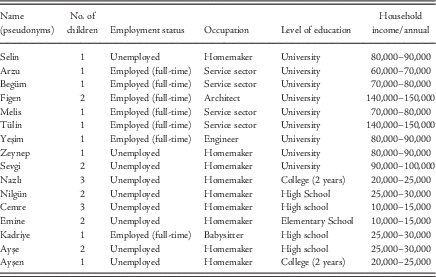
This study is based primarily on sixteen in-depth interviews with mothers from different class backgrounds in İstanbul, along with an analysis of eleven blog entries and 608 comments. As the study aims to investigate, above all, the class aspect of the possible diverse ways mothers respond to discourses of mothering, risk, and organic food on a quotidian level, the interview participant sample does not consist only of mothers from the middle and upper-middle classes, but also from the lower class. Since consumption practices are directly related to household income, this approach is used in the study as the main determinant of class differences and is evaluated together with the employment status and level of education of mothers. In this way, the study is better able to explore whether mothers’ perception and interpretations of organic food on a quotidian level vary in classed ways as they attempt to avoid potential food risks in their children’s daily diet. I thus separate the sample into two distinct groups, with lower-class mothers being the first group and middle- and upper middle-class mothers being the second. I recruited the mothers of the first group through snowball sampling from Ümraniye, a lower- and middle-class neighborhood in İstanbul. This group consists of seven participants, who are mostly elementary school or high school graduates and whose annual household income lies between 10,000 and 30,000 Turkish lira,Footnote 18 which is distinctly lower than the household income of the second group of mothers.Footnote 19 The mothers in this second group are middle- and upper middle-class women recruited either through contacts at a kindergarten or who are employees of a certain private company. These mothers are all university graduates, are mostly employed full time, and have a household income of between approximately 65,000 and 150,000 Turkish lira.Footnote 20 This design of the participant sample proved itself to be right, as the research findings suggest that, in caring for providing their children with a healthy diet, mothers interpret “the organic” differently from within their own different material realities so as to deal with the cumbersome expectations of dominant organic food discourses and food anxiety in this particular risk environment. This approach also helps in addressing the influence of cultural capital—e.g., knowledge of certain organic stores, websites, and food brands—on strengthening the distinctive boundaries that these classed interpretations of organic food-work create.
The reason why I chose İstanbul as the location of this Turkish case is, first, my sense that there people would experience more difficulty in accessing natural/organic food, feel more anxious about whom to trust and what to buy, and significantly privilege village food owing to the fact that İstanbul is Turkey’s largest and most industrialized city, where social relations are much more removed from the interaction of the agricultural production of food than in the countryside or smaller cities, or even in other large cities, like Bursa and Adana, which still have an ongoing relationship with their rural hinterland. Second, İstanbul, in comparison to other cities in Turkey, has more varied urban professional middle and upper classes, which constitute the most highly targeted group for the organic market. This enables a comparison of the organic food experiences of this group with those of lower classes. This choice of field location has repercussions on the findings, as the research suggests that organic feeding has become part of the lifestyle of middle-class professionals in İstanbul and that the sharp separation of İstanbul residents from the rural is reflected in mothers’ narratives about the vulnerabilities, especially for lower classes, of living in a city like İstanbul, in terms of access to natural/organic food. Moreover, as İstanbul residents, they all consistently idealize rural and village food in comparison with urban food, even though, in this regard, lower-class mothers can only rely on family connections in the countryside, whereas the others can also purchase food online from certain popular village farms.
Another important source of data for this study is the blog analysis. Since mothers themselves are significant actors in shaping organic food discourses as active agents, I have preferred to investigate mothers’ daily relationship to organic food and organic feeding discourses through an analysis of their own naturally ongoing interactions. While the communication of food risks to the lay public depends largely on the mainstream media, nonetheless the blogosphere, and especially blogs relating to motherhood, have become one of the most important networks of interaction where mothers can listen to, influence, support, and validate each other; circulate knowledge; and reflect upon their own motherhood. For my analysis, I chose the site blogcuanne.com because it is one of the most popular and active motherhood blogs, featuring a notably large number of posts and comments about the organic food experiences of mothers. The number of its followers on Facebook (62,920) and Twitter (23,900) as of May 2017 illustrate the ongoing popularity of the posts on this blog, which are frequently synchronized with these social platforms. Before deciding on this site, I also observed similar and similarly popular motherhood blogs, such as hassasanne.com and organikanne.com, but ultimately eliminated them owing primarily to the rarity of comments. Another reason I have chose blogcuanne.com is that it is data-rich in the sense that the data contained therein is especially detailed and descriptive, encompassing opinions, experiences, and peer support rather than simply “likes” and “retweets” or thanks and praise, as is common on other blogs and social media platforms. Moreover, while many blogs are followed by a homogeneous group of middle-class mothers, the popularity of this blog has also attracted lower-class mothers, at least to some extent, a relative heterogeneity that manifests itself in the juxtaposition of different voices from distinct classes in the comments pertaining to individual blog posts. Furthermore, the fact that, since March 2011, mothers can write their own posts on this blog significantly increases the blog’s interactivity, allowing mothers to open discussions in main posts, rather than simply adding comments. This reader-to-reader, writer-to-reader, and reader-to-writer interactivity makes this blog richer in content, more interactive, and more diverse in terms of featuring different opinions. In approaching blogcuanne.com as an ethnographic text, I have adopted a new technique called “netnography,”Footnote 21 developed by Kozinets, and using this technique, I first considered the relevancy, activeness, interactivity, heterogeneity, and data-richness of the blog’s content. I subsequently filtered the data by the word “organic” and, from the beginning of April 2011 till the end of 2014, retrieved the data from the blog’s archives, together with the comments received.
This article consists of three sections. In the first section, I draw attention to the shared food fear among mothers as neoliberal citizens and suggest that the acuteness of this fear and the ways in which mothers feel the pressures of organic mothering are experienced in classed ways. In the second section, I address how mothers respond to these stratified pressures through class-specific practices and interpretations of the concepts of “organic,” organic mothering, and the “organic child” ideal.Footnote 22 I then discuss, from a Bourdieusian perspective, how organic feeding reproduces middle-class distinctions, not only through material inequalities but also through cultural capital, which is also related to structural inequalities. In the third and final section, I elaborate upon a common tendency of valuing village food over urban food, showing that this is also reflected in organic food-work differently according to mothers’ classed means of access to village products. Presenting the consumption of organic food in Turkey merely as a commoditized solution, the article concludes by discussing the potentiality of food fear as a motivation to direct our efforts toward a collective struggle for more accessible and safer food for all.
Competing discourses, competing mothers, and maternal anxieties
You know we are what we eat. We live in tough times. You know the diseases that long-life shelf products, packaged products cause. We read, see, and watch a lot. So we believe that a good diet is very important. That is why I try to buy products that are as natural or organic as possible.Footnote 23
Along with neoliberal ideology, the universality of risks and the duties of states to deal with risks have shifted into the domain of risk management at the individual level of neoliberal citizens. Using the notion of “biological citizenship,” Petryna claims this as a new understanding of citizenship that emerged after the collapse of the welfare state in the form of an indirect relationship between state and citizens.Footnote 24 Along with this neoliberal mentality, risks have started to be seen as consumer problems, and “biological citizens” are expected to be responsible for taking their own precautions against possible food hazards through “precautionary practices.”Footnote 25 This leads to a particular way of experiencing “risk society,”Footnote 26 which means that the individualized precautionary efforts of neoliberal citizens have become more complex given the uncertainty and intangibility of multiple risks in late modernity. This makes a major contribution to the anxiety and emotional strain on individuals, especially in this époque marked by post-Chernobyl sensitivities, such as the risk of cancer in many highly affected countries, Turkey among them. The prominence of anxiety and food fear is thus clearly linked to the neoliberal responsibilization of individuals in the face of this risk environment, and in Turkey all of this is largely reconciled with the neoliberalization of agriculture and food policies and the growing but still largely inaccessible organic market.
It is in this very context that the combination of the neoliberal ideal of the self-reliant, rational, and prudent woman with the normative expectation for mothers to be caring and selfless renders mothers primarily responsible for the protection of their children’s health through the adoption of a calculating attitude and approach informed by expert advice.Footnote 27 Even so, inconclusive information concerning food risks, controversial issues, ambiguity, and the diversity of competing approaches all increase food fear and emotional conflicts for mothers:
The different discourses of experts, of course, confuse us. For a while, they said that baby formula is very healthy and so on. Then they argued that it is like this and that, with additives, causing illnesses. Now all the mothers who used baby formula mourn because of the anxiety of “What did I feed my child? What should I do? What if something bad happens to my child?” Thank God, I only used the pudding of these formula foods […] Mothers really feel confused. They feel a twinge of guilt about this.Footnote 28
This quote also suggests that the very act of witnessing the anxiety of other mothers authenticates the existence of shared food fear because affects circulate via contact and in relationship to a collective.Footnote 29 In the context of the relationality of food fear and the conflictual character of expert knowledge, mothers somehow try to overcome their confusion by finding their own style:
Everyone says something different […] This creates a loss of trust. A professor comes and says something while another, more specialized one says something different. In the end, you do something […] according to your own mind […] They do not meet in the same discourse somehow.Footnote 30
We need to conduct our own research, read and understand, analyze and make our decisions. Unfortunately, there are a limited number of people whom we can trust. Fortunately, we have our maternal instincts.Footnote 31
Despite their own interpretations based on reliable information, the mothers in this study still feel anxious owing to a lack of information about where, by whom, when, and how the food on their table in İstanbul has been produced: one interviewee said, “You just can’t know what they put in the packages in the big cities,”Footnote 32 expressing the anxiety about this issue circulating in a city like İstanbul, where social relations are removed from interaction with the actual agricultural production of food. The absence of face-to-face communication with producers makes mothers feel the need for expert advice, yet when they are unable to build up a trust in experts, this only contributes more to the level of food fear.
I argue that while anxiety matters in the management of children’s daily diets, the level of identification with food anxiety depends on one’s own perception, class realities, and individual subjectivity. This perspective suggests a strong link between how mothers feed their children and how they perceive themselves and others, showing how the choice of food thus becomes a sign of self-consciousness and self-esteem.Footnote 33 Because of this close relationship between self-esteem and feeding practices, mothers feel significant pressure in their interactions with others, especially with certain middle- and upper middle-class mothers who have internalized the “organic child” idealFootnote 34 and who devote a very significant portion of their time and money to organic food. These middle- and upper-middle class mothers are criticized by lower-class mothers due to their heavy emphasis on good motherhood and sacrifice with regards to organic consumption:
As for those who say, “It’s expensive for me, too, but I make the sacrifice”—if you can buy these products, you belong to another class. Otherwise, you couldn’t even afford to sacrifice […] Check your privilege.Footnote 35
As lower-class mothers also argue, in organic food discourses, class inequalities are generally obscured and tend to be discussed as if organic eating was classless. However, organic food is a privileged, stratified, and commoditized phenomenon, and lower-class mothers are at risk of being considered bad or careless mothers in this unfair competition. While women with a lower household income are personally involved in discussions about organic food and genuinely interested in feeding their children organic food, they are also clearly aware that they lack the capacity to afford certified organic food, and are thus put into more acute emotional conflict. The following quotes indicate the uneven affective implications of the pressures mothers feel about organic feeding, despite the fact that food fear is shared across divisions of class:
This makes me feel sad; let me give you an example from my friend Nazlı […] Even her sausage is brought in from the butcher she knows in her hometown. I sometimes ask whether I could pay more attention, whether I should do more […] Well, people with better subsistence can benefit from [organic food]. Most people cannot pump money into this.Footnote 36
Is it possible for everyone to afford organic/ecological food? […] Sometimes these discussions put families in a challenging situation, especially those who do not have the finances but still try to feed their child somehow […] Have you ever panicked about being left behind in parenthood?Footnote 37
While lower-class mothers do seem to feel more of an affective burden related to the pressures of organic feeding owing to their insufficient material capabilities, this should not be taken to mean that this study underestimates the pressures of organic mothering among middle-class mothers. For instance, although I myself have had no significant bias of any kind or degree regarding organic food-work, an intensive organic mother who expends significant effort and money on her children’s diet reveals that she felt emotional conflict even during the interview: “While having this interview with you, for example, I have indeed questioned myself as to whether I should feel guilty for not being such a strict organic mother.”Footnote 38 In speaking of intensive organic mothers, I refer to Hays’ notion of the “intensive mothering ideal,”Footnote 39 which expects mothers to have more specialized knowledge and abilities, in addition to making intensive use of time, effort, and material resources. I suggest that the concept of intensive mothering is well suited to the cultural spaces of middle-class mothers in Turkey. This has already been practiced in certain fields, such as education, where project children become a means for the social and cultural reproduction of new middle-class realities through intensive investments on the part of “self-conscientious” mothers.Footnote 40 In this context, intensive mothering practices through organic food-work have also become deeply embedded in the reality of middle-class mothers in Turkey as part of emergent cosmopolitan consumption forms.
Furthermore, the research indicates that all mothers share the pressures of the gendered unevenness of the organic food-work in the heteronormative family, albeit in classed ways. The anxieties of mothers, as well as their food fear, increase the more they are left alone without familial support in their organic feeding efforts. However, this situation also influences different mothers in distinct ways due to the incompatibility of these anxieties and concerns with the some mothers’ finances. Indicating their common concern about their extra responsibility in organic feeding, most mothers state that their husbands do not want them to be engaged so much with organic food-work, and they complain that fathers break the rules established for the children’s healthy diet. They also describe how they have to deal with this situation and try to convince fathers to support their efforts. Mothers being thus singled out in terms of managing the children’s diet seems to come to a peak in efforts at organic feeding. The mothers’ narratives address how the responsibilities regarded as motherly duties continuously increase in such a way as to bring on new tasks:
You accept this after a while. It doesn’t matter to me that much. The father leaves this responsibility to you […] He thinks that in any case you will take care of the kid. He is aware of our care to not feed [the children] anything and to avoid certain foods […] But this is not a problem. You do it because you want to do it for your kid.Footnote 41
The intensive organic mothering efforts of middle-class mothers also create intense emotional exhaustion owing to the clearly gendered unevenness of food-work in Turkish families. What is more, since most of the middle- and upper middle-class mothers in this study have full-time jobs, their lack of time often further contributes to this emotional exhaustion. Nonetheless, they seem to deal with this situation more easily than others because they earn their own money, which allows them more flexibility to insist on organic purchases. Overall, the research data indicate that, despite the shared food fear and the commonly experienced pressures of organic mothering in a neoliberal risk society, the acuteness of these pressures and the ways in which mothers feel them are experienced in classed ways. Mothers thus respond to these pressures according to a class-specific interpretation and negotiation of organic diets.
Negotiation of “organic” mothering and distinctions
This article suggests that none of the mothers in this study can buy everything organic or, in Szasz’s words, that they cannot “implement the full program of […] using all the inverted quarantine products available, all the time.”Footnote 42 By using the metaphor of “inverted quarantine,” Szasz argues that, through the consumption of organic food, individuals indeed try to create private commodity bubbles that are meant to protect their body from food risks in the society at large. However, in the industrial, urban context of İstanbul, it is nearly impossible to create such secure zones via individual commoditized solutions, even for an upper middle-class mother. Under such conditions, in order to relieve the pressures of providing an ideal organic diet and to maintain a relatively balanced emotional state, mothers have to personally interpret multiple discourses of organic food-work. In this way, they try to persuade themselves that they have maximum control. It is important to emphasize here that this very negotiation of their relationship to organic food-work is also, in and of itself, experienced in class-specific ways. Middle- and upper middle-class mothers who spend considerable time and money on organic feeding generally experience this as a process whereby they try to convince themselves that they are doing their best, while lower-class mothers who are usually unable to buy certified organic food have to adopt other strategies and draw up new definitions of “organic.” The following two quotes indicate how the former of these—i.e., middle- and upper middle-class mothers—attempt to battle against the pressures of food fear and organic mothering:
Because if I bother myself a lot with this issue, then I become unhappy. Or when I become flexible, then this bothers me a lot. But if I say somehow, “Okay, I’m doing my best to a certain extent, but after a point this kind of balance is enough,” then I can also feel comfortable […] Because you deal with a lot of things in a day and you struggle for many things inside. Rather than feeling bad when you can’t do it, it’s better to convince yourself.Footnote 43
I do not go over this issue with a fine-tooth comb because I believe that it makes you go off the deep end. You pay three times to buy it but still don’t feel at ease. On the other hand, if you can’t buy, you don’t feel relief because you ask yourself whether you’re feeding the child bad food. That’s why I try to keep my interest at moderate levels as much as possible.Footnote 44
On the other hand, lower-class mothers—and sometimes middle-class mothers as well—create alternative strategies to comfort themselves, since their restricted household income constrains their access to organic food brands or online natural food purchase from village farms. Hence, they develop different strategies of minimizing their children’s exposure to the harmful effects of conventional foods, by, for instance, making their own yoghurt, preparing home-made fruit juices and jams, and asking their parents to bring fresh fruits and vegetables from their home villages if possible. These mothers mostly present such actions as their own “organic” feeding practices. This shows that organic food discourses have also infiltrated into their daily life, but their particular interpretations of “organic” mothering are visibly linked to class conditions:
In the end, these juices have additives. We are trying to protect [our children] as much as we can. Picking [fruit] from our [i.e., my mother’s] garden […] we make juice, for example, organic. For instance, I make peach or plum marmalade in summer, removing the seeds and all. In winter, for example, I mix this marmalade with water and make her drink it like juice […] Meat products, we get those ready for the fridge during the Feast of Sacrifice [i.e., Eid al-Adha or Kurban Bayramı].Footnote 45
This is what I can afford. So I do this. I mean, if we could afford it, I’d like to do more. But how? I don’t know, they say something like avacado, or avocado, whatever they say—I don’t know where to find it. I’m supposed to go to the market, see it, and buy it, because the doctor said it’s good! I can’t go looking for an avocado, a fruit or a vegetable, in every market in a big city. That’s why I don’t mind. If I can do it, I try to make my children eat at home. I do my part. I say I know what I put in my soup, meals, and cakes. I try not to make them eat outside.Footnote 46
These discussions indicate the classed understandings of the concept of “the organic” and of organic mothering strategies that are developed in an atmosphere of food fear. These class-specific variations in interpretations and practices on the part of mothers contribute to the reproduction of the symbolic boundaries and distinctions between the middle and lower classes. Distinctions are strongly related to which ideas and practices of organic feeding are, for the most part, performed or minimized by which classes, as well as by who has the greatest access to dominant organic feeding practices. As such, being more knowledgeable regarding the privileged practices of organic feeding and the creation and propagation of knowledge about “the organic” strengthen middle-class distinctions, and hence practices as well. Through both face-to-face communication and interaction on social media, mothers—as the subjects shaping organic discourses—play a significant role in providing information about which organic foods and which organic stores are the best and which practices are the most highly valued. Although many women from different classes take part in these conversations, it is mainly those with the greatest knowledge concerning superior organic foods and stores who manage these blogs, and thus it is they who contribute the most to this distinction-making, via knowledge-making. In other words, distinctions are, as Pierre Bourdieu suggests, shaped not only by economic privilege and a cost-and-benefit logic, but also by cultural capital.Footnote 47 The cultural capital influences which foods are highly valued and consumed by different social classes and which foods remain unfamiliar to some, as the second quote above also suggests in relation to the avocado. In this study, almost half of the mothers—all from the lower class—had very limited knowledge regarding certified organic products, did not know any specific organic food brand or online organic food shopping sites, and had no idea about the existence of ecological farmers’ markets in İstanbul. They neither shop from organic stores nor buy certified organic food from supermarkets. The rest, however, gave the specific names of the organic brands they prefer and of the online food shopping sites from which they order. As the means of access to dominant organic food channels increases, knowledge of them also increases, for the most part. Furthermore, the varying levels of knowledge on the part of mothers regarding organic food and organic food channels are also closely interrelated with their different interpretations and strategies regarding organic feeding. That is to say, knowledge of and varying strategies for organic feeding are complementary, with the former contributing to symbolic boundaries just as much as the latter. Thus, the knowledge of dominant forms of organic practices becomes part of an emergent form of cultural capital and reproduces distinctions.Footnote 48
Distinctions are the repercussions of the symbolic power of capital that is needed to gain access to scarce commodities, and they are mobilized through the recognized schemes of perception and appreciation that are the manifestations of power relations in people’s minds. Bourdieu suggests that mutual recognition also contributes to social distinctions, which are “symbolic transfigurations of de facto differences, and, more generally, ranks, orders, grades, and all other symbolic hierarchies.”Footnote 49 I argue that organic feeding experiences are distinctive signals of symbolic power, and that there is mutual recognition among mothers of the same socioeconomic group, who share similar experiences of providing organic food from the same places and with analogous motivations. Thus, organic food consumption reproduces its distinctive character through the mutual recognition of both the material and cultural boundaries drawn among mothers in their daily interactions and practices.
Nostalgia for the rural and the past
Imagine chickens growing up in meadows, wandering around freely. These are natural chickens. “Organic” is more like “systematic.” For example, they build a natural-like organic farming atmosphere […] They use more technology in organic farming […] When it comes to what we call natural, it is more a kind of boutique production. Well, you have a little chicken coop, and you have thirty or forty chickens. That is natural for me. “Organic” is more like “mass consumption.”Footnote 50
Most of the mothers in this study believe that organic food is not necessarily natural. These mothers, especially those who distinguish between organic and natural food, tend to develop less trust in certified organic products:
The organic issue is far more detailed. In a seminar I met a woman who used to work in the Turkish Ministry of Food, Agriculture, and Livestock (Gıda Tarım ve Hayvancılık Bakanlığı). She told us not to trust 100 percent the certificate on organic products. The ministry can easily give [the certificate] to many firms that meet a few criteria […] I learned that if a company proves that it implements organic production by showing a small part of its field, then its other activities in the large field are not strictly controlled.Footnote 51
As this quote also suggests, there is a remarkable lack of trust in the control and surveillance mechanisms for organic agriculture in Turkey, which explains the doubt some mothers display toward certified organic food. Even so, it is interesting to see that most of the mothers have more faith in village products, which are not officially proven to have been grown without the use of pesticides, herbicides, or hormones. I argue that the reason there is a greater trust in the safety of village products as compared to certified organic products is related not only to these mothers’ conceptualization of organic food as an imitation of natural food, but also to their nostalgia for rural life.
Drawing from Sara Ahmed’s approach to affect,Footnote 52 we can conceptualize rural nostalgia as an affect that slides over bodies via socialization and reaction while so-called “natural” food and village products circulate as objects of emotion. The nostalgic affect is embraced in different ways during individuals’ contact with the circulating objects. However, it appears that the manner in which natural or organic products are circulated today also makes a significant contribution to rural nostalgia in each class. For instance, some organic brands promote their products in İstanbul by designing a village atmosphere in supermarkets and high-class shopping malls. Ahmed argues that “emotions work as a form of capital: affect does not reside positively in the sign or commodity, but is produced only as an effect of its circulation”Footnote 53 within an “affective economy.”Footnote 54 From this perspective, I suggest that the organic food industry not only markets its products, but also exploits the affective potency of rural nostalgia and circulates this nostalgia through rural or pastoral references.
All of the mothers in this study feel this rural nostalgia by establishing a distinction between food in the city and food in the village. As inhabitants of İstanbul, whose social relations are divergent from rural agricultural production, they automatically consider village products to be “natural,” whereas urban food is consistently associated with hormones, genetic modification, and the risk of illness. Most of the mothers also highlight how they feel sorry that their children are so unlucky as to be unable to eat fruit right off the tree.
In this study, then, the rural and the past are linked to natural and safe food centering around a nostalgic discourse. And yet, interestingly, this rural nostalgia is also influenced by class differences, as well as by the rural or urban origin of mothers in the sense that they all have different means and levels of access to the village food that they all praise so much. One lower-class mother says:
For example, we try to buy village eggs. My brother is in Sakarya. I try to bring some back when I go there. There is a little bazaar called organic where they sell village eggs […] But eggs are food that is quickly consumed. We cannot do it […] Now we do like this: we consume eggs only at breakfast. And only the little ones consume the village eggs. In any case, we’ve already eaten a lot of them in the past [ourselves].Footnote 55
For lower-class mothers, it is difficult to get village eggs, even with the help of family in the countryside. For some upper middle-class mothers, though, the means of accessing village products are clearly distinct, regardless of the food fear and rural nostalgia that are shared across classes. The following quote comes from an upper middle-class mother who often orders food by email. She praises a popular village farm through a nostalgic narrative:
After having read an article on the website İpek Hanım’ın Çiftliği, I think that organic farming is not so “organic.” In organic farming, they use organic seeds but also say that there is organic pest control. However, on this farm, there are no pesticides but, instead, some herbs that protect the crops from insects. As they put it, they farm like their fathers and mothers did in the past, and their products are like how we used to eat in our childhood […] There didn’t use to be any additives.Footnote 56
The mothers, especially those of rural origin, talk about village food with a deep sense of nostalgia, depicting the particularly good taste and smell of the food they remember from their own childhood and rural past:
There [in the village] one can find, for example, small tomatoes, pretty little ones. Their smell is good and their interior is dry. When you look at them, you understand it […] Tiny, crunchy cucumbers are the organic ones […] These fruits and vegetables we consume in the city are not good at all for our children, for our health, compared to the ones in our hometowns.Footnote 57
It is harmful for our kids, too. In the past, illnesses were not that common. When the children eat fruit and vegetables, even though we put them in water mixed with vinegar for a while, they get an infection from somewhere. From where? We think that it’s because of the food we eat. My sister’s children back in our hometown don’t get sick as much as mine. My sister says, “You live in a warm house, so how can your kids get sick?” I say it’s because of what they eat. They don’t eat organic like you do. We really would like to feed them that way, but it’s impossible to do that living in a big city like İstanbul.Footnote 58
This constant reference to healthy natural food in contrast to unhealthy processed or artificial food can be interpreted as a response to the uncertainty and complexity of life in an urban space.Footnote 59 This study suggests that rural nostalgia is a phenomenon shared among mothers, bearing always the same reference to an urban-rural distinction that values village food over urban food. However, the implication of rural nostalgia on purchasing practices proves to be uneven, because the emotional potency of this nostalgia in the affective economy of the organic/natural food market is largely dependent on the class realities of mothers. Lower-class mothers may not be divorced from the objects of nostalgia that are circulated in supermarkets via a village atmosphere, yet they cannot effectively take part in this affective economy by means of purchase.
Conclusion
This study has elaborated food-work as a dynamic experience, and it was for this reason that it adopted a perspective looking at the complex relationship between food practices, a neoliberal context, and micropowers in daily interactions, as well as materialities. Drawing upon interviews and blog interactions, the article has discussed concrete examples of how the new food-work of neoliberal subjects results in significant, albeit uneven, pressures and difficulties in mothers’ organic feeding experiences, which are experienced in notably “classed” ways. Exploring the varying strategies and practices mothers adopt to provide their children with an “organic” diet, the study primarily indicates that mothers attribute class-specific meanings to “the organic” and negotiate the organic ideal according to their own class realities. The article has also investigated the class-specific character of how mothers’ significant nostalgic narrative of village food translates into actual food purchase. Overall, by illustrating mothers’ interpretations of organic food, the study has addressed how, even though the power of the relevant discourses is effective, there is still no single manner of dealing with the pressures of organic mothering and food fear.
The research has shown that organic food in Turkey is an internalized and commoditized solution by means of which mothers can take their own precautions rather than deal with food risks at a collective level. Today, this mentality contributes to significant silences in the political arena, thereby postponing broader and more urgent action or mobilization. The mothers in this study feel anxious about the risks conventionally grown food brings into their children’s bodies, and they are aware of the unhealthy environment and agricultural context in which foods are grown. Even so, they continue to concentrate on their own “appropriate” individual choices, by means of which they believe they can provide protection, at least to a certain extent. The participants in the study expressed no political engagement with either environmental problems or any struggle for a larger proportion of society to have access to safe food. They also did not frame their organic food choices as being an expression of ethical and/or political values.Footnote 60 Therefore, I argue that, today, organic food in Turkey is largely seen as an “inverted quarantine” commodity for anxious consumers in search of health.Footnote 61
I nevertheless believe that, within this atmosphere, fear for our future health has the potential to be deployed as a productive political tool. Sara Ahmed addresses how unhappiness or anger have the potential to serve as catalysts for political action and change, suggesting that “political movements imagine what is possible when possibility seems to have been negated or lost before it can be recognized.”Footnote 62 From this point of view, I argue that our anxiety in the present—which is focused on losing the future—carries the potential to be a primary source of motivation toward directing our efforts to engagement in activism. In other words, anxiety, as a social phenomenon, can be converted into a means of collective movement demanding easy and equal access to safe and healthy food. Of course, in investigating the political potentiality of food fear for change, it is first necessary to examine the reasons why contemporary Turkish consumers are seemingly little interested in political expression against environmental and food-related risks.
This lack of a clear and visible politicized stance in the fight for safe food and agriculture manifests itself as a problematic result of this study, bearing in mind, of course, that organic food remains a largely stratified commodity difficult of access for a broad segment of the population. Thus, one very important question about the future of organic food in Turkey that upcoming research might address is the following: Is there a potential to go beyond the current functioning of organic agriculture in Turkey—which is pressured by the major actors in the market—and to make organic food consumption more than just something practiced by educated middle- and upper middle-class city-dwellers? With this and other related questions in mind, I suggest an examination of the subjective experiences of different actors in the area of organic agriculture and organic food consumption in Turkey, since both consumers and producers have proven and will continue to prove to be decisive in terms of our access to healthy food, a sustainable environment, and organic agriculture.
Description of Interview Participant Sample

Acknowledgement
Many thanks to Prof. Dr. Ayşe Öncü for encouraging me to write this paper and her valuable comments on an early draft of the article. I am grateful to my friend İrem Yıldırım for all her support and detailed feedbacks on different versions of this paper. Also, thanks to my friend Caitlin Miles for the English editing. Finally, my acknowledgements to TÜBİTAK for its financial support during my graduate studies.