Introduction
For over three decades, research on elder mistreatment (EM) has sought to better understand its multiple facets, the magnitude of the problem, and the associated risks and causes (Comijs et al. Reference Comijs, Penninx, Knipscheer and van Tilburg1999; Fulmer et al. Reference Fulmer, Paveza, VandeWeerd, Fairchild, Guadagno, Bolton-Blatt and Norman2005; National Research Council 2003; Pillemer and Finkelhor Reference Pillemer and Finkelhor1988; Tatara Reference Tatara1999). Because EM is increasingly viewed as both a social and legal issue, remedies often require partnerships among social service agencies, health care and the justice system (Connolly Reference Connolly2010; Quinn and Heisler Reference Quinn and Heisler2004). In the United States of America (USA), individual states rather than the Federal government developed their own definitions and approaches, many emphasising mandatory reporting laws to identify and promote investigation of EM. Although these efforts have increased recognition and concern for EM, one area missing from the discussion is the voices of older adults themselves, including the perspectives of minority elders. Therefore, the study reported in this paper sought to examine how older adults from different ethnic and cultural backgrounds define EM, the contextual factors they identify as the cause of EM and their attitudes about reporting abuse.
Definitions of elder abuse and neglect vary widely, hindering efforts by researchers, policy makers and practitioners to describe the extent of the problem and mount a co-ordinated response. The World Health Organisation (WHO) adopted the definition of the United Kingdom's (UK) Action on Elder Abuse (1995) that classifies elder maltreatment as ‘a single or repeated act or lack of appropriate action, occurring within any relationship where there is an expectation of trust which causes harm or distress to an older person’ (WHO 2008), but has argued that future definitions ‘require a cultural context’ (World Health Organisation/International Network for the Prevention of Elder Abuse (WHO/INPEA) 2002: 9). Similarly, in the USA, an expert panel convened by the National Research Council (Bonnie and Wallace Reference Bonnie and Wallace2003: 1) defined elder abuse as, ‘intentional actions that cause harm or create a serious risk of harm to a vulnerable elder by a caregiver or other person who stands in a trust relationship to the elder,’ and neglect as, ‘failure by a caregiver to satisfy an elder's basic needs or to protect the elder from harm’. These definitions offer a starting point for researchers to explore the issue, but may not align with the perspectives of older adults themselves, particularly racial/ethnic minorities who may approach EM from unique socio-cultural orientations.
International literature on how older adults from diverse societies view EM reveals a more nuanced perspective. Synthesising definitions cross-nationally, the WHO/INPEA (2002) report that older adults perceive EM as any violation of human, legal and medical rights; any deprivation of choices, decisions, status, finances and respect; and any form of neglect, including social exclusion, isolation and abandonment. Therefore, policy makers and practitioners looking to serve vulnerable populations may need to adopt a more inclusive framework that recognises diverse and subtle forms of mistreatment.
Another limitation of current EM definitions is that they insufficiently account for the contextual and interpersonal perception of abuse. What is considered abuse by one individual may not reach the standard of abuse for another (Comijs et al. Reference Comijs, Penninx, Knipscheer and van Tilburg1999; Fulmer et al. Reference Fulmer, Paveza, VandeWeerd, Fairchild, Guadagno, Bolton-Blatt and Norman2005). For example, Matsuda (Reference Matsuda2007) found that abusive care-taking behaviours directed at dependent elders with dementia were judged as less abusive than the same behaviours directed at dependent elders without dementia. In a survey by Childs et al. (Reference Childs, Hayslip, Radika and Reinberg2000), respondents judged abusive behaviours perpetrated by a middle-aged person toward an elder as more abusive, severe and reportable than the same behaviours perpetrated by an older adult. Furthermore, middle-aged respondents were more likely than young-adult respondents to label psychological maltreatment as abuse, indicating that the age of the perceiver and the age of the abuser influence how EM is defined. In a study by Selwood, Cooper and Livingston (Reference Selwood, Cooper and Livingston2007), family care-givers were significantly more likely than paid care-givers to believe that it is neglectful to permit a cognitively impaired older adult not to bathe if s/he refuses. In contrast, Ayalon (Reference Ayalon2011) found that home-care professionals were more likely to identify behaviours as neglect compared to family care-givers. Thus, beliefs about what actions constitute EM vary based on the characteristics of the individual perceiving the behaviours and the context of those behaviours.
In addition to individual perceptions, it is also important to recognise the socio-cultural context in which beliefs and attitudes about EM develop. In the USA, early research found that African Americans were more likely than Caucasians, Puerto Rican Americans and Japanese Americans to identify financial exploitation as a form of EM (Anetzberger, Korbin and Tomita Reference Anetzberger, Korbin and Tomita1996). Moon and Williams (Reference Moon and Williams1993) found that Korean Americans were significantly less likely to identify various scenarios as abuse compared to Caucasians and African Americans; and African Americans were the racial/ethnic group most likely to utilise formal help-seeking options to resolve abuse (e.g. police, 911, lawyers), and the least likely group to turn to family members and other relatives for assistance. Other research found that African Americans and Caucasians shared similar views about the causes of elder abuse, which significantly differed from the views of Korean Americans who were more tolerant of EM overall (Moon and Benton Reference Moon and Benton2000). These findings suggest that language and degree of assimilation with American culture may be a stronger driver of EM beliefs than race or ethnicity alone (Moon Reference Moon2000). In contrast to the cross-cultural variation in EM perspectives reported by earlier studies, a focus group study conducted in 2005 found a high level of consistency in EM definitions across African American, Caucasian and Mexican American elders (Mouton et al. Reference Mouton, Larme, Alford, Talamantes, McCorkle and Burge2005). This could signify that recent advocacy efforts and education about EM in the USA have produced greater congruence in beliefs among older adults from different racial/ethnic backgrounds.
Research in the UK and other European nations has more recently explored cross-cultural perspectives on elder abuse, including the perspectives of racial/ethnic minorities. In a racially/ethnically diverse community sample of middle- and older-aged adults in the UK, 74 per cent of respondents identified ‘lack of respect’ as a form of EM and more respondents mentioned psychological abuse (72%) than physical abuse (41%). Very few participants spontaneously identified sexual abuse or neglect (5 and 10%, respectively), and no White Europeans or South Asians mentioned sexual abuse as a type of EM (Bowes, Avan and Macintosh Reference Bowes, Avan and Macintosh2008). In 2006, the Cross-cultural Definitions of Family Violence and Abuse survey was administered in several European countries. Findings reveal similarities across nations in the forms of abuse/neglect that were recognised by older respondents. Psychological neglect and abandonment were the most frequent examples of abuse provided by German citizens (König and Leembruggen-Kallberg Reference König and Leembruggen-Kallberg2006); psychological and physical neglect were two of the most commonly cited abuse types given by Greek citizens (Daskalopoulos, Kakouros and Stathopoulou, Reference Daskalopoulos, Kakouros and Stathopoulou2006); and English respondents (residing in the UK) generally provided examples of EM that were acts of omission, such as neglect, rather than commission (e.g. hitting, yelling; Daskalopoulos et al. Reference Daskalopoulos, Kakouros and Stathopoulou2006). These cross-national findings in the identification of elder neglect suggest that caring for older relatives may be a shared cultural expectation in Europe, and that disregarding care-taking obligations is a serious form of EM.
As developed nations continue to grow in racial and ethnic diversity, it is important to revisit early research questions about how community and family culture shape perceptions of EM (Anetzberger, Korbin and Tomita Reference Anetzberger, Korbin and Tomita1996; Benton Reference Benton and Tatara1999; Moon and Williams Reference Moon and Williams1993; Tatara, Reference Tatara1999). Failure to update the evidence on how elders currently define mistreatment in domestic settings may result in inaccurate identification of abuse and its risk factors, leading to ineffective remedies that are unsuited to the needs and preferences of victims (Manthorpe and Bowes Reference Manthorpe and Bowes2010; Mouton et al. Reference Mouton, Larme, Alford, Talamantes, McCorkle and Burge2005; Rittman, Kuzmeskys and Flum Reference Rittman, Kuzmeskys, Flum and Tatara1999). Moreover, studies showing different perceptions of what constitutes abuse among Caucasians, African Americans and Korean Americans (Benton Reference Benton and Tatara1999; Moon and Williams Reference Moon and Williams1993) have suggested that culturally appropriate strategies help to identify, prevent and address EM in minority populations.
The purpose of the present study was to explore perceptions of EM held by older adults from different racial and ethnic groups in Los Angeles, California, one of the most culturally diverse cities in the world. Five focus groups were conducted with African American, Latino and non-Latino White older adults, as well as with African American care-givers of older adults. Because previous research suggests that cultural differences in EM definitions may be driven by the degree of acculturation with Western culture (Moon Reference Moon2000), we decided to conduct separate sessions with two groups of Latino elders – one English-speaking and one monolingual Spanish-speaking. Furthermore, research has found that acts believed by those in a care-giving role to promote the older adult's health, such as coercing him or her to take prescribed medications, are not necessarily viewed as abuse (Matsuda Reference Matsuda2007; Moon and Benton Reference Moon and Benton2000). Therefore, this study included one focus group comprised of informal (family) care-givers for dependent elders to determine whether care-givers have unique perspectives on EM compared to older adults. The care-givers in this study were all African American. Specific research questions included:
1. What specific contexts and circumstances do older African American, Latino and non-Latino Whites define as EM, and how do their perceptions compare to those of African American care-givers of older adults?
2. Are there racial/ethnic/cultural variations in how EM is perceived and beliefs for how it should be addressed?
3. What cultural or contextual factors influence EM reporting and what are the perceived barriers to reporting?
The overall aim of this study was to inform the development of contextual and culturally based interventions and policy responses to EM that are more responsive to the beliefs of older adults and family care-givers.
Methods
A qualitative study was conducted using focus groups with African American, Latino and non-Latino White older adults, as well as African American care-givers of older adults. This study was reviewed and approved by the University of Southern California Institutional Review Board.
Recruitment
Participants were recruited through local agencies in Los Angeles serving older adults, including senior centres and care-giver support groups. Research flyers were tailored to each recruiting organisation by adding their agency's logo. Staff from participating organisations posted and distributed flyers to their clients. Older adults interested in registering for the focus group sessions were requested to contact the research staff by phone. To maintain anonymity, participants were asked to register using their initials only. Recruitment criteria included being 65 years or older and a member of the specific group of interest (care-giver versus ethnic/racial minority older adult): (1) English-speaking Latino, (2) Spanish-speaking Latino, (3) African American, (4) non-Latino White, and (5) care-giver for an older adult. These particular groups were selected because they represent the diverse racial and ethnic composition of Los Angeles. In an effort to increase the diversity and range of perspectives on EM, focus groups included both males and females.
Protocol
Building on previous work on elder abuse and race/ethnicity (Benton Reference Benton and Tatara1999; Moon and Williams Reference Moon and Williams1993), an open-ended focus group protocol was developed by an advisory panel of experts in elder abuse, cultural diversity and qualitative research. Questions for discussion by focus groups were presented using various case scenarios depicting relationship conflict and potential opportunities for abuse. The following is an example of a case scenario:
John and Mary have been together since they were in their early twenties. They are now in their late sixties. Throughout their relationship, they sometimes argue, yell and scream at each other. They call each other names and insult each other.
Participants were asked whether this behaviour constitutes abuse. After the first scenario was presented and discussed, modifications were made to the basic structure of the vignette to determine if it changed how participants viewed the behaviours. Adjustments consisted of altering the age or gender of the victim/perpetrator, their relationship (spouse versus parent–child), the degree of impairment/dependency of the victim, the frequency and duration of the behaviour (e.g. occurring recently versus having occurred throughout the past 40 years) and the type of mistreatment (verbal, physical, sexual and financial). Scenarios either depicted both characters engaging in the behaviour (bidirectional), or one perpetrator and one victim. Hypothetical examples, accounts of past abuse involving friends or acquaintances, and other topics introduced by focus group participants were welcomed for discussion to obtain additional perspectives on EM. Before each session, participants were advised both verbally and in a written consent form provided that they were not expected to, nor should they, describe their personal experiences with abuse because study personnel would be required to report these incidents to Adult Protective Services in compliance with mandatory reporting laws in California. Adult Protective Services are the state agencies responsible for responding to non-institutional reports of EM in the USA.
Focus groups were conducted on-site at the participating organisations in private rooms and lasted approximately 90 minutes. All focus groups were audio-recorded and co-facilitated by a male and female trained moderator. Because the first group was asked to provide feedback on the research protocol, those participants received a cash payment of US $20; participants in subsequent groups each received a US $10 cash payment. All participants received lunch.
Demographic measures
At the beginning of each session, participants were asked to complete a demographic handout containing questions about their gender, age group (ten-year intervals), race, marital status, education level, employment, living arrangement, income and whether they had provided care for an older adult in the last five years. Forms were reviewed for completion by the facilitators and a Spanish-speaking co-facilitator provided assistance in completing the form as needed.
Analysis
Recordings were transcribed verbatim to maintain the richness and integrity of the dialogue, and then were reviewed by the focus group moderators to ensure accuracy and address ambiguities. The Spanish-language group recording was transcribed in Spanish and then translated into English by two bilingual members of the research team, who used the original recording to confirm that idiomatic expressions were accurately translated. All transcriptions were loaded into a spreadsheet program for coding and thematic analysis (Stockdale Reference Stockdale2002). Two investigators separately coded the transcripts, developed new codes by employing an iterative process of systematic review and continuous comparison of higher-order thematic categories, and revised coding patterns accordingly. Two investigators reconciled coding differences by discussing the context and meaning behind ambiguous statements. Initial themes arising from the focus group protocol – age, gender, duration of abuse, reciprocity and impairment/dependency – were augmented with additional themes and subthemes using a grounded theory approach (Strauss Reference Strauss1987). Grounded theory is an inductive analysis method that allows concepts to emerge from the data (Glaser and Strauss Reference Glaser and Strauss1967). Resulting themes and subthemes were reviewed for face validity by two of the investigators upon final review of the transcripts.
Results
Sample description
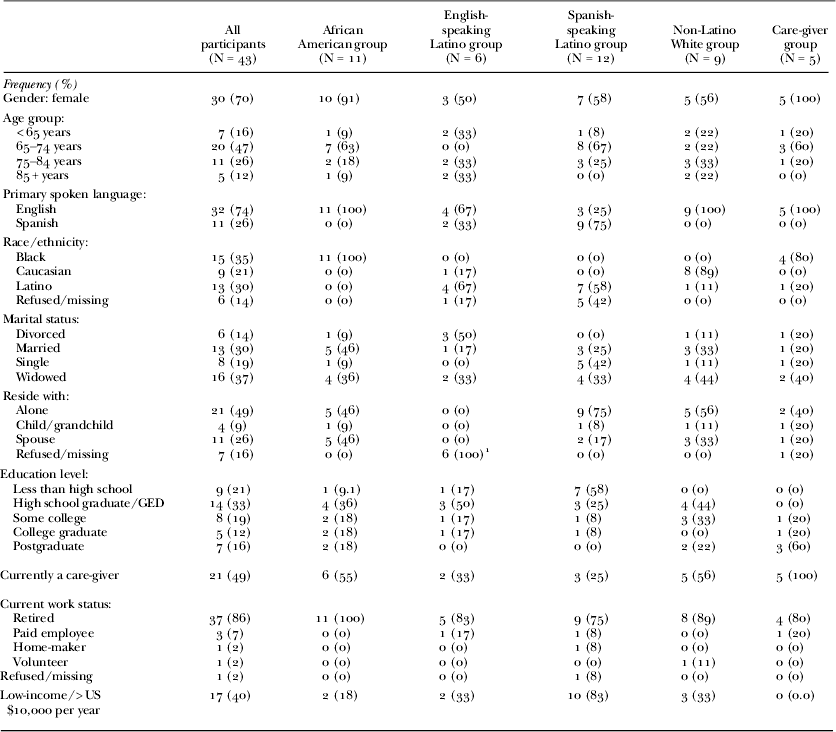
Table 1 presents the demographic characteristics of the sample. A total of five ethnically homogenous focus groups were conducted, one each with African Americans (N = 11), English-speaking Latinos (N = 6), Spanish-speaking Latinos (N = 12), non-Latino Whites (N = 9) and family care-givers who were all African American (N = 5). The age limit for participating was lowered from 65 to 55 because some participants brought younger companions to the focus groups and asked that they be included.
Sample characteristics

Note: 1. The English-speaking Latino focus group was not asked to specify the people with whom they reside. GED: General Education Development degree.
Seven participants (out of 43 in total) were under the age of 65, 20 were between 65 and 74, 11 were between 75 and 84 and five were older than 85. All participants in the care-giver group were female, as were all but one of the participants in the African American older adult group. The other three focus groups were comprised of roughly half males and half females. Nearly half of all participants reported living alone, one-quarter lived with a spouse, and less than 10 per cent lived with an adult child or grandchild. The English-speaking Latino group participants were not asked about their living arrangement and this information is therefore missing from the demographic summary in Table 1. Thirteen participants were married, 16 were widowed, eight were single and six divorced. Nearly 80 per cent of all participants reported at least having a high school diploma or General Education Development (GED) degree equivalent. Nearly half the sample attended or graduated from college. The Spanish-speaking Latino group had fewer years of education on average than the English-speaking Latino group – 58 per cent did not graduate high school compared to only one participant in the English-speaking Latino group. The vast majority of the sample was retired, including all 11 participants in the African American older adult group. All of the participants in the care-giver focus group and 37 per cent of the participants in the other groups reported providing care for an elder.
Participants in the two Latino groups were asked whether their annual income was greater or less than US $10,000, which is close to the 2008 poverty threshold for a single-person household in California. The other three focus groups were simply asked whether they considered themselves ‘low-income’. Summarising these two income questions into a single variable, approximately 40 per cent of the entire sample identified themselves as ‘low-income’. Over 80 per cent of the Spanish-speaking Latino group earned less than US $10,000 per year, compared to 33 per cent of the English-speaking Latinos, 18 per cent of the African Americans and 33 per cent of the non-Latino Whites. None of the African American care-givers reported having a low income.
Themes
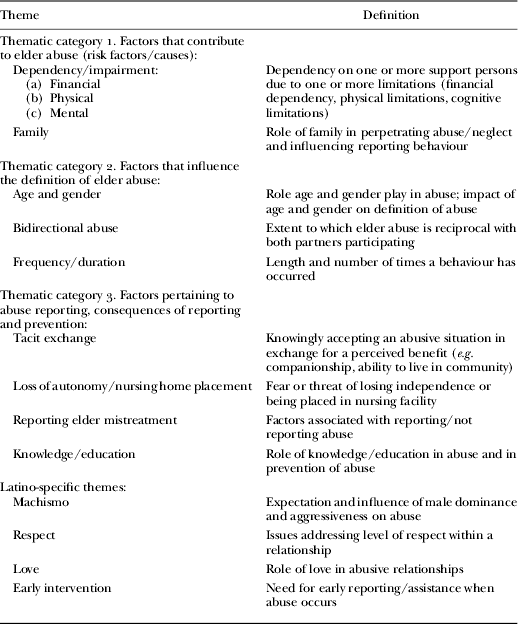
Transcript analysis revealed ten distinct themes that were common across focus groups, and an additional three themes from the Latino groups (see Table 2). Some themes emerged directly from discussing the case scenarios while others were generated spontaneously. The ten themes are grouped into three broad categories: (1) factors that contribute to EM (risk factors/causes); (2) factors relating to how EM is defined; and (3) factors pertaining to reporting abuse, the consequences of reporting, and prevention strategies or remedies for EM. Themes in the first category (risk factors/causes) include dependency/impairment (financial, physical and mental) and family. Themes within the second category (definitions/perceptions) include age and gender, bidirectional abuse and frequency/duration of abuse. Themes in the third category (reporting/preventing/responding to EM) include tacit exchange, concerns about loss of autonomy/nursing facility placement, reporting EM and knowledge/education. There was a high degree of consistency across focus group discussions, reflecting shared perceptions in EM beliefs among older adults from different racial/ethnic backgrounds, but considerable variation within groups in how individual participants interpreted abuse scenarios. Although there was consistency across groups on core themes, additional variations were offered by the two Latino groups: machismo (expectation of male dominance), respect, love and early intervention.
Themes and definitions
Thematic category 1: Risk factors/causes of EM
Dependency/impairment
Impairments were viewed as increasing one's vulnerability to abuse and elicited agreement on definitions of abuse among all ethnic/racial groups. Physical, sexual and verbal exchanges were all identified as EM if the victim was cognitively or physically impaired or could not provide consent: ‘Then I think that would be abuse … because she's sick and cannot defend herself’ (English-speaking Latina). The theme of dependency included issues of financial dependency on the perpetrator as well as issues of dependency due to physical or cognitive impairment. One African American woman stated, ‘It's probably [abuse] because of their dependence on a person or maybe the physical, you know, capabilities, you know, maybe put them more at risk.’
Notably, at least one participant in each of the five focus groups remarked that cognitively impaired seniors often display aggressive behaviour as a symptom of their disease. These behaviours were not considered abuse, but if a care-giver were to reciprocate the behaviour, it is abuse. One Latino male commented,
If I have All-Timers [Alzheimer's] and I'm hitting her, and get upset and keep hitting her, I don't consider it abuse, it's a disease. In her half, she's not aware so she hits me back and then she starts telling me things. That's abuse.
Family
There was widespread belief across ethnic groups that victimisation by family members, particularly adult children, is a serious problem but that abusers can be anyone known to the victim. According to one Latina, ‘Brother, sister, grandson, granddaughter, it doesn't matter, the abuse is still there.’ Some participants perceived intergenerational abuse as more severe because of elders' trust and reliance on family members. A few blamed the increase of EM by younger relatives on changes in generational values. According to one African American woman, ‘I would say the young crew, it's all about the money, what I can get out of it…’ Across groups, participants identified adult children as perpetrators of financial abuse, providing numerous examples of seniors who had lost their belongings, changed their wills or unwittingly transferred property to exploitative children.
Thematic category 2: Perceptions/definitions of EM
Age and gender
The age and gender of the characters in the vignettes were altered to determine if these traits influenced perceptions of abuse. Across all racial/ethnic groups, neither age nor gender was viewed as a factor in determining whether an act was abusive. According to one African American participant, ‘Abuse is abuse … it doesn't matter who it is or what age or what's happening.’ And a Latino participant stated, ‘It doesn't matter, male or female, there is a problem that needs to be issued [addressed].’
Bidirectional abuse
Exchanges between two individuals were not viewed as abuse if the behaviour involved only verbal exchanges. As stated by one participant, ‘Abuse has to be unequal, and if it is on the same level, how can you complain?’ Some participants stated that all aggressive physical acts were abuse, regardless of reciprocity, whereas other participants felt that bidirectional physical exchanges were not abuse. One Latino male commented, ‘If it's one to the other one and the other one don't replies, it's abuse. But if they both fight each other then … you know … it's not really abuse…’ These disagreements show that some EM perspectives are not explicitly driven by culture or by race, but are based on individual beliefs and experiences.
Frequency/duration
The vignettes prompted participants to consider the frequency and duration of behaviours as factors influencing the definition of EM. These factors stimulated a wide range of opinions on what constitutes abuse, and were highly dependent on both the type of behaviour and by the individual perceiving the situation, rather than by that person's ethnic/racial affiliation. All participants stated that unwanted sexual acts were abuse, including those among partners. Additionally, many participants across ethnic/racial groups identified physical mistreatment as abuse regardless of how long or how many times it occurred. According to one African American female, ‘It doesn't matter if it's one or ten times. That particular action is abusive, you know?’ However, a few participants attending the Spanish-speaking focus group expressed the view that abuse (whether verbal, physical or financial) would not be considered abuse if it only occurred once: ‘Abuse the first time is not abuse’ and ‘A couple of times does not make him an abuser. Now if it continues, then it is abuse’.
Aside from physical and sexual abuse, most groups suggested that persistent negative verbal exchanges were considered ‘normal’ to the individuals involved and thus were not EM. According to one man, ‘I was married for a long time and we fought and went through that, it was just a normal thing’, and another, ‘So maybe they are hurting each other mentally or emotionally, but they should be used to it by now’. Furthermore, participants in three of the groups – African American care-givers, non-Latino Whites and English-speaking Latinos – noted that on-going verbal mistreatment might be an established way of communicating between couples in a long relationship. Participants used phrases like ‘It's a way of communicating’ and ‘It's what they thrive on’ to describe the rationale of verbal hostility in long-standing relationships.
Conversely, some participants stated that even infrequent arguing or yelling constitutes abuse: ‘If I only do it once a week, or once every two weeks, or if I do it once a month, it's abuse’ (English-speaking Latina). Another female in the English-speaking Latino group believed that duration defines abuse: ‘If you let this problem go on for 40 years, then you have a form of abuse.’ Again, within-group variability in attitudes about the frequency and duration of mistreatment suggests that EM perceptions originate largely from personal values, beliefs and experiences.
Thematic category 3: Reporting abuse, consequences of reporting and prevention/interventions for EM
Tacit exchange
Participants discussed the act of tolerating an abusive situation in exchange for support, companionship and/or remaining in one's home. In response to a scenario depicting an adult child living off his mother without contributing financially or providing care, an African American care-giver said, ‘she is accepting this [financial abuse] as an exchange for the thought that she gets him present’. Responding to a similar scenario, a White male participant stated, ‘even though the daughter doesn't contribute to anything, the mother loves her’. Several participants, particularly in the minority groups, agreed that a financially abusive situation, though not a physically abusive situation, was preferable to living alone if the abuser leaves or is incarcerated. As described by one woman, ‘And a lot of times they accept certain things because they don't want to be alone and all.’
Reporting EM
Group differences were found in beliefs about reporting abuse. Participants in the Spanish-speaking group were emphatic about the need to report EM immediately in order to prevent it from escalating, although they did not specify to what agencies or individuals the incident should be reported. Conversely, care-giver group participants noted that there are a lot of grey areas, and one needs to be careful and thorough before reporting abuse: ‘Someone from the outside can come and evaluate based upon x, y and z criteria and not really have a true picture of what was going on.’
While the African American and non-Latino White groups expressed firm beliefs in reporting nursing home staff for neglect and physical mistreatment, all groups voiced a reluctance to report family members. As spoken by one Latina, ‘The love we have for our partner, we don't report it for fear of sending him to jail’ and ‘this is where it is a disaster because next of kin, the grandmother, the sister, the brother, the father … they're not going to want to be reported. Fear about losing a spouse or family member to incarceration was expressed pervasively across all groups. One African American participant recounted the experience of a friend who was abused: ‘They, social workers, everybody came and spoke with her, but she told me that she did not want her daughter to go to jail…’
The African American care-giver focus group noted how observations of a potentially abusive interaction differ between those external to the situation (neighbours, Adult Protective Service workers, law enforcement), and the persons involved in the abusive relationship. This group vocalised the contextual nature of mistreatment and believed that care-givers’ perceptions of what constitutes abuse often conflict with professional/legal definitions. According to one woman,
… society doesn't know what's going on inside to make an accurate decision. They can only perceive by their standards what they think is goin’ on … and that's part of the problem here, people getting involved in other people's lives.
Loss of autonomy/nursing facility placement
Participants expressed persistent concerns around being placed in a nursing facility if it was suspected that they were being abused. Several shared stories of friends who had been placed against their will, generally by family members. Many shared a fear that this could happen to them and a willingness to endure almost any situation that would allow them to remain in their homes (tacit exchange). Nursing facilities as a source of abuse was introduced, particularly within the African American group. According to one participant, ‘They [nursing facilities] don't take care of a lot of the elderly because they think you sick and gonna die anyway.’ A non-Latino White woman stated, ‘You wouldn't even treat your dog the way they're treatin’ some of the patients.’
Knowledge and education
All groups discussed the need for education about EM. Care-givers advocated for improved public awareness and training on how to properly care for older adults as a mechanism to prevent EM. According to one African American care-giver, ‘That's why they have maternity classes for teenage mothers, because they don't know how to take care of a baby, and we don't know how to take care of an elderly.’ Notably, care-givers stated that most people who provide care for an older adult would not label themselves a ‘care-giver’, suggesting that outreach and education efforts need to move beyond professionally identified labels and terminology.
Participants believed that providing accurate information was especially important for those caring for elders with dementia. Some described situations where a spouse with dementia becomes abusive and the partner retaliates not realising that the behaviour is organically related to the disease. One care-giver said, ‘Because they don't see what they are doing as abuse. It might be pointed out to them that this might not be the best way to resolve a situation.’ Participants suggested that rather than reporting these behaviours to Adult Protective Services, these care-givers would benefit from education to understand the illness better and to learn effective methods for addressing problem behaviours.
Latino-specific themes
Four themes emerged only from the Latino focus groups: machismo (male expectation of dominance), lack of respect, love between abuser and victim, and the need for early intervention at the first indication of abuse. Most of these ideas were expressed in both the English-speaking and the Spanish-speaking Latino groups, but were emphasised more strongly by the monolingual Spanish-speaking Latinos, who also expressed greater solidarity in their attitudes toward EM.
Machismo
Both Latino focus groups discussed that while gender does not matter in terms of the definition of abuse, in their experience the perpetrator is more likely to be male. According to one older Latina, ‘…in my opinion, in most marriages, usually it's the man that wants to have that last word, that last say-so, usually … I'm just saying that in my experience, I've noticed that more men are more domineering.’ This idea was bolstered by a participant discussion of machismo and the submissiveness of women within the Latino culture:
Woman: … in Latina marriages, it's always the male. In Latin marriages, the women are more…
Man: submissive.
In the discussion of gender, Latino participants generally referred to male perpetrators as spouses, rather than male children or grandchildren. This suggests that gender constitutes a culturally specific risk factor for abuse among Latinos, such that women from more traditional marriages may be vulnerable to intimate partner violence in old age.
Respect
Lack of respect in a relationship was viewed as a primary contributor to abuse. According to one participant, ‘Because there wasn't any mutual respect … the man always wants to be better [than his partner]. Therefore, he is abusing her.’ Participants identified some of the scenarios that included negative verbal exchanges as indicating a lack of respect rather than abuse: ‘For me, it is no more than lack of respect.’ One male participant described that if the abuse is one-sided then it should be defined as ‘abuse’; however, if the abuse is reciprocal, there is no respect between partners in that relationship.
Love
Participants in the Spanish-speaking group expressed an interesting association between love, respect, abuse and reporting. Some participants indicated that couples or families enduring years of abuse do so because of the love between them, ‘I say it is a lack of respect towards each other, but because there is love between them, they stayed together.’ Others shared that if there is ‘love’ in a relationship then the abuse should not be reported because love is the most important thing. According to one Latina, ‘If they report it there is no longer love.’
Early intervention
Despite the belief that love is important to consider in determining whether to report abuse, Latino participants paradoxically stated that intervention is needed at the first indication of mistreatment. Participants specified that the timing of reporting is critical in preventing escalation and the development of a long-term pattern of abuse. According to one Spanish-speaking Latino, ‘You have to stop it cold’, and a Latina stated, ‘If they had been doing it all their lives one can expect something serious to happen because this is growing and getting worse. Then you can have a bad ending. To prevent this, you have to report it.’ Reporting was viewed as a mechanism of prevention rather than punishment. One male participant voiced, ‘Report it as prevention. For prevention’, and the group agreed. Latino participants did not discuss whether formal or informal interventions were the preferred form of abuse mediation.
Discussion
While prior studies, discussed above, have explored perceptions of elder abuse among different racial and ethnic groups (Antezberger, Korbin and Tomita Reference Anetzberger, Korbin and Tomita1996; Bowes, Avan and Macintosh Reference Bowes, Avan and Macintosh2008; Dixon et al. Reference Dixon, Manthorpe, Biggs, Mowlam, Tennant, Tinker and McCreadie2010; Moon Reference Moon2000; Moon and Benton Reference Moon and Benton2000; Mouton et al. Reference Mouton, Larme, Alford, Talamantes, McCorkle and Burge2005), this is the first study to qualitatively compare meanings of abuse specifically among non-Latino Whites, Spanish-speaking and English-speaking Latinos, African Americans, and African American care-givers in the USA. Despite some differences between individuals, findings reveal a startling level of consistency across diverse groups in identifying scenarios that constitute EM or risk for EM. The similarity in attitudes across racial/ethnic groups is comparable to results from other studies in the USA that examined EM perspectives among older adults from different cultural backgrounds (Moon and Benton Reference Moon and Benton2000; Mouton et al. Reference Mouton, Larme, Alford, Talamantes, McCorkle and Burge2005), with the addition of new themes from Latino older adults, particularly those who were monolingual Spanish-speaking. Although there was also consistency in elders' knowledge about reporting abuse, demonstrating that individuals from different backgrounds are aware of resources for victims, all groups shared concerns about possible negative consequences of reporting.
While the views of African American and non-Latino White participants often aligned, a key variation in the current study was the unique EM perspective offered by Latino participants. Interestingly, these differences included additional viewpoints, rather than disparate beliefs about EM, and include machismo, respect, love and a need for early intervention at the first sign of abusive behaviour. This difference between the Latinos, particularly the Spanish-speaking group, and other groups is similar to Moon and Benton's (Reference Moon and Benton2000) finding that Korean Americans differed from African American and Caucasian older adults in their views, perhaps due to a closer connection to their native Korean culture. According to ecological theories of human development (Bronfenbrenner Reference Bronfenbrenner1979), belief-systems are embedded within socio-cultural and geopolitical contexts that shape the norms, traditions and interpersonal relationships between people in a group. Thus, personal views about how elders should be treated and how responsibilities should be allocated among family members are influenced early in life by an individual's socio-cultural context. Using language as a proxy for acculturation, the African American and non-Latino White participants, as well as English-speaking Latinos to some extent, are presumably immersed in American culture and therefore share more similar beliefs and values about EM. Alternatively, Spanish-speaking Latinos may maintain cultural identities closer to their native countries, which provide them with different perspectives on EM. Moon (Reference Moon2000) suggests that studying degree of acculturation may be more appropriate than race or ethnicity alone when exploring differences in EM perspectives among varying cultures.
Lack of respect was seen as a factor contributing to abuse as well as a form of abuse among Latinos. Vasquez and Rosa (Reference Vasquez and Rosa1999) identified respect as an important cultural value that guides interpersonal relationships and connotes recognition of status. Latinos considered a violation of respect a serious moral trespass, especially when directed at older adults who traditionally have higher status. The connection between lack of respect and EM has appeared in other international studies on elders' definitions of EM (Bowes, Avan and Macintosh Reference Bowes, Avan and Macintosh2008; WHO/INPEA 2002) indicating that researchers, policy makers and service providers need to classify EM more broadly as infringement on an elder's personal dignity and human rights.
There was universal agreement among all focus groups that gender and age were not factors to consider in defining EM, although Latino participants were quick to point out that males were significantly more likely to perpetrate abuse against females, particularly male spouses. They identified the cultural influence of machismo (e.g. male dominance in society) as the driving source of this gender imbalance. Some researchers have proposed that a culture of negative machismo may contribute to abuse against older women (Cardona et al. Reference Cardona, Meyer, Schiamberg and Post2007; Vazquez and Rosa Reference Vasquez and Rosa1999), yet studies of domestic violence have not found this to be the case (Jasinski Reference Jasinski1998; Perilla Reference Perilla2000; Perilla, Bakeman and Norris Reference Perilla, Bakeman and Norris1994).
Being 65 or older was not perceived as an inherent vulnerability. However, all focus groups agreed that abusing individuals with physical and/or cognitive dependencies constituted ‘worse’ abuse, clearly distinguishing between independent, intact older adults, and those who are too impaired to recognise or stop mistreatment. In identifying physical or cognitive vulnerability as a key component of EM, focus group participants aligned with the National Research Council Panel report (Bonnie and Wallace Reference Bonnie and Wallace2003), as well as other qualitative research on how older adults classify vulnerability (Dixon et al. Reference Dixon, Manthorpe, Biggs, Mowlam, Tennant, Tinker and McCreadie2010).
There was some disagreement about the meaning of frequency and duration of harmful behaviours as determinants of abuse, particularly for psychological and physical mistreatment. Most of this discordance was found within groups, rather than across racial/ethnic groups, suggesting that individual differences in perception about EM duration and frequency may supersede cultural differences. Some participants expressed the view that negative physical and verbal exchanges were abusive regardless of the frequency or duration. Others indicated that these actions were not abuse if both parties understood them to be ‘normative’ in the relationship, or if they happened only once.
The finding that some older adults do not consider long-standing abuse between aged spouses/partners as EM highlights the idea that some elder abuse is actually intimate partner violence (spousal abuse) that happens to persist into old age (Penhale Reference Penhale2003). In a qualitative study by Walsh et al. (Reference Walsh, Ploeg, Lohfeld, MacMillan and Lai2007), many participants, particularly women, witnessed or experienced spousal violence beginning from marriage and lasting through old age. Participants in that study stated that victims begin to accept the abuse after repeated exposure, and that cultural understandings of the role and status of married women influence whether the violence is tolerated. It is important to note that participants' perspectives in the current study were not framed within the context of gender. Participants often referred to scenarios where the female partner was responsible for committing on-going abuse, including verbal threats or showing disrespect toward her spouse. Because many studies have found that spouses/partners are the primary offenders of elder abuse (Acierno et al. Reference Acierno, Hernandez, Amstader, Resnick, Steve, Muzzy and Kilpatrick2010; Pillemer and Finkelhor Reference Pillemer and Finkelhor1988), future research exploring the connections between intimate partner violence and elder abuse will help identify how mistreatment changes as partners become more vulnerable with age.
The notion that older adults would choose to live in an abusive situation rather than live alone or in an institution is particularly important. Participants described, and seemed to support, situations where elders prefer to endure abuse or neglect in exchange for a perceived improvement in quality of life (e.g. companionship, security, avoiding placement). Social exchange theory posits that individuals seek to maximise rewards and minimise losses or punishments in a relationship (Dowd Reference Dowd1975). Some EM scholars point to social-exchange theory to explain why overburdened care-givers abuse or exploit dependent elders (for a review, see Wilber and McNeilly Reference Wilber, McNeilly, Birren and Schaie2001), but the theory is seldom applied to the other side of the dyad – dependent elders – who may tolerate abuse or exploitation (a loss/punishment) for receipt of care or shelter (a perceived benefit/gain). By emphasising the idea of ‘tacit exchange’, focus group members implied that victims may believe that they have more power and control in an acknowledged abusive relationship than in a ‘protective setting’, such as a nursing facility.
The fear of nursing home placement was particularly strong among the African Americans, who spontaneously identified nursing facilities as a source of EM. These participants endorsed a preference to undergo abuse by a family member over placement in a potentially more abusive facility. Fear of institutionalisation as a consequence of reporting abuse may in fact be warranted. A study by Lachs et al. (Reference Lachs, Williams, O'Brien and Pillemer2002) found that elder mistreatment referrals to Adult Protective Services were a significant predictor of nursing home placement.
Each group agreed that there is reluctance to report abuse by family members. These beliefs mirror findings from a study of older Mexican immigrants (Sanchez Reference Sanchez and Tatara1999), where most respondents stated that they would discuss the situation with family members rather than report abuse to authorities. The desire to protect abusive family members suggests a strong tendency for under-reporting among older victims (Bonnie and Wallace Reference Bonnie and Wallace2003) and helps to explain the reluctance of older adults to confirm incidents reported by others. Some participants stated that elders do not report victimisation to authorities because they do not want the abuser sent to jail. Despite this belief among older adults, it is rare that the criminal justice system in the USA effectively prosecutes and incarcerates abusers (Connolly Reference Connolly2010; Payne, Berg and Toussaint Reference Payne, Berg and Toussaint2001). Therefore, the fear of incarceration may reflect a more general mistrust of law enforcement, particularly among minority populations who have experienced a history of negative interactions with state authorities (Hagan, Shedd and Payne Reference Hagan, Shedd and Payne2005; Lurigio, Greenleaf and Flexon Reference Lurigio, Greenleaf and Flexon2009).
Paradoxically, the Spanish-speaking Latino group advocated early intervention at the first sign of abuse, perhaps to restore family harmony and respect. These groups did not specify which agencies or individuals would be sought for assistance. Given the tendency of Latinos to rely on kin networks to resolve family conflicts (Montoya Reference Montoya1997; Sanchez Reference Sanchez and Tatara1999), and low levels of reporting among Latino immigrants (DeLiema et al. Reference DeLiema, Gassoumis, Homeier and Wilber2012), informal support by family members may be favoured over involvement by law enforcement or Adult Protective Services, the state agencies that respond to cases of elder abuse reported in the community. To increase formal abuse reporting, Montoya (Reference Montoya1997) and Cardona et al. (Reference Cardona, Meyer, Schiamberg and Post2007) recommend a non-punitive empowerment approach that directly involves the family in generating and implementing solutions to help Latino victims of EM.
Participants in this study were very familiar with EM, and every group shared stories of abuse experienced by friends and relatives, particularly stories of financial exploitation. Additionally, they were well aware that Adult Protective Services is the agency to call to report elder abuse in community settings. This knowledge differed from a study of women's perspectives on abuse, where participants were familiar with EM but not with Adult Protective Services (Dakin and Pearlmutter Reference Dakin and Pearlmutter2009). This disparity may be related to geographic variation (Ohio state compared with California state), differences in participation in community services, and differences in elder abuse awareness and education campaigns by location.
Care-givers in the present study were more cautious in their definition of abuse, contending that abuse could not be judged without having a full understanding of the situation and history of the relationship. Care-givers were also the strongest advocates for education and training for the public, specifically for families caring for older adults with cognitive disorders. This perhaps arises from personal experiences and challenges they have encountered in caring for their family members. There was a general consensus that more information about and support for family care-givers would reduce abuse and neglect.
Limitations
This was an exploratory qualitative study conducted within a large metropolitan area in the USA. Knowledge and beliefs about EM may differ by region. Additionally, our study included only one homogenous group of African American care-givers, and a relatively small sample of individuals from other ethnic/racial groups. Further studies could determine the perspectives of care-givers from other cultural backgrounds, and conduct multiple focus groups to determine whether these results emerge in other group discussions. Focus groups included both males and females, except for the all-female care-giver group. Gender pressures may have influenced group dynamics or driven some of the discussion of EM, but generally there were no significant differences in EM beliefs expressed between males and females. A central aim of this study was to explore the meaning of age, gender, frequency/duration and family relationships as they pertain to EM. These characteristics were integrated directly into the case scenarios and thus it is unknown whether these themes would have been spontaneously discussed without the vignette prompts. Finally, participants were recruited through community agencies for older adults, and therefore may be more educated than other older adults about EM policies and Adult Protective Services through their connection with social service professionals.
Future directions for elder abuse intervention
Findings from this study suggest that older adult perspectives on EM vary by individual and do not necessarily reflect current EM policies or practices in the USA or internationally. For example, participants did not support age alone as a risk factor for EM, although they did identify mental and physical disabilities as risk factors associated with increased vulnerability. In California, as in many other states, both older adults and younger adults with disabilities are protected under EM legislation.
Second, participants identified many scenarios in which elder abuse is actually the persistence of intimate partner violence into old age as opposed to a distinct form of violence exclusive to vulnerable elders. And finally, many participants did not support using the criminal justice system to resolve cases of EM involving family members, even though this approach has achieved growing momentum and support among policy makers (Connolly Reference Connolly2010). Participants suggested preventative approaches (training/awareness campaigns) and non-punitive intervention methods (respect for the victim's autonomy and care preferences) as a way to minimise or resolve EM.
The factors that focus group participants discussed as influencing abuse reporting offer important insights to guide policy and intervention efforts. Concerns that older adults under-report EM (National Research Council 2003) were supported in this study, specifically in terms of reluctance to report family members and acceptance of abuse to avoid nursing facilities (tacit exchange). Participants across all racial/ethnic groups expressed a hesitancy to call social services when abuse is suspected. Rather than reporting EM immediately, they suggested a need to understand how victims view their situation and how they wish to improve their care in a way that ensures personal safety but does not leave family relationships in turmoil. This approach supports interventions that are empathetic and person-centred as the next step in tackling elder abuse. Interventions that acknowledge the culture, safety needs and individual care preferences of victims may reduce misconceptions about the consequences of reporting abuse, leading to improved adherence to interventions and better case outcomes. These ‘person-centred’ approaches are primarily used in health and long-term care settings. They embrace collaboration between patients and care providers and emphasise care decisions/interventions that promote the patient's dignity (Vladeck and Westphal Reference Vladeck and Westphal2012). Person-centred methodologies offer the means to explore a shift in the delivery of adult protection services toward greater victim empowerment.
Although not the specific aim of this study, seniors and care-givers provided several suggestions for preventing and reducing the incidence of EM. These include improved outreach and education, particularly among family members who may be caring for older adults with disabilities, early intervention to prevent escalation and an understanding of what cultural variations contribute to EM. New perspectives on EM were offered by the Latino participants, many of whom were immigrants to the USA. In any country, older-aged immigrants represent a group that may be particularly vulnerable to EM because of their reliance on family members for care, lower then average income and greater isolation from social service agencies (Kim et al. Reference Kim, Worley, Allen, Vinson, Crowther, Parmelee and Chiriboga2011; Montoya Reference Montoya1997). EM professionals should be attentive to the unique cultural beliefs of immigrants and accommodate their individual needs into protection and treatment strategies. Based on the EM perspectives that emerged from this study and the growing diversity of elders worldwide, it is increasingly vital to consider the multicultural and individual perspectives of older adults to guide EM prevention and intervention efforts.