The ductus arteriosus is a vital in utero vascular connection between the aorta and the pulmonary artery that allows right ventricular output to bypass the non-ventilated fetal lungs. Postnatal closure of the ductus arteriosus is an important step in normal cardiopulmonary transition that is commonly delayed or absent in very preterm infants.Reference Hajj and Dagle 1 Data from the Vermont Oxford Network show an almost linear relationship between higher incidence of patent ductus arteriosus and decreasing gestational age. In newborn infants, patent ductus arteriosus has been reported to increase pulmonary overcirculation and oedema, and to decrease renal, mesenteric, and cerebral perfusion,Reference Clyman, Couto and Murphy 2 thus becoming a significant risk factor for the development of severe morbidities associated with preterm birth.Reference Hajj and Dagle 1 However, benefits of ductal closure on serious neonatal morbidities – that is, chronic lung disease, necrotising enterocolitis, and retinopathy of prematurity – or survival have yet to be established.Reference Clyman, Couto and Murphy 2 , Reference Cooke, Steer and Woodgate 3
The indication for pharmacological and/or surgical closure of haemodynamically significant patent ductus arteriosus remains controversial, as worse outcomes have been linked with treatment.Reference Reese 4 , Reference Mitra, Rønnestad and Holmstrøm 5 Limited information is also available on the management of patent ductus arteriosus after failure of pharmacological closure.Reference Herrman, Bose, Lewis and Laughon 6 Information about spontaneous, as well as pharmacological, patent ductus arteriosus closure rate in very preterm infants before and after hospital discharge is still sparse.
The objective of this study was to examine a cohort of preterm infants born before 30 weeks’ gestation, to determine patent ductus arteriosus spontaneous and pharmacological closure rates, and to evaluate spontaneous closure rates at 24 months of follow-up.
We retrospectively evaluated a large cohort of 48 infants with a patent ductus at the time of discharge. We report on ductal closure and outpatient surgical ligation rates for a 24-month follow-up.
Materials and methods
Study population
This cohort study was conducted at the Neonatal Intensive Care Unit of the Salesi Children’s Hospital (Polytechnic University of Marche, Ancona – Italy) from January, 2004 to June, 2013. Very preterm neonates born with a gestational age between 24+0 and 29+6 weeks or birth weight <1250 g admitted within 48 hours from birth and discharged alive from hospital were eligible for inclusion into the study. Medical records and computerised unit data were reviewed. The procedures followed were in accordance with institutional guidelines for retrospective record review and protection of patient confidentiality. The need for patient consent was waived.
Diagnosis of patent ductus arteriosus
Irrespective of their clinical symptoms, all included infants received heart ultrasound between 48 and 72 hours of life as part of routine neonatal care. Echocardiography was performed with a Philips HD7 XE ultrasound machine (Philips Ultrasound, Bothell, Washington, United States of America) with a 7.5-Mhz probe. Studies were performed by two senior echocardiographers, M.S. and G.S., using standard neonatal windows.Reference Lai, Geva and Shirali 7
The criteria used by echocardiography scan evaluators to define a haemodynamically significant patent ductus arteriosus were as follows: a duct diameter >1.5 mm at the narrowest point or pulmonary end, a left atrium-to-aorta ratio >1.4, and/or an end-diastolic reversal flow in aorta >30% of the anterograde. Colour and pulsed-wave spectral Doppler scanning was applied to assess the direction and velocity of ductal flow. Ductal closure was documented by no ductal blood flow on colour Doppler scanning.
Treatment guidelines
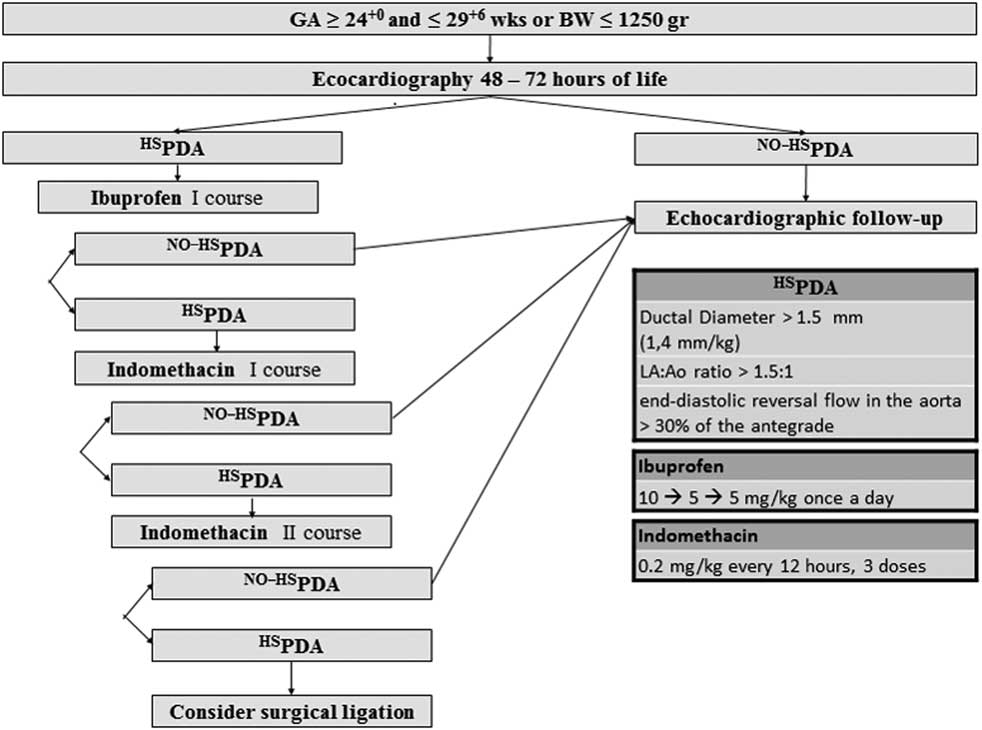
Management of a haemodynamically significant patent ductus arteriosus was in accordance with the institutional clinical guideline (Fig 1).
Institutional guideline for management of patent ductus arteriosus (PDA). BW=birth weight; GA=gestational age; HSPDA=haemodynamically significant PDA; LA:Ao ratio=left atrium-to-aorta ratio; NO-HSPDA=not haemodynamically significant PDA; wks=weeks.

After the diagnosis of a haemodynamically significant patent ductus arteriosus was made, first-line treatment with ibuprofen (Pedea, Orphan Europe SARL Puteaux, France) was initiated with 10 mg/kg for the first dose, followed by two additional doses of 5 mg/kg on consecutive days. Doses were infused during a 15-minute period with a syringe pump via a peripheral vein, and administered with a 24-hour interval between each dose. Echocardiography was conducted 12–24 hours after therapy was stopped.
In case of sonographic evidence of haemodynamically significant patent ductus arteriosus, second-line treatment was started with 0.2 mg/kg indomethacin (Liometacen, PROMEDICA S.r.l. Chiesi, Italy). Indomethacin was dissolved in normal saline (0.9%) to a final concentration of 0.1 mg/ml and infused over 30 minutes. The same dose was repeated 12 hours and 24 hours later. If echo performed 12–24 hours after therapy still showed persistence of patent ductus arteriosus, an additional course of indomethacin was repeated. A third course was given in very selected cases.
Surgical ligation was considered when patent ductus arteriosus persisted after medical treatment and there was inability to wean off respiratory support. If patent ductus arteriosus was not haemodynamically significant, during the hospital stay it was followed up twice a month by routine echocardiogram.
Outpatient surveillance
Patients with patent ductus arteriosus at the time of hospital discharge underwent evaluation by a cardiology specialist and started a planned follow-up in the cardiologic outpatient clinic. Primary care providers were involved with scheduled visits, as well as a neonatologist, as part of routine care of very preterm infants after hospital discharge.
Statistical analysis
Data are expressed as group means±standard deviation or percentages as appropriate. Data were analysed by χ2 test, independent-samples t-test, or Mann–Whitney U-test (if normal distributed or not). Significance was set at p<0.05. All statistical analyses were performed using SPSS (v 19.0; SPSS Inc., Chicago, Illinois, United States of America) and Microsoft Excel (v 2013; Microsoft Corp, Redmond, Washington, United States of America) software.
Results
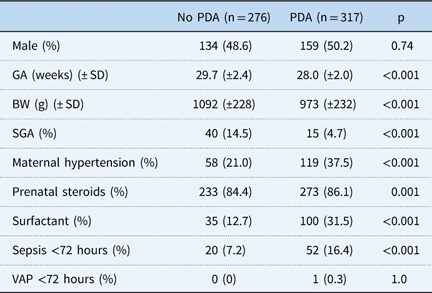
A total of 593 infants – with a gestational age of 28.7±2.4 weeks and birth weight of 1028±238 grams – met the inclusion criteria, and patent ductus arteriosus was diagnosed in 317 (53.4%). An overview of characteristics of the study population of preterm infants with and without patent ductus arteriosus is shown in Table 1. Not surprisingly, neonates with a patent ductus arteriosus on day 3 of life had more unfavourable baseline characteristics compared with infants with no patent ductus arteriosus – for example, lower gestational age and birth weight.
Characteristics of the study population.

BW=birth weight; GA=gestational age; PDA=patent ductus arteriosus; SGA=small for gestational age; VAP=ventilator-associated pneumonia
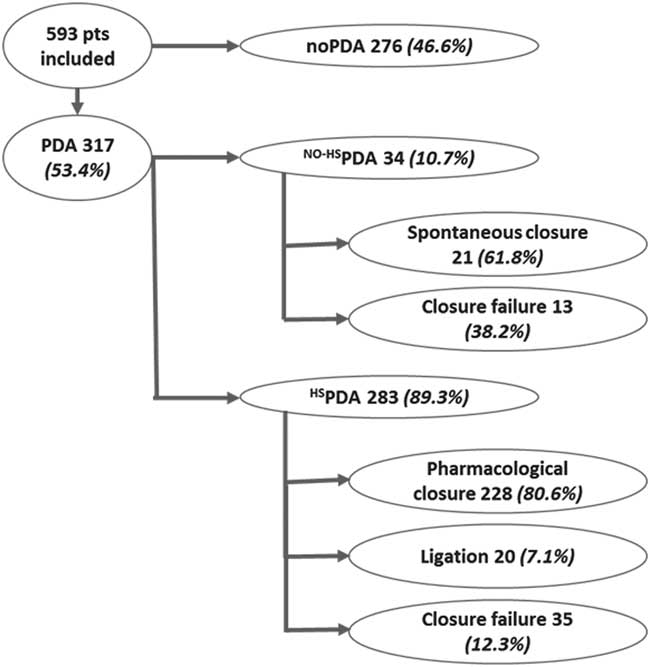
Among the 317 patent ductus arteriosus patients, 283 (89.3%) had haemodynamically significant patent ductus arteriosus and 34 (10.7%) had a non-haemodynamically significant patent ductus arteriosus. In the group of 34 patients with non-haemodynamically significant patent ductus arteriosus, which did not receive treatment, the patent ductus arteriosus closed spontaneously in 21 (61.8%) of the patients. Pharmacological closure of haemodynamically significant patent ductus arteriosus was achieved in 228 (80.6%) patients, surgical ligation was performed in 20 (7.1%) patients, and closure failure was diagnosed in 35 (12.3%) patients. A flow chart of the study population is reported in Figure 2.
Flow chart of the study population. HSPDA=haemodynamically significant patent ductus arteriosus (PDA); NO-HSPDA=not haemodynamically significant PDA; Pts=patients.

As for pharmacological treatment, ibuprofen was used in 273 (96.5%) patients, 151 (53.4%) received one indomethacin course, and 85 (30.0%) infants received an additional course of indomethacin. In total, 20 patients (7.1%) required surgical ligation, which was performed at a median age of 31 days (interquartile range (IQR) 23–42).
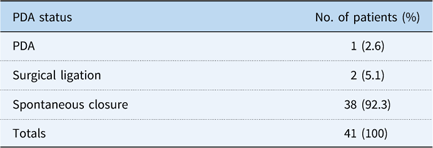
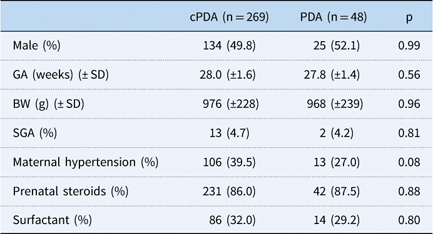
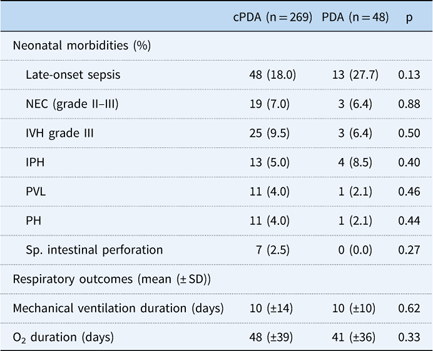
A total of 48 infants were diagnosed with patent ductus arteriosus at discharge: 35/283 (12.3%) who received treatment as inpatients and 13/34 (38.2%) who received no treatment. Nine patients were lost at follow-up; therefore, the 24-month post-menstrual-age follow-up was available for 39 (81.3%) of the 48 infants. Among these 39 patients, mean gestational age was 28.3±3.0 weeks and mean birth weight was 954±299 g. Median ductal diameter at discharge was 1.0 mm (IQR 1.0–1.3). In all, 36 (92.3%) patent ductus arteriosus underwent spontaneous closure within a post-menstrual age of 24 months, all of which were confirmed by echocardiography. Two infants (5.1%) underwent surgical ligation at 3 and 23 months of chronological age, respectively. One patient had a patent ductus arteriosus at a post-menstrual age of 24 months (Table 2). Prenatal conditions and neonatal characteristics of study patients based on patent ductus arteriosus status at hospital discharge are shown in Table 3. Neonatal morbidities and respiratory outcomes at 28 days of life based on patent ductus arteriosus status at hospital discharge are summarised in Table 4.
Spontaneous closure rate at 2 years’ post-menstrual age for patients discharged with a patent ductus arteriosus.

PDA=patent ductus arteriosus
Prenatal conditions and neonatal characteristics according to the course of patent ductus arteriosus (PDA).

BW=birth weight; cPDA=closed patent ductus arteriosus; GA=gestational age; SGA=small for gestational age
Neonatal morbidities and respiratory outcomes at 28 days of life according to the course of patent ductus arteriosus (PDA).

cPDA=closed patent ductus arteriosus; IPH=intraparenchymal haemorrhage; IVH=intraventricular haemorrhage; NEC=necrotising enterocolitis; PH=pulmonary hypertension; PVL=periventricular leukomalacia; Sp. intestinal perforation=spontaneous intestinal perforation
In a post hoc analysis, we evaluated patients who died during the hospitalisation: 34 died before 48 hours of life, not receiving echocardiographic evaluation for patent ductus arteriosus, 19 patients died in the patent ductus arteriosus group (5.6%), and 17 died in the group with no patent ductus arteriosus (5.8%), showing no significant difference in mortality between the two groups (p>0.1).
DISCUSSION
The current approach to patent ductus arteriosus in preterm infants is varied and controversial. Some clinicians treat a patent ductus arteriosus prophylactically, that is shortly after birth – that is within 24 hours of life – without reference to the state of the ductus, and others treat it when mild signs present within a few days after birth. Other clinicians take an “expectant” approach and allow for possible spontaneous closure, treating a patent ductus arteriosus at a later time if signs indicate haemodynamic significance. The definition and management of a haemodynamically significant patent ductus arteriosus are both variable and controversial.Reference Benitz 8 Little is known about the natural history of the ductus arteriosus in very preterm infants owing to the widespread acceptance of treatments to promote patent ductus arteriosus closure as a standard of neonatal care.Reference Van Overmeire 9 We identified a high rate of pharmacological closure early in the hospital course, as well as a high rate of spontaneous closure of patent ductus arteriosus after hospital discharge in a large cohort of preterm infants born before 30 weeks’ gestation. These findings add information to the growing body of literature regarding haemodynamically significant patent ductus arteriosus natural history and management.
In our cohort of preterm infants born with a gestational age between 24+0 and 29+6 weeks or birth weight <1250 g, we found a patent ductus arteriosus incidence of 53.4%. Data from the Vermont Oxford NetworkReference Horbar 10 released in 2006–2009 showed an incidence of patent ductus arteriosus ranging approximately from 75 to 25% in neonates born from 24 to 30 weeks, respectively. Neonates with a patent ductus arteriosus on day 3 of life had more unfavourable baseline characteristics compared with no patent ductus arteriosus infants, such as lower gestational age and birth weight (Table 1). They also had an increased need for surfactant use and diagnosis of sepsis, consistent with previously published data.Reference Sellmer, Bjerre and Schmidt 11 This does not mean that causality exists between patent ductus arteriosus and these outcomes, but more likely that lower gestational age and birth weight are related to neonatal complications, among which there is patency of the ductus. We found a greater number of small-for-gestational-age newborns in the group of patients without patent ductus arteriosus than in the group with patent ductus arteriosus. It is intriguing to speculate on the major role of gestational age than birth weight on ductus arteriosus patency and overall immaturity in small-for-gestational-age preterm newborns.
In this cohort, 90% of patent ductus arteriosus were diagnosed as haemodynamically significant, thus receiving medical treatment as scheduled in our institutional guideline (Fig 1). The overall haemodynamically significant patent ductus arteriosus pharmacological closure rate in our cohort was 80%. Literature indicates that lower pharmacological closure rate usually ranges from 40 to 70%.Reference Gokmen, Erdeve, Altug, Oguz, Uras and Dilmen 12 – Reference Hammerman, Shchors and Jacobson 20 Differences in closure rates between studies are probably owing to differences in study designs and methodology: the vast majority of randomized controlled trials were designed to assess the relationship between “timing” (initiation) of pharmacologic treatment and neonatal morbidity related to ductus arteriosus patency or to compare responses to different treatment modalities and drugs.Reference Lemmers, Toet and van Bel 17 , Reference Van Overmeire, Van de Broek, Van Laer, Weyler and Vanhaesebrouck 18 Moreover, there is a lack of uniformity in gestational age or birth weight of infants enrolled in different studies.
The performance of surgical ligation in our study population was quite low when compared with data from literature. Different studies, most of which were designed to compare different pharmacological approaches to patent ductus arteriosus in newborn <32 weeks, found that surgery was performed in 9–35% of patients after failed medical treatment.Reference Van Der Lugt, Lopriore, Bökenkamp, Smits-Wintjens, Steggerda and Walther 14 , Reference Vida, Lago and Salvatori 16 , Reference Gudmundsdottir, Johansson, Håkansson, Norman, Källen and Bonamy 21 – Reference Sosenko, Fajardo, Claure and Bancalari 23
In our cohort of preterm newborn with patent ductus arteriosus at the time of hospital discharge, spontaneous closure was common, occurring in the vast majority of infants (>90%) within a post-menstrual age of 24 months. Data on the natural course of patent ductus arteriosus in very low birth weight infants after discharge are still sparse. Herrman et alReference Herrman, Bose, Lewis and Laughon 6 reported the course of a smaller cohort of 21 infants discharged from the neonatal ICU with an open patent ductus arteriosus, showing a high spontaneous closure rate (18/21). Weber et alReference Weber, Weiss, Buhrer, Hansmann, Koehne and Sallmon 24 later confirmed this finding: they described spontaneous closure in 52 of the 64 infants included in their study, with five undergoing catheter intervention and seven having a detectable patent ductus arteriosus at the age of 36 months, thus evidencing a slightly less favourable outcome compared with our cohort.
No differences were detected in prenatal conditions, neonatal characteristics, neonatal morbidities, or respiratory outcomes at 28 days of life between infants discharged with a patent ductus arteriosus and those whose patent ductus arteriosus were closed during hospital stay. These results suggest that having a patent ductus arteriosus after medical treatment or a never-treated non-haemodynamically significant patent ductus arteriosus has no serious effect on major neonatal morbidities.
The favourable outcomes we reported should be interpreted with caution. Study infants had a small to moderate-sized patent ductus arteriosus, except for three who had a ductal diameter greater than 2 mm. Among them, one underwent spontaneous closure and two were surgically treated. We could speculate that patent ductus arteriosus <2 mm are more likely to close spontaneously, whereas greater diameters are more prone to require surgery. The lack of large patent ductus arteriosus in this cohort is probably a result of the manner in which haemodynamically significant patent ductus arteriosus are diagnosed and treated in our institution, where the great majority of patent ductus arteriosus received medical treatment and very few underwent surgery. In units where less or no treatment is provided, the incidence of large patent ductus arteriosus at discharge might be higher, and we do not know whether they would experience the same rate of favourable outcome.
We did not evaluate growth, neurodevelopment, and morbidities attributable to persistent ductal shunting. Another questioned consequence of persistent aorto-pulmonary shunting would be abnormal growth of the pulmonary vasculature.Reference Bancalari, Claure and Gonzalez 25 , Reference Clyman 26 Although not evaluated in our study, there was no suggestion that similar problems were present in this cohort based on 24 months’ post-menstrual-age follow-up examination. In the field of paediatric and congenital interventional cardiology, practice guidelines for closing a patent ductus arteriosus in a non-premature patient have been published in 2011.Reference Feltes, Bacha and Beekman 27 Indications are elimination of pulmonary overcirculation and subsequent development of obstructive pulmonary vascular disease, as well as prevention of endocarditis/endarteritis. The major recommendation for patent ductus arteriosus closure is a moderate-sized or large patent ductus arteriosus with left-to-right shunt that results in congestive heart failure, failure to thrive, pulmonary overcirculation, or an enlarged left atrium or ventricle.
Extensive clinical experience has consistently shown that ductal closure is not achieved in up to a third of treated premature infants.Reference Hammerman, Bin-Nun and Kaplan 28 We evidenced a high rate of spontaneous closure of patent ductus arteriosus among preterm infants born before 30 weeks’ gestation after hospital discharge. This finding suggests that withholding medical or surgical treatment to promote ductal closure during the latter period of hospitalisation in very preterm infants with small to moderate patent ductus arteriosus may be a reasonable option that should be taken into account. A careful cardiologic follow-up of these infants following hospital discharge should be assured because of the potential adverse effects of long-standing aorto-pulmonary shunts and the need for patent ductus arteriosus closure in a very small but not insignificant number of patients.
Acknowledgements
None.
Financial Support
This research received no specific grant from any funding agency or from commercial or not-for-profit sectors.
Conflicts of Interest
None.
Ethical standards
The procedures followed were in accordance with institutional guidelines for retrospective record review and protection of patient confidentiality. The need for patient consent was waived.