

Introduction
Feldspars are one of the most important groups of minerals, as they are widespread in the Earth’s crust and have been found in a number of celestial bodies (e.g. Wood et al., Reference Wood, Dickey, Marvin and Powell1970; Zolensky et al., Reference Zolensky, Zega, Yano, Wirick, Westphal, Weisberg, Weber, Warren, Velbel and Tsuchiyama2006; Jambon et al., Reference Jambon, Boudouma, Fonteilles, Guillou, Badia and Barrat2008; Chandra et al., Reference Chandra, Pandey, Parthasarathy and Sharma2016; Arai and Maruyama, Reference Arai and Maruyama2017; Knibbe, Reference Knibbe2018). Traditionally (e.g. Ribbe, Reference Ribbe and Ribbe1983; Back, Reference Back2022) feldspar group minerals include natural compounds having three-dimensional (3D) framework of tetrahedra. This 3D framework is formed by corner-sharing tetrahedra and could have two topologies: feldspar and paracelsian (Smith and Brown, Reference Smith and Brown1988). Krivovichev (Reference Krivovichev2020) drew attention to the fact that minerals with MT 4O8 general formula, where n is the average charge of the M cation (n = 1–2; M = Na, K, Rb, (NH4), Ca, Sr, Ba) and k is the average charge of the T cation (k = 4 – n/4; T = Be, Zn, Al, B, Fe, Si, As, P), can have other topologies and suggested including them in the feldspar family. According to this approach, feldspar family minerals crystallize in five different topologies. Four of them are TO4-based [feldspar (3D), paracelsian (3D), svyatoslavite (3D) and dmisteinbergite (layered or 2D)] and one is TO6-based [hollandite (3D)]. According to this conception, the feldspar family with general formula MT 4O8, includes 31 mineral species. However, this classification was not approved by International Mineralogical Association (IMA) and contradicts Mills et al. (Reference Mills, Hatert, Nickel and Ferraris2009), who stated that “…mineral families apply to groups and/or supergroups having similar structural and/or chemical features that make them unique”. Most probably, minerals belonging to the feldspar family, suggested by Krivovichev (Reference Krivovichev2020) should be divided into three separate groups, depending on their structural motif, i.e. framework (including feldspar, paracelsian and svyatoslavite topologies), layered (with dmisteinbergite topology) and TO6-based (i.e. hollandite topology). For further discussion the minerals with dmisteinbergite topology, which include dmisteinbergite, hexacelsian, kokchetavite, cymrite, minjiangite and recently discovered pfaffenbergite and wodegongjieite will be named hexacelsian-type minerals.
There are also a number of synthetic compounds with general formula MT 4O8. Most of them have feldspar or paracelsian topology, whereas the number of compounds with dmisteinbergite and svyatoslavite topology is relatively small (Czaya, Reference Czaya1972; Dollase and Ross, Reference Dollase and Ross1993; David et al., Reference David, Kabbour, Pautrat and Mentré2013; Dal Bo et al., Reference Dal Bo, Hatert and Baijot2014; Pan et al., Reference Pan, Wen, He, Li and Jia2017; Hwang et al., Reference Hwang, Seoung, Gatta, Blom, Vogt and Lee2023; Wang et al., Reference Wang, Wang, Liu, Suthirakun, Kaewraung, Jiang, Zhao, Xin and Subramanian2024). Interestingly, a synthetic compound with general formula MT 4O8, in which the T site is occupied by P, Zn or Co could have a topology not known in nature. Notably, two synthetic compounds [α-CaZn2P2O8 (Jakeman and Cheetham, Reference Jakeman and Cheetham1988) and SrCo2P2O8 (El Bali et al., Reference El Bali, Boukhari, Holt and Aride1993)] have triclinic (space group P  $\bar 1$) layered crystal structures similar to dmisteinbergite/hexacelsian, but not identical to them.
Only two synthetic strontium zinc phosphate are known: SrZn2P2O8 (Hemon and Courbion, Reference Hemon and Courbion1990) and SrZnP2O7 (Yuan et al., Reference Yuan, Zeng, Zhao, Zhang, Chen and Zhang2007). The well characterized SrZn2P2O8 with feldspar-related stoichiometry crystallizes in monoclinic (space group P21/c) symmetry with paracelsian topology. There are also data on the existence of its metastable high-temperature modification, named β-SrZn2P2O8 (Sarver et al., Reference Sarver, Hoffman and Hummel1961). However, this modification was not structurally characterized and was obtained in conditions that are unattainable today (by rapid cooling in mercury). Though zinc phosphates are not very widespread in nature, to date ∼50 minerals with essential P, Zn and O are known.
Here, the thermal behaviour of SrZn2P2O8 is described in detail with the focus on formation of different polymorphic modification and their thermal expansion. In addition, assumptions have been made about the possibility of finding related minerals in nature.
Materials and methods
Synthesis and primary characterization
The α-SrZn2P2O8 phase has been synthesized using a solid-state reactions method from chemically pure SrCO3 (99.99%, Sigma-Aldrich), ZnO (99.99%, Sigma-Aldrich) and NH4H2PO4 (99.99%, Sigma-Aldrich) taken in stoichiometric ratios. The reagent mixtures were thoroughly ground in an agate mortar, pressed into pellets, and transferred to platinum crucibles. Crucibles were placed into a muffle furnace and sequentially heated in air at 400°C for 6 hours and at 900°C for 36 hours. The polymorphic transformations of SrZn2P2O8 have been studied by solid-state reactions and a melt crystallization method in the temperature range from 800 to 1200°C for 0.5–24 hours.
The phase composition of the samples obtained was monitored by powder X-ray diffraction (PXRD) using a MiniFlex II (Rigaku Oxford Diffraction, Japan) diffractometer (CuKα12 radiation, 30 kV/15 mA, Bragg-Brentano geometry, PSD D-Tex Ultra detector). The chemical composition of the obtained compounds was monitored using a S-3400N (Hitachi, Japan) scanning electron microscope (SEM) equipped with AzTec Energy 350 energy dispersive (EDX) spectrometer (Oxford Diffraction, UK).
High-temperature powder X-ray diffraction study
High-temperature (HT) behaviour of SrZn2P2O8 has been studied under heating in air by HT powder X-ray diffraction (PXRD) using an Ultima IV (Rigaku, Japan) diffractometer (CuKα12 radiation, 40 kV/30 mA, Bragg-Brentano geometry, PSD D-Tex Ultra detector, goniometer radius = 185 mm) with a thermo-attachment in the range of 30–900°C, with temperature steps of 30°C. The fine-powdered sample was deposited on a platinum sample holder (20 × 12 × 1.5 mm) from an ethanol suspension (Filatov, Reference Filatov1971). An external Si standard was used before the measurements to control the 2θ correctness. The calculations of the unit-cell parameters were performed using the program package Topas 5.0 (Bruker, 2014; Dinnebier et al., Reference Dinnebier, Leineweber and Evans2019). The temperature dependence of the unit-cell parameters was described by linear and/or quadratic polynomial functions, depending on the amount of the experimental points. The calculation and visualization of the thermal expansion parameters tensor was performed using the TTT program package (Bubnova et al., Reference Bubnova, Firsova and Filatov2013).
Crystal structure refinement
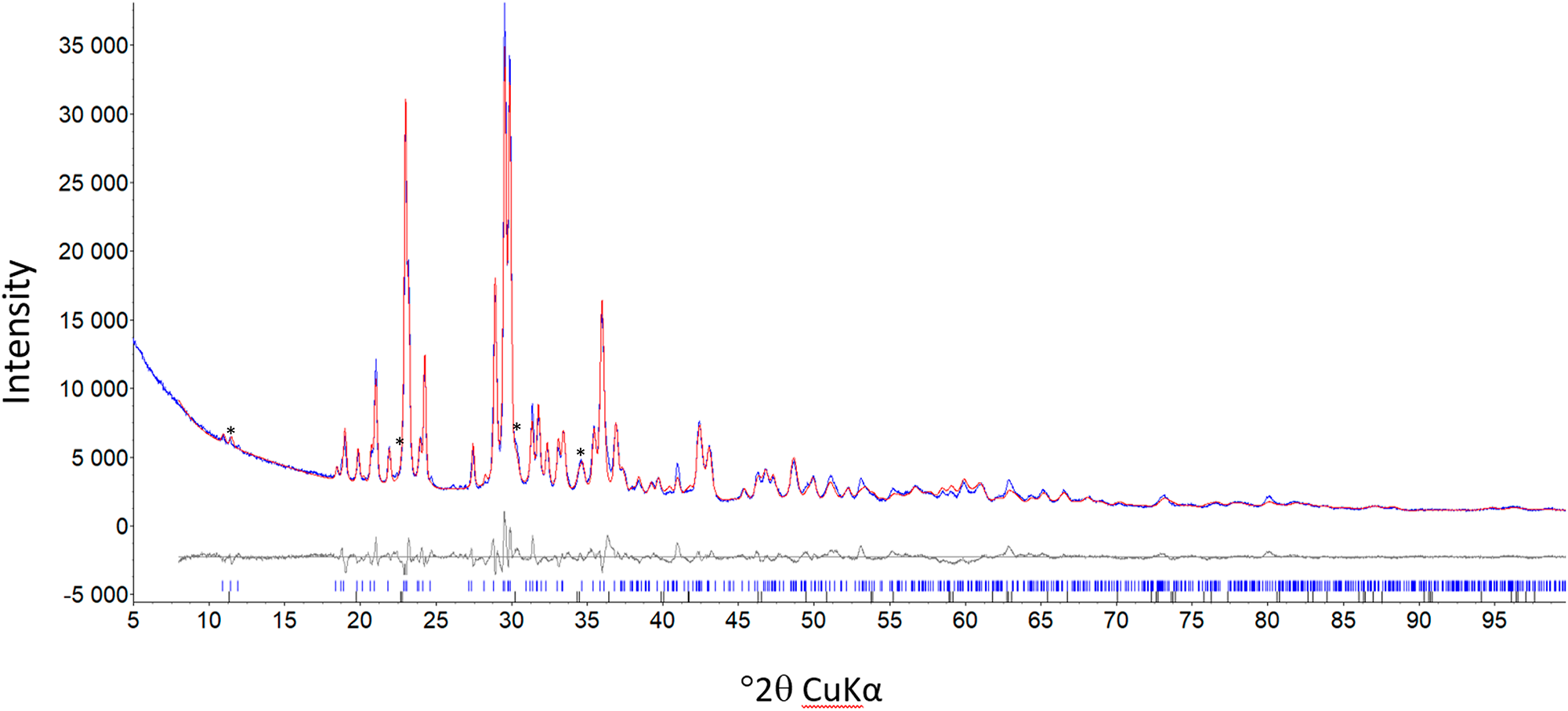
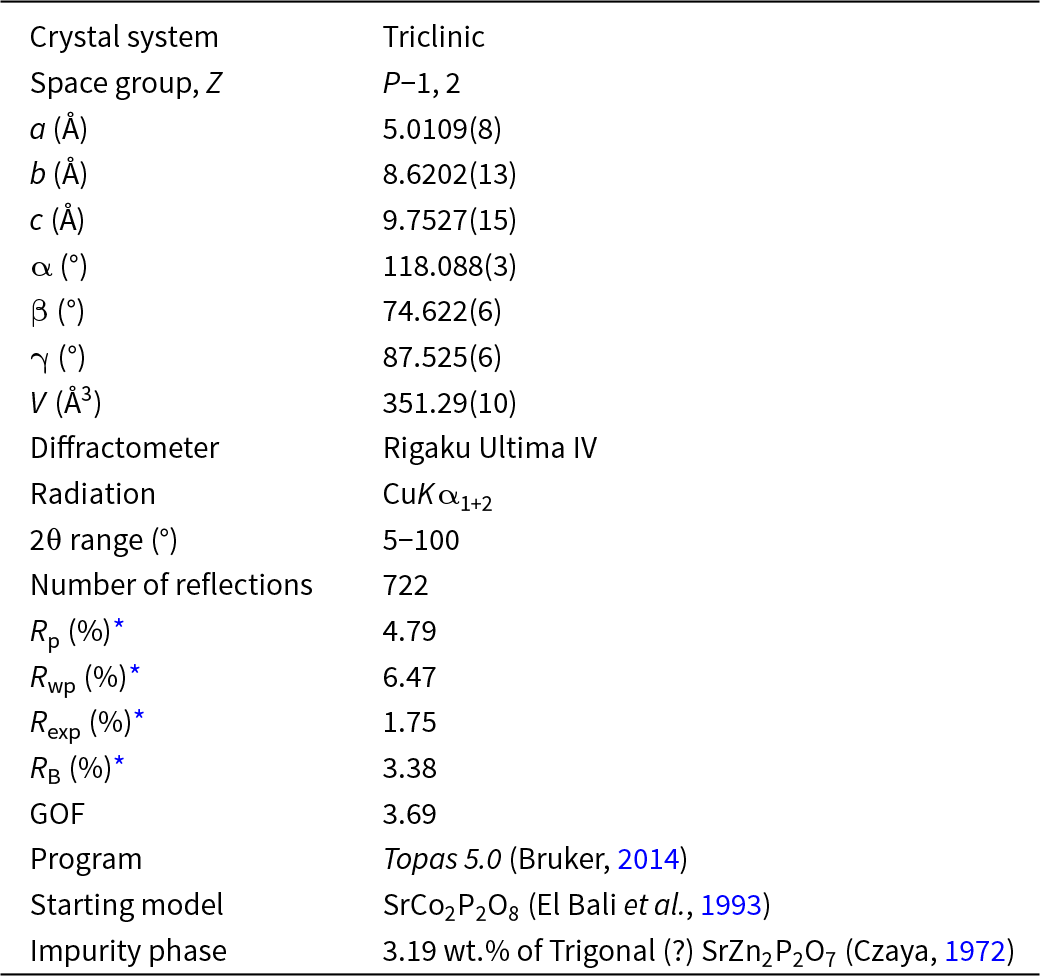
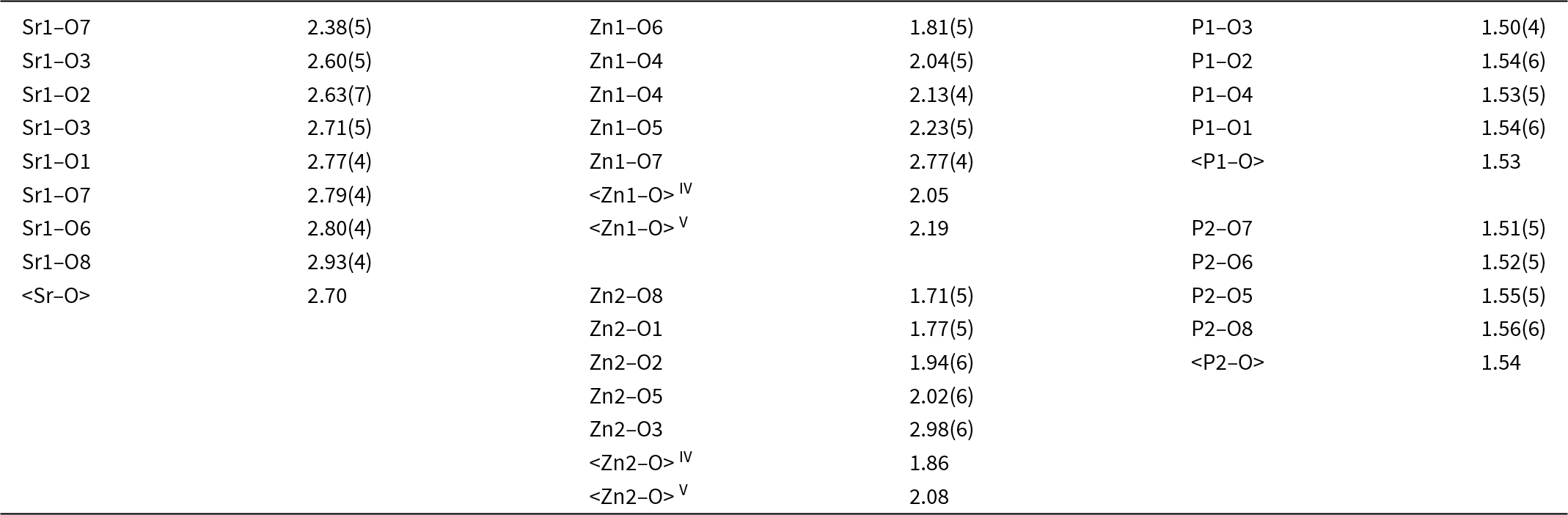
The crystal structure of β-SrZn2P2O8 was refined using a Rietveld refinement method with the use of the Bruker TOPAS 5.0 software package (Bruker, 2014; Dinnebier et al., Reference Dinnebier, Leineweber and Evans2019). A PXRD pattern was obtained with an Ultima IV (Rigaku, Japan) diffractometer (CuKα12 radiation, 40 kV/30 mA, Bragg-Brentano geometry, PSD D-Tex Ultra detector, goniometer radius = 285 mm). The powder XRD plot was collected in the range 5–100° 2θ at ambient temperature. The collecting time was ∼14 hours. The structure model of triclinic SrCo2P2O8 (El Bali et al., Reference El Bali, Boukhari, Holt and Aride1993) was used as starting models for the structure refinement. The peak profile was modelled using the Thompson-Cox-Hastings pseudo-Voigt function (TCHZ). Atomic coordinates were refined for all atomic positions (see Supplementary materials – Table S1 and CIF). Isotropic atomic displacement parameters B iso were used for all the atoms; B iso were constrained for groups of atoms (Sr, Zn1–2, P1–2, O1–8) and then refined free of limits. Soft restraints for all P–O bonds in tetrahedra as well as selected distances and angles in zinc polyhedra were realized using the Topas 5.0 Launch mode with K = 3 weighting factor for penalties. The correctness of the refined structure was confirmed by low values of final agreement factors (Table 1). The observed and calculated powder X-ray diffraction patterns (final Rietveld refinement plot) are shown in Fig. 1. Atomic coordinates and displacement parameters are given in CIF (Supplementary material) and selected interatomic distances are shown in Table 2. The calculated quantity of the impurity phase modelled by the crystal structure of a trigonal CaZn2P2O7 (Czaya, Reference Czaya1972) was ∼3 wt.%
Final Rietveld plot of triclinic β-SrZn2P2O7. Blue line shows experimental PXRD data, red line corresponds to the calculated XRD data, grey line is the difference between the measured and calculated XRD patterns. Peak positions of triclinic β-SrZn2P2O7 are shown in the lowest part of the figure in blue. Black ticks correspond to the admixture of ∼3.1 wt.% of presumably trigonal SrZnP2O7; its most intensive peaks are marked by asterisks.

Crystal data and structure refinement details of triclinic β-SrZn2P2O7

Table 1 Long description
Crystal data and refinement details are listed for beta SrZn2P2O7, including unit cell parameters, measurement conditions, reflection count, and refinement indicators. Cell angles are alpha 118.088 degrees, beta 74.622 degrees, and gamma 87.525 degrees, with volume 351.29 cubic angstroms. Data collection used a Rigaku Ultima IV diffractometer with CuK alpha 1 plus 2 radiation over a 2 theta range from 5 to 100 degrees. The number of reflections is 722. Refinement indicators are Rp 4.79 percent, Rwp 6.47 percent, Rexp 1.75 percent, RB 3.38 percent, and GOF 3.69. The program is Topas 5.0, and the starting model is SrCo2P2O8. An impurity phase is listed as 3.19 weight percent of trigonal, question mark, SrZn2P2O7.
*  ${R_p} = \frac{{\sum \left| {{Y_{o,m}} - {Y_{c,m}}} \right|}}{{\sum {Y_{o,m}}}}$;
 ${R_{wp}} = \sqrt {\frac{{ \sum {w_m}{{\left( {{Y_{o,m}} - {Y_{c,m}}} \right)}^2}}}{{\sum {w_m}{Y_{o,m}}^2}}} $;
 ${R_{exp}} = \sqrt {\frac{{M - P}}{{\sum{w_m}{Y_{o,m}}^2}}} $;
 ${R_B} = \frac{{\sum\left| {{I_{'o',k}} - {I_{c,k}}} \right|}}{{\sum{I_{'o',k}}}}$
Selected bond lengths (Å) of triclinic β-SrZn2P2O7

Table 2 Long description
Bond lengths in angstroms are listed for Sr1 to O, Zn1 to O, Zn2 to O, P1 to O, and P2 to O, including several mean values. For Sr1, distances are Sr1 to O7 2.38(5), to O3 2.60(5) and 2.71(5), to O2 2.63(7), to O1 2.77(4), to O7 2.79(4), to O6 2.80(4), and to O8 2.93(4), with mean Sr to O 2.70. For Zn1, distances are Zn1 to O6 1.81(5), to O4 2.04(5) and 2.13(4), to O5 2.23(5), and to O7 2.77(4), with mean Zn1 to O for coordination four 2.05 and for coordination five 2.19. For P1, distances are P1 to O3 1.50(4), to O2 1.54(6), to O4 1.53(5), and to O1 1.54(6), with mean P1 to O 1.53. For Zn2, distances are Zn2 to O8 1.71(5), to O1 1.77(5), to O2 1.94(6), to O5 2.02(6), and to O3 2.98(6), with mean Zn2 to O for coordination four 1.86 and for coordination five 2.08. For P2, distances are P2 to O7 1.51(5), to O6 1.52(5), to O5 1.55(5), and to O8 1.56(6), with mean P2 to O 1.54.
Results and discussion
Formation conditions of different polymorphs of SrZn2P2O8
The single-phase sample of α-SrZn2P2O8 [space group P21/c, a = 8.3163(2), b = 9.5023(2), c = 9.0248(2) Å, β = 92.285(1)°, V = 712.60(1) Å3] has been obtained using solid-state reactions methods at 900°C for 36 hours. We were unable to obtain well-cut crystals, but studies of the melt particles revealed a stepped surface relief and perfect cleavage (Fig. S1a). The compound is chemically homogeneous, free of impurities and is characterized by a predetermined elemental ratio (Sr:Zn:P:O 1:2:2:8; Fig. S1b). All the attempts to synthesize its high-temperature modification using solid-state reactions and melt crystallization methods with different heat or cooling rates and time of heat treatment were unsuccessful. Nevertheless this polymorphic modification has been obtained during the HT PXRD experiment. The α-SrZn2P2O8 modification was quickly heated in air up to 900°C with intermediate annealing at 300 and 600°C. Above 900°C the sample melted and further heating was carried out at a rate of 5°C/min up to 1200°C with annealing at each 30°C for ∼30 minutes. After that the sample was cooled rapidly to ambient temperature. As a result β-SrZn2P2O8 was obtained. The exact reasons for the formation of this phase during the HT PXRD experiment are unclear. As with other metastable phases, we are inclined to consider kinetic causes (long heating, rapid quenching) and crystallization from a superheated (boiling) melt, in which unusual atomic polymerization could exist (e.g. Toda et al., Reference Toda, Androsch and Schick2021).
Previously, α-SrZn2P2O8 doped by different cations has been obtained by different methods (chloride-flux method, solid-state reactions etc.) at the temperature from 550 to 1000°C, depending on the admixtures (Hemon and Courbion, Reference Hemon and Courbion1990; Yang and Chen, Reference Yang and Chen2006; Yi et al., Reference Yi, Zhou, Gong, Lan, Tong and Sun2010; Li et al., Reference Li, Wang, Yang and Guo2014; Guo et al., Reference Guo, Li, Wahyudi, Chen, Wang and Chen2016; Khidhirbrahmendra et al., Reference Khidhirbrahmendra, Basha, Avinash and Ravikumar2019; Xu et al., Reference Xu, Zhang and Chang2020). The existence of high-temperature β-SrZn2P2O8 has been mentioned previously only once, by Sarver et al. (Reference Sarver, Hoffman and Hummel1961). According to their data the high-temperature polymorph existences between 1035 and 1175°C, when it melts (above 1175°C). They also mentioned that this phase can be quenched at ambient temperature using only extremely rapid cooling by pouring a melted batch into liquid Hg, water or over dry ice, whereas the cooling in air always results in the formation of α-SrZn2P2O8. However, the authors were unable to obtain any crystallographic data on β-SrZn2P2O8.
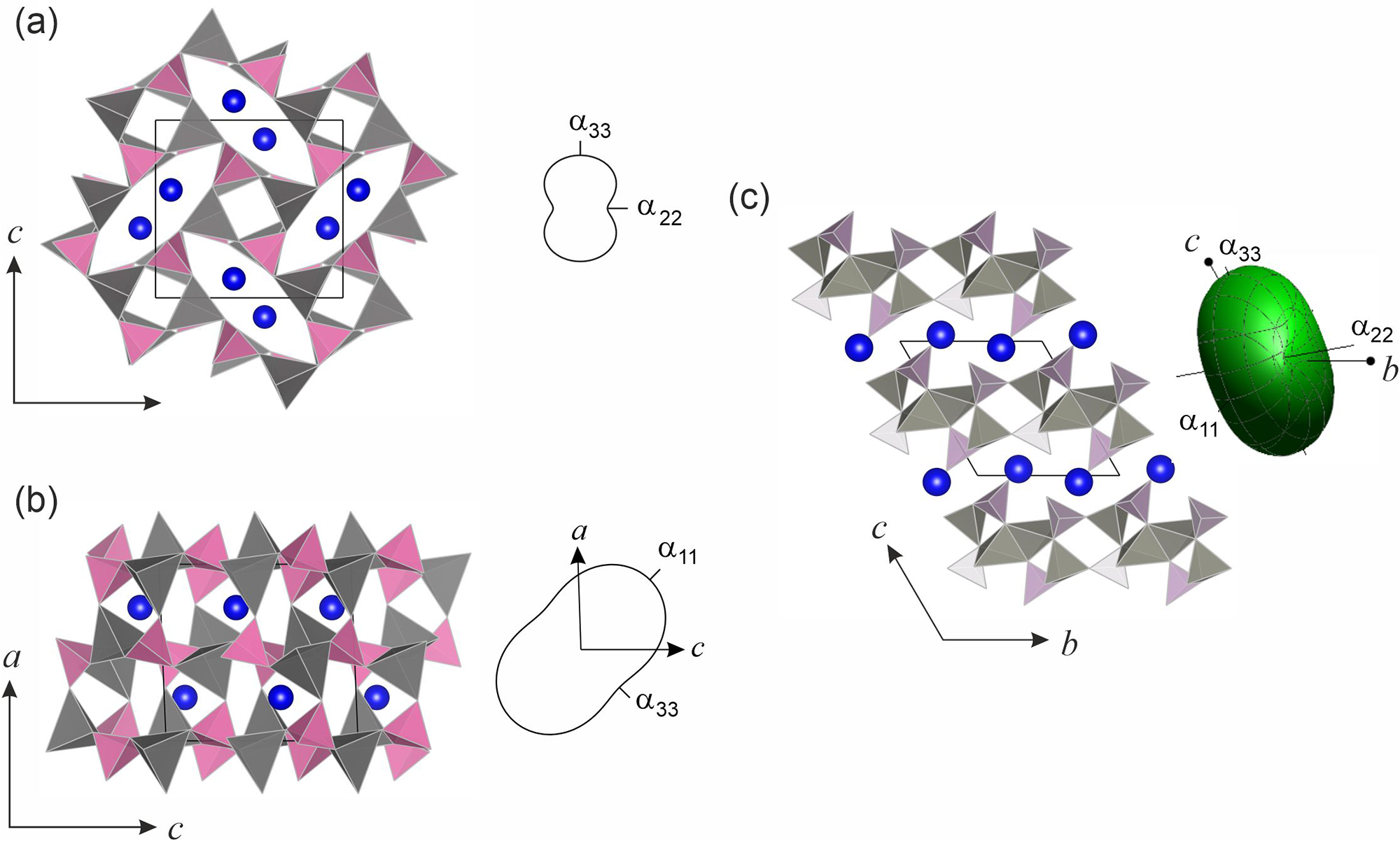
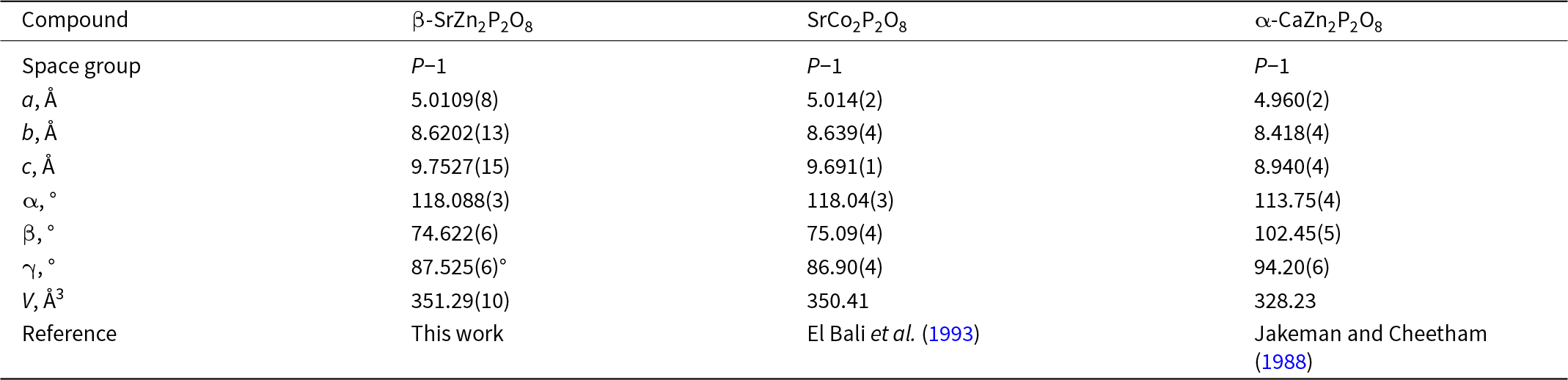
The stable α-SrZn2P2O8 is structurally related to feldspar compounds with paracelsian topology (Fig. 2a,b) and has many structural analogues with different chemical composition (e.g. alumino-, borosilicates, beryllium phosphates, etc.). As far as we know its high-temperature β-modification, has only two direct structural analogues, namely SrCo2P2O8 (El Bali et al., Reference El Bali, Boukhari, Holt and Aride1993) and α-CaZn2P2O8 (Jakeman and Cheetham, Reference Jakeman and Cheetham1988) (Table 3). However, it could be also considered as a hexacelsian-type compound (see below). SrCo2P2O8 has been obtained by slow cooling (10°C/hour) of the melt (obtained at 1200°C) with stoichiometric composition (El Bali et al., Reference El Bali, Boukhari, Holt and Aride1993). The synthesis of α-CaZn2P2O8 is completely different (Jakeman and Cheetham, Reference Jakeman and Cheetham1988). The polycrystalline sample was prepared in two steps: (1) dissolving of CaCO3, ZnO and NH4H2PO4 in acid solution; (2) the dried powder was ground and fired at 800°C for 24 hours. The single crystals of α-CaZn2P2O8 were grown using ZnCl2 as a flux, but Jakeman and Cheetham (Reference Jakeman and Cheetham1988) did not provide the temperature and speed of their crystallization. It should be noted that similar triclinic crystal structure can also be obtained with a Mg admixture (CaZn2-xMgxP2O8, x = 0–0.75), but a pure Mg analogue cannot be obtained (Jakeman and Cheetham, Reference Jakeman and Cheetham1988). It is interesting to note that anhydrous calcium and magnesium phosphates are represented by only two minerals (keplerite and stanfieldite), both of which have been discovered in native Fe-rich meteorites (Britvin et al., Reference Britvin, Krzhizhanovskaya, Bocharov and Obolonskaya2020, Reference Britvin, Galuskina, Vlasenko, Vereshchagin, Bocharov, Krzhizhanovskaya, Shilovskikh, Galuskin, Vapnik and Obolonskaya2021). Thus, it can be assumed that reducing conditions are important for the occurrence of such phosphates in nature.
Crystal structures of α- (a, b) and β-SrZn2P2O8 (c) with the section indicating thermal deformations. PO4 and ZnO4 tetrahedra are given in purple and grey, respectively. Sr atoms are presented as blue spheres.

Figure 2 Long description
Three sub-images labeled a, b and c illustrate the crystal structures of alpha and beta-SrZnPO. Sub-image a shows the alpha-SrZnPO structure with PO tetrahedra in purple and ZnO tetrahedra in grey, Sr atoms as blue spheres and axes labeled a and c. The thermal deformation section beside it includes an ellipsoid indicating anisotropic expansion with principal directions labeled alpha subscript 33 and alpha subscript 22. Sub-image b presents a similar alpha-SrZnPO structure with axes labeled a and c, accompanied by a thermal deformation ellipsoid showing directions alpha subscript 11, alpha subscript 33 and alpha subscript 22. Sub-image c depicts the beta-SrZnPO structure with the same tetrahedra and Sr atom representation, oriented with axes labeled b and c. The associated thermal deformation ellipsoid is green, indicating anisotropic expansion with directions alpha subscript 11, alpha subscript 22 and alpha subscript 33. The ellipsoids convey the anisotropy in thermal expansion along specific crystallographic axes. No scale or numeric values are shown.
Crystallographic information of the compounds isostructural to β-SrZn2P2O8

Table 3 Long description
Crystallographic parameters are listed for beta SrZn2P2O8, SrCo2P2O8, and alpha CaZn2P2O8, including space group, cell edges a, b, c in angstroms, angles alpha, beta, gamma in degrees, and volume V in cubic angstroms. Space group is P minus 1 for all three compounds. For beta SrZn2P2O8, a is 5.0109(8), b is 8.6202(13), c is 9.7527(15), alpha is 118.088(3), beta is 74.622(6), gamma is 87.525(6) degrees, and V is 351.29(10). For SrCo2P2O8, a is 5.014(2), b is 8.639(4), c is 9.691(1), alpha is 118.04(3), beta is 75.09(4), gamma is 86.90(4), and V is 350.41. For alpha CaZn2P2O8, a is 4.960(2), b is 8.418(4), c is 8.940(4), alpha is 113.75(4), beta is 102.45(5), gamma is 94.20(6), and V is 328.23. The reference row lists, for beta SrZn2P2O8, This work; for SrCo2P2O8, El Bali et al., 1993; and for alpha CaZn2P2O8, Jakeman and Cheetham, 1988.
Crystal structure of β-SrZn2P2O8
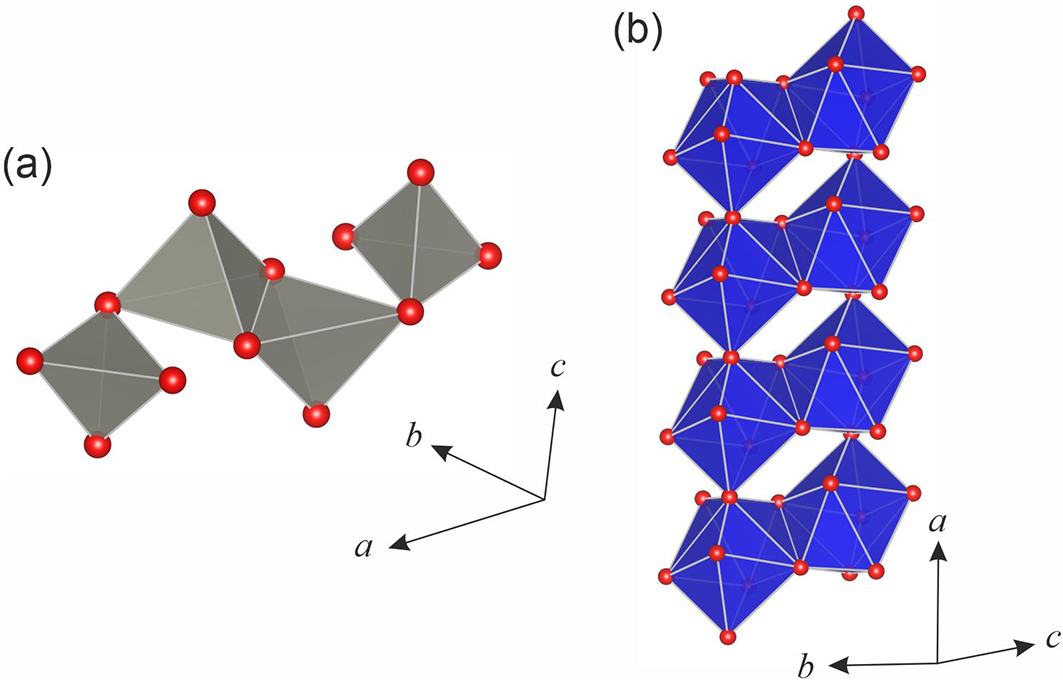
No crystallographic data were previously available for β-SrZn2P2O8 (Sarver et al., Reference Sarver, Hoffman and Hummel1961). According to our data, the crystal structure of β-SrZn2P2O8 (space group P  $\bar 1$, a = 5.0109(8), b = 8.6202(13), c = 9.7527(15) Å, α = 118.088(3), β = 74.622(6), γ = 87.525(6)° and V = 351.29(10) Å3) can be described as a layered structure (Fig. 2c), consisting of PO4, ZnO4 tetrahedra. Zn2O4 tetrahedra are connected to each other via corners, whereas Zn1O4 tetrahedra are connected to each other along edges. This type of tetrahedra connection is not common for Zn, but it is known in some crystal structures (e.g. Ghose et al., Reference Ghose, Boving, LaChapelle and Wan1977; Wiebcke, Reference Wiebcke2002; Harrisson, Reference Harrison2010). Thus the ZnO4 tetrahedra form Zn4O12 structural units (Fig. 3a). These units form layers connecting via PO4 tetrahedra (Fig. 2c, 4a). The resulting layers are formed by three-, four- and six-membered rings. The interlayer space is occupied by Sr atoms in eight-fold coordination. SrO8 polyhedra are connected to each other through the vertices and edges and form the chains along the a axis (Fig. 3b).
Fragments of β-SrZn2P2O8: (a) Zn4O12 structural units; (b) chain of SrO8 polyhedra. Grey and blue polyhedra show ZnOn (n = 4, 5) and SrO8 polyhedra, respectively; red spheres indicate oxygen atoms.

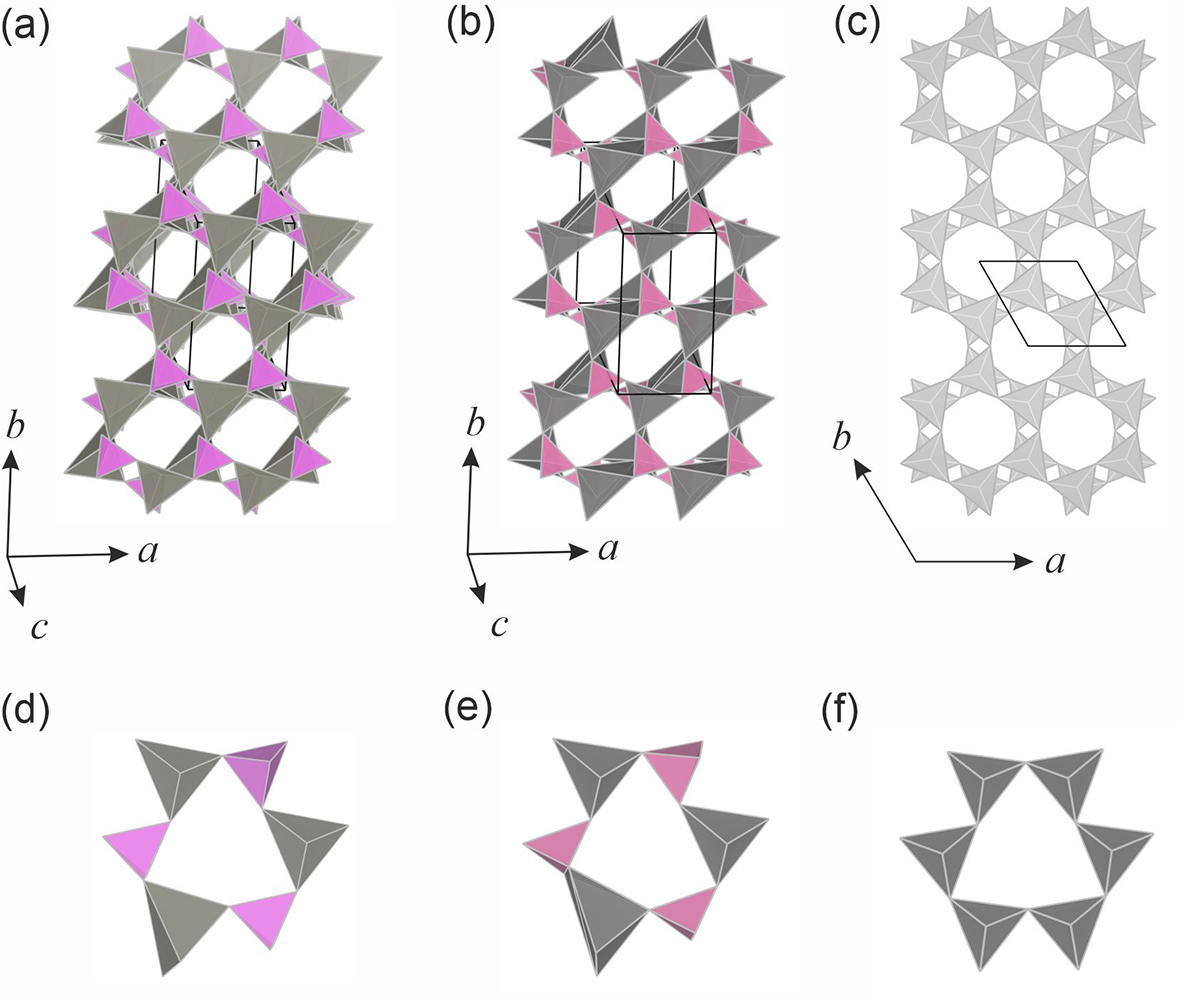
Double layers and six-membered rings in hexacelsian-type compounds: of β-SrZn2P2O8 (a, d), α-CaZn2P2O8 (b, e) (Jakeman and Cheetham, Reference Jakeman and Cheetham1988) and β-dmisteinbergite (c, f) (Gorelova et al., Reference Gorelova, Vereshchagin, Bocharov, Krivovichev, Zolotarev and Rassomakhin2023b). PO4 tetrahedra and ZnOn (n = 4, 5) polyhedra in crystal structures of β-SrZn2P2O8 and α-CaZn2P2O8 are given in purple and grey, respectively. Grey tetrahedra in β-dmisteinbergite show mixed TO4 (T = Si, Al) tetrahedra.

Figure 4 Long description
The diagram consists of six panels labeled (a) to (f), illustrating hexacelsian-type crystal structures. Panels (a) to (c) depict extended frameworks, while panels (d) to (f) show extracted ring units. Panel (a) features a layered structure with alternating grey and purple tetrahedra, representing different polyhedra types, arranged along the b and c axes. Panel (b) shows a similar arrangement with grey tetrahedra, also aligned along the b and c axes. Panel (c) presents an open framework with grey tetrahedra forming a hexagonal pattern, viewed along the b and a axes, with an outlined unit cell visible. Panels (d), (e) and (f) display individual ring structures. Panel (d) shows a ring with alternating grey and purple tetrahedra. Panel (e) presents a similar ring with fewer purple tetrahedra. Panel (f) displays a ring composed entirely of grey tetrahedra. Two colors distinguish tetrahedra types, but the legend is not shown. The diagram aims to compare hexacelsian-type frameworks and corresponding ring motifs across different compositions. No scale bar or numeric parameters are shown.
The crystal structures of the most closely related compounds, i.e. triclinic modifications of SrCo2P2O8 and CaZn2P2O8, are usually described as consisting of PO4 and Co2O4/Zn2O4 tetrahedra and Co1O5/Zn1O5 distorted trigonal bipyramids with four bonds of ∼1.94–2.04 Å and a fifth bond of 2.45 Å and 2.52 Å for Co and Zn, respectively. Although the necessity of the existence of a fifth long bond seems doubtful, the additional bond has to be included in the coordination sphere of Co/Zn atoms according to the bond length analysis (Jakeman and Cheetham, Reference Jakeman and Cheetham1988). For the case of β-SrZn2P2O8, the fifth Zn–O bond is longer than 2.7 Å, whereas four other bonds are in the range of 1.81–2.23 Å. To understand whether it is necessary to include the fifth oxygen atom in the coordination sphere of Zn, the bond weights (BW) for this cation were calculated (Table S2). The results obtained demonstrate that for the case of SrCo2P2O8 and CaZn2P2O8 the BW of the fifth Co1–O7 and Zn2–O8 bond are 0.0938 and 0.0361, respectively, i.e. an order of magnitude lower than for other four bonds. The BW for Zn1–O7 in β-SrZn2P2O8 is still an order of magnitude lower (0.0011), i.e. including this bond in the coordination sphere of Zn1 is not advisable.
Generally all three of these compounds (β-SrZn2P2O8, SrCo2P2O8 and α-CaZn2P2O8) with layered triclinic crystal structures have similarities with hexacelsian-type minerals. The main difference being that in hexacelsian-type minerals TO4 tetrahedra are joined to each other via corners, whereas some of the T atoms in crystal structures of β-SrZn2P2O8, SrCo2P2O8 and α-CaZn2P2O8 are connected to each other via edges. Most probably, this difference leads to a decrease of symmetry in the crystal structure of β-SrZn2P2O8, SrCo2P2O8 and α-CaZn2P2O8 to triclinic. Nevertheless layers consist of six-membered rings of TOn polyhedra (Fig. 4) in all types of crystal structures. In all cases the M cations are located in the interlayer space.
It is interesting to note that both SrCo2P2O8 and CaZn2P2O8 do not form framework crystal structures with paracelsian topology unlike SrZn2P2O8. SrCo2P2O8 crystallizes only in triclinic (space group P  $\bar 1$) symmetry (El Bali et al., Reference El Bali, Boukhari, Holt and Aride1993) with layered crystal structure, whereas CaZn2P2O8 has triclinic (space group P
 $\bar 1$; α-CaZn2P2O8) and hexagonal (space group P
 $\bar 3$; β-CaZn2P2O8) polymorphs (Czaya, Reference Czaya1972; Jakeman and Cheetham, Reference Jakeman and Cheetham1988), but both of them are layered too. A number of closely related compounds also do not exhibit similar polymorphism. Thus, BaZn2P2O8 crystallizes only in monoclinic symmetry (space group P21/c) with framework paracelsian topology (Lucas et al., Reference Lucas, Elfakir, Wallez, Quarton and Lagache1998). CaCo2P2O8 and BaCo2P2O8 form completely different crystal structures (Faza et al., Reference Faza, Treutmann and Babel1950; Bircsak and Harrison, Reference Bircsak and Harrison1998; David et al., Reference David, Kabbour, Pautrat and Mentré2013). We can assume that the key to polymorphism is not only the density of oxygen layers (as was suggested earlier), but also the fundamentally different thermal behaviour of large cations [e.g. Ca (R = 1.00 Å), Sr (R = 1.18 Å), Ba (R = 1.42 Å); Shannon, Reference Shannon1976], that lead to the limited isomorphism and changes in their coordination polyhedra.
Temperature behaviour of different polymorphs of SrZn2P2O8
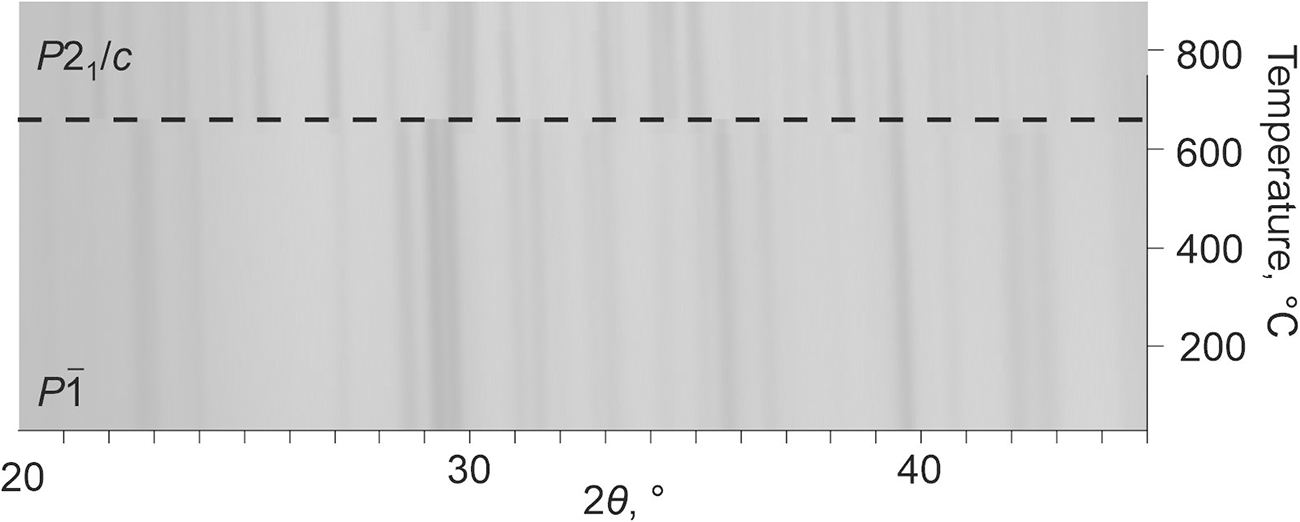
According to the HT PXRD data, α-SrZn2P2O8 is stable up to 900°C, above which it starts to melt, whereas β-SrZn2P2O8 is less stable and transforms into α-modification above 630°C (Fig. 5).
The evolution of the PXRD patterns of β-SrZn2P2O8 in the range 30–900°C.

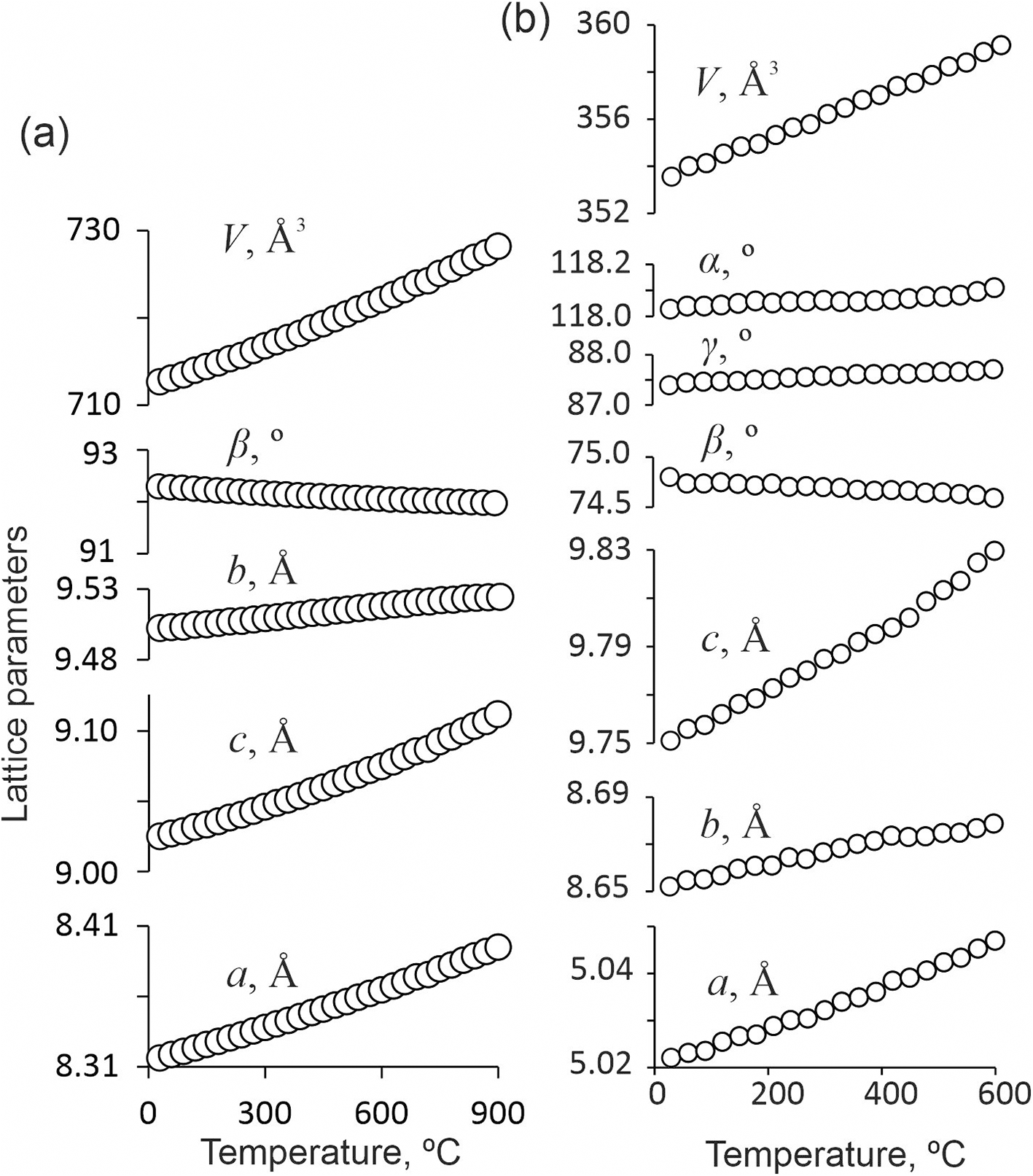
The temperature dependencies for the unit-cell parameters of both SrZn2P2O8 modifications are shown in Fig. 6. The volume thermal expansion of framework α-SrZn2P2O8 equals 25 × 10–6 °C–1 that is close to the average volume expansion coefficient (αV = 23 × 10–6 °C–1) for different compounds with paracelsian topology (Gorelova et al., Reference Gorelova, Khandarkhaeva, Yukhno, Krzhizhanovskaya, Vereshchagin and Dubrovinsky2023a). The thermal expansion of α-modification has sharply anisotropic character (αmax/αmin = 4.9) with the maximal expansion close to the a axis and minimal along b axis (Table 4, Figs 2a, 2b and 6a). It should be noted that though the anisotropic expansion is typical for paracelsian-like phases, the directions of maximal and minimal expansion are usually in the plane of the layer formed by four- and eight-membered rings of TO4 tetrahedra (T = Si, Al, B). In the case of α-SrZn2P2O8 the direction of maximal expansion is perpendicular to these layers and is located along the flexible crankshaft chains of TO4 tetrahedra (T = Zn, P), that is more typical for compounds with feldspar topology. A similar behaviour has been described previously for BaAs2Zn2O8·H2O (Gorelova et al., Reference Gorelova, Vereshchagin, Bocharov, Pankin and Đorđević2022).
Unit-cell parameters of α-SrZn2P2O8 (a) and β-SrZn2P2O8 (b) at different temperatures. Errors are smaller than symbols.

Figure 6 Long description
Five stacked line graphs with open-circle markers. The horizontal axis label reads, Temperature, degree celsius, with tick labels 0, 300, 600, 900. The vertical label reads, Lattice parameters. From top to bottom, the plots are labeled, V, A superscript 3; beta, degree; b, A; c, A; a, A. V increases from about 710 to about 730. Beta decreases from about 92 to about 91. b increases from about 9.48 to about 9.53. c increases from about 9.00 to about 9.10. a increases from about 8.31 to about 8.41. The image B showing five stacked line graphs with open-circle markers. The horizontal axis label reads, Temperature, degree celsius, with tick labels 0, 200, 400, 600. From top to bottom, the plots are labeled, V, A superscript 3; alpha, degree; gamma, degree; beta, degree; c, A; b, A; a, A. V increases from about 352 to about 360. Alpha is near 118.0 to 118.2. Gamma is near 87.0 to 87.3. Beta is near 74.5 to 75.0. c increases from about 9.75 to about 9.83. b increases from about 8.65 to about 8.69. a increases from about 5.02 to about 5.04.
Thermal expansion coefficients (TECs) (×106 °C–1) of SrZn2P2O8 along the principle axes of the thermal expansion tensor and along the crystallographic axes

Table 4 Long description
Thermal expansion coefficients are listed for SrZn2P2O8 in units of times 10 to the 6 per degree C, with columns for Delta T, alpha11, alpha22, alpha33, mu alpha33 c, alphaa, alphab, alphac, alphaalpha, alphabeta, alphagamma, alphaV, and alpha max over alpha min. For SrZn2P2O8 with space group P21/c over 30 to 900 degrees C, alpha11 is 14.3(1), alpha22 is 2.9(1), alpha33 is 7.8(2), mu alpha33 c is 44.6(9), alphaa is 10.84(1), alphab is 2.9(1), alphac is 11.0(2), alphaalpha is shown as a dash, alphabeta is minus 3.98(9), alphagamma is shown as a dash, alphaV is 25.0(2), and alpha max over alpha min is 4.9. For SrZn2P2O8 with space group P minus 1 over 30 to 600 degrees C, alpha11 is 10.2(2), alpha22 is 2.5(2), alpha33 is 14.1(3), mu alpha33 c is 14.3(2), alphaa is 8.7(2), alphab is 5.3(2), alphac is 13.6(3), alphaalpha is 0.86(8), alphabeta is minus 3.7(2), alphagamma is 5.6(2), alphaV is 26.7(4), and alpha max over alpha min is 5.6. Across the two rows, alpha33 is higher for P minus 1 than for P21/c, while mu alpha33 c is higher for P21/c than for P minus 1. Dashes appear in the P21/c row for columns alphaalpha and alphagamma.
The layered β-SrZn2P2O8 shows very similar thermal behaviour despite a different structural motif. Its volume expansion and degree of anisotropy are slightly large (αV = 27 × 10–6 °C–1; αmax/αmin = 5.6). The direction of maximal thermal expansion almost coincides with the c axis, i.e. it is perpendicular to the layer plane (Table 4, Figs 2c and 6b), which is generally typical for layered crystal structures. Additionally, such a sharp expansion along the c axis can be due to the so-called ‘preparing’ of the crystal structure to a phase transition into α-modification. The thermal expansion within the layer plane is quite anisotropic too (α11/α22 = 4.1), that can be explained by the low symmetry of the studied compound, for which the shear character of thermal deformations is typical (Filatov, Reference Filatov1990, Reference Filatov2011).
Possible natural formation conditions
According to the International Mineralogical Association (IMA) List of Minerals, 47 minerals contain essential Zn, P and O, while only two of them are anhydrous, namely kuksite Pb3Zn3TeO6(PO4)2 (Kim et al., Reference Kim, Zayakina and Makhotko1990) and tululite Ca14(Fe3+,Al)(Al,Zn,Fe3+,Si,P,Mn,Mg)15O36 (or Ca14(Fe3+O6)[(Si,P)O4][(Al,Zn)7O13]; Khoury et al., Reference Khoury, Sokol, Kokh, Seryotkin, Nigmatulina, Goryainov, Belogub and Clark2016). Kuksite was found in several Au, Ag-related deposits in Russia (Kim et al., Reference Kim, Zayakina and Makhotko1990; Kondratieva et al., Reference Kondratieva, Anisimova and Kardashevskaia2021) and the USA (e.g. Kampf et al., Reference Kampf, Rossman and Housley2009, Reference Kampf, Missen, Mills, Ma, Housley, Chorazewicz, Marty, Coolbaugh and Momma2022; Mills et al., Reference Mills, Kampf, Kolitsch, Housley and Raudsepp2010; Yang et al., Reference Yang, Gibbs, Schwenk, Xie, Gu, Downs and Evans2021) and is always formed as a secondary mineral at low temperatures (below 250°C), whereas its synthetic analogue has been prepared above 500°C by solid-state methods (Mill’, Reference Mill’2009b; Reference Mill’2009a). Tululite is only found in combustion metamorphic rocks in central Jordan (Khoury et al., Reference Khoury, Sokol, Kokh, Seryotkin, Nigmatulina, Goryainov, Belogub and Clark2016; Sokol et al., Reference Sokol, Kokh, Seryotkin, Deviatiiarova, Goryainov, Sharygin, Khoury, Karmanov, Danilovsky and Artemyev2020; Galuskina et al., Reference Galuskina, Stachowicz, Woźniak, Vapnik and Galuskin2021) and is formed at ∼800–850°C and ambient pressures.
There is no single mineral with essential Zn, P and O, which contains Sr2+ or Ba2+. In addition, only 11 minerals with essential Zn, P and O contain Ca2+ and only five of them contain Pb2+. Among the calcium minerals are: batagayite CaZn2(Zn,Cu)6(PO4)4[PO3(OH)]3·12H2O (Yakovenchuk et al., Reference Yakovenchuk, Pakhomovsky, Konopleva, Panikorovskii, Bazai, Mikhailova, Bocharov, Ivanyuk and Krivovichev2018), ehrleite Ca2ZnBe(PO4)2(PO3OH)·4H2O (Robinson et al., Reference Robinson, Grice and Velthuizen1985), falsterite Ca2MgMn2+2Fe2+2Fe3+2Zn4(PO4)8(OH)4(H2O)14 (Kampf et al., Reference Kampf, Mills, Simmons, Nizamoff and Whitmore2012), guimarãesite Ca2Be4Zn5(PO4)6(OH)4·6H2O (Chukanov et al., Reference Chukanov, Atencio, Zadov, Filho and Coutinho2008), hillite Ca2Zn(PO4)2·2H2O (Yakubovich et al., Reference Yakubovich, Massa, Liferovich, Gavrilenko, Bogdanova and Tuisku2003), jahnsite-(CaMnZn) CaMn2+Zn2Fe3+2(PO4)4(OH)2·8H2O (Grey et al., Reference Grey, Keck, Kampf, MacRae, Cashion and Glenn2020), jungite Ca2Zn4Fe3+8(PO4)9(OH)9·16H2O (Moore and Ito, Reference Moore and Ito1980), scholzite and parascholzite CaZn2(PO4)2·2H2O (Strunz, Reference Strunz1948; Strunz and Tennyson, Reference Strunz and Tennyson1956; Sturman et al., Reference Sturman, Rouse and Dunn1981), skorpionite Ca3Zn2(PO4)2(CO3)(OH)2·H2O (Krause et al., Reference Krause, Effenberger, Bernhardt and Medenbach2008) and, already mentioned above, tululite. Among lead minerals are: cuprodongchuanite Pb4CuZn2(PO4)4(OH)2 (Sun et al., Reference Sun, Li, Xue, Shen and Hao2021), cuprozheshengite Pb4CuZn2(AsO4)2(PO4)2(OH)2 (Sun et al., Reference Sun, Grey, Li, Rewitzer, Xue, Mumme, Shen, Hao, MacRae, Riboldi-Tunnicliffe, Boer, Williams and Kampf2024a), dongchuanite Pb4ZnZn2(PO4)4(OH)2 (Li et al., Reference Li, Sun, Shen, Xue, Hao and de Fourestier2023), zheshengite Pb4ZnZn2(AsO4)2(PO4)2(OH)2 (Sun et al., Reference Sun, Li, Xue, Shen and Hao2024b) and, mentioned above, kuksite. It is interesting to note that all the Pb-dominant minerals except kuksite were discovered recently, have supergene origin (low temperatures, low pressures) and are members of the dongchuanite group (Sun et al., Reference Sun, Grey, Li, Rewitzer, Xue, Mumme, Shen, Hao, MacRae, Riboldi-Tunnicliffe, Boer, Williams and Kampf2024a; Reference Sun, Li, Xue, Shen and Hao2024b). The Ca-dominant minerals are extremely rare and most of them (except scholzite and parascholzite) are found in only 1–2 localities (mindat.org, Ralph et al., Reference Ralph, Von Bargen, Martynov, Zhang, Que, Prabhu, Morrison, Li, Chen and Ma2025). Notably all these minerals are secondary low-temperature minerals.
It should be noted that none of the mentioned minerals contain Sr, even in trace amounts, although Sr is usually dispersed in calcium minerals (e.g. apatite group minerals; Pekov et al., Reference Pekov, Kulikova, Kabalov, Eletskaya, Chukanov, Menshikov and Khomyakov1996). Furthermore Sr-containing minerals rarely have layered structures (exceptions are lamprophyllite and Sr-rich borates; e.g. Pekov et al., Reference Pekov, Chukanov, Kulikova, Zubkova, Krotova, Sorokina and Pushcharovsky2004; Pekov, Reference Pekov2005; Ralph et al., Reference Ralph, Von Bargen, Martynov, Zhang, Que, Prabhu, Morrison, Li, Chen and Ma2025). It is the structural motif of these minerals that may explain the absence of calcium (see below).
The crystal structures of the minerals mentioned above, can be formed by different combinations of Zn- and P-based polyhedra: phosphorous is always surrounded by four oxygen atoms, whereas zinc can be coordinated by four and/or six oxygen atoms. The crystal structures of kuksite, tululite, ehrleite, falsterite, skorpionite, scholzite and parascholzite are based on layers of corner-sharing ZnO4 and PO4 tetrahedra (Taxer, Reference Taxer1975; Hawthorne and Grice, Reference Hawthorne and Grice1987; Taxer and Bartl, Reference Taxer and Bartl1997; Krause et al., Reference Krause, Effenberger, Bernhardt and Medenbach2008; Mills et al., Reference Mills, Kampf, Kolitsch, Housley and Raudsepp2010; Kampf et al., Reference Kampf, Mills, Simmons, Nizamoff and Whitmore2012; Khoury et al., Reference Khoury, Sokol, Kokh, Seryotkin, Nigmatulina, Goryainov, Belogub and Clark2016; Tobase et al., Reference Tobase, Yoshiasa, Jinnouchi, Kitahara, Hongu, Tokuda, Okube and Sugiyama2019). In crystal structures of guimarãesite, hillite and jahnsite-(CaMnZn) phosphorous is coordinated by four oxygen atoms, whereas zinc is coordinated by six oxygens (Yakubovich et al., Reference Yakubovich, Massa, Liferovich, Gavrilenko, Bogdanova and Tuisku2003; Chukanov et al., Reference Chukanov, Atencio, Zadov, Filho and Coutinho2008; Grey et al., Reference Grey, Keck, Kampf, MacRae, Cashion and Glenn2020). Pb-dominant minerals, related to the dongchuanite group, have a layered crystal structure. The layers are formed by TO4 (T = Zn, P, As) tetrahedra and XO6 octahedra (X = Zn, Cu), i.e. in their crystal structures zinc is surrounded by four and six oxygen atoms (Sun et al., Reference Sun, Grey, Li, Rewitzer, Xue, Mumme, Shen, Hao, MacRae, Riboldi-Tunnicliffe, Boer, Williams and Kampf2024a; Reference Sun, Li, Xue, Shen and Hao2024b). A similar tendency is in the crystal structure of batagayite, in which layers are formed by PO4 and ZnO4 tetrahedra and TO6 (T = Zn, Cu, Mg) octahedra (Yakovenchuk et al., Reference Yakovenchuk, Pakhomovsky, Konopleva, Panikorovskii, Bazai, Mikhailova, Bocharov, Ivanyuk and Krivovichev2018).
Nevertheless, to date three Sr-dominant minerals are known in the feldspar family, namely slawsonite SrAl2Si2O8 (Griffen et al., Reference Griffen, Ribbe and Gibbs1977), pekovite SrB2Si2O8 (Pautov et al., Reference Pautov, Agakhanov, Sokolova and Hawthorne2004) and strontiohurlbutite SrBe2P2O8 (Rao et al., Reference Rao, Wang, Hatert, Gu, Ottolini, Hu, Dong, Dal Bo and Baijot2014). All of them belong to the paracelsian topology, i.e. have framework crystal structures. An interesting fact is that pekovite has both Ca- and Ba-dominant analogues, namely danburite (Phillips et al., Reference Phillips, Gibbs and Ribbe1974) and maleevite (Pautov et al., Reference Pautov, Agakhanov, Sokolova and Hawthorne2004), whereas slawsonite has only a Ba-dominant analogue, namely paracelsian (Smith, Reference Smith1953) and strontiohurlbutite has only a Ca-dominant analogue, namely hurlbutite (Lindbloom et al., Reference Lindbloom, Gibbs and Ribbe1974). Notably, minerals with the composition of CaAl2Si2O8 and BaBe2P2O8 are known in nature, but crystallize in other topologies. CaAl2Si2O8 is known in feldspar (anorthite; Wainwright and Starkey, Reference Wainwright and Starkey1971), dmisteinbergite (dmisteinbergite; Chesnokov et al., Reference Chesnokov, Lotova, Nigmatulina, Pavlyuchenko and Bushmakin1990; Zolotarev et al., Reference Zolotarev, Krivovichev, Panikorovskii, Gurzhiy, Bocharov and Rassomakhin2019), svyatoslavite (svyatoslavite; Chesnokov et al., Reference Chesnokov, Lotova, Pavlyuchenko, Nigmatulina, Usova, Bushmakin and Nishanbaev1989; Krivovichev et al., Reference Krivovichev, Shcherbakova and Nishanbaev2012) and hollandite (stöfflerite; Tschauner and Ma, Reference Tschauner and Ma2017) topologies. BaBe2P2O8 is known in dmisteinbergite topology only (minjiangite; Rao et al., Reference Rao, Hatert, Wang, Gu, Dal Bo and Dong2015). The recent discovery of two new hexacelsian-type metastable minerals of the feldspar family, namely pfaffenbergite KNa3(Al4Si12)O32 (Silvio et al., Reference Silvio, Lorenzon, Borriello, Borghini, Wirth, Schreiber, Fuchs, O’Brien, Grew and Mugnaioli2026) and wodegongjieite KCa3(Al7Si9)O32 (Mugnaioli et al., Reference Mugnaioli, Xiong, Xu, Gemmi, Wirth, Yang and Grew2022), is one more confirmation that layered modification of SrZn2P2O8 can be also found in nature.
Based on that we assume that the zinc phosphate minerals with both feldspar- and hexacelsain-type crystal structures (i.e. different polymorphic modifications of SrZn2P2O8 or CaZn2P2O8), can be found in nature. The α-modification of the SrZn2P2O8 phase with the paracelsian structure may be found in nature under high-temperature and low-pressure conditions. However, the existence of a β-modification of SrZn2P2O8 is questionable, as this phase is undoubtedly metastable and requires very specific formation conditions (e.g. superheated melt).
Conclusion
During this work, the crystal structure of β-SrZn2P2O8 was determined for the first time. It has been shown that β-SrZn2P2O8 can be synthesized by the rapid cooling of stoichiometric SrZn2P2O8 melt in air. According to the obtained results, the triclinic (space group P  $\bar 1$) crystal structure of β-SrZn2P2O8 is layered and close to SrCo2P2O8 and α-CaZn2P2O8. The β-SrZn2P2O8 transforms into stable α-modification with framework crystal structure of paracelsian topology when heated above 630°C. The thermal expansion coefficients of both SrZn2P2O8 modifications were determined. The volume expansion (αV = 26 ± 1 × 10⁻⁶ °C–1) and the anisotropy of thermal expansion are similar for both phases despite the fact that they have significantly different structures. We assume the possibility of discovering a new feldspar- and hexacelsian-type minerals in nature.
Supplementary material
The supplementary material for this article can be found at https://doi.org/10.1180/mgm.2025.10187.
Acknowledgments
The authors are grateful to anonymous reviewers for a careful examination of the manuscript contents and positive feedback. The authors express their gratitude to Principal Editor Stuart Mills and Associate Editor Irina Galuskina for editorial handing of this contribution. The authors thank X-ray Diffraction Centre and Geomodel Centre of Saint Petersburg State University for providing instrumental and computational resources. This research was funded by the Russian Science Foundation, grant number 22-77-10033-П.
Competing interests
The authors declare none.