INTRODUCTION
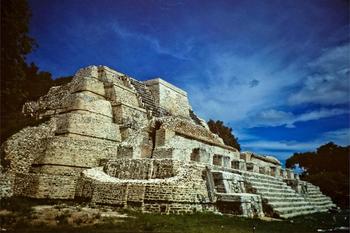
In 1965, while excavating at the northern Belizean site of Altun Ha, David M. Pendergast encountered Tomb 6 within Structure B-4 (Figure 1). Hiding behind this rather prosaic archaeological designation is the Temple of the Masonry Altars, as it is better known today, the iconic building that is featured on innumerable advertisements and banners, not to mention the Belizean two-dollar bill and seemingly countless Belikin Beer bottles.
Structure B-4, otherwise known as the Temple of the Masonry Altars, at Altun Ha, Belize. Photograph by Helmke.

This was but one of the many richly furnished tombs found at the site that testify to the wealth and affluence of this small, but clearly important, center. So disproportionate to the size of the site is the wide array of material culture and exotic goods recovered in excavation that Gordon Willey exclaimed in uncharacteristically strong terms—which we will not repeat here—his agitation and disbelief (David M. Pendergast, personal communication 1999). Indeed, the monumental epicenter of Altun Ha encompasses no more than 3.5 ha, consists of just 14 major structures, with inscribed monuments unknown at the site, otherwise a hallmark of prominent and strong dynasties during the Classic period. Counterbalancing these features is the veritable wealth of materials found throughout the site, not only in royal tombs and within the palatial structures, but also in affluent neighborhoods surrounding the site core, where well-made and highly decorated serving vessels were found in fine vaulted masonry structures, often accompanied by a wide array of imported goods including jadeites, obsidian, and marine shells from both Caribbean and Pacific sources (Pendergast Reference Pendergast1979, Reference Pendergast1982, Reference Pendergast1990).
Clearly, Altun Ha owed much of its prominence to its strategic location, in relative proximity to the Caribbean Coast and just 16 km north of the Belize River, which provided a major artery of transport and trade inland to the central lowlands. This connection is made clear in the realm of ceramics, for many of the Late Classic forms and decorative modes found at Altun Ha are identical to those that predominate farther inland at sites in the Upper Belize River Valley (compare Pendergast Reference Pendergast1979, Reference Pendergast1982, Reference Pendergast1990 with Gifford Reference Gifford1976). In addition to these more quotidian ceramics, Altun Ha was also the production center for a particular type of polychrome serving vessels designated as Petkanche Orange-polychrome (see Ball Reference Ball1977:72, 177, Figure 29a). Ceramics of this type have been found in abundance at Altun Ha, but have also been recovered from sites farther afield, including Coba and Río Hondo to the north, Becan to the northwest, on Ambergris Caye to the northeast, as well as at Pusilha and Copan to the south (see Reents-Budet et al. Reference Reents-Budet, Bishop, MacLeod and Reents-Budet1994:198–203). The pattern revealed by the ceramics of Altun Ha, speaks forcefully to a wide network of influence centered at the site and stretching across coastal Belize and considerable distances beyond.
Returning to Tomb B-4/6, it was found to contain, among other objects, a large jadeite plaque, its front embellished with the portrayal of a ruler seated in power, its reverse covered with a lengthy and detailed glyphic text. In many ways, the plaque has the appearance of a miniature stela, a type of monument famous in the Maya world for bearing the portraits of kings and lengthy texts commemorating their rule. This absence of this type of monument at Altun Ha remains conspicuous, although there is at least one large stone slab in a residential zone that has yet to be examined in detail, which might turn out to be a monument (David M. Pendergast, personal communication 2004). The text of the jadeite plaque was first discussed by Pendergast (Reference Pendergast1969) and thereafter studied by Mathews (Mathews and Pendergast Reference Mathews and Pendergast1979, Reference Mathews, Pendergast and Graham1981). These groundbreaking studies were conducted at a time when modern epigraphy as we know it today was still in its infancy. Nevertheless, they made it clear that the text includes a previously unknown emblem glyph, the exalted dynastic title of ruling Maya kings. The principal sign of the emblem glyph can be described as a “Water Scroll” and from the outset was thought to refer to the dynasty established at Altun Ha.
We review this initial hypothesis here in light of the many examples of the Water Scroll emblem glyph that have been amassed over the past few decades, in texts both at nearby and distant sites throughout the Maya lowlands. In so doing, we hope to present more conclusive evidence that the Water Scroll emblem glyph did indeed function as the dynastic title of ruling kings at Altun Ha, and also to assess the historical and even cosmological significance of this important site. The glyphic texts that make mention of the Water Scroll emblem glyph can be divided into two major categories: local texts in the relative vicinity of Altun Ha, and foreign texts that mention the influence, presence, or intervention of Water Scroll kings. We present and examine these texts in chronological sequence, from earliest to latest, in order to outline the events associated with the Water Scroll kings in antiquity and to ultimately evaluate their deeds and their place in Classic Maya history.
EMBLEM GLYPHS: A BRIEF APPRAISAL
Emblem glyphs were first identified as a special category of Maya glyphs by Berlin (Reference Berlin1958) and, in the six decades since that seminal publication, scholars have slowly begun to reveal the many-faceted nature of these glyphs. Today we know that emblem glyphs were exalted titles of the rulers of the various polities that made up the ancient Maya political landscape. When borne by a man, the title is functionally equivalent to that of ‘king’ and as ‘queen’ when borne by woman (Martin Reference Martin2004; Martin and Grube Reference Martin and Grube2000:17–19). These emblem glyphs comprise three constituent parts. The first sign is the logogram K'UH and its many allographs, functioning in abbreviated or “underspelled” fashion (see Zender Reference Zender1999:130–142; Zender et al. Reference Zender, Lacadena and Davletshin2015) for k'uhul, ‘godly, divine,’ serving as a qualifier for what follows. The final sign is always the titular AJAW (Mathews Reference Mathews and Patrick Culbert1991), literally ‘shouter, orator’ (Stuart Reference Stuart1995:190–191), but functionally as ‘king, ruler, queen.’ Between the qualifier and the title is a main sign that names the dynasty that ruled over a given polity. In the present case, we focus on the Water Scroll sign that serves as the main sign for a particular emblem glyph.
Just as in most other cultures of the ancient world, the name of a polity, or “kingdom,” as it were, was derived, at least originally, from either a place name (toponym) or the name of an ethnic group (ethnonym). Such toponyms can derive from the geography of the real world (Stuart and Houston Reference Stuart and Houston1994), or may at times find their source in the realm of mythology (see Helmke Reference Helmke2012). A further wrinkle is introduced when one recognizes that changing patterns of history could serve to complicate the picture (Helmke and Awe Reference Helmke and Awe2008:75–76). Thus, for instance, whereas later Roman emperors did not actually rule from Rome, they continued to be styled as Emperors of Rome (Scarre Reference Scarre1995:218–232). In much the same way, we have evidence that certain Maya dynasties saw shifts in their seats of power, but the later monarchs continued to use the original title, referring to their place of origin. The best example of this for the Classic Maya is the case of the Kanu'l dynasty, also known as a Snake-head kings, whose capital shifted from Dzibanche to Calakmul in the seventh century (see Helmke and Awe Reference Helmke and Awe2016; Helmke and Kupprat Reference Helmke, Kupprat and Graña-Behrens2016; Martin Reference Martin2005; Martin and Grube Reference Martin and Grube2000:106–108).
Historical incidents could also lead different factions of a court to contest the use of an emblem glyph by opposing claimants, with one faction being forced into exile, and yet maintaining use of the contested emblem glyph of the original and eponymous capital. The best-known example of such a case appears to be that of the rulers of Dos Pilas, a splinter dynasty that continued to use the emblem glyph of Tikal (Houston Reference Houston1993; Martin and Grube Reference Martin and Grube2000:42, 55, 56–57). In other cases, such as the emblem glyph shared by Palenque, Tortuguero, and Comalcalco, we still lack coherent historical information that would explain the pattern (Helmke Reference Helmke2012:95–100; Martin Reference Martin2004; Martin and Grube Reference Martin and Grube2000:165). These illustrative cases demonstrate the complexity involved in attempting to analyze the origins and referents of the main signs at the heart of emblem glyphs.
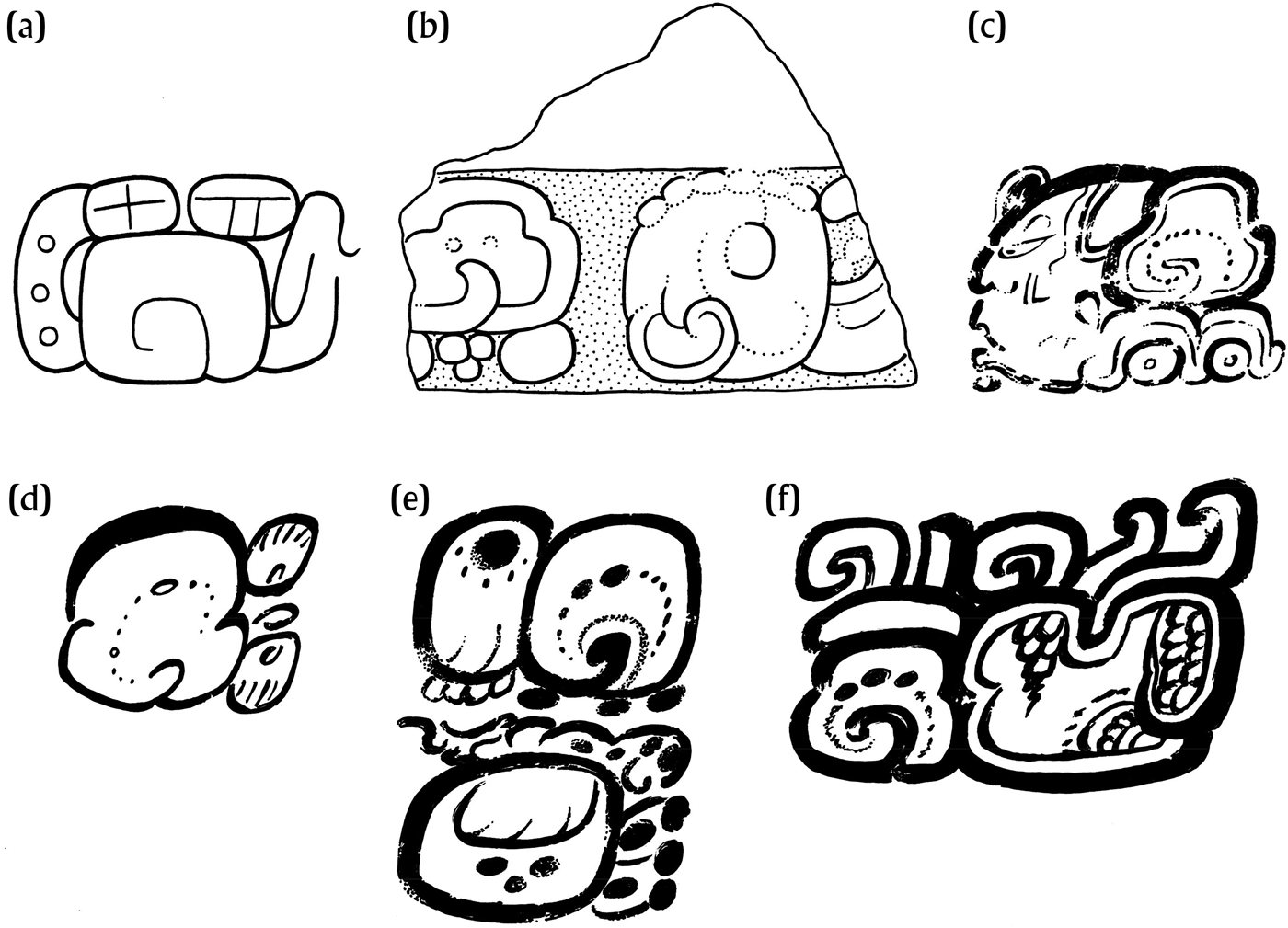
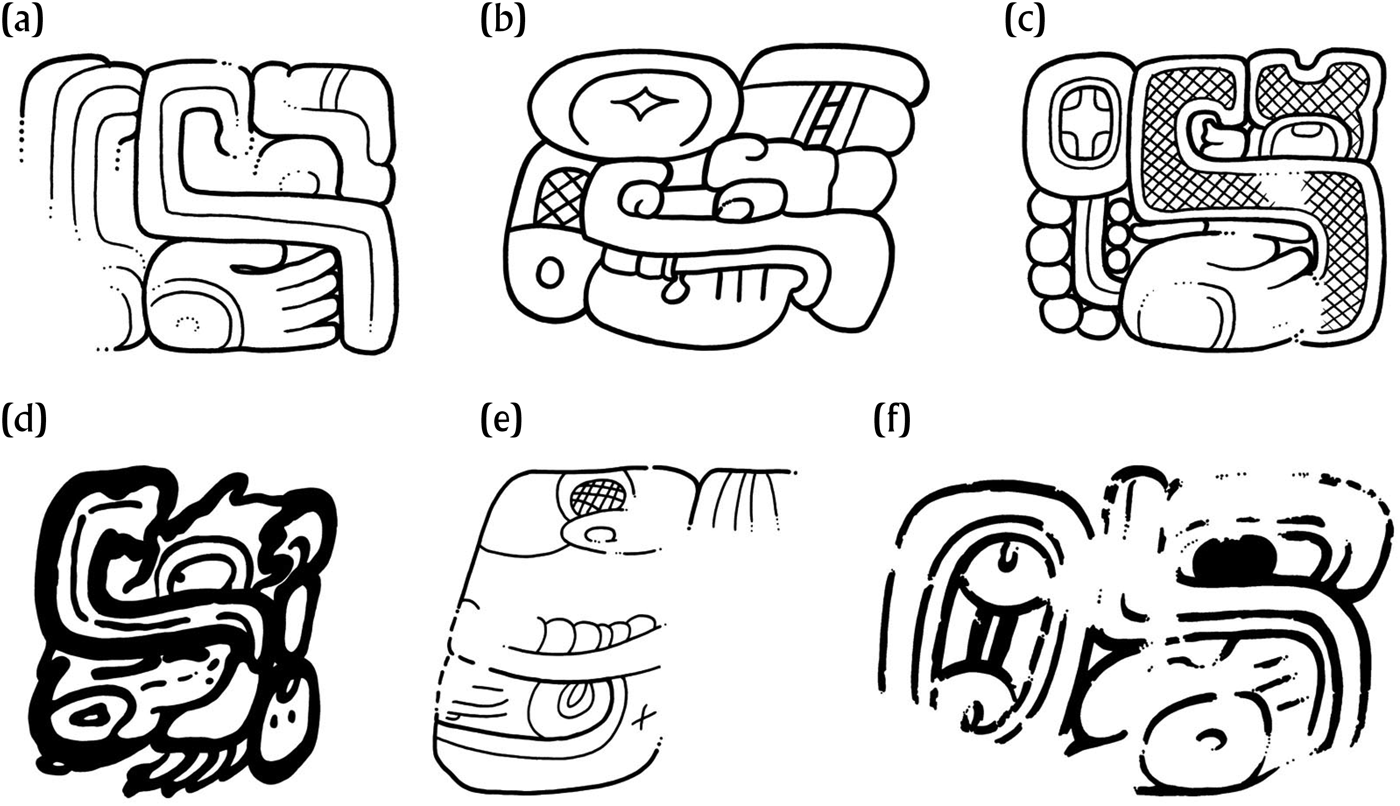
The Water Scroll main sign of the emblem glyph under examination remains an undeciphered logogram. We therefore continue to refer to it by its nickname and also at times by its number in the Thompson (Reference Thompson1962:205) sign catalog, namely T579 (a related variant was given the designation T578). What appears to be the same logogram is seen with various phonetic signs in final position (as postfix or subfix), which suggests that these may serve as phonetic complements, or to spell derivational suffixes. On the jadeite plaque found at Altun Ha, for instance, the main sign appears to be complemented by –niFootnote 1 (Figure 2a; Helmke Reference Helmke1999:19, 21; Mathews and Pendergast Reference Mathews and Pendergast1979:202, Reference Mathews, Pendergast and Graham1981:247; Pendergast Reference Pendergast1982:85). In contrast, in an unpublished monument fragment from Tonina, the logogram is affixed by –la, in what may be a nominal context, presumably providing an anthroponym (Figure 2b). This may compare to the name of the mother of the Naranjo ruler “Itzamnaaj” K'awil, who was drawn from the royal house of Yaxha and was nicknamed Lady Shell Star (Closs Reference Closs, Hanks and Rice1989; Martin and Grube Reference Martin and Grube2000:82), although her name consists of the same Water Scroll sign above an EK’ logogram, for ‘Water Scroll star’ (Figure 2c). Finally, on an unpublished vase in a private collection, the same Water Scroll sign receives a clear –ma sign as a subfix (Figure 2d; Matteo Reference Matteo2015). This is a feature shared with a pair of codex style vases naming a supernatural entity or spirit familiar (Helmke and Nielsen Reference Helmke and Nielsen2009; Houston and Stuart Reference Houston and Stuart1989:6; Stone and Zender Reference Stone and Zender2011:233, n. 7). On these vases, the spirit is named HA’-T579-ma-Hix, or ‘water … feline,’ which indicates that the Water Scroll cues a word with an aquatic semantic domain (Figure 2e). A similar case is also seen in a nominal sequence on the recently discovered Monument 3 at the site of Tipan Chen Uitz in Belize (Helmke et al. Reference Helmke, Andres, Morton and Wrobel2015:16).
Examples of the Water Scroll logogram: (a) The Emblem Glyph on the jadeite plaque found in Tomb B-4/6. (b) Detail of Monument 133 at Tonina. (c) The name of Lady Shell Star of Yaxha on a Chinos Black-on-cream vase produced at Naranjo (K635). (d) Example of the logogram with ma syllabogram on a vase in a private collection (after Matteo Reference Matteo2015:Figure 7). (e) Name of the aquatic feline spirit rendered on a Codex Style vase (K771). (f) The name of a supernatural mountain rendered on the wall of Tomb 25 at Río Azul. Drawings by Helmke.

Given the wide array of syllabograms, while not impossible, it is unlikely that these all function as typical phonetic complements. As a result, and in the absence of a fuller understanding of the semantics of this sign, we are not yet closer to proposing a decipherment.Footnote 2 Yet, the iconography does, however, make it clear that the sign marks bodies of water, perhaps specifically freshwater, and may, in fact, represent a wave (see Hellmuth Reference Hellmuth1987:Figures 179–182, 189; Matteo Reference Matteo2015; Schele and Miller Reference Schele and Miller1986:47). As a result, we may venture to suggest that toponyms involving the Water Scroll sign name prominent bodies of freshwater. The very same sign also occurs as part of a toponym that is prominently painted on the walls of the famed Early Classic tombs at Río Azul, particularly Tombs 5, 6, 25, and possibly also Tomb 2 (Figure 2f; Hall Reference Hall and Adams1986). This toponym is one of four named supernatural mountains that are tied to one of the principal cardinal directions, and it appears to be written SAK[T579]-WITZ-NAL, for ‘white Water Scroll mountain place’ (Acuña Reference Acuña, Golden, Houston and Skidmore2015).
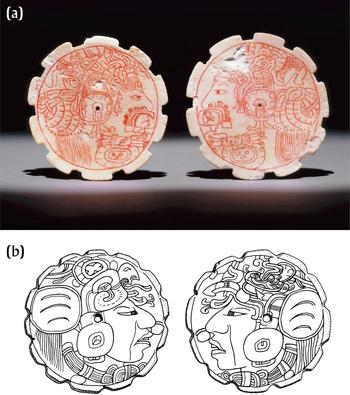
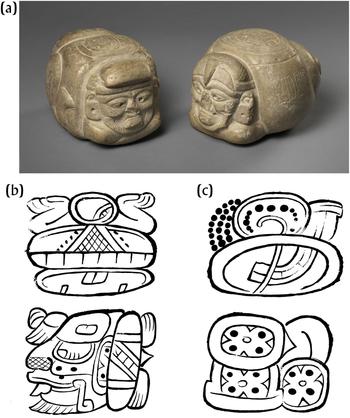
Another interesting example is found integrated in the iconography decorating a set of unprovenienced carved shell ear ornaments (K5086; Figure 3a). The set depicts two regal figures in profile, the carved details emphasized by hematite pigment. The style of the depictions suggests that they were produced sometime in the sixth century. Both figures have elements adorning their mouths, and wear large earspools that echo the very objects that bear these depictions. In addition, the figures wear large capes with long fringes, attached at their necks with broad knots above shell gorgets. These objects are very reminiscent of a pair of contemporaneous shell ornaments found in Burial C-16/13 at Altun Ha (Figure 3b; Pendergast Reference Pendergast1982:Figures 109a–109b). These ornaments portray individuals with headdresses that bear glyphic elements that appear to spell the names of the figures depicted. The name on the left includes both the elements k'in, ‘sun,’ and mo’, ‘macaw’ (see Zender Reference Zender1998:14), whereas that on the right has a paw, or at least a claw, perhaps ich'aak, and the head of the great celestial bird, elements attested in other regnal names. Similarly, there are elements on the unprovenienced set that appear to provide the name of the figure at the left, whereas that on the right has a Water Scroll sign, topped by the ajaw logogram. Whereas these two elements do not constitute a complete emblem glyph, they nevertheless designate the figure as the Water Scroll king. Considering the many points of equivalence between these ornaments those found at Altun Ha, a provenience attribution to that site is quite plausible, especially since the site had suffered considerable looting before the onset of archaeological interventions in 1964.
(a) A pair of decorated shell earspools depicting royal figures in profile, including a Water Scroll king (at right). Photograph K5086 © Justin Kerr. (b) A comparable pair of decorated shell earspools found in Burial C-16/13 at Altun Ha, dated to ca. a.d. 550. Drawing by David Findlay, reproduced with permission (after Pendergast Reference Pendergast1982:Figures 109a–109b).

In the initial analyses of this title presented by Mathews and Pendergast (Reference Pendergast1979:202, Reference Mathews, Pendergast and Graham1981:247–248) they rightly point out that there are broad similarities between the Water Scroll emblem glyph and that borne by lords of the Petexbatun region, particularly Tamarindito and Arroyo de Piedra (see Mathews Reference Mathews and Patrick Culbert1991:20; Martin and Grube Reference Martin and Grube2000:19), but it is now clear that these two signs are distinct. The similarities between the signs are brought about by shared iconographic attributes, as both appear to refer to bodies of water or hydrological features (see Schele and Miller Reference Schele and Miller1986:47; Stone and Zender Reference Stone and Zender2011:23, 232). In addition, both signs can be rendered either as a spiral within a rounded square, or as a coiled trilobate form. That used in the Petexbatun region frequently illustrates small aquatic plants at the corners of the sign and the scroll is often embellished with cross-hatched fields (see Houston Reference Houston1993:99, Figure 4-2f). These observations have led Guenter (Reference Guenter2008) to suggest that the main sign represents the Petexbatun lagoon, the most prominent body of water in the area, where aquatic plants often grow to the surface of the waters. In contrast, the main sign of the Water Scroll kings never has such plants, nor the cross-hatching, and, instead, has a plain scroll and small circular elements within the scroll, presumably denoting air bubbles (see Matteo Reference Matteo2015). The differences make it clear that the Water Scroll emblem glyph is the dynastic title of another distinct royal house.Footnote 3
ALTUN HA, JADEITE PLAQUE
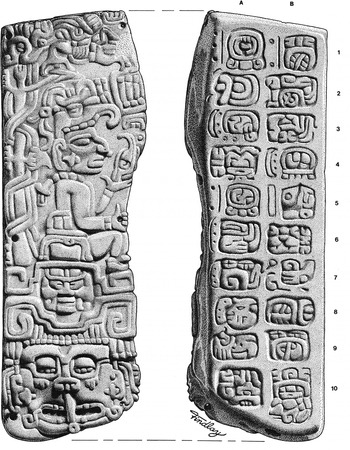
Without a doubt, the jadeite plaque (RP256/3) found at Altun Ha, and mentioned at the onset, is at the root of all research concerning the Water Scroll emblem glyph (Figure 4). It was found in Tomb B-4/6, which contained the remains of a probable young to middle-aged adult male skeleton. The tomb was richly furnished with three ceramic vessels, two chimneyed censers, a pair of pearls, a stucco-coated object, an obsidian flake, the complete shell of a fighting conch (Strombus pugilis), 10 spiny oyster shells (Spondylus americanus), most of them modified, and 55 angular pieces and a single lamina of crystalline hematite. Items of personal adornment included a necklace of 109 shell discs, a stunning set of 19 carved jadeite and albite pendants and beads, a necklace of 21 beads, an anklet of 69 beads, as well as the large inscribed jadeite plaque (Pendergast Reference Pendergast1982:84–91). The tomb was built within the second phase of construction (penultimate), which has been dated to ca. a.d. 650, in the Mac phase (Pendergast Reference Pendergast1982:102–103, 136–137). When the plaque was first studied by Pendergast (Reference Pendergast1969:91), he concluded rather pessimistically that: “this group of twenty glyphs seems a hopeless jumble of symbols and meanings, a maze through which no path can be cleared … until such time as our knowledge of the meanings of the glyphs, as well as the workings of the system, has increased.” Mathews studied the plaque in the late 1970s and a short coauthored paper eventually appeared (Mathews and Pendergast Reference Mathews and Pendergast1979). Revised syntheses that integrated Mathews's most recent readings were subsequently published (Mathews and Pendergast Reference Mathews, Pendergast and Graham1981; Pendergast Reference Pendergast1982:84–85).
The large jadeite plaque (RP256/3) found within Tomb B-4/6. Drawing by David Findlay, reproduced with permission (after Pendergast Reference Pendergast1982:Figure 55).

In his detailed and attentive analyses of the plaque, Mathews was able to identify the two clauses that together constitute the text. The first is headed by the calendar round date 8 K'an 7 Sip, which can be anchored to the 9.6.15.6.4 Long Count date and correlated to May 6, a.d. 569 (expressed in proleptic Gregorian calendar, using the GMT+1 correlation coefficient; see Martin and Skidmore Reference Martin and Skidmore2012). On this date a warfare event is recorded against an unidentified person or locality, an event that is described as ch'ahkaj, ‘he axed, chopped.’ The individual behind the attack is introduced by an agency expression read uchabjiiy, and the name of agent is given as K'inich Chak Pax(iil). This figure is not known from other texts and, as such remains, rather obscure.
The second clause is initiated by another calendar round date, 7 Kaban 5 K'ank'in. This date can be anchored to 9.7.11.2.17 in the Long Count and correlates to December 7, a.d. 584. The verb or action that transpired on this date is written u-K’AL[HUN]-ja, to be read as u-k'al-huun-aj. The verbal expression involves the root k'al, ‘to hold, take, present, bind,’ and the substantive huun, literally ‘(bark) paper,’ but ‘crown’ by extension, since this refers to a particular type of paper headband worn in accession ceremonies (see Schele et al. Reference Schele, Mathews and Lounsbury1990; Stuart Reference Stuart, Golden, Houston and Skidmore2012; Zender Reference Zender2016). Together the compound k'al-huun forms a derived noun, which can be denominalized, or verbalized, by the affixation of the suffix –aj (Lacadena Reference Lacadena, González Blanco, Pablo Vita Barra and Ángel Zamora López2003:855–857), as is seen in this case. With the addition of the third person pronominal prefix u–, functioning as a possessive marker, the entire construction can be understood as ‘it is his crown-taking,’ clearly referring to the acquisition of a crown as part of a royal investiture ceremony. The person that is said to have acceded to kingship on this day is named Til Man K'inichFootnote 4 (Helmke Reference Helmke1999:19, 20–21; Mathews and Pendergast Reference Mathews and Pendergast1979:201–202), whose name is written with three logograms. The first represents a small figure with bent arms that functions as TIL, whereas the main sign is the so-called “Serpent Segment” that depicts a lateral view of snake, with ventral scales at the bottom and trapezoidal dorsal markings at the top, for MAN, followed by K'INICH at the right. Onomastically, this name is a verbal theonym that refers to one particular attribute or facet of the sun deity K'inich, literally ‘radiant (one)’ (e.g., Colas Reference Colas2003).
The pedigree of this individual closes the text by providing references to his mother and father, in that order. The mother bears the title k'uhul ixik, ‘divine lady,’ and seems to be named Chan(al) Lem?, Maax Ajaw, perhaps ‘Celestial Celt, Spider Monkey Lord.’ The father, in turn, is not named as such, but is only referred to by his title, and he is described in this capacity as one who bore the title of kalo'mte’ for a k'atun, or score of years. Although far from adequate, this kalo'mte’ title can be translated very loosely as “warlord” or “emperor” (Guenter Reference Guenter2002:20; Stuart Reference Stuart, Carrasco, Jones and Sessions2000:487), and, in the Early Classic, served as a mark of distinction of the most exalted kings who often served as overlords to other kings, as the very nexus of allegiances with vassal kings (e.g., Martin and Grube Reference Martin and Grube1994).
As discussed by several authors, the appearance of the kalo'mte’ title in the Maya area coincides with the so-called Teotihuacan entrada (e.g., Martin Reference Martin, Grube, Eggebrecht and Seidel2001; Stuart Reference Stuart, Carrasco, Jones and Sessions2000). The use of the title by Maya kings thereby implies ties with that great central Mexican metropolis, be they genuine or fictive. In this connection, the presence of 23 Teotihuacan ceramic forms (including jars, bowls, and dishes), and 248 pieces of green obsidian from Pachuca within Tomb F-8/1 at Altun Ha is strongly indicative of some intimate relationship between the two centers (Pendergast Reference Pendergast and Braswell2003). One can venture the conjecture that the use of the highly exalted kalo'mte’ title by the kings of Altun Ha was vindicated by precisely this connection.
Most interesting for the present study, the title borne by Til Man K'inich is a complete emblem glyph, with the Water Scroll as its main sign, followed by a ni syllabogram, possibly a phonetic complement. The second agent presented on the plaque, who acceded to the throne in December a.d. 584, was therefore one who bore the Water Scroll emblem glyph as his dynastic title and who would see his claims bolstered with an illustrious pedigree.
Because the Water Scroll emblem glyph and the emblem glyph utilized in the Petexbatun region are now recognized as distinct, it is clear that the former is the dynastic title of another royal house. In view of the portability of the jadeite plaque, it is possible that its origin lies at another site. This is an important observation, not the least since the plaque appears to have been an heirloom, as the last date mentioned on the plaque corresponds to a.d. 584 and the tomb can be dated to ca. a.d. 650 (Mathews and Pendergast Reference Mathews and Pendergast1979:204–205, Reference Mathews, Pendergast and Graham1981:250). Nevertheless, as has been aptly remarked by Pendergast, considering the profusion of imported and finely worked greenstone at Altun Ha and the evident importance of the site, the provenience of the plaque makes it at least a very promising candidate as an object produced at the site (Mathews and Pendergast Reference Mathews and Pendergast1979:202, Reference Mathews, Pendergast and Graham1981:248). As a result, it was suggested from the outset that the Water Scroll emblem glyph may well refer to the royal house established at Altun Ha, and, without any evidence to the contrary, by the early 1990s this interpretation had become entrenched in epigraphic circles (see Martin and Grube Reference Martin and Grube2000:19; Mathews Reference Mathews and Patrick Culbert1991:20). This conclusion still has much to favor it, and has been pursued by the authors collaboratively (see Grube et al. Reference Grube, MacLeod and Wanyerka1999:28–29, Figure 5; Helmke Reference Helmke1999; Helmke and Awe Reference Helmke and Awe2008:75; Wanyerka Reference Wanyerka2009). In the discussion that follows, we continue to explore the various occurrences of the Water Scroll emblem glyph, both to ascertain the probability that the title refers to the kings of Altun Ha, and to begin to sketch out a historical overview of prominent kings of that royal house.
LIMESTONE STATUETTES OF UNKNOWN PROVENIENCE
Another set of evidence is afforded by a pair of fine limestone statuettes representing aged male deities (Figure 5a). These statuettes have recently been acquired by the Princeton Art Museum (Just Reference Just2013), but were originally part of the private collection of Jay C. Leff, an affluent banker of Uniontown, Pennsylvania. From published records, Leff acquired the statuettes in 1959, and they were on loan to the Brooklyn Museum in the mid-1960s, where they were exhibited along with large parts of the substantial collection (Easby Reference Easby1966). Thereafter, the businessman Peter G. Wray, of Scottsdale, Arizona, acquired the pieces in question. While they were part of the Wray collection, these pieces were featured in an exhibit hosted by the Perls Gallery in 1984 (Emmerich Reference Emmerich1984) before their acquisition by the Princeton Art Museum in 2013. Evidently, these pieces are of unknown provenience and have had a very active life since they were unearthed in the 1950s, but the middlemen or antiquities dealers related to Leff that these were allegedly from British Honduras. As we will see, the glyphs that adorn the statuettes support this attributed provenience.
(a) A pair of limestone statuettes representing aged male deities. Note the incised glyphs on the side and the larger, circular glyphic medallions on the backs of the statuettes. Photograph by Bruce White © Princeton Museum of Art. The glyphic text adorning the sides of the Itzam K'an Ahk figure: (b) the left side of the statuette naming the original owner; and (c) the right side of the same, providing the owner's titles. Drawing by Helmke.

Together, the two statuettes represent crouching male deities, with prominent facial hair, the mark of aged figures, similar to the pawahtun or bakab known from the ethnohistoric sources of Colonial period Yucatan (see Martin Reference Martin, Golden, Houston and Skidmore2015; Taube Reference Taube1992:92–99). More properly speaking, the supernatural entities are seen emerging from other beings, since one may appears from what may be a crocodilian creature, replete with a fish nibbling on its tail (see Hellmuth Reference Hellmuth1987:Figures 710–713). This is one particular variant or aspect of the aged male deities, who are usually subsumed under the heading of God N (see Taube Reference Taube1992:92–99), a matter discussed at length by Martin (Reference Martin, Golden, Houston and Skidmore2015:194–196). The other figure wears a characteristic netted headdress and is shown emerging from the large coiled shell of a marine gastropod (Hellmuth Reference Hellmuth1987: Figures 706–709). These attributes mark him as one of the Atlantean figures that were thought to bear the sky, known from other hieroglyphic texts as Itzam K'an Ahk, or ‘wizard yellow/shell turtle’ (Martin Reference Martin, Golden, Houston and Skidmore2015:188–192). Epigraphic, ethnohistoric, and ethnographic sources make it clear that such Atlantean figures are said to occur in sets of four, and, as such, it is likely that these two statuettes originally formed part of a set of four, wherein each represented a distinct aged deity, each tied to a particular cardinal direction.
Both statuettes bear short glyphic captions and one prominent glyph block on their backs. Each of the large glyphs is rendered in a circular cartouche, and together probably once formed an independent clause to be read across the presumed original set of four. As preserved, we have a relationship expression and a personal name, but we can expect a verbal or possessive statement on the first statuette and a title on the last, to form a complete clause. At present, the name that adorns the back of the Itzam K'an Ahk effigy can be transliterated as a-K'AN-ba-tz'u for ajk'an ba'tz’, or ‘he the yellow howler monkey.’ On the back of the crocodilian figure, we can identify the relationship expression 1-TAN-na for juuntahn, literally ‘one chest,’ but more freely as ‘of one's breast.’ This expression is typically used to describe the relationship between a mother and her child (Stuart Reference Stuart, Macri and Ford1997:8–9), and thereby can be understood as “cherished one,” but at times can also refer to the affection that kings have for their deities (Guenter Reference Guenter2007:30, 54; Helmke Reference Helmke2012:99). Although conjectural, the original set of four glyphs is likely to have formed a statement of ownership, or nametag, asserting that “the four aged deities were the cherished ones of Ajk'an Ba'tz’, who was lord of such-and-such a place.”
Most interesting are the small, incised texts that adorn the two effigies, particularly that found on the sides of the Itzam K'an Ahk figure (Figures 5b–5c). On one side, we see two glyph blocks that provide a name (Figure 5b), whereas the opposite side provides his titles in another two glyph blocks (Figure 5c). Together these can be analyzed as follows:

Fascinatingly, this caption provides precisely the same name as that seen on the Altun Ha plaque (Houston Reference Houston1984:796, Figure 9). The secure archaeological provenance of the plaque lends much weight to the initial attribution of British Honduras to the statuettes as originally being from Belize, if not from Altun Ha itself or its vicinity. Whereas some of the details are not entirely evident on the plaque, the glyphs on the statuette are perfectly clear and executed by a highly skilled hand. Here, the details of the TIL and MAN logograms are all visible and the final part of the name is rendered with the head of the Sun God. The emblem glyph that this figure bears is also significant because the scribe has chosen to place the T579 Water Scroll sign in the superfix or upper portion, leaving most of the AJAW logogram exposed, which is usually concealed by the toponymic main sign. There can be little doubt, therefore, that the person named on the plaque and on the statuette are one and the same. Stylistically, the statuettes can also be attributed to the sixth century and, as such, are wholly contemporaneous references.
In addition, Til Man K'inich is also provided with another title that may be read elk'in …k'in. The reading of this title is complicated by the fact that one part is written on its head, whereas the second appears to refer to a title that continues to flummox epigraphers. Assuming that the orientation of the initial portion is to be ignored as a scribal error of sorts, we can read this segment as elk'in or ‘east.’ The second portion appears as the title proper, which here may be rendered in a phonetically transparent form as yo?-K’IN, but one that is syncopated and affected by morphophonemic processes, possibly read as yok'in.Footnote 5 Whereas the precise form and meaning of this title remain debated, the surface form may find its origins in /y-ok-k'in/, referring to ‘the sun's entry’ or the ‘sun's pedestal, base, plinth’ (see Valencia Rivera and Sheseña Hernández Reference Valencia Rivera and Sheseña Hernández2016). Significantly, this title is here qualified and preceded by elk'in, east, indicating that the person bearing this title hailed from this quadrant of the world and exerted his office over a commensurate area.
The use of geographic qualifiers is seen in a series of different titles, and it indicates that the ancient Maya were keenly aware of what we today call the Maya area. Whereas the kings of Copan and Quirigua at times used the prefix nojool, ‘south,’ with their titles, kings of the Yucatan peninsula such as Ek Balam used xaman, ‘north,’ in theirs, while kings of the eastern central lowlands and Belize in particular used elk'in, ‘east’ (see Tokovinine Reference Tokovinine2013:94). The use of elk'in as a titular modifier is exceedingly rare and has only been securely documented in texts at Lamanai, Uaxactun, and Yaxchilan. At Lamanai (Stela 9), the local monarch K'ahk’ Yipyaj Chan Yopaaht bears the title elk'in kalo'mte’, or “eastern emperor” (Closs Reference Closs1988:14).Footnote 6 At Uaxactun, the title is found on the so-called Initial Series Vase, designating a mythical ruler (Carter Reference Carter2015:10–11, Figure 10) who is qualified as k'uhul kan[u'l], ‘godly Kanu'l’ (Simon Martin, personal communication Reference Martin, Tokovinine, Treffel, Fialko, Arroyo, Salinas and Ajú Álvarez2017). This suggests that this figure may have ruled at the ancient capital of the Snake-head dynasty, quite possibly Dzibanche in modern Quitana Roo (Martin and Velásquez García Reference Martin and Velásquez García2016). Similarly, at Yaxchilan (Stela 10) it is the mother of the famed Bird Jaguar IV who also takes the elk'in kalo'mte’ title. Based on her other titles, including that of Ixkanu'l ajaw (lit. ‘lady-Kanu'l princess’), she may also originate from Dzibanche, the original seat of the Snake-head dynasty, to the east (Martin Reference Martin2005; Martin and Velásquez García Reference Martin and Velásquez García2016). The provincial division huk tzuk, ‘seven province,’ was likewise divided between east and west, wherein elk'in was used to designate individuals hailing from sites east of Naranjo, a site that is only 14 km from the modern Guatemalan-Belizean border (see Beliaev Reference Beliaev, Colas, Delvendahl, Kuhnert and Schubart2000:65; Tokovinine Reference Tokovinine2013:99–102; Helmke et al. Reference Helmke, Andres, Morton and Wrobel2015:26–28). As such, the use of elk'in, ‘east’ in the titular string of Til Man K'inich confirms that he ruled over the eastern reaches of the Maya world in what is now Belize. This key piece of evidence supports the identification of the Water Scroll dynasty with a site in Belize, such as Altun Ha.
CHAU HIIX: CARVED BONE PIN
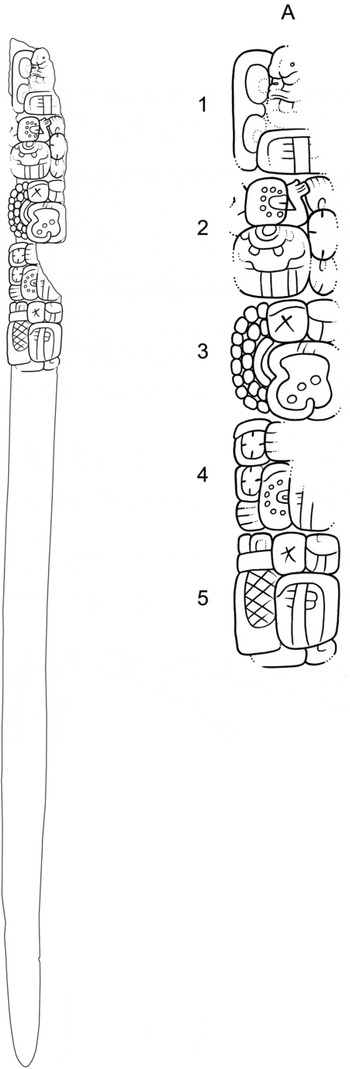
Another remarkable piece of evidence is a small glyphic text incised on a bone pin found at the archaeological site of Chau Hiix (Figure 6). The site is located just 19 km west of Altun Ha, along the Western Lagoon of northern Belize, essentially midway between Lamanai and Altun Ha (Pyburn Reference Pyburn1991). The pin was found within Burial 43, in the core of Structure 38, the basal platform supporting four structures that together form a residential group or plazuela just to the south of the palatial complex (Group C) and possibly connected to the monumental architecture by a raised via (Andres Reference Andres2009:Figure 2b; Cook Reference Cook1997:182). The burial contained the remains of an adult male accompanied by three ceramic vessels, including a large red ware dish and a black ware bowl with small “coffee bean” incised motifs along the base. Although the excavators identified these vessels with Early Classic types (Cook Reference Cook1997:171, 177), it is more probable that the dish is a sixth-to-seventh-century Tiger Run form (perhaps Mountain Pine Red) and that the bowl is a postslip incised black ware, clearly a form and type of the Late Classic (see Gifford Reference Gifford1976:193–195; Pendergast Reference Pendergast1990:Figures 106n and 163q). In addition, a chalcedony axe head was recovered near the cranium, as well as four conch shell “ladles,” which may have served as inkwells, and a series of other shell objects (Cook Reference Cook1997:171–174). Most significant was the discovery of a highly fragmented, red-painted bone pin bearing five glyphs at its distal end (Cook Reference Cook1997:174). Based on comparisons to similar artifacts (see Dacus Reference Dacus2005; Stuart and Houston Reference Stuart, Houston, Inomata and Houston2001:64–65), this object may have served as a weaving pin, and as found measured approximately 23.4 centimeters in length, although the proximal end has broken off. It was clearly made from the bone of a large mammal and could well be made from a human fibula (Cook Reference Cook1997:174; Pyburn Reference Pyburn2005:150; Gabriel Wrobel, personal communication 2005).
The carved bone pin found in Burial 43 at the site of Chau Hiix and detail of the glyphic text. Drawing by Helmke.

The short text that adorns the head of the pin consists of five glyphs arranged in a column. Not surprisingly, the text is a name tag, providing a statement of possession between the object and its original owner. The first glyph (A1) makes reference to the pin itself and is preceded by the third person pronominal marker u– for ‘his’ in this instance. A reference to the pin follows and, whereas the main sign is unclear owing to breakage and erosion, it appears to represent a cranium and is clearly followed by the syllabogram ki. As such, it would appear that the first glyph is written u-BAK-ki, to be read u-baak ‘it is his bone.’ The name and titles of the owner follow suit. First comes the name (A2) which here is written as TIL-MAN-K'INICH, precisely duplicating the name seen both on the Altun Ha plaque and the stone statuettes that are said to be from the area. The first title borne by Til Man K'inich on the bone pin is once more the Water Scroll emblem glyph (A3), which confirms that the same person once owned this object as well as the other two examined above. More surprising is the following title (A4), which attributes to him the title of elk'in kalo'mte’, or “eastern emperor” in precisely the same terms as K'ahk’ Yipyaj Chan Yopaaht, who is celebrated in the seventh century on Stela 9 at Lamanai (see Closs Reference Closs1988:14). The final glyph block (A5) is written as tu-AJAW-wa, but here the meaning is not entirely clear. One might conjecture, for instance, that it involves a prepositional phrase involving the contraction tu from /ti-u/, melding the preposition ti with the possessive prefix. This syntactically duplicates the final segments of similar texts on bones, such as tu-ma-ma on the bones of Burial 116 at Tikal (which we will return to, below), and tu-ba-ki. The latter may be contractions of chehe'n tu-baak, ‘it is said on the bone,’ providing a self-referential quotative (see Grube Reference Grube, Dedenbach-Salazar Sáenz, Arellano Hoffmann, König and Prümers1998; Martin and Grube Reference Martin and Grube2000:51; Stephen Houston, personal communication 2017; Stuart et al. Reference Stuart, Houston, Robertson and Grube1999:23). Assuming that the same type of elision is represented on the Chau Hiix bone, the final segment may be understood as ‘he said on the bone, the king,’ making the initial part of the text an utterance by the king himself.
Whatever the reading of the final glyph on the bone, the significance of the bone pin is that it was once the property of Til Man K'inich and that it found its way to Chau Hiix sometime at the onset of the Late Classic, to judge from the ceramics found in Burial 43. Considering also the proximity of Chau Hiix to Altun Ha, the occurrence of the same name with the same dynastic title once more increases the probability that the Water Scroll identifies kings from the area and suggests that Chau Hiix, for at least part of its history, found itself within the political ambit of the Water Scroll kingdom.
The preliminary interpretations that have been made of the bone pin in the literature must also be briefly commented upon. Rosemary Joyce initially worked on the glyphic text, but misidentified the Water Scroll emblem glyph as the one used in the Petexbatun region. In this respect, she also remarked on the partial similarity between the name rendered on the bone pin to that of a Tamarindito ruler, whose name is recorded on the Hieroglyphic Stairway 3 at the site, perhaps raised in the eighth century (Houston et al. Reference Houston, Chatham, Chinchilla, Ponciano, Wright, Pedro Laporte, Escobedo and Brady1992:Figure 2). The individual in question is named TIL-HA’-EK’, for Til(iw) Ha’ Ek’, wherein it is only the initial element that provides a superficial point of similitude. It was further assumed that the bone pin might mention this Tamarindito individual and, therefore, was a foreign import to Chau Hiix from the distant Petexbatun region (see Pyburn Reference Pyburn2005:150). In addition, the Late Classic reference on the hieroglyphic stair at Tamarindito was used to significantly push back the date of Burial 43 by several centuries into the Terminal Classic. Based on current evidence, however, it is more plausible to assume that the burial dates to around the same time as the whole vessels found within the burial and to assign the interment to the initial part of the Late Classic. Of course, it is still possible that the bone pin is an import to Chau Hiix and that it is an heirloom, but it is much more proximate both temporally and geographically. This view finds support in the title that Til Man K'inich bears on the bone pin, which is also qualified by ‘east’ and therefore is more likely to be of local origin.
PUSILHA, STELA D
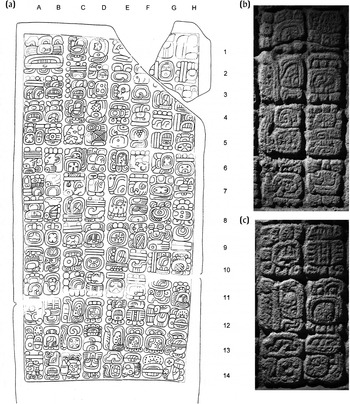
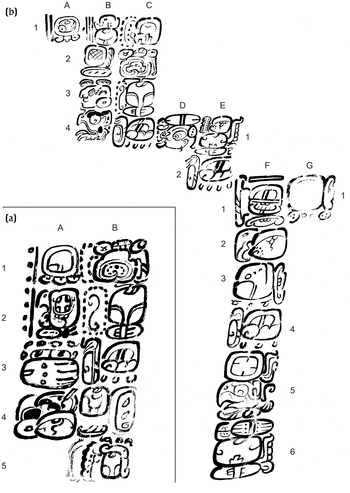
The next references to the Water Scroll are found at Pusilha, on the back of Stela D (Figure 7a); these do not make use of the emblem glyph, but only the main sign, which is employed for its toponymic function. These examples are key to understanding that the main sign of the Water Scroll emblem glyph is indeed toponymic and confirm that it can function by itself, retaining its referential value as a place name. The lengthy text starts with the dedicatory date of 9.8.0.0.0 (erroneously written 9.3.0.0.0), which corresponds to August 25, a.d. 593 (see Prager Reference Prager2013:259; Wanyerka Reference Wanyerka2003:21, Reference Wanyerka2009:333). After recording the erection of a stela under the aegis of one K'awiil Chan K'inich, the narrative skips forward a little under two years, to the date 2 Lamat 1 Sip, or April 25, a.d. 595. On this date, we see a rare warfare expression, here written i-k'a-sa-ya (D11) LAKAM-TUN-ni (C12) for i-k'as-ay lakam-tuun, or ‘and then were splintered the stelae’ (Figure 7b; Prager Reference Prager2013:261, 277; Wanyerka Reference Wanyerka2003:23, Reference Wanyerka2009:338–339). This event was clearly one that marred the dynastic history of Pusilha, and those responsible for this assault and damage are introduced by means of an uchabiiy agency expression (D12). It is interesting that the agent is referred to by neither name nor title but by a toponym instead, to provide a type of demonym. The toponym is question is written with the T579 Water Scroll main sign, accompanied by the syllabogram ni-bi (Wanyerka Reference Wanyerka2009:338–339). Together these provide the compound suffix –n-ib that is seen with a series of other toponyms, including te’-n-ib and took’-n-ib, cited in the texts of Xunantunich and Topoxte, as well as one of the place names for Naranjo in which the head of the Jaguar God of the Underworld, perhaps read chuwaaj, is equally followed by the same suffix (see Helmke et al. Reference Helmke, Awe, Grube, LeCount and Yaeger2010:104–106; Houston et al. Reference Houston, Robertson and Stuart2001:50, n. 7). Based on collaborative work with Alfonso Lacadena, we have been able to conclude that this suffix involves an -n- particle that serves to denominalize and intransitivize the preceding substantive so that it can take the instrumental suffix –ib, which is typically only used with intransitive verbs. As such, the resulting forms provide toponyms that specify where particular things occur or, more properly speaking, take place, including ‘trees’ at Te'nib, ‘flint’ at Took'nib, the ‘Jaguar deity’ at Naranjo, and freshwater waves at the Water Scroll place. The text of Pusilha Stela D therefore informs us that those responsible for destroying and despoiling the stelae of Pusilha hailed from the Water Scroll place, which we surmise must refer to Altun Ha.
(a) The hieroglyphic text on the back of Pusilha Stela D. Drawing by John Montgomery reproduced with permission (after Wanyerka Reference Wanyerka2003:Figure 47). (b) Details of the first clause (C11–D14) to mention the Water Scroll Emblem Glyph and (c) the second clause (E12–F14). Photographs by Helmke (British Museum catalog no. Am1928,Q.79).

As an event that took place in a.d. 595, it may well be that this occurred under the aegis and on the orders of none other than Til Man K'inich, who acceded to power just 11 years earlier. The clause in question on Stela D continues with more martial actions, including jub-uuy (D13) u-took’, u-pakal (C14), providing the record of a defeat wherein the ‘his flints and the shields were toppled’ (Wanyerka Reference Wanyerka2009:339). To whom these implements of war belonged is specified in the following segment, although only the very first portion remains, which records ma’ ahk'ab-aal (D14), literally “without night.” The expression is the first part of a difrasismo, or poetic couplet, that is used to qualify kings as powerful, when they are labeled as ti ch'ahb ti ahk'ab-aal, ‘with creation, with night’Footnote 7 (see Knowlton Reference Knowlton, Hull and Carrasco2012:260–261; Stuart et al. Reference Stuart, Houston, Robertson and Grube1999:18; Zender Reference Zender1999:126–127). In contrast, kings that are defeated and powerless are designated as being without these attributes by adding the negative particle ma’, ‘none,’ as ma’ ch'ahb ma’ ahk'ab, ‘without creation, without darkness’ (see Zender Reference Zender1999:126–127), and it is part of this form of the difrasismo that is seen on Stela D. As such, the toppled armies were those of the defeated king, undoubtedly the ruler of Pusilha.
The Water Scroll toponym occurs once more, later in the text of Stela D as part of a reiteration, in which the account is driven forward by counting almost 53 years from the pivotal nadir in the narrative, the episode of the shattered stelae (Figure 7c). After a long distance number, the attack is reiterated as k'as-ay (F12) lakam-tuun (E13), acquiescently followed by uchabij (F13) and the Water Scroll toponym, written T579-ni-bi (E14). As such, this is not a separate mention of another later event, but is merely a repetition of the same earlier event. Nevertheless, with these two examples we can be sure of the meaning and intent of these statements, as well as ensuring the reading of key parts of these parallel clauses.
What is significant here from the vantage of this study is that the references to the Water Scroll place are provided to mark out distant adversaries, which means that it is improbable that the locality should be in the immediate vicinity. The location of Altun Ha just west of the Caribbean coast ensured that the site was extremely well-situated in terms of trade and commerce, but also allowed its dynasts to travel far both up and down the coast, perhaps also making use of the Belize River as a major artery of travel inland into the central lowlands. Considering that Pusilha is located approximately 207 kilometers south of Altun Ha as the macaw flies, it is interesting to note that the only other military expeditions recorded during the Classic period of an equal or greater reach are those of the Snake-head kings, when the dynasty was at the apogee of its power.Footnote 8 That the Water Scroll kings could mount an attack on such a distant enemy is ample testimony to the power they wielded and helps to explain, at least in part, the comparative richness of the relatively small site of Altun Ha.
TIKAL, CARVED BONE PINS
Thanks to the advances made in the decipherment of Maya writing, our understanding of Classic Maya politics and dynastic allegiances has greatly increased in recent decades and allows us to identify the dominant dynasties that controlled much of the politics in the central lowlands. These were the Mutu'l dynasty established at Tikal and the Kanu'l dynasty established at Calakmul in the Late Classic (e.g., Harrison Reference Harrison1999; Helmke and Awe Reference Helmke and Awe2016; Helmke and Kupprat Reference Helmke, Kupprat and Graña-Behrens2016; Martin Reference Martin2005). This over-simplified presentation of ancient Maya politics, however, fails to convey the fact that, for much of the Late Classic, Tikal was in an appreciably subservient position, vanquished by war and suffering through what has been termed a hiatus, from a.d. 562 to 692. During much of this time, Tikal rulers failed to erect monuments, and the few that were raised were obliterated in dynastic struggles (see Guenter Reference Guenter2002; Martin Reference Martin1999). In contrast, precisely the same period was one of dominance and triumph for the Kanu'l dynasty and its allies. This delicate balance of power was strikingly upset on August 9, a.d. 695, when a newly ascendant Tikal king bearing the regnal name Jasaw Chan K'awiil met the forces of the Kanu'l king Yuhkno'm Yich'aak K'ahk’ and decisively defeated them on the battlefield. Although Yuhkno'm Yich'aak K'ahk’ survived the encounter (Stuart et al. Reference Stuart, Canuto, Barrientos Q., Ponce and Baron2015), this event was a real turning point in Maya history. The Kanu'l were never able to fully recover from this defeat, and the eighth century saw the rise of a series of polities that once had been subservient allies of the Kanu'l. The relatively short period of domination, when the power and influence of the Kanu'l shone brightest, was quickly diminished, and would see Jasaw Chan K'awiil raise large and imposing structures throughout his city, including his iconic mortuary shrine, Structure 5D-1, better known as Temple I (see Harrison Reference Harrison1999:140–145; Martin and Grube Reference Martin and Grube2000:47). It is within this structure that a large wooden lintel was raised that commemorates the victory of Jasaw Chan K'awiil over the forces of the Kanu'l.
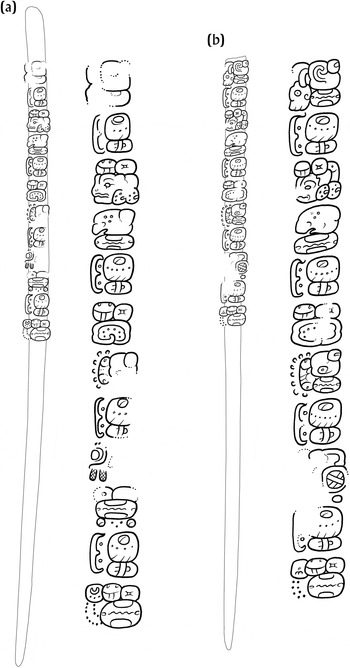
One of the most interesting sources on the reign of Jasaw Chan K'awiil stems from his tomb, designated as Burial 116, over which Temple I was raised. A bundle of bones, deposited in the southwestern corner of the funerary chamber, was among the many funerary goods that filled his richly provisioned tomb. This assemblage of bones derived from large mammals and, in all likelihood, many, if not most, are carved human long bones (Moholy-Nagy Reference Moholy-Nagy2008:61–62, Figures 189–209). The bones were worked into a wild array of forms, including tubes, tweezers, spatulate forms, and weaving pins. Many of the objects are inscribed with glyphic texts designated rather indelicately as “Miscellaneous Texts.” Some accompany mythological events, such as the famed scene of the Maize God's demise, in which he is ferried across and into the watery underworld by the Paddler Deities (see Freidel et al. Reference Freidel, Schele and Parker1993:89–92; Schele and Miller Reference Schele and Miller1986:52, 270–271; Stone and Zender Reference Stone and Zender2011:50–51). In addition, one bone provides a lengthy list of death dates, recording the passing of foreign kings, many of whom appear to have been foes of Jasaw Chan K'awiil (Houston Reference Houston1993:99, Figure 4-3). Others relate legendary events that came to pass centuries earlier, wherein celebrated predecessors travelled to far-off lands to be invested with the symbols of power (Taube Reference Taube2000). One set, with which we will concern ourselves here, is a pair of weaving pins with glyphic texts that provide near identical parallel clauses. The texts on these bones have been designated as Miscellaneous Texts 42A and 42B, the first consisting of 12 glyph blocks and the latter of 11 (Figures 8a–8b). We can reconstruct the complete clause using both texts, as both have suffered some breakage and erosion and also because MT42B omits one glyph block. On this basis, the following transliteration and structural analysis can be provided:

A pair of carved bone pins found in Burial 116 at Tikal. The pins and details of the glyphic texts (a) MT42A and (b) MT42b. Drawings by Helmke (after Moholy-Nagy Reference Moholy-Nagy2008:Figures 194c–194d and Tokovinine Reference Tokovinine2013:Figures 48b–48c).

Based on this analysis, we can see that the texts provide a clear pattern and structure, with each secondary clause introduced by a descriptive label followed by a statement of ownership, read u-baak, ‘it is the bone of,’ and a final portion that provides the name of a particular dynasty to which the bone is attributed. We must recall, however, that the term baak in Classic Mayan is homophonous for ‘bone’ in a literal sense and is also the word for ‘captive’ in an extended sense. The medial segments of the clauses recorded on these bones may therefore also refer to captives from the four corners of the world, and provide a distinctly Tikal-centric template of Classic Maya political geography.
The very first label that introduces the initial sub-clause may be read tzul baak, or ‘it is a foreign bone’ (see Beliaev Reference Beliaev, Nielsen and Helmke2013:170; Tokovinine Reference Tokovinine2013:97), which is attributed to the Copan dynasty. The second sub-clause may refer to a til-baak, possibly a ‘stoking bone,’ based on the use of this root in other contexts. This particular type of bone is attributed to the kings of the Water Scroll dynasty. The third sub-clause refers to a jul-baak, or ‘perforator bone,’ since jul means ‘spear, projectile’ as a noun but can also serve as the verb ‘to perforate, spear’ (see Boot Reference Boot2009:87), which appears to pertain to the dynasty of Edzna (see Pallán Gayol Reference Pallán Gayol2012:99).Footnote 9 Finally, the fourth sub-clause appears to be headed by patal-baak or ‘fashioned bone,’ involving the intransitive verb pat ‘to make, shape,’ and an –al nominalizing suffix. This type of bone pertains to the kings of Palenque, who bore the Bake'l emblem glyph (see Helmke Reference Helmke2012:95–100), here preceded by the honorific k'uhul, ‘godly, divine.’
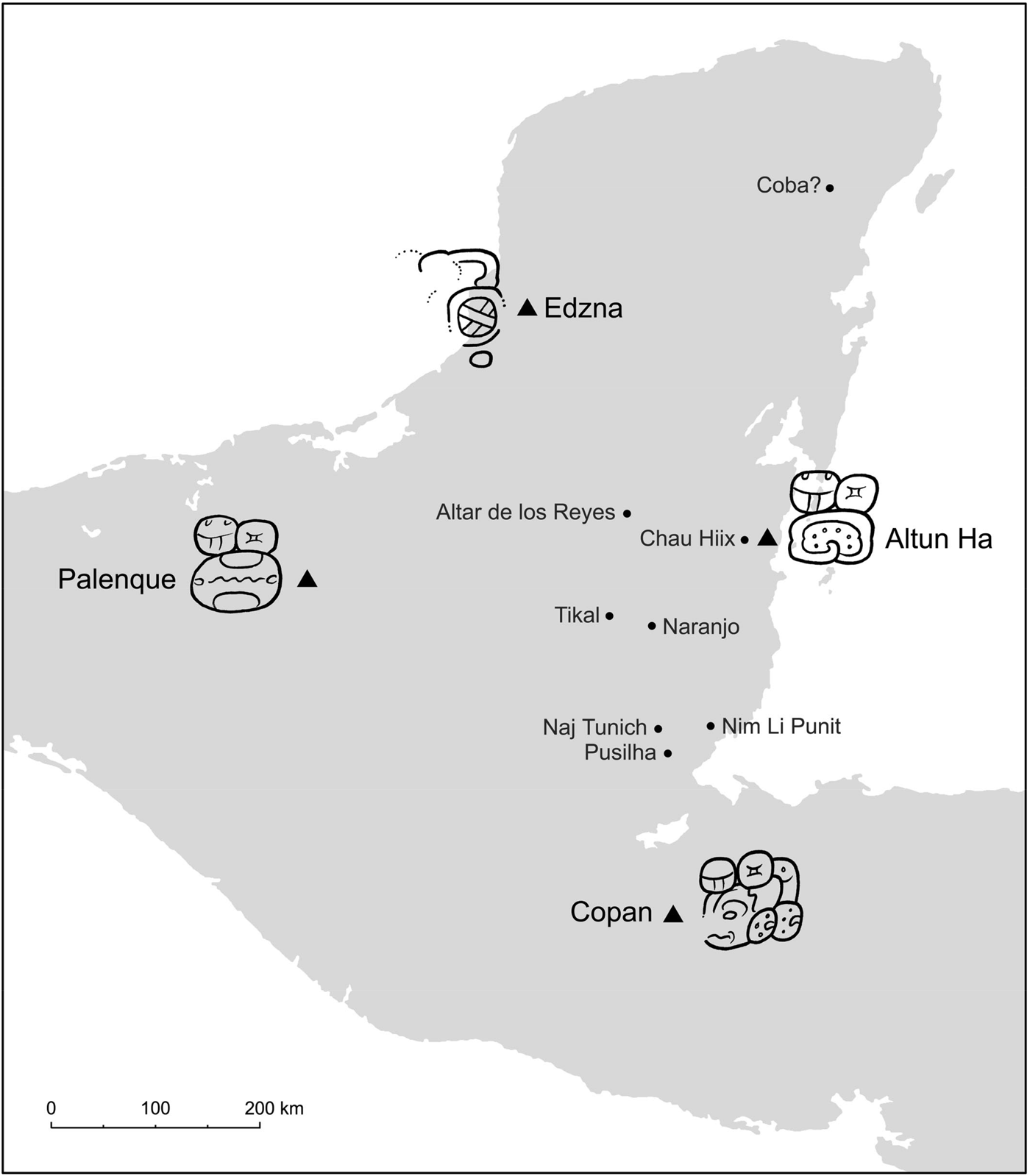
Apart from the clearly morbid medium that serves as the support for these texts, their content is also driven by macabre themes, by focusing on foreign bones and/or captives. Whereas we are able to parse the structure of these texts, the meaning and impetus behind them remain much more difficult to ascertain. What is interesting here is the reference to the Water Scroll dynasty in and among the dynasties of Copan, Edzna, and Palenque. One way to account for their inclusion here is that the four dynasties were somehow perceived to delimit the central Maya lowlands, as if they were thought to be located at the geographic extremities. This pattern would duplicate other instances wherein sets of four emblem glyphs are cited in texts commemorating encounters between kings, such as those recorded on Stela A at Copan and Stela 10 at Seibal (see Barthel Reference Barthel1968; Marcus Reference Marcus1973; Helmke and Kupprat Reference Helmke and Kupprat2017; Schele and Mathews Reference Schele and Mathews1998:159–161, 185–187). Assuming that this interpretation is correct, it can be suggested that Palenque was deemed to represent the west and Copan the south. In fact, Copan is the southernmost site that produced glyphic texts and had its own emblem glyph, in much the same way that Palenque is far to the west, not only of Tikal, but also in relation to the Maya world as a whole. This would leave Edzna to demarcate the north and the Water Scroll to typify the east. On these grounds, it seems likely that the Water Scroll should be situated in the east, and the location of Altun Ha agrees perfectly with such a scheme (see Figure 9). It can also be added that the rulers of these sites—Tikal, Copan, Altun Ha, Edzna, and Palenque—were all styled with the kalo'mte’ title, providing yet further support for the identifications provided here. These highly intriguing bones from Tikal speak of an emic awareness of the central Maya lowlands, of a geographic knowledge of distant Maya realms, a knowledge that strengthens the location of a victorious Tikal at the center of such a cosmological model, at the heart of Late Classic political geography (see also Tokovinine Reference Tokovinine2013:91–97).
Map of the Maya area showing the probable locations of the capitals of the four dynasties mentioned on the carved bone pins found at Tikal. Salient sites mentioning the Water Scroll Emblem Glyph are also presented. Map by Helmke.

ALTAR DE LOS REYES, ALTAR 3
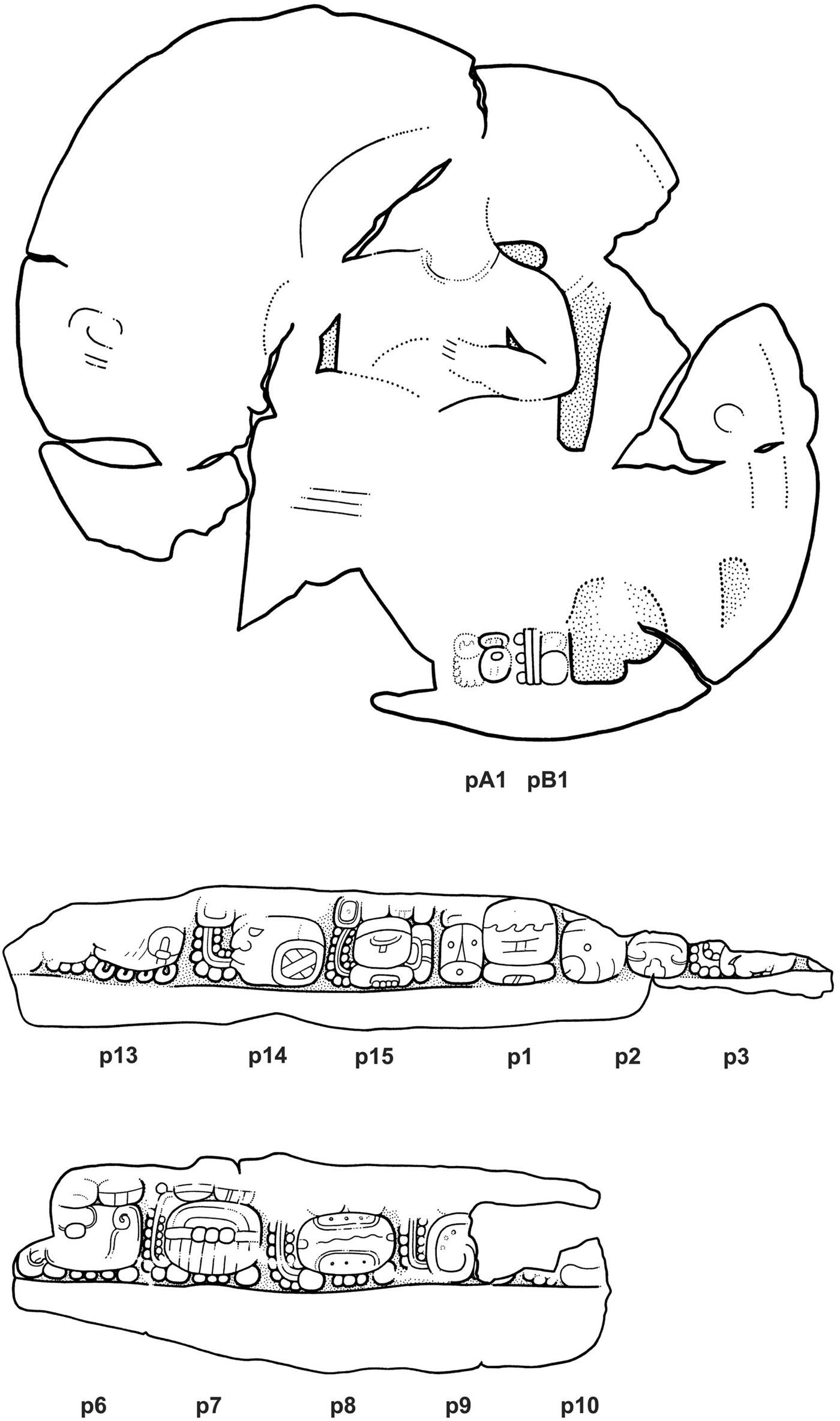
The next text to make reference to the Water Scroll emblem glyph was found at the archaeological site of Altar de los Reyes, in southeastern Campeche. The circular monument in question is the one that gives the site its name, as it provides a lengthy list of emblem glyphs (Figure 10; Grube Reference Grube and Sprajč2003). The top of the monument once bore an elaborate iconographic scene, but, sadly, it is now mostly eroded. If this monument once bore a date, it is now completely weathered away. Nevertheless, based on style and content, it is likely that the monument was raised sometime in the first part of the late eighth century (Grube Reference Grube and Sprajč2003:37). Amid the outlines across the top of the altar, we can discern a seated ruling figure and two small glyphs survive at the base. Although weathered, these can be read as k'uhul kab (pA1), uxlajuun kab (pB1), or ‘divine lands, thirteen lands’ (Grube Reference Grube and Sprajč2003).Footnote 10 The caption is not immediately clear, but it would seem to make reference to the thirteen emblem glyphs that are emblazoned around the circumference of the altar. Based on their placement, the emblem glyphs appear to designate not dynastic titles so much as placeholders for territorial entities that reflect some sort of meaningful subdivision of the lowlands according to these thirteen emblems. Unfortunately, only about half of the emblem glyphs that originally graced the altar remain legible. Those that remain are of the Kanu'l at Calakmul (p6), the Mutu'l at Tikal (p7), the Bake'l at Palenque (p8), the Water Scroll (p9), the dynasty established at Edzna (p13), and the Ik'a’ of Motul de San José (p14), followed by a closing statement (p1). Whereas Grube read this text as starting at Glyphs p1 and p2, we instead see these as the summary conclusion of the text. This closing statement can be read saak tz'amaal, or ‘seed thrones,’ and would be tied to the following glyph block (p2), which provides the titular ethnonym Chatahn Winik (see Boot Reference Boot2005:505–516). The lengthy listing of emblem glyphs may relate that these are the ‘seed thrones’ of the Chatahn Winik, a title that was held by a variety of lords as a type of secondary emblem glyph, with the exception of rulers of the Mirador area, who appear to have used this title as their primary (and, in fact, sole) dynastic title (Guenter Reference Guenter2013). One interpretation that therefore presents itself is the view that the thirteen kingdoms listed on the monument of Altar de los Reyes were descendants of an early dynasty once established in the Mirador area.
Altar 3 of Altar de los Reyes, showing the eroded scene on its top and the emblem glyphs along its side. Drawing by Nikolai Grube (after Grube Reference Grube and Sprajč2003:Figures 1–2).

This grouping of emblem glyphs does not readily conform to a cosmological pattern, and may instead provide a list of dynasties that were considered to be equal in terms of the dates at which their dynasties were founded (from a decidedly Late Classic vantage). Significantly, in addition to the Water Scroll emblem glyph, those of Palenque and Edzna are also cited on the altar, duplicating in large measure the quadripartite pattern recorded in the texts of Tikal that we have just seen above. Moreover, one of the other significant texts found at Altun Ha, incised into a pair of exquisite obsidian earspools found within Tomb A-1/1, records the title 13-K'UH or uxlajuun k'uh, ‘thirteen gods’ (see Mathews Reference Mathews and Pendergast1979; Helmke Reference Helmke1999:13–17). As first suggested by Wanyerka (Reference Wanyerka2009:383–384) and again by Tokovinine (Reference Tokovinine2013:106–107), the use of this title in a text at Altun Ha and the inclusion of the Water Scroll emblem glyph among those listed at Altar de los Reyes may well indicate that all of the sites named once formed part of a distinct network operating on the number thirteen. This number was a significant one in ancient Maya cosmology (see Thompson Reference Thompson1950:54–55, 99, 129, 210, 252–256) and, unless this is coincidental, this numeral may have been one of the underlying features of this framework (see Houston et al. Reference Houston, Stuart and Taube2006:89–97). Whereas the details and motivations behind this list remain obscure, it is highly significant that the Water Scroll kings are once more cited in and amongst the privileged few, standing alongside the most influential and powerful dynasties of the Late Classic period.
NARANJO, STELA 46
The kings of the Water Scroll dynasty and their role in the dynastic matters of distant city-states are made all the more clear by the recently discovered Stela 46 at Naranjo (Martin et al. Reference Martin, Tokovinine, Treffel, Fialko, Arroyo, Salinas and Ajú Álvarez2017). This lengthy, wonderfully detailed, and well-preserved text provides us with answers to many of the queries that have plagued epigraphers concerning matters of dynastic succession towards the end of the reign of K'ahk’ Tiliiw Chan Chaahk, thirty-eighth king of the dynasty (see Proskouriakoff Reference Proskouriakoff1993:72–75; Martin Reference Martin, Macri and McHargue1996:230; Martin and Grube Reference Martin and Grube2000:74–77). He acceded to power at the tender age of five in May a.d. 693, under the mindful gaze of his mother, Lady Six Sky, who wielded an iron grip on the throne and matters of state, not just during the regency that accompanied the minority of K'ahk’ Tiliiw but also throughout his reign and beyond, eventually intervening in the dynastic succession (see Helmke Reference Helmke2016; Helmke and Savchenko Reference Helmke and Savchenko2016). In fact, during the entirety of K'ahk’ Tiliiw's reign, Lady Six Sky appropriated the prerogatives of kings, raising monuments in her name, assuming the title of bahkab, literally ‘first of the land’ or “chief,” and trampling captives from wars that she seems to have instigated. On present evidence, Lady Six Sky outlived her son, and then went on to favor the cause of two other claimants, Yax Mayuy Chan Chaahk and Yax Bajlaj Chan Chaahk, who may have been her younger offspring and siblings of the defunct king, rather than letting the succession proceed patrilineally to the son of K'ahk’ Tiliiw (but see Martin et al. Reference Martin, Tokovinine, Treffel, Fialko, Arroyo, Salinas and Ajú Álvarez2017 for an alternate scenario). These machinations were apparently intended to ensure her place, power, and prerogatives within the court, and ultimately resulted in delaying the accession of Yax Mayuy until after her passing, ostensibly in a.d. 741, a fateful consequence of her protracted regency (Houston Reference Houston1993:108; Helmke Reference Helmke2016; Helmke and Savchenko Reference Helmke and Savchenko2016; but see Guenter Reference Guenter2008).
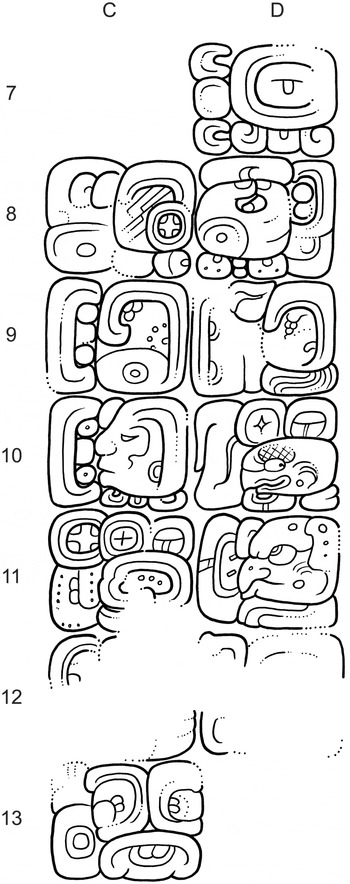
The text of Naranjo Stela 46 plots out the relationship between all of these agents and attempts to establish the claims of the younger siblings by associating them with K'ahk’ Tiliiw and mentioning a series of ritual events in which they participated together. This monument bears the dedicatory date of 9.14.15.0.0, corresponding to September 18, a.d. 726, and thereby dates to the end of K'ahk’ Tiliiw's reign. It is perhaps on account of this late date that this is the first monument to bear explicit information regarding the parentage of the king, citing Lady Six Sky as his mother and a more obscure figure from the Naranjo court as his father (Martin et al. Reference Martin, Tokovinine, Treffel, Fialko, Arroyo, Salinas and Ajú Álvarez2017:673–674). After the rituals that involved the two claimants, events that took place under the aegis of the king and in company of Lady Six Sky, the narrative shifts to the date 1 Ik’ 0 Pop (Figure 11), which can be anchored to 9.14.14.7.2, and matched to February 12, a.d. 726. This date is precisely the same as that seen on Stela 18 at Naranjo and records a New Year's date, since it corresponds to the celebrations of the incoming year in the Haab calendar, as identified by Stuart (Reference Stuart2004). The event that transpired on this propitious date is not well-understood. It may record a ritual action related to the preparation of the ground or the cavity in which the stela would be erected just seven months later, to commemorate the holahuntun period ending of the fourteenth k'atun (Martin et al. Reference Martin, Tokovinine, Treffel, Fialko, Arroyo, Salinas and Ajú Álvarez2017:672).
Excerpt of the lengthy text adorning the back of Stela 46 of Naranjo, mentioning the king of the Water Scroll dynasty. Drawing by Helmke (after Martin et al. Reference Martin, Tokovinine, Treffel, Fialko, Arroyo, Salinas and Ajú Álvarez2017:Figure 5).

The odd predicate aside, what is really intriguing is that the ground-breaking ceremony was officiated by a number of foreign dignitaries, prominent among them one figure called Yobe Ajaw (D10) bearing the Water Scroll emblem glyph (C11), another possibly named Yax Ikin (D11) whose emblem glyph (C12) has unfortunately spalled off, and followed by the names of two additional local figures (D12–C13), who may either be lesser dignitaries or supernatural entities that are attributed agency in this ritual (see Martin et al. Reference Martin and Velásquez García2017:672). The last two figures cited in the sentence are referred to only by title, which they share, usually distinguished on the basis of cardinal directions xaman, ‘north,’ and nojool, ‘south,’ something that is also seen in the following clause on Stela 46, as well as in the text of Stela 24 and Altar 2 at the site (Grube Reference Grube2004:208–209), and on the recently discovered Komkom Vase excavated at Baking Pot (Helmke et al. Reference Helmke, Hoggarth, Awe, Bednar and López-Johnson2017). In this important clause on Stela 46 we once more see a group of four individuals, with the local figures tied to the north and south, respectively, whereas the two foreign lords may therefore be tied to the remaining cardinal directions. In this scheme, Yax Ikin would stem from the west, whereas Yobe Ajaw would hail from the east. Once more, this implies a very close affinity of the Water Scroll emblem glyph with a dynasty established in the east, which is most likely to be Altun Ha. This and the foregoing examples make it clear that the Water Scroll kings occupied a site that was not only significant in terms of status, power, and political geography, but also on a cosmological level, considering the many references made to this title and its repeated associations with the eastern realms.
That there may have been a sustained relationship between Altun Ha and Naranjo is suggested not only by the relatively late text inscribed on Stela 46, but also on the basis of shared supernatural entities. Chief among them is the so-called “Square-nosed Beastie,” a label of endearment attributed to this entity by Schele (Reference Schele1992:140–141; Figure 12). We know that this figure was thought to be the dynastic founder at Naranjo; the narratives in which it is involved stretch all the way back to mythological times, in texts that provide huge distance numbers, one going back more than 895,000 years into the past (Figures 12a–12b; see Martin Reference Martin, Macri and McHargue1996:226; Martin and Grube Reference Martin and Grube2000:70, 71–72; Helmke Reference Helmke2016). Two references to this same supernatural entity are known from Altun Ha, both from locally produced ceramics (Helmke and Awe Reference Helmke and Awe2008:82–83). One is rendered on a sixth-century incised brown ware bowl (Figure 12e) and the other on a seventh-century painted vase (Figure 12f). The exact significance of the supernatural entity to the nobility of Altun Ha remains unknown, but it may well be that this common ground indicates a bond between the two dynasties, perhaps even shared descent, or at least perceived affinity.
The supernatural entity known as the “Square-nosed Beastie”: (a) Naranjo, Stela 24; (b) Naranjo, Altar 1; (c) Tikal, Temple IV, Lintel 2; (d) unprovenanced ceramic bowl, K2358; (e) Altun Ha, incised ceramic bowl RP595/161; and (f) Altun Ha, Petkanche ceramic vase RP 595/56. Drawings by Helmke.

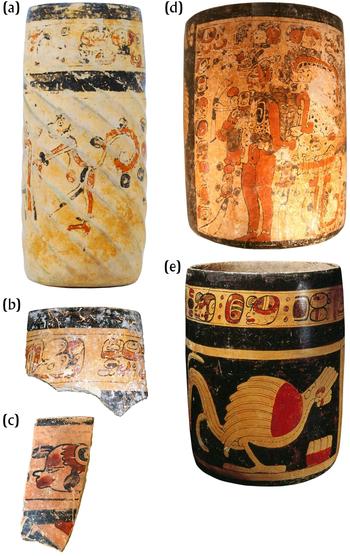
This affinity may also be partially reflected in the ceramics produced at the two sites during the sixth century, especially as there are many similarities in form, surface treatment, and choice of palette in the ceramics produced in the workshops of Naranjo's long reigning Ajasaaj Chan K'inich (also nicknamed in the literature as “Aj Wosal,” see Martin and Grube Reference Martin and Grube2000:71–72) and many of the Petkanche Orange-polychrome bowls found at Altun Ha and sites in the vicinity (see Ball Reference Ball, Sabloff and Henderson1993:260–261). Significantly, the petrography and sphere of distribution of Petkanche ceramics indicates that these likely were produced at Altun Ha, where the vast majority have been recovered (Reents-Budet et al. Reference Reents-Budet, Bishop, MacLeod and Reents-Budet1994:198–203). Nevertheless, the ceramics were distributed far and wide, including the so-called Blom Plate found at Río Hondo in Quintana Roo (Blom Reference Blom1950), the specimens found at sites on Ambergris Caye (Figures 13a–13b; see Guderjan and Garber Reference Guderjan and Garber1995; Guderjan Reference Guderjan1993:25, 28–30; Christophe Helmke, personal observation 2007), as well as the famed Quetzal Vase found at Copan (Figure 13e). Typologically and stylistically related, but petrographically distinct, are Petkanche vases found at Coba in Quintana Roo and Becan in Campeche (Figure 13d; Ball Reference Ball1977:72, 177, Figure 29a; Reents-Budet et al. Reference Reents-Budet, Bishop, MacLeod and Reents-Budet1994:201). Significant in this regard are a group of sherds of the same type found at Pusilha, which confirm the connection to Altun Ha as revealed by the epigraphy (Figure 13c). All of these ceramics testify to the importance and the reach of Altun Ha's influence and, interestingly, they closely duplicate the extent of the references to the Water Scroll emblem glyph. With trade to the north, we may even have a mention of Til Man K'inich at Coba (Guenter Reference Guenter and Stanton2014:412) and, with contacts to the south, we also see the Water Scroll kings interacting with polities in southern Belize. The case of Pusilha has already been discussed but such interactions would also be made manifest at Nim Li Punit in the Late Classic.
Examples of Petkanche Orange-polychrome vessels that were manufactured in workshops at Altun Ha. (a) A vase discovered at Chac Balam on Ambergris Caye and (b) A sherd of comparable specimen in a private collection in San Pedro. (c) One of the Petkanche sherds discovered in excavations at Pusilha. Photographs by Helmke. (d) Vase found in Structure N2 at Becan. Photograph by Harri Kettunen. (e) The Quetzal Vase found in Tomb 2 at Copan. Photograph Hillel Burger © President and Fellows of Harvard College, Peabody Museum of Archaeology and Ethnology, Harvard University (PM# 2004.24.34540.1).

NIM LI PUNIT, STELA 2
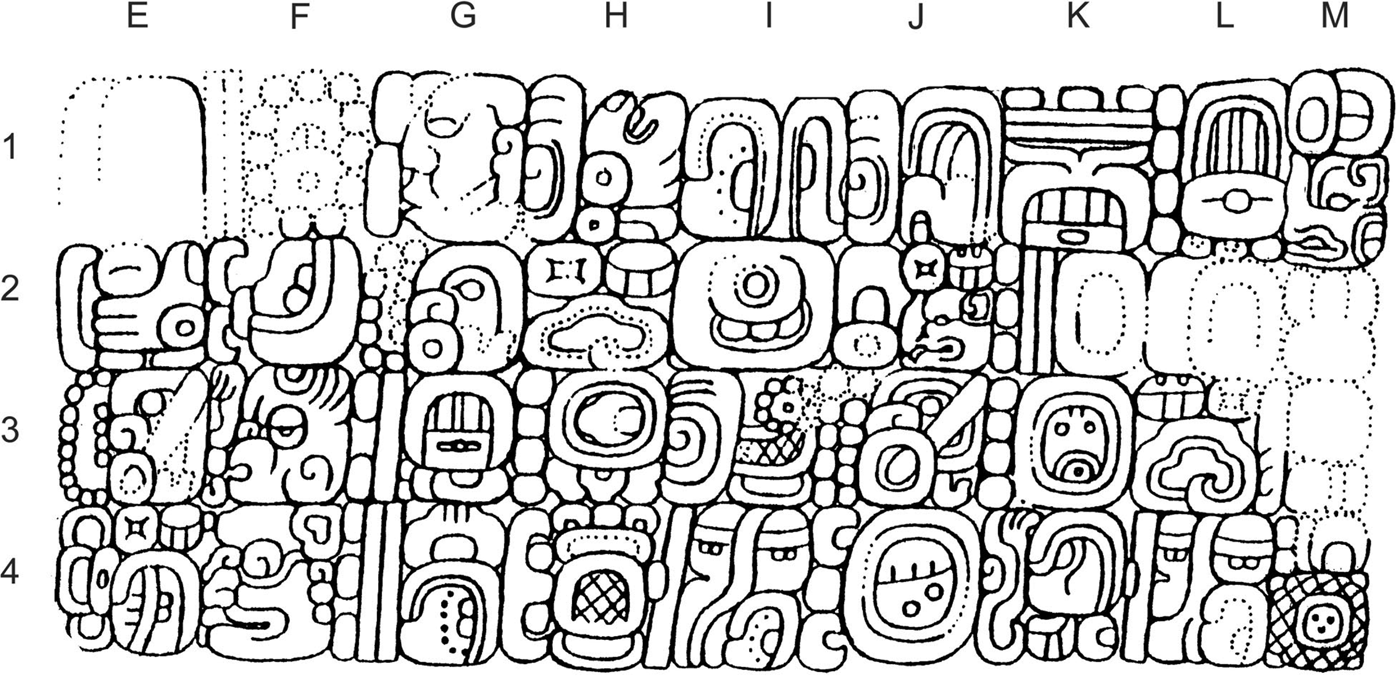
The references to the Water Scroll kings at Nim Li Punit are twofold and both are recorded on Stela 2 (Figure 14). The latest date on the monument is 9.15.7.0.0 and thereby probably marks the date of its dedication, which corresponds to July 17, a.d. 738 (Wanyerka Reference Wanyerka2009:489). The text records that the lord of Nim Li Punit, bearing the local dynastic title of Wakaam Ajaw (F3–E4), acceded to power by taking the k'awiil scepter (E2–F2) on this date. Interestingly, the accession is said to have taken place yichnal (H1), ‘in front of’ or ‘before’ the ‘godly Water Scroll king’ (G2–H2; Grube et al. Reference Grube, MacLeod and Wanyerka1999:28; Wanyerka Reference Wanyerka2009:518). We can therefore see that the local lord of Nim Li Punit acceded to power, but under the watchful gaze of a foreign overlord. While it is not explicitly stated that the accession of the local king took place under the auspices of the foreign ruler, it is certainly implied. Recalling the mentions made at Pusilha 143 years earlier, this constitutes a resounding echo of the presence of Water Scroll kings in southern Belize. Based on the textual evidence, it would seem that the Water Scroll kings had a strong, if intermittent, hand to play in the politics of the polities of southern Belize.
The lowest portion of the glyphic text of Stela 2 at Nim Li Punit. Drawing by John Montgomery reproduced with permission (after Wanyerka Reference Wanyerka2003:Figure 17).

As regards the possible relations between southern Belizean sites with Copan and Quirigua to the south (e.g., Braswell et al. Reference Braswell, Bill and Prager2008), it is not altogether surprising to see frequent mentions of titles and placenames familiar from these latter sites (e.g., Grube et al. Reference Grube, MacLeod and Wanyerka1999; Stuart and Grube Reference Stuart and Grube2000; Tokovinine Reference Tokovinine2013:63–66; Wanyerka Reference Wanyerka2003:70). The same is true on Stela 2, where titles such as the “Black Bat,” also found at Quirigua (Wanyerka Reference Wanyerka2003:8), appear. On Stela 2, this title appears in the context of a stela dedication event seven years prior in 9.15.0.0.0 or August a.d. 731, when the raising of the stela is said to have taken place yita (J1), or ‘in the company of’ the twenty lords of “Black Bat” (I2–J2; Wanyerka Reference Wanyerka2009:519–520).
Thereafter, the narrative jumps back to an event in a.d. 726 (J4–K1), which incidentally is also the date borne at the top of Stela 2, and ties this event with the period ending of a.d. 731 (L1–K3; Wanyerka Reference Wanyerka2003:37). Although the particular action or event that occurred on this date is not specified, the Water Scroll emblem glyph is once more cited, and is related to the Black Bat title (M1) by means of an agency expression (K4). The Water Scroll kings appear to have also had a hand in the ritual events that transpired on the major period ending of 9.15.0.0.0. The remainder of the text is quite eroded, and therefore less instructive, but it closes with the part of the martial couplet we saw on Pusilha Stela D, which is only preserved in this instance as tu-pakal, ‘with his shield’ (M4).
The references to foreign lords, both of the Water Scroll dynasty to the north and of the Black Bat kings to the south, indicate that the polities of southern Belize were firmly integrated into the geopolitics of the area and the times, with foreign lords expressing interests in local events, including the celebration of period endings and the enthronement of local kings (Wanyerka Reference Wanyerka2009:517–521). This implies that the kings of Nim Li Punit were vassals, but whether their overlords had their capital to the north or to the south remains unknown. The tug of war in which these southern polities undoubtedly found themselves may also account for the presence of the Quetzal Vase at Copan and perhaps also the large quantity of jadeite artifacts at Altun Ha, presumably sourced in the Motagua Valley (see Taube et al. Reference Taube, Hruby and Romero2005), bespeaking their involvement in the area and the manner in which this presence was translated into economic gain and material wealth. The accession of the Nim Li Punit king in a.d. 738 in the presence of the Water Scroll king implies that the former owed fealty to the latter and paints a picture in which Altun Ha assumed a position of power in the region.
NAJ TUNICH, WALL PAINTINGS
The final two mentions of lords of the Water Scroll emblem glyph are once more found far away from their presumed capital in painted texts rendered in stark black pigment on the limestone walls of the cave of Naj Tunich in the southeastern Peten. The site of Naj Tunich has the distinction of being a ritually important cave, one that was both used for inhumation of prominent elites in the Protoclassic, within walled enclosures at the entrance (see Brady Reference Brady1989:101–147) and also for its varied rock art, which exhibits dozens of stunning painted glyphic texts in addition to petroglyphs and handprints. Although other caves with painted glyphic texts are known in the Maya area (Bassie-Sweet et al. Reference Bassie-Sweet, Zender, de Lara, Guenter, Bassie-Sweet, Laughlin, Hopkins and Brizuela Casimir2015; Helmke Reference Helmke2009:508–511; Stone Reference Stone1995), Naj Tunich has by far the largest glyphic corpus of any cave and one that rivals the written corpora of many surface sites. Given their context, the content of these texts expectably does not duplicate the same matters, phraseology, and genres that are seen in texts found at surface sites throughout the Maya area (MacLeod and Stone Reference MacLeod, Stone and Stone1995). Many, if not most, of the texts are records of the arrival of high-standing pilgrims to the site, especially in the years between a.d. 692 and 745 (Helmke Reference Helmke2009:167–173; MacLeod and Stone Reference MacLeod, Stone and Stone1995:157–164). As such, many of the texts make references to verbs of motion, such as hul-i, ‘he arrived here’; hul-oob, ‘they arrived here’; and even pakxi, ‘he returned’ (Helmke Reference Helmke2009:150–161). Other texts relate that one of the primary purposes of these pilgrimages was to il– (with its many derivations) ‘see’ or ‘witness’ something called monpaan ~ monpan. What this may be remains unknown, but it bears an uncanny similarity to Mopan, the name of the river that has its source just to the north of Naj Tunich. One cannot help but wonder if this was the name of a deity or formation or place within the cave that pilgrims were meant to see, the culmination of the pilgrimage. Perhaps owing to of the importance of this feature, the area and the river were progressively associated with that name (see Helmke Reference Helmke2009:164–173; Helmke et al. Reference Helmke, Awe, Grube, LeCount and Yaeger2010:103).
Among the many texts seen at Naj Tunich are two that are of real importance for understanding the role and significance of the Water Scroll kings. In Drawing 34, we have a relatively short text that records the arrival of pilgrims on the date 8 Men 9 K'ayab (A1–A2), possibly correlated to span from the second to the third of January, a.d. 744 (Figure 15a; see Helmke Reference Helmke2009:160–161; MacLeod and Stone Reference MacLeod, Stone and Stone1995:163). The verb in question is hul-i, ‘he arrived here’ (A3), with the locality specified in the following glyph block, perhaps read as Ik’-jul-kab (A4) or ‘black-pierced-earth,’ an apt name for Naj Tunich. The person said to arrive at this locality is named in the following two glyph blocks, first by attributing him the Water Scroll emblem glyph (B1) and thereafter by naming him as MUYAL-cha-ki (B2) for Muyal Chaahk, or ‘cloudy thunder god.’Footnote 11 Interestingly, this figure is not said to arrive alone, but yitaaj, or ‘in the company of’ or ‘with’ (B3) another person, who in part seems to be named Wakax (B4), and bears the distinctive Sak Chuwen title of Naranjo dynasts (B5). In this text, we can see a continued and intimate relation between the Water Scroll kings and the lords of Naranjo. At this date, the ruling figure at Naranjo would appear to have been Yax Mayuy Chan Chaahk, who was defeated and captured by Tikal forces in a surprise attack just one month later, on February 9, a.d. 744 (Martin Reference Martin, Macri and McHargue1996; Zender Reference Zender2005:13–14). Although the end of the text of Drawing 34 is not entirely clear, it appears to make reference to a high-standing member of the Naranjo court conducting a joint pilgrimage with the ruler of Altun Ha. This pairing of names and titles confirms the close bonds between the rulers of the two sites and repeats the joint ritual actions celebrated on Stela 46 at Naranjo.
All the more fascinating is another text at Naj Tunich, known as Drawing 65, which records another pilgrimage event (Figure 15b). The caption is headed by the calendar round 10 Manik’ 16 Kumk'u (A1–B1), again presumably for a span of dates, January 28–29, a.d. 745 (see Helmke Reference Helmke2009:168–170; MacLeod and Stone Reference MacLeod, Stone and Stone1995:165–167). This dates the text of Drawing 65 to some 392 days after Drawing 34. The initial verb of this text is pakxi, ‘he returned,’ (B2) and the place that is returned to appears to be written ka-ti’ ch'een, ‘to the mouth of our cave’ (B3–B4). The first person in the lengthy list of names is none other than Muyal Chaahk (C3), to whom the Water Scroll emblem glyph is once more attributed (C1–C2). A litany of other pilgrims is introduced by the person conjunctive yitaaj (C4, E2, and F4), including one Ajchak Maax (D1), said to be the elder brother (E1), who is previously mentioned in Drawing 52 (perhaps dated to a.d. 738), in the company of another figure who is said to be subservient to a figure from Sako'k, the ancient name of El Palmar in Quintana Roo (see MacLeod and Stone Reference MacLeod, Stone and Stone1995:163, Figure 7-2; Tsukamoto and Esparza Olguín Reference Tsukamoto, Esparza Olguín, Golden, Houston and Skidmore2014:52–53). Other names mentioned in Drawing 65 include an entity known as K'anal Tahn Ahk (G1, F2–F3), possibly a supernatural figure considering the Nahho'chan title that precedes its name (F1; Helmke et al. Reference Helmke, Andres, Morton and Wrobel2015:18, Figure 16a), and one K'in Muwan, (F4) said to be the younger brother (F5; Stuart Reference Stuart, Macri and Ford1997:5, Figure 6d). Based on this text, we can see a known figure returning to the cave with an entourage of kin to conduct an iterative pilgrimage, just a year later than the first. These two texts confirm the vitality of the Water Scroll dynasty and the power of a Late Classic king to venture far from his capital to conduct a pilgrimage to an important ritual site.
Texts from Naj Tunich mentioning a Water Scroll king. (a) Drawing 34. (b) Detail of Drawing 65. Drawings by Helmke, based on photographs by Chip and Jennifer Clark.

As this is the last clear reference to a king of the Water Scroll dynasty, we can appreciate the many mentions made throughout the central lowlands, from the accession of Til Man K'inich in a.d. 584 to the second pilgrimage of Muyal Chaahk, 161 years later. The Water Scroll kings exerted a huge amount of influence during this period and figured prominently in various geopolitical schemes devised by the kings of Tikal, Naranjo, and Altar de los Reyes. With the reversals of fortune that befell Naranjo after the defeat of Yax Mayuy, this strong ally was plunged once more into a second hiatus that would endure until the accession of K'ahk’ Ukalaw Chan Chaahk, the son of K'ahk’ Tiliiw, in a.d. 755. From that point on, the texts are mute as to the fate of the Water Scroll kings, but they shared the fortunes of other dynasties at the advent of the collapse.
CONCLUDING THOUGHTS
Although the decipherment of the enigmatic T579 Water Scroll emblem continues to elude epigraphers, the many references to the kings bearing this title in texts throughout the eastern Maya lowlands amply demonstrate the importance of these rulers in antiquity. The numerous texts as well as their geographic distribution lend support to the identification of Altun Ha as the capital of the Water Scroll dynasty from at least the sixth through to the eighth century. In fact, we can divide the references to the Water Scroll emblem glyph into two dominant categories. The first encompasses relatively early and local instances at Altun Ha, Chau Hiix, and the statuettes of the aged Atlantean figures. In contrast, the other references are both later and more geographically distant. This patterning reflects the growing importance of the site and also serves as a proxy for the power wielded by the dynasty, not omitting the fact that Caracol, the veritable behemoth of Belize, is not mentioned by foreign centers, but only at sites such as Hatzcab Ceel, La Rejolla, and Caballo, i.e., subservient satellites that were physically integrated into the urban fabric by an extensive network of causeways (see Chase and Chase Reference Chase and Chase2001; Helmke and Kettunen Reference Helmke and Kettunen2005). The distribution of the external references to the Water Scroll kings forms a neat arc around epicentral Altun Ha, with the curve extending from Pusilha, to Naj Tunich, Tikal, and Altar de los Reyes. The possible mention of Altun Ha at Coba is part and parcel of this model and helps to substantiate the influence that Altun Ha exerted both north and south along the Caribbean coast. Interestingly, the distinctive Petkanche Orange-polychrome ceramics that are the hallmark of Altun Ha are found predominantly within the same sphere of influence as the one delineated by the epigraphy. This concurrence speaks of a region that was often under the influence of Altun Ha, where elite serving vessels functioned as social currency to cement alliances between sovereigns (see Reents-Budet et al. Reference Reents-Budet, Bishop, MacLeod and Reents-Budet1994:198–203).
The relationships that Altun Ha maintained with different kings varied according to the times and the polities in question. At both Tikal and Altar de los Reyes, the Water Scroll kings are mentioned in their capacity as markers for the sacred geopolitics of the Late Classic, whereas in southern Belize we see Altun Ha in a decidedly assertive manner, meting out attacks on Pusilha as well as officiating over the investiture of the kings of Nim Li Punit. At Naj Tunich we see the Water Scroll kings participating in joint pilgrimages and ritual actions, much the same as recorded at Naranjo. In fact, the relationship between these two dynasties may have been much closer than is generally recognized, possibly involving shared affinal relations followed by consanguinity.
Mentioning Altun Ha's diminutive size is not meant to be a monotonous exercise, but instead conveys our genuine appreciation and wonderment of its wealth and prominence in antiquity. Strategically located between the Caribbean coast and the Belize River, the Water Scroll capital exercised extraordinary power and displayed opulent wealth that is likely to have been the result of the ability of its rulers to maintain control of the major inland waterways between the Caribbean coast and the central Maya heartland. In addition to the tangible markers of the realm of commerce and wealth, the epigraphy demonstrates that the Water Scroll kings were entitled to bear some of the most exalted titles and to be styled by the kalo'mte’ title, which ascribed the kings the eastern quadrant of the Maya lowlands as their realm. As one of the four cardinal directions, that of the east was the most significant one in Mesoamerican cosmology, not the least since that is the direction of the rising sun. The repeated references to the bearers of the Water Scroll emblem, as kings of the east, indicates that Altun Ha constituted one of the corners of the diamond of Classic Maya geopolitics, and, as such, was among the truly influential capitals in ancient Maya history.
RESUMEN
La importancia de los glifos emblema en los estudios mayas ha sido reconocida desde hace mucho tiempo. Entre éstos se encuentran los emblemas que todavía no han sido asociados de manera concluyente con sitios arqueológicos específicos. Un ejemplo de este tipo es el Glifo Emblema que permanece no descifrado y por lo tanto ha sido denominado Voluta de Agua, que aparece en numerosas ocasiones en los textos mayas de periodo clásico, entre los siglos VI y VIII. Estas muchas referencias se encuentran en una variedad de sitios a través de las tierras bajas, lo que atestigua de la importancia de este antiguo reino y de los reyes que llevaron este título. En la presente contribución revisamos las evidencias epigráficas y arqueológicas y proponemos que este sea el título real de los reyes que reinaron desde Altun Ha, en las tierras bajas mayas orientales, en lo que ahora es Belice. La presentación de la evidencia epigráfica sigue su incidencia temporal y se inicia con textos descubiertos en Altun Ha y sitios vecinos, y de allí va en la exploración de las menciones realizadas en sitios más allá, incluyendo Pusilha, Tikal, Altar de los Reyes, Naranjo, Nim Li Punit y Naj Tunich. Al hacerlo, comenzamos a reconstruir la historia dinástica de los reyes de la dinastía Voluta de Agua, desde la perspectiva de fuentes locales tanto como extranjeras.
ACKNOWLEDGMENTS
First and foremost, we would like to thank Helen Haines for stimulating conversations that prompted the writing of this paper. Many thanks also to Anne Pyburn for permission to include the bone pin from Chau Hiix in this paper and to Rosemary Joyce for her comments on the glyphic text. To Christopher Andres, our appreciation for information pertaining to Structure 38 at Chau Hiix and to Gabriel Wrobel for information on Burial 43. Many heartfelt thanks to Elizabeth Graham and David Pendergast for all their help and support in our study of the glyphic corpus of the texts of Altun Ha and for their insightful and constructive comments on an earlier draft of this paper. The senior author would like to thank the Royal Ontario Museum for providing access to the glyphic materials from Altun Ha and permission to document them. Likewise, a warm thanks to the British Museum, particularly to Jago Cooper and Kate Jarvis, for their kind and courteous help in examining the monuments and ceramics of Pusilha. Further thanks also to Elizabeth Graham for including the senior author on her team as project epigrapher and facilitating the documentation of the monuments of Lamanai.
Our gratitude is due to Justin Kerr, Harri Kettunen, and Nikolai Grube for allowing us to reproduce some of their excellent photographs and drawings. Sincere thanks to David Pendergast, the Princeton Museum of Art, the President and Fellows of Harvard College, the Peabody Museum of Archaeology and Ethnology, and the British Museum for allowing the reproduction of selected drawings and photos.
Thanks to Sebastían Matteo for relating his research on the Water Scroll sign. To Simon Martin, Alexandre Tokovinine, and Vilma Fialko many thanks for sharing with us the fascinating text of Stela 46 at Naranjo. We are also extremely thankful for the many constructive comments made by Simon Martin and the three anonymous reviewers. Although the comments and insights of our colleagues have greatly contributed to this paper, none of the shortcomings can be attributed to them, for they are ours alone. Last, but certainly not least, many thanks to the director and staff of the Belize Institute of Archaeology for their help, support, and encouragement of our work throughout the years.