Introduction
The thalamus holds rich connections to the cortex and cerebellum, and supports sensory perception and higher order cognitive functions (Sherman, Reference Sherman2016; Sherman & Guillery, Reference Sherman and Guillery2002). Disruptions in thalamic circuitry are consequential and result in neurological disorders (Esmaeeli et al., Reference Esmaeeli, Murphy, Swords, Ibrahim, Brown and Llano2019; Whitwell et al., Reference Whitwell, Avula, Master, Vemuri, Senjem, Jones and Josephs2011), psychiatric illness (Modell, Mountz, Curtis, & Greden, Reference Modell, Mountz, Curtis and Greden1989; Tu et al., Reference Tu, Bai, Li, Chen, Lin, Chang and Su2019; Woodward, Giraldo-Chica, Rogers, & Cascio, Reference Woodward, Giraldo-Chica, Rogers and Cascio2017), and disorders of consciousness (Yao et al., Reference Yao, Song, Gao, Yan, Huang, Ding and Xu2015). Evidence suggests that thalamic pathology is prominent in schizophrenia (Pergola, Selvaggi, Trizio, Bertolino, & Blasi, Reference Pergola, Selvaggi, Trizio, Bertolino and Blasi2015) and bipolar disorder (Ng, Lau, Graham, & Sim, Reference Ng, Lau, Graham and Sim2009), where abnormal thalamocortical connections may underlie aspects of the psychopathology including clinical symptoms and cognitive deficits (Steullet, Reference Steullet2020). But it is unclear which specific aspects of severe psychopathology are most related to thalamic pathology.
Prominent thalamic abnormalities have been observed in task-based functional MRI (fMRI) in psychosis (Andrews, Wang, Csernansky, Gado, & Barch, Reference Andrews, Wang, Csernansky, Gado and Barch2006; Çetin et al., Reference Çetin, Christensen, Abbott, Stephen, Mayer, Cañive and Calhoun2014; Huang, Rogers, & Woodward, Reference Huang, Rogers and Woodward2019), but recent work has shifted focus toward thalamocortical connectivity measured during rest. Seed-based resting-state thalamocortical connectivity has been extensively used to study the psychosis spectrum, and has revealed consistent patterns of thalamo-prefrontal hypoconnectivity (reflecting reduced connectivity from the thalamus to regions including the middle frontal and anterior cingulate cortex) and thalamo-sensory hyperconnectivity (characterized by increased thalamic connections to sensory areas including motor, temporal, and occipital regions) (Giraldo-Chica & Woodward, Reference Giraldo-Chica and Woodward2017; Ramsay, Reference Ramsay2019). Interestingly, patients with stronger thalamo-sensory hyper-connections are found to have hypo-connected thalamo-prefrontal and thalamo-cerebellar connections, suggesting that these thalamocortical abnormalities may arise from a common neural mechanism (Ramsay, Reference Ramsay2019).
In comparisons with healthy control subjects, patterns of aberrant thalamocortical hyper/hypo-connectivity appear to be shared across schizophrenia (Anticevic et al., Reference Anticevic, Cole, Repovs, Murray, Brumbaugh, Winkler and Glahn2014a; Ferri et al., Reference Ferri, Ford, Roach, Turner, van Erp, Voyvodic and Mathalon2018) and bipolar disorder with psychosis (Anticevic et al., Reference Anticevic, Cole, Repovs, Murray, Brumbaugh, Winkler and Glahn2014a; Tu et al., Reference Tu, Bai, Li, Chen, Lin, Chang and Su2019), as well as early-onset psychosis (Zhang et al., Reference Zhang, Palaniyappan, Deng, Zhang, Pan, Fan and Pu2021), first-episode psychosis (Bergé, Lesh, Smucny, & Carter, Reference Bergé, Lesh, Smucny and Carter2020; Huang et al., Reference Huang, Rogers, Sheffield, Vandekar, Anticevic and Woodward2021; Kwak et al., Reference Kwak, Cho, Hwang, Kim, Park and Lee2021; Penner et al., Reference Penner, Ford, Taylor, Schaefer, Théberge, Neufeld and Williamson2016; Woodward & Heckers, Reference Woodward and Heckers2016), and chronic phases of the illness (Woodward, Karbasforoushan, & Heckers, Reference Woodward, Karbasforoushan and Heckers2012). In individuals affected by significant psychopathology, thalamocortical dysconnectivity patterns may reflect the severity of psychosis. For instance, patients with bipolar disorder I compared to bipolar disorder II show a pattern of hyper- and hypo-connectivity differences closer to that of schizophrenia patients (Tu et al., Reference Tu, Bai, Li, Chen, Lin, Chang and Su2019).
Similar connectivity abnormalities have been observed in individuals at clinical high risk for developing psychosis (Anticevic et al., Reference Anticevic, Haut, Murray, Repovs, Yang, Diehl and Cannon2015; Fryer et al., Reference Fryer, Ferri, Roach, Loewy, Stuart, Anticevic and Mathalon2021), as well as unaffected first-degree relatives of schizophrenia patients (Cho et al., Reference Cho, Kim, Yoon, Lee, Lee and Kwon2019; Xi et al., Reference Xi, Liu, Yang, Zhang, Deng, Pan and Pu2020; Yao, Neggers, Kahn, & Thakkar, Reference Yao, Neggers, Kahn and Thakkar2020), suggesting that thalamocortical dysconnectivity may reflect familial risk for psychosis and possibly serve as an endophenotype. Unaffected siblings of people with schizophrenia have been found to have an intermediate connectivity pattern between healthy controls and their affected siblings both during rest (Xi et al., Reference Xi, Liu, Yang, Zhang, Deng, Pan and Pu2020) and during an attentional control task (Antonucci et al., Reference Antonucci, Taurisano, Fazio, Gelao, Romano, Quarto and Blasi2016). Similarly, individuals at clinical high risk for developing psychosis (with subthreshold psychosis symptoms) were found to have an intermediate resting connectivity pattern between healthy and early psychosis patients (Fryer et al., Reference Fryer, Ferri, Roach, Loewy, Stuart, Anticevic and Mathalon2021). But while it appears that abnormalities in thalamocortical connectivity could reflect both risk for psychotic psychopathology and severity of psychopathology in affected individuals, it remains to be directly investigated within a single study sample whether thalamocortical dysconnectivity is central to the symptoms and cognitive deficits manifested in psychotic psychopathology, and whether a common pattern emerges across probands and first-degree biological relatives with elevated genetic liability.
Overall, research has focused on group differences in thalamocortical connectivity, highlighting the presence of disrupted thalamic circuitry in particular mental disorders, but with limited investigation of the relationship of dysconnectivity to symptoms and cognition. In a large study of schizophrenia (N = 415 patients and N = 405 healthy controls) examining brain-wise thalamocortical connections, investigators found positive psychotic symptoms to be associated with weaker thalamo-prefrontal connectivity; negative psychotic symptoms and general psychopathology were modestly related to both hyper- and hypo-connected brain areas throughout the cerebral cortex (Cheng et al., Reference Cheng, Palaniyappan, Li, Kendrick, Zhang, Luo and Feng2015). Similarly, a meta-analytic summary of seed-based connectivity studies revealed that thalamocortical hyperconnectivity in sensory regions was associated with both positive and negative symptoms of psychosis (Ramsay, Reference Ramsay2019). Fewer studies have examined relationships between thalamocortical dysconnectivity and cognition. One study demonstrated a small, but significant relationship between increased thalamo-prefrontal connectivity and higher scores on a metric of global cognition (Woodward & Heckers, Reference Woodward and Heckers2016). Another used whole-brain linear models to identify relationships of connectivity with cognitive sub-domains. This study revealed that poorer attention and processing speed related to higher thalamic connectivity in the pre/post-central gyrus, and lower connectivity to the cerebellum (Chen, Ye, Jin, Zhu, & Wang, Reference Chen, Ye, Jin, Zhu and Wang2019).
Dimensional rather than categorical characterizations of psychopathology can be an effective means of investigating the neurobiological basis of psychotic symptomatology and cognitive deficits in severe psychopathology (Baker et al., Reference Baker, Dillon, Patrick, Roffman, Brady, Pizzagalli and Holmes2019; Barch, Reference Barch2017; Buckholtz & Meyer-Lindenberg, Reference Buckholtz and Meyer-Lindenberg2012; Sheffield et al., Reference Sheffield, Kandala, Tamminga, Pearlson, Keshavan, Sweeney and Barch2017). Schizophrenia and bipolar disorder with psychosis likely share aspects of their etiologies (Forstner et al., Reference Forstner, Hecker, Hofmann, Maaser, Reinbold, Mühleisen and Nöthen2017). Neural anomalies such as dysconnectivity that partially account for clinical symptoms and cognitive deficits that span schizophrenia and bipolar disorder with psychosis may reflect overlapping risk for the disorders. It is therefore useful to examine thalamocortical dysconnectivity and its relationship with dimensions of psychopathology by studying people with various psychiatric diagnoses and those with familial risk (i.e. transdiagnostic samples) in order to better understand covariation on neural and clinical phenomenology.
Here we report on an examination of thalamocortical connectivity patterns in relation to symptoms and cognition across the psychosis spectrum and attempt to clarify whether aberrant connectivity patterns are tied to specific aspects of clinical phenomenology. Specifically, we interrogate the mediodorsal thalamus, which is well known to have strong prefrontal connections (Pergola et al., Reference Pergola, Danet, Pitel, Carlesimo, Segobin, Pariente and Barbeau2018), and is implicated in higher-order cognitive processes (Antonucci et al., Reference Antonucci, Penzel, Pigoni, Dominke, Kambeitz and Pergola2021). Previous findings indicate that the mediodorsal thalamus may be a locus of prominent thalamocortical dysfunction in both schizophrenia and bipolar disorder (Anticevic et al., Reference Anticevic, Yang, Savic, Murray, Cole, Repovs and Glahn2014b), but is also implicated in transdiagnostic models of psychosis (Szeszko et al., Reference Szeszko, Gohel, Vaccaro, Chu, Tang, Goldstein and Hazlett2022) and broader psychopathology (Gong et al., Reference Gong, Puthusseryppady, Dai, He, Xu, Shi and Mechelli2019). Mediodorsal thalamus has also been found to play a prominent role in the cognitive deficits observed in psychosis (Woodward & Heckers, Reference Woodward and Heckers2016).
The current study used data collected from the Psychosis Human Connectome Project to examine thalamocortical connectivity in a sample of schizophrenia-spectrum subjects (including schizophrenia and schizoaffective disorder), individuals with bipolar disorder with psychotic features, first-degree relatives of individuals with psychosis, and a group of healthy controls. We sought to investigate the relationship of mediodorsal thalamocortical connectivity to clinical symptomatology and cognitive deficits associated with psychotic psychopathology. Given findings of previous investigations in human (Chen et al., Reference Chen, Ye, Jin, Zhu and Wang2019; Cheng et al., Reference Cheng, Palaniyappan, Li, Kendrick, Zhang, Luo and Feng2015; Ramsay, Reference Ramsay2019; Woodward & Heckers, Reference Woodward and Heckers2016) and animal models of psychosis (Parnaudeau et al., Reference Parnaudeau, O'Neill, Bolkan, Ward, Abbas, Roth and Kellendonk2013; Parnaudeau, Bolkan, & Kellendonk, Reference Parnaudeau, Bolkan and Kellendonk2018), we hypothesized that increased symptoms (measured by the Brief Psychiatric Rating Scale; BPRS) across individuals regardless of diagnosis would relate to weaker thalamo-prefrontal connections and stronger thalamo-sensory connections, and worse global cognition (measured by the Brief Assessment of Cognition in Schizophrenia; BACS) would also relate to weaker thalamo-prefrontal connections similar to that observed previously (Woodward & Heckers, Reference Woodward and Heckers2016).
Methods
Full methods related to data collection for the Psychosis Human Connectome Project are described elsewhere (Demro et al., Reference Demro, Mueller, Kent, Burton, Olman, Schallmo and Sponheim2021). Methodological considerations for the current study are described below.
Participants
A total of N = 249 participants were included in the current study, including psychosis probands with a schizophrenia-spectrum diagnosis [SCZ; N = 100; including schizophrenia (N = 82) or schizoaffective disorder (N = 18)], psychosis probands with a bipolar-spectrum illness (BP; N = 33), first-degree biological relatives of psychosis probands (REL; N = 73; schizophrenia relatives: N = 41; schizoaffective relatives: N = 11; bipolar relatives: N = 22), and a sample of healthy controls (CON; N = 43). Participants were recruited from the community through advertisements, mental health providers, and mental health advocacy agencies in and around the Minneapolis metropolitan area. All participants were required to speak English as their primary language; have no legal guardian (or otherwise be able to provide informed consent); have an estimated IQ of 70 or greater; and have no history of seizures or other neurologic disorders including head injury with loss of consciousness >30 min, no history of electroconvulsive therapy in the past year, no significant hearing or vision problems, and no condition that would prevent participation in the study tasks or MRI procedures. SCZ, BP and CON participants were required to be between the ages of 18 and 65, while REL participants were required to be between the ages of 18 and 69. All participants underwent informed consent prior to study participation, and all study procedures were approved by the Institutional Review Board at the University of Minnesota.
Clinical and cognitive assessment
Participants underwent a clinical interview using the Structured Clinical Interview for DSM-IV-TR (First, Spitzer, Gibbon, Williams, & Others, Reference First, Spitzer, Gibbon and Williams2002) and the psychosis module of the Diagnostic Interview for Genetics Studies (Nurnberger et al., Reference Nurnberger, Blehar, Kaufmann, York-Cooler, Simpson, Harkavy-Friedman and Reich1994). In addition to obtaining demographic information, symptom ratings on all participants were collected using the BPRS – 24-item version (Ventura, Nuechterlein, Subotnik, Gutkind, & Gilbert, Reference Ventura, Nuechterlein, Subotnik, Gutkind and Gilbert2000). Clinical raters, trained to achieve an intraclass agreement of >0.80 with a gold standard, conducted clinical interviews to appraise symptom severity over the prior 30 days. BPRS total scores were additionally broken down into psychotic (positive, negative, and disorganized symptoms), manic, and depressed factor scores (Wilson & Sponheim, Reference Wilson and Sponheim2014). Cognitive assessment involved the paper version of the BACS (Keefe et al., Reference Keefe, Goldberg, Harvey, Gold, Poe and Coughenour2004), with composite scores across cognitive domains that included verbal learning and memory, working memory, verbal fluency, motor speed, processing speed, and problem solving (Keefe et al., Reference Keefe, Harvey, Goldberg, Gold, Walker, Kennel and Hawkins2008). Handedness was assessed using the 10-item Edinburgh Handedness Inventory (Oldfield, Reference Oldfield1971). Medication status was quantified through the use of defined daily doses to calculate chlorpromazine equivalents (CPZ; Leucht, Samara, Heres, & Davis, Reference Leucht, Samara, Heres and Davis2016).
Image acquisition
All images were collected using a Siemens 3-Tesla Prisma scanner and a 32-Channel head coil. The imaging procedures matched those developed for the Lifespan Human Connectome Projects (Harms et al., Reference Harms, Somerville, Ances, Andersson, Barch, Bastiani and Yacoub2018). Multi-echo T 1 weighted MPRAGE images were collected with prospective motion correction using the following parameters: matrix = 300 × 320 × 208; field of view (FOV) = 240 × 256 × 166 mm; resolution = 0.8 mm isotropic; flip angle = 8°; echo time (TE) = 1.81, 3.6, 5.39, 7.18 ms; repetition time (TR) = 2500 ms; inversion time (TI) = 1000 ms; acceleration factor (AF) = 2; length of scan = 8:22. In the same session, two resting-state fMRI scans were collected in opposite phase encoding directions: the first from anterior to posterior and the second from posterior to anterior. Participants were instructed to keep their eyes open and fixated on a cross presented on a screen, to clear their mind of anything in particular, and to remain awake. Each scan had the following parameters: matrix = 104 × 104; FOV = 208 × 208 mm; resolution = 2 mm isotropic; flip angle = 52°; TE = 37 ms; TR = 800 ms; slices/orientation = 72 oblique axial with 2 mm thickness; length of each scan = 6:41 min. Real-time assessment of subject motion was captured using Framewise Integrated Real-time MRI Monitoring (FIRMM), which allowed technicians to visually monitor in-scanner movement as the scan was being collected. A pair of spin echo images with AP and PA phase encoding with matching coverage and voxel size were acquired to correct the fMRI images geometric distortion caused by magnetic field inhomogeneities.
Image processing
Image pre-processing relied on the CONN toolbox's ‘default pre-processing pipeline for volume-based analysis’. Functional data were realigned using SPM12, wherein all images were resampled and co-registered to the first scan of the first session. Functional outlier detection used the artifact detection toolbox, where images with a framewise displacement >0.9 mm or BOLD signal change >5 standard deviations above the mean were flagged. Then both structural and functional images underwent a unified non-linear normalization to the MNI template image as well as segmentation into gray matter, white matter, and cerebrospinal fluid (CSF) (Ashburner & Friston, Reference Ashburner and Friston2005). Last, images underwent spatial smoothing using a Gaussian kernel of 8 mm full-width half-maximum.
Next, all images underwent de-noising using CONN's anatomical component-based noise correction (aCompCor) procedures (Behzadi, Restom, Liau, & Liu, Reference Behzadi, Restom, Liau and Liu2007), which have been previously found to identify anticorrelated brain networks that are not the result of global signal regression (Chai, Castañón, Ongür, & Whitfield-Gabrieli, Reference Chai, Castañón, Ongür and Whitfield-Gabrieli2012). Linear regression of confounding variables included noise components from white matter and CSF, six realignment (motion) parameters and their derivatives, and outlier scans identified in pre-processing (motion scrubbing). Last, images were band-pass filtered from 0.008 to 0.09 Hz to minimize the influence of physiological noise. Quality control images were generated and individually inspected to ensure that functional connectivity values normally distributed after the completion of de-noising.
Connectivity analysis
Seed-based connectivity was computed first for each subject individually. The BOLD time series was extracted from the average across a structurally defined probabilistic bilateral mediodorsal ‘prefrontal’ thalamus ROI [Oxford Thalamic Connectivity Atlas; threshold = 25 (Behrens et al., Reference Behrens, Johansen-Berg, Woolrich, Smith, Wheeler-Kingshott, Boulby and Matthews2003)]; and correlated with every voxel in the brain. The resulting map reflected the bi-variate Fisher's Z-transformed correlation value for each voxel. Analysis of group differences in connectivity was performed using a whole-brain F test (uncorrected voxel threshold of p < 0.001 and a FDR cluster threshold of p < 0.01); follow-up Tukey tests on connectivity values extracted from significant ROIs determined directionality of the effects.
To examine the relationship of thalamocortical connectivity with symptoms and cognition, we first we examined whole-brain group × BPRS total/BACS total interactions to identify whether slope differences were present between groups using an uncorrected voxel threshold of p < 0.001 and a FDR cluster threshold of p < 0.01. Next, based on our hypotheses, we performed common slope analyses (across all participants regardless of group membership and controlling for age and gender); two tailed significance was defined using an uncorrected voxel threshold of p < 0.001 and a FDR cluster threshold of p < 0.01. Post-hoc analyses testing for additional confounding factors of group membership, subject motion [mean translational motion displacement (Van Dijk, Sabuncu, & Buckner, Reference Van Dijk, Sabuncu and Buckner2012)], medications, handedness, and years of education were performed on extracted Fisher's Z-transformed values in R.
Next, to identify whether specific symptoms or cognitive domains were driving the observed effects, we performed post-hoc regressions in significant ROIs to examine the relationships between both BPRS symptom factor scores and cognitive subdomains with thalamocortical connectivity. We also performed common slopes analyses (as described above) examining whole-brain thalamocortical relationships with BPRS symptom subscales and BACS cognitive sub-domains. These results are reported in the online Supplementary material.
Results
Group differences
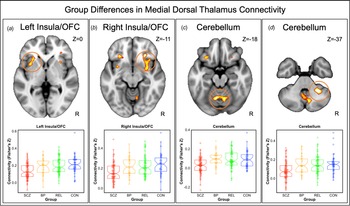
Groups differed on the basis of age, gender, and years of education, in addition to expected differences in medication status, on clinical measures of symptom severity (BPRS total and symptom factor scores), and on cognition (BACS total and sub-domain scores; Table 1). F tests (covarying for age and gender) examining group differences in connectivity identified four distinct clusters in the cerebellum, and bilateral insula/orbitofrontal cortex (Table 2; Fig. 1). Post-hoc Tukey's tests revealed that group differences in all cases were driven by reduced connectivity in the SCZ group.
Group differences in mediodorsal thalamocortical connectivity.
Note: F tests (covarying for age and gender) examined group differences in mediodorsal thalamocortical connectivity (uncorrected voxel threshold p < 0.001; FDR cluster threshold p < 0.01). We identified four distinct clusters in the (a) left insular/orbitofrontal cortex, (b) right insular/orbitofrontal cortex, and (c and d) and two clusters in the cerebellum. Post-hoc Tukey's tests revealed that group differences in all cases were driven by reduced connectivity in the SCZ group.

Demographic, clinical, and cognitive data

CON, controls; REL, relatives; SCZ, schizophrenia/schizoaffective disorder; BP, bipolar disorder; CPZ, chlorpromazine equivalents; BPRS, Brief Psychiatric Rating Scale; BACS, Brief Assessment of Cognition in Schizophrenia.
Group differences in mediodorsal thalamocortical connectivity

Note: F test results comparing CON, REL, BP, and SCZ (uncorrected voxel threshold p < 0.001; FDR cluster threshold p < 0.01). Directionality is based on post-hoc Tukey tests (p < 0.05).
Thalamocortical relationships with psychiatric symptoms
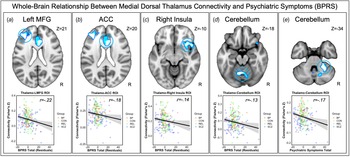
First we examined whole-brain group × symptoms (BPRS) interactions (covarying for age and gender) to identify brain regions where the relationship between symptoms and connectivity differed by group. No voxels survived the FDR p < 0.01 cluster correction. Next we examined the relationship between symptoms and whole-brain thalamocortical connectivity across subjects (covarying for age and gender). Higher psychiatric symptoms corresponded to decreased thalamocortical connectivity in five clusters including the left middle frontal gyrus (LMFG), anterior cingulate cortex (ACC), right insula, and two clusters in the right cerebellum (Fig. 2; Table 3a). To determine whether the associations between symptoms and connectivity were driven by diagnosis/group, subject motion, medication status, or other potential confounds, we extracted connectivity values from each individual cluster for further analysis. In all five clusters when we re-ran the regression analysis covarying for group, mean motion, handedness, and years of education, the relationship between symptoms and connectivity remained significant (all p's < 0.05). Similarly, in the subset of subjects taking antipsychotic medications, we found no relationships between CPZ equivalents and connectivity for any cluster (all Spearman's rho p's > 0.14). We also performed post-hoc regression analyses between symptoms and ROI connectivity within each diagnostic group individually (online Supplementary Table S1a). LMFG showed a significant relationship in the SCZ group (t = −2.60; p = 0.03) and a trend in the REL group (t = −1.96; p = 0.05), while the ACC showed a significant relationship in the REL group (t = −2.31; p = 0.02) and a trend in the SCZ group (t = −1.98; p = 0.05; full descriptions are available in the online Supplementary material).
Clusters significantly related to psychiatric symptoms across groups.
Note: Seeding from bilateral mediodorsal thalamus with covariates for age and gender, significant relationships with psychiatric symptoms (measured using the Brief Psychiatric Rating Scale; BPRS) were observed in (a) left middle frontal gyrus (LMFG), (b) anterior cingulate cortex (ACC), (c) right insula, (d and e) and two separate cerebellum clusters. For visualization purposes, the relationships between thalamocortical connectivity and BPRS total score (residualized for group, mean motion, handedness, and years of education) are depicted using a correlation value derived from a leave-one-subject-out analysis.

Clusters significantly related to clinical symptomatology and global cognition across groups

Note: Whole-brain analyses report coordinates observed in linear models across groups (uncorrected voxel threshold p < 0.001; FDR cluster threshold p < 0.01) for a) Psychiatric symptoms, and b) Global Cognition. Post-hoc analysis examined extracted ROIs with covariates for group, mean motion, handedness, and years of education.
Next, we performed follow-up regression analyses of BPRS factor scores for each extracted cluster to determine whether a particular symptom domain was the basis for association with overall symptomatology (online Supplementary Table S2). In all five ROIs, greater positive and negative psychotic symptomatology, as well as disorganized and depressive symptoms were all predictive of lower thalamocortical connectivity (all p's < 0.04). Manic symptoms were unrelated to all ROIs (all p's > 0.14) except for one in the cerebellum which revealed higher manic symptoms relating to reduced thalamo-cerebellar connectivity (t = −2.47; p = 0.01). These findings indicate that thalamocortical connectivity to prefrontal, cerebellar, and insular areas was related to all domains of psychotic symptomatology as well as depressive symptoms, but were generally unrelated to manic symptoms that are central to bipolar disorder. We also examined post-hoc symptom domain associations with brainwise thalamocortical connectivity. Higher positive symptoms (e.g. hallucinations/delusions) showed a relationship with reduced thalamocortical connectivity to bilateral insula and increased connectivity in right parahippocampal gyrus (see online Supplementary Fig. S1a and Table S4a). Increased depressed symptoms revealed a relationship with reduced left frontal pole and cerebellar connectivity (online Supplementary Fig. S1b and Table S4b).
Thalamocortical relationships with global cognition
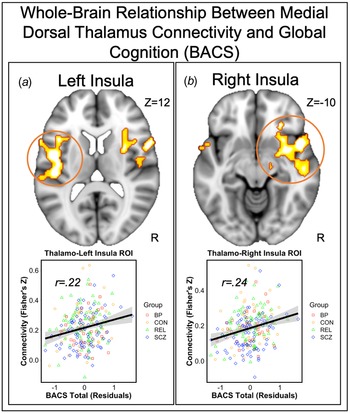
We performed a whole-brain group × cognition (BACS total) interaction analysis (covarying for age and gender) to determine if the relationship between thalamocortical connectivity and cognition differed by group. No voxels survived the FDR p < 0.01 cluster correction. Next, we examined the relationship between global cognition and whole-brain thalamocortical connectivity of subjects disregarding diagnosis (covarying for age and gender). Higher global cognitive scores on the BACS corresponded to greater thalamocortical connectivity in bilateral insula (Fig. 3; Table 3b). Again we determined whether significant results were better accounted for by effects of diagnosis, subject motion, medication status, or other potential confounds. We extracted connectivity values from the significant clusters and re-ran regressions in both clusters covarying for group, mean motion, handedness, and years of education. The relationship between global cognition and connectivity in both clusters remained significant (all p's < 0.001). We examined the subset of subjects taking antipsychotic medications and found CPZ equivalents to be unrelated to connectivity for either cluster (all Spearman's rho p's > 0.38). We also performed follow-up analyses to examine the relationships between cognition and ROI connectivity within each group individually (online Supplementary Table S1b). Significant relationships were observed in both the SCZ (t = 2.82; p = 0.006) and REL groups (t = 2.31; p = 0.02) in the right insula ROI, indicative of a putative endophenotype pattern (full descriptions are provided in the online Supplementary material).
Clusters significantly related to global cognition across groups.
Note: Seeding from bilateral mediodorsal thalamus with covariates for age and gender, significant relationships with global cognition (measured using the Brief Assessment of Cognition in Schizophrenia; BACS) were observed in (a) left insula and (b) right insula regions. For visualization purposes, the relationships between thalamocortical connectivity and BACS score (residualized for group, mean motion, handedness, and years of education) are depicted using a correlation value derived from a leave-one-subject-out analysis.

We sought to determine whether a particular cognitive domain accounted for the association with the overall measure of cognition and carried out post-hoc regression analysis of the BACS subtests on the extracted connectivity values. In both the right and left insula clusters, higher scores on all subtests except for the Tower of London problem-solving domain were associated with greater connectivity (all p's < 0.01; online Supplementary Table S3). Though these relationships appeared most strongly for the verbal fluency and verbal learning and memory subdomains, the results suggest that the degree of thalamocortical connectivity involving ACC and right insula accounts for broad variation in cognitive ability and is generally nonspecific with respect to cognitive domain. We also performed post-hoc analyses to examine brainwise relationships between cognitive sub-domains and thalamocortical connectivity. Verbal fluency was found to predict increased thalamocortical connectivity to bilateral insula (online Supplementary Fig. S2a and Table S5a), while motor speed was predictive of increased connectivity to bilateral occipital cortex, left insula, and right middle temporal gyrus (online Supplementary Fig. S2b and Table S5b).
Discussion
To investigate thalamocortical dysconnectivity in psychotic psychopathology without the limitation of diagnostic boundaries, we adopted a transdiagnostic approach to examine associations between core aspects of psychotic psychopathology with connectivity between mediodorsal thalamus and cortex. In addition to observing group differences in thalamocortical connectivity (driven by reduced connectivity to insular, orbitofrontal, and cerebellar regions in the schizophrenia group), we found that variability in thalamocortical connectivity was related to both symptoms and cognition regardless of psychiatric diagnosis and presence of diagnosable psychotic psychopathology. Similar patterns of dysconnectivity were observed across psychosis probands and first-degree biological relatives of probands (i.e. convergent relationships among probands and relatives between thalamo-insular connectivity and cognition), suggesting that thalamocortical disruptions involving insular brain regions may reflect familial risk for psychotic psychopathology. This interpretation is bolstered by the observation that first-degree relatives showed intermediate connectivity patterns between psychosis probands and healthy controls.
Overall, we found greater psychotic symptomatology and poorer cognition related to weaker thalamocortical connections. Higher scores on a clinician-rated measure of psychopathology (BPRS) were tied to reduced thalamocortical connectivity with frontal regions including the LMFG and the ACC, as well as the right insula and the cerebellum. This effect was driven most strongly by positive psychotic symptoms including hallucinations and delusions, but similar patterns appeared with negative psychotic, disorganized, and depressive symptoms. Lower scores on a measure of global cognition corresponded to reduced thalamocortical connectivity in bilateral insula. These relationships were strongest for scores reflecting verbal fluency and verbal learning and memory, though most higher-order cognitive domains showed a similar pattern (with the exception of the problem-solving subdomain).
Previous work has also examined relationships between symptomatology and thalamocortical connectivity, typically yielding small positive relationships between thalamo-sensory hyper-connectivity and symptoms (Anticevic et al., Reference Anticevic, Cole, Repovs, Murray, Brumbaugh, Winkler and Glahn2014a; Ferri et al., Reference Ferri, Ford, Roach, Turner, van Erp, Voyvodic and Mathalon2018; Ramsay, Reference Ramsay2019). Such patterns are also evident during ketamine modeling of psychosis (Abram et al., Reference Abram, Roach, Fryer, Calhoun, Preda, van Erp and Mathalon2022). Unexpectedly, we observed that symptoms were related to hypo-connectivity between mediodorsal thalamus and both prefrontal and cerebellar areas. Yet, this pattern has been previously observed, where increased positive symptoms (driven by delusions and bizarre behavior) were related to decreased thalamo-cerebellar connectivity (Ferri et al., Reference Ferri, Ford, Roach, Turner, van Erp, Voyvodic and Mathalon2018). Critically, this cerebellar circuitry has been found to be inversely correlated to hyper-connected sensory networks during rest (Ramsay, Reference Ramsay2019).
Connectivity in dorsal ACC, anterior insula, and mediodorsal thalamus areas has been previously identified as the cingulo-opercular or ‘salience’ network (Seeley et al., Reference Seeley, Menon, Schatzberg, Keller, Glover, Kenna and Greicius2007), and holds critical importance in the pathology associated with psychosis (Palaniyappan & Liddle, Reference Palaniyappan and Liddle2012). Integrity of this circuitry is hypothesized to support the attribution of significance to incoming stimuli, which when disrupted may result in aberrant salience attribution (manifesting as hallucinations or delusional ideation) or impaired cognitive functioning (Miyata, Reference Miyata2019). In the current transdiagnostic sample we found that reduced mediodorsal connectivity with the anterior insula and ACC coincides with increased symptomatology. This is consistent with findings from individuals at clinical high risk for developing psychosis who showed relationships between salience network activity and distortions of reality (Wotruba et al., Reference Wotruba, Michels, Buechler, Metzler, Theodoridou, Gerstenberg and Heekeren2014), as well as individuals early on in the illness who were actively experiencing auditory-verbal hallucinations (Mallikarjun et al., Reference Mallikarjun, Lalousis, Dunne, Heinze, Reniers, Broome and Upthegrove2018).
Relatedly, we also observed specific thalamo-insular disruptions that broadly related to impaired cognition. The importance of the anterior insula and its relationship to cognitive performance has been previously highlighted (Sheffield et al., Reference Sheffield, Repovs, Harms, Carter, Gold, MacDonald and Barch2015), as it may play a crucial interoceptive role that influences meta-cognitive aspects of cognitive and emotion processing (Gasquoine, Reference Gasquoine2014). Taken together, the current thalamo-ACC and thalamo-insular findings are consistent with prior evidence establishing salience network disruptions in relation to cognitive deficits in psychosis. It may also contextualize a lack of previous findings showing relationships between thalamocortical dysconnectivity and cognition, as much of this work examined these relationships in hypo-connected regions of the lateral prefrontal cortex and cerebellum.
Post-hoc analyses examining thalamocortical relationships within each group yielded similar patterns for SCZ and REL subjects in relationships between cognition and thalamo-insular connectivity. To a lesser extent, we also observed trend-level patterns among SCZ and REL subjects in both LMFG and ACC connectivity as they related to psychosis symptoms. Taken with previous findings that demonstrated intermediate thalamo-prefrontal connections in unaffected siblings of patients with schizophrenia (Xi et al., Reference Xi, Liu, Yang, Zhang, Deng, Pan and Pu2020), and similar patterns in bipolar patients (Tu et al., Reference Tu, Bai, Li, Chen, Lin, Chang and Su2019), thalamocortical dysconnectivity may represent a psychosis endophenotype. This is bolstered by task-based findings demonstrating that mediodorsal connectivity to the prefrontal cortex during attentional control was similar between schizophrenia patients and their healthy siblings (Antonucci et al., Reference Antonucci, Taurisano, Fazio, Gelao, Romano, Quarto and Blasi2016), and related to polygenic risk for schizophrenia (Antonucci et al., Reference Antonucci, Di Carlo, Passiatore, Papalino, Monda, Amoroso and Blasi2019). Together these findings reinforce the need to examine dimensional constructs of psychopathology to fully understand the role of thalamocortical dysconnectivity as it relates to familial and genetic risk for psychosis.
Relationships between psychopathology and thalamocortical connectivity observed across diagnoses may hold promise for identifying novel treatment targets in psychosis. Ongoing work has targeted both the left dorsolateral prefrontal cortex and temporo-parietal junction (adjacent to the insula) using non-invasive neuromodulation (e.g. transcranial electrical stimulation and transcranial magnetic stimulation) to reduce symptoms (Brunelin et al., Reference Brunelin, Mondino, Gassab, Haesebaert, Gaha, Suaud-Chagny and Poulet2012; Cole, Green Bernacki, Helmer, Pinninti, & O'reardon, Reference Cole, Green Bernacki, Helmer, Pinninti and O'reardon2015) and enhance cognition in psychosis (Gupta, Kelley, Pelletier-Baldelli, & Mittal, Reference Gupta, Kelley, Pelletier-Baldelli and Mittal2018). Such interventions may be informed by previous work showing that working memory training in schizophrenia yielded changes in intrinsic thalamo-ACC connectivity that corresponded to improvements in global cognition (Ramsay, Nienow, & MacDonald, Reference Ramsay, Nienow and MacDonald2017). A similar study targeting auditory perception and verbal working memory with cognitive training in first-episode schizophrenia revealed increases in thalamo-temporal connectivity (adjacent to the insula/temporal cortex region observed in the current analysis) that related to global cognitive improvements (Ramsay et al., Reference Ramsay, Roach, Fryer, Fisher, Loewy, Ford and Mathalon2020). Overall, the current findings further indicate that both frontal and temporal connectivity with the thalamus may be viable treatment targets to enhance cognition. Thalamo-prefrontal connectivity may also be a worthwhile neuromodulatory target given the relationship we identified with symptoms.
A major limitation was that the groups were not matched for age and gender, and by controlling for these factors in whole-brain models we may have removed meaningful variance associated with aspects of symptomology and cognition. Relatedly, additional confounds such as effects of medication or group status were examined in post-hoc tests on data extracted from ROIs; ultimately, these analyses benefited from non-independent selection of voxels where connectivity was already found to be correlated with symptoms and cognition. We were also unable to test whether thalamocortical dysconnectivity fully meets criteria for an endophenotype. While patterns of dysconnectivity appeared to segregate between individuals with and without psychotic symptomatology, we did not formally assess whether these markers are heritable or state dependent (Ross & Freedman, Reference Ross and Freedman2015). Last, there are major limitations to brain-wide association studies in fMRI (Marek, Tervo-Clemmens, Calabro, & Montez, Reference Marek, Tervo-Clemmens, Calabro and Montez2020), with varying approaches to data pre-processing and denoising that can influence connectivity. As the current study did not use an especially conservative approach in single-site data, multi-site consortium samples will likely be necessary to establish reliable brain–behavior relationships, as well as replication of the current findings in similar transdiagnostic samples.
In conclusion, we demonstrate that connectivity between the thalamus and prefrontal and insular brain areas may underlie symptoms (e.g. positive, negative, disorganized, and mood symptoms) and cognitive deficits that are prominent in individuals with psychotic psychopathology. Clearer understanding of the neural circuitry underlying psychosis in transdiagnostic samples will usher in the next generation of targeted treatments that can alter the neural mechanisms underlying psychotic psychopathology.
Supplementary material
The supplementary material for this article can be found at https://doi.org/10.1017/S0033291722002793
Acknowledgements
Research reported herein was supported by the work of Psychosis Human Connectome Project clinical interviewers, neuroimaging technicians, and recruiters. Funding sources include the National Institute of Mental Health under Award Numbers U01MH108150 (PI: SRS) and K01MH117451 (PI: ISR). We owe additional thanks to the subjects and their families for their participation. The content is solely the responsibility of the authors and does not necessarily reflect the views of the funding agency.
Financial support
Funding sources include the National Institute of Mental Health under Award Numbers U01MH108150 (PI: SRS) and K01MH117451 (PI: ISR).