‘. . .when the greater part of jurisconsults agree upon a certain rule – the presumption in favour of that rule becomes so strong, that only a person who makes a mock of justice would gainsay it.’Footnote 1 – Baron Descamps, citing Chancellor Kent
1. Introduction
In the first chapter of her book Cyber Warfare and the Laws of War, Heather Harrison Dinniss describes how ‘[t]he world in which we live and fight’Footnote 2 has changed over the last few decades. The sheer possibility presented by attacks perpetrated in cyberspace, Harrison Dinniss says, requires a scholar ‘to examine the current legal regulation of armed conflict and consider how it can be applied to computer network attacks’, as well as to ‘return to the underlying principles for those laws’.Footnote 3 Thus, as part of her inquiry, Harrison Dinniss sets out to find out how, given the possibility of cyber-attacks, we should assess a violation of Article 2(4) of the UN Charter.Footnote 4 It brings her to reconstruct the meaning of ‘force’ and as part of this reconstruction, she reaches back into the interpretive history of the prohibition:
The travaux préparatoires of Article 2(4) detail a proposal by the foreign minister of Brazil to specifically extend the prohibition to the threat or use of “economic measures” which was firmly rejected.
Following this reference to the drafting of the UN Charter, Harrison Dinniss proceeds by outlining two positions with regard to what the rejection of this Brazilian amendment implies, for the interpretation of Article 2(4):
Although Randelzhofer has cited this as evidence that military force is the only intended concern of the prohibition, David Harris states that it is unclear from the texts whether the rejection of the Brazilian amendment is proof that the Article was not intended to prohibit economic force, or that the term force in Article 2(4) was thought sufficient to cover it without specific mention. The latter view appears to stem from the Belgian delegate's comments regarding Brazil's proposed amendment and the phrase “or any other manner”.
Concluding on the opposition of the views of Randelzhofer and Harris, she writes:
Despite this, writers have generally concluded that the better view is that Western states were not prepared to admit anything other than armed force.Footnote 5
Opposing the view of Randelzhofer to that of David Harris, Harrison Dinniss thus concludes that we should read the travaux as limiting the prohibition on the use of force to ‘armed’ force. So, at the end of her chapter, we have heard the case for a particular interpretation of ‘force’. But something more is happening here. What remains unexplained, is how she has come to identify Randelzhofer's view with the ‘general conclusion of writers’.
On closer inspection, scholarly writing in the debate on cyber-attacks and international law contains more of these claims. They come in different shapes and sizes: writers not only refer to the ‘majority view’ of scholars, they also reference a ‘generally accepted’ interpretation of the norm, or state how their interpretation is ‘consistent with mainstream thought’. Others talk of how ‘the jurists seem unanimous’, or of what the ‘prevailing view’ holds with regard to Article 2(4).Footnote 6
Referring to these claims as ‘consensus claims’, this article asks what we invoke exactly, when referring to majority opinion, and what the effect is of the way these claims are referenced. For example, the phrase ‘the prevailing and commonly accepted view put forward by scholars is that the force referred to in Article 2(4) is limited to armed force’ is followed by a footnote, in which the claim that this is, indeed, ‘the prevailing and commonly accepted view’ is substantiated.Footnote 7 Originating in earlier research on reconstructions of Article 2(4) in the cyberwar debate,Footnote 8 I have looked at 26Footnote 9 of these consensus claims made in this debate. They all roughly state the same thing: that ‘force’ in the UN Charter means armed force (and thus excludes, for example, economic coercion). For all 26 claims, the references in the accompanying footnote have been noted down. This is followed by a ‘trackback’ of these ‘primary’ references, in order to find out to which sources they, in turn, themselves refer (the ‘secondary references’). This process has then been repeated once over (‘tertiary references’); the resulting ‘trackback table’ can be found in the appendix to this article.Footnote 10
What the analysis shows, is that the footnotes following these claims most of the time consist of references to largely the same, limited set of scholars. Simply put, in order to support their consensus claims, scholars largely refer to the same publicists.Footnote 11 By using Henry Small's idea of ‘concept symbols’ as developed in the sociology of science, I argue that through sheer repetition, the publicists that scholars refer to in order to support their consensus claim, turn into the bearers – or ‘concept symbols’ – of majority opinion.Footnote 12 Though in an individual piece a singular reference can appear to be quite harmless, when considered as a more widespread practice of ‘self-referentiality’Footnote 13 it seriously impacts who gets a say – and thus, ultimately, what we know – in international law.Footnote 14
The article proceeds as follows. Section 2 very briefly introduces the international legal debate on cyber-attacks, followed by an illustration of the use and different functions of consensus claims. Section 3 deals with the question of whether consensus is ‘really out there’, and seeks to clarify what is invoked exactly, when it is referred to. Section 4 delves deeper into the question of substantiation. Making use of work done in sociology of science as well as applied linguisticsFootnote 15 , I elaborate on the function of the footnotes supporting these claims, and what the effect is of repeated use of the same authors.
2. The use of consensus claims in the cyberwar debate
The last few years have seen a sharp increase in international legal writing on cyber-attacks.Footnote 16 Part of the debate focuses on the applicability and meaning of familiar concepts such as ‘use of force’ and ‘armed attack’ to attacks in cyberspace, given, inter alia, the non-kinetic nature of the instrument.Footnote 17 Whereas some point out the particular nature of cyber-attacks and the inability of extant norms to regulate them, others have argued along the lines of a ‘law-by-analogy approach’, claiming that international law, though mostly pre-dating the cyber age, still applies to this ‘fifth domain of warfare’.Footnote 18
Other than those issues particular to cyber-attacks, the application of Article 2(4) specifically proves to be problematic in its own right. It has already been shown that on the basis of its interpretive history, completely contradictory outcomes are possible when arguing the applicability of Article 2(4) to cyber-attacks.Footnote 19 These issues put pressure on the idea of ‘the automatic character of law-application’Footnote 20 – it is rather more helpful to think of these interpretations as reconstructions to arrive at a particular legal answer.Footnote 21
Thus, scholars who question the permissibility of such actions under the jus ad bellum, draw from a wealth of materialFootnote 22 to arrive at their conclusions regarding the applicability of Article 2(4). They analyze, inter alia, the rejection of a Brazilian amendment to the original UN Charter text; they argue over the meaning of the word ‘force’ in the Friendly Relations Declaration adopted by the General Assembly in 1970, and they consider the relation between the word ‘force’ as used in Article 2(4) and other Charter-based references to, instead, armed force.Footnote 23 Consensus claims are very much part of this reconstruction. The supposed uniformity of scholarly opinion is claimed with regard to different issues; for example, scholars might conclude that there ‘is a general consensus that some cyber operations will constitute a use of force’,Footnote 24 meaning that, allegedly, most scholars agree that the jus ad bellum, as such, lends itself to application in the cyber context. Others specify this further in a different set of consensus claims: Charles Dunlap, for example, states that ‘[t]he leading view. . .among legal experts. . .calls for an effects-based analysis of a particular cyber incident to determine whether or not it equates to an “armed attack”. . .’.Footnote 25 Examples of similar claims are abundant.Footnote 26
For the purposes of this article, I have looked at one group of claims in particular, namely those concerning the majority opinion on the meaning of force.Footnote 27 The 26 claims under scrutiny here allege that it is ‘generally accepted’ that force equals armed force, rather than an all-encompassing prohibition on both military as well as economic or political coercion.Footnote 28 Under ‘consensus claim’ I have understood those phrases that refer to a majority opinion, general acceptance, unanimity etc. The reason for combining these different phraseologies lies in their function in the argument (elaborated on below), or the impression they leave in the reader's mind.Footnote 29 Phrases such as ‘majority opinion’ or ‘general acceptance’ achieve a similar effect: they make us think of interpretations as fixed,Footnote 30 regardless of how the author in question subsequently relates to this interpretation (for example, in a neutral or opposing fashion). In other words, these claims, in whatever shape or form they appear to the reader, impact the perceived meaning of a particular norm.
This article starts with an example taken from Harrison Dinniss's analysis of the meaning of Article 2(4). To continue along those lines, it is worth inquiring into the role played by these claims on the level of the individual paragraph of which they are part.Footnote 31 As a start, Oona Hathaway et al., for example, argue that:
The precise scope of the international prohibition on the threat or use of force has been the subject of intense international and scholarly debate. Weaker states and some scholars have argued that Article 2(4) broadly prohibits not only the use of armed force, but also political and economic coercion. Nonetheless, the consensus is that Article 2(4) prohibits only armed force.Footnote 32
This paragraph is fairly similar to the one cited earlier, from Harrison Dinniss's piece. It starts with an assessment of ‘intense international and scholarly debate’ – in other words, there is uncertainty about what the prohibition means exactly. Hathaway et al. proceed by stating the position held by ‘weaker states and some scholars’, which entails a broader interpretation of force.Footnote 33 Despite the existence of these other views, they nevertheless identify a ‘consensus’ on force as meaning armed force. The function of the consensus claim, as it is in Harrison Dinniss's piece, is to present a ‘decision’ on what ‘force’ is. One question that could be asked following their statement, is how much room an actual consensus really leaves for other views, put forward by ‘weaker states and some scholars’; but that is not my main point here. What the consensus claim offers is a ‘reference point’Footnote 34 against which the rest of the discussion can be positioned. It offers a departure point, from which to move the discussion forward.Footnote 35 A similar argumentative move from the ascertainment of debate and/or the sketching of opposing views, to a statement about consensus (though the sequence of these moves can differ), is found in other pieces as well.Footnote 36 Though these authors might, to a larger or lesser extent, provide an analysis of why this interpretation is the right one, the appeal to the majority opinion – its particular function, and why it is invoked in the first place – remains somewhat mystifying.
The point is not that the consensus claim is the only support given for the interpretation in question – though something really close to this happens occasionally.Footnote 37 For example, Todd Morth points out that this majority view is based on, in his words ‘historical context and state practice’.Footnote 38 The issue here, however, is not to point out a lack of argumentation to support a particular interpretation. Scholars can be very elaborate in piecing together the evidence to argue that force is, indeed, supposed to be read as armed force. Rather, I seek to emphasize that consensus claims are very much part of this interpretation, with a specific function in the argument. Consider this paragraph taken from Russell Buchan's piece on the subject, worth quoting in full:
In light of these [previous] observations, it is therefore apparent that there is textual support within the Charter to support an interpretation of Article 2(4) that includes political and economic force on the one hand and an interpretation that is restricted to armed force on the other. Article 32 VCLT provides that if after the application of Article 31 the meaning of the term or provision is still ambiguous recourse can be had to the preparatory materials of the treaty. This is significant in the context of Article 2(4) because the preparatory materials reveal that the Brazilian delegation proposed that Article 2(4) expressly prohibit “the threat or use of force and the threat or use of economic measures in any manner inconsistent with the purposes of the Organization”. As is well known, this proposal was vetoed by the drafting committee. As a result, “the travaux preparatoires also reveal that the drafters did not intend to extent the prohibition to economic coercion and political pressures”. Thus, the generally accepted interpretation is that the term force within Article 2(4) is limited to armed force.Footnote 39
Buchan refers here to both ‘textual support’ as well as the Charter's travaux préparatoires to argue that force equals armed force. In his final sentence, however, he suddenly shifts gear: we move from interpretation, to a claim that this interpretation is the ‘generally accepted’ one. A similar mechanism can be found in other works as well.Footnote 40
A completely contrary way of invoking consensus can be seen in a book written by Walter Sharp. He affirms the existence of majority opinion on the interpretation of ‘force’, but proceeds to argue against it: ‘A more balanced, contextual interpretation of Article 2(4)’, he writes, ‘concludes that political and economic sanctions may indeed be. . . an unlawful use of force. . .in violation of Article 2(4)’.Footnote 41 This ultimately brings him to the conclusion that ‘any state activity in CyberSpace that intentionally cause [sic] any destructive effect within the sovereign territory of another state are [sic] an unlawful use of force’.Footnote 42
However formulated, the claims described in this section have one thing in common: they fix the meaning of ‘force’;Footnote 43 perhaps temporarily, as is the case with Sharp's argument, but they offer the scholar the opportunity to build the argument from there. As is the case with all the other elements taken from the interpretive history of the prohibition, consensus claims are just as much a part of the construction of an argument. In other words, the invocation of consensus is similar to, say, a conclusion on the meaning of the rejection of the Brazilian amendment.
However, there is one crucial difference between the two kinds of arguments. One can disagree with a scholar's conclusions drawn from the rejection of the Brazilian amendment – for example, one can instead claim that the Charter is open to evolving interpretationsFootnote 44 – but it is much harder to argue against claims to majority opinion. In his discussion of the use of consensus claims by US Courts, Frederick Schauer points out that ‘[i]t is the very actions of the other nations, and not their justifications for those actions, that add weight to the Court's conclusion’.Footnote 45 The invocation of consensus is, to some extent, ‘empty’: it does not rely on substantive conviction, but on a leap of faith that the interpretive claim in question is shared by the majority.Footnote 46 Those arguing against majority opinion, such as Walter Sharp, do not argue against the existence of the majority: they take issue with its interpretation.
The next section further explores the elusive nature of consensus by asking whether this typology is fitting. This inevitably leads to the question of whether consensus is ‘real’, and what ‘substantiated consensus’ would look like.
3. ‘But surely consensus exists’ – on the historicity of consensus and an inquiry into causal relations
Whether a scholar agrees with a majority interpretation, or argues against it – as in the case of Walter Sharp's work – the consensus claim presents a certain interpretation as something to which the scholar working with it will have to relate. To be more precise, by posting the claim, the scholar has manoeuvred herself to a position where relating to this majority view becomes inevitable. The effect of invoking consensus comes close to what Horst and Irwin describe as ‘closure’Footnote 47 : it ‘represents a point of stabilization in the political process where, typically, certain arguments and forms of evidence are ruled “in” and others “out”’; it creates a ‘dividing line between legitimate and illegitimate claims’.Footnote 48 This ‘dividing line’ follows from, plainly put, the power of numbers.Footnote 49 To appeal to consensus is to invoke what Young refers to as ‘nose-counting authority’,Footnote 50 regardless of the function of the claim for the author's argument. Yet, these ‘numbers’ are difficult to grasp in academic writing, for what would this look like?Footnote 51 A thought experiment would be to ask what we would demand of the ‘evidence’ to prove the existence of consensus. What would we consider as proof, in an individual piece of scholarly work? Would it suffice to list the support of ten, 20, or maybe 50 writers listed in a footnote?Footnote 52 The work on the trackback table resulted in one, arguably two, authors who provided a footnote containing what we could consider as a ‘list’, a substantiated consensus claim (but more on this in the next section). What such a list does, however, is that it provides support for a particular interpretation – it does not ‘prove’ the existence of consensus, as such. The difference between the two – between an interpretive and a consensus claim – can be illustrated by the following phrase from one of the most cited works in this debate, by Albrecht Randelzhofer: ‘. . . the fundamental notion of “force”. . . is, according to the correct and prevailing view, limited to armed force’.Footnote 53 What Randelzhofer is saying here, is that his view of Article 2(4) is not only the right one but, moreover, the one adhered to by the majority of scholars. He is invoking the power of numbers, reinforced by subsequently listing thirteen authors in a footnote that support this interpretation. But however large this list – a scholar might list 100 authors in a footnote – it would still fail to capture what a consensus claim does. I do not mean to imply that consensus is falseFootnote 54 and that it does not exist. What I mean to point out is its character as being quite distinct from the empirical nature it seems to have when invoked by scholars as part of their argument. This makes sense if we consider a consensus claim as being more than the sum of its parts – its ‘character’ exceeds what we might successfully grasp in a footnote. However contradictory, consensus seems to evaporate the moment we attempt to substantiate it. Consensus evades capture; and this might be precisely where its strength lies. This view of consensus would account for the phraseology found in some footnotes: those that start with ‘see, for example . . .’, followed by the works of a few scholars.Footnote 55 These ‘examples’, then, function as reference points, touchstones, or placeholders for the elusive consensus that exceeds them.
But regardless of what consensus does, is its mystical character really that mystical? One might respond that, taken together, among this group of scholars at least, there is general agreement on the interpretation of ‘force’ as armed force. Consensus, in that case, follows from the mass of consensus claims: what we have at the end of the 26 consensus claims under scrutiny here, is consensus on the existence of consensus. What results is a meta-consensus, if you like, on the idea of ‘force’ as armed force. After all, if everyone says it is there – the majority opinion on force as armed force – might we not, at some point, simply assume that this is apparently the interpretive framework within which we design and create our arguments? The result might arguably be the same as when we were to organize a referendum amongst scholars as to the most appropriate interpretation of force. There is something to be said for this argument, but some notes are in order.
The image that is evoked by those scholars making these claims is that consensus is the result of some empirical inquiry into the dominating opinion among scholars. The fact that these claims are substantiated, makes the reader think that the empirical support for this claim lies with the authors referred to in a footnote.Footnote 56 Consensus is supposedly ‘out there’, brought into the argument by an individual scholar. This raises the question of whether ‘actual consensus’ precedes its being claimed, or whether the chain of causality works in exactly the opposite way? That postulation leads to ‘actual consensus’ through the performativity of the claim and by creating the meta-consensus, described above – or that there is no postulation without an ‘actual consensus’ preceding it?Footnote 57 In other words, the question is whether consensus merely results from its postulation in the debate, or whether it also precedes it.
This brings us to the ‘chronology’ of consensus: supposedly, someone, at some particular point in the interpretive history of Article 2(4), was the first to claim consensus on the idea that force equals armed force, calling consensus to life for the first time. We could assume that at this point in the history of scholarly thinking on the prohibition, consensus resulted from the debate, and did not precede it. All we would arguably need after this point, is many repetitions of the claim that consensus exists: at this tipping point in history, consensus also becomes performative. One of the findings of the trackback ‘exercise’, however, is that consensus was claimed to exist very early after the creation of Article 2(4) in 1945. This makes it difficult to consider consensus only as the outcome of some collective scholarly deliberation, but suggests that it also approaches something like the invocation of a fairly magical ‘out there’. To illustrate, what follows below is an example of the trackback of a footnote following an interpretive claim, made by Russell Buchan in the debate on cyber-attacks. The starting point is a claim made by Buchan on increasing support for a particular approach to cyber-attacks; the authors he cites to support his claim discuss the meaning of ‘force’. If one traces the footnotes these authors use back to their origin – back to that one author that does not use a footnote anymore, or where the ‘trackback chain’ stops – one finds a consensus claim as early as 1952. This claim, in turn, reaches back to an interpretive claim made on the meaning of force in 1949.
Russell Buchan, in a 2012 article in the Journal of Conflict and Security Law states the following:
In order to ensure that [chemical, biological and nuclear weapons] fell within the use of force prohibition, the definition of Article 2(4) moved . . . towards the effects that the weapon produced . . . This effects-based approach has since gained considerable traction in international legal literature, particularly in the context of cyber war.Footnote 58
In support, he cites a 2001 article by Christopher Joyner and Catherine Lotrionte on cyber-attacks. In their article, on the page referred to by Buchan, they state the following:
This fundamental proscription against the use of interstate force is traditionally regarded as being confined to the use or threat of “armed” force, meaning the possible resort to a violent weapon that inflicts human injury.Footnote 59
To support this claim, they cite books by Ian Brownlie as well as Derek Bowett. On the page referred to by Joyner and Lotrionte, Brownlie says that ‘force’ ‘is commonly understood to imply a military attack’ but points out that this does not necessarily imply the involvement of a state's ‘military and other forces’.Footnote 60 On the next page Brownlie is more specific about why force should be understood as armed force – but this is not the one referred to by Joyner and Lotrionte.Footnote 61 Also cited by Joyner and Lotrionte, Derek Bowett writes the following:
In the absence of authoritative decisions on the meaning of the article [2(4)] it becomes necessary to discuss its interpretation in the light of accepted rules of construction. Taking the words in their plain, common-sense meaning, it is clear that, since the prohibition is of the “use or threat of force”, they will not apply to economic or political pressure but only to physical, armed force.Footnote 62
Bowett, in turn, refers to Waldock's 1952 contribution to the Hague Recueil:
This general prohibition of the use of force is, however, qualified. . .by the fact that the word “force” in Article 2(4) undoubtedly covers only armed or physical force. . .There seems to be general agreement on this point.Footnote 63
Ultimately, Waldock refers to a 1949 book dealing, inter alia, with the meaning of force:
While the paragraph is not explicit on the point, the discussions at San Francisco, other provisions of the Charter and common usage strongly suggest that the word “force” is to be understood in the sense of “physical force” or “armed force”.Footnote 64
The above citations show that at no point in this entire chain of references is the ‘general acceptance’ of the interpretation of ‘force’ as ‘armed force’ actually attested – it is stated. This suggests that consensus does not merely precede the debate: it is likewise confirmed by its invocation.Footnote 65 This would explain how it is possible for one of the contributors to the debate, Todd Morth, to argue in his article that ‘the general consensus of scholars is that economic coercion . . . does not violate Article 2(4)’, at the same time adding in the accompanying footnote that Belatchew Asrat has, contrarily, argued ‘that no clear consensus exists on the prohibition of economic force . . .’.Footnote 66
At the same time, there is no denying the existence – at least, as far as the empirical material here allows – of meta-consensus. Thus, the answer to the question of the causality between consensus and its invocation seems to be, ‘both’.Footnote 67 Consensus appears to result from its invocation as much as it precedes the works of those making these claims.
The next section takes a closer look at how the consensus claims used for this article, are substantiated by those scholars making them. Following the above, it explores a scholar's attempt to grasp consensus in an individual piece; in other words, how the struggle to grasp the elusive nature of consensus materializes in a footnote.
4. Consensus claims and their footnotes
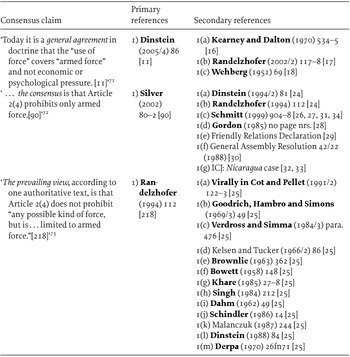
The Introduction to this article already briefly addressed the way the analysis for this piece came about.Footnote 68 To reiterate, for those 26 claims used here, I have listed the references given in the footnote; the same then has been done, twice over – resulting in a list of primary, secondary and tertiary references. What this shows, is that most writers, most of the time, refer to mostly the same set of scholars.Footnote 69 The convergence on the names of a very few can best be demonstrated by means of one of the most cited works in the table, which is Albrecht Randelzhofer's chapter on the use of force, in Bruno Simma's Commentary on the UN Charter. A very basic count of the number of times he is cited in the footnotes following those 26 claims under scrutiny here, shows that in the ‘primary references’ column, he is mentioned seven times out of a total of 39 primary references.Footnote 70 How this happens, and how the trackback proceeds, is illustrated in the table below.
Excerpt from trackback table

The rows displayed are a sample from the trackback table; the consensus claim itself, as well as the primary and secondary references for three separate consensus claims are presented. Those authors whose work – not generally, but one work in particular – reappears throughout the trackback table are presented in bold.Footnote 74
The first row tells us that for this particular claim, a reference is given to a book by Yoram Dinstein, to be specific, to his War, Aggression and Self-Defence (2005, 4th edition). The second column shows that Dinstein himself refers to, inter alia, Randelzhofer's chapter in Simma (2002, 2nd edition).
The second row shows that this claim is substantiated by reference to an article by Daniel Silver; he himself refers to, inter alia, the same Dinstein book cited in the first row – only this time, the reference is to an earlier edition (1994, 2nd edition). Daniel Silver also refers to Albrecht Randelzhofer; again, this concerns a previous edition (1994) of the same chapter in Bruno Simma's Commentary on the UN Charter.
The third row indicates that this particular consensus claim is substantiated by reference to Randelzhofer's chapter in Bruno Simma's book; Randelzhofer himself, in turn, refers to 13 other works. One of these is Dinstein's War, Aggression and Self-Defence; the 1988 edition.
A couple of specific observations emerge from this snapshot, as well as from the trackback table generally.
First, consensus claims are hardly substantiated in individual cases: writers resort to the work of one or a few individual scholars.Footnote 75 The list of cited authors expands with the trackback for Randelzhofer's work, but if we trace the secondary and tertiary references for his consensus claim the same thing happens – to some extent – as well. The column listing the tertiary references for his claim, for example, contains six separate entries for the 1949 book by Goodrich and Hambro (their 1969 book with Simons, referred to by Randelzhofer himself, is the revised edition of the same book). Furthermore, the trackback table shows that several authors cited by Randelzhofer are likewise cited by others; e.g., Virally's chapter in Cot and Pellet's book; the 1969 book by Goodrich, Hambro and Simons (as well as its first, 1949, edition); Brownlie's 1963 International Law and the Use of Force by States; Bowett's 1958 book, and Derpa's book on the use of force.
Most striking is the cross-referencing between Yoram Dinstein's several editions of his War, Aggression and Self-Defence, and Randelzhofer's chapter in Bruno Simma's edited volume. For his claim that force equals armed force (2005, 4th edition), Dinstein refers to Randelzhofer's chapter in Simma's Commentary; the 2002 edition. In this 2002 edition, for his consensus claim that force means armed force, Randelzhofer refers to 13 scholars, including Dinstein's War, Aggression and Self-Defence of 2001. On the page referred to by Randelzhofer, Dinstein himself refers to the previous, 1995 edition of the same Randelzhofer chapter in Simma's Commentary. In that 1995 edition, on one of the pages indicated by Dinstein, Randelzhofer refers, inter alia, to the previous, first edition of Dinstein's War, Aggression and Self-Defense of 1988.Footnote 76
This practice of what J.S. Watson refers to as ‘mutual cross-citation’ is not unique to this particular debate nor to the discipline of international law.Footnote 77 In 1979 Watson wrote a critique of legal reasoning on human rights in international law. With regard to academic writing he argued that:
In articles advocating the international protection of human rights one usually finds that initial reference is made to Lauterpacht's International Law and Human Rights . . . After citing Lauterpacht, writers usually allude to the works of any of a large group of colleagues who, in varying degrees, have reached conclusions similar to Lauterpacht's: Cassin, Humphrey, McDougal, Robertson, Schwelb, Sohn and others . . . this tendency . . . can develop into mutual cross-citation . . .Footnote 78
Though Watson's critique aimed at the ‘discrepancy’ between what he referred to as ‘reality’ and ‘advocacy in an academic context’, and the use of secondary rather than primary sources,Footnote 79 the practice observed is similar to that under scrutiny here – and it has been observed elsewhere.Footnote 80 Part of it might be explained through the ‘Matthew effect’, ‘which predicts that authors who are already well-cited will get a disproportionate share of additional citations’.Footnote 81 A blog post on the subject phrased the individual scholar's thinking as follows: ‘[I]f so many people cite it, it must be a reasonable paper to cite.’Footnote 82
Something more might happen here, though, which might be clarified by asking, what is a footnote supposed to do? In his work on footnotes and the sociology of science, Henry Small writes:
In the tradition of scholarship, the references are the “sources” which the author draws upon to give further meaning to his text. Reversing this view . . . the author is imparting meaning to his “sources” by citing them . . . Referencing viewed in this way is a labelling process . . . In citing a document an author is creating its meaning, and this . . . is a process of symbol making.Footnote 83
Small writes how this ‘symbolic content’ can become ‘shared among a number of citing authors’ – for which he uses the phrase ‘uniformity of usage’ or ‘standardized terminology’.Footnote 84 Small argues that certain sources acquire meaning through the citation process. Of course, this meaning cannot be detached from what the source says, but Small points out that there is a process of identification, where the source comes to represent a certain idea (a relation Small defines as metaphoric as well as metonymic).Footnote 85 If this is repeated a sufficient amount of times between ‘citing authors’ – between those involved in a similar debate – the source turns from one author's ‘private symbol’ to a ‘standard symbol’ for those involved.Footnote 86
Translating this to consensus claims and their footnotes, we might think of frequently cited authors such as Randelzhofer as ‘concept symbols’, representing the idea of ‘consensus’.Footnote 87 Though the claims under scrutiny here are by no means proof of how this process has taken place,Footnote 88 it might be helpful to understand these clusters of references in the way understood by Small. ‘Meaning’, as Small says, ‘[is] conferred through usage’,Footnote 89 and thus, symbols come into being. As described above, ‘proving’ the existence of consensus is extraordinarily difficult, precisely because of what it purports to convey, and what – in the same move – is almost impossible to grasp. The elusive nature of consensus forces scholars to resort to the work of largely the same set of scholars, who become the figureheads of consensus; in their wake we find – and this is an implicit part of the substantiation of the claim – many more scholars whose opinion converges around this particular interpretation. So rather than listing in a footnote all the support they can find, most scholarsFootnote 90 resort to those publicists they identify as being the ‘bearers’ of this majority opinion; in and of themselves these cited scholars represent a larger body of work.
Another way to approach this, is by asking (following the work of Anthony Grafton) whether we think of footnotes as sources, or as authority.Footnote 91 Historians, Grafton writes, cite sources, in which the historian ‘explains the methods and procedures used to produce the text’.Footnote 92 This is different from the function of a footnote as authority, which ‘list[s] . . . the great writers who sanction a given statement or whose words an author has creatively adapted’.Footnote 93 Whereas we might think of the footnotes accompanying consensus claims as ‘evidence’, or sources, the fairly consistent reference to the same people makes them more closely resemble claims to authority. The authority of the footnote, then, is based on its value as a ‘concept symbol’: the community of scholars an author engages with by means of his or her text, recognizes the source given as one that represents a certain idea.Footnote 94 In this way, the name of the cited author and a particular idea collapse into each other,Footnote 95 to the point where what is said by them, becomes indistinguishable from who is doing the saying.
Small's work describes what citations can signify;Footnote 96 and to speak of the authority of footnotes, inevitably leads to a discussion on why an individual scholar would cite Randelzhofer, or one of the other frequently cited scholars.Footnote 97 Susan Cozzens has argued that the citation following a particular ‘knowledge claim’ serves either as ‘rhetoric’ or as ‘reward’.Footnote 98 The first serves as the means ‘through which scientists try to persuade each other of their knowledge claims’; the second, as the one ‘through which credit for achievement is allocated’.Footnote 99 Given what consensus claims are used for, it seems that the first motivation – citation as rhetorical device – at least in this case, is much more likely. Consensus claims carry the weight of collective scholarly authority. To invoke consensus is an attempt to evoke a sense of certainty about the substance of the lawFootnote 100 – even if a scholar, like Walter Sharp, ultimately argues against it. As shown above, the consensus claims studied here serve as a stepping stone to move the argument further. Persuasion of the reader, then, can only spring from an identifiable substantiation of the claimed consensus.Footnote 101 Whether we rely on authority explicitly, or are simply lazy, or not familiar enough with a particular field of law to cite lesser-known works, we cite so others will recognize.Footnote 102 In other words, this is not a casual practice: we do not just cite anybody; we cite those we believe to be holders or representatives of the majority view.Footnote 103 Thus, references used to support the invocation of majority opinion tend to converge on the names of a very few, sometimes by direct reference to their work, at others via the work of less known scholars.
But what are we to make of those authors that do cite a long list of scholars? Because, whereas many references converge around the work of Randelzhofer, references given by Randelzhofer himself – especially if we focus on the secondary and tertiary references – fan out over a large range of authors. As shown in the trackback table, this also means that, if we do a similar trackback for his claim, the list of cited authors and works in support of his interpretive, as well as consensus claim, expands. The first, primary references given in the trackback table present a rather bleak view on the substantiation of consensus claims; the list of works cited is short. This list of works cited expands, as we move to the secondary and tertiary references, especially following the work of Randelzhofer: we come to see a large body of work stretching out over several decades. I have addressed the notion of ‘meta-consensus’ in the previous section; but what are we to make of one single footnote containing a ‘list’ of references, such as in Derpa's book? We could understand these lists as supportive of the interpretation argued; that force equals armed force. A few reflections on this are in order.
To revert once again to citation analysis, the question is what these lists are for. John Budd, for example, argues that these citations appear in the text without explicating how exactly they support the knowledge claim made. In other words, there is no contextualization. ‘There is no discrimination among the cited works’, Budd writes, ‘they are simply accorded bibliographic mention’.Footnote 104 Steve Nimis, in a scathing critique of the way footnotes are used in classicism, refers to the ‘single monster footnote’, the problem with which, he says, is that it ‘has the character of a “pile,” a collection of opinions which is ahistorical: not because dates are not given, but because the judgments recorded are “reified” knowledge’.Footnote 105 This notion of ‘ahistoricity’ can be illustrated by, again, taking a closer look at the work of Albrecht Randelzhofer. What is problematic about the continuous reference to his work, is that the works he himself cites in support of his consensus claim are virtually unchanged between the 1994, 2002 and latest, 2012, edition of the chapter; and all cited works, save one, pre-date 1992.Footnote 106 In effect, this means that a contemporary reference to this particular consensus claim in Randelzhofer constitutes a reference to works most of which are over 20 years old. Put differently, if a scholar (such as Yoram Dinstein) were to inquire into the meaning of force in 1994 and would thereby refer to Randelzhofer, he would be referring to the exact same works Heather Harrison Dinniss would be referring to, almost 20 years later. The claim based on his work – that force as ‘armed force’ is the ‘generally accepted’ interpretation – is presented as ‘given’ or as ‘reified knowledge’.Footnote 107
In that sense, a list of footnotes might even make the argument less persuasive: ‘A scientist’, Nimis says, ‘would never refer to past opinions on a scientific matter’.Footnote 108 In that respect it is interesting to note that some authors, as can be seen in the appendix, do not substantiate their consensus claim at all. So, rather than think of this lack of footnotes as a weakness, we could also think of the consensus as – at least in the minds of these authors – being such common knowledge that there is no need to support it.Footnote 109
Ultimately, both a plethora of references, as well as a complete lack of them, fails to catch what a consensus claim does to a reader: the ‘magical out there’ still stands, however many – or few – authors we might find to support a particular claim.Footnote 110 The practice of self-referentiality, or in Watson's terms, mutual cross-citation, brings a select group of scholars to the forefront of the legal academic community. Ken Hyland describes how ‘[t]he social interactions in the writings of academics not only negotiate community knowledge and credibility, but [also] exercise exclusivity’.Footnote 111 By doing so, these interactions privilege the work of some at the cost of marginalizing that of others. One might ask whether this matters at all, arguing that scholars cannot make law and that their opinions have little weight in comparison to, for example, treaty law.Footnote 112 Incidentally, this is the light in which we have to view Watson's statement that we should not ‘confuse the snowballing acceptance of a rule by academics with snowballing acceptance by states’.Footnote 113 However, as pointed out by Koskenniemi, ‘[t]he metaphor of sources aiding in “finding” the law is premised upon a (positivist) understanding of the law existing “out there” to be “found”’. He states that, ‘[the positivist view] clearly does not tell the whole truth about the law's constructive side, the aspect of law as a result of the legal argument and not a condition of it’.Footnote 114 To illustrate, the appendix to this article shows that, even though writers do cite some ICJ Judgments as well as General Assembly Resolutions, the majority of footnotes contain references to other scholars.Footnote 115 The fairly recent ‘turn to practice’ allows one to view law's meaning as being established in practice:Footnote 116 the law is ‘made’ by those working with it, and there are very many different people doing so, in many different capacities.Footnote 117 In this practice, a legal scholar is no more a neutral participant than is, for example, a state legal adviser. Therefore, his or her work requires as much scrutiny as that of those arguing the substance of the law at their own state department.
5. Conclusion
This article has inquired into the use of consensus claims as part of legal reasoning; into their particular function in the scholar's argument and what it is exactly that is invoked when a scholar refers to majority opinion. In its second part, it has looked at the substantiation of these consensus claims, and questioned what it is these footnotes do, and what they represent. Ultimately, what I have sought to do in this article, in a very exploratory and initial way, is to portray how we come to know what we know in international law through its practice by scholars.Footnote 118 The image that emerges from the previous pages is that of a practice of self-referentiality: an intricate web of cross-references between authors such as Randelzhofer and Dinstein; between first, second and third editions of the same titles. By means of consensus claims, particular interpretations are brought to the fore; but it also elevates those we use to substantiate these claims to be bearers of majority opinion. On the level of the single academic piece, this might appear to be fairly innocent. Yet, the individual scholar merely pointing out in a footnote where consensus might be found, is in fact participant in a larger practice that seriously impacts who is given a voice in the debate, and whose voice remains in the dark.Footnote 119 It means that what the community of scholars knows about the law is based on what is said, as much as on who gets a seat at the table.
Supplementary material
To view supplementary material for this article, please visit http://dx.doi.org/10.1017/S0922156516000480