1. Introduction
In this paper, we examine the use of modal particles (henceforth MPs), such as even ‘just’, in imperatives, as illustrated in 1. An imperative clause in Dutch has the finite lexical verb, such as doe ‘do’, in first position (see 1) and it lacks a subject. Speakers may produce MPs or not, but in both cases their utterances belong to what is considered standard Dutch in both Netherlandic and Belgian Dutch. The number in brackets is the speaker identification number given in the Corpus Gesproken Nederlands (CGN; Spoken Dutch Corpus).
(1)


We have selected the optionality of MPs as a linguistic variable whose context is determined both within and above the level of the sentence. On the one hand, the value of the variable is determined at the sentence level, that is, whether the imperative appears with or without an MP. On the other hand, the variable context is also constrained by pragmatic factors (see Cheshire Reference Cheshire2005). Since MPs signify the rational and emotional position of the speaker toward what is being expressed, MPs can only acquire their full pragmatic meaning in the context of interaction (Foolen Reference Foolen1993). Although grammars, such as the Algemene Nederlandse Spraakkunst (ANS), give examples of MPs with fixed meaning, their interpretation(s), in fact, emerge through situated interactions between interlocutors. To fully analyze patterns of variation in the use of MPs in imperatives, it is thus necessary to add a qualitative, interpretive dimension to the analysis (Cheshire Reference Cheshire2005). Therefore, we analyze imperative clauses with and without MPs not only quantitatively, by applying mixed effects modeling, but also qualitatively, according to the function of the kind of MP used in spoken interaction (see Cameron & Schwenter 2013:467). Specifically, we focus on two types of MPs in imperatives, MITIGATING (weakening) and REINFORCING (strengthening) particles (Vismans Reference Vismans1994).
In this paper, we address the following research questions: i) Does the use of MPs in spoken Dutch imperatives show sociolinguistic stratification, and ii) is their use geographically motivated? In order to answer these questions, we examine the occurrence versus absence of MPs in imperatives in the CGN. The CGN contains recordings of contemporary Dutch as spoken by adults in Flanders (Belgium) and the Netherlands between 1998 and 2004. Our analysis focuses on the spontaneous speech subcorpora—face-to-face conversations (component a) and telephone dialogues (components c and d)—as it has been argued in the literature that MPs occur most frequently in these types of informal spoken registers (see, among others, van der Wouden Reference Ton van der2002a:24–25). Our data set is comprised of 1,714 imperatives produced by 629 speakers. The sociolinguistic variables annotated in the CGN, and hence inevitably included in our analysis, are gender (men versus women), age, education level, occupation level, and interlocutor (that is, the person the utterance is addressed to). The geographic distribution of MPs can also be examined since the CGN is annotated for region: the Netherlands (NL) versus Flanders (VL, Dutch speaking Belgium).
The abovementioned research questions are important, since answers will shed light not only on the use or nonuse of MPs, but also on what is considered the MP usage norm in a pluricentric language such as Dutch spoken in the Netherlands and Belgium. Furthermore, our research also sheds light on the limits of using already existing large corpora such as the CGN when examining the social distribution of linguistic phenomena. As researchers, we are tied to the demographic categoriz-ations determined by the CGN, such as the binary male/female distinction, or education and occupation levels. These categorizations are inherently essential; however, although these categories may underlie general patterns of language use, they, as Eckert (Reference Eckert2014) argues, may not offer a priori explanations for those patterns. For linguists, therefore, the challenge is to look for explanations beyond the given demographic factors in the CGN.
The paper begins with an overview of MPs in spoken Dutch and their various functions when used in imperative utterances. Particular focus is placed on whether a particle has a mitigating or reinforcing function (section 2). Section 3 outlines the methodology used for data collection and analysis, that is, the type of imperatives collected, the method of collection, and the sociolinguistic variables included in the analysis. Section 4 discusses the statistical approach used to analyze the data and presents the results. Section 5 provides a detailed discussion of the results, and section 6 examines the implications of our findings for wider sociolinguistic research dealing with a priori demographic factors in a given corpus.
2. Modal Particles: An Overview
2.1. The Use of MPs in Imperatives
MPs are small words that are often used in the spoken language to convey a variety of attitudes such as uncertainty, politeness, and urgency (van der Wouden Reference Ton van der2002a:21). Superficially, they have the same form as certain adverbs, but they do not have the meaning that is normally associated with those adverbs. For instance, as an adverb, even means ‘briefly’, and a Dutch sentence such as Doe de radio even uit, where even is stressed, will be interpreted as ‘Turn off the radio just for a minute.’ (Vismans Reference Vismans1994:2). By contrast, if the word radio is stressed, and not even, the temporal meaning associated with the adverb is lost, and the function of even is now to make the order or request less urgent and/or more polite: ‘(Just) turn off the radio/Turn off the radio (will you?)’. The bracketed words in the English translation give suggestions of possible ways of conveying the meaning of MPs, but often they are left untranslated in English, as English does not usually use particles in this way. Indeed, MPs are notoriously difficult to translate into any language because they are context-dependent and can have many possible translations depending on the nuances that the speaker wants to convey in a given situation (see, among others, Vandeweghe Reference Vandeweghe2010).
What all MPs have in common is that they are almost always unstressed and appear exclusively in the Mittelfeld, that is, between the main verb and the final nonfinite verb(s) in main clauses, or between the subject and verb in subordinate clauses. This distinguishes MPs from discourse particles, such as hé, hoor, joh ‘hey’/‘you know’, which usually appear in a peripheral position in the sentence, as in Stikstof is een gas, hoor! ‘Nitrogen’s a gas (you know)!’ (van der Wouden Reference Ton van der2002a:25). MPs can also be distinguished from focus particles, such as alleen ‘only’ or zelfs ‘even’, which only modify a particular part of the utterance, for instance, a noun phrase or a prepositional phrase, as in Jip speelt alleen met autootjes ‘Jip plays only with cars’ (van der Wouden & Caspers Reference Ton van der and Caspers2010:53). In contrast, MPs modify the whole utterance, as in Doe je trui maar uit ‘Take your jumper off (will you)/Just take your jumper off’ (van der Wouden & Caspers Reference Ton van der and Caspers2010:53).Footnote 1
The ANS demonstrates how inserting a specific MP into an imperative sentence allows the speaker to change the nuances of the utterance. Consider the following ways of expressing the instruction give those books here (E-ANS:8.3.2) shown in 2.
(2)

It should be noted, however, that the types of illocutionary acts in brackets (from the ANS) represent a potential interpretation; the actual meaning and function of each particle only becomes clear when one hears it in a wider context. For example, geef die boeken maar hier may often be used in a reassuring and friendly way; yet if someone is damaging books and the speaker wants him/her to stop, the speaker can use that same utterance to express anger or irritation.
Vismans’ (Reference Vismans1994) investigation of the use of MPs in directives divides the particles into two opposing groups: mitigating particles (such as maar, even) that usually weaken the force of the speech act, and reinforcing particles (such as dan, nou) that usually strengthen the force of the speech act.Footnote 2 Following Searle (Reference Searle1976) and Leech (Reference Leech1983), Vismans explains why MPs play a particularly important role in directives: The illocutionary goal of a directive is to induce the interlocutor to perform an action, often for the benefit of the speaker, which could compete with the overarching social goal of “establishing and maintaining comity” (Leech Reference Leech1983:104ff.). Indeed, directives could be seen as “face-threatening acts” that may need to be counteracted by taking a “redressive action” (Brown & Levinson Reference Brown and Levinson1987:65).
For instance, a directive in the form of a bare imperative such as Lend me a fiver could be considered face-threatening by the interlocutor. By contrast, if a directive is “softened” with, for example, a term of endearment and/or an offer of reassurance, as in Can I borrow five pounds from you, dear? I’ll pay you back tomorrow, this shows that the speaker is acknowledging the threat in the face-threatening act and attempting to counteract it (Brown & Levinson Reference Brown and Levinson1987:69–70). Vismans (Reference Vismans1994:26–27) argues that mitigating particles in Dutch perform a similar redressive function.
2.2. Mitigating Particles
The general function of mitigating particles is to weaken the force of the speech act. Common subfunctions of mitigation are to indicate nonassertivenes, doubt, indefiniteness, negativity, insignificance, generality, and politeness (Vismans Reference Vismans1994:58–59, 69). The very frequent maar, for example, has been argued to have a restrictive character when used as a focus particle, meaning ‘only’, ‘merely’, as in Jan is maar officier ‘John is only an officer’ (Foolen Reference Foolen1993:149), and this restrictive nature can also be seen in its use as an MP. De Vriendt & van de Craen (1984:58) state that maar in imperative constructions often has a trivializing function: By inserting it into a directive the speaker is indicating that the action to be carried out is of little consequence.
Maar can also have the function of giving permission or making a suggestion (van der Wouden Reference Ton van der2002a:25), which also mitigates the directive. Consider the following examples of imperatives with maar in 3 contrasted with similar constructions without maar in 4. These examples are taken from the data set that we are using in our current analysis, collected from the CGN.Footnote 3
(3)

(4)

In 4, the imperatives are direct, containing no mitigating particle. By contrast, in 3, the use of maar expresses different nuances, such as suggestion, permission, trivialization: What all of these nuances have in common is that they mitigate the utterance. We have translated maar as ‘just’ here, although other translations would be possible, depending on the context, for example, ‘give me the jacket, if you like’ or ‘do you want to give me the jacket?’ (see Vandeweghe Reference Vandeweghe2010 on the difficulty of translating MPs).
Another common MP that has been described in the literature as having a mitigating function is even (including its many variants such as effe, effens, effetjes, eventjes, effekes, efkes). As an adverb, even indicates short duration (for example, ‘briefly’). This temporal aspect can still be part of the interpretation of the MP even if the action expressed by the utterance is of short duration, as in Kun je me even helpen? ‘Could you (just/briefly) lend me a hand (for a minute)?’ (Vismans Reference Vismans1994:70). In situations of longer duration, however, even loses its temporal aspect and is used to indicate that the action in question will not require a lot of effort, as in Kun je me even helpen met het installeren van mijn computer ‘Can you (just) give me a hand with installing my computer?’ (Vismans Reference Vismans1994:70). In this sense it is similar to maar in that it suggests that the action to be carried out is of little significance.
Consider the examples below. The imperatives mitigated by the use of even in 5 contrast with similar, more direct, utterances using the bare imperative in 6. These examples all denote actions of relatively short duration, and therefore the temporal aspect of even could (partly) be present in the interpretation of the particle.
(5)

(6)

Eens, often pronounced es and transcribed as ns (or een keer/ne keer in Belgian Dutch, which has the same function) is initially treated as a reinforcing particle by Vismans (Reference Vismans1994:62–63) on the grounds that it is often used to denote temporal specificity. For instance, he argues that a speaker issuing the directive Kom eens hier ‘Come here, will you’ wants the hearer to come immediately (Vismans Reference Vismans1994:63), which indicates that the temporal MP eens has a reinforcing function. Of course, this depends on the context of the utterance as this MP does not always reinforce the utterance.Footnote 4
Moreover, Vismans (Reference Vismans1994) points out that the historical development of eens ties in with that of other reinforcing particles such as toch and dan, which are attested earlier than the mitigating particles. Having said that, Vismans (Reference Vismans1994:212–214) notes that the results of an experiment in which Dutch native speakers had to rate the politeness of directives with and without MPs, suggest that imperatives with eens are judged to be less forceful than bare imperatives. Interestingly, the interpretation of the MP appeared to be dependent on the type of directive used: The participants in Visman’s study felt that interrogatives such as Kun je de deur dichtdoen? ‘Can you shut the door’ were reinforced by eens; modal expressions such as Je moet de deur eens dichtdoen ‘you (just) have to shut the door’ were interpreted as either mitigated or reinforced, depending on the context, and imperatives such as Doe de deur dicht ‘shut the door’ were interpreted as mitigated by eens (rather than reinforced). Thus, the interpretation of the MP as mitigating or reinforcing depends on the strength of the speech act itself, with imperatives being the most forceful illocutions and interrogatives the least forceful, according to Vismans (Reference Vismans1994:214–215).Footnote 5
Broadly speaking, the research literature on particles and descriptive grammars of Dutch treat eens as a mitigator. For example, the ANS states that this particle can turn a directive into a friendly request (E-ANS:8.3.2); the Woordenboek der Nederlandsche Taal (WNT; Dictionary of Dutch Language states that eens lends a directive a “soothing or co-operative character.”Footnote 6 Jansen (Reference Jansen and Maat1992:65–66) puts eens on a par with even, as can be seen in the following example: Bekijkt u eerst ’ns op uw gemak de folder. En vult u daarna even de vragenlijst in ‘First (just) look at the folder at your leisure. Then (just) fill in the questionnaire.’ Similarly, Hendriks & Le Pair (2004:24) classify eens as an understater within the general category of mitigators, including maar and even. The following examples are from the CGN. The utterances in 7 demonstrate the use of eens as a mitigator; they contrast with similar, more direct, utterances in 8, without eens.
(7)

(8)

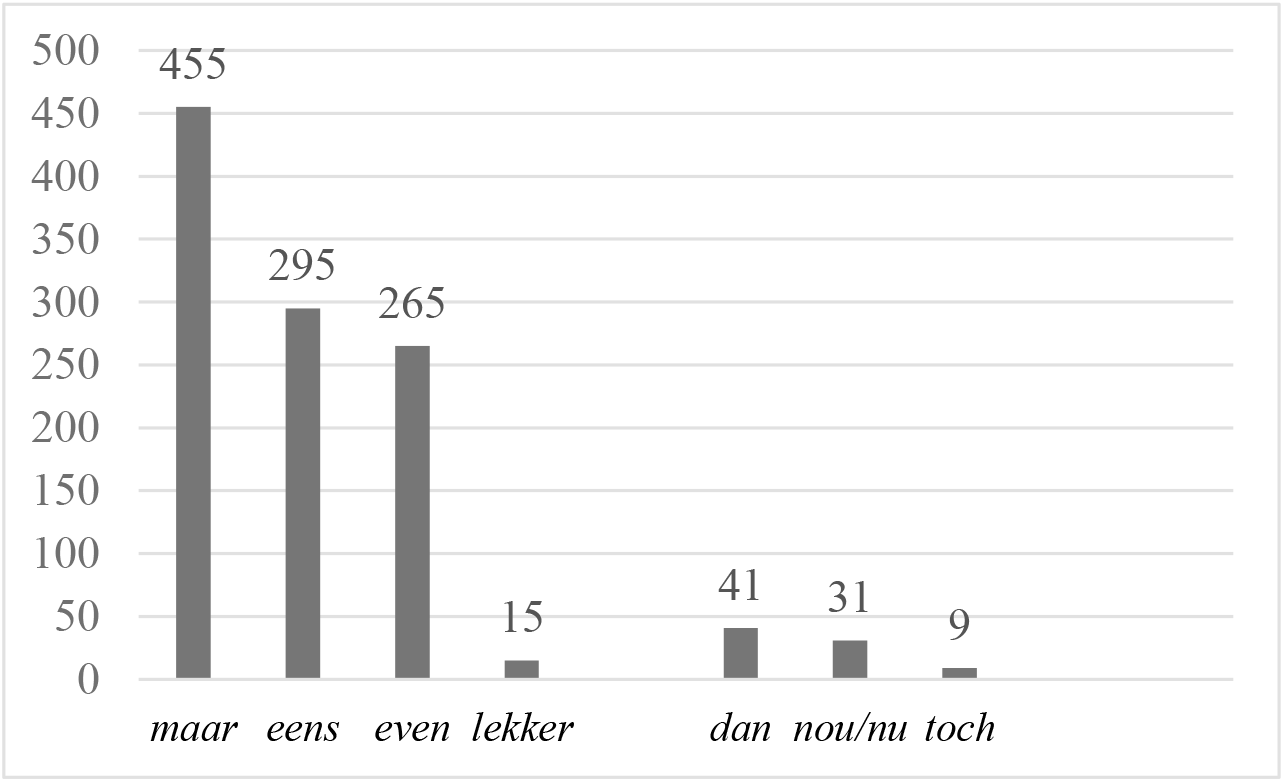
The other mitigators mentioned in Vismans Reference Vismans1994—misschien ‘perhaps’ and soms ‘by any chance’—did not occur in our data set, as they do not usually combine with imperatives. However, there were some tokens of lekker ‘nice’ (N=15). When used in directives, lekker suggests to the interlocutor that the requested action is for his/her own enjoyment (see WNT:LEKKER 6.0). Thus, lekker can also be classified as a mitigating particle:Footnote 7
(9)

Example 9a shows lekker occurring together with maar. Indeed, it is not uncommon for MPs to occur in clusters (see van der Wouden 2002b:151), and a number of imperatives in our data set demonstrate this (12.8% of tokens contain two mitigating particles and two tokens contain three). The examples in 10 illustrate the use of two or three particles in the same utterance.Footnote 8
(10)

In sum, mitigating particles are used frequently in spoken Dutch to weaken the force of imperative utterances. The examples from the CGN above have shown that one of the most common subfunctions of mitigation is politeness. The inclusion of mitigating particles such as maar, eens or even (or a combination of these) in an imperative can be used to counteract the face-threatening nature of the speech act.
2.3. Reinforcing Particles
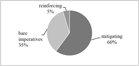
The most frequently occurring reinforcing particles in our data set are dan, nou, and toch, although it must be noted that these occur much less frequently than mitigating particles (5% of utterances occur with a reinforcing particle as opposed to 60% with a mitigating particle). This is probably because our study concentrates on direct imperatives, which, as argued in 2.2 above, are forceful illocutions in themselves, and so speakers feel little need to reinforce them further. This claim is supported by the results of Vismans’s (Reference Vismans1994:214–215) experiment, in which listeners had to judge the forcefulness of different directives. His results show that reinforcers were most effective in weaker directives such as questions (Kun je de deur dichtdoen? ‘Can you shut the door?’), whereas in imperatives they were often judged to be no more forceful than a bare imperative.
As an adverb, dan refers to time, as in Ik ga morgen naar Amsterdam—ben jij daar dan ook? ‘I’m going to Amsterdam tomorrow—will you also be there then?’ It also has a nontemporal use in conditionals in the sense of ‘in that case’, as in Als je aan alle voorwaarden hebt voldaan, dan mag je gaan ‘If you have met all conditions, then you may go’ (Vismans Reference Vismans1994:61). Vismans classifies dan as reinforcing when used as an MP, as it usually lends weight to the imperative (the temporal aspect is absent in such contexts). Indeed, it is often used to express impatience on the part of the speaker. Consider the examples in 11: 11a,b contains the particle, whereas 11c does not.
(11)

Similarly, nou (more formally nu, and Belgian Dutch nu) also shares its form with a temporal adverb, meaning ‘now’, as in We gaan nu koffie drinken ‘We’re going to drink coffee now’ (Vismans Reference Vismans1994:64). Vismans argues that the sense of immediacy of nou gives the word a reinforcing effect when used as an MP, although in most imperatives it has lost its temporal meaning. Its function now is “to give more emphasis to an adhortation, an injuction or a wish” (Geerts & Heestermans 1992:1963). Examples 12a,b show nou being used as a general reinforcer; compare 12a,b with 12c, which does not contain the particle.
(12)

Toch shares its form with a modal adverb that is often used to counter assumptions, as in Al is hij maar kapper, hij is toch geleerd ‘He may only be a barber, but he’s a scholar all the same’ (Vismans Reference Vismans1994:67–68). As an MP it is not used to contradict, yet it has retained its assertive nature. According to the WNT, toch is used to add force to a directive, as in Sta toch stil, alsjeblieft ‘(Now) keep still, please’ (WNT TOCH 5.), and it can often express irritation or impatience (E-ANS 8.3.2).Footnote 9 Consider the examples with toch in 13a,b, the first of which shows two reinforcing particles being used together (see section 3 below for the discussion of MP clusters). In contrast, example 13c contains no particle.
(13)

In sum, the general function of reinforcing particles such as dan, nou, and toch is to lend more weight to an utterance. As imperatives already have considerable illocutionary force, the occurrence of reinforcing particles in these utterances is not particularly frequent. Our data from the CGN show that reinforcing particles occur significantly less frequently than mitigating particles in imperatives.
3. Methodology and Analysis
3.1. Data Collection
The CGN is an electronic corpus of transcribed contemporary Dutch, as spoken by adults in the Netherlands and Flanders, spanning the years 1998 to 2004, comprising around nine million words. Table 1 provides an overview of the subcorpora investigated, giving the numbers according to the design, where NL denotes data from the Netherlands and VL from Dutch-speaking Belgium (Vlaanderen). One can see from the table that the majority of data comes from Netherlandic Dutch.
Spontaneous speech components, the CGN.

An initial search for imperative utterances was carried out using verbs that frequently occur in the imperative: komen ‘come’, gaan ‘go’, geven ‘give’, nemen ‘take’, blijven ‘stay’, wachten ‘wait’, zetten/leggen ‘put’, houden ‘hold’, vertellen ‘tell’, kijken ‘look’, zoeken ‘look for’, proberen ‘try’, doen ‘do’, maken ‘make’, laten ‘let’, bellen ‘call’, schrijven ‘write’. Only direct imperatives were targeted, for example, Doe de deur (MP) dicht ‘Close the door’, as opposed to interrogative, modal or infinitival directives, as in Kun je de deur (MP) dichtdoen? ‘Can you shut the door?’ Je moet de deur (MP) dichtdoen ‘You have to shut the door’, De deur (MP) dichtdoen ‘Shut (infinitive) the door’.
The rationale for the restriction of the analysis to direct imperatives is that utterances with varying illocutionary force do not show the same use of MPs. As direct imperatives have the strongest illocutionary force (Vismans Reference Vismans1994:214–215, Hendriks & Le Pair 2004:27–28), the need for a mitigating particle may be greater in such contexts than in weaker directives such as interrogatives or infinitive constructions, which are perceived as less face-threatening (see van Olmen Reference Olmen2009 for a discussion of infinitive directives). Similarly, it is likely that the need for mitigation is greater in imperatives expressing an order or request than, for example, in imperatives expressing invitations or advice (as in maak je geen zorgen, er is nog tijd (V40186) ‘don’t worry, there’s still time.’). Thus, our analysis concentrates on direct imperatives expressing an order or request. We recognize that this is a somewhat restrictive approach; however, the inclusion of different types of directive would make the variation too complex for an effective comparison of the use of MPs.
Over 2,000 utterances were initially collected: a mixture of bare imperatives and imperatives with a modal particle (or particles). The main criterion for the inclusion of an utterance in the final analysis was the context that allowed variation. For instance, in many contexts, utterances optionally occurred with or without a particle, which suggests that the use of the particle was decided on by the speaker based on situational interaction, as in Geef mij dat jasje maar (N05057) ‘(just) give me that jacket’ versus Geef hier (N05176) ‘give it here.’
This was not the case, however, in many idioms and set phrases. In such utterances there appears to be a fixed pattern of usage, where specific MPs are favored in certain expressions (while other expressions occur without an MP). Westheide (Reference Westheide1986:154) and Foolen (Reference Foolen, van der Auwera and Vandeweghe1984:73) discuss the conventionalized use of MPs in phrases such as reken maar! ‘you bet!’ lit. ‘count MP’ and argue that such utterances should be treated as “conversational routines” (Westheide Reference Westheide1986:155). In these contexts, the presence or absence of an MP is a lexical rather than a pragmatic matter, and consequently, such utterances were excluded from our analysis.
The benefit of analyzing spontaneous unplanned speech is that one might come across “prefabricated expressions” (Cheshire Reference Cheshire2005:81) that would be missed when dealing with intuitions (Cornips & Gregersen Reference Cornips and Gregersen2016). Examples of frequent set phrases in our data set are laat maar ‘never mind’, laat maar zitten ‘forget it’, doe maar ‘go ahead’, which almost exclusively contain maar. Consider the dialogues in 14.
(14)

Other set phrases where variation appeared to be restricted are doe de groeten aan ‘give my regards to’, as in doe de groeten aan iedereen (N08051) ‘give my regards to everyone’ and ga je gang (N05176) ‘go ahead’, which occur mostly without a particle.
Imperatives with nonpropositional meaning, as in 15b,c, were also excluded.
(15)

In 15a, the verb kijken carries the propositional meaning ‘to look’, whereas in 15b,c, it is used as a discourse particle (van der Wouden & Caspers Reference Ton van der and Caspers2010:53). In case of the nonpropositional usage, the aim of the speaker is to focus the attention of the hearer on the utterance to come rather than requiring him/her to look at something. Kijk also appears nonpropositionally in the expression kijk (eens) aan, as in 16, which is frequently used to express surprise or admiration rather than its lexical meaning ‘look at that’.
(16)

Similarly, the expressions kom and kom op ‘come on’ are often used (usually without a particle) as general exhortations rather than specifically denoting movement toward the speaker.
(17)

Furthermore, there are a number of set expressions with laten in the imperative form plus zeggen that are frequently used as formulaic utterances, for example, laat ons zeggen, laat maar zeggen ‘let’s say’:
(18)

Again, such expressions are pragmatic markers rather than true imperatives and therefore needed to be excluded from the analysis.
3.2. Establishing the Sociolinguistic Variable
As the interpretation of MPs is dependent on the pragmatic context of the situation, each conversation was analyzed in order to determine whether the particle could be interpreted as having a mitigating effect on the utterance (in the case of maar, eens, even, lekker) or a reinforcing effect (in the case of dan, nou, toch). Three investigators were involved in this part of the data analysis. Each person was tasked with verifying the decisions of the other two, and if there was any area of disagreement, the utterance was excluded. As intonation plays an important role in the interpretation of illocutionary force (Risselada Reference Risselada1990:4–5, Vismans Reference Vismans1994:167), the CGN sound files were also consulted. As the default intonation pattern of an imperative does not show a rise at the end of the utterance, imperatives with a final rising intonation were considered marked and excluded from the analysis. It was decided that such cases would be likely interpreted as questions and therefore not have the usual force of an imperative (and therefore not require mitigation).
Similarly, the imperatives were examined in the context of the dialogue in which they occurred. To be confident that a particle is serving, for example, a mitigating function in a particular imperative, it is important to hear the preceding and following utterances. For instance, in most cases, even (effe) was found to be a mitigator. However, the excerpt in 19 (speakers A, B, and C) shows that this was not always the case.
(19)

Speaker B’s response to the criticism made by Speaker A, doe effe normaal ‘get over yourself’ contains a particle that would normally be mitigating, but there is no evidence that the addition of effe mitigates this (somewhat aggressive) utterance, as indicated by the response of Speaker C, who feels the need to defend his girlfriend. Thus, imperatives containing particles that are usually mitigating or reinforcing but in the wider context turned out not to be fulfilling their usual function were excluded from the analysis.
Utterances containing two mitigating MPs, as in kijk ’ns even in die doos (N01024) ‘(just have a) look in that box’, or two reinforcing MPs, as in maak het nou toch (N01250) ‘(just) fix it (then)’, which made up 12.8% and 0.1% of utterances, respectively, were double-weighted (and in two cases, where there were three mitigating particles, triple-weighted).Footnote 10 In 7% of the imperatives initially collected, mitigating and reinforcing particles co-occurred (see 20). Such cases are particularly challenging for the analyst, as it is often difficult to determine the relative strength of mitigation and reinforcement. In some cases they appear to cancel each other out: For example, in 20a the reinforcing nature of nou is mitigated by the inclusion of ’ns even. In 20b, the encouragement expressed by maar can be seen as overlaid with a tinge of impatience due to the addition of nou. At the same time, the addition of nou in 20b can be seen as reinforcing the following MP maar and therefore emphasizing the mitigation.
(20)

Thus, owing to the pragmatic complexity of such utterances, imperatives with a combination of mitigators and reinforcers were excluded from the analysis.
In sum, after all nonvariable, nonpropositional, and prosodically marked contexts had been filtered out, and the double weightings and removal of utterances with co-occurring mitigators and reinforcers had taken place, we were left with a total of 1,714 imperatives (1,211 in Netherlandic Dutch and 503 in Belgian Dutch). Figure 1 shows the proportions of imperatives with mitigating particles, reinforcing particles, and with no particle, which are included in the analysis.
Percentage of utterances with mitigating particles, reinforcing particles, and bare imperatives.

The frequencies of the individual particles are set out in figure 2, with the mitigating particles on the left and the reinforcing particles on the right. The data for eens include ns, es, een keer, ene keer; even includes effen, effens, effe, effetjes, eventjes, effekes, efkes, and nou includes nu. It is clear from this chart that maar is by far the most frequently used particle in the data set.Footnote 11
Frequencies of individual particles.

Negative imperatives were also considered in the analysis, as these too provide a variable context for MPs. Such utterances are marked by the presence of a negator, such as niet ‘not’, geen ‘no’, nooit ‘never’, nergens ‘nowhere’, niemand ‘no-one’, niets ‘nothing’, as shown in 21.
(21)

It should be noted, however, that negative imperatives are quite rare in this data set (N=62, 3.6%).Footnote 12
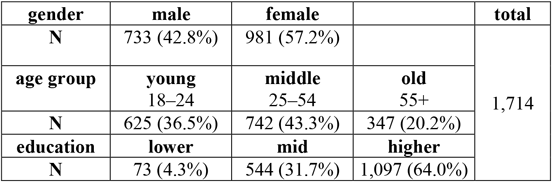
Table 2 demonstrates how the total of 1,714 imperatives were distributed across the speakers in the corpus.Footnote 13
Frequencies of imperatives across speakers in the CGN.

N refers to the number of utterances produced. For example, 733 out of a total of 1,714 utterances were produced by male speakers, 981 by female speakers. The corpus distinguishes three main age groups: 18–24 (young), 25–54 (middle), and 55+ (old) (see Oostdijk 2000:290 for discussion); it also provides the age of each individual speaker (the youngest in the imperative data set being 18 and the oldest 87). Education is divided into three categories. The first category, labeled higher, encompasses speakers with a university degree or other higher education diploma, and also speakers with a higher school-leaving certificate roughly equivalent to the English Advanced Level (such as VWO in The Netherlands, Diploma van Hoger Secundair Onderwijs in Belgium). The second category covers mid-level educational qualifi-cations roughly equivalent to the English GCSE and similar, more vocational, qualifications (such as MAVO and MBO in the Netherlands, ASO in Belgium). Finally, the third category covers lower-level educational qualifications (such as the VBO and LBO in the Netherlands, and the lager middelbaar onderwijs in Belgium), which are generally below the English GCSE level and include some lower-level vocational diplomas. Speakers who left school with no qualifications are also assigned to this category. Note that there is a particularly striking imbalance in the area of education, where 64.0% of the total number of utterances are produced by speakers with a higher education background (compared to only 4.3% of speakers with lower education). Such imbalances are due to the composition of the GCN: The majority of participants in the project were educated speakers.
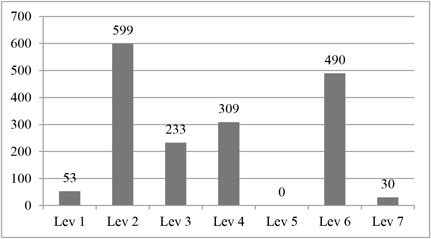
Moreover, the corpus also provides information on speakers’ employment and distinguishes between different occupational levels. In our data set, each occupation is assigned a level between 1 and 7, in line with the CGN classification of the Netherlandic speakers.Footnote 14 Thus, roughly speaking, high ranking professionals and directors are assigned level 1, teachers, lecturers, and managers level 2, white collar workers (such as secretaries or office workers) level 3, manual workers level 4, students level 6, and housewives/husbands level 7 (there were no level 5 speakers in our data set). Figure 3 shows the number of imperatives produced by speakers in each occupation level.
Number of MPs by occupation levels.

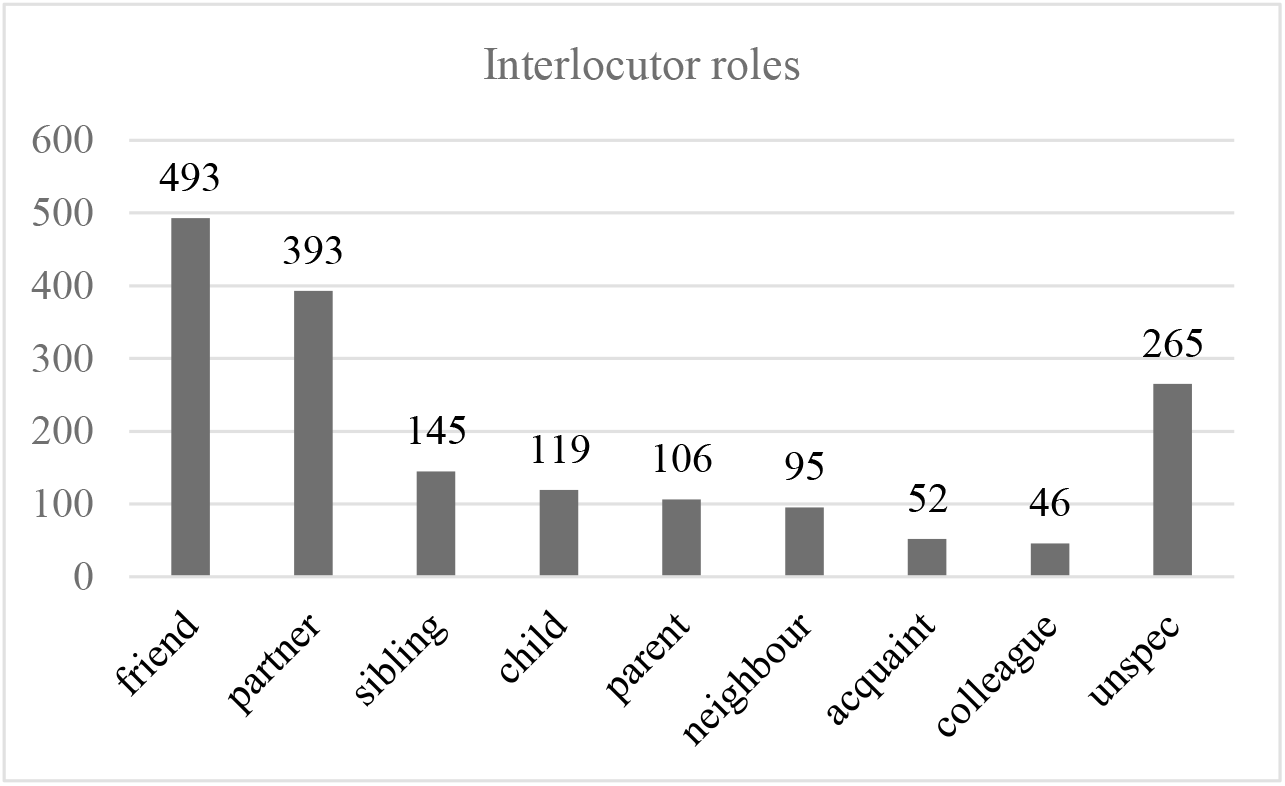
Interlocutor roles.

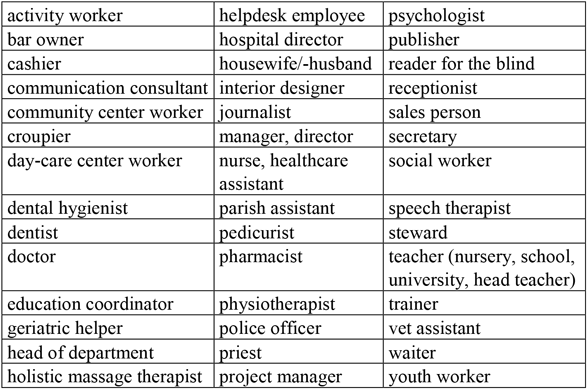
As the occupation of each speaker is noted in the corpus, we considered the possibility that some professional practices might be more conducive to the use of mitigating particles than others, based on the assumption that mitigating particles in Dutch serve as politeness markers (de Hoop et al. 2016). This hypothesis led us to create our own classification beyond the existing ones dictated by the CGN corpus, namely, the grouping of speakers into service-oriented and nonservice-oriented occupations. We defined service-oriented occupations as those that require frequent interactive practices in service encounters with clients, patients, customers, colleagues, pupils, etc. In other words, the interaction can be seen as being between service providers and their clients/customers (Friginal & Hardy 2014:128). In such contexts, politeness markers such as mitigating particles could be of more value than in nonservice-oriented contexts.
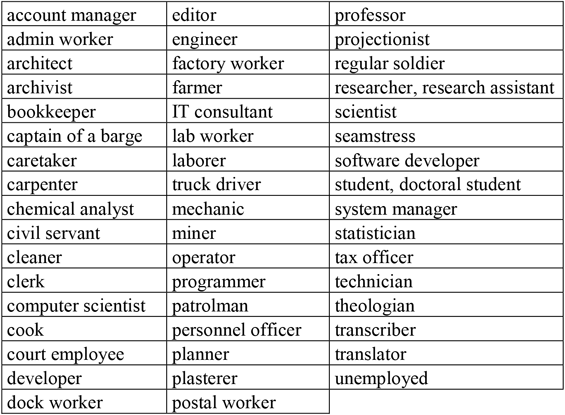
Table 3 illustrates the type of service-oriented occupations held by the speakers in our data set: 44.6% of utterances are produced by speakers in service-oriented occupations. By contrast, occupations which are not typically service-oriented are shown in table 4.
Service-oriented occupations.

Nonservice-oriented occupations.

In addition to the speaker variables listed above, we also collected information on the interlocutor in order to determine whether the choice of addressee had any effect on the use of mitigating or reinforcing particles. It has been pointed out in the literature (for example, Hendriks & Le Pair 2004) that speakers are often more polite and/or careful in their speech to an addressee who is either unknown to the speaker or who, socially, is in a position of power relative to the speaker (for instance, an employee speaking to an employer). In the spontaneous speech components in the CGN, all interlocutors are known to the speaker, and most of the relationships have, in theory, an equal power balance (such as partner, friend, neighbor), although some relationships are hierarchical (such as parent-child). Figure 3 shows the number of utterances directed at each interlocutor. The term partner refers to a member of a couple, married or unmarried. Child is defined as being the son or daughter of the speaker, not as a person under eighteen years old. In a small number of cases, parent, child, and sibling refer to in-laws rather than blood relatives. In some cases, the relationship was not specified in the corpus, in particular, in the Belgian Dutch subcorpus (hence the rightmost column). One can see from the chart that most of the speakers in our data set were conversing with a friend or a partner.
Further data on interlocutors were also included in the analysis. Specifically, we considered whether the interlocutor differed from the speaker in terms of gender, education or age (this latter variable was set at 20 years or more, in order to mark a difference in generation between speakers).
Finally, we also recorded whether the interaction took place face-to-face or via the telephone. Despite the fact that both situations are highly interactive, the conditions for the interaction are different since the speakers cannot see each other during a telephone conversation, which might have some effect on their use of pragmatic markers such as MPs (see Aijmer Reference Aijmer2013:49). In our data set, 1,088 imperatives were produced in face-to-face interactions (63.5%) and 626 in telephone conversations (36.5%).
4. Statistical Analysis and Results
In this section, we investigate to what extent the constraints outlined in section 3 above are significant in determining the choice of an imperative structure (that is, with or without a mitigating particle, with or without a reinforcing particle). We use mixed effects modeling—a statistical method that quantifies the simultaneous effects of several contextual predictors on a response variable. Specifically, the statistical package used in our analysis was lme4 in R, as the mixed-effects model is particularly effective in this type of investigation, being designed to deal with both fixed and random effects (see Tagliamonte & Baayen 2012:171).
First, we carried out a logistic regression, entering the following variables as fixed effects:
region (nl, vl)
gender (female, male)
age (young, middle, old)Footnote 15
education (lower, mid, higher)
occupation level (1 to 7)
occupation (service-oriented, nonservice-oriented)
interlocutor’s relation to speaker (friend, partner, parent etc.)
negative versus affirmative imperative
situation (face-to-face, telephone)
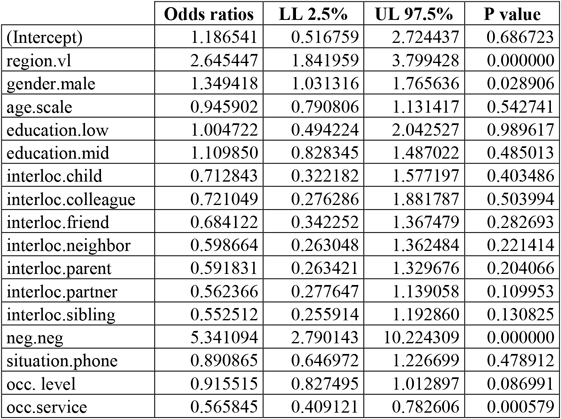
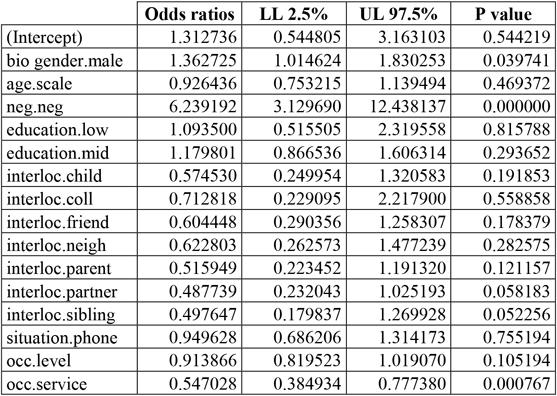
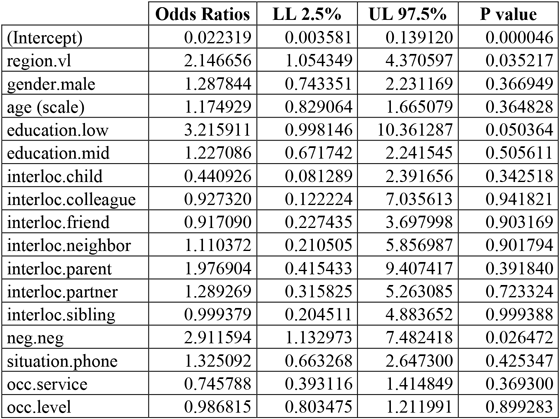
The results are displayed in table 5 below. It shows the main predictors that were entered into the analysis. If one examines the probability values in the rightmost column, one can see that region, negation, occupation, and gender have a significant effect on the use of mitigating particles (that is, their p-value is less than 0.05). The second column shows the effects of the predictors as odds ratios, where numbers higher than 1 indicate a decrease in the odds of imperatives containing mitigating particles and numbers lower than 1 indicate an increase in the odds (1 indicates neither an increase nor a decrease).
Predictors for the use of mitigating particles (LL and UL=the lower and upper confidence intervals).

Table 5 demonstrates the size of each individual effect. The lowest odds of mitigating particles being used are in negative imperatives followed by region (Belgian Dutch speakers are less likely to use mitigating particles than their Netherlandic counterparts), and gender (male speakers are less likely to use mitigating particles than female speakers). Conversely, the other significant predictor, occupation, shows the highest odds of mitigating particles being used: Speakers in service-oriented occupations are more likely to use a mitigating particle than those in nonservice-oriented occupations. The age, education, occupation level of the speaker, the relation between the speaker and the interlocutor, and the speech situation (face-to-face versus telephone) are not significant.Footnote 16
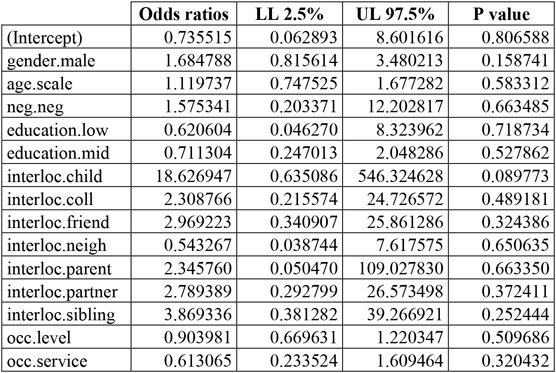
As region plays a significant role in the use of mitigating particles (64.8% of imperatives in Netherlandic Dutch contain a mitigating particle, as opposed to only 48.7% in Belgian Dutch), we built separate models for each region. The results are shown in tables 6 and 7, respectively.
Use of mitigating particles in Netherlandic Dutch.

Use of mitigating particles in Belgian Dutch.

Tables 6 and 7 reveal that the significant effects we found in the combined analysis are not present in Belgian Dutch, which is the smaller of our two data sets.Footnote 17 Conversely, removing Belgian Dutch from our analysis leads to an increase in effect size of the significant predictors in Netherlandic Dutch: negative imperatives, occupation, and gender.
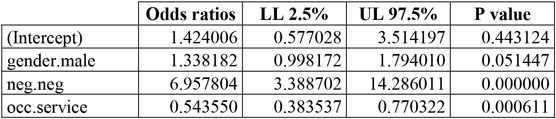
The results in table 6 include one random effect, namely, speaker (n=392), which allows us to ascertain whether individual speaker preference had any impact on the decision whether to use a particle or not. The variance and standard deviation are 0.2456 and 0.4956, respectively, meaning there is not much variability between the speakers. If the model is refined by adding a second random effect, namely, verb (n=18), one can see that the significance of gender is reduced when testing the fixed effects. The significant variables are reported in table 8 (speaker: variance 0.2070, standard deviation 0.4549; verb: variance 0.1838, standard deviation 0.4287).
Mitigating particles in Netherlandic Dutch: Model containing two random effects.

If the models for Netherlandic Dutch in tables 6 and 8 are compared, one can see that they are significantly different (p=0.001). The AIC and BIC values are smaller in the latter model (AIC=1525.9, down from 1533.4; BIC 1617.7, down from 1620.1), whereas the concordance value is slightly higher (C=0.75, up from 0.74), which suggests that the model presented in table 8 has the better fit.Footnote 18 Thus, it can be concluded that the two significant predictors of the use of mitigating particles in Netherlandic Dutch are negation (negative imperatives contain fewer mitigating particles than affirmatives) and occupation (speakers in service-oriented occupations use more mitigating particles than those whose occupations are not service oriented). The p-value for gender just misses significance.Footnote 19
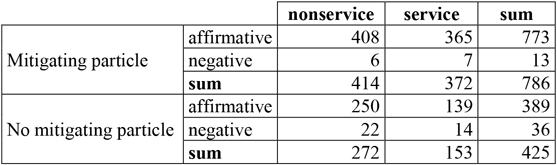
In order to compare the relationship between the two significant variables, we carried out a cross-tabulation, the results of which are given in table 9.
Cross-tabulation of negation and service-oriented professions.

One can see from table 9 that, although negation appears to be highly significant in determining the use of mitigating particles in imperatives, the small number of negative utterances in our data set means that they have little effect on the results for service-oriented versus nonservice-oriented occupations. If all negative utterances are removed from the calculations, one is still left with a highly significant result for occupation (p<0.001).
Finally, we tested the use of reinforcing particles against the predictors set out in section 3 above. As was the case with the mitigating particles, the best fit model was achieved by adding two random effects: speaker and verb.Footnote 20 The results are given in table 10 (speaker: variance 0.2124, standard deviation 0.4609; verb: variance 1.1351, standard deviation 1.0654). Table 10 shows that region and negation have a significant effect on the use of reinforcing particles, and the odds ratios show that these two variables increase the likelihood of imperatives containing a reinforcing particle (values less than 1 show a decrease). In Belgian Dutch, 10.7% of imperatives contain a reinforcing particle, compared to 4.6% in Netherlandic Dutch; 11.3% of negative imperatives contain a reinforcing particle (in both varieties), as opposed to only 4.4% of affirmatives.
Predictors for the use of reinforcing particles.

It must be noted, however, that the analysis of reinforcing particles has considerably less statistical power than that of the mitigating particles. Utterances with reinforcing particles are not particularly frequent in our data set (5%, n=80), which means that numbers for some of the variables are very small. For instance, education.low appears as almost significant in table 10, and the odds ratios indicate that speakers with a low education level have higher odds of using reinforcing particles. However, there are only 7 utterances with reinforcing particles in this group (total utterances for this group=73). If one examines Netherlandic Dutch only, no significant sociolinguistic effects are found, although negation remains significant (p=0.048).Footnote 21 For Belgian Dutch, the numbers are too small to test the variables effectively.
5. Discussion
As described above, mitigating particles are used significantly less frequently in Belgian Dutch than in Netherlandic Dutch (that is, in 48.7% of imperatives in Belgian Dutch as opposed to 64.8% in Netherlandic Dutch). It is not clear why this should be the case, but it could be that restricting our search to direct imperatives rather than including other types of directives has prevented us from seeing the wider picture. That is to say, it might be the case that, instead of using mitigating particles, the Belgian Dutch speakers in the CGN corpus employ other ways to mitigate their directives, such as modal verbs, infinitives, participles, and other polite (nonimperative) formulations, which our analysis has not covered.
Conversely, when it comes to reinforcing particles, Belgian Dutch speakers are more likely to use these in imperatives than their counterparts in The Netherlands. Again, a thorough investigation of all directives would be needed to account for this difference adequately. If, for instance, Belgian Dutch speakers prefer to use nonimperative directives more than Netherlandic Dutch speakers and only use imperatives when they need extra force, it is not unlikely that these imperatives might be accompanied by a reinforcer. Having said that, it must be borne in mind that our data set contains a relatively small number of reinforcing particles, therefore some caution is necessary when interpreting these results.
The sociolinguistic variable that has proved to be significant in determining the use of mitigating particles in Netherlandic Dutch is occupation, specifically whether a speaker has an occupation that is service-oriented or not.Footnote 22 Results show that speakers in service-oriented occupations use a significantly higher number of mitigating particles than those in nonservice-oriented occupations when producing imperatives. Thus, it is probable that the use of MPs in imperatives is linked to politeness in professional encounters between service providers and their customers/clients (Friginal & Hardy 2014:128-129):
An effective server is able to maintain a problem-solving focus throughout the interaction and gain the customer’s trust or patience by using polite and respectful language, focused on the particular need(s) of the customer. Friginal & Hardy (2014:129)
Indeed, there is evidence that imperatives containing mitigating particles such as maar and even are judged by speakers to be more polite not only when compared to bare imperatives, but also when compared to imperatives containing the word alsjeblieft ‘please’ (de Hoop et al. 2016). Imperatives with alsjeblieft are not judged as being significantly different from bare imperatives. Thus, one can conclude that the use of mitigating particles in imperatives is an important politeness strategy in spoken Dutch, and our data suggest that speakers in service-oriented occupations make good use of this strategy.
What is particularly interesting is that this study demonstrates that (at least some) speech patterns and practices used in the workplace and private sphere have an effect on each other. Our data set consists of spontaneous speech of an informal nature, where speakers are largely conversing with friends and family, and one would not necessarily assume a particular need for politeness in such interactions. Thus, it appears that the politeness strategies used in workplace interactions can become part of the speaker’s general communicative practices and/or that people who interact in a more polite way are more likely to work as a service provider than people who are less polite in general.
With regard to negation, our results clearly show that negative imperatives are significantly less likely to contain a mitigating particle than affirmatives. A possible explanation for this might be that the act of telling someone not to do something is deemed by the speaker to require more force than would be needed for a positive directive. This would also explain the significantly higher odds of a reinforcing particle co-occurring with a negative imperative than with an affirmative one.
6. Conclusion
In this paper, we have addressed two research questions: Does the use of MPs in spoken Dutch imperatives show sociolinguistic stratification, and is their use geographically motivated? With respect to geographical variation, mitigating particles are used significantly less frequently in Belgian Dutch than in Netherlandic Dutch (that is, in 48.7% of imperatives in Belgian Dutch, as opposed to 64.8% in Netherlandic Dutch, p<0.001). Conversely, reinforcing particles appear to be used more frequently in Belgian Dutch (that is, in 10.7% of imperatives in Belgian Dutch, compared to 4.6% in Netherlandic Dutch, p=0.04); however more research is needed in order to determine the true significance of this difference, as our results for reinforcing particles have relatively little statistical power, owing to the small number of these MPs in our data set.
With respect to sociolinguistic stratification, our study demonstrates that the use of mitigating particles in spoken Dutch imperatives is sociolinguistically motivated. This is at least the case in Netherlandic Dutch, where the frequency of mitigating particles in imperatives is relatively high. Specifically, speakers in service-oriented occupations use significantly more mitigating particles than speakers in nonservice-oriented occupations, and we argue that this is a function of their need to be more polite in their role as a service provider. However, as the data do not come from the speakers’ workplace interactions but from informal conversations with friends, family, and neighbors, we suggest that speech patterns of a speaker’s professional life can be carried over into his/her personal life and/or that people who interact in a more polite way are more likely to work as a service provider than people who are less polite in general.
In order to uncover the significant sociolinguistic variable, it was necessary to look beyond the a priori demographic classifications given in the CGN. According to Eckert (Reference Eckert2014:529), “The question that this raises for a development of best practices in coding large corpora is how close can we get to explanation with the kinds of categories that are available for selecting and classifying speakers?” and how to integrate these with what we know from sociolinguistic, qualitative research (see also Bamman et al. Reference Bamman, Eisenstein and Schnoebelen2014:147). Thus, although an initial analysis suggested that gender might play a significant role in the use of mitigating particles, the inclusion of the occupation variables service versus nonservice oriented provided us with the more significant result, and the best-fit model revealed that gender was not significant.
In sum, this analysis has attempted to go beyond simple demographic categories to explore how ideologies (for example, of service culture and commodification) correlate with observed variable practice. It is hoped that further research into the relationship between linguistic behavior and discourse context will be able to shed some light on this area.