Introduction
Pheromone traps can be useful for monitoring populations of pest insects. Dome® traps (Mullen et al. Reference Mullen, Highland, Taggart and Lingren1992; Mullen Reference Mullen2011) are used to monitor populations of Tribolium confusum Jacquelin du Val and T. castaneum (Herbst) (Coleoptera: Tenbrionidae) in Canadian and American flour mills (Campbell et al. Reference Campbell, Mullen and Dowdy2002, Campbell et al. Reference Campbell, Toews, Arthur and Arbogast2010a, Campbell et al. Reference Romero, Campbell, Nechols and With2010b; Harrison Reference Harrison2007). Traps are baited with an isomeric mixture of 4R,8R-(–)- and 4R,4S-(+)-4,8-dimethyldecanal, the aggregation pheromone of the two species (Suzuki et al. Reference Suzuki, Kozaki and Sugawara1984), and food attractants in the form of cereal oil. Trap catches provide relative measures of size and rate of change of beetle populations in flour mills (Phillips Reference Phillips1997; Subramanyam and Hagstrum Reference Phillips, Cogan, Fadamiro, Subramanyam and Hagstrum2000; Campbell et al. Reference Campbell, Mullen and Dowdy2002; Trematerra and Sciarretta Reference Trematerra and Sciarretta2004; Mullen Reference Mullen2011).
However, trap catches can be influenced by many factors, including population size, nutritional and mating status, food availability, presence of other species, number of trapped insects, temperature, lighting, and type of lure (Phillips Reference Phillips1997; Burkholder Reference Burkholder1985; Toews et al. Reference Toews, Arthur and Campbell2005; Athanassiou et al. Reference Athanassiou, Kavallieratos and Trematerra2006; Fedina and Lewis Reference Fedina and Lewis2007; Semeao et al. Reference Semeao, Campbell, Whitworth and Sloderbeck2011). Little is known about the effect of species and strains of Tribolium Macleay on trap catch. Furthermore, the relationship between population size and number of trapped beetles is not clearly understood (Phillips et al. Reference Phillips, Cogan, Fadamiro, Subramanyam and Hagstrum2000; Subramanyam and Hagstrum Reference Subramanyam, Hagstrum, Subramanyam and Hagstrum2000; Campbell et al. Reference Campbell and Hagstrum2002). Currently, many food-processing plants are fumigated once or twice a year on predetermined dates, regardless of pest population size (Fields and White Reference Fields and White2002). A better understanding of factors affecting trap catch will allow better estimation of pest population sizes, and ultimately lead to better IPM programs for Tribolium flour beetles in flour mills.
Tribolium confusum and T. castaneum are economically important pests worldwide. Tribolium castaneum is found in granaries on farms and in grain elevators, whereas T. confusum rarely is, and both species are found in food-processing facilities and warehouses (Trematerra and Sciarretta Reference Trematerra and Sciarretta2004; Abdelghany et al. Reference Abdelghany, Awadalla, Abdel-Baky, El-Syrafi and Fields2010). These habitat differences may be explained by behavioural differences (Rees Reference Rees2004): adults of T. castaneum can fly; those of T. confusum are flightless (Rees Reference Rees2004). A mixture of 4R-8R-(–)- and 4R-8S-(+)-4,8-dimethyldecanal, at species-specific ratios, is the aggregation pheromone for both species (Suzuki and Mori Reference Suzuki and Mori1983; Suzuki et al. Reference Suzuki, Kozaki and Sugawara1984). Tribolium castaneum prefers fresh flour and is repelled by conditioned flour (Ghent Reference Ghent1966; Sokoloff Reference Sokoloff1974). In contrast, T. confusum prefers conditioned flour (Naylor Reference Naylor1959; Ghent Reference Ghent1966; Ogden Reference Ogden1970). In addition, there are differences in insecticide resistance, behaviour, and population growth between strains of Tribolium species (Sokoloff Reference Sokoloff1974; Rigaux et al. Reference Rigaux, Haubruge and Fields2001; Sousa et al. Reference Sousa, Faroni, Pimentel and Guedes2009).
The objective of this study was to examine the differences between strains and species of T. confusum and T. castaneum in an effort to increase the effectiveness of sampling for these beetles in flour mills. We examined the effectiveness of pheromone-trap monitoring in the laboratory, a small warehouse, and a flour mill, using mill and laboratory strains of T. confusum and T. castaneum; we tested the efficacy of pheromone traps in a flour mill; and we compared ratios of the two species in traps and flour samples in a mill. In addition, we released adults of both species into a small simulated warehouse to compare numbers of trapped beetles with actual population numbers. Because of observed differences in species ratios between mill populations and trap captures, in the laboratory we examined attractiveness to pheromone, speed of movement, and burrowing behaviour in flour for strains of both species using specimens recently taken from flour mills and established laboratory populations.
Materials and methods
Flour mill
Flour-sample collection
Flour samples were taken from roll stands, boots, and sifters in mill 1 (19 samples) and sifters in the adjoining packing plant (3 samples) during the week of 16–23 November 2006 (while the baited versus unbaited monitoring trap study was underway). Roll stands contain roller mills, corrugated cylinders that grind and break up the wheat kernels and flour into progressively smaller particles. Sifters contain sieves of different sizes that sort the flour by particle size. Boots are the bottom most section of bucket elevators. Bucket elevators move wheat kernels or flour to the top of the mill (Posner and Hibbs 2005). Flour samples weighed approximately 0.5–2.0kg, and the amount sampled depended upon available flour residues. All samples were sifted using a 850μm aperture sieve, and collected beetles were identified as T. confusum or T. castaneum.
To compare species ratios in flour samples with those in traps, specimens of T. confusum and T. castaneum caught in 30 traps on four different floors of mill 1 were also collected and identified. Beetles were collected from traps daily from 18 to 23 November 2006 and from 10 traps in the packing plant on 24 November 2006, upon completion of the baited versus unbaited monitoring trap study. All traps were Dome® traps baited with mixtures of 4R-8R-(–)- and 4R-8S-(+)-4,8-dimethyldecanal and a food oil (Trécé Inc., Adair, Oklahoma, United States of America).
Trap efficacy
A 100cm diameter circle with release spots at 10, 30, and 60cm along lines radiating north, south, east, and west from the centre of the circle was drawn on the fifth floor of mill 1. A single monitoring trap was placed in the middle of the circle. Depending on the treatment, the trap was baited (pheromone and cereal oil) or unbaited (no pheromone and no oil).
Recently emerged virgin male T. confusum from sexed pupae (Hinton Reference Hinton1942) in a laboratory strain were shipped to mill 1 for this experiment. Beetles were placed in a large Petri dish containing a sprinkle of flour from the mill and small pieces of filter paper for no more than 7h prior to the experiment. To minimize disturbance to the beetles, each was transferred on a piece of filter paper to a randomly chosen release spot.
Elapsed time (to a maximum of 10min) was recorded from release of each beetle until it had left the circle or been caught in the trap. If a beetle went under the trap, the trap was checked after 1min to see if the beetle had been caught. Trap touching by beetles was recorded; instances of a beetle under the trap but not caught after 1min were counted as a touch. One repetition of this experiment consisted of 12 releases, one beetle at each of the release spots.
There were seven repetitions using a baited trap with new pheromone and cereal oil. The trap was assembled on the first day of the experiment and used for the next 3days. An additional four repetitions of the experiment were performed using a trap containing a pheromone septum that had aired in the mill for 5days and new cereal oil. This pheromone lure was from a trap that was assembled 5days prior to its use in this experiment, and had previously caught beetles on the fourth floor of the mill. There were also six repetitions using an unbaited trap. Ambient temperature and humidity (range, measured with a HOBO® data logger (Onset Company, Bourne, Massachusetts) attached to a wall in the centre of the fifth floor) were 28.7–34.0°C (31.2 ± 0.06°C; mean ± SEM) and 35.0%–45.2% RH (39.1% ± 0.13% RH).
Ten baited (cereal oil and pheromone) monitoring traps in the packing plant of mill 1 (5 each on the first and fifth floors) were used as part of the mill's IPM programs. All beetles in these traps were counted and discarded and 10 unbaited traps were placed 1m from each of the baited traps along a wall. All traps, baited and unbaited, were left for 1week and then the trapped beetles were counted.
Laboratory and simulated warehouse
The laboratory and simulated warehouse were located at the Cereal Research Centre in Winnipeg, Manitoba (approximately 49°53′N, 97°03′W).
Insect strains
All insects were maintained in the laboratory on unbleached white flour and 5% brewer's yeast at 30oC, 65% RH. Unbleached white flour is hereinafter referred to as plain flour, and unbleached white flour + 5% brewer's yeast is referred to as flour. The laboratory strain of T. castaneum was originally collected from Steinbach, Manitoba (approximately 49°32′N, 96°41′W), in 1989. The laboratory strain of T. confusum has been in culture since about 1985. Mill strains of T. castaneum were collected from three Canadian mills in different provinces in March (mill 2), June (mill 1), and May (mill 3) 2007. Tribolium confusum was collected from mill 1 in June 2007, and separated from T. castaneum by examining adults.
Warehouse release–recapture
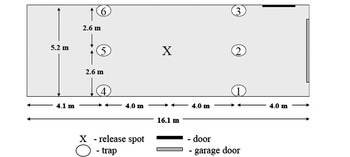
The simulated warehouse (Fig. 1) was cleaned, and sites potentially harbouring beetles were removed. Tests were run during the winter in 2007 and 2008. The warehouse was opened for approximately 4 days before each test, allowing temperatures to reach between −6 and −24°C and ensuring that no beetles remained in the warehouse. Six baited traps were placed in the warehouse 4days before the release of beetles to allow the baits to “air-out” (new pheromone septa can have lower efficacy; Hussain et al. Reference Hussain, Phillips, Mayhew, AliNiazee, Highley, Wright, Banks and Champ1994) and then checked for beetles to verify that the warehouse was beetle-free. Floor temperature and relative humidity were measured at nine locations (Hawkin Reference Hawkin2008) and ranged from 22.3 to 27.6°C and from 23.9% to 24.1%, respectively, during the tests. Warehouse lights were left on for the duration of the experiment to simulate flour-mill working conditions.
Schematic diagram of the simulated warehouse, including placement of pheromone traps and release spot. Tribolium confusum and T. castaneum (500 adults per species) were placed at the release spot and the numbers caught in the traps were recorded daily over a 10-day period.

Five hundred beetles of each species were released on the middle of the warehouse floor at the same time. Mill and laboratory strains were run on different dates. Adults ranged in age from newly emerged to 3 months old. The beetles were sieved out of the flour and immediately released by overturning the sieves on the warehouse floor. After 30 min, any beetles remaining on the sieves were swept off with a paintbrush.
After beetle release, all six traps were checked daily for 10 days. Beetle health was monitored by holding 20 beetles in 12g of plain flour per vial, 3 vials per species in the warehouse. Live and dead beetles were counted at the end of the 10-day release period. The average mortality for the trials ranged from 0% to 2% for T. confusum and from 10% to 18% for T. castaneum.
Arena
This experiment was carried out because it was impossible to run more than two species at a time in the warehouse release-recapture experiment. To test several species and strains at the same time under the same conditions, we tested trap efficacy in small arenas containing one monitoring trap per arena but no food or harbourage sites. Six arenas were used for this experiment, each consisting of a 1.2m2 plywood base with 4cm high metal sides attached to the outside of the plywood. Fluon® (AGC Chemicals Americas, Inc., Bayonne, New Jersey) was applied to the metal sides to keep beetles from escaping from the arena. The arenas were placed in a grid pattern in a warehouse at the Cereal Research Center (Winnipeg, Manitoba; Fig. 1). Temperature and relative humidity inside the warehouse were measured by data loggers taped to the outside of each arena. The distance between arenas was 0.22–0.35m. The arenas were vacuumed between repetitions.
The beetles used in the experiments were reared by placing 100 adults in 200g flour, and adults used were 4–6 weeks old. For each repetition, 200 unsexed adults of each of the six types of beetles were released in the left-hand corner of each arena. A monitoring trap was placed in the centre of each arena prior to release of the insects; a new trap and pheromone lure were used for each repetition. Baited traps contained a pheromone septum and three or four drops of cereal oil; unbaited traps had no oil or pheromone. New traps were used for each repetition and the three unbaited replications were done first in order to avoid contamination. Beetles were left in the arenas for 24h in the dark and then beetles in the trap, under the base of the trap, and elsewhere in the arena were counted. The arenas were vacuumed after each trial. Average temperature and relative humidity during the tests ranged from 15.1 to 20.7°C and from 29.1% to 55.5%, respectively (Hawkin Reference Hawkin2008). There were three replicates, each done on a different date. All experiments were completed in a 2-week period.
Movement rates
The rate of movement of adults of T. confusum and T. castaneum and two strains (mill 1 and laboratory) was measured using techniques similar to Rigaux et al.'s (2001), with 17cm diameter rings (acrylonitrile-butadiene-styrene (ABS) plastic) placed over black paper. The sides of the rings were painted with Fluon to prevent escape of beetles. Mill 1 beetles were the progeny of beetles taken from the mill. Beetles were sexed as pupae and mated as adults, and the marked mates (DayGlo Color Corporation, Cleveland, Ohio, United States of America (Hawkin Reference Hawkin2008)) were separated from the unmarked test insects. Experiments were run in the dark. There were 13–15 beetles of each sex per treatment. Ten beetles were run at once, each in a separate ring. Beetle order was random. Average temperature and humidity during the experiment were 17.5 ± 0.02°C and 37.4% ± 0.08%, respectively. We observed beetles with an infrared camera (WV-CD820, Panasonic Inc., Tokyo, Japan), after letting them acclimate for at least 1 h. A remote-control system was used to move the camera and minimize disturbance to beetles. Rate of movement was measured by placing a sheet of acetate over a TV screen, playing the recording and constantly marking the path of the beetle for 1 min, and estimating path length using a ruler placed beside the rings.
Pheromone-pitfall-trap bioassay
We used a paired pitfall-trap bioassay modified from Boake and Wade (Reference Boake and Wade1984) and Phillips et al. (Reference Phillips, Jiang, Burkholder, Phillips and Tran1993) to test the attractiveness of pheromone in the absence of trap-design effects. Species, strains, and rearing method were as in the arena experiment. Pupae were sexed and males and females held in separate jars with flour. Tested adults were at least 1 week old. Response to synthetic aggregation pheromone (Trécé Inc., Adair, Oklahoma, United States of America) was tested against a hexane control. Rubber septa were loaded with 1μL of pheromone in 19μL of hexane, or 19μL of hexane alone, using a syringe, and allowed to dry at room temperature for 24h.
A glass plate (16 cm × 16cm) with two 0.8cm diameter holes 8cm apart was sanded to provide a roughened surface upon which beetles could walk. The sides of the holes were coated with Fluon to increase the efficiency of beetle capture. The glass plate was placed level in a wood casing above two glass vials that held the rubber septa and collected beetles. A flat-bottomed glass bowl (6.5cm high, 12.5cm diameter, with a 1cm diameter hole in the centre) was placed over the glass plate to prevent beetle escape. An inverted glass funnel was placed on the glass plate over a 4.25cm diameter filter paper. Ten beetles were dropped onto the filter paper through the stem of the inverted funnel, which held them in place until the funnel was raised after 30min. The number of beetles in the vials was recorded after 10min. All glass was washed with 95% ethanol between runs. There were six replicates for each sex, species, and strain combination. The experiments were run in the dark at 25 ± 0.5°C, 60% ± 10% RH.
Burrowing
This experiment tested for differences in burrowing behaviour between the six strains of the two Tribolium species. Beetles for this experiment were collected from one of mills 1–3 less than 7 months prior to the experiment or were taken from existing laboratory strains. All mill beetles and laboratory T. confusum were reared for almost 3 months prior to the experiment in groups of 100 adults in 200g flour.
Six polyvinyl chloride tubes, 100cm × 10cm, were used to measure burrowing distributions. There were horizontal slots every 10cm of height and metal separators were fashioned to fit into these slots. Tape was used to cover the slots during the experiment.
Plain flour (1800g) was placed in each of six tubes, resulting in a flour depth of approximately 36cm. The tubes were placed vertically in an incubator for at least 10 h to allow the temperature to stabilize at 29.1–29.5°C.
Two hundred beetles of each of the six strains were placed on the surface of the flour (one strain per tube) and allowed to burrow for 24h in the dark. Tubes were removed from the incubator and the metal separators were inserted into the 10, 20, and 30cm horizontal slots, resulting in three 10cm deep and one 6cm deep sections of flour in each tube. The flour was sifted, section by section, using a 850μm aperture sieve and the beetles in each section were counted.
Statistical analysis
Differences in the ratio of T. confusum to T. castaneum from various locations, obtained by means of various sampling methods, were tested using subdivided contingency tables and the χ2 test with Holm's correction. Differences between species and strains in their rate of movement, mass, and number of beetles caught in traps or found under traps were analyzed using three-way, two-way, and one-way ANOVAs. As necessary, data were transformed using log(x+1)-transformation to normalize means and equalize variances. Significant differences between treatments were determined with Tukey's multiple-range test (P = 0.05). We employed a general linear model using a multinomial model (in our case different depths) to determine whether the distribution of the depths of burrowing differed between species and strains. This analysis uses the entire distribution to compare groups. We used specific contrasts to compare particular groups and a χ2 test for significant differences. All statistics were run using SigmaStat® (Systat Software Inc. 2006), except for the general linear model, for which we used SAS® (SAS Institute Inc. 2004).
Results
Flour mill
Flour-sample collection
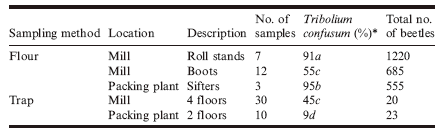
Flour samples from boots located on the ground floor of mill 1 contained approximately 50% T. confusum and 50% T. castaneum, whereas flour samples from the roll stands on the fourth floor and sifters in the packing plants contained over 90% T. confusum (Table 1). Beetles in flour samples from the packing plant were almost entirely T. confusum (95%), whereas beetles trapped in pheromone traps were mostly T. castaneum (81%). Of beetles from mill 1 flour samples, 45%–95% were T. confusum, whereas of beetles from mill 1 pheromone traps, 45% were T. confusum (Table 1). All 22 flour samples collected contained both species.
Percentages of adult Tribolium confusum in flour samples or pheromone traps (remaining beetles were Tribolium castaneum) collected from mill 1 on 18–24 November 2006.
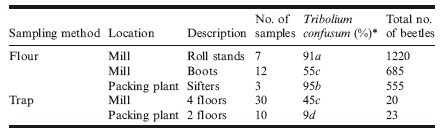
*Values followed by a different letter are significantly different (subdivided contingency tables, χ2 test, P > 0.05, using Holm's correction).
Trap efficacy
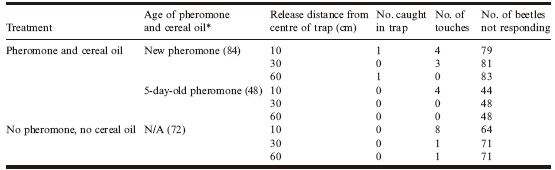
When a trap with new pheromone and cereal oil was placed in the middle of the circle, only 2 of 84 released beetles were captured; these 2 beetles were released either 10or 60cm away from the trap. No beetles were captured in unbaited traps or traps using 5-day-old pheromone and new cereal oil (Table 2). Pheromone did not affect the number of insects that touched the trap (χ2 = 1.467, P = 0.48).
Numbers of adult beetles (Tribolium confusum and T. castaneum) that were caught in or touched a trap in a flour mill.
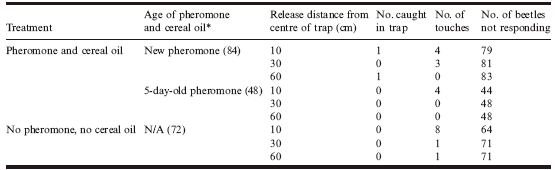
*Numbers in parentheses show the number of beetles in the treatment.
Of traps placed throughout the mill for 6 days, baited traps caught more (2.3 ± 1.1) beetles than did unbaited traps (0 ± 0 beetles; paired t test, t = 3.1, P = 0.01, n = 10).
Laboratory and simulated warehouse
Warehouse release–recapture
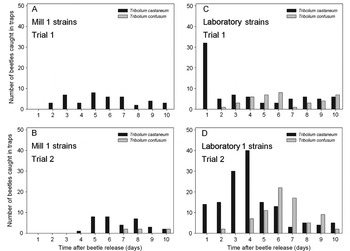
More T. castaneum than T. confusum were caught overall during both trials (Table 3). When mill beetles were released into the warehouse (Fig. 1), no beetles of either species were caught on the first day of trial 1 and on the first 3 days of trial 2. No T. confusum were caught during trial 1 (Fig. 2). Both species were caught in trial 2, but T. confusum was caught only on days 7, 8, and 10 of sampling (Fig. 2).
Numbers of beetles caught in pheromone traps over a 10-day period when 500 Tribolium confusum and 500 T. castaneum from mill strains (A, B) or laboratory strains (C, D) were released into a simulated warehouse. (A) Trial 1, 4–14 February 2007. (B) Trial 2, 14–24 December 2007. (C) Trial 1, 7–17 March 2007. (D) Trial 2, 6–16 January 2008.

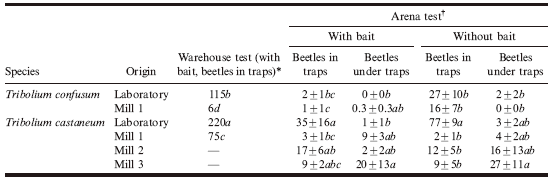
Numbers of adult beetles caught in traps or found under traps after 24 h in dark conditions.
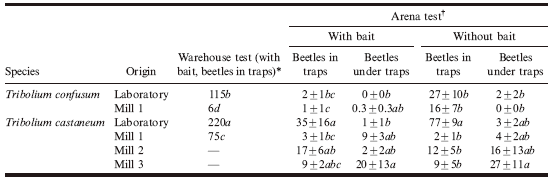
*Two hundred beetles were released into each of six 1.2 m2 arenas, each with a trap in the middle, one species/strain per arena. Traps contained pheromone and cereal oil (with bait) or no pheromone and no oil (without bait). There were two replicates, 500 T. castaneum and 500 T. confusum were released at the same time, mill and laboratory strains were tested on different dates; differences between species/strains were tested using subdivided contingency tables, χ2 test, P > 0.05, using Holm's correction.
† Values are given as the mean ± SEM. Values in each column followed by different letters are significantly different (Tukey's multiple-range test, P = 0.05, n = 3).
When laboratory beetles were released into the warehouse, both species were caught in every trap in both trials. In trial 1, no T. confusum were caught on the first day of sampling. In trial 2, no T. confusum were caught on days 1 and 3 of sampling (Fig. 2).
Arena experiment
Baited traps caught fewer beetles than did unbaited traps (three-way ANOVA, F 1,28=19.0, P < 0.001). This was mainly due to the higher number of laboratory and mill 1 T. confusum and laboratory T. castaneum in unbaited traps than in baited traps (Table 3). To simplify analysis, we analyzed the data from baited and unbaited traps separately. Tribolium castaneum was caught more often than T. confusum in baited traps (two-way ANOVA, F 1,14=22.4, P < 0.001), laboratory beetles were caught more often than mill beetles (F 1,14=4.8, P = 0.05), and there was no interaction between species and strain (F 1,14=0.53, P = 0.48). Laboratory T. castaneum were caught more often than any other group, T. confusum from mill 1 were caught least, and the others fell in the middle (one-way ANOVA, F 5,12= 8.3, P = 0.001; Table 3). There were no differences in the number of beetles under the trap between strains (two-way ANOVA, F 1,14= 2.2, P = 0.16) or species (F 1,14= 3.7, P = 0.08). More mill 3 T. castaneum than laboratory T. confusum and T. castaneum were under the trap (one-way ANOVA, F 5,12= 5.0, P = 0.011; Table 3).
There was no difference in numbers between species in unbaited traps (two-way ANOVA, F 1,14= 0.30, P = 0.59), and laboratory beetles were caught in the traps more often than mill beetles (F 1,14= 15.7, P = 0.001). There was a significant interaction between species and strain (F 1,14= 6.1, P = 0.03) (probably because there was no difference between laboratory and mill strains for T. confusum), but there were differences for T. castaneum. One-way ANOVA showed differences between the groups (F 5,12= 17.4, P < 0.001). Laboratory T. castaneum were caught most frequently, with no differences between the other groups (Table 3). For unbaited traps, T. castaneum were found under the trap more often than were T. confusum (two-way ANOVA, F 1,14= 7.0, P = 0.02), with no difference between strains (F 1,14= 0.14, P = 0.71) or interaction between species and strain (F 1,14= 2.2, P = 0.16). There were differences between groups (one-way ANOVA, F 5,12= 4.8, P = 0.01).
Movement rates
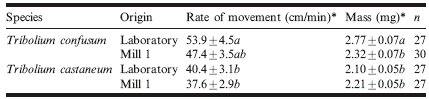
There was no difference in movement rates between mill and laboratory strains (three-way ANOVA, F 1,103= 1.7, P = 0.20); sex did not affect movement rates (F 1,103 = 0.62, P = 0.43), but T. confusum moved faster than T. castaneum (F 1,103= 11.0, P = 0.001; Table 4). No significant interactions between sex, species, and strain were found (P >0.05). Significant differences in mass were found: T. confusum weighed more than T. castaneum (three-way ANOVA, F 1,103=55.0, P < 0.001), laboratory strains weighed more than mill strains (F 1,103= 9.23, P = 0.003), and males weighed more than females (F 1,103= 35.5, P < 0.001), with significant interactions between species and strain (F 1,103= 28.7, P < 0.001) and between species and sex (F 1,103= 14.1, P < 0.001). Female laboratory T. confusum were heaviest, female mill T. confusum and male laboratory T. confusum were second heaviest, and there was no significant differences in mass between the other beetle groups (Table 4). There was a significant positive correlation between movement rate and mass (r 2 = 0.05, n = 111; mass = 0.005 ± 0.00002 mg; rate of movement = 2.1 ± 0.1 cm/min; slope, intercept, and r 2 value were significantly different from 0, P < 0.01).
Movement rates and masses of Tribolium confusum and T. castaneum from laboratory cultures and recently collected from a flour mill and reared for 1 month in the laboratory.
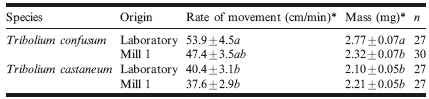
*Values are given as the mean ± SEM; within a column, values followed by a different letter are significantly different (Tukey's multiple-range test, P = 0.05).
Pheromone pitfall trap bioassay
There was no difference between males and females for a given species and strain combination (Fisher's exact test, P > 0.41). When the data from male and female beetles were combined, there was no difference between species or strains (χ2 = 7.741, df = 5, P = 0.171). More than 88% of beetles selected the pheromone vial over the control vial.
Burrowing
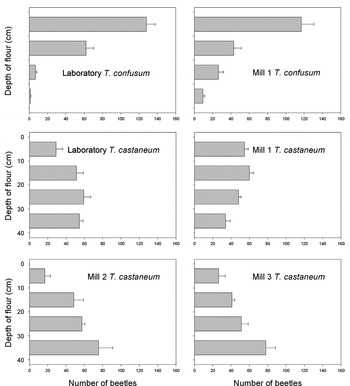
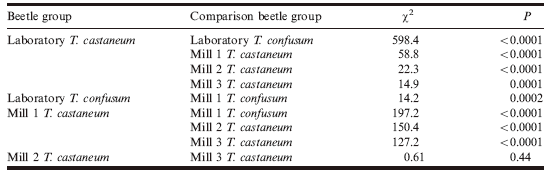
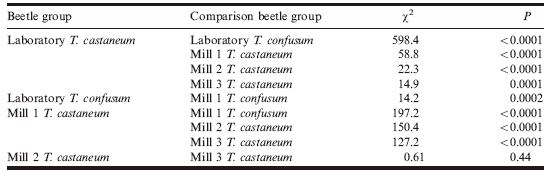
Most of the comparisons between the distributions of burrowing depths of the different species and strain combinations showed a difference (P < 0.05; Table 5). Tribolium confusum burrowed less than T. castaneum (Fig. 3, Table 5). For both species, distributions of burrowing depths of laboratory strains differed from those of mill strains. There were significant differences in distribution between the four strains tested for T. castaneum (Fig. 3), except between the strains from mills 2 and 3 (P = 0.44; Table 5).
Distributions of mill and laboratory strains of Tribolium confusum and T. castaneum in a column of flour after 24 h (n = 4, except for mill 3 T. castaneum, for which n = 3).

Contrasts of Tribolium beetle distributions of beetles (Tribolium confusum and T. castaneum) measured after 24 h in a column of flour, using a generalized linear model procedure.
Discussion
Traps baited with pheromone and cereal oil capture Tribolium species in flour mills (Campbell et al. Reference Campbell and Hagstrum2002, Campbell et al. Reference Campbell, Toews, Arthur and Arbogast2010a, Campbell et al. Reference Campbell, Toews, Arthur and Arbogast2010b). However, our study showed that these traps have low efficacy in mills; fewer than 2% of T. confusum released within 60cm from a pheromone trap were caught. One reason for the low efficacy could be that the trap was placed in the middle of the floor, not along a wall or a corner, structural features that are often followed by insects (Mullen Reference Mullen2011). The effect of monitoring released beetles compared with resident beetles may also be a factor. Fresh lures in traps can repell individuals of T. castaneum (Hussain et al. Reference Hussain, Phillips, Mayhew, AliNiazee, Highley, Wright, Banks and Champ1994). In this study, fresh lures and 5-day-old lures did not differ appreciably in trapping efficiency. It is possible that 5 days did not allow for sufficient ageing of lures, but this is unlikely because traps reach peak effectiveness at 1 week (Hussain et al. Reference Hussain, Phillips, Mayhew, AliNiazee, Highley, Wright, Banks and Champ1994) and Dome® traps had caught beetles on the floor of the mill prior to the experiment. Trap catches were higher for T. castaneum than for T. confusum, so further testing with T. castaneum would probably show efficacy greater than 2%.
Ideally, traps could be used to estimate the total population in a flour mill or warehouse. In our simplified warehouse, we released approximately six T. castaneum or T. confusum per square metre, and the daily trap-capture rate over the 10-day trapping period was relatively constant at 0–2.4 beetles/trap-day. However, even in this simplified warehouse, there was significant variation among dates, strains, and species. In our tests, insects were released onto the floor; to be caught in traps in a commercial setting, the adults would need to leave the food deposits where they developed deep inside processing equipment or the building structure (Campbell and Hagstrum Reference Campbell and Hagstrum2002; Hawkin Reference Hawkin2008; Romero et al. Reference Romero, Campbell, Nechols and With2010). Processing plants such as flour mills are complex structures with many floors and different habitats with variable food availability, temperature, and humidity. This is very different from the simplified warehouse in which we tested traps. Therefore, more research is required to determine whether traps can be used reliably to estimate total beetle populations in commercial facilities.
The monitoring traps used in this study seemed to be less attractive than sex-pheromone-baited traps used for monitoring Plodia interpunctella (Hübner) (Lepidoptera: Pyralidae) and Lasioderma serricorne (F.) (Coleoptera: Anobiidae). In simulated warehouse experiments, up to 30% of L. serricorne were captured in pitfall traps on the floor over 2 days (Arbogast et al. Reference Arbogast, Kendra and Chini2003) and approximately 20% of P. interpunctella were captured in sticky traps on the wall over 3 days (Arbogast et al. Reference Arbogast, Chini and McGovern2005). In our experiments fewer than 1% of T. confusum and fewer than 7% of T. castaneum were captured in 2 days. The Tribolium aggregation pheromone utilizes food volatiles attractive to both sexes, whereas the P. interpunctella and L. serricorne pheromones are attractive only to males. These traps are attractive enough to control populations of P. interpunctella and L. serricorne through mass-trapping (Pierce Reference Pierce, Highley, Wright, Banks and Champ1994; Phillips et al. Reference Phillips, Cogan, Fadamiro, Subramanyam and Hagstrum2000). Nothing similar has been attempted with Tribolium.
In these mill, simulated-warehouse, and arena tests, T. confusum were caught in pheromone traps less often than T. castaneum, and mill strains were caught less often than laboratory strains. Three possible reasons for these differences relate to the pheromone/food bait used, rate of beetle movement, and beetle-trap interactions.
The isomeric mixture of 4R-8R-(–)- and 4R-8S-(+)-4,8-dimethyldecanal in the synthetic pheromone may have been less attractive to T. confusum. Attraction of T. confusum to the 4R, 8S-(+) isomer is one-tenth that of T. castaneum (Suzuki and Mori Reference Suzuki and Mori1983; Suzuki et al. Reference Suzuki, Kozaki and Sugawara1984). We found no difference in the attraction of either species to pheromone in a pitfall-trap bioassay. However, Boake and Wade (Reference Boake and Wade1984) found that different strains of T. castaneum react differently to natural and synthetic pheromone in two-choice pitfall-trap bioassays. Female T. castaneum from four different strains, all reared in the laboratory for at least 7 years, differed in their sensitivity to synthetic aggregation pheromone, with some beetles preferring higher concentrations than others (Boake and Wade Reference Boake and Wade1984). We tested only a single concentration. Perhaps by testing the pheromone at several doses, we could have revealed differences in attractiveness to the pheromone. Also T. confusum may be less attracted than T. castaneum to the cereal oil used in the trap.
There were differences in movement rates, and we expected that faster moving insects would be captured more often. However, this was not the case. Specimens of T. castaneum moved more slowly than did T. confusum but were captured more often in traps. There were no significant differences in movement rates between laboratory and mill strains, but there were differences in trap catches in the warehouse and arena tests.
We did not test for beetle-trap interactions; however, more T. castaneum than T. confusum were caught in unbaited traps. Further tests are required to examine whether there are differences in how the different species and strains approach traps, climb up the trap ramps, and are captured.
In addition to the differences in trap capture, there were significant differences in burrowing behaviour between species and strains. Tribolium castaneum burrowed more than did T. confusum, as was seen in previous studies (Ghent Reference Ghent1966). Also there were differences between the four strains of T. castaneum. This could have been due to differences between mills and between mills and the laboratory. In the laboratory, 100–200 beetles were typically taken from filter paper protruding above the culture; this could select, over many generations, for strains that burrow less. Similarly, mill fumigation or contact-insecticide treatments may select for beetles that burrow deeply and survive treatments.
Mixed-species laboratory cultures of T. castaneum and T. confusum do not co-exist indefinitely; one species is eventually eliminated (Park Reference Park1948, Leslie et al. Reference Leslie, Park and Mertz1968). In contrast, we found a mix of T. confusum and T. castaneum in every flour sample taken from mill 1. Trematerra and Sciarretta (Reference Trematerra and Sciarretta2004) and Abdelghany et al. (Reference Abdelghany, Awadalla, Abdel-Baky, El-Syrafi and Fields2010) also found both beetle species in the same facility, although in the former study, populations of T. confusum and T. castaneum occurred in different parts of the mill. Lack of competition may encourage co-existence of the two species in commercial facilities. Beetle populations in mills are regularly severely reduced by fumigation and sanitation and generally occur at lower densities than they do in laboratory colonies. For example, Park (Reference Park1948) reared beetles in the laboratory at much higher densities (hundreds of beetles in 8g of flour) than are seen in mills.
The results reported here have significant implications for trap monitoring in mills. Since a smaller proportion of T. confusum are caught in traps, mills infested with T. confusum may have higher levels of infestation than is indicated by trap catches. Also, much of our knowledge of pheromone attractiveness and trap monitoring comes from laboratory-reared beetles, which, as indicated by our work, do not behave like mill beetles. Because mill beetles burrow more, they may be even less prone to being captured in mills. Beetles in mills may also be caught less than the mill strains seen here because they move more slowly and would be less likely to come in contact with traps. More research is needed on the differences in trap efficacy between species and strains, as we tested only one location. Further research on the chemical components of T. confusum and T. castaneum aggregation pheromones would be useful, as would research on the effects of adding other food volatiles to these monitoring traps to make them generally more attractive to beetles. Because effective population sampling is a critical part of any IPM program, and behavioural differences can affect trap efficacy, further research into the behaviour of beetles in mills is needed.
Acknowledgements
We thank Tannis Mayert and Alicia Leroux for technical assistance. Partial funding for this project was provided by the Manitoba government (Manitoba Graduate Scholarship) and Steritech Inc. Flour-milling staff were exceptionally helpful; without their assistance none of the mill-related work reported here would have been possible.