Word learning is an extended process that involves acquisition of semantic, syntactic and pragmatic knowledge and has profound consequences for children's conceptual development (Carey, Reference Carey, Bresnan, Miller and Halle1978). It is well established that in the initial stage of this process, known as fast mapping, children construct quick and generally correct hypotheses about the meaning of new words (e.g. Houston-Price, Plunkett & Harris, Reference Houston-Price, Plunkett and Harris2005; Markman & Wachtel, Reference Markman and Wachtel1988). It is crucial that children also construct quick and correct hypotheses about the lexical category of new words – whether they are nouns, verbs, adjectives, etc. – in order to be able to use these new words productively in sentences.
The phonological bootstrapping hypothesis states that the perceptual properties of speech at suprasegmental, phonetic, phonotactic and prosodic levels provide children with cues to the most fundamental syntactic distinctions (Kelly, Reference Kelly1992; Morgan & Demuth, Reference Morgan, Demuth, Morgan and Demuth1996; Werker & Yeung, Reference Werker and Yeung2005). Yet, multiple cues – syntactic, semantic, pragmatic, as well as phonological – can support the identification of the meaning of a word and its lexical category (Hollich et al., Reference Hollich, Hirsh-Pasek and Golinkoff2000; Morgan & Demuth, Reference Morgan, Demuth, Morgan and Demuth1996), and under normal circumstances multiple cues are simultaneously available to children. In some situations cues can provide conflicting information, while in others they might be aligned. For example, if a novel word with the phonological properties of a verb is used in a sentence as a verb, phonological and syntactic cues converge. If this word is used in a situation where the action being attended to already has a label, phonological cues compete with the principle of exclusion, which states that the learner should seek something in the environment that does not yet have a label to serve as a referent of the novel word.
Clear support for the role of phonology in fast mapping the grammatical properties of new words currently comes from research where phonology is the only cue available to children (Cassidy & Kelly, Reference Cassidy and Kelly1991, Reference Cassidy and Kelly2001). However, the relative impact of phonology in the context of multiple-cue integration is unknown. The main purpose of the present research was to examine whether phonological cues can affect word learning when other information is available (that either conflicts or converges with the phonological information). Specifically, in the studies we report, the process of word learning was also supported by the principle of exclusion. The research also examined whether the role of phonology depends on extensive experience with a language.
Learning by exclusion
We chose to examine phonology in relation to learning by exclusionFootnote 1 rather than other word-learning cues (e.g. syntactic or pragmatic cues) for a couple of reasons. First, learning by exclusion is one of the earliest heuristics that children use in fast mapping (Markman, Wasow & Hansen, Reference Markman, Wasow and Hansen2003). It also appears to be a general, pragmatically driven learning strategy that can be applied in domains other than word learning (e.g. Diesendruck & Markson, Reference Diesendruck and Markson2001). Second, learning by exclusion appears to work about equally well for a variety of lexical categories. In particular, Golinkoff, Jacquet, Hirsh-Pasek & Nandakumar (Reference Golinkoff, Jacquet, Hirsh-Pasek and Nandakumar1996) showed that children apply exclusion to the learning of action labels (verbs) at about the same age as to the learning of object labels (nouns).
Learning by exclusion clearly depends on the child's existing vocabulary. It cannot guide children to the meaning of a new word in the environment of multiple nameless objects. However, as children's vocabulary grows, and the set of nameless objects decreases, learning by exclusion becomes a potentially powerful mechanism for identifying the referent of a novel word.
Phonological information in the input
For phonological bootstrapping to proceed, phonological form must be correlated with lexical category. In a seminal paper, Kelly (Reference Kelly1992) summarized evidence from English, Hebrew and Russian suggesting that stress, syllable number, word duration, voicing and vowel type may provide cues to lexical category. For example, in English, nouns tend to have more syllables than verbs, fewer consonants per syllable and bisyllabic nouns are likely to have stress on the first syllable while bisyllabic verbs have stress on the second syllable. In the last decade, about sixteen phonological cues to lexical category in English have been proposed in the literature (for a review, see Monaghan, Chater & Christiansen, Reference Monaghan, Chater and Christiansen2005). Phonological cues to lexical category have been identified in languages as diverse as English, French, Dutch, Turkish, Japanese and Mandarin (Monaghan et al., Reference Monaghan, Chater and Christiansen2005; Monaghan, Christiansen & Chater, Reference Monaghan, Christiansen and Chater2007; Shi, Morgan & Allopenna, Reference Shi, Morgan and Allopenna1998). Importantly, many of these studies are based on analyses of child-directed speech and therefore show that phonological cues to lexical categories are available specifically in children's linguistic environments (Cassidy & Kelly, Reference Cassidy and Kelly1991; Monaghan et al., Reference Monaghan, Chater and Christiansen2005; Monaghan et al., Reference Monaghan, Christiansen and Chater2007; Shi et al., Reference Shi, Morgan and Allopenna1998). As Kelly (Reference Kelly1992) pointed out, however, although phonological cues to grammatical class may exist, it is necessary to establish independently that they are used by children to bootstrap language learning.
Phonology and new word learning
Storkel (Reference Storkel2001, Reference Storkel2003) provided strong evidence for the role of phonological knowledge in preschoolers' word learning. Her studies manipulated the phonotactic probability of pseudo-words, a measure of the likelihood of occurrence of a sound sequence (computed over the entire lexicon). The results showed that children learned phonotactically common sound sequences, e.g. /pin/ more rapidly than phonotactically rarer sound sequences, e.g. /gim/. Research with adults suggests that encountering a stimulus of low phonotactic probability may trigger word learning quicker than a stimulus of high phonotactic probability (Storkel, Armbrüster & Hogan, Reference Storkel, Armbrüster and Hogan2006). However, the cognitive demands of maintaining a new lexical representation in memory are also an important constraint on word learning, and these demands are arguably lower for phonotactically common stimuli.
Importantly, phonological features appear to affect the organization of words into lexical categories. In order for children and adults to distinguish between arbitrary subclasses of words in an artificial language, these subclasses have to be phonologically marked (Brooks, Braine, Catalano, Brody & Sudhalter, Reference Brooks, Braine, Catalano, Brody and Sudhalter1993; but see Gerken, Wilson & Lewis, Reference Gerken, Wilson and Lewis2005, for evidence concerning the sufficiency of multiple distributional cues). Most relevant for the present research, studies by Cassidy and Kelly (Reference Cassidy and Kelly1991, Reference Cassidy and Kelly2001) suggest that phonological knowledge affects children's inferences about the lexical categories of new words. These studies investigated whether English-speaking children associated monosyllabic (i.e. verb-like) pseudo-words with actions, which are prototypical verb referents, and trisyllabic (i.e. noun-like) pseudo-words with objects, which are prototypical noun referents. Three- to six-year-old children watched a video, e.g. of a moving door, heard a pseudo-word said by a puppet, e.g. pell, and had to answer whether the pseudo-word referred to an object or an action from the video, e.g. ‘When Blip says pell, do you think he means close or door?’ To assess the role of phonology, Cassidy & Kelly (Reference Cassidy and Kelly2001) contrasted three conditions. In the English-consistent condition, pseudo-words and pictures were paired so that the relationship between stimulus length and object/action concept was the same as in English, i.e. short (verb-like) pseudo-words were action labels and long (noun-like) ones object labels. In the English-inconsistent condition, the association between stimulus length and concept was the reverse of English (short pseudo-words mapped to objects and long ones to actions). In the English-independent condition, the association between syllable length and concept was not systematic. The intended word–referent associations were made explicit through feedback. The prediction was that if children apply their knowledge of the relation between phonology and lexical categories, the children in the English-consistent condition would outperform children in the other two conditions. Indeed they did so in both Blocks 1 and 3. Cassidy and Kelly interpreted children's guesses when the stimuli were presented for the first time (Block 1) as a measure of whether phonology constrained children's initial expectations about the lexical category of the stimuli, and performance on the second and third presentation of the stimuli (Blocks 2 and 3), once feedback was used to teach the intended associations, as a measure of learning.
Cassidy and Kelly's findings suggest that phonology has a strong and extended impact on word learning: it influenced children's initial hypotheses about the lexical category of a word as well as their remembering of the word. However, these results have to be interpreted with caution. First, the impact of phonology was not assessed in the context of other cues. Second, Cassidy and Kelly's stimuli varied on a number of phonological dimensions other than length. An analysis of their stimuli for sixteen phonological cues identified as grammatically relevant in previous research (Monaghan et al., Reference Monaghan, Chater and Christiansen2005) suggests that, compared to one-syllable pseudo-words, the three-syllable ones contained significantly more phonemes (t(10)=8·91, p<0·001), a larger proportion of their consonants were nasals (t(10)=2·73, p<0·05) and they had marginally fewer consonants per syllable (t(10)=−1·96, p=0·08). On the basis of nasals, three-syllable pseudo-words, which were classified as noun-like, actually resembled verbs more than nouns.Footnote 2 Thus, syllabic length was not the only phonological cue that could have influenced children's performance, and moreover, phonological cues could have confounded each other's effect.
Phonological typicality
Phonological cues to grammatical class are probabilistic rather than deterministic and thus, individually, they only provide partial information for the determination of lexical categories. Monaghan et al. (Reference Monaghan, Chater and Christiansen2005), for instance, found that the syllable-length cue for English, though distributed differently for nouns and verbs, provided a poor basis for categorization when used alone. Classifying all words containing two syllables or more as nouns and all words with one syllable as verbs resulted in correctly classifying only 55·4% of the nouns and 53·5% of the verbs, meaning that nearly half of the words in these categories were misclassified. While single phonological cues are unreliable indexes of grammatical category, taken together they do discriminate between open- and closed-class words as well as nouns and verbs (Monaghan et al., Reference Monaghan, Chater and Christiansen2005; Monaghan et al., Reference Monaghan, Christiansen and Chater2007; Shi et al., Reference Shi, Morgan and Allopenna1998). In the present research, we used an aggregate measure of the potential grammatical information carried by a word's phonological form: phonological typicality (Farmer, Christiansen & Monaghan, Reference Christiansen, Monaghan, Hirsh-Pasek and Golinkoff2006). As described in more detail below, phonological typicality provides a measure of the degree to which the phonology of a given word is typical of other words from the same lexical category.
Phonology and lexical categories
Cassidy & Kelly (Reference Cassidy and Kelly1991, Reference Cassidy and Kelly2001) did not report any differences in children's performance with noun-like and verb-like stimuli. Similarly, Storkel (Reference Storkel2001, Reference Storkel2003) found that children learned pseudo-words with high phonotactic probability faster than pseudo-words with low phonotactic probability regardless of whether they referred to objects, i.e. behaved like nouns, or actions, i.e. behaved like verbs. However, recent research by Christiansen & Monaghan (Reference Christiansen, Monaghan, Hirsh-Pasek and Golinkoff2006) suggests that phonological cues may play a larger role in the learning of verbs. They estimated the role of phonological and distributional cues for the lexical categorization of nouns and verbs. Specifically, they coded the 1000 most frequent words in child-directed speech (obtained from corpora that altogether had more than five million words) for the sixteen phonological cues mentioned previously and assessed the role of distributional cues through the co-occurrence of the twenty most common words in the corpus with these 1000 words. The analysis showed that combining phonological and distributional cues resulted in the best lexical classification of nouns and verbs. However, when considered separately, phonological cues resulted in significantly more accurate and complete classification of verbs than nouns. Distributional cues provided more accurate and complete classification of nouns. These findings were replicated across other languages – Dutch, French and Japanese (Monaghan et al., Reference Monaghan, Christiansen and Chater2007) – suggesting that phonology provides more reliable cues for identifying verbs than nouns across languages. These effects of phonology with respect to grammatical category remain even when only monomorphemic words are assessed, indicating that they do not depend on derivational or inflectional morphology.
While the identification of a cue that favors verb rather than noun learning is a recent result, the idea that the usefulness of cues varies by category is not. For example, Gentner (Reference Gentner and Kuczaj1982) argued that object referents have greater perceptual availability than action referents. Gillette, Gleitman, Gleitman & Lederer (Reference Gillette, Gleitman, Gleitman and Lederer1999) suggested further more that it is more challenging to discover how verbs combine the elements in a visual scene. As cognitive and perceptual biases may better support the learning of object labels, a division of labor may have arisen in which phonology differentially supported the learning of action labels (Christiansen & Monaghan, Reference Christiansen, Monaghan, Hirsh-Pasek and Golinkoff2006).
The present research
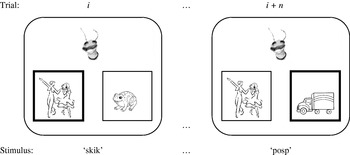
To sum up, our main goal was to examine the role of phonological cues when children could also rely on learning by exclusion. We accomplished this using a slight modification of Cassidy and Kelly's procedure. Specifically, instead of having a question presenting two unique and fixed options about the meaning of each pseudo-word, one always being a target and one always being a foil in the course of a test session, we presented the options in the form of pictures, which across trials played the roles of both targets and foils. This is illustrated in Figure 1. On trial i, children encounter two pictures for the first time and hear the word skik. Only phonological cues (and guessing) can affect children's choice of referent here. The target referent (the dancing picture in this example) is then revealed through the feedback. Thus, on trial i+n, children encounter a picture already associated with a pseudo-word. Here, as before, they could use phonological cues to select a referent for the pseudo-word in the current trial; however, they could also use exclusion to reject the already labeled picture as a possible referent. As in natural settings, the usefulness of learning by exclusion in this procedure ought to increase as vocabulary grows. The ideal learner could use exclusion on average in 50% of the trials in Block 1 and 100% of the trials in Blocks 2 and 3.
Illustration of the procedure. On trial i, children have not seen either picture, and only phonology (and guessing) can guide their selection of a referent for the word skik. On trial i+n, children already have a label for one of the pictures. Thus, they may rely on exclusion in selecting a referent for posp. note: the pictures in the figure are not actual stimuli from the study.

We tested three hypotheses about the relation between phonological typicality and learning by exclusion. The ‘no impact’ hypothesis suggests that phonological cues would be entirely superceded by the exclusion principle and have no impact on learning at any point. The ‘strong impact’ hypothesis, motivated by Cassidy and Kelly's results, suggests that even when children can rely on learning by exclusion, phonological typicality will show an effect both in the initial assumptions children make about the pseudo-words and in the outcome of learning. That is, children's accuracy both at the beginning and the end of the study will be highest in the English-consistent condition. The ‘weak impact’ hypothesis suggests that phonological typicality will influence only children's initial inferences about the lexical category of words, after which learning by exclusion will dominate and ultimately lead to no differences between conditions.
A fourth hypothesis, suggested by the computational results discussed above (Christiansen & Monaghan, Reference Christiansen, Monaghan, Hirsh-Pasek and Golinkoff2006), was that the role of phonology, as predicted by both the strong and weak impact hypotheses, will be most clearly seen with verb-like stimuli. We refer to this as the ‘verb-bias’ hypothesis.
Experiment 1 was conducted with monolingual English-speaking seven-year-olds. We chose an age group just beyond the age range of the children in Cassidy and Kelly's studies (three to six) to maximize the likelihood of replicating their results. We also wanted to be sure that children did not fail the task for lack of phonological knowledge, which increases substantially with the development of literacy.
Seven-year-olds have an extensive experience and knowledge of their native language. Thus, our secondary goal in this research was to examine whether more limited linguistic experience can result in children using phonological cues to constrain their categorization of new words. This was undertaken in Experiment 2. Specifically, we examined whether the performance of French immersion seven-year-olds is influenced by their knowledge of French.
EXPERIMENT 1
METHOD
Participants
Forty-five monolingual English-speaking second-graders with no history of speech or hearing impairment and living in Canada were recruited for the study. There were fifteen children in each condition. The average age in the English-consistent condition was 7 ; 4 (range: 6 ; 5 to 7 ; 10), in the English-inconsistent condition 7 ; 4 (range 6 ; 10 to 8 ; 4) and in the independent condition 7 ; 5 (range 6 ; 10 to 8 ; 0). In each condition there were eight girls. Four other children were tested but excluded because of inattentiveness. The participants received a small gift.
Materials
Pseudo-words were created by joining the onsets of all monosyllabic words from the CELEX database (Baayen, Pipenbrock & Gulikers, Reference Baayen, Pipenbrock and Gulikers1995) with the rimes of other monosyllabic words. We assessed the phonological typicality of these pseudo-words using the measure developed by Farmer et al. (Reference Farmer, Christiansen and Monaghan2006). The calculations involved determining the similarity between the phonological representation of each pseudo-word and each of the 4,547 monosyllabic nouns and verbs listed in the CELEX database that are unambiguous with respect to grammatical category (so nouns that are also verbs, e.g. paint, as well as nouns or verbs that belong to another grammatical category, e.g. old, were omitted), including words listed with a frequency of 0.Footnote 3Appendix A provides an example of such calculations. The phonological typicality of each pseudo-word was derived by subtracting the mean Euclidean distance between the pseudo-word and all of the 2,137 verbs from the mean Euclidean distance between the pseudo-word and all of the 2,410 nouns. Although phonological typicality was computed on the basis of CELEX, which uses canonical forms in British English received pronunciation, the measure is also applicable to Canadian English, which was spoken by our participants. This is because similarity is computed based on phonological features which respect the relative distances in the vowel part of the IPA chart and because the vowel space in each dialect respects the relative properties of vowels in terms of height, position and voicing.
Eight noun-like and eight verb-like pseudo-words conforming to the phonotactic constraints of English were selected for the study (Appendix B). The stimuli were synthesized using the Festival speech-synthesis software (Black, Taylor & Caley, Reference Black, Taylor and Caley1990). We conducted a norming study (n=12) to make sure the pseudo-words were not consistently associated with existing words as such associations could bias the results. The participants were asked to write the first word that comes to mind after hearing each pseudo-word, skipping items only if truly stuck. Verb-like and noun-like pseudo-words were associated with existing words equally often: 64% of the participants came up with an association for noun-like words and 62% for verb-like words. (The majority of the associates, 52%, were ambiguous with respect to category.) We also computed a measure of variability in the responses by calculating the type/token ratio (i.e. the number of different responses divided by the total number of responses). The higher the ratio, the less likely it is that the pseudo-word is associated with a specific real word. The ratios were indeed high −0·77 for noun-like and 0·72 for verb-like pseudo-words – suggesting that even though the stimuli could be associated with existing words, these associations are unlikely to be strong. (The difference between noun-like and verb-like pseudo-words was not significant, t(14)=0·36. n.s.)
In a separate norming study, twenty undergraduates provided the first word that came to mind for 168 black-and-white images of everyday objects and actions taken from the Peabody Picture Vocabulary Test (Dunn & Dunn, Reference Dunn and Dunn1997). The students were asked to precede their labels with to or one of the determiners a, an, some or the. The use of to was scored as an identification of an action and use of a determiner as an identification of an object. Eight action and eight object pictures for which the participants showed perfect agreement were selected for the study (Appendix C). The use of pictures of common objects and actions limits the generalizations from this study to later stages of word learning after children's learning of their first words. However, for interpreting the result of this study, it was critical that the pictures provide unambiguous depictions of actions and objects.
The use of pictures rather than video helped us avoid having to provide verbal input to children. In addition, unlike in Cassidy & Kelly's (Reference Cassidy and Kelly1991, Reference Cassidy and Kelly2001) research, the mapping between words and pictures in this study was randomly determined for each participant. The between-subject randomization of word–picture pairs ensured that any effects of phonological typicality could not be accounted for by spurious associations between the pseudo-words and the English words referring to the pictures.
Design and procedure
Children were randomly assigned to one of three conditions and tested individually in sessions that lasted approximately thirty minutes. In the English-consistent condition, noun-like pseudo-words mapped onto pictures of objects and verb-like pseudo-words onto pictures of actions. In the English-inconsistent condition, the mapping was reversed. That is, noun-like pseudo-words were mapped to actions and verb-like pseudo-words to objects. In the independent condition, half of the noun-like and verb-like words were mapped to objects and actions as in the English-consistent conditions and the other half were mapped to objects and actions as in the English-inconsistent condition. The foil picture was randomly determined in each block.
Children were told that they would be learning the language of a creature from another planet. They were also told that each word means only one thing and that they would see the pictures and hear the words several times so that they could remember them. To familiarize children with the sound of synthesized speech, the instructions were synthesized and played over the computer. The experimenter reiterated them to ensure comprehension.
There were four practice trials followed by forty-eight experimental trials divided into three blocks. On each trial, children saw two pictures, one of an object and one of an action (see Figure 1). In the practice trials, the experimenter labeled one of the pictures in English and the children's task was to repeat it and select the picture on the screen that corresponded to the label. In the experimental trials, an animated puppet (the alien) said a word in his language. The children had to repeat the word and pick the picture they thought the puppet was referring to. To provide feedback, the target picture was then marked by thickening the border around it and extending an arrow to it from the puppet picture. Simultaneously, the puppet repeated the word. The experimenter sat behind and to the side of the child and, if the child turned to her, commented on the child's performance in neutral language, e.g. ‘Oh, it's that one. Let's hear another word!’ Each experimental block consisted of sixteen trials and there were no pauses between blocks. The trials were presented in random order. As a consequence, in Block 1 the place of the trials on which children could apply learning by exclusion varied randomly.
To ensure that the three groups did not differ in terms of sensitivity to phonology, children were administered the Elision and Blending Words subtests of the Comprehensive Test of Phonological Processing (CTOPP; Wagner, Torgesen & Rashotte, Reference Wagner, Torgesen and Rashotte1999). Performance on the two tests is highly correlated and the combined number of correct responses provides a measure of phonological awareness (in this study, r=0·53, p<0·001).
Coding
To assess the effect of phonological cues on children's performance in Block 1, children's responses were coded according to whether they corresponded to the phonological typicality of the pseudo-word. If a child selected an object picture in response to a noun-like pseudo-word and an action picture in response to a verb-like pseudo-word, the response was given a score of 1, and 0 otherwise. Children's responses were also coded according to whether they selected the intended referent as defined by the condition they were in. In this form, the data were used to assess children's learning over time.
RESULTS
The three groups did not differ significantly in their phonological awareness. Children in the English-consistent condition scored on average 24·2 (SD=6·5), in the English-inconsistent condition 24·1 (SD=7·2) and in the English-independent condition 25·4 (SD=6·2); all pairwise test p's>0·62.
Effect of phonology in Block 1
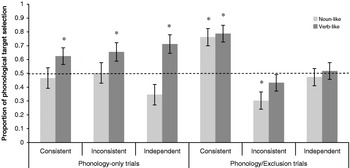
The trials in Block 1 were divided according to whether phonological typicality was the only cue available to children, phonology-only trials, or whether children could also rely on exclusion (as a result of previous feedback) to identify the referent of the pseudo-word, phonology/exclusion trials. Both the weak and strong impact hypotheses assume that children approach the word-learning task guided by assumptions about the relation between phonology and lexical class. Thus, both predict that children will perform above chance on phonology-only trials. We compared the two types of trials to see if the effect of phonology is maintained after a single instance of feedback, which is predicted by the strong impact hypothesis. Importantly, the verb-bias hypothesis predicts that the effect of phonology will be constrained to trials with verb-like stimuli.
Figure 2 shows the average scores in the phonology-only trials and phonology/exclusion trials by condition and the phonological typicality of the auditory stimuli. The data were submitted to a 3 (condition: English-consistent, English-inconsistent, and independent)×2 (phonological typicality: noun- vs. verb-like stimuli)×2 (trial type: phonology-only vs. phonology/exclusion) ANOVA. There was a main effect of phonological typicality (F(1, 42)=13·236, p=0·001, ηp2=0·24), a main effect of condition (F(2, 42)=9·974, p<0·001, ηp2=0·32), an interaction between trial type and phonological typicality (F(1, 42)=4·11, p=0·049, ηp2=0·09) and an interaction between trial type and condition (F(1, 42)=7·934, p=0·001, ηp2=0·27).
Proportion of times children selected the picture corresponding to the phonological typicality of the pseudo-word on phonology-only trials and phonology/exclusion trials in Block 1 of Experiment 1. * indicates probability greater than chance, p<0·05.

As Figure 2 shows, in all of Block 1 children were more likely to select an action referent for the verb-like stimuli than an object referent for the noun-like stimuli. The interaction between trial type and phonological typicality was due to the fact that children performed significantly better on verb-like than noun-like stimuli only on phonology-only trials, 66% vs. 44% (F(1, 42)=14, p=0·001, ηp2=0·25). Here, performance with verb-like stimuli was significantly above chance (t(47)=3·88, p<0·001) but performance with noun-like stimuli was not (t(47)=1·38, p=0·17). Thus, the effect of phonology was visible in the entire block but children clearly began to revise their preliminary phonology-driven associations after a single instance of feedback.
The interaction effect between condition and trial type reflects the fact that performance did not differ between conditions in the phonology-only trials (F(2, 42)=1·379, p=0·26, ηp2=0·06). However, condition mattered in the phonology/exclusion trials (F(2, 42)=20·617, p<0·001, ηp2=0·495). As Figure 2 shows, consistent with the feedback they were receiving, children in the English-consistent condition continued to select referents corresponding to the phonological typicality of the stimuli but children in the English-inconsistent condition selected referents different from those suggested by the phonology of the stimuli, and children in the independent condition were at chance.
Children's responses to noun-like stimuli in the independent condition show an action-selection bias (see Figure 2). However, no such bias is evident in the English-consistent and English-inconsistent conditions. It could be that this effect in the independent condition is responsible for the difference in children's performance with noun-like and verb-like stimuli (because it exaggerates the difference between them). A follow-up analysis excluding this condition, however, showed that the difference between noun-like and verb-like stimuli was still significant (49% vs. 64%, F(1, 26)=4·16, p=0·05, ηp2=0·13 ).
Effect of phonology across all blocks
The preceding analyses showed that children are sensitive to the phonological typicality of new words. However, even a single instance of feedback enabled children to apply exclusion and mitigated the effect of phonology. Thus, while we obtained clear evidence for the weak impact hypothesis, we also obtained some indication that the strong impact hypothesis may not hold. To facilitate comparison with previous findings (Cassidy & Kelly, Reference Cassidy and Kelly1991, Reference Cassidy and Kelly2001), in this analysis we included the entire dataset and measured the proportion of times children selected the predetermined referent (i.e. ‘accuracy’). Again, both the strong and weak impact hypotheses predict an effect of phonological knowledge in Block 1. Specifically, children were expected to perform more accurately in the consistent than in the inconsistent condition because the latter violates their English-driven expectations. Performance in the independent condition was expected to be in-between. The critical question in this analysis, however, was whether children would perform better in the English-consistent than the English-inconsistent condition in Blocks 2 and 3, as predicted by the strong impact hypothesis. According the verb-bias hypothesis, any of these effects may be most clearly seen in children's performance with verb-like stimuli.
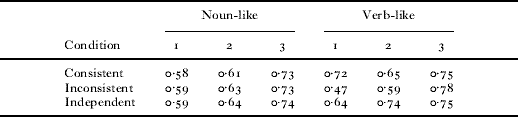
Table 1 shows the average proportion of correct responses as a function of learning block and condition. The scores were subjected to a 3 (condition: English-consistent, inconsistent and independent)×3 (block: 1, 2 and 3)×2 (phonological typicality: noun-like vs. verb-like) ANOVA with block and phonological typicality as within-subject variables. The ANOVA showed a main effect of block: children's accuracy improved with each block (F(2, 84)=17·759, p<0·001, ηp2=0·29). There was also a significant three-way interaction (F(2, 84)=2·61, p=0·04, ηp2=0·11). No other effects reached statistical significance.
Accuracy scores in Experiment 1 by condition, pseudo-word phonological typicality and block

The results of a follow-up analysis of the data of Block 1 were consistent with the findings from the preceding analyses of phonology-only and phonology/exclusion trials. The analysis revealed a main effect of condition (F(2, 42)=3·629, p=0·035, ηp2=0·14) and a significant interaction between condition and pseudo-word phonological typicality (F(2, 42)=5·628, p=0·007, ηp2=0·21). As Table 1 shows, children performed equally well in the three conditions when they had to select a referent for a noun-like pseudo-word. However, children's accuracy varied by condition when they had to select a referent for a verb-like pseudo-word (F(1, 42)=11·52, p<0·001, ηp2=0·35). Post-hoc tests with Bonferroni correction showed that performance in the consistent condition was significantly better than performance in the inconsistent condition (t(28)=4·72, p<0·001). Performance in the inconsistent condition was worse than in the independent condition (t(28)=3·10, p=0·006).
To evaluate whether phonological knowledge has a lasting effect on word learning we examined children's performance in Block 3. The ANOVA revealed no main effects or interactions. This was also true for Block 2. Thus, the outcome of learning in all three conditions was the same and children learned equally well noun-like and verb-like pseudo-words. The lack of difference between conditions suggests that phonology did not affect these later stages of learning.
Relation with phonological awareness
Is children's phonological awareness related to their sensitivity to phonological typicality? We measured sensitivity to overall phonological typicality by the number of times children chose action referents for verb-like stimuli and object referents for noun-like stimuli in the phonology-only trials in Block 1. The correlation between this measure and phonological awareness was not significant (r=0·10, p=0·47).
DISCUSSION
The major finding from this study is that phonological knowledge primarily affects children's initial inferences about new words. Specifically, an effect of phonological knowledge was demonstrated in the phonology-only trials where all other cues were eliminated. Although this effect held in all of Block 1, it clearly was affected by the application of the principle of exclusion in the phonology/exclusion trials, and there was no evidence for it in Blocks 2 and 3. Taken together, these findings are consistent with the weak impact hypothesis, which states that phonology affects only the early stages of word learning.
Another important result is that phonological typicality influenced only children's response to verb-like stimuli. This differential effect was predicted by recent corpus analyses indicating that phonological cues are more useful for discovering verbs than nouns (Christiansen & Monaghan, Reference Christiansen, Monaghan, Hirsh-Pasek and Golinkoff2006) and supports the verb-bias hypothesis. Thus, the weak impact hypothesis has to be considered together with the verb-bias hypothesis to account for the present findings.
The tendency to select action pictures, observed in the English-independent condition, raises the question of whether such a tendency could be contributing to children's better performance with verb-like stimuli. A possible explanation of this finding is that, as actions may be less tied to specific words than objects, the exclusion principle may lead children to select them as referents. One way to assess this explanation is by the frequency of the object and action labels: if the frequency of the nouns is higher than that of the verbs, children may indeed use exclusion. The average noun and verb frequency in the corpus of English child-directed speech used by Christiansen & Monaghan (Reference Christiansen, Monaghan, Hirsh-Pasek and Golinkoff2006), however, was 512 and 608 words respectively (t(14)=0·28, p=0·3). This suggests that neither the action selection in the English-independent condition nor the verb-bias effect were driven by the frequency of the English labels of the pictures.
We also found no correlation between children's phonological awareness and their overall sensitivity to phonological typicality. This finding may be due to several factors. In particular, our phonological awareness measure captured mainly children's procedural knowledge of phonological segmentation and may not be sensitive to children's implicit knowledge of category-specific phonological patterns. To more completely capture children's phonological knowledge, it may be necessary to also measure their phonological memory and the efficiency of retrieval of phonological information (usually tested through rapid naming).
A potential concern about the findings is that the study may have failed to support the strong impact hypothesis because children's strong performance in the English-consistent condition in Block 1 could have made further improvements difficult to detect. Nevertheless, it is important to note that learning by exclusion had already had a visible effect in the phonology/exclusion trials in Block 1.
Furthermore, the study was conducted with seven-year-old children who have extensive knowledge of many aspects of their native language and substantial phonological experience. Is such extensive experience required for phonological typicality to constrain children's grammatical inferences about new words? If so, phonological typicality is unlikely to play a role in the word learning of young children despite its influence on the word learning of seven-year-olds (as evidenced by the results of this study). In Experiment 2, we addressed the issue of experience by investigating whether limited knowledge of a second language also affects children's grammatical inferences about new words.
EXPERIMENT 2
In this experiment, we examined the grammatical inferences of seven-year-old English-speaking children enrolled in a French immersion program. These children's knowledge of French is far inferior to their knowledge of English. The goal of the French immersion program is that by the end of first grade children comprehend, speak, read and write simple sentences on familiar everyday topics (Ontario Ministry of Education, 2001). The children, however, have not mastered such mundane syntactic tools as the past tense and coordination and, as they come mainly from English-speaking homes, their use of French is constrained to school settings. No explicit standards are set about vocabulary but even by the most optimistic estimates they know no more than 3000 French words.Footnote 4 In contrast, typical seven-year-olds know about 14,000 words in their native language and have mastered a vocabulary and syntactic devices to meet all kinds of communicative goals. The question is, would children's limited knowledge of French influence their grammatical inferences or would these inferences continue to be guided by English?
We chose to work with the same age children as in Experiment 1 because of the interpretational ambiguity that findings with younger children would have presented: if younger children show a weaker effect of phonology it is not clear whether this is due to their more limited linguistic experience, a different tendency to rely on learning by exclusion, or smaller memory capacity. Similar issues arise if younger children show stronger effects of phonological cues. Recruiting seven-year-old children allowed us to isolate the effect of linguistic experience from these other factors that could affect of the role of phonological cues in grammatical categorization (see also Snedeker, Geren & Shafto, Reference Snedeker, Geren and Shafto2007).
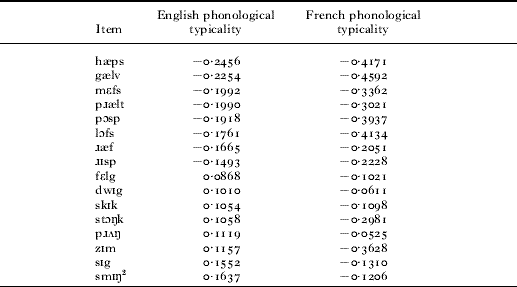
We examined the effect of phonological knowledge of French with the English-consistent condition used in Experiment 1. If French immersion children's grammatical inferences are influenced by French, we could expect them to perform differently in this condition compared to their monolingual peers due to the phonological typicality of the stimuli in French (rightmost column of Appendix B). Phonological typicality for French was computed by comparing the phoneme-feature representations of the pseudo-words with that of all unambiguous monosyllabic French nouns and verbs from the Lexique database (New, Pallier, Ferrand & Matos, Reference New, Pallier, Ferrand and Matos2001). This analysis suggested that all of our stimuli were phonologically closer to French nouns than verbs.
If extensive linguistic experience is required for phonology to affect grammatical inferences, French immersion children will be guided by their English phonological knowledge and will be indistinguishable from their monolingual peers. If not, the influence of their knowledge of French could be seen in a higher likelihood to select objects as the referents of the stimuli. It could also be seen as a decrease of the difference in how often children select action referents for the stimuli that are verb-like in English relative to object referents for the stimuli that are noun-like in English. This is because expectations based on French phonology converge with those based on English phonology for the latter set of items but diverge for the former set of items.
We tested French immersion children with instructions given either in English or in French. Ambient language is an important determinant of language mode – ‘the state of activation of the bilingual's languages and language processing mechanisms at a given point in time’ (Grosjean, Reference Grosjean and Nicol2001: 3). We anticipated that the activation of knowledge of French may be necessary for this knowledge to show an effect on children's grammatical inferences. By manipulating the language of the test, the study ensured that our hypotheses are comprehensively tested.
METHOD
Participants
Participants were recruited from two of the schools from which the participants for Experiment 1 were recruited. The French immersion programs in these schools offered 100% instruction in French from junior kindergarten to grade 2, instruction in English beginning only in grade 3. There were fourteen children in each language-of-test group. All participating children came from English-speaking homes and had no history of speech and hearing impairments. We ascertained through teachers' reports that all had been in the French immersion programs since senior kindergarten (approximately age 5 ; 0). The average age of the children tested in English was 7 ; 8 (range 7 ; 3 to 8 ; 0) and of those tested in French 7 ; 5 (range 7 ; 0 to 7 ; 10). There were eight and eleven girls respectively in the two groups. Four other children were tested but excluded from the study for failing to repeat the stimuli or overhearing English during a French-based session. Children received a small toy for their participation.
Materials, design and procedure
Children were randomly assigned to a language-of-test condition. The mapping between pseudo-words and pictures followed the English-consistent condition in Experiment 1. The procedure for the children tested in English was the same as in Experiment 1. To acquaint the children in the French-test group with the sound of synthesized speech, a research assistant first played about two minutes of synthesized English (the beginnings of popular fairy tales). The experimenter was not present during this period and ran the experiment entirely in French. The task instructions were translated into French by an English–French bilingual in consultation with a teacher from one of the participating schools. The instructions were back-translated by another English–French bilingual and discrepancies were resolved through discussion.
The CTOPP phonological awareness tests were administered in English at the end of the session. Previous research shows that there is a strong correlation between the phonological awareness in English and French of children in French immersion programs (Comeau, Cormier, Grandmaison & Lacroix, Reference Comeau, Cormier, Grandmaison and Lacroix1999). Thus, we did not administer a French phonological awareness test to the participants.
Coding
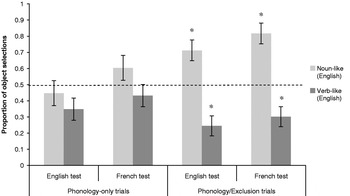
To assess the effect of phonology in Block 1, the data were coded according to whether children responded to French phonological typicality in their choices, i.e. if children chose the object picture, they received a score of 1, and 0 otherwise (Figure 3). In addition, all the data were coded according to whether children responded to the phonological typicality of the stimuli in English (Figure 4, Table 2). Here, children received a score of 1 if they selected the object picture as the referent of a stimulus that is noun-like in English and an action picture as the referent of a stimulus that is verb-like in English, and 0 otherwise.
Proportion of times children selected the object picture on phonology-only trials and phonology/exclusion trials in Block 1 of Experiment 2. * p<0·05.

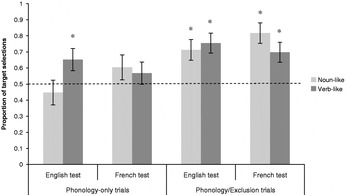
Proportion of times children selected the picture corresponding to the English phonological typicality of the pseudo-word on phonology-only trials and phonology/exclusion trials in Block 1 of Experiment 2. * p<0·05.

Accuracy scores in Experiment 2 by language-of-test condition, pseudo-word phonological typicality in English and block

RESULTS
The English-test group scored 25·36 (SD=5·7) and the French-test group 24·36 (SD=5) on the phonological awareness test. The two groups did not differ from each other (t(26)=0·49, n.s.). They also did not differ significantly from the monolingual group run in the English-consistent condition of Experiment 1.
As comparing Figures 2 and 4 and Tables 1 and 2 suggests, the children tested in English performed almost identically to their monolingual peers in Experiment 1. Indeed, none of the series of analyses performed to compare these groups yielded any main effects of or interactions including the variable of language background. This suggests that our participants' knowledge of French was insufficient in itself to influence their English-based biases in word learning. However, the French language-of-test group demonstrated a different pattern of performance. Thus, we focus this analysis on the data from the two French immersion groups.
Effect of phonology in Block 1
The dependent variable in the first analysis was the probability of selecting an object picture. We expected that this probability would be higher for the children in the French-test group. Moreover, we also expected that this probability would depend on the English phonological typicality of the pseudo-words because English was the dominant language of the participants in this study. That is, we expected that children would be more likely to select objects for the stimuli that were noun-like in English than those that were verb-like in English.
The data are summarized in Figure 3. They were submitted to a 2 (trial type: phonology only vs. phonology/exclusion)×2 (phonological typicality of the pseudo-words in English: noun-like vs. verb-like)×2 (language of test: French vs. English) ANOVA. Children tested in French selected object referents more than children tested in English, 54% vs. 44% respectively (F(1, 26)=5·853, p=0·02, ηp2=0·18). There was also a significant effect of English phonological typicality (F(1, 26)=41·33, p<0·001, ηp2=0·61), which was qualified by a significant interaction with trial type (F(1, 26)=16·37, p<0·001, ηp2=0·39). In the phonology-only trials children selected object referents more often when the stimuli were noun-like in both English and French than when the stimuli were noun-like in French but verb-like in English (F(1, 26)=4·303, p=.0048, ηp2=0·14). However, this difference was greater in the phonology/exclusion trials (F(1, 26)=53·375, p<0·001, ηp2=0·67). Arguably, this was due to the feedback that reinforced the difference between the stimuli. No other effects were significant.
We elaborated the analysis by recoding the data from Block 1 according to the phonological typicality of the stimuli in English. As Figure 4 shows, in the phonology-only trials the English-test group performed better with the stimuli that are verb-like than those that are noun-like in English (65% vs. 45% correct, t(13)=2·17, p=0·049). In contrast, the French-test group performed approximately the same with stimuli that are noun-like and stimuli that are verb-like in English (60% vs. 57% correct, t(13)=0·39, p=0·7). There was a marginal interaction between phonological typicality and language of test in the phonology-only trials (F(1, 26)=3·389, p=0·07, ηp2=0·12). There were no significant effects in the analysis of the phonology/exclusion trials. Comparing the data from the phonology-only and phonology/exclusion trials showed that children performed better in the latter (F(1, 26)=16·198, p<0·001, ηp2=0·38). The interaction between phonological typicality and language of test was also significant overall (F(1, 26)=6·057, p=0·02, ηp2=0·19).
These two analyses complement each other to show that testing in French: (1) encourages the selection of object pictures across all stimuli; and (2) decreases the difference between selecting object and action pictures respectively for the stimuli that are noun-like and verb-like in English.
Effect of phonology across all blocks
The preceding two analyses suggest that children's knowledge of French can affect their initial grammatical inferences about new words when they are in a French language environment. Again, however, even a single instance of feedback enabled children to apply exclusion and mitigated the effect of phonology. We coded the data in Blocks 2 and 3 according to whether children selected the intended referent, which corresponded to the English phonological typicality of the stimulus (Table 2). We analyzed the entire dataset using a 2 (language of test: English vs. French)×2 (pseudo-word phonological typicality in English: noun-like vs. verb-like)×3 (block: 1, 2 and 3) ANOVA. The interaction effect between language of test and phonological typicality was significant (F(1, 26)=4·30, p=0·048, ηp2=0·14). Overall, children tested in English selected the intended referent for noun-like pseudo-words 63% of the time and for verb-like pseudo-words 71% while children tested in French selected the intended referents 66% and 63% respectively. There was a marginal 3-way interaction between language of test, phonological typicality and block (F(2, 52)=3·1, p=0·054, ηp2=0·11). Although this effect was marginal, the results from Experiment 1 suggested that differences in performance are to be found specifically in Block 1. Indeed, as we have already showed, there was a significant interaction between phonological typicality and language of test in Block 1. Follow-up 2 (language of test)×2 (phonological typicality) ANOVAs on the data of Blocks 2 and 3 showed no main or interaction effects. This suggests that even when it was activated, children's phonological knowledge of French had no significant effect on the overall outcome of learning.
Relation with phonological awareness
We correlated children's phonological awareness and their sensitivity to overall phonological typicality using the same measure as in Experiment 1. Again, the correlation was not significant (r=0·02, p=0·8).
DISCUSSION
The English-test condition in this study replicated the results of the English-consistent condition of Experiment 1. The study also offers two further findings. First, even though second-grade French immersion children have limited knowledge of French compared to English, that knowledge nevertheless appears affected their initial grammatical inferences about new words. Within about two years of predominantly academic exposure to a language, children apparently can develop sensitivity to the relationship between phonology and grammatical category in that language.
This first conclusion should be considered within the context of the second finding: unless appropriately activated, the linguistic experience with French of second-grade French immersion students does not appear to be sufficient to influence their inferences. The French immersion children did not differ from the monolingual English-speaking children when tested in English, their native language. Both groups were more accurate on verb-like than noun-like items. But when the French immersion children were tested in French, there was no difference in the number of object referents selected for English verb-like and noun-like pseudo-words, which we interpret as being due to all the pseudo-words being noun-like in French. This language-of-test effect suggests that activation of the linguistic representations associated with a language may be necessary for it to affect the learning of new words. It is important to note in regard to both of these findings, however, that all stimuli in this study were noun-like in French and hence called for chance performance, which is open to interpretation. Further research including stimuli that are verb-like in French and a monolingual French group for comparison may strengthen our conclusions.
GENERAL DISCUSSION
The main goal of the present research was to examine whether and how phonological knowledge affects children's grammatical inferences about new words when learning by exclusion can also constrain the identification of the referent. Experiment 1 showed that phonological knowledge affects children's inferences when exclusion cues are absent or weak. Experiment 2 showed that even limited phonological knowledge of a second language could influence children's grammatical inferences about new words. The findings support the phonological bootstrapping hypothesis but in a weak version, one in which phonology is part of a multiple-cue integration learning process (Farmer et al., Reference Farmer, Christiansen and Monaghan2006; Hollich et al., Reference Hollich, Hirsh-Pasek and Golinkoff2000; Monaghan et al., Reference Monaghan, Chater and Christiansen2005, Reference Monaghan, Christiansen and Chater2007; Morgan & Demuth, Reference Morgan, Demuth, Morgan and Demuth1996).
It is important to underscore that our research provides a strong test of the role of phonological knowledge. Not only is exclusion a robust word-learning strategy but our experimental design supported its application by providing children with feedback rather than allowing them to discover the picture–word mappings on their own. Without feedback, children's incorrect guesses would not be immediately revised and could lead to other incorrect associations. It is possible that in such situations phonological knowledge has longer lasting effects. Furthermore, at no point did we suggest to children that the pseudo-words belonged to English or French. On the contrary, we explicitly told children that the pseudo-words belonged to a language they had not heard before. Nevertheless, children applied their implicit knowledge of the phonology–grammar correlations in English and French to constrain the process of word learning. The effect of phonological typicality might have been even stronger if the ‘alien’ language was presented as English or French.
The findings are also relevant to research on first- as well as second-language acquisition. In particular, they suggest that the effect of L1 on L2 phonology extends beyond the perception and production of sounds (Eckman, Reference Eckman2004) to inferences about the lexical class of words. Furthermore, the findings have implications about the study of multilingualism (e.g. Cenoz, Hufeisen & Jessner, Reference Cenoz, Hufeisen and Jessner2001) in suggesting that it is the currently activated language that affects the learning of the target language.
In support of the verb-bias hypothesis, we found that verb phonology appeared to direct children's attention to actions much more reliably than noun phonology directed it to objects. This difference is consistent with computational analyses indicating that, across different languages, phonological cues to lexical class are much stronger for verbs than nouns (Christiansen & Monaghan, Reference Christiansen, Monaghan, Hirsh-Pasek and Golinkoff2006; Monaghan et al., Reference Monaghan, Christiansen and Chater2007). Importantly, adults also show greater impact of phonology in the processing of verb-like than noun-like words. Farmer et al. (Reference Farmer, Christiansen and Monaghan2006) found that when presented with noun/verb homonyms adults experienced processing problems when the sentence continued in a manner that was incongruent with the phonological typicality of the homonym. As an example, when needs, which is a verb-like homonym, was used in the sentence fragment The teacher told the principal that the student needs … , participants took much less time to read a continuation that treated needs as a verb (… to be more focused) than one that treated needs as a noun (… were not being met), despite both completions being judged as equally acceptable in a norming study. The difference between the consistent and inconsistent continuations was much greater for verb-like than noun-like homonyms as shown by the effect sizes for the two types of stimuli: d=0·660 for verb-like homonyms vs. d=0·395 noun-like homonyms.Footnote 5
Our results stand in contrast with much previous research demonstrating noun advantage in learning, e.g. nouns being learned after fewer repetitions than verbs (Oetting, Rice & Swank, Reference Oetting, Rice and Swank1995), but the phonological properties of the non-words were not controlled in these studies. Our results, however, also contrast with some earlier research addressing the role of phonology in word learning: Cassidy & Kelly (Reference Cassidy and Kelly1991, Reference Cassidy and Kelly2001) found no difference between monosyllabic (verb-like) and trisyllabic (noun-like) pseudo-words; similarly, Storkel (Reference Storkel2001, Reference Storkel2003) found no difference in the learning of pseudo-words when their referents were objects and actions. Perhaps most notable of the differences between these studies and ours is the difference in the stimuli used. As we noted, syllable length was not the only cue to lexical category in Cassidy and Kelly's stimuli and the cues may have conflicted. Storkel, on the other hand, measured phonotactic probability across the whole lexicon rather than in relation to a particular grammatical category. Further research, however, is needed to identify conclusively the source of the difference.
Experiment 2 indicated that even limited knowledge of a language can provide children with phonological knowledge that they can use to constrain their inferences about the lexical class of a new word. But how much linguistic experience do children need to begin to use their knowledge of the phonological features of lexical categories to help learn new words? The present studies do not obviate the need to examine the role of phonology with younger children but suggest that even limited knowledge of a language can enable phonological bootstrapping. Judging from our gross estimates of vocabulary, children may begin to rely on the phonology of their native language to make grammatical inferences about novel words before the age of four, the mode age of the participants in Cassidy & Kelly's (Reference Cassidy and Kelly1991, Reference Cassidy and Kelly2001) and Storkel's (Reference Storkel2001, Reference Storkel2003) experiments. Thanks to their perceptual abilities, children may quickly build phonological representations of lexical categories that are reliable and stable enough to scaffold further word learning, although these representations undoubtedly change with language development.
We end by discussing five outstanding issues related to our research that have to be addressed in future studies. First, the generalizations from the current experiments to typical word-learning situations are limited by the very issue that we attempted to address, namely there are many other cues besides phonology and learning by exclusion that affect word learning in natural settings. For example, although Cassidy & Kelly (Reference Cassidy and Kelly1991) found that about 15% of the utterances children hear are single-word utterances, most often new words are embedded in sentences that provide distributional cues to the new word's lexical category. Second, we used pictures of familiar objects and actions as referents for the pseudo-words. However, an ability to learn a second label for a referent has not been demonstrated in children younger than 2 ; 0 (e.g. Mervis, Golinkoff & Bertrand, Reference Mervis, Golinkoff and Bertrand1994). Thus, research is specifically needed to establish whether phonological cues can facilitate word learning prior to this age. Third, our study did not address the ‘extended’ process of word learning. For example, we did not test whether children learned the pseudo-words as labels for the categories represented by the referents. The more general issue here is whether the influence of phonological cues is circumscribed to the formation of word–referent links or extends to other aspects of the word leaning process.
Fourth, our study focused on the usefulness of phonological cues for learning nouns and verbs. More generally, research into phonological cue use has investigated differences between open- and closed-class words and, within the former, nouns and verbs. It remains to be seen whether phonological cues may also facilitate learning of words belonging to other lexical categories. Both more computational and experimental research is needed to answer this question. Finally, although our research suggests that both English and French phonological cues can influence children's grammatical inferences about new words, a question remains about whether such cues exist in every language. Polysynthetic languages, such as Salish, Chukchi and Ainu are characterized by the incorporation of many morphemes (that Indo-European language speakers may consider nouns and verbs) into a single word. Such languages challenge the traditional distinctions between lexical categories, and hence it is unclear to what degree phonology might be useful for grammatical inferences about new words in these languages.
Despite these limitations, the present research is the first to examine the role of phonology relative to other cues and represents an important advancement toward understanding its place in word learning. Phonological knowledge appears to have a relatively weak impact, yet the ability to form quick hypotheses about new words is crucial for children's rapid language development (Carey, Reference Carey, Bresnan, Miller and Halle1978). Thus, the role of phonology has to be carefully considered in mapping the multiple-cue integration mechanism that supports language development.
APPENDIX A
COMPUTATION OF EUCLIDEAN DISTANCE AND PHONOLOGICAL TYPICALITY
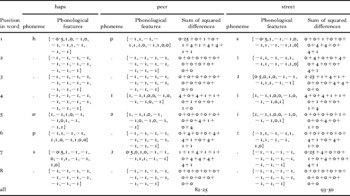
The phonological typicality of an item is defined as the difference between its average Euclidean distance to nouns and its average Euclidean distance to verbs. To compute Euclidean distances, each item was represented in terms of three phoneme slots for the onset, two slots for the nucleus, and three slots for the coda. Hence, the word cat was represented as /k.._æ._t../, where “.” denotes an empty slot. Each phoneme was then represented in terms of eleven phonemic features (sonorant, consonantal, voice, nasal, degree, labial, palatal, pharyngeal, round, tongue, radical) adapted from Harm & Seidenberg (Reference Harm and Seidenberg1999). For word–pseudo-word comparisons, the phonemes were shuffled between each slot within the onset, nucleus or coda positions to minimize the Euclidean distance between words. Thus, when the pseudo-word haps is compared with street, the alignment is /h.._æ._ps./ and /stɹ_ii_t../, because the distance between /h/ and /s/ was smaller than between /h/ and /t/ or /h/ and /ɹ/, and the distance between /p/ and /t/ was the smallest for the coda. However, when haps is compared with peer the alignment is /h.._.æ_ps./ and /p.._ iə_.ɹ./ because the distance between /ɹ/ and /p/ is larger than between /ɹ/ and /s/.
Table A1 shows an example for computing the Euclidean distance between the pseudo-word haps and the words peer and street. The Euclidean distance is given by summing the squares of the differences between each phoneme slot in terms of its phonological features, and then taking the square root of this sum. For the first phoneme position, in the comparison between haps and peer, for instance, the phonological feature representation of /h/ is {−0·5,1,0,−1,0,−1,−1,1,−1,−1,−1}, and for /p/ it is {−1,1,−1,−1,1,1,0,−1,1,0,0}. Then the squared difference between the first phonological feature for this phoneme position is: (−0·5–−1)2=0·52=0·25. For the second position, the squared difference is (−1–−1)2=0, for the third position, the squared difference is (0–1)2=1, and so on for all eleven phonological features. Then, the distance between haps and peer is the square root of the sum of all the squared differences for all phoneme positions: for haps and peer, the Euclidean distance is  =9·07. For the distance between haps and street, the Euclidean distance is
 =9·67.
Overall, haps is a noun-like pseudo-word because its average Euclidean distance to nouns is 8·48, which is less than its average Euclidean distance to verbs, 8·72. Its phonological typicality is 8·48–8·72=−0·25.
Examples of computing Euclidean distance between the pseudo-wordhaps and the wordspeer and street

APPENDIX B
Pseudo-word stimuli used in Experiments 1 and 21

note 1: Stimuli are shown in IPA transcription. Positive value indicates that the item is similar to verbs and negative that it is similar to nouns in the respective language.
note 2: A reviewer noted that there is no English word of the form /sm.ŋ/ and suggested that this poses a question about the phonotactic validity of this item in English. However, phonotactic probability of non-words is typically determined by the frequency of certain phonemes or phoneme clusters appearing in onset, nucleus and coda positions (e.g. Storkel, Reference Storkel2001, Reference Storkel2003; Vitevitch & Luce, Reference Vitevitch and Luce1998). Under this approach, /smІŋ/ contains relatively frequent phonemes by position. However, in view of the reviewer's concern, all analyses were redone without the data from /smІŋ/, and the results upheld the major conclusions of the studies.
APPENDIX C
Pictures used Experiments 1 and 2