Introduction
Older persons have particularly high suicide rates compared to younger age groups (Conwell et al., Reference Conwell, Duberstein and Caine2002; Hawton and Van Heeringen, Reference Hawton and Van Heeringen2009). Mental health problems, such as mood disorders, substance misuse, and a history of suicide attempt have been identified as risk factors for suicidal behavior among older people (Conwell et al., Reference Conwell, Duberstein and Caine2002). Up to three quarters of those who commit suicide in late life suffer from a current depression, and the recognition and treatment of depression is thus an important target for the prevention of suicide in this age group (Conwell et al., Reference Conwell, Duberstein and Caine2002; Lapierre et al., Reference Lapierre2011).
There are several studies indicating that the use of antidepressants is associated with decreased suicide risk in older people (Gibbons et al., Reference Gibbons2007; Barbui et al., Reference Barbui, Esposito and Cipriani2009). In the light of this, it is remarkable that we know so little about attitudes to antidepressant medication among older adults at high risk of suicide.
Among older persons who are prescribed antidepressants, adherence to treatment may be suboptimal, which is likely to influence treatment results (Maidment et al., Reference Maidment, Livingston and Katona2002; Fawzi et al., Reference Fawzi2012; Pompili et al., Reference Pompili2013), and could indeed increase the risk of suicide. Factors associated with poor adherence to medication in general are e.g. depression, side effects, and a lack of belief in the effect of the medicine (Osterberg and Blaschke, Reference Osterberg and Blaschke2005). In a qualitative study, older persons with depression, expressing reluctance toward antidepressants, expressed a fear of dependence and prior negative experiences with antidepressants (Givens et al., Reference Givens2006). Concerning beliefs about antidepressants, older age and an increased severity of depression have been associated with a perceived necessity of antidepressant medicine, among 18–75 year-olds with depression (Aikens et al., Reference Aikens, Nease and Klinkman2008). Clinical intervention studies for older depressed persons show that those who are suicidal are slower to respond to antidepressant treatment than those who are not. Further, they may require augmentation treatment (Szanto et al., Reference Szanto2001; Reference Szanto, Mulsant, Houck, Dew and Reynolds2003). Yet knowledge about correlates of beliefs about antidepressant medicines among the suicidal older persons is poor.
Recently, we carried out a prospective study on a clinical cohort of persons aged 70 years and above who were treated in hospital in connection with a suicide attempt (Wiktorsson et al., Reference Wiktorsson, Runeson, Skoog, Ostling and Waern2010). Almost all were prescribed antidepressants at discharge. The aim of this study was to assess beliefs about antidepressant medicines in this cohort, one year after the index attempt. Another aim was to analyze the association between beliefs about antidepressant medicines and sociodemographic and clinical variables.
Methods
Study population
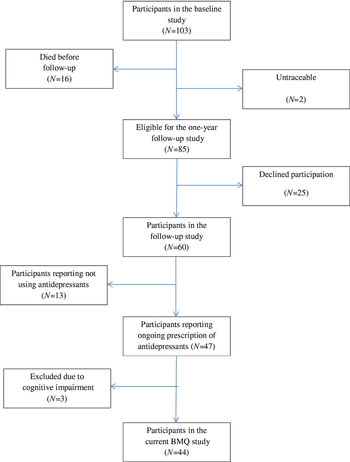
The cohort has previously been described in detail (Wiktorsson et al., Reference Wiktorsson, Runeson, Skoog, Ostling and Waern2010). Briefly, individuals aged 70 years and older who were treated in hospital in connection with a suicide attempt were eligible for inclusion. Persons with dementia (n = 2), terminal illness (n = 2) and language difficulties (n = 1) were excluded. The participants were identified in emergency wards at five hospitals in western Sweden during 2003–2006. Of the 133 who were invited to participate, 103 accepted (77%) (Figure 1). As previously described (Wiktorsson et al., Reference Wiktorsson, Marlow, Runeson, Skoog and Waern2011), 16 died before the one-year follow-up and two were not possible to trace. Among the remaining 85 individuals, 60 accepted reassessment and gave informed consent for the one-year follow-up (response rate 71%). The study includes no control group, since virtually all depressed older persons in Sweden who attempt suicide are prescribed antidepressant medication.
Participant flow.

A psychologist (SW) performed both the baseline and the follow-up interviews. The median duration from the suicide attempt to the baseline interview was 11 days, and 391 days (median) passed from the suicide attempt to the follow-up interview.
Participants who reported having a prescription for antidepressant medicine at the 12 month follow-up interview were eligible for this study (n = 47). Participants’ beliefs about their antidepressant medicine were assessed with the BMQ specific for antidepressants (Horne and Weinman, Reference Horne and Weinman1999). Three persons lacked cognitive ability to respond to the BMQ as determined by the interviewer hence, the study includes 44 individuals. Self-reported antidepressant use was later confirmed in a medical record review. All participants gave written informed consent. All procedures were in accordance with ethical standards and the Helsinki Declaration. The study was approved by the Regional Ethical Review Board in Gothenburg.
Beliefs about antidepressant medicines
The BMQ specific for antidepressants includes 10 items; 5 items on beliefs about the necessity of using antidepressant medicines (the necessity subscale), and 5 items assessing concerns about using antidepressant medicines (the concerns subscale). Due to the frailty of the participants, the BMQ items were read out loud by the interviewer, and the participants responded orally. Each BMQ item is scored on a 5-point Likert scale ranging from 1 = strongly disagree to 5 = strongly agree. Separate subscale scores were calculated for the necessity subscale and for the concerns subscale. The scores on each subscale could thus range from 5 to 25 points. A necessity-concerns differential was calculated by subtracting the concerns subscale score from the necessity subscale score. A positive differential indicates that the perceived benefits outweigh the perceived concerns for that patient.
The English BMQ specific for antidepressants was translated to Swedish by MW and translated back to English by Language Services in Cambridge, UK. The English back translation was approved by the original author Professor Robert Horne at the UCL School of Pharmacy, London, UK (personal communication).
Covariates
Sociodemographic variables
Information about age, sex, marital status, cohabitation, and educational level was self-reported by the participants.
Clinical variables
Medication:
Data on prescribed antidepressant medicines prior to the index attempt was collected by self-report and via medical records. Information on prescriptions at discharge following the index attempt was collected from medical records. The number of prescribed medicines at follow-up was assessed by self-report and included medicines used regularly and as needed. The respondents were also asked if they took the antidepressant as prescribed (yes/no). Ongoing prescriptions were classified according to the Anatomical Therapeutic Chemical classification system (Who Collaborating Centre for Drug Statistics Methodology, 2012).
Psychiatric examination:
Major depression was diagnosed according to the Diagnostic and Statistical Manual of Mental disorders, fourth edition (DSM-IV) and minor depression was based on DSM-IV research criteria (Frances and American Psychiatric Association, Reference Frances1994). The symptom algorithms employed have been shown in detail (Wiktorsson et al., Reference Wiktorsson, Runeson, Skoog, Ostling and Waern2010). Information about lifetime history of alcohol or tablet misuse/dependence was assessed by self-report, medical record review and hospital discharge register (Morin et al., Reference Morin2012).
Past month anxiety symptom burden was rated using a slightly modified version of the Brief Scale for Anxiety (BSA) (Tyrer et al., Reference Tyrer, Owen and Cicchetti1984), a subscale of the Comprehensive Psychopathological Rating scale (CPRS) (Asberg et al., Reference Asberg, Montgomery, Perris, Schalling and Sedvall1978). The phobia question was not included in this version and there were thus 9 items; each scored from 0–6, with higher scores indicating more severe symptoms.
History of psychiatric treatment was assessed based on interview data and medical records from primary care, psychiatric clinics, hospital emergency departments and geriatric departments.
The item “Do you think your situation is hopeless?” from the Geriatric Depression Scale (Yesavage et al., Reference Yesavage1982) was used to assess hopelessness at both interviews.
Information about number of suicide attempts prior to index attempt was based on self-report at index attempt and medical record review.
The presence of suicidal feelings between index attempt and follow-up were examined using Paykel's five questions concerning life weariness, death wishes, suicidal thoughts, suicidal plans, and suicide attempts (Paykel et al., Reference Paykel, Myers, Lindenthal and Tanner1974).
Personality traits:
The Eysenck Personality Inventory (EPI) measured two personality dimensions: neuroticism-emotional stability and extroversion–introversion (Eysenck and Eysenck, Reference Eysenck and Eysenck1964). Each of the two dimensions comprises 24 dichotomous (yes/no) items. High scores on the neuroticism scale imply emotional reactivity, anxiety and psychosomatic concerns. Impulsive, outgoing persons score high on extroversion.
Statistical analyses
The median and interquartile ranges (IQR) were calculated for the necessity and concerns subscale scores. Non-parametric tests were used since data was not normally distributed. Median values were compared between groups with two-tailed Mann–Whitney test with correction for ties. For continuous variables, the median and IQR were calculated, and Spearman's rank correlation was used to assess the correlation with the necessity and concerns subscale scores, respectively. The statistical significance level was 0.05. Stata 10.1 statistical software (StataCorp, Texas, USA) was used for statistical analyses.
Results
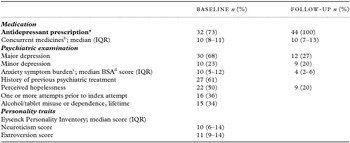
Half of the participants were older than 80 years, and the majority (57%) was women. Fifty-five percent had only mandatory education (7 years or less). One-fifth was married or cohabiting. Twenty-seven (61%) participants had a history of psychiatric treatment. Further clinical characteristics are presented in Table 1. Thirty-two participants had an ongoing prescription for antidepressants prior to the index attempt. Among these, 28 participants reported that they took their antidepressants as prescribed. Six persons (21%) used more than one antidepressant at baseline. All participants had a prescription for antidepressant medicine at follow-up as this was an inclusion criterion for the study; 14 of these (32%) used more than one antidepressant. Two reported that they did not take the prescribed antidepressant. The median number of medicines was 10 at both baseline examination and at follow-up.
Clinical characteristics of older suicide attempters at baseline and at one-year follow-up (N = 44)

aPrior to the index attempt.
bAt baseline interview.
cThe month prior to the index attempt and the month prior to the follow-up.
dBrief Scale for Anxiety.
The most common type of antidepressant at follow-up was mirtazapine (n = 27, 61%) followed by escitalopram (n = 10, 23%). Other antidepressants were venlafaxine (n = 6), sertraline (n = 5), citalopram (n = 5), duloxetine (n = 2), reboxetine (n = 1), amitriptyline (n = 1), clomipramine (n = 1) and paroxetine (n = 1). Thirty-three (75%) participants had a prescription of hypnotics. The most common was zopiclone (n = 22, 50%) followed by oxazepam (n = 18, 41%). Further, 9 persons were prescribed propiomazine and 7 persons zolpidem. Sedatives were prescribed to 9 persons (21%) as follows; diazepam (n = 3), alprazolam (n = 3), hydroxyzine (n = 2) and promethazine (n = 2). Ten persons had a prescription for antipsychotics. The most common was risperidone (n = 5), followed by olanzapine (n = 3), aripiprazole (n = 2), perphenazine (n = 1), zuclopenthixol (n = 1) and quetiapine (n = 1). Finally, three persons (7%) had a prescription of mood stabilizers, lamotrigine (n = 3) and lithium (n = 1).
The percentage with major depression was lower at follow-up than at index attempt (27% at follow-up vs. 68% at index attempt; p < 0.001), as was the percentage experiencing hopelessness (20% vs. 50%; p = 0.002). Further, 18 participants (42%) acknowledged having experienced some level of suicidal feelings during the follow-up period (life weariness, n = 13 (30%), death wishes, n = 16 (37%), suicidal thoughts, n = 9 (21%), suicidal plans, n = 4 (9%), and suicide attempts, n = 2 (5%)).
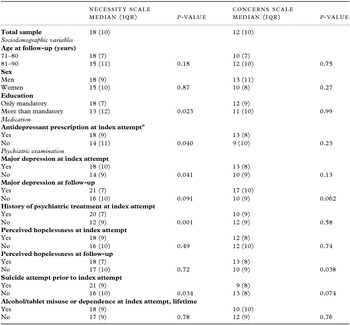
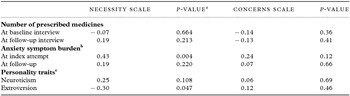
As presented in Table 2, the median score was 18 on the necessity subscale of BMQ and 12 on the concerns subscale. A positive necessity-concerns differential was observed among more than half of the participants (median = 2, range −12 to 18), i.e. the perceived necessity outweighed the perceived concerns they had. About half of the participants (48%; n = 21) acknowledged that they were worried about becoming too dependent on their antidepressant. Table 2 shows further that low education, use of antidepressant medicine at index attempt, major depression at index attempt, a history of psychiatric treatment, and previous suicide attempt were associated with a higher perceived necessity of antidepressant medicines. Hopelessness at follow-up was associated with higher perceived concerns. Among the continuous variables (Table 3), higher severity of anxiety symptoms at index attempt was associated with a higher perceived necessity of antidepressant medicines, and a higher score on the extroversion scale was associated with a lower score on the necessity scale.
Median values for Beliefs about the necessity and concerns of antidepressant medicines among older suicide attempters at one-year follow-up (N = 44), by sociodemographic and clinical variables

aPrior to the index attempt. Notes: IQR: Interquartile range. P-values were calculated with Mann–Whitney test for medians.
Correlations with Beliefs about the necessity and concerns of antidepressant medicines among older suicide attempters at one-year follow-up (N = 44)

aSpearman's rank correlation.
bThe month prior to the index attempt and the month prior to the follow-up.
cAt baseline interview.
Discussion
This is the first study assessing beliefs about antidepressant medicines in a clinical cohort of older persons at high risk of suicide. The majority of participants perceived the necessity of their antidepressant medicine to outweigh their concerns. Lower perceived necessity of antidepressants was observed in those who were not on antidepressants at the time of the attempt as well as those with no prior history of suicide attempt before the index attempt. Individuals reporting hopelessness at follow-up had a higher perceived concern about using medication.
Since a history of suicide attempt is a particularly strong risk factor for completed suicide in late life (Conwell et al., Reference Conwell, Duberstein and Caine2002), and the identification and treatment of depression is a priority for suicide prevention in this age group, it is encouraging that the majority of the participants perceived that the necessity of antidepressants outweigh their concerns. New users of antidepressants have been found to discontinue therapy to a large extent (Lu and Roughead, Reference Lu and Roughead2012), and it is probable that this is even more common among those who do not perceive the medication as necessary for their health. A low perceived necessity and a high perceived concern about antidepressant medication has been associated with poor adherence (Maidment et al., Reference Maidment, Livingston and Katona2002; Hunot et al., Reference Hunot, Horne, Leese and Churchill2007; Fawzi et al., Reference Fawzi2012). Thus, to efficiently target efforts in clinical practice, it is important to identify the groups who express low necessity or high concerns. Half of our participants worried about becoming too dependent on antidepressants, a proportion larger than that previously reported in a study of depressed persons aged 55+ (Fawzi et al., Reference Fawzi2012). Psychoeducation (Sherrill et al., Reference Sherrill, Frank, Geary, Stack and Reynolds1997) on antidepressant medication is vital to increase patients’ knowledge and understanding of these drugs.
In the current study, we did not find increased concerns in those who were new users of antidepressants. This was somewhat surprising as there is evidence that those lacking prior treatment are more likely to have concerns about harmfulness (Aikens et al., Reference Aikens, Nease and Klinkman2008). However, it should be noted that questions on beliefs were asked at the follow-up interview, one year after the suicide attempt. Harmful beliefs may have dissipated during the follow-up period, as was observed in a previous depression treatment trial (Aikens and Klinkman, Reference Aikens and Klinkman2012). In our population, 98% were prescribed antidepressants at discharge and many had perceived the positive effects of the medication when interviewed about a year later.
The relation of major depression with a higher score on the necessity scale parallels earlier results on the severity of depressive symptoms in a mixed age clinical cohort (Aikens et al., Reference Aikens, Nease and Klinkman2008). Concerning other covariates studied, lower education was associated with greater necessity. The literature on this is sparse, but an opposite trend was observed in a clinical sample of migraineurs, although that result was not significant (Hedenrud et al., Reference Hedenrud, Jonsson and Linde2008).
Individuals with a high score on the extroversion scale perceived antidepressants to have low necessity. A negative relation between extroversion and adherence to antidepressant medication was found in a previous study that employed the five-factor model to measure personality traits (Cohen et al., Reference Cohen, Ross, Bagby, Farvolden and Kennedy2004). A larger study is needed to determine the relationship between personality, beliefs about antidepressant medication, and adherence.
Hopelessness at follow-up was the only covariate statistically associated with perceived concerns about antidepressants. Hopelessness has been suggested to represent a trait (Rifai et al., Reference Rifai, George, Stack, Mann and Reynolds1994; Szanto et al., Reference Szanto, Reynolds, Conwell, Begley and Houck1998), reflecting vulnerability, and high levels of hopelessness have been found among suicide attempters (Szanto et al., Reference Szanto, Reynolds, Conwell, Begley and Houck1998). The clinical relevance of the identified difference in concerns about antidepressants, between those perceiving hopelessness and not, must be further evaluated. It could be that these individuals are important to identify in clinical practice in order to e.g. encourage treatment adherence, since high perceived concern about antidepressant medication has been associated with poor adherence (Maidment et al., Reference Maidment, Livingston and Katona2002; Hunot et al., Reference Hunot, Horne, Leese and Churchill2007; Fawzi et al., Reference Fawzi2012).
Some of the participants reported that they had suicidal feelings during the one-year follow-up period. The study was not sufficiently powered to determine whether beliefs in this group differed from those of persons without suicidal feelings. Further, a larger study would be needed to examine beliefs among older persons with bipolar disorders, a vulnerable patients group (Pompili et al., Reference Pompili2012).
The existing literature does not provide figures suitable for direct comparison with the BMQ scale scores in the present study. Previous studies analyzing beliefs about medicines in a population using antidepressant medication (Maidment et al., Reference Maidment, Livingston and Katona2002; Brown et al., Reference Brown2005; Hunot et al., Reference Hunot, Horne, Leese and Churchill2007; Fawzi et al., Reference Fawzi2012) have either not presented a mean or a median score (Maidment et al., Reference Maidment, Livingston and Katona2002; Brown et al., Reference Brown2005; Fawzi et al., Reference Fawzi2012), or they have used a modified version of the BMQ (Hunot et al., Reference Hunot, Horne, Leese and Churchill2007). Few studies have analyzed beliefs about specific types of medication in older populations (Schuz et al., Reference Schuz2011; Ruppar et al., Reference Ruppar, Dobbels and De Geest2012), and only one of them, which focused on antihypertensive medication used the full BMQ scale (Ruppar et al., Reference Ruppar, Dobbels and De Geest2012). Mean scores for both necessity and concerns scales were somewhat higher in the latter study in comparison with our own. However, it should be noted that both studies have small sample sizes.
Strengths and limitations
The high age of the participants, together with the fact that all interviews were carried out by the same psychologist, are major strengths of this study. Further, we used a validated and clinically relevant instrument for quantifying psychiatric symptom burden (CPRS) in older persons (Van Der Laan et al., Reference Van Der Laan, Schimmel and Heeren2005).
The original small sample size and the progressive loss of subjects are major limitations which entail low precision; hence results must be interpreted with caution. Cases were recruited in the hospital setting and attempters not treated in hospital might be expected to have more negative beliefs about medicines and less own experience of antidepressant treatment. Further, those who did not continue to take their antidepressant may have more negative beliefs toward antidepressants compared to those who persisted. A single question was used to examine hopelessness and this must be seen as a limitation. A more specific instrument would have been more reliable. Further, one limitation is the lack of a validated measure of adherence, which would have added relevance and important knowledge to the study. Finally, as only persons with a working knowledge of Swedish were included results cannot be generalized to those with different cultural backgrounds.
Conclusion
The majority of older persons in treatment after a suicide perceived the necessity of their antidepressant medicine to outweigh their concerns. The BMQ specific for antidepressants might be a valuable tool in clinical practice for physicians who treat persons who attempt suicide in late life, but studies using objective measures of adherence are called for.
Conflict of interest
The study was supported by grants from the Swedish Research Council (2005–21X-14598–03A, 2009–62X-2079–01–3), the Swedish Council for Working Life and Social Research (2002–0153), the Söderström-König Foundation, the Thuring Foundation, the Hjalmar Svensson Foundation, the Organon Foundation, the Axel Linder Foundation and the Wilhelm and Martina Lundgren Foundation.
None of the funders have had any role in the research.
Description of authors’ role
Eva Lesén was involved in data analysis and interpretation, and contributed to the draft and final manuscript. Stefan Wiktorsson collected all data at baseline and at follow-up. He was involved in the interpretation of data, contributed to the original manuscript and prepared the revised manuscript. Eva Lesén and Stefan Wiktorsson are joint first authors. Anders Carlsten was involved in the design of the study and preparing the final manuscript. Margda Waern designed and supervised the original study, and carried out the Swedish translation of the BMQ for antidepressants. Further she was involved in data interpretation and contributed to the final manuscript. Tove Hedenrud was involved in the Swedish translation of the BMQ for antidepressants. Further she was involved in data interpretation and has contributed to the final manuscript.
Acknowledgments
The authors wish to thank all study participants and hospital staff.