Introduction
The fossil decapods of the Cretaceous of northeast Texas have been the subject of numerous studies over the past 80 years. Many authors have studied various parts of the entire fauna (i.e., Rathbun, Reference Rathbun1935; Stenzel, Reference Stenzel1945). This study is based on extensive, previously unstudied private collections put together by Robert Reid, Chris Sampson, and Gale A. Bishop, totaling over 2,000 specimens representing a large array of decapods. The specimens have been collected over the span of 20 years, or more, from multiple localities where the Albian Pawpaw Shale and the Turonian Britton Shale crop out. These shales are rich in fossiliferous concretions. A large number of the fossils found in concretions are decapods because the concretions have formed along infaunal burrows mainly excavated by decapods.
Geological setting
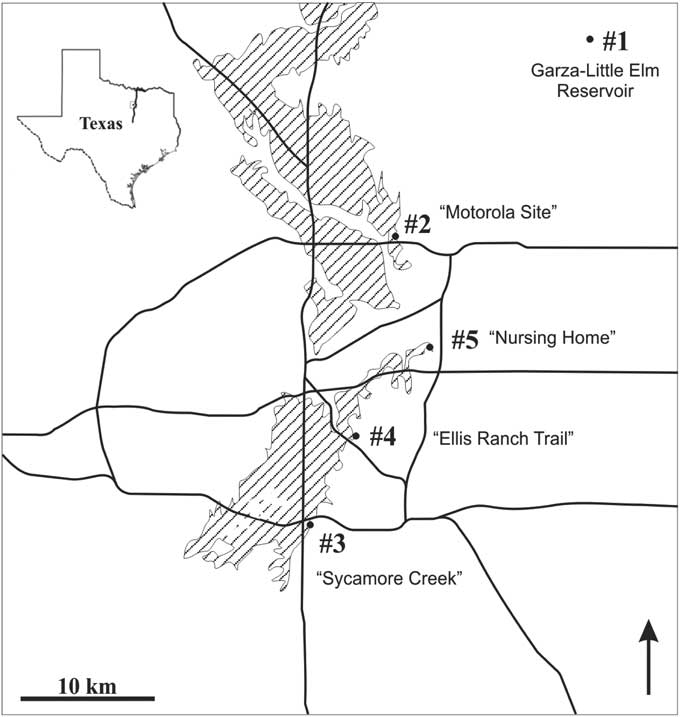
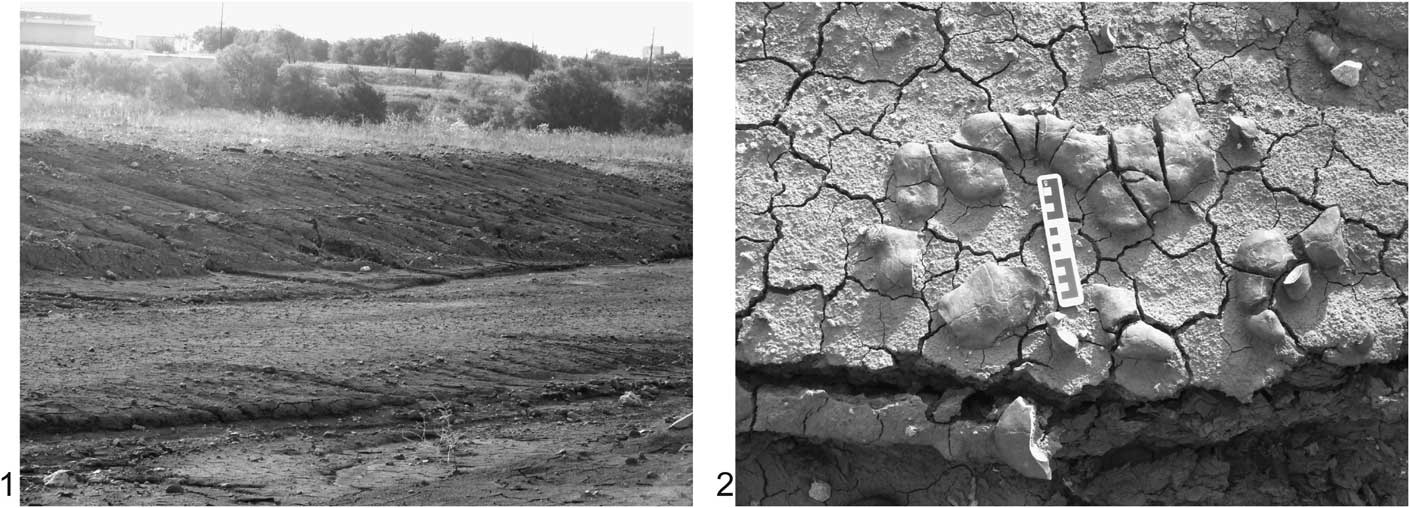
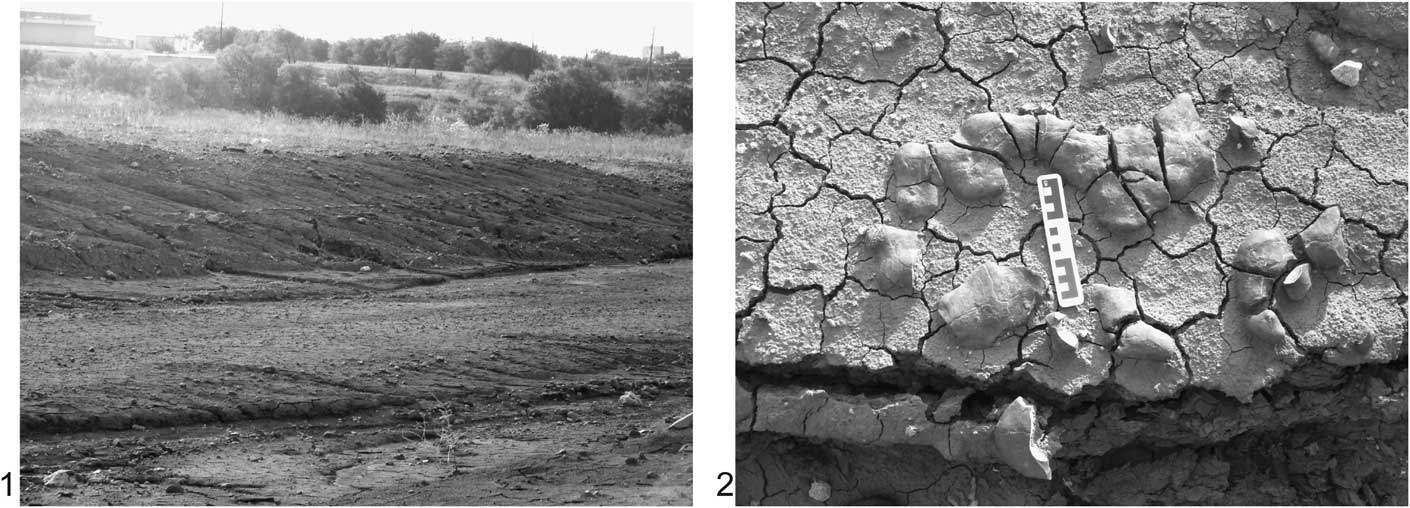
In the Fort Worth area, Cretaceous (Albian-Cenomanian) strata crop out in extensive areas in sub-horizontal exposures (Fig. 1). The fossils were collected from the Albian Pawpaw Shale (Kennedy, Reference Kennedy2004) of the Washita Group from multiple localities, and from Britton Shale of the Eagle Ford Group from a single locality in the spillway of Garza-Little Elm Reservoir. The localities depicted in Figure 1 are representative of approximately 20 sites in the Fort Worth area that have yielded fossils in the past, many of them decapods. Rapid development of the area has rendered nearly all of them inaccessible for collecting. The Britton Shale ranges from Cenomanian to Turonian (Adkins and Lozo, Reference Adkins and Lozo1951), and Stenzel (Reference Stenzel1945) referred his Britton Shale fossils to Turonian age. The Pawpaw Shale lies within the Mortoniceras (Subschloenbachia) rostratum Subzone (Kennedy et al., Reference Kennedy, Cobban, Gale, Hancock and Landman1998). The unit extends in a north-south band from southern Oklahoma and the Red River in the north to the Fort Worth area in the south (Fig. 1). Fine siliciclastics dominate in the north transitioning into marl and limestone in the south. In the Fort Worth area, the formation is comprised of olive-light olive gray to dark yellowish brown clay and calcareous shale, rich in limonitic concretions (Fig. 2.1). Many of the concretions formed along decapod burrows (Fig. 2.2). The Pawpaw Shale was deposited in a near-shore environment and is rich in fossils, both vertebrates and invertebrates (Franţescu, Reference Franţescu2013a, Reference Franţescub, and references therein) and grades into the correlative Weno Formation (Kennedy, Reference Kennedy2004). The Britton Shale is dark gray to black and rich in dark reddish to brown fossiliferous concretions that have formed along anastomosing burrows (Bishop et al., Reference Bishop, Brannen, Hill, Meyer, Pike and Sampson1992).
Locality map of Fort Worth, Texas, area. #1, Britton Formation, Eagle Ford Group, Late Cretaceous, Garza-Little Elm Reservoir, Denton, Texas; #2–5, Pawpaw Shale, Washita Group, Early Cretaceous, Fort Worth, Texas. Stippled area indicates outcrop area of Pawpaw Shale in Fort Worth Area. Arrow indicates north.

Pawpaw Shale. (1) Concretion abundance on outcrop of Pawpaw Shale along bedding planes. (2) Fossil burrow transformed into a large concretion.
Materials and methods
The specimens forming the basis for this work were collected from surface exposures over a period of several years by local fossil collectors. Those collections were supplemented by collections by the authors. Most specimens had weathered out of the matrix so that no preparation was necessary. Those specimens requiring preparation were exposed using pneumatic needles and dental instruments. Macrophotography was accomplished using a Leica Z6 macroscope equipped with a Spotflex digital imaging system, and a Nikon D3100 digital camera with a Nikkor 60-mm lens. Brightness and contrast were adjusted in Photoshop. Scanning electron micrographs were taken using an Amray 1645 Turbo scanning electron microscope.
Repositories and institutional abbreviations
Samples examined in this study are deposited in the following institutions: KSU, Department of Geology, Kent State University, Kent, Ohio, USA; TMM NPL, BEG, Texas Memorial Museum, Non-vertebrate Paleontology, Jackson School of Geosciences, The University of Texas at Austin, USA; USNM, United States National Museum, Smithsonian Institution, Washington D.C., USA
Systematic paleontology
Superfamily Necrocarcinoidea Förster, Reference Förster1968
Family Cenomanocarcinidae Guinot, Vega, and Van Bakel, Reference Guinot, Vega and Van Bakel2008
Genus Cenomanocarcinus Van Straelen, Reference Van Straelen1936
Type species
Cenomanocarcinus inflatus Van Straelen, Reference Van Straelen1936, by subsequent designation of Stenzel (Reference Stenzel1945: 447).
Other species
Cenomanocarcinus beardi Schweitzer et al., Reference Schweitzer, Feldmann, Fam, Hessin, Hetrick, Nyborg and Ross2003; C. boedekeri Ossó, Jackson, and Vega, Reference Ossó, Jackson and Vega2015; C. cantabricus Van Bakel et al., Reference Van Bakel, Guinot, Artal, Fraaije and Jagt2012; C. carabus (Bishop, 1988b); C. cookseyi Ossó, Jackson, and Vega, Reference Ossó, Jackson and Vega2015; C. dissimilis Collins, Reference Collins2010; C. hierosolymitanus Avnimelech, Reference Avnimelech1961; C. inflatus Van Straelen, Reference Van Straelen1936; C. multituberculatus (Joleaud and Hsu, Reference Joleaud and Hsu1935); C. nammourensis Beschin and De Angeli, Reference Beschin and De Angeli2013; C. oklahomensis (Rathbun, Reference Rathbun1935); C. robertsi Feldmann et al., Reference Feldmann, Schweitzer, Baltzly, Bennett, Jones, Mathias, Weaver and Yost2013; C. siouxensis (Feldmann, Awouta, and Welshenbaugh, Reference Feldmann, Awouta and Welshenbaugh1976); C. tenuicarinatus Collins, Reference Collins2010; C. vanstraeleni Stenzel, Reference Stenzel1945.
Diagnosis
See Karasawa et al. (Reference Karasawa, Schweitzer, Feldmann and Luque2014, p. 232).
Cenomanocarcinus oklahomensis (Rathbun, Reference Rathbun1935)
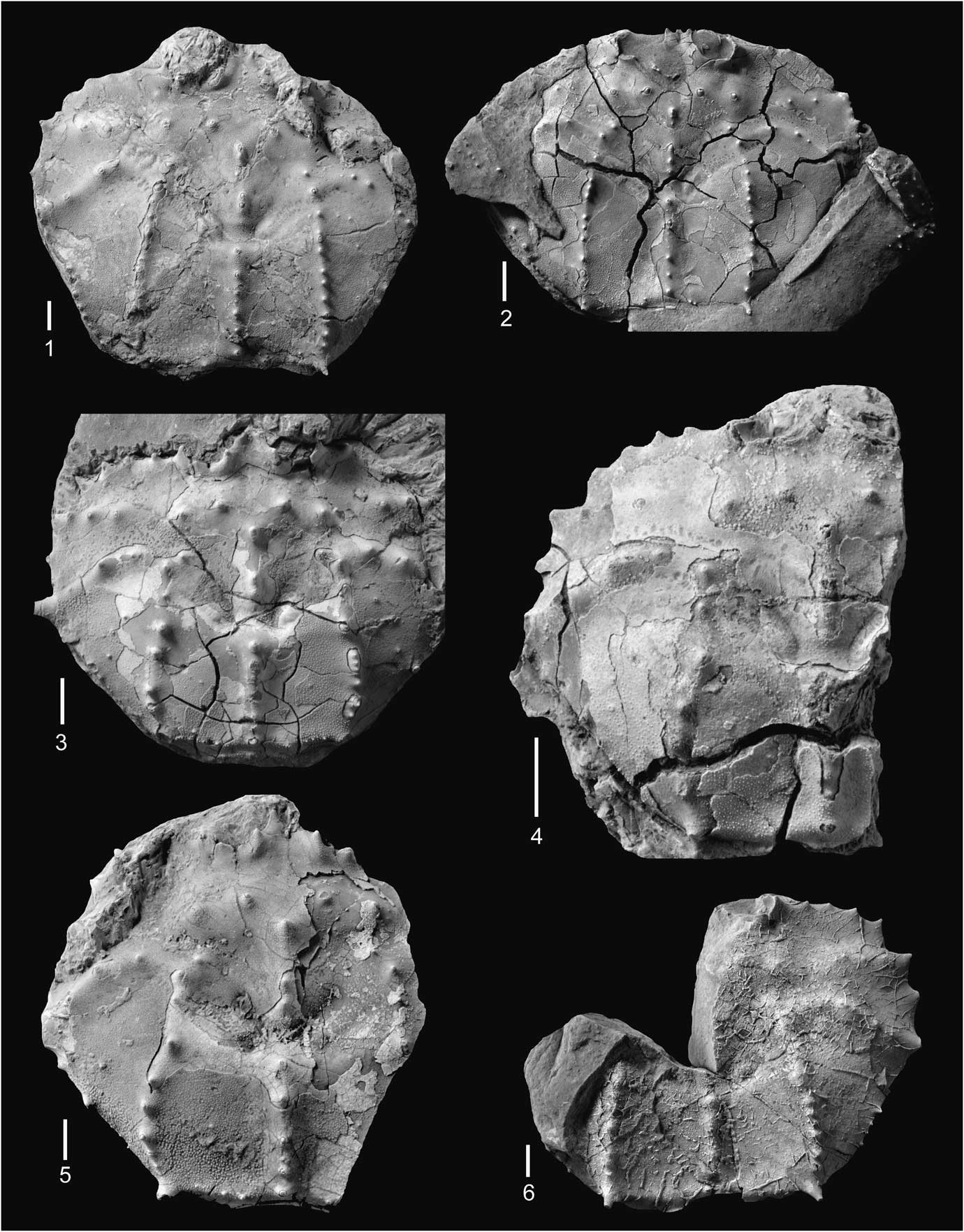
Cenomanocarcinus oklahomensis (Rathbun, Reference Rathbun1935). (1) USNM 558986, dorsal carapace; (2) USNM 558987, dorsal carapace with well-preserved orbits; (3) USNM 558983, dorsal carapace with well-preserved rostrum and anterolateral margins; (4) USNM 558988, partial dorsal carapace; (5) USNM 558990, dorsal carapace with well-preserved rostrum and orbits; (6) USNM 558985, partial dorsal carapace with well-preserved lateral margins. Scale bars represent 5 mm.

1935 Necrocarcinus oklahomensis Reference RathbunRathbun, p. 44, pl. 11, fig. 9.
1936 Cenomanocarcinus oklahomensis; Reference Van StraelenVan Straelen, p. 39.
2003 Cenomanocarcinus oklahomensis; Schweitzer et al., p. 36.
2008 Cenomanocarcinus oklahomensis; Reference Guinot, Vega and Van BakelGuinot, Vega, and Van Bakel, p. 685.
2010 Cenomanocarcinus oklahomensis; Reference Schweitzer, Feldmann, Garassino, Karasawa and SchweigertSchweitzer et al., p. 70.
2012 Cenomanocarcinus oklahomensis; Reference Van Bakel, Guinot, Artal, Fraaije and JagtVan Bakel et al., p. 203.
2013a Cenomanocarcinus oklahomensis; Reference FranţescuFranţescu, p. 269.
2014 Cenomanocarcinus oklahomensis; Reference Karasawa, Schweitzer, Feldmann and LuqueKarasawa et al., p. 232.
2016a Cenomanocarcinus oklahomensis; Schweitzer et al., Appendix 2.
Description of material
Carapace sub-circular or sub-hexagonal, finely granular, slightly wider than long, moderately vaulted longitudinally and transversely with seven spiny ridges radiating from gastric region. Rostrum triangular, short, axially sulcate, bearing five spines. Orbits circular, pointing upward and forward, with two orbital fissures, well-developed outer orbital spine. Anterolateral margin rounded, bearing four rounded spines; lateral margins gently curved, bearing three spines, posterior one largest; posterolateral margins arched, bearing small spines; posterolateral angle marked by prominent round spine; posterior margin gently concave, thinly rimmed.
Cervical groove moderately to well defined axially, less developed laterally, strongly arched, shallow, broad, crosses axis about mid-length; branchiocardiac groove not defined.
Protogastric regions wider than long, gently elevated, bearing two round spines; mesogastric and metagastric regions not differentiated, gently elevated, bearing two to four spines; urogastric and cardiac regions not differentiated, gently elevated, bearing 4 to 10 rounded spines and spinules; spines and spinules of the gastric and cardiac regions form elevated median ridge with 4 to 14 spines and spinules; hepatic regions defined by short, raised ridge armed with two to four spines; epibranchial regions defined by raised ridge bearing two to four spines; metabranchial regions defined by raised ridges bearing 6 to 11 spines. On a single specimen, the remainder of pereiopods bear longitudinal rows of spines.
Materials
USNM 558982 to USNM 558990.
Occurrence
Britton Formation, Eagle Ford Group, Late Cretaceous (Turonian), Garza-Little Elm Reservoir, 33°03'28.2''N, 96°54'12.7''W, Denton, Texas. This is Bishop locality, GAB 18.
Remarks
Rathbun (Reference Rathbun1935) described and figured Cenomanocarcinus oklahomensis as Necrocarcinus based on a single specimen from Bryan County, Oklahoma in the Marietta Formation, today called the Weno Formation. The term Marietta Formation as a Lower Cretaceous formation in Oklahoma was abandoned in place of the Weno Formation in recognition that the term Marietta Formation was preoccupied by a unit in Ohio, Pennsylvania, and West Virgina (Branson, Reference Branson1957). A decade later Stenzel (Reference Stenzel1945) described and figured Cenomanocarcinus vanstraeleni based on nine specimens from the Britton Formation. In the remarks, Stenzel compared C. vanstraeleni against C. oklahomensis and separated the two species based on the number of spines on the hepatic, branchial, cardiac, and intestinal regions, with C. vanstraeleni consistently having more spines than C. oklahomensis. The difference in the number of spines between the two species is actually quite small, anywhere between one and three spines more on C. vanstraeleni than on C. oklahomensis. One of the specimens described herein (Fig. 2.3) has seven spines on the left meso-metabranchial ridge, and on the right meso-metabranchial ridge has 11 spines, suggesting that the number of spines on these ridges is variable on a single individual, thus making them unreliable characters in species differentiation. The single specimen of C. oklahomensis described from the Albian Weno Formation is smaller, and older, than the specimens of C. vanstraeleni described from the Turonian Britton Formation, which are larger. The nine specimens described herein have been collected from the Turonian Britton Formation, and they range in size considerably. The three smaller specimens present an intermediate number of spines between C. vanstraeleni and C. oklahomensis as follows: the hepatic regions have three spines, the same as C. vanstraeleni; the epibranchial regions have three spines, unlike two as in C. oklahomensis and four as in C. vanstraeleni; the meso-metabranchial ridge has 7 to 11 spines, whereas in C. oklahomensis there are eight, and C. vanstraeleni has 10.
The size and number of spine variations observed in the nine specimens described herein and the published specimens of Cenomanocarcinus oklahomensis and C. vanstraeleni are different, to be sure; however, whether the differences offer enough morphological evidence to warrant the synonymy of C. vanstraeleni as a junior synonym of C. oklahomensis is debatable. The variation between the two species may be explained by ontogenetic variations with the morphological form of C. vanstraeleni being a more advanced ontogenetic state of C. oklahomensis, but given the differences in size and the considerable difference in stratigraphic position, a more thorough study of the relationships is necessary. For the present, we adopt the more conservative view of retaining the two as separate species. This view was echoed by Vega et al. (Reference Vega, Nyborg, Kovalchuk, Etayo, Luque, Rojas-Briceño, Patarroyo, Porras-Múzquiz, Armstrong, Bermúdez and Garibay2010, p. 272), noting the problems of camparison attendant with differences in preservation.
Family Orithopsidae Schweitzer et al., Reference Schweitzer, Feldmann, Fam, Hessin, Hetrick, Nyborg and Ross2003
Included genera
Aetocarcinus Schweitzer et al., Reference Schweitzer, Feldmann, Rader and Franţescu2016a; Bellcarcinus Luque, Reference Luque2014; Cherpiocarcinus Marangon and De Angeli, Reference Marangon and De Angeli1997; Colombicarcinus Karasawa et al., Reference Karasawa, Schweitzer, Feldmann and Luque2014; Cristella Collins and Rasmussen, Reference Collins and Rasmussen1992; Marycarcinus Schweitzer et al., Reference Schweitzer, Feldmann, Fam, Hessin, Hetrick, Nyborg and Ross2003; Orithopsis Carter, Reference Carter1872; Paradoxilissopsa Schweitzer, Dworschak, and Martin, Reference Schweitzer, Dworschak and Martin2011 (=Lissopsis Frič and Kafka, Reference Frič and Kafka1887); Paradoxicarcinus Schweitzer et al., Reference Schweitzer, Feldmann, Fam, Hessin, Hetrick, Nyborg and Ross2003; Planocarcinus Luque et al., 2012; Shazella Collins and Williams, Reference Collins and Williams2004; Silvacarcinus Collins and Smith, Reference Collins and Smith1992; Texicancer n. gen. herein.
Remarks
Colombicarcinus, Cristella, Planocarcinus, and Shazella were previously referred to Necrocarcinidae (Karasawa et al., Reference Karasawa, Schweitzer, Feldmann and Luque2014); however, a phylogenetic analysis of the Necrocarcinoidea (Schweitzer et al., Reference Schweitzer, Karasawa, Luque and Feldmann2016b) confirms their placement within Orithopsidae.
Genus Texicancer new genus
Texicancer n. gen. Franţescu, Reference Franţescu2013a, p. 271, unpublished Ph.D. dissertation.
Type species
Necrocarcinus renfroae Stenzel, Reference Stenzel1945, by original designation.
Diagnosis
Carapace hexagonal, wider than long, widest at position of last anterolateral spine; moderately vaulted transversely and longitudinally; fronto-orbital width approximately 60% of maximum width; regions weakly defined; protogastric regions with small nodes; branchial regions with longitudinal ridge; axial regions with longitudinal ridge.
Etymology
Franţescu (Reference Franţescu2013a) erected the name in an unpublished dissertation, recognizing the state from which the holotype and subsequent material were collected—Texas. We formally propose the name herein.
Material examined
Necrocarcinus renfroae, BEG 21093, holotype; BEG 21094; TMM NPL 69681-69682; cast of holotype of Hasaracancer cristatus Jux, Reference Jux1971, numbered KSU D 560 taken from BSP 1988 III 147.
Remarks
Texicancer renfroae (Stenzel, Reference Stenzel1945) as Necrocarcinus had been arguably moved to Cenomanocarcinus by Bishop (Reference Bishop1986). Van Bakel et al. (Reference Van Bakel, Guinot, Artal, Fraaije and Jagt2012) assigned Necrocarcinus renfroae to Hasaracancer without further details. We examined the holotype of Necrocarcinus renfroae, a paratype, two specimens from the Glen Rose Formation (Schweitzer et al., Reference Schweitzer, Feldmann, Rader and Franţescu2016a), and 12 specimens collected from the Fort Worth area and compared them to a cast of the type specimen of Hasaracancer cristatus Jux, Reference Jux1971. We concluded that N. renfroae is markedly different from Necrocarcinus, Cenomanocarcinus, and Hasaracancer, and it is therefore removed to a new genus, Texicancer. Texicancer n. gen. has a less vaulted carapace than Hasaracancer; the branchial ridges in Hasaracancer diverge posteriorly, whereas in Texicancer n. gen. the ridges are parallel. The epibranchial region of Hasaracancer has an extra ridge that is short and diagonal to the axis, whereas in Texicancer n. gen. these secondary ridges on the epibranchial region are absent. Comparison of the Texas specimens with H. merijaensis Ossó-Morales, Artal, and Vega, from the Campanian of Morocco, further confirms that the specimens referred to T. renfroae cannot be assigned to Hasaracancer. Hasaracancer merijaensis has a deep cervical groove that curves around the gastric regions, divergent branchial ridges, and a rounded posterior margin terminating in an axial spine. In fact, the shape of its posterior margin calls into question whether H. merijaensis is referrable to Hasaracancer. Much more work is required to resolve that issue and, for now, the species will be retained in Hasaracancer.
Upon comparing the length-width ratios of the specimens described herein against the length-width ratios published for Orithopsidae (Schweitzer et al., Reference Schweitzer, Feldmann, Fam, Hessin, Hetrick, Nyborg and Ross2003), it has been concluded that specimens described herein fall within the range described for Orithopsidae. Specimens from the Pawpaw Formation exhibit a sternum that is consistent with Orithopsidae. Finally, a cladistic analysis of Necrocarcinoidea (Schweitzer et al., Reference Schweitzer, Karasawa, Luque and Feldmann2016b) secures this placement; thus, Necrocarcinus renfroae, now Texicancer renfroae, is placed within Orithopsidae.
The new genus Texicancer is warranted based on the strikingly different ornamentation of frontal and anterolateral margins of all other genera within Orithopsidae, which are characterized by long, strong, sharp spines, whereas Texicancer n. gen. has greatly reduced spines on the frontal and anterolateral margins. Furthermore, Texicancer n. gen. lacks the prominent nodes on the anterior half of the carapace, present in Marycarcinus, and the axial ridge of Texicancer n. gen. is much better defined than the axial ridge of Marycarcinus. The axial and branchial ridges of Texicancer n. gen. are much better developed than the axial and branchial ridges of Cherpiocarcinus. Other genera of Orithopsidae bear branchial and axial ridges that are substantially broader that those of Texicancer which definitively separates the new genus from others within the family.
Texicancer renfroae (Stenzel, Reference Stenzel1945) new combination
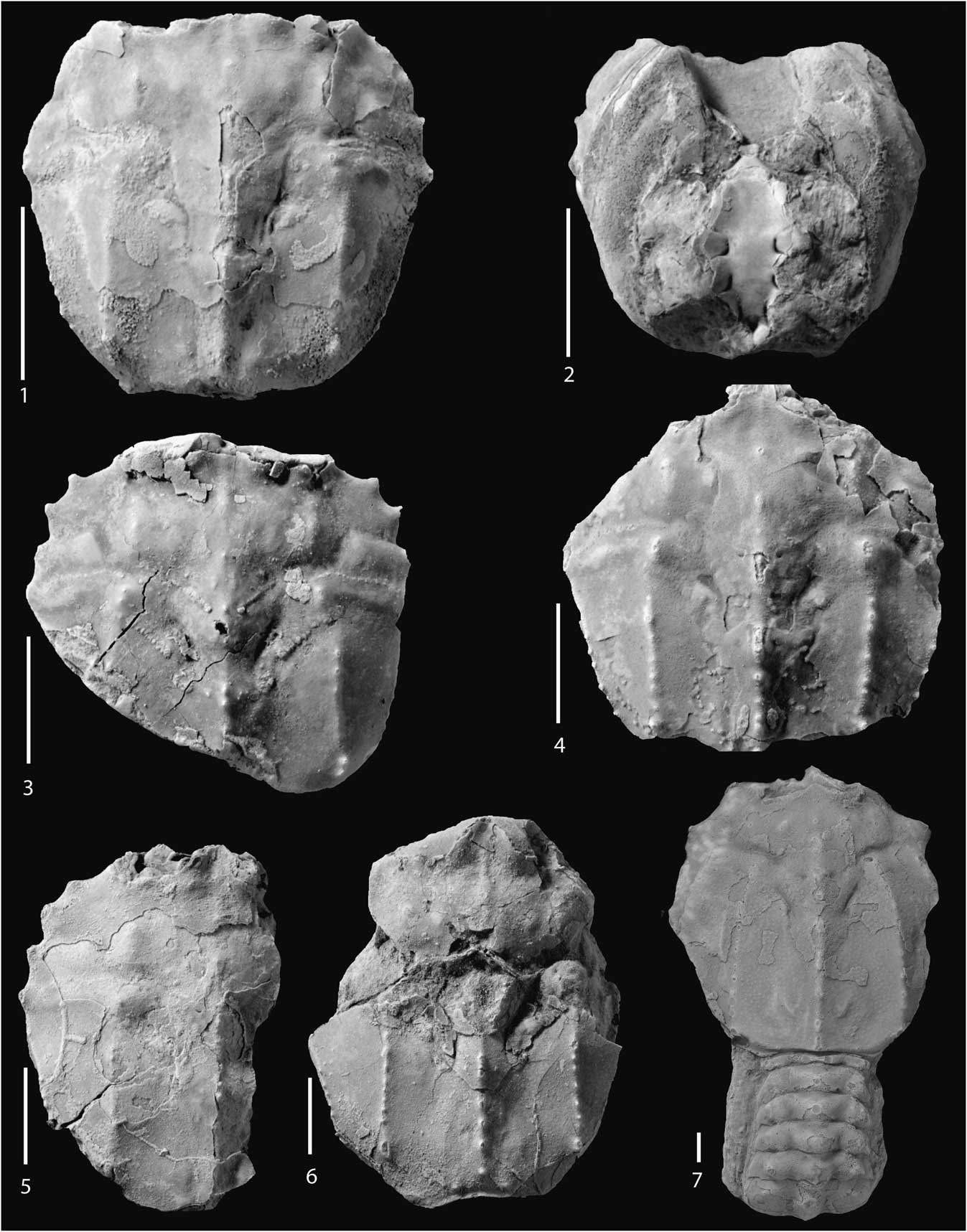
(1–6) Texicancer renfroae (Stenzel, Reference Stenzel1945). (1) USNM 558998, dorsal carapace with well-preserved axial and branchial keels; (2) USNM 558992, ventral view of sternum; (3) USNM 558993, with well-developed anterolateral spines; (4) USNM 598997, preserving granular ornamentation on keels and posterolateral margins; (5) USNM 558991, partial dorsal carapace with well-preserved orbit; (6) USNM 559001, partial dorsal carapace with rostrum and well-preserved posterior margin; (7) Hasaracancer cristatus Jux, Reference Jux1971, cast of holotype BSP 1988 III 147 numbered KSU D 560. Scale bars represent 5 mm.

1945 Necrocarcinus renfroae Reference StenzelStenzel, p. 443, pl. 41, fig. 13.
1968 Necrocarcinus renfroae; Reference FörsterFörster, p. 176.
1986 Cenomanocarcinus renfroae; Reference BishopBishop, p. 123.
2003 Cenomanocarcinus renfroae; Reference Schweitzer, Feldmann, Fam, Hessin, Hetrick, Nyborg and RossSchweitzer et al., p. 36.
2008 “Necrocarcinus” renfroae; Reference Guinot, Vega and Van BakelGuinot et al., p. 698, fig. 8A–D.
2010 Cenomanocarcinus renfroae; Reference Vega, Nyborg, Kovalchuk, Etayo, Luque, Rojas-Briceño, Patarroyo, Porras-Múzquiz, Armstrong, Bermúdez and GaribayVega et al., p. 272, fig. 8.6–8.12.
2010 Cenomanocarcinus renfroae; Reference Schweitzer, Feldmann, Garassino, Karasawa and SchweigertSchweitzer et al., p. 70
2012 Hasaracancer renfroae; Reference Van Bakel, Guinot, Artal, Fraaije and JagtVan Bakel et al., p. 58.
2014 Cenomanocarcinus renfroae; Reference Karasawa, Schweitzer, Feldmann and LuqueKarasawa et al., p. 17.
2015 ?Hasaracancer renfroae; Reference Ossó, Jackson and VegaOssó, Jackson, and Vega, table 1, p. 233.
2016a Cenomanocarcinus renfroae; Reference Schweitzer, Feldmann, Rader and FranţescuSchweitzer et al., p. 12, fig. 8.3, 8.4.
2016b Necrocarcinus renfroae; Reference Schweitzer, Karasawa, Luque and FeldmannSchweitzer et al., p. 355.
Diagnosis
As for genus.
Description
Carapace poorly to well preserved, hexagonal, finely punctuate, moderately vaulted longitudinally and transversely. Rostrum partly preserved, appears triangular, axially sulcate; orbits partly preserved, oval, directed anteriorly and upward, with two fissures; anterolateral margin arched, bearing four large spines; posterolateral margin gently arched, with thin ridge bearing six spinules concentrated at the posterior end; posterior margin gently concave, thinly rimmed.
Cervical groove well defined, shallow, broad, highly convoluted; branchial groove poorly defined laterally as shallow depressions.
Epigastric region small, rounded, bearing a single low node; protogastric regions, weakly inflated, bearing two low nodes each; mesogastric and metagasrtic regions not differentiated bearing axial row of low, elongated, nodes; cardiac and intestinal regions not differentiated, cardiac region more inflated than intestinal region, bearing axial row of low, elongated nodes; nodes on gastric, cardiac, and intestinal regions form an axial ridge; hepatic regions as shallow depression; epibranchial regions well defined, gently elevated; metabranchial regions well defined, bearing longitudinal ridge with low nodes; subhepatic regions well defined, inflated, bearing single, arched, smooth ridge.
Sternum partly preserved, narrow; sternites 1–3 fused, small, diamond shaped, bearing one large axial node anteriorly, and two smaller posterolateral nodes; sternite 4 largest, axially depressed, episternal projections partly preserved, appear short, rounded; sternites five and six become progressively smaller, sternites 3–6 partly fused; sternite 7 not fused, partly exposed, coxae of pereiopods four close over sternite 7, touching each other over sternum; sternite 8 obscured. Reminder of maxilliped 3 appears long and slender, blade like; coxae of pereiopods 4–8 exposed in cross-section, diameter of coxae 7 smaller than 4–6, diameter of coxae 8 much smaller than other coxae.
Referred materials
USNM 558991 to USNM 559002.
Occurrence
Pawpaw Shale, Washita Group, Early Cretaceous (Albian), Fort Worth, Texas.
Family Necrocarcinidae Förster, Reference Förster1968
Genus Elektrocarcinus Schweitzer et al., 2016b
Type species
Necrocarcinus pierrensis Rathbun, 1917, by original designation.
Other species
See Schweitzer et al. (Reference Schweitzer, Karasawa, Luque and Feldmann2016b).
Diagnosis
See Schweitzer et al. (Reference Schweitzer, Karasawa, Luque and Feldmann2016b).
Elektrocarcinus texensis (Rathbun, Reference Rathbun1935)
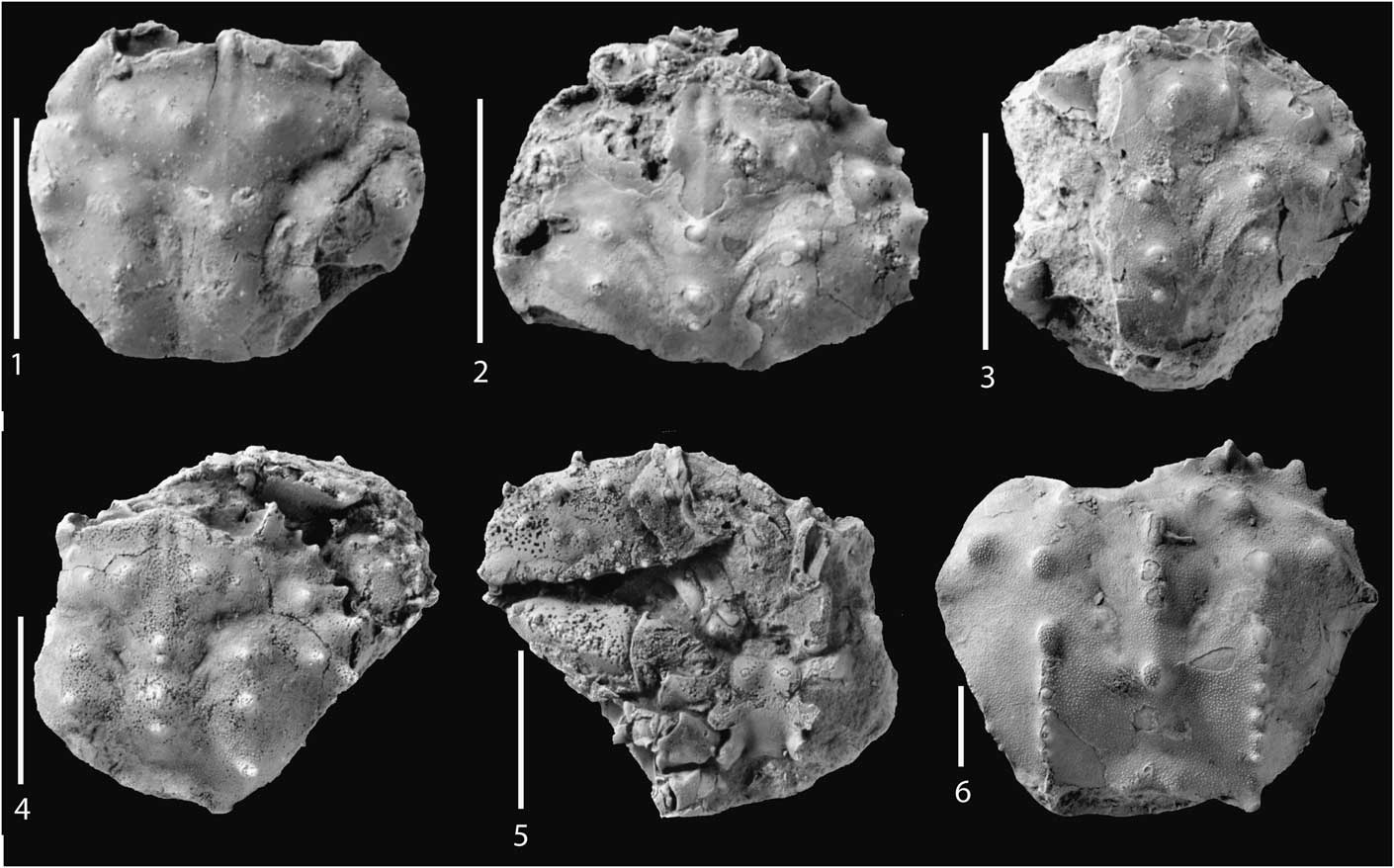
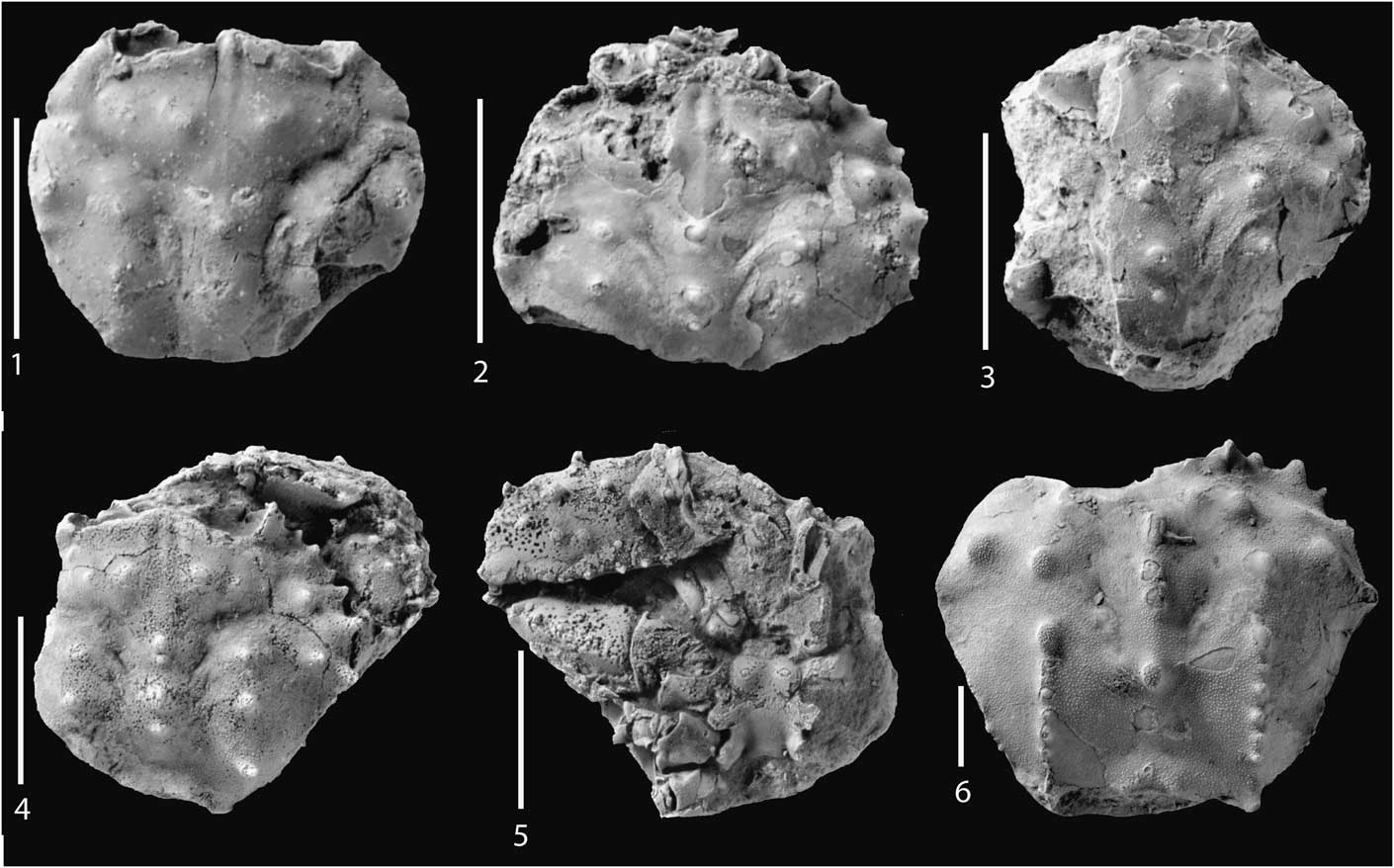
(1-6) Necrocarcinus texensis Rathbun, Reference Rathbun1935. (1) USNM 559015, dorsal carapace with complete fronto-orbital width; (2) USNM 559016, dorsal carapace with well-preserved right anterolateral margin; (3) USNM 559017, dorsal carapace with large tubercles; (4, 5) USNM 559010, dorsal carapace with right orbit and chelipeds (4) and sternum (5); (6) USNM 559008, nearly complete dorsal carapace. Scale bars represent 5 mm.
1935 Necrocarcinus texensis Reference RathbunRathbun, p. 45, pl. 11, figs. 20–22.
1945 Necrocarcinus texensis; Reference StenzelStenzel, p. 441.
1968 Necrocarcinus texensis; Reference FörsterFörster, p. 175.
2003 Necrocarcinus texensis; Reference Schweitzer, Feldmann, Fam, Hessin, Hetrick, Nyborg and RossSchweitzer et al., p. 34.
2010 Necrocarcinus texensis; Reference Schweitzer, Feldmann, Garassino, Karasawa and SchweigertSchweitzer et al., p. 81.
2012 Necrocarcinus texensis; Reference Van Bakel, Guinot, Artal, Fraaije and JagtVan Bakel et al., p. 204.
2014 Necrocarcinus texensis; Reference Karasawa, Schweitzer, Feldmann and LuqueKarasawa et al., p. 234.
2016b Elektrocarcinus texensis (Rathbun, Reference Rathbun1935); Schweitzer et al., p. 354, fig. 6B–F.
Description of material
Carapace sub-hexagonal, moderately vaulted longitudinally and transverse, finely punctuate. Rostrum poorly preserved, triangular, axially sulcate, tip broken transversely; orbits ovoid, transverse, directed forward, pointing upward, with two orbital fissures and strong triangular outer orbital spine; anterolateral margin arched, bearing five rounded, sharp spines; posterolateral margin straight, with two anterior spines, remainder smooth; posterior margin gently concave, thinly rimmed.
Cervical groove well defined, shallow, broad, highly sinous. Epigastric region defined by small axial, gently raised process; protogastric regions well defined, inflated, bearing two sharp, rounded spines, inner spine largest; mesogastric and metagastric regions not differentiated, small, circular, bearing single large, sharp, rounded spine; cardiac region well defined, rounded, inflated, bearing two, sharp, rounded spines, anterior spine larger; intestinal region defined as shallow depression; hepatic regions small, weakly depressed; epibranchial regions well defined, bearing two sharp, rounded spines; metabranchial regions well defined, axially inflated, bearing three to five spines in a longitudinal row, decreasing in size posteriorly.
Remainder of first, right pereiopod large for size of individual, bearing longitudinal, parallel rows of sharp spines, smaller on inner surfaces; remainder of third maxillipeds appear long, slender, unarmed; sternum partly preserved, sternite 3 subrectangular, axially sulcate, bearing two large, low posterolateral nodes; sternite 4 large, axially flat, with large raised triangular episternal projections directed posterolaterally.
Referred materials
USNM 559007 to USNM 559017.
Occurrence
Pawpaw Shale, Washita Group, Early Cretaceous (Albian), Fort Worth, Texas.
Remarks
The specimens described herein are in a moderate to poor state of preservation, on the smaller specimens the ornamentations is sharper, and on the larger ones the ornamentation is more subdued. Elektrocarcinus texensis individuals are easily recognizable by having their dorsal spines arranged in longitudinal, parallel rows, and the smoothly depressed intestinal region.
Superfamily Palaeocorystoidea Lőrenthey in Lőrenthey and Beurlen, Reference Lőrenthey and Beurlen1929
Family Palaeocorystidae Lőrenthey in Lőrenthey and Beurlen, Reference Lőrenthey and Beurlen1929
Included genera
Alessandranina Karasawa et al., Reference Karasawa, Schweitzer, Feldmann and Luque2014; Cenocorystes Collins and Breton, Reference Collins and Breton2009; Cretacoranina Mertin, Reference Mertin1941; Eucorystes, Bell, Reference Bell1863; Ferroranina Van Bakel et al., Reference Van Bakel, Guinot, Artal, Fraaije and Jagt2012; Joeranina Van Bakel et al., Reference Van Bakel, Guinot, Artal, Fraaije and Jagt2012; Notopocorystes M’Coy, Reference M’Coy1849 (=Palaeocorystes Bell, Reference Bell1863); Planocorystes new genus.
Remarks
For generic descriptions and diagnoses, see Van Bakel et al. (Reference Van Bakel, Guinot, Artal, Fraaije and Jagt2012) and Karasawa et al. (Reference Karasawa, Schweitzer, Feldmann and Luque2014).
Genus Ferroranina Van Bakel et al., Reference Van Bakel, Guinot, Artal, Fraaije and Jagt2012
Type species
Notopocorystes dichrous Stenzel, Reference Stenzel1945, by original designation of Van Bakel et al. (Reference Van Bakel, Guinot, Artal, Fraaije and Jagt2012).
Other species
Ferroranina australis (Secretan, Reference Secretan1964) as Notopocorystes; F. tamilnadu Van Bakel et al., Reference Van Bakel, Guinot, Artal, Fraaije and Jagt2012.
Diagnosis
See Van Bakel et al. (Reference Van Bakel, Guinot, Artal, Fraaije and Jagt2012) and Karasawa et al. (Reference Karasawa, Schweitzer, Feldmann and Luque2014).
Ferroranina dichrous (Stenzel, Reference Stenzel1945)
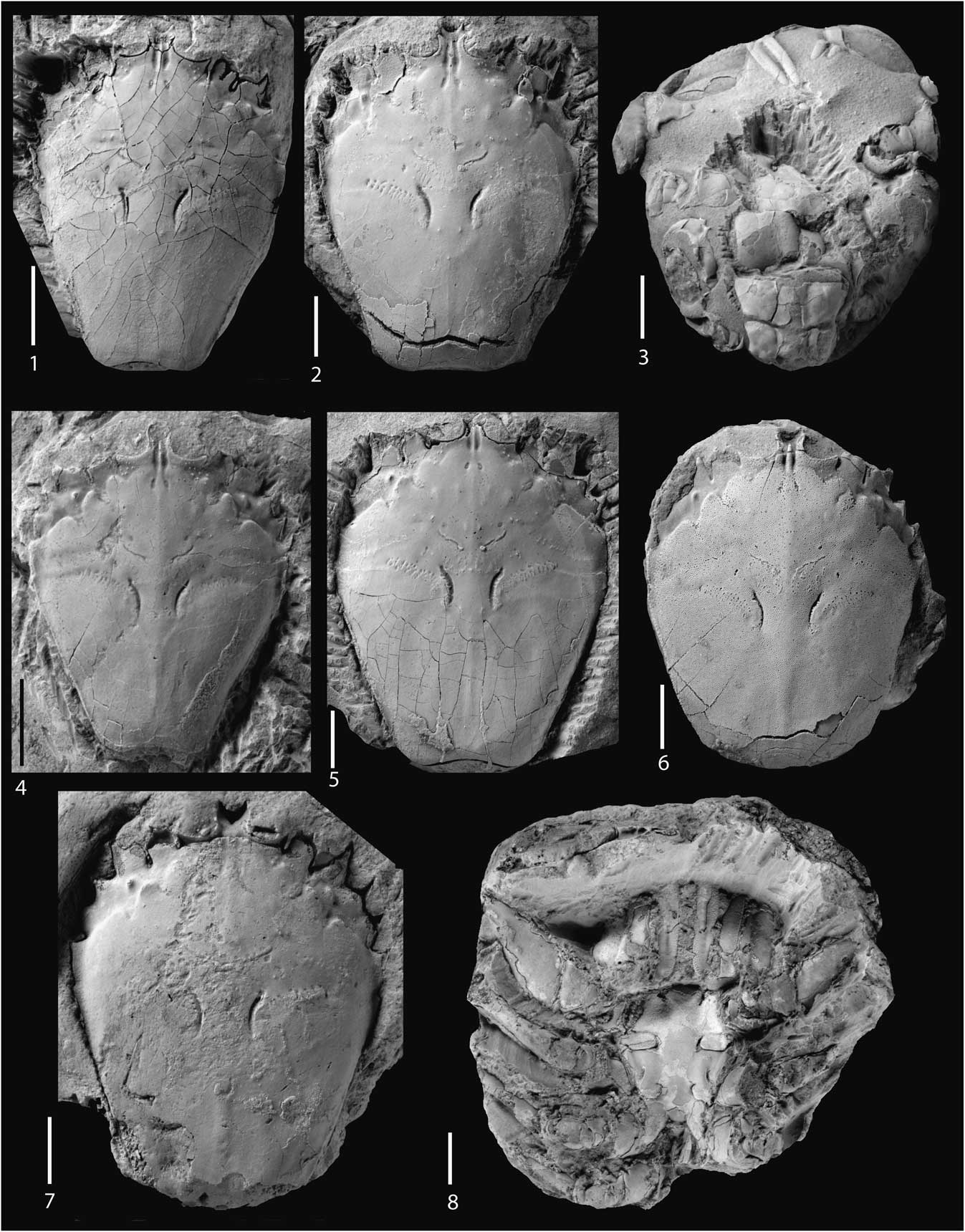
Ferroranina dichrous (Stenzel, Reference Stenzel1945). (1) USNM 559020, dorsal carapace with well-preserved right orbital spines; (2) USNM 559024, dorsal carapace with well-preserved rostrum and right anterolateral spines; (3) USNM 559027, female pleon; (4) USNM 559029, dorsal carapace with well-preserved ornamentation; (5) USNM 559021, dorsal carapace with well-preserved muscle scars; (6) USNM 559022, dorsal carapace with well-preserved post-frontal terraces; (7, 8) USNM 559025, dorsal surface (7) and sternum (8). Scale bars represent 5 mm.

1945 Notopocorystes dichrous Reference StenzelStenzel, p. 438, pl. 43, figs. 5–7.
1964 Notopocorystes dichrous; Reference SecretanSecretan, p. 161, fig. 92.
1983 Notopocorystes (Cretacoranina) dichrous; Reference BishopBishop, p. 907.
1992 Notopocorystes dichrous; Reference Bishop, Brannen, Hill, Meyer, Pike and SampsonBishop et al., p. 414, figs. 6, 7.
1998 Cretacoranina dichrous; Reference TuckerTucker, p. 334.
2002 Cretacoranina dichrous; Reference Haj and FeldmannHaj and Feldmann, p. 478, fig. 9.1.
2007 Cretacoranina sp. cf. C. dichrous; Reference Vega, Nyborg, Rojas-Briceño, Patarroyo, Luque, Porras-Múzquiz and StinnesbeckVega et al., p. 418, figs. 9.6–9.8.
2008 Cretacoranina dichrous; Reference Guinot, Vega and Van BakelGuinot, Vega, and Van Bakel, p. 712, fig. 9c.
2010 Cretacoranina dichrous; Reference Schweitzer, Feldmann, Garassino, Karasawa and SchweigertSchweitzer et al., p. 76.
2012 Ferroranina dichrous; Reference Van Bakel, Guinot, Artal, Fraaije and JagtVan Bakel et al., p. 29, figs. 7, 8.
2014 Ferroranina dichrous; Reference Karasawa, Schweitzer, Feldmann and LuqueKarasawa et al., p. 241.
Description
Carapace elongated, sub-hexagonal, weakly arched transversally, flattened longitudinally; cuticle, when present, finely granular; rostrum rectangular, bifid, with two lateral spines, depressed, and with axial ridge bounded by deep grooves extending shortly onto carapace; orbits wide with two narrow, deep fissures, upper orbital margin with four rounded spines, outer orbital spine largest, extending to the level of lateral spines on rostrum; anterolateral margins with three round, elongated spines directed anterolaterally and dorsally; posterolateral margins longer than anterolateral margins, straight, and with small anterior spine, with thin, granular rim; posterior margin weakly concave, with thin, smooth rim.
Cervical groove weakly defined medially, as two narrow, shallow segments, converging posteriorly; branchiocardiac groove moderately well defined as arched segments only lateral of cardiac region. Carapace regions not differentiated, epigastric region with two small, shallow pits; hepatic region depressed, with small, blunt tubercle. Post-frontal terrace divided into four broad, rounded lobes by wide sulci.
Pleon narrow, long, with longitudinal, broad, smooth, axial ridge, bounded by shallow grooves, pleonal somite 1 narrowest. Sternum broad anteriorly, narrows posteriorly, sternites 1 and 2 not exposed, sternite 3 partly exposed, separated from sternite 4 by wide reentrant, sternite 4 trapezoidal, anterior margin much wider than sternite 3, with flat, episternal projections as short rounded, blunt corners; sternite 5 trapezoidal, anterior margin widest point of sternum, steeply drops posteriorly; sternites 6 and 7 progressively narrower, with episternal projections much raised to form a narrow, deep posterior end of sternum; sternite 8 not exposed. Third maxillipeds blade like, long, narrow, axially sulcate, coarser ornamentation on outer margins and distal ends.
Pereiopod 1 largest, chelate, all segments strongly ornamented with spines and ridges; pereiopod 5 smallest, carried sub-dorsally; pereiopod 5 and remainder of pereiopods thin, long, slender, smooth.
Materials
USNM 559018 to USNM 559029. Over 250 specimens, 40 specimens from the Robert Reid collection, and over 200 specimens from the Gale Bishop collection, originally collected by Lloyd Hill, housed at the Department of Geology, Kent State University, all collected from the Garza-Little Elm Creek reservoir spillway, near Denton, Texas, have been examined. Twelve of the specimens have been donated to the USNM.
Occurrence
Britton Formation, Eagle Ford Group, Late Cretaceous (Turonian), Garza-Little Elm Reservoir, Denton, Texas.
Remarks
The specimens described herein have been placed within Ferroranina because the rostral (frontal) furrows slightly extend onto the dorsal carapace; the cervical groove is weakly defined as two independent segments near the axial region; a weak, low, smooth median carina is present; the anterior part of the thoracic sternite 4 is much wider than sternite 3; and the most prominent feature is the presence of the post-frontal terrace. These characters fit well within the diagnosis of Ferroranina.
Following the remarks of Van Bakel et al. (Reference Van Bakel, Guinot, Artal, Fraaije and Jagt2012), Ferroranina dichrous is separated from F. tamilnadu based on the overall size of the carapace, with F. dichrous being smaller. The vaulting of the carapace is also different, as F. dichrous is flatter, and the size and direction of the anterolateral margin spines differs. Ferroranina australis is separated from F. dichrous based on the rostral differences and the number of spines on the anterolateral margin.
Genus Planocorystes new genus
Type species
Planocorystes robreidi, by original designation and monotypy.
Diagnosis
Carapace ovoid, ornamented with fine granules axially, laterally, and bounding cervical groove; median carina extends entire length of carapace; weakly defined cervical and branchiocardiac grooves; carapace regions poorly defined; lacking large nodes on carapace; Anterior margin of sternite 4 much broader than sternites 1–3; sternites 4 and 5 with similar-sized episternal projections; subdistal locking peg on sternite 5 larger than distal peg.
Etymology
The generic name combines the Latin planus=smooth and corystes, a common suffix for genera within Palaeocorystidae. The sex is masculine.
Planocorystes robreidi new species
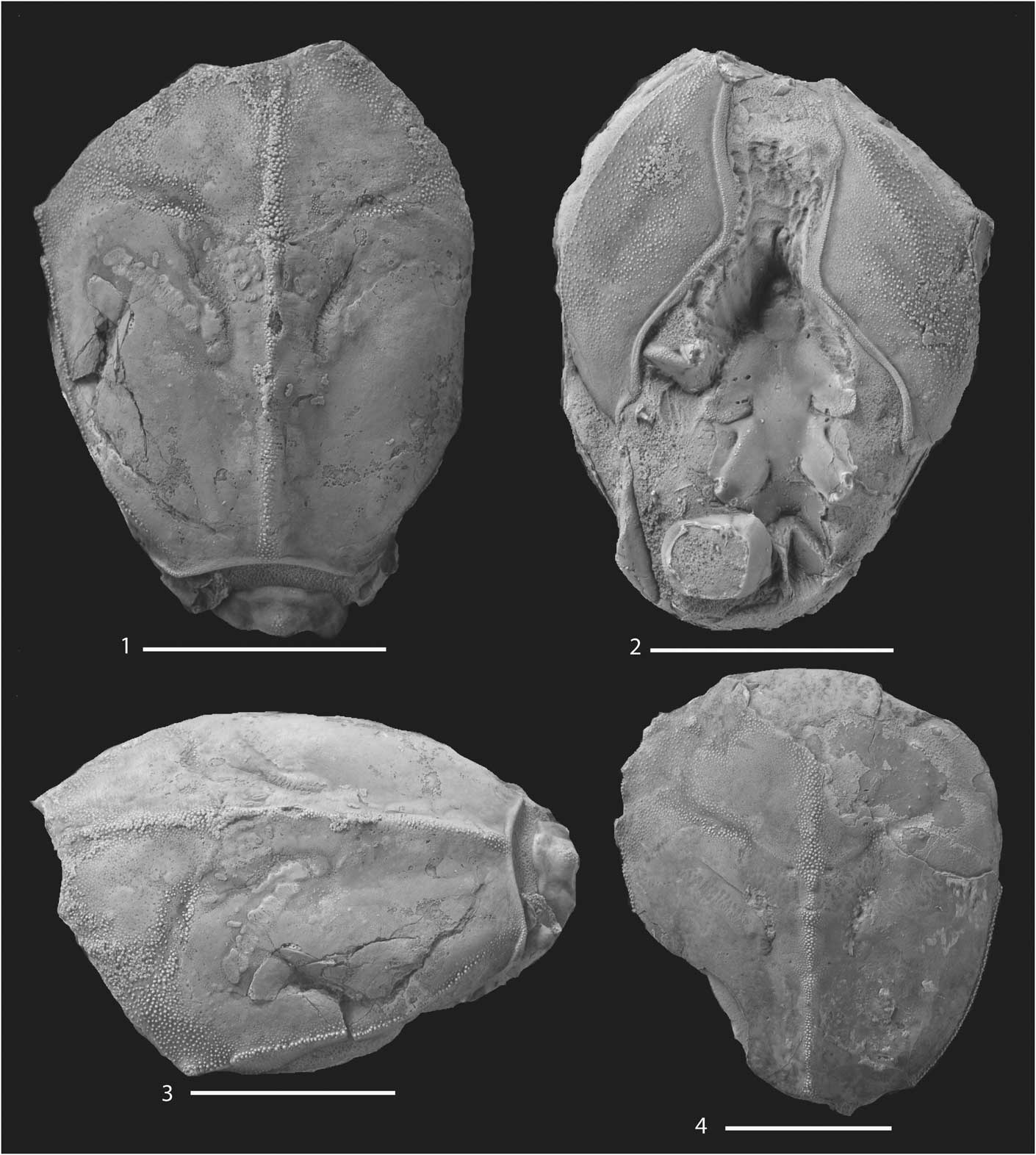
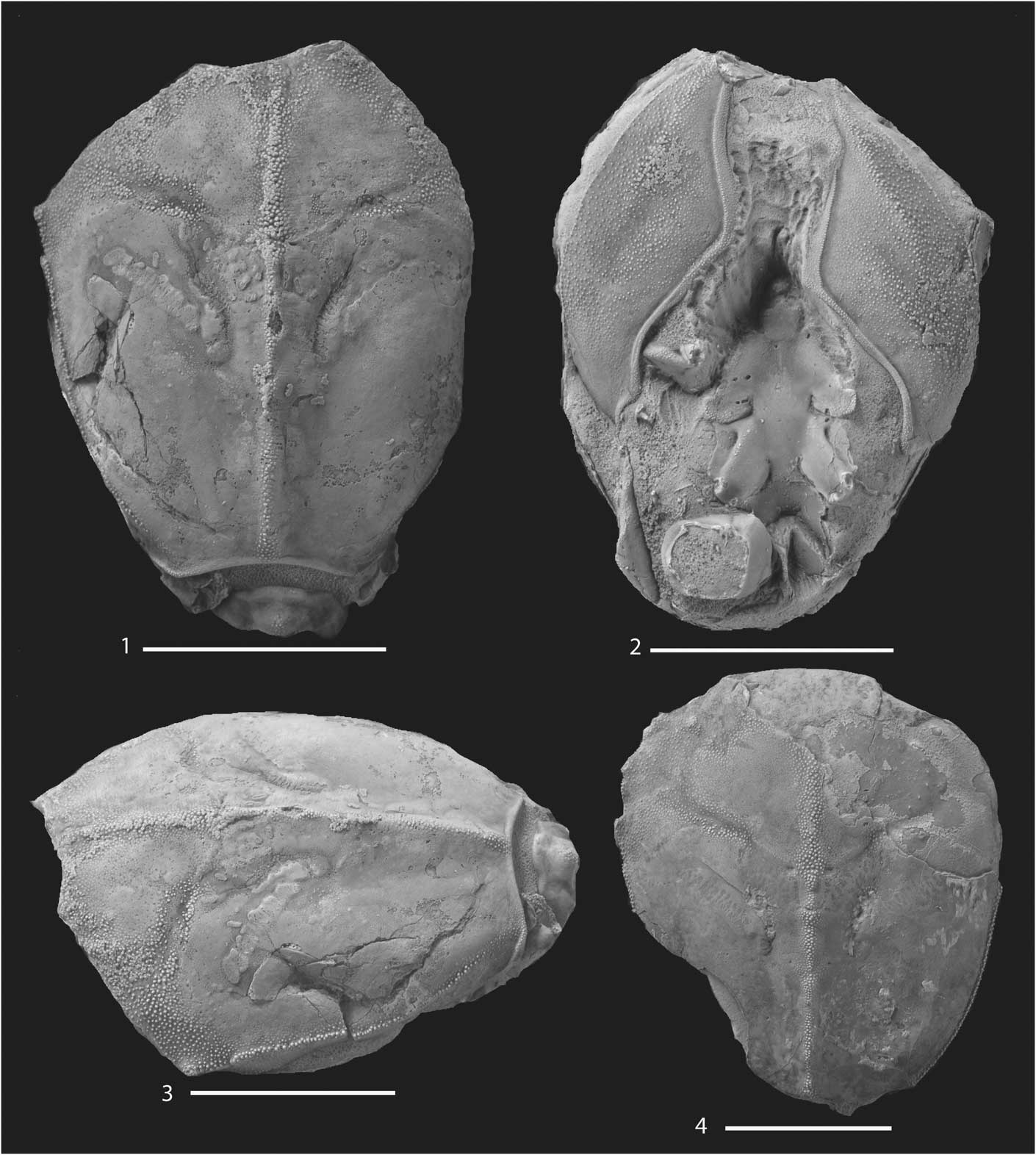
Planocorystes robreidi n. sp. (1–3) USNM 559030, holotype, dorsal carapace with pronounced axial ridge (1), ventral surface including sternum (2), and puncture wound on left branchial area (3); (4) USNM 559032, paratype, dorsal carapace showing ornamentation. Scale bars represent 10 mm.
Diagnosis
As for genus.
Description
Carapace ovoid, gently arched longitudinally, moderately arched transversely, ornamented with fine granules on dorsal carina, epigastric region, lateral margins, and bounding lateral extensions of cervical groove. Fronto-orbital margin poorly preserved, estimated to be about 45% maximum carapace width measured at anterolateral corner; frontal margin appears narrower than posterior margin. Anterolateral margin rounded, bearing three to four rounded spines directed anteriorly, posterior-most spine, the epibranchial spine, largest; posterolateral margins rounded, converging posteriorly, with thin, finely granular rim arising at tiny, elongated, granular marginal node posterior to anterolateral corner; post-anterolateral node small, elongated, granular; posterior margin gently concave, with thin, smooth, elevated rim.
Cervical groove moderately well defined, shallow, wide; axial segment concave anteriorly, lateral segments extend anterolaterally to weakly defined hepatic region and curving posterolaterally to margin. Branchiocardiac groove shallow, broad, arcuate, posterior ends become parallel with medial carina, not reaching posterior margin. Longitudinal axial carina entire from posterior margin to anterior margin, of constant width, granular, with low, obscure nodes most prominent posterior to cervical groove.
Carapace regions poorly defined. Mesogastric and protogastric regions undifferentiated. Hepatic region defined only by granular surface. Metagastric region broad, narrowing posteriorly to straight sided urogastric region, both defined laterally by branchiocardiac region. Cardiac region subtle, rectangular. Branchial regions undifferentiated except by granular surface on epibranchial region.
First pleonal somite narrower than posterior margin, axially elevated with small node posteriorly. Pleura smooth, quadrate.
Sternum broad, axially fused. Sternites 1–3 crown shaped, widest near anterior end. Sternite 4 longest sternite, anterior margin much wider than posterior margin of sternites 1–3; axial region smooth, last episternal projections elevated, flabellate, largest posteriorly, with granular mrgin. Sternite 5 with gently arched, smooth axis; episternal projections similar in size to those of sternite 4, with medial keel terminating in large subdistal and smaller distal locking pegs. Sternites 6 and 7 axially smooth, inclined posterodorsally; margins broken.
Etymology
The trivial name honors Robert Reid IV who collected the holotype specimen and made it available for study.
Types
Holotype USNM 559030, and paratype USNM 559032.
Occurrence
Pawpaw Shale, Washita Group, Early Cretaceous (Albian), Fort Worth, Texas.
Remarks
Planocorystes new genus is referred to Palaeocorystidae based upon development of a granular carapace surface with broadly U-shaped axial segment of the cervical groove and lateral segments composed of two straight elements and weakly defined carapace regions. Perhaps most distinctive is the architecture of the sternum in which the margins of the sternum are more or less parallel and the episternal projections of sternites 4 and 5 are nearly equal is size. Presence of subdistal and distal locking pegs on episternite 5 are important features defining the family (Van Bakel et al., Reference Van Bakel, Guinot, Artal, Fraaije and Jagt2012, p. 17). Planocorystes can be readily distinguished from other genera within the family based upon having a fronto-orbital margin that is approximately 45% the maximum carapace width, whereas other genera are characterized by species with broader margins. Although the fronto-orbital width is remeniscent of Raninoidea, it is noteworthy that some species of Palaeocorystoidea have fronto-orbital widths of approximately 50% their total carapace width. That is the case, for example, of Notopocorystes serotinus Wright and Collins, Reference Wright and Collins1972, with an estimated fronto-orbital width of 50% its total width.
The specimens forming the basis for this new genus and species have a sufficient amount of cuticle preserved to characterize the external morphology. Among other things, the cuticle illustrates a pattern of granulation on the surface that is unique. Although granulation is well developed in the described areas, there are other areas, notably the mesogastric, protogastric, and most of the branchial regions that are smooth.
The left branchial region has been severely damaged by what may be a bite mark (Fig. 7.1 and 7.3). A nearly circular puncture with fractures and broken cuticle extending out from the puncture suggests that it may have resulted from a lethal attack by a predator. There is no evidence that any healing occurred so that the animal either survived for a time with the damage or died shortly after the event. Bite marks have been reported in brachyurans previously. Bishop (Reference Bishop1972) reported a crab, Raninella sp., that he interpreted as having been bitten by a fish. In this case, three circular punctures were evident on the carapace of the crab but there was no fracturing involved. This may suggest that there was a considerable difference in the structure of the cuticle in the two animals; Planocorystes robreidi having a much more brittle cuticle than that of Raninella sp. This is conjectural, based upon the assumption that the damage on P. robreidi was, in fact, a bite mark.
Superfamily Raninoidea De Haan, Reference De Haan1839
Family Lyreididae Guinot, Reference Guinot1993
Subfamily Marylyreidinae Van Bakel et al., Reference Van Bakel, Guinot, Artal, Fraaije and Jagt2012
Genus Marylyreidus Van Bakel et al., Reference Van Bakel, Guinot, Artal, Fraaije and Jagt2012
Type species
Notopocorystes punctatus Rathbun, Reference Rathbun1935, by subsequent designation of Van Bakel et al. (Reference Van Bakel, Guinot, Artal, Fraaije and Jagt2012).
Diagnosis
See Van Bakel et al. (Reference Van Bakel, Guinot, Artal, Fraaije and Jagt2012) and Karasawa et al. (Reference Karasawa, Schweitzer, Feldmann and Luque2014).
Marylyreidus punctatus (Rathbun, Reference Rathbun1935)
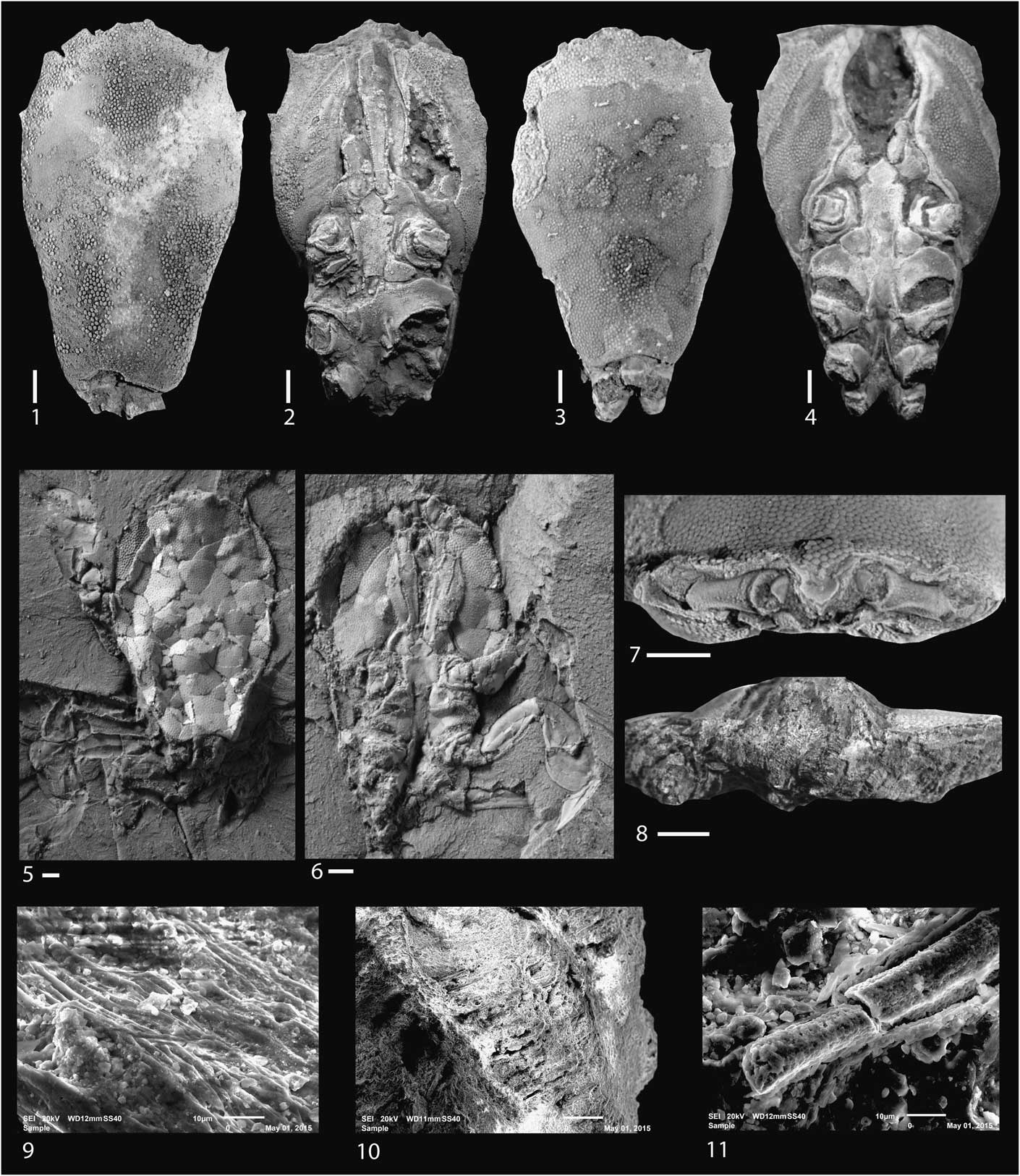
Marylyreidus punctatus (Rathbun, Reference Rathbun1935). (1, 2) USNM 559039, dorsal (1) and ventral (2) views; (3, 4) USNM 559035, dorsal (3) and ventral (4) views; (5) USNM 539041, dorsal view including appendages; (6) USNM 559043, ventral view including appendages; (7) USNM 559038, frontal margin detail showing eyestalks; (8–11) USNM 559037, lateral view showing preserved gills; (9–11) scanning electron microscopy images of gill filaments. Scale bars (1–8) represent 1 mm; scale bars (9–11) represent 1 μm.

1935 Notopocorystes punctatus Reference RathbunRathbun, p. 48, pl. 12, figs. 14–16.
2002 Cretacoranina punctata; Reference Haj and FeldmannHaj and Feldmann, p. 473, figs. 3, 4.1–4.6.
2010 Notopocorystes punctatus; Reference Schweitzer, Feldmann, Garassino, Karasawa and SchweigertSchweitzer et al., p. 77.
2012 Marylyreidus punctatus; Reference Van Bakel, Guinot, Artal, Fraaije and JagtVan Bakel et al., p. 87, figs. 25a–25e.
2014 Marylyreidus punctatus; Reference Karasawa, Schweitzer, Feldmann and LuqueKarasawa et al., p. 255, figs. 14A, B.
Description
Carapace oblong, gently arched longitudinally, moderately arched transversely; width 63% of length, widest anteriorly of midlength; ornamented with small granules; no grooves or regions defined. Rostrum triangular, strongly downturned, axially depressed; fronto-orbital width 85% of maximum width; orbits wide, shallow, with strong outer-orbital spine, upper orbital margin with two wide, rounded orbital fissures, lower orbital margin with single, wide, rounded fissure.
Anterolateral margin, short, smooth; anterolateral angle with single short, stout spine; posterolateral margins gently concave, smooth; posterior margin gently concave. Pterygostome with diagonal, low, wide ridge, coarser ornamentation anteriorly.
Sternites 1 and 2 not exposed; sternite 3 small, chordate shaped, separated from sternite 4 by short, wide reentrants; sternite 4 rectangular, longer than wide, not touching pleurites; sternite 5 longest, widest, episternal projections large, crescent shaped, posterior half of sternite 5 dipping at sharp angle, posterolateral corners raised, creating concavity; sternites 6–8 much narrower, deeply concave, progressively smaller. Pleon long, narrow, with low, smooth median ridge, pleonal somite 1 shortest, posterolateral corners as sharp, triangular spine; pleonal somite 2 rectangular, lateral margins concave, narrowest, posterolateral corners as sharp, triangular spine; pleonal somite 3 rectangular, as long as wide, posterolateral corners as blunt spine; pleonal somites 4–6 trapezoidal, progressively longer, posterolateral corners as rounded, blunt spine; telson small, trapezoidal, distally narrow, with radial pattern of granules and subtle transverse ridge.
Third maxilliped, long, narrow, lanceolate, with fine, anterolaterally directed denticles; first pereiopod largest, chelate; occlusal surface with large, low, rounded dentition, dactylus with single, sharp spine near base; propodus with single sharp spine on upper margin, and two sharp spines on lower margin; carpus cylindrical with longitudinal rows of small spines and tubercles; merus long, cylindrical, with longitudinal rows of small tubercles; pereiopods 2–4 progressively shorter, merus long, slender, with longitudinal rows of small tubercles, and carpus, propodus flatter, wider; dactylus flat, broad, spade shaped, distally sharp; pereiopod five thinnest, with longitudinal rows of small tubercles, carried sub-dorsally.
Referred materials
USNM 559033 to USNM 559046.
Occurrence
Pawpaw Shale, Washita Group, Early Cretaceous (Albian), Fort Worth, Texas.
Remarks
Numerous specimens of Marylyreidus punctatus have been found at various collecting localities, and they exhibit a wide range of preservational styles. Some exhibit original cuticle, whereas some are flattened and replaced by pyrite or hematite. Others are inflated, with pereiopods and pleons articulated. A single specimen has been preserved with gills (Fig. 8.8) in living position. The wide array of preservational styles has made possible a detailed description of the specimens, allowing for a confident placement within M. punctatus.
Conclusions
Cretaceous shales from Texas (Pawpaw and Britton) have a rich decapod fauna with representatives of most of the major decapod taxa. The raninoid-like decapods found in the Fort Worth area represent a large percentage of all the fossil decapods found, and in the Britton Shale raninoid decapods are almost exclusive. These decapod taxa are also highly abundant; nearly every concretion found contains one specimen, with over 250 specimens available for study from four or five fossil localities. After more than eight decades from the first major work on the fossil decapods of northeast Texas, this study has made an update of the raninoid systematics, with the description of a new species, Notopocorystes robreidi n. sp., and a new genus, Texicancer n. gen.
Acknowledgments
We would like to thank R. Reid and C. Sampson for accompanying us in the field, allowing us to study the specimens from their private collections, and for donating them to the U.S. National Museum of Natural History. M. Florence, K. Hollis, and K. Reed at the United States National Museum of Natural History, Smithsonian Institution, provided assistance in researching museum specimens. S. Shelton, South Dakota School of Mines and Technology, Rapid City, South Dakota, arranged access to the G.A. Bishop collection. A. Molineaux, Non-Vertebrate Paleontology Lab, University of Texas at Austin, loaned comparative type material. Helpful reviews by T. Nyborg, Loma Linda University, California, USA, and B. Van Bakel, Oertijdmuseum De Groene Poort, Boxtel, the Netherlands, as well as careful technical editing by J. Hoeg substantially improved the manuscript. Supported in part by NSF grant EF-0531670 to Feldmann and Schweitzer.