INTRODUCTION
The coconut (Cocos nucifera) contributes to the livelihoods of millions of people in the developing world, not only through its production but also through employment generated by the many associated industries. It is the most widespread, economically useful palm of the wet tropics, being found mainly in coastal areas between latitudes 20°N and 20°S of the equator. A great deal of research has been reported on the ecophysiology and water relations of coconut and the adverse effects of water stress on yield are well established. This paper attempts to synthesize this research from an independent perspective and to do this in practically useful ways. It follows the format used in previous reviews in this series, notably those on coffee (Carr, Reference Carr2001), banana (Carr, Reference Carr2009), tea (Carr, Reference Carr2010a; Reference Carr2010b) and sugar cane (Carr and Knox, Reference Carr and Knox2011). It begins with background information on the origin and centres of production of coconut. This is followed by descriptions of the stages of crop development, as influenced by water availability, and then by reviews of plant water relations, crop water use and water productivity, including drought mitigation. Various aspects of this topic have previously been reviewed (e.g. Murray, Reference Murray, Alvim and Kozlowski1977), most recently in a paper by Gomes and Prado (Reference Gomes and Prado2007), which focuses on the physiological responses of coconut to water stress. Emphasis is placed on those publications describing research of international relevance.
CENTRES OF PRODUCTION
Origin
Although there still remains some uncertainty about the coconut's centre of origin (it may be South America), it is generally accepted that the coconut originated in the south-west Pacific or the Indian Ocean and that it became domesticated in Malaysia and on the coasts and islands between Southeast Asia and the western Pacific. It has been present in the Pacific islands (a centre of genetic diversity), where it is an indigenous species, for millions of years, long before their settlement by Polynesians. It is believed that coconut was distributed widely by nuts floating in ocean currents and germinating after they were washed ashore in new locations. In this way it probably reached southern India and Sri Lanka, where the coconut has a recorded history of 2000–3000 years, and possibly Madagascar and eastern Africa. The nuts were probably also carried by humans as a source of food and drink on long sea voyages, reaching West Africa and the Americas about 500 years ago when the coconut became pan-tropical (Harries, Reference Harries1978; Reference Harries, Smart and Simmonds1995; Persley, Reference Persley1992; Purseglove, Reference Purseglove1972).
As already implied, coconut is a crop of the humid tropics. It grows best at altitudes below 1000 m and near the coast where the mean air temperature is in the range 25–29 °C (Persley, Reference Persley1992). In their review paper, Gomes and Prado (Reference Gomes and Prado2007) specify a slightly broader optimum temperature range of 23–34 °C, with the absence of temperatures below 15 °C, and a relative humidity between 60 and 90%. Annual rainfall should exceed 1500 mm, preferably evenly distributed throughout the year. Coconut palms can be grown on a wide range of soils, providing they are free draining (Murray, Reference Murray, Alvim and Kozlowski1977; Purseglove, Reference Purseglove1972). As Murray (Reference Murray, Alvim and Kozlowski1977) explains, deficiencies in rainfall can sometimes be compensated for by access to groundwater by roots especially, for example, where coastal beach plantations are backed by rain-fed freshwater swamps and lagoons that drain towards the sea.
In 2007, the total planted area was estimated by FAO (2010) to be about 11.2 million ha, spread across more than 90 countries, and producing 10 million t of copra (the dried endosperm of the nut from which oil is extracted) equivalent and 6 million t of oil equivalent. The main producing countries are Indonesia, the Philippines (both with more than three million ha) and India (>one million ha). For many small island and coastal communities, the coconut is a major source of wealth. In such places, apart from fishing, there are often few other viable enterprises. Internationally it is a smallholder crop, with planted areas typically in the range 0.5 to 4.0 ha per household (Persley, Reference Persley1992; Purseglove, Reference Purseglove1972). Brazil, the fourth largest producer, has, for example, 220 000 small-scale producers occupying 300 000 ha mostly in the coastal zone. In addition, Brazil has about 80 000 ha of dwarf cultivars grown commercially in non-traditional areas (with irrigation) (Gomes and Prado, Reference Gomes and Prado2007).
Uses
The coconut is often referred to as the ‘tree of life’ because of the diverse range of products, more than 100, which are derived from all parts of the plant (Persley, Reference Persley1992). The oil is used for both edible and industrial purposes. The edible uses include the manufacture of margarine and cooking oil, and the industrial uses detergents, soap and fatty acids. The residue left after oil extraction from the copra is used as animal feed. The balance of production (about 50%) is consumed fresh in producing countries. Other components of the nut, as well as the rest of the palm, provide such diverse products as food, drinks, medicines, building materials, furniture, ornaments and household goods.
Types
There are two naturally occurring types of coconut, the tall and the dwarf. In addition, hybrids (mainly tall × dwarf) have been bred in many countries. But, as Harries (Reference Harries, Smart and Simmonds1995) pointed out, although this is a convenient distinction it is misleading as even dwarf types can reach a considerable height given time. Dwarfness in coconut really means precocity as the first fruit is set close to the ground.
The coconut has a single, unbranched trunk, which in the tall type (var. typica) grows up to 30 m in height. The production of fruit begins five to seven years after planting and reaches a peak at 15–20 years. The economic life is considered to be 60 years but plants can live to 90 years. Under favourable conditions they produce 60–70 nuts a year. By contrast, the dwarf type (var. nana) starts bearing after three years and peaks after six years. Hybrids are early bearing, after four years, with peak production within 20 years when they can produce 160 nuts a year (30 kg copra) (Persley, Reference Persley1992; Purseglove, Reference Purseglove1972).
As tall palms are largely cross pollinated (by insects and wind), coconut populations are very variable. Dwarf palms in contrast are generally self fertilizing. A study of genetic diversity by Lebrun et al. (Reference Lebrun, N'cho, Seguin, Grivet and Baudouin1998), using restriction fragment length polymorphism (RFLP) analysis, identified two major groups. One included ecotypes from the Far East and the South Pacific whilst the other comprised ecotypes from India, Sri Lanka and West Africa. All dwarf types belonged to the first group, even those collected in West Africa. Tall ecotypes were generally more polymorphic than dwarfs. Where they are sufficiently distinctive local and regional populations receive names that reflect their location (e.g. Malayan Dwarf; West African Tall). Colour variants and local ecotypes within such populations have also been given names (Harries, Reference Harries, Smart and Simmonds1995).
CROP DEVELOPMENT
Stem and leaves
As Tomlinson (Reference Tomlinson2006) highlights, palms as a family are unique, possessing distinctive features of leaf development, vascular structure and anatomical properties of the stem. The coconut palm is conventionally propagated by seed. After germination, no visible trunk (stem) is formed in the tall ecotype for several years as there is no cambium (therefore no secondary thickening), and the trunk can only be formed when the apical meristem has attained its full diameter. The single stem develops entirely from cells derived from the apical meristem. Its structure means that it is not only a conductor of water to the leaves but also, because of its volume, acts also as an important water store or capacitor (Gomes and Prado, Reference Gomes and Prado2007). For example, Passos and Da Silva (Reference Passos and Da Silva1991) have described the diurnal variation in the circumference of the stem that can occur in response to changes in the water balance of the palm, a response that is enhanced when the fruits are removed. The carbohydrate reserves of coconut are mainly stored in the stem in soluble form (primarily sucrose). By contrast, the roots do not appear to have a storage function (Mialet-Serra et al., Reference Mialet-Serra, Clement-Vidal, Roupsard, Jourdan and Dingkuhn2008).
The terminal bud differentiates a single leaf at a time (it takes about 30 months from differentiation to the emergence of the leaf), an internode (the growth of which constitutes the incremental increase in height of the stem) and an inflorescence, in regular succession (Mialet-Serra et al., Reference Mialet-Serra, Clement-Vidal, Roupsard, Jourdan and Dingkuhn2008). The pinnate leaves are borne in a terminal radiating crown, which in an adult palm consists of 25–35 opened leaves and a central bud. In tall cultivars one leaf opens at intervals of about one month and in dwarfs about every three weeks. A fully mature leaf remains on the (tall) palm for 2.5–3 years before falling. There is a waxy cuticle on the upper epidermis beneath which are two layers of large hypodermal cells, which serve as water storage tissue. These and other leaf anatomical adaptations to drought tolerance have been described by Naresh Kumar et al. (Reference Naresh Kumar, Rajagopal, Karun, Muraleedharan and Rajkumari2000) and cited by Gomes and Prado (Reference Gomes and Prado2007).
As Huxley (Reference Huxley1999) points out, the canopy of the young palm is dense and spreading, but as it grows older it becomes sparser and, as it is also well above ground, allows light penetration. So although young palms in a plantation cover the ground, well older palms do not. Using a mobile sampling method in Thailand, Moss (Reference Moss1992) measured the amount of photosynthetically active radiation intercepted by the leaf canopy at monthly intervals throughout one year. Seasonal reductions in the amount of light intercepted were related to water stress, its most immediate effect being to increase the rate of frond shedding and to slow the production of new fronds. As coconuts take about one month to produce a new frond, it can take many months for lost leaf area to be replaced, with long-term effects on yield. For crops well supplied with potassium, 60–70% of the incident light was intercepted by the canopy of an eight-year-old dwarf × tall hybrid (Malayan Yellow Dwarf × West African Tall) over the year (plant density 156 ha−1). Increasing the plant density from 142 to 205 ha−1 (cv. Thai Tall; 13-years-old) increased light interception over the same year from 55 to 73%.
Based on these measurements, Moss (Reference Moss1992) was able to demonstrate a close linear relationship between yield of copra (and the whole fruit) and cumulative light interception (n = 6; r 2 = 90%). As the line(s) did not pass through the origin, this suggested that there was a minimum level of light interception below which no yield is produced.
In the Solomon Islands, Friend and Corley (Reference Friend and Corley1994) showed how the maximum leaf area was reached about five years after planting in all three (tall, dwarf and hybrid) of the cultivars compared. The ‘dwarf’ had the smallest leaf area (ca. 4 m2) whilst the ‘tall’ and the ‘hybrid’ had similar values (ca. 6–7 m2). The leaf area indices were in the range 4–5 (modified by differences in plant density; average density = 217 ha−1).
In a comparison of five cultivars in Zanzibar, Juma and Fordham (Reference Juma, Fordham and Topper1998) found that increases in the saturation deficit of the air had a negative effect on the rate of leaf expansion, while an increase in temperature within the range 24–30 °C showed a positive effect.
Flowering
When flowering commences (after about three years for dwarfs and five years for talls), a single inflorescence (botanically a spadix) is borne in the axil of each leaf with numerous male and a few (up to 30–40) female flowers (subject to seasonal variation). The fruit (botanically a drupe) develops its full size about six months after fertilization and matures within 12 months (Gomes and Prado, Reference Gomes and Prado2007; Purseglove, Reference Purseglove1972; Murray, Reference Murray, Alvim and Kozlowski1977). The inflorescence is in fact initiated up to 32 months before the spathe (a large bract enclosing the spadix) opens, or 44 months before the fruit is harvested (Wickramaratne, Reference Wickramaratne1987).
Fruit
Botanically the fruit consists of (1) the exocarp, or outer skin, (2) the mesocarp, or fibrous layer (source of coir), (3) the endocarp, or shell, and (4) a single seed. The ‘nut’ of commerce consists of the seed and endocarp (Purseglove, Reference Purseglove1972). According to Murray (Reference Murray, Alvim and Kozlowski1977), variations in monthly and annual yields are determined largely by rainfall distribution. During the first few months after the inflorescence appears a considerable number of immature fruits are shed, and later-maturing nuts may be shed at the end of a long dry spell.
Roots
Roots are adventitious, being formed on the lower part of the stem (the bole), which is usually beneath the soil surface. They are produced throughout the life of the plant; like the stem, they are also without cambium. The major roots (up to 4 mm in diameter) produce numerous secondary and tertiary roots; there are no root hairs (Murray, Reference Murray, Alvim and Kozlowski1977). A marked ability to generate new roots allows palms to be transplanted easily. Different measurement techniques have been used to study the root systems of the coconut in several countries, which makes direct comparisons difficult.
In a detailed study in the Philippines, Magnaye (Reference Magnaye1969) recorded roots extending laterally 5 m from the base of the trunk, and to a depth of 2 m. On a free draining, sandy loam soil, the greatest concentration of roots was within 0.3–1.0 m from the stem and at 0.6–1.2 m depth. In a similar study in Kerala, again on a sandy loam soil, roots of mature palms extended laterally about 3.5 m from the trunk (spacing 7.5 × 7.5 m), although the majority were within 2.0 m and reached depths of 1.5 m (Kushwah et al., Reference Kushwah, Nelliat, Markose and Sunny1973).
In northern Venezuela, Avilan et al. (Reference Avilan, Rivas and Sucre1984) compared the root systems of tall and dwarf cultivars of different ages (4 and 12 years, and 5 and 11 years, respectively). Root distribution was markedly influenced by the physical properties of the soil and by fertilizer application and irrigation. Roots of both cultivars reached depths of at least 0.8 m, regardless of age, with the majority (77–94%, by number) in the top 0.5 m.
In the Ivory Coast, Pomier and Bonneau (Reference Pomier and Bonneau1987) completed a detailed study of factors influencing the depth and distribution of roots (dry mass per unit volume of soil). On free-draining sandy soils, roots of mature palms (hybrid PB-121) reached 3.5–4 m depths and extended laterally at least 4 m from the stem. The greatest density of roots was within 1 m depth and 1.2–1.5 m spread. Root growth beyond 1.5 m was restricted when the water table was within 3 m of the soil surface.
In northeast Brazil, on a sandy soil, Cintra et al. (Reference Cintra, Leal and Passos1992) compared the root distribution (dry mass) of six dwarf cultivars (six-years-old) at the end of the rainy season and again at the end of the dry season. Roots reached a depth of 1.0 m (water table at 1.10 m), but with the highest root density in the 0.20–0.60 m layer. About 70% of the roots were within a 1.0 m radius of the trunk and 90% within 1.5 m. Cultivars Malayan and Gramame Yellow Dwarfs had better vertical and horizontal root distribution than, in particular, Jiqui Green Dwarf and Cameroon Red Dwarf. In a parallel study, Cintra et al. (Reference Cintra, Passos and Leal1993) compared root distribution of six tall cultivars (also six-years-old). The maximum depth of rooting was 0.8 m, with 70% of the roots in the 0.1–0.5 m layer and within a 1.0 m radius from the trunk. Cultivars Polynesia Tall and Praia de Forte Brazil had ‘better’ root distributions (in terms of total root production and fine root density, and more roots at depth when subjected to water stress) than the others. It is not clear whether differences in the surface area of circles with different radii from the trunk were taken into account in the comparisons of total root mass at increasing distance from the trunk.
Also in northeast Brazil (10°17′S; 37°35′W; alt.120 m asl), Azevedo et al. (Reference Azevedo, Sausa and Silva2006) used digital image analysis to record root distribution of six-year-old dwarf green palms growing on a sandy soil (irrigated). All the roots were found in the top 1.0 m soil with the following distribution: 0–0.2 m 8%; 0.2–0.4 m 24%; 0.4–0.6 m 24%; 0.6–0.8 m 15%; 0.8–1.0 m 8%.
As part of a study to specify the design criteria for drip irrigation in Sri Lanka, Arachchi (Reference Arachchi1998) excavated roots of 15-year-old palms (cv. CRIC 60) to a depth of 1.5 m. In a Xanthic ferrasol soil, root distribution by mass declined exponentially from 0.3 m downwards and spread laterally 2.0 m from the base of the palm (spaced 7.7 m square).
Summary: crop development
1. The single stem of the coconut palm is an important water store (or capacitor).
2. It takes about 30 months from differentiation of a leaf to its emergence. New leaves open at intervals of about four weeks (talls) or three weeks (dwarfs).
3. Water stress increases the rate of frond shedding and slows the emergence of new leaves.
4. There is a close linear relation between yield and cumulative light interception. Seasonal changes in light interception are related to water stress.
5. An inflorescence is initiated up to 44 months before the fruit is harvested.
6. Variations in monthly and annual yields are determined largely by rainfall distribution.
7. Roots are adventitious.
8. Root systems have been described in different ways, which makes direct comparisons difficult.
9. Roots can reach depths >2 m (down to 4 m), but the root density is usually greatest in the top 0.5–1.0 m.
10. Roots can extend laterally >3 m (up to 10 m), but the root density is usually greatest within 1.0–1.5 m of the trunk.
11. Tall and dwarf cultivars appear to have similar root distributions, but there are apparent differences in root distribution between cultivars within each ecotype.
PLANT WATER RELATIONS
Perhaps the first detailed review of the water relations of the coconut was that by Copeland (Reference Copeland1906) who described in great detail the results of his experiences in the Philippines. Because of the simplicity of the apparatus available little of what he reported is of value today, although he did describe the structure and function of the root and the leaf, including the location (lower surface), size and density (144 mm−2) of the stomata. He also attempted to measure transpiration by recording the loss in weight of individual severed leaves and by the cobalt-chloride colour test. By extrapolation, he derived daily water use figures for a single palm tree ranging from 25 to 45 l. He also recorded his observations of the effects of drought (including: the folding of the pinnae, ageing and loss of leaves, check to the growth of young leaves and flowering branches, and premature falling of nuts). He concluded that, as recovery after the onset of rain was a slow process, a ‘dry season’ occurring every other year would reduce the yield of nuts by half.
In more recent research, measurements of stomatal conductance, leaf water status, and gas exchange (photosynthesis and transpiration) have been used to monitor the effects of water stress on the coconut. As one output from this process, procedures for screening cultivars for drought tolerance have been proposed.
In Sri Lanka, Manthriratna and Sambasivam (Reference Manthriratna and Sambasivam1974) compared stomatal densities of different cultivars and forms of the coconut palm. The results, expressed on an unspecified unit area basis only, suggested that there may be varietal differences as all three colour forms of the self-pollinating cv. nana had higher densities than cv. typica (+12%). In Kerala, Mathew (Reference Mathew1981) reported stomatal densities in the range 170–180 mm−2 for healthy palms but more in root (wilt) diseased plants (220–230 mm−2). Again in Kerala, Rajagopal et al. (Reference Rajagopal, Kasturi Bai and Voleti1990), in a comparison of 23 cultivars, recorded stomatal densities averaging 208 mm−2 for talls (n = 10), 232 mm−2 for dwarfs (n = 6) and 216 mm−2 for hybrids (n = 7).
In healthy palms, partial stomatal closure was observed from mid-morning (cv. West Coast Tall) in Kerala. By contrast, stomata of palms suffering from root (wilt) disease remained open throughout the day regardless of the season (Rajagopal et al., Reference Rajagopal, Patil and Sumathykuttyamma1986). Leaf water potentials were also less in diseased plants (down to −1.99 MPa) leading to flaccidity (Rajagopal et al., Reference Rajagopal, Sumathykuttyamma and Patil1987). Progressive stomatal closure (from 10:00 to 12:00 hours) was also observed by Kasturi Bai et al. (Reference Kasturi Bai, Voleti and Rajagopal1988) alongside a decline in the leaf water potential (from −0.6 to −1.55 MPa). Stomatal conductances began to fall when the saturation deficit of the air exceeded about 2.4 kPa. During dry weather, conductances were always greater in a hybrid (dwarf × tall) cultivar than in cv. West Coast Tall.
Using both a diffusion porometer and the infiltration technique, diurnal changes in stomatal opening were also monitored in Brazil (Passos and Da Silva, Reference Passos and Da Silva1990). Both methods showed the stomata (leaf 14, mature palm, Géant de Brésil) to be wide open during the middle of the day (from 08:00 hours to 16:00 hours) before closing rapidly as solar radiation levels declined. In this example, the temperature (range 25 to 34 °C) and saturation deficit (up to 2.8 kPa) of the air, and leaf water potential (pressure bomb; −0.5 to −2.5 MPa) appeared to have little effect on stomatal opening.
The pressure bomb was first used in Florida by Milburn and Zimmerman (Reference Milburn and Zimmerman1977) to record diurnal and seasonal changes in leaf water potential. The base of the 5 m tall tree (cv. Malayan Dwarf) was only 0.5–1.5 m above sea level at high tide. Using carefully prepared leaflet samples (rolled and stored in situ in a sealed plastic bag), leaf water potentials as low as −1.3 MPa were reached during the day in the rainy season before increasing to −0.2 MPa at night. Surprisingly, the minimum values were larger during the dry season (−0.9 MPa) than during the rains. This was attributed to partial stomatal closure (measured with a viscous flow porometer) from mid-morning onwards. In Kerala, Voleti et al. (Reference Voleti, Kasturi Bai, Rajagopal, Nair, Khan, Gopalasundaram and Bhaskara Rao1993b) compared water potential measurements made on different leaves within the canopy. There was a vertical profile, with the spindle (unfolding) leaf having the highest (least negative) leaf water potential throughout the day in both irrigated and rain-fed plants.
Changes in leaf water potential (cv. West Coast Tall) were monitored over a six-month period in Kerala, South India (12°30′N; 70°00′E; alt. 11 m asl) by Shivashankar et al. (Reference Shivashankar, Kusturi Bai and Rajagopal1991). Daytime values declined as the dry season progressed, from about −1.0 MPa to −2.0 MPa. By contrast, values for irrigated palms remained above −1.3 MPa. These values were linked to the time when stress-induced changes in the activities of three enzymes were recorded.
In an irrigation trial in Kerala, there was a progressive reduction in stomatal conductance and leaf water potential (from −0.9 to −1.4 MPa), as the irrigation interval was extended from 12 to 16 and 24 days. The epicuticular wax content increased over the same range. Irrigation treatments were applied from December to May over two consecutive years. At this time of the year, there was both soil and atmospheric (saturation deficits >3 kPa, as recorded from 10:00 to 12:00 hours) induced stress (Rajagopal et al., Reference Rajagopal, Ramadasan, Kasturi Bai and Balasimha1989).
The leaf gas exchange processes and water relations of six tall genotypes were compared by Prado et al. (Reference Prado, Passos and de Moraes2001) in Sergipe State, northeast Brazil (10°26′S; 36°32′W; alt. 26 m asl). During the wet season, the controlling factor for photosynthesis and transpiration was solar radiation, whereas in the dry season it was stomatal conductance. One cultivar (Brazilian Tall) maintained gas exchange at a higher level than the other five during the dry season, despite low daytime leaf water potentials (−1.9 MPa).
Similarly, Gomes et al. (Reference Gomes, Mielke, Almeida and Muniz2002b) compared gas exchange processes of two dwarf coconut genotypes (Malayan Yellow Dwarf and Brazilian Green Dwarf) over four days in Bahia State, Brazil (15°16′S; 39°06′W; alt. 105 m asl). The two cultivars differed in rates of photosynthesis and transpiration, and in stomatal conductance, with values for BGD exceeding those of MYD in all three processes. For both genotypes, stomatal conductance (and photosynthesis) was negatively correlated with the leaf-to-air saturation deficit (within the chamber): BGD was more sensitive than MYD (but the evidence presented is not very convincing due to large variability). In a parallel study, Gomes et al. (Reference Gomes, Mielke and Almeida2002a) confirmed (based on a comparison of two contrasting sites; see below for details) that the dryness of the air (between 0.7 and 3.5 kPa) influenced stomatal control of gas exchange in BGD.
More recently, Passos et al. (Reference Passos, Prado and Aragāo2009) compared the responses of cv. Jiqui Green Dwarf to atmospheric water stress at the same two sites in northeast Brazil. One, described as wet tropical, was near the coast (10°17′S, 36°30′W; alt. 75 m asl) the other was at an inland site in a semi-arid area (09°09′S; 42°22′W; alt. 387 m asl). Both crops were irrigated (150 l palm−1 d−1). A portable infra red gas analyser was used to measure the diurnal and seasonal changes in stomatal conductance, photosynthesis and transpiration. Leaf water potentials were measured with a pressure chamber. Measurements were made on leaf 14 counting from the top. Although several correlations between these variables are presented, they are not all statistically convincing. Leaf water potentials declined linearly with increases in the saturation deficit of the air at both sites. In general, stomatal conductance was less at the semi-arid site where the saturation deficit was larger (monthly mean values reaching 1.6 kPa; daytime summer maximum ca. 2.8 kPa) than at the coastal site (1.0 kPa; 1.8 kPa). Instantaneous water use efficiencies increased linearly with increases in the saturation deficit, but only at the coastal site. The authors concluded that, as global warming would lead to increased saturation deficits, coconut plantations could not be justified in semi-arid areas even with irrigation. They did not however consider the effects of increased carbon dioxide levels on photosynthesis and water use efficiency.
In Brazil, Gomes et al. (Reference Gomes, Oliva, Mielke, De Almeida, Lette and Aquino2009) monitored abscisic acid (ABA) accumulation in the leaves of droughted coconut palms (Brazilian Green Dwarf ecotypes) grown in a greenhouse. ABA is produced in the root tips in response to dry soil conditions and is carried to the leaves in the transpiration stream. Its accumulation in the leaflets occurred before there were significant changes in predawn leaf water potentials and remained high even after eight days of rewatering. Under mild stress stomatal conductance was ‘controlled’ by ABA accumulated in the leaflets, and at greater stress levels by the leaf water status (pre-dawn leaf water potential down to −1.2 MPa, when photosynthesis ceased). Stomatal conductances (and photosynthetic rates) were slow to recover on rewatering but sufficient to sustain photosynthesis and to allow rapid recovery of transpiration. Intrinsic water use efficiency was improved at mild stress levels without impairment of the photosynthetic rate. This suggested that ‘regulated deficit irrigation’ may have a role in increasing the water productivity of irrigated palms.
In a related paper on the same experiment, Gomes et al. (Reference Gomes, Oliva, Mielke, De Almeida, Lette and Aquino2008) described in more detail the photosynthetic limitations encountered during the recovery phase after the relief of water stress. Non-stomatal factors were identified as contributing to the delayed and incomplete recovery of photosynthesis following rewatering. The two ecotypes tested differed in their responses. The one normally cultivated in a hot dry environment (Una Green Dwarf) recovered more quickly than the one cultivated under hot humid conditions (Jiqui Green Dwarf).
The influence of canopy shape on gas exchange processes of mature coconut palms (cv. West Coast Tall) has recently been described by Naresh Kumar and Kasturi Bai (Reference Naresh and Kasturi Bai2009). An oval shaped canopy was considered to be superior to X- or semi-circle shaped canopies in terms of photosynthetic and water-use efficiencies under both irrigated and rain-fed conditions (in Kerala). Nut productivity was however only influenced by canopy shape in rain-fed palms. Gas exchange properties varied with the position of the leaf within the canopy, and with the stage of development of the subtended fruit.
In most species, chloride ions (Cl−), and potassium ions (K+), increase in concentration in the guard cells during stomatal opening with a corresponding reduction in their concentration in the adjacent subsidiary cells. In coconut the important role of Cl− in regulating stomatal opening has been demonstrated by Braconnier and d'Auzac (Reference Braconnier and d'Auzac1990) in a greenhouse study in which plantlets were exposed to osmotic stress in a hydroponic medium. Chloride deficiency resulted in delayed stomatal opening at the start of the day, and a reduction in the capacity for osmoregulation when plants were stressed. Subsequently, Braconnier and Bonneau (Reference Braconnier and Bonneau1998) showed clearly in a field study in Sumatra (cv. PB-121) how stomatal conductance was reduced in chloride deficient palms, but only in the dry season not in the rains. This observation has implications in terms of gas exchange (net assimilation and transpiration were also reduced) and drought mitigation (see below). The role of the chloride ion (and other biochemical mechanisms) in water regulation at the cell level, including osmotic adjustment to maintain leaf turgor when plants are under water stress, has been reviewed in detail by Gomes and Prado (Reference Gomes and Prado2007).
Screening for drought tolerance
Being able to identify drought resistant cultivars early in the selection process using physiological traits would be a great asset to breeders of coconuts. Many attempts have been made using a range of techniques. Some of these are summarized below.
In Kerala, Rajagopal et al. (Reference Rajagopal, Shivishankar, Kasturi Bai and Voleti1988) described how the relative rate of decline in leaf water potential in dehydrating excised leaflets could act as an index of drought tolerance. Despite a lack of statistical analysis, three cultivars were identified as being drought tolerant in this way.
In a comparison of the response to drought of 23 cultivars, again in Kerala, Rajagopal et al. (Reference Rajagopal, Kasturi Bai and Voleti1990) recorded stomatal conductance (steady state porometer), leaf water potential (pressure bomb) and epicuticular wax content of physiologically mature leaves (the 11th counting from the top) on 22-year-old palms. Measurements were made between 10:00 hours and 12:00 hours on successive days before there was water stress (November) and when the plants were experiencing stress (March). Stomatal conductances declined over this period in all cases but the dwarf types showed the least change (that is the stomata remained open longer), together with one hybrid (Chowghat Orange Dwarf × West Coast Tall). In general, leaf water potentials of all types fell to similar mean values in March, −1.27 MPa talls, −1.36 MPa dwarfs; −1.24 MPa hybrids. The epicuticular wax content was consistently least in the dwarf types. Ranking drought tolerance on the basis of all four indicators (including stomatal frequency) suggested that a ‘hybrid’ (West Coast Tall × West Coast Tall) was the most drought tolerant cultivar, followed by six of the tall genotypes. The dwarf types were, with one exception, the most drought susceptible because of limited stomatal and epicuticular control of water loss by transpiration. Some of the hybrids had desirable drought resistance characteristics, including Laccadive Ordinary × Gangabondam, LO × Chowghat Orange Dwarf and West Coast Tall × Chowghat Orange Dwarf. Based on a selection of these indices, a rapid screening method was developed (Rajagopal et al., Reference Rajagopal, Shivishankar, Kasturi Bai, Nair, Khan, Gopalasundaram and Bhaskara Rao1993).
In a similar follow-up study, Voleti et al. (Reference Voleti, Kasturi Bai, Nambiar and Rajagopal1993a) compared the responses of three genotypes (WCT, WCT × COD and COD × WCT) to drought stress on two contrasting soils (laterite and sandy loam). Cultivar West Coast Tall again showed effective stomatal regulation of water loss, whilst there was some evidence (not very clear) that the three cultivars differed in their responses (in terms of stomatal conductance and the components of leaf water potential) depending on the soil type.
In Sri Lanka, Jayasekara et al. (Reference Jayasekara, Ranasinghe, Mathes, Nair, Khan, Gopalasundaram and Bhaskara Rao1993) used similar physiological criteria to screen for drought tolerance amongst a selection of 32–35 year old individual tall × tall hybrid palms. Their criteria were based on the relative sensitivity of stomatal conductance, transpiration rates and leaf water potentials of individual palms thought to be drought tolerant compared with the environmental mean for each variable measured over a four-year period. It is not easy to follow the details of the methodology as described in the paper, but genotypes demonstrating stability in two out of the three variables (after screening twice) were considered to be drought tolerant.
In the Ivory Coast, Repellin et al. (Reference Repellin, Zuily-Fodil and Daniel1993; Reference Repellin, Laffray, Daniel, Braconnier and Zuily-Fodil1997) compared several physiological tests for characterizing the response to drought (by withholding water for 29 days) of young (two years old) coconut palms grown in plastic containers. The dwarf varieties tested (Malayan Yellow Dwarf and Cameroon Red Dwarf, both known to be susceptible to drought) dehydrated (as measured by the rate of decline in leaf water potential and relative water content) more quickly than West African Tall (moderately drought resistant), whilst the hybrid PB-121 was intermediate between its two parents (WAT × MYD). These differences between cultivars were only observed under severe stress when stomatal closure was complete. The reduction in gas exchange (transpiration and carbon assimilation) with drought, primarily due to stomatal closure, was similar in all the cultivars tested. (This is in contrast to the findings of Rajagopal et al. (Reference Rajagopal, Kasturi Bai and Voleti1990) who reported that stomatal conductance discriminated between adult palms.) As this response was virtually independent of the plant water status, it suggested that a chemical signal (possibly abscisic acid) from the root may be the cause of stomatal closure. The activity of two hydrolytic enzymes (lipase and protease) increased in response to drought and the research suggested that their micro-sequencing could provide molecular tools for selecting drought-tolerant coconut parents.
Based on the research done in Kerala, Rajagopal and Kasturi Bai (Reference Rajagopal and Kasturi Bai2002) summarized the many possible drought tolerance mechanisms in coconut. These included the maintenance of high leaf water status through effective stomatal regulation, deposition of wax on the leaf surface and the accumulation of organic solutes aided by anatomical adaptations. They believed that genotypes with these characteristics could be used in breeding programmes. Rajagopal et al. (Reference Rajagopal, Kasturi Bai, Kumar and Niral2007) have since reported on their attempt, with some success, to understand the genetics of drought resistance, whilst Kasturi Bai et al. (Reference Kasturi Bai, Naresh Kumar, Rajagopal and Vijayakumar2008) have suggested that the chlorophyll fluorescence technique (in combination with measurements of leaf water potential) may have a role in screening coconut seedlings for adaptation to water stress.
Summary: plant water relations
1. Stomata are confined mainly to the abaxial surface of the leaf at a density of about 200 mm−2. Dwarf ecotypes may have a higher density than talls (+12%).
2. Depending on the weather conditions, partial closure of the stomata usually occurs from mid-morning onwards.
3. Stomata are slow to reopen fully after the relief of water stress.
4. Stomatal conductances decline as the saturation deficit of the air increases (atmospheric drought).
5. As water stress levels increase, the stomata of adult dwarf ecotypes remain open for longer than those of tall ones.
6. Abscisic acid may be involved in controlling stomatal closure, at least under mild stress conditions.
7. Leaf water potential is a sensitive indicator of plant water status, declining to values as low as −1.3 MPa in the middle of the day even when the soil is wet, or −2.0 MPa if the soil is dry (unless stomatal conductance is reduced by dry air).
8. Leaf water potentials decline linearly with increases in the saturation deficit of the air (at least until the stomata begin to close).
9. Pre-dawn leaf water potentials of −1.2 MPa correspond to complete stomatal closure during the day.
10. Instantaneous water use efficiencies appear to increase in plants experiencing moderate water stress.
11. Chloride ions play an important role in the stomatal opening process, in osmoregulation and in drought tolerance.
12. Epicuticular wax content increases as the soil water deficit increases. It is normally higher in dwarf ecotypes than talls.
13. The activities of certain hydrolytic enzymes increase in response to drought.
14. Various physiological traits have been identified that can assist in the screening for drought tolerance.
15. In general, talls are considered to be more resistant to drought than dwarfs, and than most dwarf × tall hybrids. West Coast Tall in particular is recognized for its drought resistance.
CROP WATER USE
Several techniques have been used in different regions of the world to quantify (or predict) the water use of the coconut palm. They include lysimeters, the soil water balance, sap flow and the eddy-flux methods. Results are reported in terms of litres palm−1 d−1 and/or as mm d−1, depending on whether the plant population is specified.
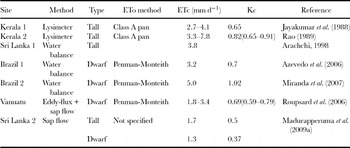
In Kerala, Jayakumar et al. (Reference Jayakumar, Saseendran and Hemapraba1988) used a pair of drainage lysimeters to measure the actual water use of two six-year-old irrigated palms (cv. West Coast Tall; leaf area index 2.4) over a six-month period (May to November, the dry season). Actual water use (ETc), averaged over five-day intervals, ranged from 2.7 to 4.1 mm d−1 (mean 3.3). By comparison, reference crop evapotranspiration (ETo) averaged 6.2 mm d−1 (Penman equation), 4.6 mm d−1 (Blaney Criddle) and 5.3 mm d−1 (USWB Class A pan) (Doorenbos and Pruitt, Reference Doorenbos and Pruitt1977). The corresponding crop coefficients (Kc) were 0.54, 0.73 and 0.65 respectively.
A similar study was reported by Rao (Reference Rao1989), also in Kerala (11°13′N 75°52′E; alt. 70m). A five-year-old palm (cv. West Coast Tall; 3 m tall with six or seven functional leaves) was transplanted into each of a pair of drainage lysimeters (3.5 × 3.5 m square). Monthly evapotranspiration rates (ETc) were recorded over a year. For irrigated palms, ETc varied from 3.3 mm d−1 in June to 7.8 mm d−1 in April, with an annual mean of 5.1 mm d−1. By comparison, evaporation from a USWB Class A pan averaged 4.4 mm d−1 over the year. Depending on the season, Kc varied from 0.60 to 0.68 in the rains to 0.87 to 0.96 in the summer, with an annual mean value of 0.82. An attempt was made to allow for the wider spacing (7.0 × 7.0 m) of palms in a plantation on crop water use, based on changes in soil water content, but it is not easy to evaluate how well this was done.
In Sri Lanka (08°02′N; 79°E; alt. 35 m asl), on a gravelly soil, water use of 15-year-old palms (CRIC 60, spaced 7.7 × 7.7 m, 170 plants ha−1) was monitored with a neutron probe over four consecutive dry periods. Water use (ETc) averaged about 3.8 mm d−1 for the first eight days before declining as the soil dried. This equates to about 220 l palm−1 d−1. The average ETc over the whole 45-day dry period was 2.5 mm d−1, or 150 l palm−1 d−1 (Arachchi, Reference Arachchi1998).
Using a soil water balance approach, Azevedo et al. (Reference Azevedo, Sausa and Silva2006) estimated actual evapotranspiration (ETc) for six-year-old dwarf green palms in northeast Brazil. Depending on the irrigation treatment, mean values were 2.5, 2.9 and 3.2 mm d−1, with cumulative annual totals of 900–1100 mm. At a planting density of 205 ha−1 (triangular arrangement, 7.5 × 7.5 × 7.5 m) these equate to 120–160 l palm−1 d−1. By comparison, the Penman-Monteith estimate of reference crop evapotranspiration (ETo, Allen et al. Reference Allen, Pereira, Raes and Smith1998) over the year averaged 4.6 mm d−1, giving a peak crop coefficient (Kc) of 0.7. For comparison, in Brazil, Miranda et al. (Reference Miranda, de, Gomes, Oliveira, de, Montenegro and Bezerra2007) derived Kc values for an irrigated (micro-sprinklers) dwarf green cultivar (Jiqui) over a 32-month period, beginning 11 months from planting (spacing 7.5 m triangular; 205 palms ha−1). Using the water balance approach (based on tensiometers), ETc increased from a minimum 0.5 mm d−1 (25 l palm−1 d−1) up to a maximum of 5 mm d−1 (244 l palm−1 d−1) at a coastal site in Ceará State (3°17′S; 39°15′W; alt. 30 m asl). Over the same period, ETo (Penman–Monteith) varied between 3 and 6 mm d−1. During the canopy development phase, Kc increased linearly from 0.63 (11 months after planting) to 1.0 (23 months, when the palms were flowering). Thereafter it remained constant, with an average value of 1.02.
In a detailed experiment in Vanuatu (15° 26.6′S 167° 11.5′E; alt. 80 m asl), Roupsard et al. (Reference Roupsard, Bonnefond, Irvine, Berbigier, Nouvellon, Dauzat, Taga, Hemel, Jourdan, Saint-André, Mialet-Serra, Labouisse, Epron, Joffre, Braconnier, Rouzière, Navarro and Bouillet2006) monitored water use of a coconut plantation (Vanuatu Red Dwarf × Vanuatu Tall Hybrid) over a three year period. The eddy-flux method was used to estimate actual evapotranspiration (ET) from the palms and grass under-storey, and the sap flow method to measure transpiration (T) from the palms alone. Water was freely available in the soil throughout the experimental period. The leaf area index was constant (L = 3), and the crop cover averaged 75% (both values for palms only). Transpiration (annual total 640 mm) represented 68% of ET (950 mm). ET rates varied seasonally between 1.8 and 3.4 mm d−1, T from 1.3 to 2.3 mm d−1 and ETo (Penman-Monteith) from 2.4 to 5.8 mm d−1. At a density of 144 palms ha−1, these ET values equate to 93–160 l palm−1 d−1. The crop coefficient Kc (= ET/ETo) values averaged 0.79 and 0.59 in the cool and warm seasons respectively. Canopy transpiration during the warm season was apparently limited by partial stomatal closure linked to the saturation deficit of the air, although the maximum daytime value did not exceed 1.2 kPa.
Recently, Madurapperuma et al. (Reference Madurapperuma, de Costa, Sangakkara and Jayescara2009b) used the ‘compensation heat pulse method’ to measure actual water use of two cultivars of mature palms (20 years old) grown on two contrasting soils in Sri Lanka (7°35′N; 80°57′E; alt.100 m asl; square spacing 8.3 × 8.3 m, 145 palms ha−1). Diurnal patterns of sap flow were clearly discernable on successive days, averaging about 3 l h−1 at night before, on the water retentive soil, typically rising rapidly from about 06:00 hours until 10:00 hours. Sap flow then remained high until about 16:00 hours before declining in the late afternoon. Peak rates of water use differed between the two cultivars, reaching 13–14 l palm−1 h−1 for CRIC 60 (a tall × tall hybrid) but only 9–10 l palm−1 h−1 for CRIC 65 (a dwarf × tall hybrid). Total daily water use averaged 120 l palm−1 d−1 (range 105–135 l palm−1 d−1) or 1.74 mm d−1 for CRIC 60, and 25% less at 90 l palm−1 d−1 (range 75–97 l palm−1 d−1) or 1.31 mm d−1 for CRIC 65. By comparison, daily water use on the second, less water retentive soil was less, averaging 92 and 79 l palm−1 d−1 (1.33 and 1.15 mm d−1) for each of the two cultivars respectively. The mean daily ET rate (method not specified) over the period of measurement was stated as 3.5 mm giving a Kc value of 0.37–0.50. Concurrent measurements over the study period indicated that stomatal conductance was substantially greater in CRIC 60 (tall) than in CRIC 65 (dwarf). Palms growing on the water retentive soil had larger leaf areas and trunk diameters (and hence more stem water storage) than the corresponding palms grown on the second soil. In Sri Lanka, CRIC 65 is known for its sensitivity to water stress, whilst CRIC 60 is recognized as being drought tolerant. The ‘compensation heat pulse method’ had previously been successfully evaluated (except at very low flow rates) on palms in Australia by Madurapperuma et al. (Reference Madurapperuma, Bleby and Burgess2009a).
Summary: crop water use
1. A diverse selection of methods has been used to measure the water use of coconut palm so that direct comparisons of the results are not easy (Table 1).
2. Across all the sites, ETc for mature palms ranged from 1.2 to 7.8 mm d−1. A ‘typical’ rate of water use is probably 3.0–3.5 mm d−1.
3. Corresponding values of Kc for mature palms range from 0.5 to 1.02, with some evidence of seasonal variability. A ‘working’ value for irrigation planning purposes is probably 0.7, but this needs to be confirmed. For immature palms the value is proportionally less.
Summary of measured crop water use (ETc, mature coconut palms) and corresponding estimates of the crop coefficient (Kc = ETc/ETo, mean and seasonal range in brackets).

WATER PRODUCTIVITY
This section covers first the attempts made to forecast yields based on statistical correlation techniques and, more recently the development of a process-based simulation model. Second, the results of irrigation experiments in which yield responses to water are quantified are reviewed. Third, some of the recommended drought mitigation practices are summarized.
Yield forecasting
In an analysis of the effects of the 1931 drought (80 mm rain in five months) on the commercial yield of coconuts in Sri Lanka, Park (Reference Park1934) observed that the minimum nut yield occurred 13 months after the drought ended. The spathes that opened when the drought was most severe were more affected by drought than the flowering and fruiting branches at other stages of development. Yields of nuts did not recover fully until two years after the conclusion of the drought, but the yield of copra per nut had recovered within 12 months. This analysis was followed up by Abeywardena (Reference Abeywardena1968) who attempted to develop a yield forecasting model using long-term rainfall and yield data (1935–1966) in Sri Lanka. But, because of the great time lapse between the initiation of leaf and flower primordia and flowering, and with many other inflorescences at various stages of development present at the same time, it is difficult to relate yield responses to any particular climatic condition. It is not surprising therefore that Abeywardena (Reference Abeywardena1968), using multiple regression techniques, was unable to establish a causal link between rainfall over the 12 months prior to harvest and yield. However, by breaking the year into different periods, when other external factors were similar, he developed an equation (with 12 variables) that explained 86% of the yield variation. Because of the complexity, it is doubtful if this analysis has generic value. Later, Peiris et al. (Reference Peiris, Thattil and Mahindapala1995) reviewed the many attempts to develop statistical relationships between climatic factors and nut yield (including button shedding and premature nut fall). This highlighted the difficulties (and weaknesses) in this approach to the development of yield forecasting models. Notwithstanding, Peiris and Thattil (Reference Peiris and Thattil1998) subsequently used multivariate analysis in an attempt to explain within and between year variation in nut yield in Sri Lanka. They believed that their ‘parsimonious’ approach (three key variables were identified as important determinants: maximum air temperature, afternoon relative humidity and pan evaporation) could be used to develop meaningful models in other locations. It has not been reported whether or not this is the case.
Of greater potential generic value is the simulation model (InfoCrop-coconut) developed, calibrated and validated in India by Naresh Kumar et al. (Reference Naresh Kumar, Kasturi Bai, Rajagopal and Aggarwal2008). The model simulates development stages of growth (based on thermal time), dry matter production (solar radiation interception × radiation conversion efficiency) and dry matter partitioning. There were good linear relationships between simulated dry matter production and measured values (r 2 = 0.95) and between the corresponding nut yields (r 2 = 0.86) across a range of sites and experimental treatments. Nut productivity under rain-fed and irrigated conditions at four sites within India was simulated. In north Kerala, for example, irrigation (200 l palm−1 every four days plus fertilizer) was predicted to increase the (simulated) average annual nut yield from about 4000 to 15500 kg ha−1. Further evaluation of this model is justified.
The long-term effect (up to four years) of an extended dry period on nut yields was confirmed by Naresh Kumar et al. (Reference Naresh Kumar, Rajagopal, Siju Thomas, Cherian, Ratheesh Narayanan, Ananda, Nagawekar, Hanumanthappa, Vincent and Srinivasulu2007) in an analysis of the impact of rainfall amount and distribution on yields from commercial plantations in the different agro-ecological zones in India. Whether the simulation model takes this into account is not clear.
Yield responses to irrigation
Actual yield responses to irrigation have been recorded in field experiments in India (Kerala), Sri Lanka and Brazil.
The irrigation requirement of immature palms (from 5–7 years in the field; cv. West Coast Tall) was reported by Nelliat and Padmaja (Reference Nelliat, Padmaja and Nelliat1978) in Kerala. The ‘best’ combination of treatments in terms of yield of nuts and water use efficiency was the application of 40 mm of irrigation water (I) when the cumulative potential evaporation (CPE) total reached 53 mm (I/CPE ratio 0.75, which is equivalent to a Kc value of 0.75). In this way, an average total of 680 mm of water was applied in the summer months, yielding a total of 157 nuts palm−1 over the three years after the palms started to come into bearing. By comparison, when the I/CPE ratio was 0.5 the total yield was significantly less, at 126 nuts palm−1. There was no unirrigated/rain-fed control treatment.
In Kerala, Nair (Reference Nair1989) reported the results of an irrigation trial in which water was applied at 500 l palm−1 (at a plant density of 178 ha−1 this is equivalent to 9 mm) at different intervals (cv. WCT) during the summer months (December to May) over a five-year period. Water was applied in 1.8 m radius basins to a sandy clay loam soil. Compared to the control rain-fed treatment (average yield ca. 90 nuts palm−1) significant increases (range +15–39 nuts palm−1) in yield were obtained in the third and subsequent years from irrigation applied when the ‘cumulative potential evaporation’ totalled 50 or 25 mm. No indication is given on how much water in total was applied in each year.
Previously, Bhaskaran and Leela (Reference Bhaskaran, Leela and Nelliat1978) had described a similar trial in Kerala lasting 12 years with the same cultivar (WCT). Water was applied at a rate of 800 l palm−1 every seven days (equivalent to 2 mm d−1 only) in 2 m radius basins during the summer months. The soil was a red sandy loam. It took three years before the full yield benefits (averaging +30 nuts palm−1 year−1 compared with pre-irrigation yields of a variable 40) were realized. Before that, in the ‘transition period’, the yield increase was about half this. The largest increase (+39 nuts palm−1) came from palms initially classified as ‘low’ yielding (20–40 nuts palm−1). Yield increases followed an increase in female flower production and setting percentage. This and other work on water management of coconut undertaken in India is summarized in Yusuf and Varadan (Reference Yusuf, Varadan, Nair, Khan, Gopalasundaram and Bhaskara Rao1993).
In Sri Lanka, Nainanayake et al. (Reference Nainanayake, Ranasinghe and Tennakoon2008) evaluated the responses of mature palms (20 years old; cultivar not named), growing on a shallow (0.6 m) sandy clay loam soil, to drip irrigation over a two-year period, two to four years after irrigation began. During this period there were three dry spells lasting 48, 78 and 83 days. Irrigation during these dry periods (80 l palm−1 d−1, or 1.3 mm d−1) reduced the afternoon soil temperature (from 31 to 27 °C), nut surface (seventh bunch from the top, by up to 2.5 °C) and air (by up to 2.0 °C) compared with the control (unirrigated) treatment. Irrigation therefore ameliorated the temperature regime and created conditions close to the optimum (27 °C) for coconut. Even with irrigation, stomatal conductance declined during the dry periods but applications of 80 l palm−1 d−1 (1.3 mm d−1) maintained transpiration at rates similar to those recorded in the rainy season. Irrigation also increased female flower production and reduced premature nut fall. Over the two year period, applications of 80 l palm−1 d−1 resulted in a 45% yield increase over the control. Halving the amount of water applied (to 40 l palm−1; 0.65 mm d−1) halved the yield benefit (to 20%). The absolute yields were not clearly specified.
In northeast Brazil, Azevedo et al. (Reference Azevedo, Sausa and Silva2006) applied 50, 100 or 150 l palm−1 d−1 (equivalent to 1.0, 2.0 and 3.0 mm d−1 respectively) to six-year-old dwarf green palms on a sandy soil over a two-year period. It appears that these daily applications were made regardless of rainfall. There was no rainfall-only control treatment. The whole experimental area had previously been irrigated. Using a water balance approach actual evapotranspiration was estimated from which water use efficiencies were calculated (i.e. apparently based on total ETc not on the depth of irrigation water applied). There were no yield differences between treatments in terms of the number of bunches per palm or the number of fruits per bunch but extra irrigation water increased the volume of water per fruit by about 16%. When yield was expressed as the number of fruits per hectare there was a significant 12% yield loss from applying 1.0 mm d−1 compared with 2 mm d−1 (equivalent to a reduction in the number of nuts per palm from 93 to 82). Water use efficiencies (as inadequately defined) were essentially the same for all three irrigation treatments.
In Kerala, irrigation was recently reported to have increased annual yields from mature coconut palms (cv. West Coast Tall) over a six-year period by, on average, an estimated 30–40 nuts palm−1 (from 50–60 to 90 nuts palm−1; Naresh Kumar and Kasturi Bai, Reference Naresh and Kasturi Bai2009).
In Sri Lanka, Arachchi (Reference Arachchi1998) developed criteria for the design of a drip irrigation system for coconuts grown on a gravelly soil. The maximum flow rate he recommended was 30 l h−1 for 2.5 h from each of four drippers spaced equidistant around, and 1.0 m from, the base of the trunk. This regime wetted a large volume of soil within the effective root zone of 15-year-old palms (cv. CRIC 60; 170 plants ha−1) and equates to 5.1 mm d−1 (300 l palm−1d−1). By comparison, actual crop water use during the first eight days of the dry period averaged about 3.8 mm d−1 (220 l palm−1d−1) before declining (see Crop water use above). Eight days became the recommended irrigation interval. Such an analysis does not allow for the fact that drip irrigation enables small quantities of water to be applied frequently, rather than requiring the whole root zone to be wetted at extended intervals. The productive and economic advantages of designing drip systems for deficit (under) irrigation as compared to standard drip systems designed for full irrigation to meet potential evapotranspiration have been described by Keller et al. (Reference Keller, Sivanappan and Varadan1992) in Kerala.
However, the limited size of the wetted soil volume under drip irrigation was identified as a cause for concern during an on-farm evaluation of drip irrigation in South India, although that view may have been influenced by the fact that only very small quantities of water (32 l palm−1 d−1; 0.6 mm d−1) were being applied (Thambam et al., Reference Thamban, Mathew and Arulraj2006). What also appear to be very small amounts of water (30–40 l palm−1 d−1) are recommended for drip (and basin) irrigation on sandy soils in the Konkan region of Maharashtra (India) (Nagwekar et al., Reference Nagwekar, Desai, Sawant, Haldankar, Joshi and More2006). This advice is inconsistent with the recommendation of the Coconut Development Board of India, which states ‘generally’ an adult palm requires 600–800 litres of water once in four to seven days’ (CDB, 2010).
Drought mitigation
In view of the sensitivity of palms to water stress, water conservation is strongly recommended (Mahindapala and Pinto, Reference Mahindapala and Pinto1991). In Sri Lanka, this means: mulching (to restrict evaporation from the soil surface) by placing a layer of vegetation (such as coconut husks) in a 1.75 m radius circle around the trunk. Husk or coir dust pits or trenches increase the retention and availability of water especially in sandy soils. They should be at least 0.6 m deep and 1.2–1.5 m wide and situated within reach of the roots of each palm. They are filled with alternating layers of husk (or coir dust) and soil. The results of original studies undertaken in India by Marar and Kunhiraman (Reference Marar and Kunhiraman1957) and by Balasubramanian et al. (Reference Balasubramanian, Ramanathian and Vijayaraghavan1985) on husk burial as a drought mitigation measure have been summarized by Yusuf and Varadan (Reference Yusuf, Varadan, Nair, Khan, Gopalasundaram and Bhaskara Rao1993). For young palms in South India, Shanmugam (Reference Shanmugan1973) describes other drought mitigation practices including deep planting (with the bole 0.6–1.2 m below ground level), the placement of porous earthen pots regularly filled with water (pitcher irrigation) adjacent to the stem, in addition to husk burial (500–1000 husks per palm) and husk mulch. Xavier Bonneau (personal communication) confirms the benefits that can result from these interventions.
In Indonesia (Gunung Patan, Sumatra), hybrid palms, four to six-years-old, were observed to be more susceptible to drought than younger or older palms because of an imbalance between the relative sizes of the foliage and the root systems (Bonneau and Subagio, Reference Bonneau and Subagio1999). Other things being equal, dwarfs (e.g. Malayan Yellow Dwarf and Cameroon Red Dwarf) were more susceptible to drought than talls or hybrids. They also found that the mortality of commercially grown palms during the long dry season was negatively correlated with the chloride status of the palm (as measured in leaf 14 at the beginning of the dry season). Applying common salt (sodium chloride) at annual rates of up to 4.5 kg palm−1 reduced mortality, reduced defoliation, advanced recovery after the start of the rains and increased the yield of copra from 10 to 15 kg palm−1 (averaged over eight seasons). Previously, Braconnier and Bonneau (Reference Braconnier and Bonneau1998) had confirmed the important role that the chloride ion plays in maintaining gas exchange (net assimilation and transpiration) in dry weather through stomatal regulation. Indeed, sodium chloride is recommended as a cheaper alternative to potassium chloride as a fertilizer in Indonesia, particularly in dry areas, where it contributes to drought mitigation (Bonneau et al., Reference Bonneau, Boulin, Bourgoing and Sugarianto1997).
For example, in a field experiment in Indonesia, in which different levels of common salt (from 0 to 4.5 kg palm−1 y−1) were compared, mature hybrid palms (cv. PB-121) responded as follows to these two extreme treatments, averaged over the period 1989–1996: an increase from 55 to 76 nuts palm−1 y−1; from 184 to 201 g copra nut−1; from 10.7 to 15.8 kg copra palm−1 y−1; from 6.4 to 14.9 green leaves palm−1 (at the end of the 1991 drought); from 78 to 148 palms ha−1 (at the end of the 1996 drought, the original plant population was 152 ha−1); and from 1.47 to 2.38 t copra ha−1 y−1. The critical chloride concentration in the leaf (14th) of mature palms is considered to be 0.5% (Bonneau et al., Reference Bonneau, Boulin, Bourgoing and Sugarianto1997).
The role of chloride in the nutrition of palms and its contribution to drought resistance in coconut has been well reported. Only in plantations close to the sea, where salt spray occurs naturally, is there apparently no benefit from its application (Bonneau et al., Reference Bonneau, Ochs, Kitu and Yuswohadi1993; Ollagnier et al., Reference Ollagnier, Ochs, Pomier and de Taffin1983; Von Uexhull, Reference Von Uexhull1985).
In this context, Yusuf and Varadan (Reference Yusuf, Varadan, Nair, Khan, Gopalasundaram and Bhaskara Rao1993) cited a study by Shanmugam (Reference Shanmugan1973) which demonstrated that coconut can withstand irrigation with sea water (salt content 0.6–1.0%; 90 l palm−1 twice a week; sandy or sandy loam soils; 1.5 m radius basins). The monsoon rains leached out any residual salt. In Brazil (5°46′S; 35°12′W; alt. 18 m asl), Marinho et al. (Reference Marinho, Gheyi, Fernandes, de Holanda and Neto2006) evaluated the viability of using saline water for irrigation. In a two year study with (initially) three and a half-year-old green dwarf coconut (cv. Anão Verde), the number of female flowers was increased when salt was added to the irrigation water, but at an electrical conductivity (ECw) greater or equal to 5 dS m−1 the mean weight of a fruit (beginning at the 11th harvest) and the number of fruits (14th harvest) were both reduced compared with the control treatment (ECw = 0.1 dS m−1). However, even when the ECw was 10 dS m−1 acceptable yields were still achieved.
Summary: water productivity
1. Partly because of the long time interval (44 months) between flower initiation and harvest of the mature nut, it has not been possible to establish a direct causal link between yield and rainfall for coconut.
2. Full responses to irrigation are only obtained in the third and subsequent years after irrigation is introduced.
3. There is a limited amount of reliable and complete field data on actual yield responses to irrigation/drought. In general, it appears that relatively small quantities of water have been applied in the irrigation trials compared with ETc.
4. In Kerala, yield increases of 20–40 nuts palm−1 (mature cv. West Coast Tall) have been recorded after the application of the equivalent of about 2 mm d−1 during the summer months. This represents a 50% yield increase on base yields averaging about 60 nuts palm−1.
5. In Sri Lanka, applications of 1.3 mm d−1 during the dry season ameliorated the microclimate, maintained transpiration and increased yields by 45%.
6. In northeast Brazil, yields were reduced by 12% if only 1.0 mm d−1, rather than 2.0 mm d−1, was applied during the dry season to dwarf green cultivars
7. Irrigation increases female flower production and reduces premature nut fall.
8. It has not been possible to derive yield/water-use (water productivity) response functions here because of incomplete data.
9. Drought mitigation practices include husk burial and mulching, and the application of common salt.
10. Mature palms can withstand irrigation with sea water.
CONCLUSIONS
Until relatively recently much of the research reported was empirical, so that the results were only of value in the immediate location of the experiments. They were time and space limited. This is understandable and is due, in part, to the difficulty of undertaking research on this fascinating crop. It is also due in part to limited funding at the relatively small research institutes with the mandate to undertake this research. There has also been, with some exceptions, a notable lack of international collaboration in research (coconuts are outside the CGIAR system) for a crop on which millions of people depend for their livelihoods (Carr and Punchihewa, Reference Carr and Punchihewa2002).
Potential and actual yields are determined mainly by climate, and its day to day variability which is known as weather. In the case of coconuts, this simple statement is complicated by the long time interval between the initiation of the inflorescence and the harvesting of the mature nut (44 months). Changing weather conditions during this period will influence yield development in different ways.
In 1992, following a visit to Sri Lanka, I wrote ‘to the best of my knowledge only a limited amount of research on the physiological basis of yield development in coconuts has been reported. For example, how do environmental (and agronomic) factors influence such variables as fractional light interception by the canopy; dry matter production and partitioning and the harvest index; conversion efficiency for solar radiation; crop water use and water-use efficiency? What are the potential yields of copra (and other commercially valuable products) in given locations with existing cultivars? Why do actual yields differ from potential yields? How important is water stress as a limiting factor? Is irrigation justified economically? What are the other principal limiting factors? If we can begin to quantify some of these variables and the relationships between them in systematic ways, it should be possible to develop procedures for yield forecasting (with and without water stress as a limiting factor) and even perhaps to identify selection criteria for new cultivars. To do this successfully though will require a co-ordinated team approach within an agreed framework for analysis. Experiments must be designed so that key measurements are taken to provide basic data that can be used do develop and validate a yield forecasting model’ (Carr, Reference Carr1992).
Substantial progress has been made since 1992 in many of these areas, including the development of a yield forecasting model, although this needs to be developed and validated further. In the immediate context of this review, there is still a lack of knowledge on the actual water use of coconut and of yield responses to water. Indicators of drought tolerance have been identified but it is not clear whether these have resulted in new genotypes. The challenge that remains is to quantify how little rather than how much water is needed to produce an economically viable crop. A co-ordinated international approach to addressing this issue is recommended.
Acknowledgements
Dr Xavier Bonneau and Dr Hereward Corley kindly commented on a draft version of this paper. Dr Rob Lockwood provided access to some of the cited papers. Grateful thanks to all three for their support.