With much of the Arabian Peninsula characterized by hot and arid weather conditions during long summer seasons, residents are forced to rely on air conditioning to cool their surroundings. Before the construction of air conditioning infrastructures, many would leave the coast during the summer months to head to oases, such as Al Ain near Abu Dhabi, or live in tents in the desert to find relief from the heat. From the 1950s, European and American building practices shaped the region with little consideration of vernacular design elements or energy conservation. These building practices introduced air conditioning as a cooling method. For instance, the 1951 Report of Operations to the Saudi Arab Government by the Arabian American Oil Company explained how “automobiles, air conditioning units, sewing machines, washing machines, refrigerators, and many other modern conveniences are now readily available” in Al Hasa, a significant region for Aramco's operations on the east of Saudi Arabia.Footnote 1 By 1952, workers residing in Aramco's camps could have air conditioning units installed in their rooms on a rental basis.Footnote 2 Air conditioning technology reconfigured urban environments, altering the relationship between indoors and outdoors, and ultimately constituting what Jiat-Hwee Chang and Tim Winter term a “thermal modernity” that transforms how built forms are imagined and inhabited.Footnote 3 The current widespread use of air conditioning in the region is therefore connected not only to high temperatures, but also to how air conditioning is singled out as the ultimate technical fix in confronting the climate. Other solutions to managing heat, such as improving insulation mechanisms for residences and office buildings, have been less pervasive.
Tariq, a Saudi electrical engineer I met in late 2016 while doing research on electrification in the Arabian Peninsula, reflected on how air conditioning has emerged as the single most important method of handling the heat in Saudi Arabia. “Sometimes it's fifty-five degrees Celsius in Saudi Arabia,” he commented during a telephone conversation, “it's hot to a degree that you keep the air conditioner on all the time, twenty-four hours. And most of our electricity demand is because of air conditioning, it is the major driver of demand.” Tariq knew how air conditioning accounts for 70 percent of annual peak electricity consumption in the Arabian Peninsula. He suggested that this demand was the result of a growing acceptance of air conditioning devices as “necessary” home and office appliances, and lack of a serious alternative to electrical air conditioners. Tariq continued:
Our homes don't have insulation. In reducing consumption of energy, insulation is going to help, we won't need to operate air conditioning all the time. Until recently, Saudi Arabia did not have insulation in homes as a requirement. We don't have the cultural education about how to monitor our consumption . . . the government does not do public outreach to consumers on how to be efficient in using electricity or water.
He believed that cooling mechanisms were essential to life in Saudi Arabia, but that the use of air conditioning could change with the introduction of novel alternatives.
Though not mentioned by Tariq, conceptions of ideal room temperature also play a part in high air conditioning consumption rates. In the UAE newspaper The National, an unidentified white collar worker from Sharjah complained about feeling cold in the office despite the heat outside:
I get very cold in the office, not just cold but seriously cold. It's a case of taking in jumpers and shawls to wrap myself up against the chill. I realize it's hot outside, but why does it have to be freezing inside? We have a central chilling system, so when I complain to my manager, he tells me everyone else is fine. Moving to a warmer spot in the office would require ousting another member of staff. What can I do here?Footnote 4
In responding to this query, a writer from the National drew on personal experience: “We actually have a system in my workplace, where if someone decides they are too cold, we take a democratic approach and everyone in the office casts their vote on the temperature. This is working well.” He added that
employees who are cold tend to work less efficiently—few people can focus properly on their work when they're trying to stay warm. . . . But you don't want a chilly atmosphere to lead to arguments over what the ideal temperature should be. Try to avoid a heated backlash over air-conditioning by talking to your colleagues first.Footnote 5
This comment recognized that every individual has different expectations based on their body type and cultural background, and suggested that casting a vote may resolve these differences in opinion.
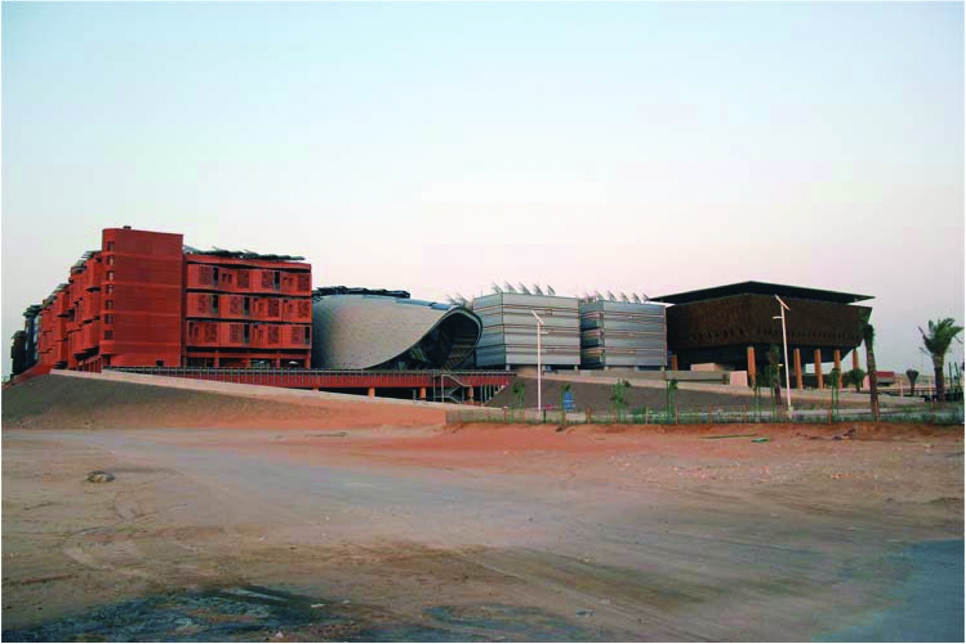
Yet casting votes is not the only way in which professionals in the UAE have resolved such differences. At Abu Dhabi's eco-city project Masdar City, experimental air conditioning infrastructures prohibited the occupants from interfering with room temperature (Figure 1).Footnote 6 By targeting lowering electricity demands of the building rather than creating new power generation mechanisms to satisfy demand, this strategy set a stark contrast to the supply-side policies favored by the GCC governments. It also dictated certain types of behavior for building residents.
Masdar Institute, Abu Dhabi, 2014. (Photo by the author)

The building's temperature had been a topic of heated debate on the campus of Masdar Institute—a research institute established inside Masdar City by the Massachusetts Institute of Technology. Brad, an executive from Masdar City whom I interviewed on campus, offered a lengthy explanation, saying at one point, “Temperature and air conditioning change your mood when you're in a building. But people have different senses of temperature. Would you like to inhabit a room that is twenty-three, twenty-four, or twenty-six degrees Celsius?” Some on-site architects working with Foster + Partners on the Masdar City master plan suggested that the discussion over temperature occurred strictly between the Emiratis and the non-Emiratis. According to them, the Emirati students had become used to occupying buildings that remained firmly set to twenty-one degrees Celsius, or even less. “Don't you freeze when you go to shopping malls in this country?” Daniel, the German architect who worked with Foster + Partners, asked me, thereby problematizing temperature as a matter of cultural concern. However, stabilizing the temperature at the desired twenty-one degrees Celsius level would significantly increase the Masdar Institute building's energy demands. The architects knew the temperature would be somewhere between twenty-one and twenty-six degrees; later, after weeks of deliberation, one on-site architect noted to me that they had settled on twenty-four degrees Celsius. The decision upset some of the occupants, they acknowledged, but it was implemented anyway. One Foster + Partners architect added that the sustainability that was their goal did not allow for flexibility. “It's not possible to have both at the same time,” he underlined.
Martyn Potter, the facilities manager of Masdar Institute, also wanted to make sure that sustainability would not be compromised at Masdar City, even if this would require surrendering flexibility. According to him, this would be the future of energy management in the United States and Europe as well. A 2011 article in Time magazine titled “Masdar City: The World's Greenest City?” referred to Potter's position:
Martyn Potter, Masdar's director of operations and facilities, noted that most Abu Dhabi citizens are used to keeping their air-conditioning as low as 60°F (15.5°C)—it helps that electricity is heavily subsidized—but in Masdar, AC needs to be set closer to 77°F (25°C) to keep within its efficiency targets. With the ability to monitor exactly how much electricity every room in the city is using, Potter can keep citizens in line. “It's name and shame,” he says. “I'm a green policeman.”Footnote 7
Another article, in the Guardian, highlighted Potter's regulatory approach:
Here, residents live with driverless electric cars, shaded streets cooled by a huge wind tower and a Big Brother–style “green policeman” monitoring their energy use . . . “The city is a laboratory for the future,” says Martyn Potter, director of operations at the institute and dubbed the “green policeman.” The Big Brother approach to cutting energy is likely to become the norm as computerised smart grids are rolled out in Europe and the U.S., he adds. “I want to know exactly how these buildings work. I can pinpoint who is using the most energy and water, whether in an apartment or the academy. Certain students have been used to having the air conditioning on at 16°C (61°F), here it is 24°C. Yes, they complain. But I have told them that's how it is.”Footnote 8
When I asked Brad, the executive from Masdar City, what he thought about these ongoing complaints from building residents, he responded, “But that's exactly why we have to implement dummy controls.” He laid out how dummy controls would work for residents: “You get up and change the environment psychologically. And that saves so much energy.” Karim, a young energy efficiency engineer, also argued that occupants would be more satisfied with their living situations if they believed they could change a room's temperature, even if in reality they could not. He referred to a study in China in which engineers had implemented dummy thermostats in rooms in response to repeated protests by the residents of an office block regarding their lack of control. “The dummy thermostats made everyone much happier,” Karim reported. Evidently, in the industry this placebo effect was argued to provide the illusion of control to tenants without compromising the system's efficiency.
At Masdar Institute, the building would serve as a discrete sense-making apparatus. In her book on the emergence of sick building syndrome, historian of science Michelle Murphy touches upon such sense-making capacities. She proposes the concept of “regimes of perceptibility” to describe the ways in which certain phenomenological conditions become blocked while others are accentuated, thus creating a definitive methodology for the building occupant to relate to his or her environment.Footnote 9 In the China example proposed by Karim, the dummy thermostats had served as material manifestations of the desired “regime of perceptibility” within the building's environment. If they were implemented in the Masdar Institute building, the subjects who privileged sight over thermoception would easily be manipulated into believing that their environment had been improved when, in fact, the thermostat remained fixed at a predetermined temperature, generating thermal monotony. The building's machinery would work in what might be called a deceptive manner.Footnote 10
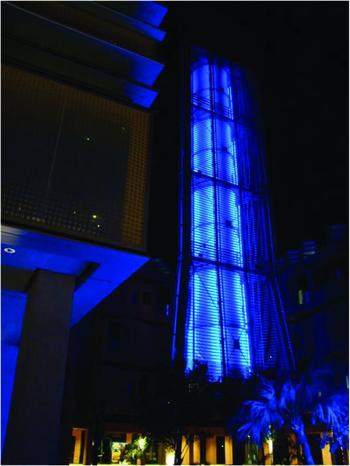
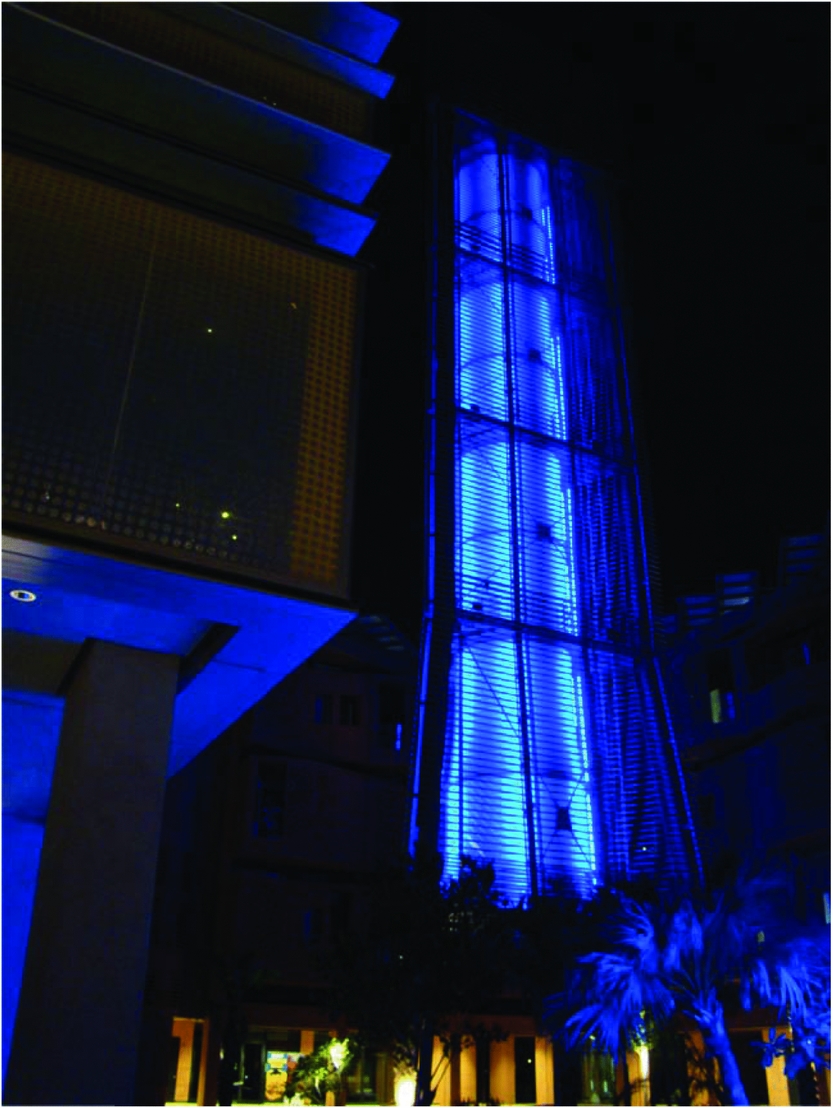
At Masdar City, this reimagination of thermoception was coupled with the reintroduction of the vernacular wind tower as a cooling strategy. The steel-framed wind tower, which rose above one of the courtyards, served as a reinterpretation of an architectural element used for cooling in different parts of the Middle East, most commonly Iran. At the top, the 150-foot-tall structure featured louvers and mist jets that aimed to abate high-heat temperatures in the space surrounding its base; it was expected to produce a localized cooling effect (Figure 2). The production of a wind tower at Masdar City was in line with other heritage-based approaches to cooling. These approaches seek to incorporate urban climatology and everyday weather, and have been gaining some traction in the region.Footnote 11
Wind tower in a courtyard at the Masdar Institute, Abu Dhabi, 2010. (Photo by the author)
Experimental ways of thinking about heat and cold have emerged in the Arabian Peninsula, as exemplified by the Masdar City project. Yet the perception of air conditioning as the ultimate way of keeping bodies comfortable remains persistent.
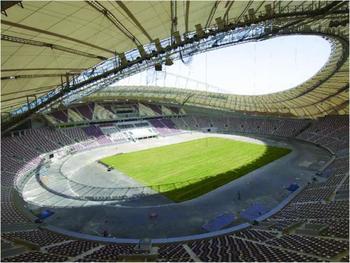
For instance, Khalifa International Stadium, one of the proposed venues for the controversial 2022 FIFA World Cup in Doha, Qatar, is the first open-air air-conditioned stadium in the world (Figure 3). The stadium opened after extensive renovations in May 2017. It provides seating to 48,000 people, and relies on district cooling, a cooling technology that makes use of chilled water produced at a central plant and then piped out to buildings for air conditioning. Very little has been written about the history of air conditioning in the Arabian Peninsula, but perhaps the future of thermal comfort in the region will set the stage for more extensive debate over why and how people confront the heat.
Khalifa International Stadium, Doha, 2017.