Introduction
Mood disorders are the most common psychiatric disorders in modern society (Reference Lee, Jeong, Kwak and Park1). The major symptoms of mood disorders include personality change, loss of appetite, fatigue, depression, aggression, anxiety and agitation. There are different types of mood disorders, based on their durations, prevalent features and severity of symptoms. The two main categories of mood disorders are unipolar disorder and bipolar disorder. Approximately 16 and 1% of the population are affected by unipolar and bipolar disorders, one or more times during their life time, respectively (Reference Kessler, Berglund, Demler, Jin, Merikangas and Walters2). Mood disorders have a large impact on social health, with a considerable amount of both direct and indirect costs (Reference Greenberg, Stiglin, Finkelstein and Berndt3–Reference Wittchen and Jacobi5). Twin, family and adoption studies have suggested that susceptibility to mood disorders is strongly influenced by genetic factors (Reference Fan, Liu, Jiang, Jiang, Zhao and Zhang6). Beckman et al. (Reference Beckman, Beckman, Cedergren, Perris and Strandman7) first conducted a case–control study on the relationship between genetic polymorphisms and mood disorders in 1978. Subsequently, many genetic association studies were conducted (Reference Lopez-Leon, Janssens and Gonzalez-Zuloeta Ladd8).
The fact that dysfunction of hypothalamic-pituitary-adrenal (HPA) axis was found in depressive patients has made the HPA axis an interesting candidate endophenotype for mood disorders (Reference Holsboer9,Reference Holsboer10). Recently, during their search for the genetic mechanisms underlying the HPA dysfunction in mood disorders, many researchers focused on genes involved in HPA-axis regulation. Among these, FK506 binding protein 5 (FKBP5) gained growing interest. FKBP5 is a member of the immunophilin protein family, which in humans is encoded by the FKBP5 gene. It is a co-chaperone of hsp-90, and is involved in the regulation of the HPA system by adaptive changes in the glucocorticoid receptor (GR), and plays a role in immunoregulation and basic cellular processes involving protein folding and trafficking (Reference Nair, Rimerman and Toran11). FKBP5 gene is located on chromosome 6p21, a chromosomal region associated with bipolar disorder and psychosis (Reference Cheng, Juo and Loth12).
Several single nucleotide polymorphisms (SNPs) in FKBP5 have been found (Reference Binder13). These SNPs have been associated with increased FKBP5 protein expression, and variation in the correlation between plasma cortisol levels and peripheral blood FKBP5 mRNA expression, indicating that the alleles of these polymorphisms are associated with differences in GR sensitivity (Reference Binder, Salyakina and Lichtner14). In healthy controls, the alleles are associated with a relative GR resistance (Reference Binder, Bradley and Liu15). Taking these facts into account, one could speculate that FKBP5 alleles associated with a slower return to baseline of stress-induced cortisol levels also increase the risk for stress-related psychiatric disorders (Reference Binder13). Currently, there is evidence for the impact of FKBP5 in mood disorders. Several studies have investigated the association of FKBP5 gene polymorphisms with mood disorders, but findings are not always consistent (Reference Binder, Salyakina and Lichtner14,Reference Zobel, Schuhmacher and Jessen16–Reference Gawlik, Moller-Ehrlich and Mende20). There are several possible explanations for this discordance, such as small sample size, ethnic background, different types of mood disorders and publication bias.
Meta-analysis is a statistical procedure for combining the results of several studies to produce a single estimate of the major effect with enhanced precision, and it is considered a powerful tool for summarising inconsistent results from different studies (Reference Munafo and Flint21). This method also helped in the investigation of a possible association between FKBP5 gene polymorphisms and mood disorders. Therefore, it is necessary to perform a comprehensive meta-analysis to evaluate the association between FKBP5 gene polymorphisms and mood disorders.
Methods
Identification of eligible studies
All studies examining the association of FKBP5 gene polymorphisms with mood disorders were carefully selected. Data were collected from the following electronic databases: PubMed, Elsevier Science Direct, Cochrane Library, Chinese Biomedical Literature Database (CBM), China National Knowledge Infrastructure (CNKI) and Wanfang (Chinese). The key word ‘FKBP5' was used for searching. Meanwhile, additional literature was collected from cross-references within both original and review articles. We recruited data only from the full-published paper and not from any meeting or conference abstracts. No language restrictions were applied. A study was included in the current meta-analysis if (a) it was published up to March 2010; (b) it was a case–control study; (c) patients were diagnosed by psychiatrists according to the Diagnostic and Statistical Manual of Mental Disorders IV criteria (DSM-IV) or the International Statistical Classification of Diseases and Related Health Problems 10th Revision (ICD-10). We excluded the study in which family members had been studied because the analysis is based on linkage considerations. When a study reported the results on different sub-populations/ethnicities, we treated them independently. Additionally, an independent search was done by two investigators with the same method. The contents of abstracts were reviewed independently by two investigators to determine if they met the eligibility criteria for inclusion.
Data extraction
Two investigators independently extracted the data with the standard protocol and the result was reviewed by a third investigator. From each study, we extracted the first author's name, year of publication, source of publication, racial ancestry, type of diseases, polymorphisms, the number of cases and controls and the available genotype and allele frequency information from the FKBP5 gene. In addition, if original genotype frequency data was unavailable in relevant articles, a request for additional data was sent to the corresponding author.
Meta-analysis methods
Meta-analysis was performed for polymorphisms that had been investigated in at least two studies. We examined the relationship between the allele, as well as genotypes, and susceptibility to mood disorders. The odds ratio (OR) and its 95% confidence interval (CI) were estimated for each study. The degree of heterogeneity between the study results was assessed by the Q-test based on Chi-squared statistic (Reference Cochran22). A significant Q-statistic (p < 0.10) indicated heterogeneity across studies. We also measured the effect of heterogeneity by another measure, I 2 = 100% × (Q−df)/Q (Reference Higgins and Thompson23). The pooled OR was obtained by Mantel–Haenszel method in the fixed effect model and by DerSimonian–Laird method in the random effect model (Reference Mantel and Haenszel24,Reference Dersimonian and Laird25). The pooled OR was performed by weighting individual ORs by the inverse of their variance, and the significance of the pooled OR was determined by the Z-test.
Additionally, Chi-squared test was used to determine if the observed frequencies of genotypes conformed to Hardy–Weinberg equilibrium expectations.
Evaluation of publication bias
Publication bias was investigated with the funnel plot. Funnel plot asymmetry was further assessed by the method of Egger's linear regression test (Reference Egger, Davey, Schneider and Minder26). Analyses were performed using the software Review Manager 4.2 (Cochrane Collaboration, http://www.cc-ims.net/RevMan/relnotes.htm/) and Stata version 10 (StataCorp LP, College Station, Texas). A p value less than 0.05 was considered statistically significant, and all the p values were two sided.
Results
Characteristics of eligible studies
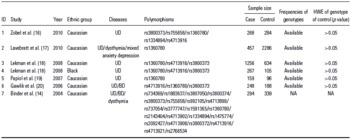
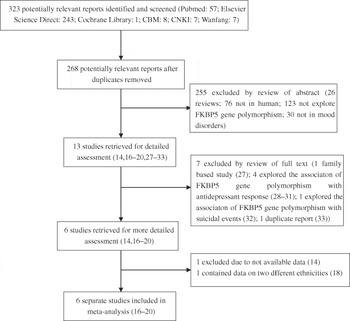
The characteristics of studies investigating the association of FKBP5 gene polymorphisms with mood disorders are presented in Table 1(Reference Binder, Salyakina and Lichtner14,Reference Zobel, Schuhmacher and Jessen16–Reference Gawlik, Moller-Ehrlich and Mende20). There were 323 papers relevant to the searching word. The study selection process is shown in Fig. 1. The six separate studies studied five different polymorphisms (rs1360780, rs3800373, rs4713916, rs755658 and rs1334894) in the FKBP5 gene. Only three of these polymorphisms were investigated in more than two studies. Thus, meta-analysis was performed for three polymorphisms [rs1360780 (Reference Zobel, Schuhmacher and Jessen16–Reference Gawlik, Moller-Ehrlich and Mende20), rs3800373 (Reference Zobel, Schuhmacher and Jessen16, Reference Lekman, Laje and Charney18,Reference Gawlik, Moller-Ehrlich and Mende20), rs4713916 (Reference Zobel, Schuhmacher and Jessen16,Reference Lekman, Laje and Charney18,Reference Gawlik, Moller-Ehrlich and Mende20)]. The six separate studies consisted of five Caucasian and one Black population. The distribution of the genotype in control population was in Hardy–Weinberg equilibrium in these studies (p > 0.05).
Characteristics of studies investigating the association of FKBP5 gene polymorphisms with mood disorders

BD, bipolar disorder; HWE, Hardy–Weinberg equilibrium; NA, not available; UD, unipolar depression.
Flow diagram of the study selection process.

Meta-analysis
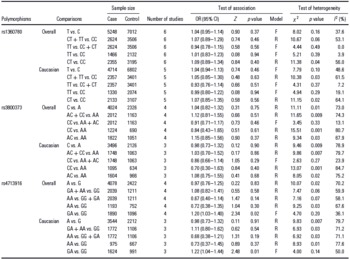
The summary of the meta-analysis for FKBP5 gene polymorphisms with mood disorders is shown in Table 2.
Meta-analysis of FKBP5 gene polymorphisms and mood disorders association

F, fixed effect model; R, random effect model.
Analysis for FKBP5 gene rs1360780 polymorphism. We did not detect any association of FKBP5 gene rs1360780 polymorphism with mood disorders in the overall population (T vs. C: OR = 1.04, 95% CI = 0.95–1.14, p = 0.37; CT + TT vs. CC: OR = 1.07, 95% CI = 0.89–1.29, p = 0.46; TT vs. CC + CT: OR = 0.94, 95% CI = 0.78–1.15, p = 0.56; TT vs. CC: OR = 1.01, 95% CI = 0.83–1.23, p = 0.94; CT vs. CC: OR = 1.09, 95% CI = 0.89–1.34, p = 0.40). We performed group-specific meta-analysis in the Caucasian population. No statistically significant association was established for FKBP5 gene rs1360780 polymorphism in the Caucasian population (T vs. C: OR = 1.04, 95% CI = 0.94–1.13, p = 0.46; CT + TT vs. CC: OR = 1.05, 95% CI = 0.85–1.30, p = 0.63; TT vs. CC + CT: OR = 0.93, 95% CI = 0.76–1.14, p = 0.51; TT vs. CC: OR = 0.99, 95% CI = 0.80–1.22, p = 0.94; CT vs. CC: OR = 1.07, 95% CI = 0.85–1.35, p = 0.56).
Analysis for FKBP5 gene rs3800373 polymorphism. We did not detect the association of FKBP5 gene rs3800373 polymorphism with mood disorders in the overall population (C vs. A: OR = 1.04, 95% CI = 0.82–1.32, p = 0.75; AC + CC vs. AA: OR = 1.12, 95% CI = 0.81–1.55, p = 0.51; CC vs. AA + AC: OR = 0.91, 95% CI = 0.71–1.17, p = 0.46; CC vs. AA: OR = 0.84, 95% CI = 0.43–1.65, p = 0.61; AC vs. AA: OR = 1.15, 95% CI = 0.85–1.56, p = 0.37). We also did not detect the association of FKBP5 gene rs3800373 polymorphism with mood disorders in the Caucasian population (C vs. A: OR = 0.98, 95% CI = 0.73–1.32, p = 0.90; AC + CC vs. AA: OR = 1.03, 95% CI = 0.70–1.52, p = 0.86; CC vs. AA + AC: OR = 0.86, 95% CI = 0.66–1.14, p = 0.29; CC vs. AA: OR = 0.70, 95% CI = 0.30–1.63, p = 0.40; AC vs. AA: OR = 1.08, 95% CI = 0.75–1.55, p = 0.68).
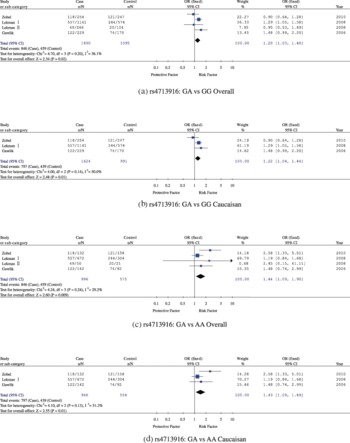
Analysis for FKBP5 gene rs4713916 polymorphism. An association of FKBP5 gene rs4713916 polymorphism with mood disorders was found in the overall population when examining the contrast of GA versus GG (OR = 1.20, 95% CI = 1.03–1.40, p = 0.02), and the forest plot of the distribution of the ORs is shown in Fig. 2a. However, we did not find the association when examining the contrast of A versus G (OR = 0.97, 95% CI = 0.76–1.25, p = 0.83), GA + AA versus GG (OR = 1.08, 95% CI = 0.82–1.41, p = 0.58), AA versus GG + GA (OR = 0.67, 95% CI = 0.40–1.14, p = 0.14) and AA versus GG (OR = 0.72, 95% CI = 0.38–1.35, p = 0.30).
Forest plots for statistically significant meta-analysis.

The association of FKBP5 gene rs4713916 polymorphism with mood disorders was found in the Caucasian population when examining the contrast of GA versus GG (OR = 1.22, 95% CI = 1.04–1.44, p = 0.01), and the forest plot of the distribution of the ORs is shown in Fig. 2b. Similarly, no statistically significant association was found when examining the contrast of A versus G (OR = 0.98, 95% CI = 0.73–1.32, p = 0.91), GA + AA versus GG (OR = 1.11, 95% CI = 0.80–1.62, p = 0.54), AA versus GG + GA (OR = 0.68, 95% CI = 0.38–1.21, p = 0.19) and AA versus GG (OR = 0.73, 95% CI = 0.37–1.45, p = 0.37).
Evaluation of publication bias
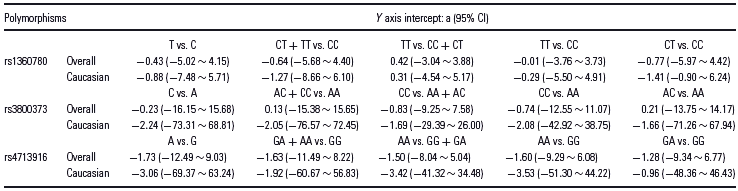
The results of Egger's linear regression test are shown in Table 3. It has been shown that there was no publication bias (all p > 0.05). For the association of FKBP5 gene rs4713916 polymorphism with mood disorders in the overall and Caucasian populations, Egger's linear regression test provided no evidence of publication bias (overall: t = −0.69, p = 0.564; Caucasian: t = −0.26, p = 0.839).
Egger's linear regression test to measure the funnel plot asymmetric
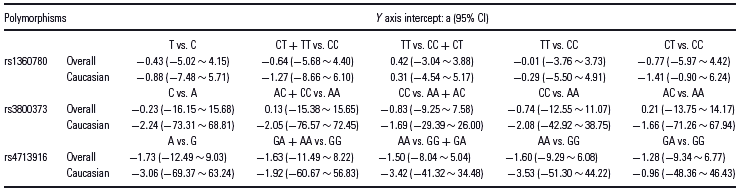
All p > 0.05.
Discussion
Mood disorders are common psychiatric disorders with a complex aetiology that likely involves multiple genes in addition to non-genetic influences (Reference Lee, Jeong, Kwak and Park1,Reference Fan, Liu, Jiang, Jiang, Zhao and Zhang6). An impaired signalling by cortisol-activated GR, leading to a weakened negative feedback regulation, appears to be one significant biological abnormality observed in mood disorders (Reference Holsboer10). FKBP5 is an important regulator of the GR activity (Reference Grad and Picard34). HPA axis also plays a role in other pathomechanisms of depression, such as inflammatory background or neurodegeneration (Reference Pace and Miller35,Reference Maes, Galecki, Chang and Berk36). Therefore, FKBP5 may play a role in the pathophysiology of mood disorders, and appears to be a good candidate for studies on the pathogenesis of mood disorders. Several studies have investigated the association of FKBP5 gene polymorphisms with mood disorders (Reference Binder, Salyakina and Lichtner14,Reference Zobel, Schuhmacher and Jessen16–Reference Gawlik, Moller-Ehrlich and Mende20). A positive result has been reported in patients with unipolar depression as compared to controls in the STAR*D study (Reference Lekman, Laje and Charney18). However, This finding is not supported by other studies (Reference Binder, Salyakina and Lichtner14,Reference Lavebratt, Aberg, Sjoholm and Forsell17,Reference Papiol, Arias, Gasto, Gutierrez, Catalan and Fananas19,Reference Gawlik, Moller-Ehrlich and Mende20). The negative results from these studies might be related to the lack of power (Reference Ioannidis, Ntzani, Trikalinos and Contopoulos-Ioannidis37). Recently, Zobel et al. (Reference Zobel, Schuhmacher and Jessen16) reported a positive result in patients with unipolar depression. Thus, we performed a meta-analysis to assess the association of FKBP5 gene polymorphisms with mood disorders.
In this study, we retrieved six separate studies that included data from 2655 cases and 3593 controls to evaluate the association between FKBP5 gene polymorphisms and mood disorders. A meta-analysis was performed for three FKBP5 gene polymorphisms (rs1360780, rs3800373 and rs4713916) in the overall and Caucasian populations. A significant association of FKBP5 gene rs4713916 polymorphism with mood disorders was found in the overall and Caucasian populations. However, we did not find the association of FKBP5 gene rs1360780 and rs3800373 polymorphisms with mood disorders. To our knowledge, the present meta-analysis is the first to assess the association between FKBP5 gene polymorphisms and mood disorders.
In our study, we found that the FKBP5 gene rs4713916 polymorphism GA genotype increased the risk of mood disorders in comparison to GG genotype. We further examined the contrast of GA versus AA, and found that GA genotype also increased the risk of mood disorders in comparison to AA genotype in the overall and Caucasian populations (overall: OR = 1.44, 95% CI = 1.09–1.90, p = 0.009; Caucasian: OR = 1.43, 95% CI = 1.09–1.89, p = 0.01). Egger's linear regression tests showed that there was no publication bias (overall: t = 1.09, p = 0.391; Caucasian: t = 1.48, p = 0.379). The result indicates that the heterozygous individual (GA genotype) is more susceptible to mood disorders in comparison to homozygous analogues (GG or AA genotype). Homozygosity for the minor allele T of SNP rs1360780, located <200 bp from a functional response element for progesterins and glucocorticoids in intron 2, has been associated with increased FKBP5 mRNA and protein expression (Reference Binder, Salyakina and Lichtner14). Increased FKBP5 activity would imply reduced GR activity and less efficient termination of stress, leading to an increased risk of stress-related psychiatric disorders (Reference Binder13). The promoter SNP rs4713916 is located in a putatively functional region (Reference Lekman, Laje and Charney18). Therefore, our results seem to support the assumption that heterozygous individual (GA genotype) of SNP rs4713916 may have higher FKBP5 mRNA and protein expression than homozygous analogues (A/A or G/G genotype). However, to date, the function of the FKBP5 gene rs4713916 polymorphism is unclear. Further studies on the function of the FKBP5 gene rs4713916 polymorphism and the association between the polymorphism and mood disorders are required. In addition, whether SNPs in strong linkage disequilibrium (LD) with it in other functional parameters is conferring the susceptibility to mood disorders is unknown (Reference Binder, Salyakina and Lichtner14).
Several specific details merit consideration in this meta-analysis. First, significant between-study heterogeneity was detected, and may be distorting the meta-analysis. A second consideration is that only published studies were included in the meta-analysis, and so publication bias may have occurred. A third consideration is that we could not do subgroup analysis by types of mood disorders because of unavailable data. These results should be interpreted with caution because different types of mood disorders may have different causes. A fourth consideration is that our results are based on unadjusted estimates and a more precise analysis could be performed if individual data were available. Finally, meta-analysis remains a retrospective research that is subject to the methodological deficiencies of the included studies.
In conclusion, our meta-analysis shows that there is a lack of association of FKBP5 gene rs1360780 and rs3800373 polymorphisms with mood disorders. There is an association between FKBP5 gene rs4713916 polymorphism and mood disorders, and the heterozygous individual (GA genotype) is more susceptible to mood disorders in comparison to homozygous analogues (GG or AA genotype). More studies based on larger sample size, case–control design and stratified by ethnicity are still needed in future research.
Acknowledgements
We thank all the people who have helped for this study. Special thanks to Dr Elisabeth B. Binder (Max-Planck Institute of Psychiatry, Kraepelinstr. 2–10, 80804 Munich, Germany) for her kind help. This work was supported by grants from the National Natural Science Foundation of China (81001283).