Introduction
Laryngeal carcinoma is the eleventh commonest cancer in men worldwide, and is the second commonest malignancy of the head and neck.Reference Chu and Kim1 More than 95 per cent of all laryngeal malignancies are squamous cell carcinomas, which are generally quick to invade and metastasise. The two major causes of squamous cell carcinoma treatment failure are metastasis (to regional lymph nodes or distant organs) and local recurrence. Currently, the prognosis of laryngeal squamous cell carcinoma is mainly based on clinical tumour–node–metastasis (TNM) staging. However, patients with laryngeal squamous cell carcinoma of the same stage often have different clinical outcomes.Reference Benasso, Bonelli, Numico, Corvò, Sanguineti and Rosso2 Therefore, we suggest that TNM staging alone is insufficient to precisely predict the disease prognosis. Thus, it is important to search for novel and easily detectable molecular biomarkers which can help clinicians to improve both their prognostic accuracy and their therapeutic interventions for laryngeal squamous cell carcinoma patients. However, the mechanisms of occurrence and development of this disease have not been fully explained. New approaches to the detection and treatment of laryngeal carcinoma are urgently needed.
The HuR RNA binding protein is a member of the embryonic lethal abnormal vision protein family.Reference Do, Araujo, Kalil, Bacchini, Bertoni and Unni3 This family includes the HuB, HuC, HuD and HuR proteins, and is generally believed to be involved in the development of the nervous system. The HuR gene was first found in cervical cancer HeLa cells by Wei et al. in 1996.Reference Ma, Cheng, Campbell, Wright and Furneaux4 Under normal circumstances, it is expressed more in the cell nucleus than in the cytoplasm. The HuR protein is a messenger RNA stability factor, and can enter into the cell nucleus from the cytoplasm and combine with the 3′ untranslated region (UTR) zone Adenine (A) and Uracil (U) nucleotides-rich element of the messenger RNA to enhance RNA stability. This mechanism is associated with carcinogenesis.Reference Ross5 The HuR protein is the only member of the embryonic lethal abnormal vision protein family that can enhance RNA stability. A large number of studies have shown that abnormal HuR expression is associated with the occurrence of a variety of cancers (e.g. breast, colon, ovarian and gastric.)Reference Denkert, Weichert, Winzer, Müller, Noske and Niesporek6–Reference Nabors, Gillespie, Harkins and King10 Abnormal HuR expression in these tumours would appear to be a universal phenomenon. Recently, using an immunohistochemical method, Cho et al. Reference Cho, Han, Soh, Lee and Son11 detected high levels of cytoplasmic HuR expression in laryngeal cancer tissues, indicating that abnormal HuR expression might be involved in the formation of laryngeal cancer.
Cyclooxygenase-2 is a key enzyme in prostaglandin biosynthesis, catalysing arachidonic acid into prostaglandin H2. Cyclooxygenase-2 plays an important role in inflammation and tumour development.Reference Dubois, Abramson, Crofford, Gupta, Simon and Van De Putte12, Reference Gupta and Dubois13 Cyclooxygenase-2 expression is rapidly increased in the presence of inflammation and tumour.Reference Kolev, Uetake, Iida, Ishikawa, Kawano and Sugihara14, Reference Cho, Kim, Kim, Jung and Song15 It is now known that high levels of cyclooxygenase-2 expression occur in many types of tumour cells; however, the exact causative mechanism is unclear.
Survivin is a structurally unique member of the inhibitors of apoptosis family of proteins, and is unique in being expressed in fetal tissue and in a variety of human cancers, but not in non-proliferating adult tissue.Reference Lu, Mu, Cao, Zeng, Schneider and Tan16 In addition to its function as an inhibitor of apoptosis, survivin is involved in the regulation of cellular proliferation and angiogenesis in cancer.Reference Kawasaki, Toyoda, Shinohara, Okuda, Watanabe and Yamamoto17 Increased survivin expression has been observed in the most common human neoplasms, including oesophageal cancer,Reference Kato, Kuwabara, Mitani, Shinoda, Sato and Toyama18 ovarian carcinoma,Reference Yin, Peng, Yang and Kang19 laryngeal carcinoma,Reference Wang, Kong, Xiong, Zhang and Sun20 colorectal carcinoma,Reference Fan, Dong, Jiang, Qian and Yu21 breast carcinomaReference Nassar, Sexton, Cotsonis and Cohen22 and lymphoma.Reference Liu, Zhang and Zou23 Most of these studies have found a negative correlation between survivin expression and patient prognosis; i.e. multivariate statistical analysis has shown that survivin expression is an independent prognostic factor for disease progression.Reference Knutsen, Adell and Sun24
Knowledge of the molecular mechanisms of endogenous RNA interference has expanded. The use of small interfering RNA segments has emerged as an innovative nucleic acid treatment for previously incurable diseases such as cancer. This treatment has many advantages, such as a high degree of specificity, high levels of efficacy and low toxicity.
Recently, some authors have stated that the stability of post-transcriptional messenger RNA translation is an important part of the process of tumour cell growth regulation and control.Reference Sachs25, Reference Garneau, Wilusz and Wilusz26 As a result, the regulation of messenger RNA stability and its effects on tumour aetiology have become popular research topics.
Related studies have found that HuR and cyclooxygenase-2 expression is increased in the cytoplasm of a variety of tumour cells, prompting the conclusion that HuR protein synthesis may increase cyclooxygenase-2 expression and thereby promote tumour cell proliferation.Reference Denkert, Weichert, Winzer, Müller, Noske and Niesporek6–Reference Mrena, Wiksten, Thiel, Kokkola, Pohjola and Lundin9 The HuR protein can combine with the 3′UTR zone Adenine (A) and Uracil (U) nucleotides-rich element of cyclooxygenase-2 messenger RNA to enhance the stability of this RNA in carcinoma cells, and this can increase cyclooxygenase-2 expression.Reference Sengupta, Jang, Wu, Paik, Furneaux and Hla27 In addition, high levels of cyclooxygenase-2 expression in tumour cells often coincide with high levels of survivin expression. Furthermore, the two are positively correlated: cyclooxygenase-2 selective inhibition can inhibit survivin expression.Reference Athanassiadou, Grapsa, Athanassiades, Gonidi, Athanassiadou and Tsipis28, Reference Li, Tong, Zhang, Wang, Chen and Wu29 Expression of both cyclooxygenase-2 and survivin involves the same molecular pathway.Reference Erkanli, Bolat, Kayaselcuk, Demirhan and Kuscu30
The present study aimed to assist the identification of an effective target for laryngeal carcinoma treatment. To this end, we used the laryngeal carcinoma Hep-2 cell line, which endogenously expresses HuR, cyclooxygenase-2 and survivin, to create an experimental model with which to investigate the effect of HuR small interfering RNA segment on the proliferation and apoptosis of laryngeal carcinoma cells. We analysed the molecular mechanisms of these effects, and attempted to provide experimental evidence to support the use of HuR small interfering RNA segments in the treatment of laryngeal carcinoma. We also assessed the correlation between the expression of the HuR, cyclooxygenase-2 and survivin genes.
Materials and methods
The study protocol was approved by the institutional review board of the Lihuili Hospital of Ningbo University.
Materials
Human laryngeal carcinoma Hep-2 cells were purchased from the Cell Bank of Shanghai Institutes of Life Sciences, Chinese Academy of Science, Shanghai, China. Dulbecco's modified eagle medium, Opti-MEM and LipofectamineTM 2000 were obtained from Invitrogen (Grand Island, California, USA). Fetal bovine serum was obtained from Biochrom (Berlin, Germany). Trizol reagent was purchased from Sangon (Shanghai, China). Materials for semi-quantitative reverse transcription polymerase chain reaction and Western blot were purchased from Haigene (Beijing, China). 3-(4,5-Dimethylthiazol-2-yl)-2,5-diphenyltetrazolium bromide and dimethylsulphoxide were purchased from Sigma (St Louis, Missouri, USA).
Cell culture
Hep-2 cells were cultured in Dulbecco's modified eagle medium supplemented with 10 per cent fetal bovine serum, 100 U/ml penicillin and 100 µg/ml streptomycin. Cultures were kept at 37°C in a 5 per cent CO2 atmosphere. Exponentially growing cells were used for experimentation.
Small interfering RNA segment transfection
We designed three pairs of double-stranded small interfering RNA oligonucleotide against the HuR gene. These three sequences were as follows: for HuR-54, 5′-GAACGAAUUUGAUCGUCAATT-3′ and 5′-UUGACGAUCAAAUU CGUUCTC -3′; for HuR-291, 5′-CGAGCUCAGAGGUGAUCAATT -3′ and 5′-UUGAUCACCUCUG AG CUCGGG-3′; and for HuR-493, 5′-CAGUUUCAAUGGUCAUAAATT-3′ and 5′-UUUAUGACCAUU GAAACUGGT-3′ (where G = guanine; A = adenine; C = cytosine; U = uracil and T = thymine). The Basic Local Alignment Search Tool was used to search the National Center for Biotechnology Information database for homology of these sequences to other known human genes; none was found. The oligonucleotide sequences were synthesised by Genepharma (Shanghai, China).
One day before transfection, Hep-2 cells were seeded into a 24-well plate, without antibiotics or serum, at a concentration of 1 × 10⁵ cells/well. Cell density was 60–70 per cent at the time of transfection. There were three cell groups: (1) small interfering RNA segment groups (i.e. cells were transfected with various doses of small interfering RNA segment (i.e. 0.2, 0.4 and 0.8 µmol/l); (2) empty Lipofectamine 2000 control groups (i.e. cells treated with Lipofectamine 2000 alone); and (3) blank control groups (i.e. untreated cells). All transfections were performed in triplicate for each treatment. When Lipofectamine 2000 was used, the medium was changed after 4 hours of incubation.
Twenty-four hours after transfection, cells were harvested and assays performed as described below. During the initial part of the experiment, we found that the interference effect of HuR-291 was stronger than that of HuR-54 or HuR-493, so we selected cells transfected with HuR-291 for the following assays.
3-(4,5-Dimethylthiazol-2-yl)-2,5-diphenyltetrazolium bromide assay
Hep-2 cells transfected with the HuR-291 RNA oligonucleotide were seeded into 96-well plates at a density of 5 × 10⁵/well. After incubation for 24 hours, 10 µl of 3-(4,5-dimethylthiazol-2-yl)-2,5-diphenyltetrazolium bromide was added directly to the microplate. Cells were then incubated for another 4 hours to allow the 3-(4,5-dimethylthiazol-2-yl)-2,5-diphenyltetrazolium bromide to be metabolised. Finally, the reaction was stopped with 100 µl dimethylsulphoxide, and the absorbance (A) values at 490 nm were measured. The survival rate was calculated using the following equation: survival rate (per cent) = A Test/A Control × 100 per cent. The inhibition rate was calculated using the following equation: inhibition ratio (per cent) = (1 − A Test/A Control) × 100 per cent.
Reverse transcription polymerase chain reaction
In order to analyse expression of the HuR, cyclooxygenase-2 and survivin genes in terms of messenger RNA levels, reverse transcription polymerase chain reaction was performed. A total of 1 × 10⁶ cells was collected and the total RNA content isolated using Trizol reagent. The amount of RNA was determined using the SmartSpec Plus spectrophotometer (Bio-Rad, Hercules, California, USA). Copy DNA was synthesised with 2 µg of the total RNA, using the Fermentas reagent (Fermentas Corporation; Beijing, China). Polymerase chain reaction primers for the HuR, cyclooxygenase-2 and survivin genes, and for an internal reference gene (β-actin), were designed using Primer 5.0 software, and synthesised by Invitrogen. The HuR primers were 5′-CGAAATTGACATCACTCAGC-3′ (forward) and 5′-TTCTACT GCCATCATTACACG-3′ (reverse); their product was 349 bp long. The cyclooxygenase-2 primers were 5′-ATTTATTAAGGTGGTGGAGCC-3′ (forward) and 5′-GCACCTACTGA ATTGGCTTC-3′ (reverse); their product was 434 bp long. The survivin primers were 5′-CACTCCAGCCTCTGTACTCAT-3′ (forward) and 5′-AAGCCTCATTCACAACCCT-3′ (reverse); their product was 437 bp long. The β-actin primers were 5′-GTGGGGCGCCCCAG GCACCA-3′ (forward) and 5′-CTCCTTAATGTCACGCACGAT TTC-3′ (reverse); their product was 540 bp long. After denaturation at 94° for 4 minutes, amplification proceeded at 94° for 30 seconds, 58° for 30 seconds and 72° for 50 seconds, for 35 cycles, followed by incubation at 72° for 10 minutes. Amplification products were separated on 1 per cent agarose gel and observed under ultraviolet light.
Western blot analyses
Hep-2 cells were harvested and lysed in radioimmunoprecipitation buffer. The protein concentration was determined by bicinchoninic acid protein assay (Perbio Science, Bonn, Germany). For Western blot analyses, 30 µg of total protein was applied per lane, prior to sodium dodecylsulphate polyacrylamide gel electrophoresis. Following transfer to nitrocellulose, the membranes were blocked with 5 per cent defatted milk powder for 1 hour, and then incubated with rabbit anti-human HuR antibody, anti-human cyclooxygenase-2 antibody or anti-human survivin antibody (1:1000 dilution) at 4° overnight and subsequently incubated for 1 hour with horseradish peroxidase labelled secondary antibodies (all from Santa Cruz Biotechnology, Santa Cruz, California, USA) at room temperature. The expression of β-actin (Sigma-Aldrich, Saint Louis, Missouri, USA) was used as a normalisation control for protein loading. Blots were developed using enhanced chemiluminescence plus reagent, and relative optical density was analysed using the Quantity One gel imaging system (Bio-Rad).
Statistical analysis
Data were expressed as means ± standard deviations (SDs). The Statistical Program for the Social Sciences (SPSS) for Windows version 16.0 software (SPSS Inc, Chicago, Illinois, USA) was used for statistical analysis. The chi-square test was used to compare the means of two groups, and statistical analysis of the data was then performed using the t-test. The correlation between HuR, cyclooxygenase-2 and survivin expression was clarified using the Spearman measure of agreement test. Differences were regarded as statistically significant if p values were less than 0.05.
Results
3-(4,5-Dimethylthiazol-2-yl)-2,5-diphenyltetrazolium bromide assay
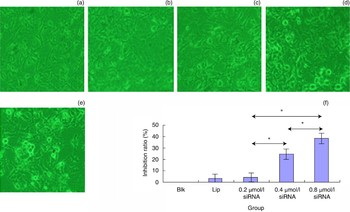
In order to evaluate the inhibitory effects of HuR small interfering RNA segment on the growth of Hep-2 cells, cells were treated with 0.2, 0.4 or 0.8 µmol/l of HuR small interfering RNA segment for 24 hours; cell viability was then determined by 3-(4,5-dimethylthiazol-2-yl)-2,5-diphenyltetrazolium bromide assay. As shown in Figure 1, HuR small interfering RNA segment inhibited the growth of Hep-2 cells in a dose-dependent manner. The inhibition ratios for the HuR small interfering RNA segment groups were statistically significantly higher than those for the Lipofectamine 2000 control group and the blank control group (p < 0.05, Figure 1). There was no statistically significant difference between the growth inhibition ratio for the Lipofectamine 2000 control group compared with the blank control group (p < 0.05).
Growth of Hep-2 cells 24 hours after transfection with various concentrations of HuR small interfering RNA segment (siRNA). Photomicrographs show Hep-2 cells treated with (a) nothing (i.e. blank control; Blk), (b) Lipofectamine™ 2000 control (Lip), (c) 0.2 µmol/l siRNA, (d) 0.4 µmol/l siRNA or (e) 0.8 µmol/l siRNA (×200). (f) Inhibition ratios for the various cell groups; *p < 0.05.

Reverse transcription polymerase chain reaction
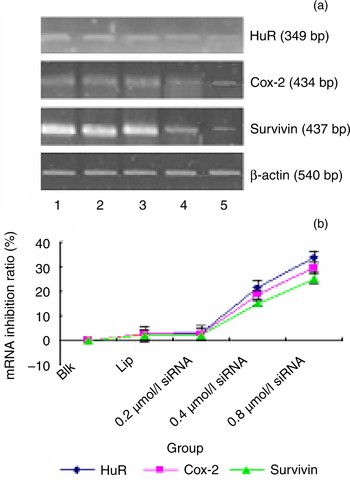
Expression of HuR, cyclooxygenase-2 and survivin gene messenger RNA was significantly inhibited by HuR small interfering RNA segment, compared with the control groups (Figure 2). These data suggest that HuR small interfering RNA segment can specifically inhibit the transcription of HuR, cyclooxygenase-2 and survivin messenger RNA in Hep-2 cells.
Reverse transcription polymerase chain reaction analysis of HuR, cyclooxygenase-2 (Cox-2) and survivin messenger RNA (mRNA) transcription in the various cell groups. (a) Appearance of amplification products on 1 per cent agarose gel under ultraviolet light; lane 1 = blank control (Blk), lane 2 = Lipofectamine™ 2000 control (Lip), lane 3 = 0.2 µmol/l HuR short interfering RNA segment (siRNA), lane 4 = 0.4 µmol/l siRNA, and lane 5 = 0.8 µmol/l siRNA. (b) Messenger RNA inhibition ratios for the various cell groups and proteins.

Western blot
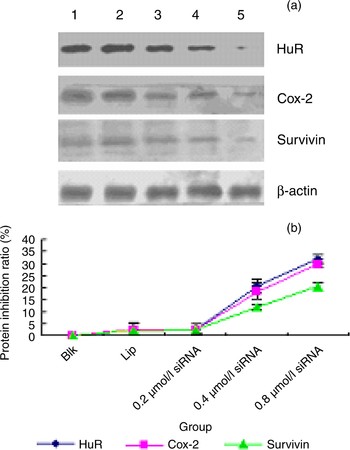
Western blot analysis showed that the levels of HuR, cyclooxygenase-2 and survivin in cell groups treated with HuR small interfering RNA segment were lower than those in the control groups, in a dose-dependent manner (Figure 3). This suggests that the expression of these three genes was suppressed by HuR small interfering RNA segment.
Western blot analysis of HuR, cyclooxygenase-2 (Cox-2) and survivin protein synthesis. (a) Membrane appearance; lane 1 = blank control (Blk), lane 2 = Lipofectamine™ 2000 control (Lip), lane 3 = 0.2 µmol/l HuR short interfering RNA segment (siRNA), lane 4 = 0.4 µmol/l siRNA, and lane 5 = 0.8 µmol/l siRNA. (b) Protein inhibition ratios for the various cell groups and proteins.

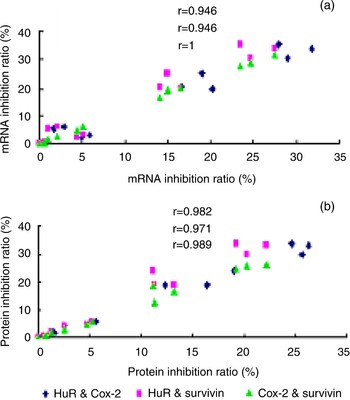
A correlation was observed between the changes in HuR gene, cyclooxygenase-2 gene and survivin gene messenger RNA transcription and protein synthesis (r > 0.9, p < 0.05; Figure 4).
Comparison of inhibition ratios for (a) messenger RNA (mRNA) and (b) protein, for the HuR, cyclooxygenase-2 (Cox-2) and survivin genes. Correlation coefficients for (a) were: HuR and Cox-2, r = 0.946; HuR and survivin, r = 0.946; Cox-2 and survivin, r = 1. Correlation coefficients for (b) were: HuR and Cox-2, r = 0.982; HuR and survivin, r = 0.971; Cox-2 and survivin, r = 0.989.

Discussion
Many studies have reported tumour occurrence to be closely related to a wide variety of signal transduction pathway changes, to mutation, deletion and/or over-expression of relevant genes, and to abnormal post-transcriptional protein translation.
In the current study, small interfering RNA segment directed against the HuR gene was transfected into laryngeal carcinoma Hep-2 cells. 3-(4,5-Dimethylthiazol-2-yl)-2,5-diphenyltetrazolium bromide assay revealed that Hep-2 cell proliferation was significantly inhibited following such transfection (Figure 1). This indicates that a reduction in HuR gene expression may markedly restrict the abnormal biological behaviour of tumour cells. After transfection with various concentrations of HuR small interfering RNA segment, HuR gene expression was obviously inhibited, as indicated by dose-dependent reductions in messenger RNA and protein levels (Figures 2 and 3).
Transfection of HuR small interfering RNA segment into Hep-2 cells was also observed to produce noticeable reductions in cyclooxygenase-2 and survivin gene expression (Figures 2 and 3). At present, the specific regulatory mechanisms linking the HuR, cyclooxygenase-2 and survivin genes are still unclear. This research confirmed that the HuR, cyclooxygenase-2 and survivin genes are involved in laryngeal carcinoma Hep-2 cell growth. Combined with other authors' findings, these results may support the existence of signalling pathway links.
Related research has found that the HuR protein can combine with the 3′UTR zone Adenine (A) and Uracil (U) nucleotides-rich element of cyclooxygenase-2 messenger RNA to enhance the stability of this RNA in carcinoma cells, leading to increased cyclooxygenase-2 expression.
In vitro study of rapidly metastasising lung cancer cells has found cyclooxygenase-2 expression to correlate positively with tumour invasion and with metastatic potential, while inhibition of cyclooxygenase-2 expression resulted in reduced metastatic potential.Reference Kozaki, Koshikawa, Tatematsu, Miyaishi, Saito and Hida31 High levels of cyclooxygenase-2 expression have been found in non-small cell lung cancer cells displaying anti-apoptotic properties; these cells also showed a concomitant, constant expression of survivin.Reference Krysan, Merchant, Zhu, Dohadwala, Luo and Lin32 Inhibition of cyclooxygenase-2 activity resulted in reduced survivin expression. Impairment of survivin gene expression, using RNA interference techniques, did not affect cyclooxygenase-2 expression. It has therefore been deduced that cyclooxygenase-2 acts as an upper regulator in the survivin expression pathway. Muchmore et al. speculated that the survivin and Bcl-2 genes (which are both regulated via a GC-rich non-TATA promoter) had a common mechanism of transcription regulation and a synergistic anti-apoptotic effect.Reference Muchmore, Chen, Jakob, Zakula, Matayoshi and Wu33 Sheng et al. found that prostaglandin E2, the main product of cyclooxygenase-2, could directly increase Bcl-2 expression.Reference Sheng, Shao, Morrow, Beauchamp and DuBois34 Prostaglandin E2 appeared to regulate apoptosis through blocking the release of cytochrome C from the mitochondria into the cellular cytoplasm. The link between cyclooxygenase-2 and survivin was located upstream of the cysteine protease caspase cascade. From this, we deduce that survivin and cyclooxygenase-2 may act through bcl-2 channels to inhibit apoptosis.
• Laryngeal carcinoma is the eleventh commonest cancer in men worldwide, and the second commonest head and neck malignancy
• This study was the first to investigate the effect of the HuR gene on laryngeal carcinoma Hep-2 cell growth; it also assessed the correlation between HuR, cyclooxygenase-2 and survivin gene expression
• Impairment of HuR gene expression, using RNA interference technology, was observed to significantly suppress Hep-2 cell proliferation
• The HuR gene may represent an effective target for gene therapy in laryngeal carcinoma patients; further studies are required to explore this possibility
Conclusion
This study used varying concentrations of HuR small interfering RNA segment to inhibit HuR gene expression and to suppress laryngeal cancer cell proliferation. These findings clarify the role of the HuR gene in laryngeal cancer development. Moreover, this study explored the links between the HuR, cyclooxygenase-2 and survivin genes, supplying further information on the mechanism of laryngeal carcinoma development, and also providing a new theoretical basis to assist the development of laryngeal cancer treatment.
Acknowledgement
This work was supported by a grant from the Ningbo Social Developmental Key Research Project (number 2008C50019).