Introduction
Pro rata ne (PRN) medication is frequently prescribed and administered in both acute psychiatric units and secure services (Stewart et al. Reference Stewart, Robson, Chaplin, Quirk and Bowers2012; Haw & Wolstencroft, Reference Haw and Wolstencroft2014a, Reference Haw and Wolstencroftb, Reference Haw and Wolstencroftc). Traditionally lorazepam and haloperidol, sometimes given in combination and either orally or intra-muscularly (IM), have been used as PRN to calm the patient, although more recently other drugs, such as promethazine and midazolam have been promoted for PRN and rapid tranquillisation (RT; TREC Collaborative Group, 2003; Parker, Reference Parker2015). The administration of calming medication to disturbed patients is a potentially risky act, since some drugs, notably haloperidol, can prolong the cardiac QTc interval placing the patient at risk of developing a dysrhythmia (Blom et al. Reference Blom, Bardai, van Munster, Nieuwland, de Jong, van Hoeijen, Spanjaart, de Boer, de Rooij and Tan2011). Haloperidol commonly causes unpleasant motor side effects, while benzodiazepines have the potential to cause respiratory depression. Use of PRN antipsychotics can also lead to creeping and inadvertent high dose antipsychotic administration (Milton et al. Reference Milton, Lawton, Smith and Buckley1998; Paton et al. Reference Paton, Barnes, Cavanagh and Taylor2008), although Haw & Wolstencroft (Reference Haw and Wolstencroft2014a) reported that this is an uncommon occurrence in clinical practice. A further problem with PRN medication is its propensity to lead to unforeseen and sometimes clinically important drug interactions, particularly those involving the cytochrome P450 enzyme systems, for example haloperidol interacting with co-codamol or zuclopenthixol (Davies et al. Reference Davies, Lennard, Ghahramani, Pratt, Robertson and Potokar2007).
Despite common use, the evidence base for the effectiveness of PRN medication in psychiatry is surprisingly weak (Chakrabarti et al. Reference Chakrabarti, Whicher, Morrison and Douglas-Hall2007; Srivastava, Reference Srivastava2009) and studies where there has been a unit ban on the prescribing of PRN medication have not demonstrated an increase in violence, restraint or seclusion, rather the opposite (Thapa et al. Reference Thapa, Palmer, Owen, Huntley, Clardy and Miller2003; Smith et al. Reference Smith, Davis, Altenor, Tran, Wolfe, Deegan and Bradley2008).
In a retrospective investigation of the use of PRN medication for 242 forensic rehabilitation inpatients over a two week period, PRN administration was associated with younger age, female gender, emotionally unstable personality disorder, detention in medium security and tended to occur early on in the course of their hospital stay (Haw & Wolstencroft, Reference Haw and Wolstencroft2014a). It was difficult to determine the circumstances under which PRN medication was being administered since case note documentation was often absent or lacked clarity, this being a finding of other studies of PRN administration in psychiatry (Usher et al. Reference Usher, Lindsay and Sellen2001; Curtis & Capp, Reference Curtis and Capp2003; Akram et al. Reference Akram, Slavin and Davies2014). None of the 542 doses of PRN doses studied by Haw & Wolstencroft (Reference Haw and Wolstencroft2014a) were recorded as constituting RT, suggesting that episodes of RT were not being recorded as such in patients’ case notes.
In view of the uncertainty surrounding the reasons behind the prescription and administration of calming PRN medication, the authors decided to carry out a survey of nurses’ views and reported clinical practice in two PICUs and two medium secure admission units (MSAUs). An additional aim was to compare the opinions of nursing staff with those of a group of psychiatrists working at the same hospital, some of whom were employed on the two PICUs, with the remainder working on secure wards. It was hypothesised that PICU nursing staff would be more in favour of PRN medication use than those nurses working on MSAUs, since most newly admitted PICU patients exhibit acute behavioural disturbance and hence require rapid stabilisation with medication. By comparison, all MSAU patients will have had a face-to-face assessment by ward staff prior to admission, most are less acutely disturbed and some will be quite stable at the time of admission. Also, MSAU patients are cared for in an environment with higher levels of physical and procedural security than those found in a PICU. We surmised that psychiatrists would hold less liberal views than nurses on the use of PRN medication. We also hypothesised that lorazepam and promethazine would be the most widely prescribed PRN drugs with much less use of haloperidol than in the past because of the recent introduction of ECG monitoring requirements (see Joint Formulary Committee, 2014) and its unpleasant motor side effects. Finally, we anticipated that most staff would define RT along the lines of the NICE guidelines on the short-term management of disturbed/violence (NICE, 2005), namely the use of medication to calm or lightly sedate the patient, reduce the risk to self and/or others and achieve an optimal reduction in agitation and aggression. The term ‘sedative PRN medication’ has been used in this paper, though strictly speaking there are some PRN drugs, such as aripiprazole, that have the ability to calm patients without being sedative. The use of sedative PRN medication was intended to include calming medication administered orally or intra-muscularly to a patient with the intention of alleviating agitation, violence or distress.
Method
Questionnaire
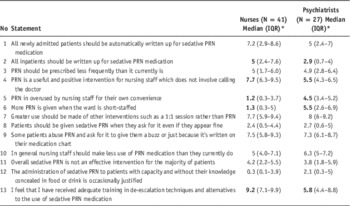
CH devised a structured questionnaire based upon clinical experience, earlier research concerning the prescription and administration of PRN calming medication (Haw & Wolstencroft, Reference Haw and Wolstencroft2014a, Reference Haw and Wolstencroftb, Reference Haw and Wolstencroftc) and a review of the research literature. The first part of the questionnaire consisted of 13 statements about the use of PRN sedation (see Table 1). Participants were invited to make a mark on a 10 cm visual analogue scale which best captured the strength of their opinion in relation to the patient group they were currently working with. For example, participants were asked to consider the statement ‘All inpatients should be written up for sedative PRN medication’. One end of the 10 cm line was marked ‘Strongly agree’ and the other end ‘Strongly disagree’. Participants then made a mark on the 10 cm line indicating where between the two extremes their opinion lay. The second part of the questionnaire first inquired about their job title, type of ward they worked on and the length of time they had worked in psychiatry. It then asked which drug they favoured for PRN use and the reasons for this. They were also asked if there were any sedative drugs they avoided prescribing or administering and the reasons for avoiding these medicines. Participants were asked to describe when, in their opinion, does the administration of sedative PRN medication become RT. Inquiry was made as to which, if any, gender and diagnostic groups the participant thought made the greatest use of PRN sedation. Finally, they were asked if they had ever administered PRN sedation covertly to a patient with capacity and if in their opinion this could be justified in an emergency situation.
Comparison of the responses of nurses to that of psychiatrists on strength of agreement concerning 13 statements about PRN medication

* Strength of agreement with the statement on a scale of 0–10
IQR=Inter-quartile range
Participants
During May to July 2014, the authors visited the wards and, with the permission of the ward manager, distributed questionnaires to all qualified nurses on duty at that time. Permanent, qualified nursing staff from two PICUs (one for male and one for female patients) and two MSAUs were invited to complete the questionnaire. As well as day staff, some night staff were also approached. Potential participants were provided with verbal information about the study and were also offered an information sheet about it. Permanently employed psychiatrists working either on one of the two PICUs or on secure wards within the hospital were also invited to participate.
Data analysis
Quantitative data were entered into an SPSS database (IBM Corp., 2011) and subject to a descriptive analysis. For each of the visual analogue scales, the point on the 10 cm line the participant had marked was converted into a 0–10 score to one decimal place. Median scores were calculated for different staff groups on the 13 statements about PRN and median number of years worked in psychiatry by PICU nurses and MSU nurses (non-parametric tests were used as the data were not normally distributed). We did not carry out any statistical analysis of the results as a power calculation showed the study was relatively underpowered.
Answers to the question ‘When does the administration of PRN sedation become rapid tranquillisation?’ were analysed using thematic analysis. CH classified individual participant’s responses to allow for the identification of key themes. Initially responses were analysed and a preliminary code assigned e.g. ‘RT is always IM’ or ‘RT is when there is a crisis’. We then went back to the original questionnaires to check that the coding scheme matched the data and to quantify the extent of each theme in the dataset. The thematic analysis was a theoretical one, since we were guided by previous research (Braun & Clarke, Reference Braun and Clarke2006). It was recognised that the researcher might bring preconceptions to the analysis of the data and that these assumptions could distort the interpretation of the data. It was envisaged that most participants would distinguish RT from the administration of PRN medication by the intention of RT to rapidly calm an acutely disturbed patient rather than by the route of administration of medication. A realist standpoint was adopted, seeking to understand the data in a straightforward way in which what participants said reflected their experiences and opinions.
Results
A total of 68 participants took part in the study. All 21 PICU nursing staff approached agreed to participate in the study. Similarly, all 20 nurses from the two MSAUs who were approached participated in the survey. Of the 29 psychiatrists invited to take part, 27 completed the questionnaire (9 consultants and 18 non-consultants). They had a median of 12 years (IQR 9–18 years) experience of psychiatry. Among the nursing staff, 5 were ward managers, 8 deputy ward managers and 28 staff nurses. There was little difference in the median number of years PICU nurses as compared to MSAU nurses had worked in psychiatry (PICU nurses, median 9.5 years (IQR 5.5–19.5 years) vs MSAU nurses median 7 years (IQR 3.3–11.8 years)).
Views on prescription and administration of PRN sedation
PICU nurses vs MSAU nurses
When the views of PICU nurses were compared with those of nurses working on MSAUs, no major differences of opinion were found in responses to the 13 statements about PRN medication. PICU nurses on average felt more strongly than MSAU nurses that all newly admitted patients should be prescribed PRN sedation (median score 7.9 vs 5.5).
Nursing staff vs psychiatrists
The scores for PICU nurses were then combined with those of nurses working on MSAUs (total number of nursing staff=41) and compared with those of all 27 psychiatrists who participated in the study (see Table 1). Psychiatrists and nurses appeared to be in broad agreement on a number of issues, for example that some patients abuse PRN, and that patients should not be given PRN medication if they ask for it when they appear to be fine. Both groups weakly disagreed with the statement that PRN sedation was for most patients an ineffective intervention. It was reassuring that most nursing staff and psychiatrists strongly disagreed with the statement that covert administration of PRN medication to a patient with capacity is occasionally justified, with nursing staff on average more strongly disagreeing with this statement than psychiatrists. There were, however, some differences of opinion between psychiatrists and nurses. Nursing staff were on average more likely than psychiatrists to believe that all inpatients should be written up for sedative PRN medication and to view PRN as a positive intervention for nurses which does not involve calling the doctor. Psychiatrists on average felt more strongly than nurses that PRN medication was overused by nursing staff for their own convenience and that more PRN is given when the ward is short-staffed. Nursing staff were on average more strongly of the opinion that they had received adequate training in de-escalation techniques and alternatives to the use of PRN medication than were psychiatrists. Yet despite this, both staff groups were of the view that greater use should be made of other (non-pharmacological) interventions.
Medication preferences for use as PRN sedation
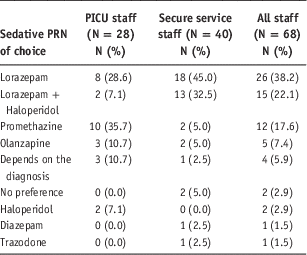
PICU staff (nurses and psychiatrists combined) favoured the use of promethazine followed by lorazepam as the drugs of choice for PRN sedation (see Table 2). Promethazine was favoured by a total of 12 participants as it was perceived as having fewer side effects (N=9/12; 75%), not to be addictive and therefore having less abuse potential (N=6/12; 50%), effective in calming patients (N=3/12; 25%), causing less respiratory depression than other drugs (N=1/12; 8%) and that patients prefer it (N=1/12; 8%) (participants could express more than one reason for believing a particular drug was superior to other PRN medicines). By contrast staff working in secure settings (nurses working on the two MSAUs and psychiatrists working on LSU and medium secure units) named lorazepam on its own followed by the combination of lorazepam and haloperidol as their PRN drug of choice. A total of 26 participants favoured lorazepam. The benefits of lorazepam when used alone were it: is quick-acting (N=11/26; 42%); is effective in calming patients (N=8/26; 31%); has fewer side effects (N=6/26; 23%); is short-acting (N=5/26; 19%); is frequently prescribed (N=2/26; 8%); is reversible (N=1/26; 4%); causes less respiratory depression than other PRN drugs (N=1/26; 4%); is safe (N=1/26; 4%); and is easy to administer (N=1/26; 4%). A total of 15 participants preferred to use haloperidol and lorazepam together. They gave the following reasons for their preference, it: is an effective combination (N=5/15; 33%); has useful antipsychotic properties for patients with psychosis (N=4/15; 27%); is quick-acting (N=3/15; 20%); is short-acting (N=2/15; 13%); and can be administered orally (N=1/15; 7%).
Comparison of PRN sedation preferences of PICU and secure service staff

Medicines to be avoided for use as PRN sedation
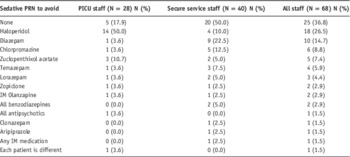
When asked which drug(s) participants would avoid using for PRN sedation, 14/28 (50%) of PICU staff named haloperidol, though 5/28 (17.9%) said there were no drugs they would avoid and 3/28 (10.7%) named zuclopenthixol acetate (Acuphase) as a drug they would avoid using for PRN (see Table 3) (NB participants could cite more than one medicine they would avoid). By contrast 20/40 (50%) of non-PICU staff stated there were no drugs they would avoid using as PRN and only 4/40 (10%) said they would not use haloperidol. A minority (9/40; 22.5%) said they would avoid using diazepam while 5/40 (12.5%) would not use chlorpromazine.
Comparison of PRN sedation avoidances of PICU and secure service staffFootnote *

* Some staff cited more than one sedative they would avoid giving as PRN
The 18 participants who would avoid haloperidol said they would do so mainly because of extra-pyramidal side effects (N=10), the drug having more and more unpleasant side effects than other PRN medicines (N=6), the risk of oculo-gyric crises (N=2) and tardive dyskinesia (N=1). Cardiac side effects were mentioned by five participants and four stated the patient needed to have an ECG before haloperidol could be administered and so for that reason it was not a useful PRN drug for newly admitted patients (NB some participants cited multiple reasons for avoiding particular drugs as PRN). A total of 10/68 (14.7%) participants said they would not use diazepam as a PRN for the following reasons: abuse and addiction by patients (N=3), slow onset of sedation (N=2) and risk of respiratory depression (N=1) (NB four participants did not give a reason for avoiding diazepam).
When does the administration of PRN sedation become RT?
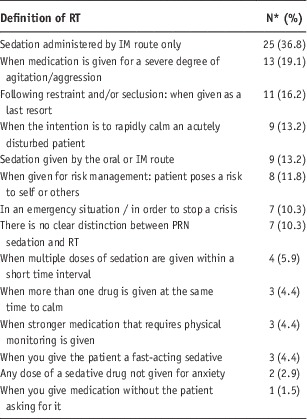
We asked all 68 participants about how they would distinguish the administration of PRN medication from RT. The full range of responses is given in Table 4. The most common response (25/68 participants; 36.8%) given was that RT was sedation given by the IM only, whereas PRN was usually administered orally. The second most common definition of RT concerned its use to treat severe agitation or aggression (13/68; 19.1%). Other common responses included it being a treatment of last resort when all other measures had failed (11/68; 16.2%) and when the indication for administering medication was to quickly calm an acutely disturbed patient (9/68; 13.2%). Some (7/68; 10.3%) participants felt there was no clear distinction between PRN medication administration and RT, while a few (4/68; 5.9%) talked about RT being the use of multiple doses being administered within a short space of time or more than one drug being given at the same time (3/68; 4.4%).
When does the administration of PRN sedation become RT?

* Participants could express more than one way of distinguishing PRN sedation from RT.
Discussion
This is one of only a few studies that has examined the views of nurses and psychiatrists concerning the use of sedative PRN medication in inpatient psychiatry. In an Australian study, Usher et al. (Reference Usher, Baker, Holmes and Stocks2009) used qualitative methods to explore nurses’ and doctors’ decision-making surrounding the administration of PRN psychiatric drugs and identified four main themes (decision-making processes, factors influencing prescription and administration of PRN, individual protocols and improving practice). The authors concluded that nursing staff needed an educational intervention concerning the appropriate use of PRN medication and that regular audits should be undertaken of clinical practice in relation to best practice standards for the use of PRN sedation. In our own study PICU and MSAU nursing staff appeared to hold very similar views whilst psychiatrists held more conservative views about the use of PRN medication, believing more strongly that PRN drugs are over-used by nurses and that more PRN medication is administered when the ward is short-staffed. Geffen et al. (Reference Geffen, Cameron, Sorensen, Stokes, Roberts and Geffen2002) also found that doctors and nurses entertained rather different sets of expectations about the circumstances under which PRN medication should be given. For example, there were differences between the two professions with respect to the numbers of indications for using PRN antipsychotics and benzodiazepines and less experienced staff had less knowledge of non-pharmacological alternatives to PRN medication. In our study, nurses were more strongly of the view that they had received adequate training in de-escalation despite receiving the same mandatory training and annual refresher course as psychiatrists.This difference could relate to the fact that nurses are more familiar with the use of de-escalation techniques as they have much greater patient contact than psychiatrists.
Both nurses and psychiatrists expressed disagreement over the statement that ‘The administration of sedative PRN to patients with capacity and without their knowledge concealed in food or drink is occasionally justified’. Nurses’ disagreement with the statement was stronger than psychiatrists. There has been concern about the covert administration of psychotropic medication, especially antipsychotics, to patients with dementia resident in nursing homes (All-Party Parliamentary Group on Dementia, 2008). Covert administration of medication in food and drink occurs among 1.5–17% of institutionalised patients (Haw & Stubbs, Reference Haw and Stubbs2010). Ethically and clinically it is clear that covert administration is only appropriate in patients who lack capacity and following the completion of a Mental Capacity Act (2005) best interest checklist by the patient’s multi-disciplinary team with consultation of carers and relatives. In practice its use in psychiatry is restricted to patients with severe cognitive impairment (dementia) leading to permanent loss of capacity to consent to treatment with respect to medication administration.
Regarding the PRN drug of choice, PICU staff differed from staff working in secure services in preferring promethazine. Non-PICU staff preferred lorazepam or the combination of lorazepam and haloperidol, this despite the recent introduction by the manufacturers, Janssen-Cilag, of the requirement for a pre-treatment ECG before commencing haloperidol outlined in the Summary of Product Characteristics (SPC) from 2010 onwards. The combination of IM haloperidol with IM lorazepam for RT is supported for the emergency management of behavioural disturbance in the context of acute psychosis by the NICE Guidelines (NICE, 2005), although new guidance on RT is expected to be published in 2015. Recent NICE advice concerning the use of IM promethazine only considers its use in RT when combined with IM haloperidol and finds the evidence for safety and efficacy to be no better than existing RT drugs (NICE, 2014). The use of promethazine alone or in combination with lorazepam has not been addressed in the literature. Promethazine use is likely to have increased in the UK due to the recent shortages in the supply of lorazepam injection. Its use for RT and as PRN sedation in psychiatry is off-label, which is another area of difficulty since acutely disturbed patients are unlikely of being able to give informed consent to its use in urgent situations. Notable was the finding that promethazine was the most popular PRN drug named by PICU staff whereas it was rarely considered the drug of choice by staff working in secure settings. Haloperidol, often in combination with lorazepam, was favoured by a sizeable minority of staff, most of who were working in secure units and not PICUs. Consistent with this finding was the observation that PICU staff showed greater recognition of the potentially serious side effects of haloperidol, though only a handful mentioned the requirement to carry out an ECG to check the QTc interval prior to drug administration. In a recent review of 45 RT documents in the UK, Innes & Sethi (Reference Innes and Sethi2013) found that there was little consensus concerning which drugs should be used for RT apart from oral or IM lorazepam, haloperidol and olanzapine. These authors recommended that national consensus guidelines be developed for RT so as to rationalise prescribing.
In our own study it was notable that the commonest definition of RT given by participants was sedation administered by the IM route, with fewer participants stating RT could also include oral sedation. This latter point is clearly made in the current NICE guideline on the management of aggressive and disturbed behaviour (NICE, 2005). However, in the draft revision of this guideline the latest definition of RT no longer includes medication administered by the oral route. Some participants grasped the essence of the existing 2005 NICE definition, namely the intention to rapidly calm a disturbed patient but many did not and some stated that there was no clear distinction between RT and the administration of sedative PRN medication.
Limitations
The study was conducted within a single organisation, a charity outside of the NHS, although almost all patients are funded by the NHS. Thus, the generalisation of the findings to other settings cannot be assumed. Participants were given a questionnaire to complete. Had we instead interviewed them we might have obtained richer and greater volume of comments than we did by asking them for their written comments. A further limitation was that participants were not entirely randomly recruited – the authors went to the wards to be included in the study and handed out questionnaires to all staff on duty; psychiatrists working on these wards were also asked to participate. The study was underpowered due to the relatively small number of participants and so statistical analysis was not possible.
As far as further research into the use of PRN medication in psychiatry is concerned, prospective observational studies involving the observation of medicines administration and the interviewing of nursing staff after they have administered PRN sedation would shed light on current clinical practice, including the exact reasons for the administration and choice of PRN medication. Prospective studies examining the effectiveness or otherwise of PRN medication, with use of objective rating scales, are also needed as are regular audits of case note documentation of PRN prescribing and administration as this is an area where improvement is recognised to be needed (Usher et al. Reference Usher, Lindsay and Sellen2001; Baker et al. Reference Baker, Keady, Hardman, Kay, Jones and Jolley2010; Haw & Wolstencroft, Reference Haw and Wolstencroft2014a).
Conclusion
In conclusion, nurses held more positive views about the use of PRN medication than psychiatrists. Both groups agreed that greater use of non-pharmacological means of calming patients was desirable. There were differences in the preferred PRN drug between PICU and MSAU staff. The continued popularity of haloperidol as a PRN medication was concerning given its side effects. Given the confusion over what constituted rapid tranquillisation and its distinction from PRN medication, further clarity of these definitions would be helpful.
Acknowledgement
My thanks to Professor Jackie Campbell at the University of Northampton for statistical advice.
Financial support
This research received no specific grant from any funding agency, commercial or not-for-profit sectors.
Ethical standards
This study was deemed to be a service evaluation of current clinical practice and hence not to require Research Ethics Approval. It was, however, approved by the Head of Clinical Effectiveness.