

THROUGH regulation, taxation, or outright expropriation, government policies can depress the value of a firm’s assets. Where property rights are strong, firms have recourse against such policies, which may deter the government in the first place. Where property rights are weak, firms lack such recourse and are exposed to political risk. How do firms protect themselves against their own government in environments with weakly institutionalized property rights? We develop a theory based on asymmetries in access to international law that identifies financial relationships between firms as a response to weak property rights. By forming financial relationships with foreign firms, domestic firms tap into the protections available to foreign firms through international law.
Because governments expand the rights afforded to foreign firms through international law, foreign firms frequently enjoy stronger property rights than domestic firms. Investment treaties and investment chapters in trade agreements allow foreign firms to initiate arbitration against host governments.Footnote 1 By raising the cost of property rights violations, both through compensation for damages and the reputational costs of arbitration, these agreements reduce the threat of government predation. For firms with access to such protections, international law thus substitutes for weak domestic property rights.Footnote 2
Investment agreements protect foreign firms but are not available to domestic firms. We demonstrate how this segmentation of the property rights environment creates a rationale for financial relationships between firms through which a foreign firm covered by international law acquires a stake in a domestic firm. Such financial relationships allow domestic firms to benefit indirectly from the protections of international law. Any damage to the domestic firm’s assets also reduces the value of the foreign firm’s assets. If a government is reluctant to violate the rights of a foreign firm that is protected by international law, it is also less likely to damage assets the firm holds jointly with domestic partners. At the core of this mechanism is an observation about asset ownership more generally. A policy that harms the value of an underlying asset harms all owners of related assets indiscriminately; a government therefore cannot isolate the effects of its policies to individual asset owners.
We evaluate an observable implication of our theory: as property rights deteriorate, more firms should seek financial relations with foreign firms covered by investment agreements. Data on the activities of firms in countries that have investment agreements with the United States, the world’s largest and deepest financial market, provide systematic evidence. We construct a data set of mergers and acquisitions (m&as) through which a US firm (as a foreign entity) acquires a stake in a domestic firm in another country. In additional results, we also evaluate when domestic firms issue bonds and equity. We find that the weaker a country’s property rights, the more its domestic firms form relationships with US firms that are protected by investment agreements. Our research design establishes that the results are driven by asymme-tries in access to international law. The negative association between property rights and financial relationships between firms disappears when potential partner firms lack access to arbitration under investment agreements.
The notion that the involvement of foreign firms offers protections to domestic firms is closely related to work by Stanislav Markus, who documents that Russian and Ukrainian firms with foreign connections perceive fewer threats to their property rights because foreign stakeholders “usually work through backdoor lobbying” to protect affiliated domestic firms,Footnote 3 and at times enjoy access to foreign courts that is not available to domestic firms.Footnote 4 We expand on his argument in two ways. We develop a theory around the asymmetry between domestic and foreign firms created by international investment law, and we document how firms systematically seek out connections to foreign firms in response to weakly institutionalized property rights.
The theory we develop contributes to the literature on firms’ responses to government predation. How firms respond to weak property rights is a prominent question in the literature on state development.Footnote 5 It motivates research on the value of political connectionsFootnote 6 and the effects of capital mobility.Footnote 7 We identify an additional response to weakly institutionalized property rights. Rather than moving assets out of the government’s reach, domestic firms can form financial ties with foreign firms to benefit from the protections available through international investment agreements. Our theory therefore emphasizes a broader phenomenon: domestic political contests and theories of domestic politics are reshaped in the context of international markets and international institutions.Footnote 8
Our work also offers a new perspective on international financial flows. The literature on foreign direct investment typically emphasizes the motivations of multinational corporations for investing abroad,Footnote 9 but the motivations of domestic firms for partnering with foreign firms are often ignored.Footnote 10 Existing explanations focus on economic considerations: technology transfers, improvements in corporate governance, or access to financing in constrained credit markets.Footnote 11 We add a political explanation of international financial flows that is driven by domestic firms. The fragmentation of ownership stakes across jurisdictions enables firms to engage in a variant of forum shopping,Footnote 12 reinforcing the asymmetry between firms and governments in the investment regime where only firms can initiate disputes.Footnote 13
In this view, access to international law arises as a source of comparative advantage, suggesting new distributional consequences: firms with access to international law are more attractive partners than firms without such access, and firms that can secure foreign partners enjoy elevated protections relative to domestic competitors. Our focus on financial relationships between firms complements recent political economy models that emphasize the importance of relationships between firms through global supply chains for understanding firm and government behavior.Footnote 14 While this literature is based on the fragmentation of production processes across jurisdictions, we offer a political logic to the fragmentation of ownership stakes across jurisdictions, and we direct attention to the ownership structure of firms as a fruitful area for research.
Foreign Ownership as a Source of Property Rights
In this section, we discuss how weak property rights motivate domestic firms to form financial relationships with foreign firms to gain indirect protection against costly government policies. We consider a financial relationship to be any transaction in which a foreign firm acquires a financial interest in a domestic firm. The domestic firm does not move its assets abroad and out of the government’s reach but instead sells a portion of its assets to the foreign firm; the assets remain within the government’s jurisdiction.
For domestic firms, forming such financial relationships with foreign firms has many potential benefits: foreign firms can provide access to financing in exchange for an ownership stake in the firm,Footnote 15 they can strengthen firm-specific corporate governance,Footnote 16 and joint asset ownership can encourage technological and managerial spillovers.Footnote 17
We emphasize another attractive attribute of foreign firms that complements these advantages. Assets held by foreign firms are frequently protected by international investment agreements. Foreign ownership may therefore deter government policies that are costly to domestic firms. Such trading of property for property rights should be most attractive to domestic firms where property rights are weak, and it should be limited to foreign firms that are covered by international law. The theory is based on a simple formal model that we summarize after presenting the theory in more detail.
Policy choices by a government can be costly to domestic firms. Government policies may reduce a firm’s profits through taxation, outright expropriation, breach of contract, or new regulations. Implementing damaging policies may be beneficial to the government if it receives taxes or support from constituents for implementing these policies. We make no presumption that the reduction in the value of the firm’s assets is intentional or that the government is responsible for the initial loss. The government’s failure to enforce contracts impartially or to assert control over its bureaucracy, for example, may also be interpreted as damaging policies.Footnote 18
Frequently, firms lack recourse against such actions. Domestic property rights shape the ability of a firm to seek redress. Strong property rights are not equivalent to the absence of government action, and governments in countries with strong property rights may still enact legislation that is harmful to firms.Footnote 19 But where domestic property rights are strong, a domestic firm is more likely to have recourse and to be compensated for the damaging policy or to have the offending policy reversed, for instance, through the legal system. In turn, where property rights are weak, firms are more concerned about government predation.Footnote 20
For firms, the protection of domestic property through a rule-based system should be preferable to alternative mechanisms, such as reliance on political connections. Although political connections to bureaucrats and policymakers can be profitable while they exist,Footnote 21 a firm that is privileged by a government today cannot guarantee that these privileges will continue in the future. For instance, changes in a government’s support coalition may induce the government to implement damaging policies.Footnote 22 Mere rumors of an impending leadership change can depress the valuations of politically connected firms.Footnote 23 The volatility of policy and privileged access to the government, without recourse to a rule-based system, can be concerning even for influential elites.
International investment agreements provide such a rule-based system of property rights. Foreign firms that are covered by investment agreements, such as a bilateral investment treaty (bit) or a trade agreement with investment chapters, enjoy additional protections over domestic firms.Footnote 24 Most important, many investment agreements allow foreign firms to dispute government actions through arbitration proceedings at an international tribunal if they perceive their rights to have been violated. The International Centre for Settlement of Investment Disputes (icsid), which is housed at the World Bank, is the most prominent tribunal. Other arbitration bodies include the United Nations Committee on International Trade Law and the International Criminal Court.Footnote 25 If a ruling is issued, the reputational and economic costs of not following through on it often compel governments to provide compensation to foreign investors.Footnote 26
Beyond granting access to arbitration, investment agreements frequently have stipulations about what constitutes permissible government regulation. The content of these stipulations may exceed what would be covered under domestic law. The protections afforded by investment agreements can be far-reaching, regardless of government intent. As noted in a 1984 ruling against Iran, “The intent of the government is less important than the effects of the measures on the owner [of the assets], and the form of the measures of control or interference is less important than the reality of their impact.”Footnote 27 These features of investment agreements have drawn strong criticism, partly because they grant foreign firms effectively stronger property rights than what is available to domestic firms, both in terms of the scope and strength of the protections.Footnote 28
Additionally, investment agreements clarify the standards against which government behavior can be evaluated, making it easier to identify violations and facilitating the creation of reputational penalties.Footnote 29 By contrast, where appropriate government behavior is vaguely defined, violations are more difficult to assess. Clarifying these stipulations and the protections they entail is valuable to foreign asset owners.
That international firms typically enjoy stronger property rights than domestic firms is also evidenced in surveys and expert interviews. Even where foreign firms perceive substantial political risks, they still receive better treatment than their domestic counterparts.Footnote 30 The protections for foreign firms entailed under common rules in investment agreements surpass even those in firm-friendly environments such as the United States.Footnote 31 In brief, as Andrew Kerner notes, investment agreements protect foreign investors “above and beyond what can be achieved with domestic law”; domestic investors, meanwhile, “must face a legal system that is often slower, more capricious and less investor friendly.”Footnote 32
Consequently, foreign firms frequently have greater recourse against government actions than domestic firms. In addition to whatever recourse is available domestically, some foreign firms—those firms whose investments are covered by an investment agreement between their home government and the host government—enjoy access to a rule-based system of property rights through international law. Domestic firms, by contrast, do not gain coverage under investment agreements.
For example, when the South African government wanted to address historical inequalities in the mining sector by terminating existing mining rights and mandating that black South Africans receive a 25 percent ownership share, foreign mining companies sued in the icsid;Footnote 33 domestic miners had no such recourse. The case ended in a settlement. The claimants withdrew their cases and paid some of South Africa’s litigation costs. In exchange, the mandated ownership share of black South Africans was dropped to 5 percent for the claimants but remained at 25 percent for domestically owned mining companies.
Foreign firms protected by investment agreements are therefore attractive partners for domestic firms. For the foreign firm, acquiring the assets of domestic firms can prove lucrative. Where property rights are weak, domestic financial markets tend to be underdeveloped, implying above average returns to firms willing to enter these markets.Footnote 34 Relatedly, if the threat of government predation makes it difficult for domestic firms to enter and remain in the market, foreign firms that enjoy elevated protections through investment agreements have advantages over competitors. To the extent that access to arbitration substitutes for weakly institutionalized property rights,Footnote 35 the foreign firm may not even be overly concerned with the domestic property-rights environment.
Anecdotal evidence documents that attracting foreign owners is recognized by firms, governments, and arbitration bodies alike as a strategy to gain coverage under investment agreements. In 2005, the Panamanian firm La Mina Hydro-Power Corporation was awarded (but later lost) a contract to build a power plant in Panama. When its attempts at domestic arbitration failed, La Mina formed an international partnership with the US firm Transglobal Green Energy (tgge). tgge filed an icsid claim against Panama in 2013 for breach of contract under the investment agreement between Panama and the United States. The Panamanian government challenged the jurisdiction of the icsid on five counts, among them that the partnership was created only “in order to create an international dispute over a pre-existing domestic dispute.” Because the relationship between La Mina and tgge was created after La Mina lost the contract and domestic litigation had been resolved, tgge should not have reasonably expected a profit from the defunct contract. The icsid ultimately ruled in Panama’s favor, rejecting La Mina’s claims.Footnote 36
Although in this case foreign ownership was added too late to gain compensation, the example illustrates that domestic firms are aware of the benefits of foreign owners for accessing arbitration. Foreign asset ownership can also provide a deterrent effect by preventing the government from implementing costly policies. The deterrent effect of potential arbitration combines with a feature of joint asset ownership—the inability of the government to discriminate between domestic and foreign owners of the same underlying asset to provide indirect protection to the domestic firm.
Even if the government knows that a foreign firm holds a specific percentage of a firm’s assets, it cannot draft policies that discriminate between assets held by the domestic and the foreign firm. Any reduction in the value of the domestic firm’s assets also affects the value of the assets held by the foreign firm because they are based on the same underlying business.
This mechanism is best illustrated in the case of equity stakes: any government action that depresses equity values affects all owners of that equity, regardless of the size of their equity stake or their nationality. Consequently, policies targeted at domestic firms hurt the property rights of foreign owners of those firms, and, if the foreign firm is covered under an investment agreement, actions that hurt the foreign firm’s assets may violate the government’s commitments under the investment agreement.
If the government implements a policy that hurts the domestic firm’s assets, a foreign firm covered by an investment agreement and holding some of these assets can therefore seek compensation through international arbitration. Because the foreign firm has this additional channel to obtain compensation, relative to the domestic firm, foreign ownership increases the costs to the government of implementing damaging policies. In turn, this effect reduces the overall probability that the government will implement harmful policies. Thus, access to arbitration deters costly government policies.
The deterrent effect of arbitration is a prominent mechanism to explain the efficacy of investment agreements. Investment agreements are expected to increase foreign direct investment because of the potential costs of arbitration, which should reduce the instances of costly government actions in the first place.Footnote 37 And although the details of arbitration at the icsid remain undisclosed in many cases, the icsid publishes its caseload, making it possible to identify the governments that have become subject to disputes.Footnote 38 The process of arbitration can be enough to sour investors’ perceptions of a country’s investment climate, regardless of the outcome, and can reduce future investment flows.Footnote 39 Concerns about reputation reinforce the costs of compensation and reduce the likelihood that a government will implement damaging policies toward assets owned by foreign firms.
The regulatory chill recently ascribed to investment agreements is similarly driven by deterrent effects. Krzysztof Pelc documents the deterrent effects of threatened disputes against Canadian tobacco and Indonesian mining regulations and notes that governments may also be deterred by the precedent set by disputes levied against other governments.Footnote 40 The deterrent effect can also be seen in the growing perception by governments that existing treaties constrain their policy options. Based on experiences with litigation in the past, governments seem to be shying away from new investment agreements.Footnote 41 Many leaders in Latin America have “viewed the spread of [investment] treaties as a threat to their countries’ sovereignty.”Footnote 42 The US–EU Transatlantic Trade and Investment Partnership and the EU–Canada Comprehensive Economic and Trade Agreement floundered due to concerns over the constraints imposed by their investment chapters. Governments have become increasingly reluctant to agree to investment chapters, because the aim of litigation is “not only to obtain compensation but also to deter governments’ regulatory ambitions.”Footnote 43
The decision to implement damaging policies is frequently more complex than a central policymaker opting for one policy or another. For example, domestic interest groups may demand regulation, or policymakers from different branches of government may reach a compromise. But even in complex policy environments, international law can shape the political debate and tip decisions toward compliance.Footnote 44 This was evident, for instance, when the Guatemalan government considered challenging a gold mine owned by Goldcorp, a Canadian mining company with access to international arbitration. Several domestic interest groups, as well as citizens, supported restrictions on the mining operation. Internal government documents show that the decision not to challenge the operation of the gold mine was shaped by the fear of Goldcorp taking advantage of its “access to international arbitration and subsequent claims of damages to the state.”Footnote 45 The threat of litigation tilted the debate against imposing restrictions on Goldcorp.
In short, investment agreements plausibly have a deterrent effect, in particular in the perception of governments. This effect is key for theories identifying a constraining effect of investment agreements, it is corroborated by recent evidence, and it is echoed by government concerns about infringements on state sovereignty. The prominence of investment arbitration in public debates about the global investment regime further increases the likelihood that domestic firms are aware of its possible deterrent effect, which may mobilize them to pursue financial relationships with foreign firms.
Of course, deterrence will not completely eliminate government policies that are costly to firms. Governments may intentionally violate international law, and international investment law is contested on many issues. For example, as Benjamin Graham, Noel Johnston, and Allison Kingsley point out, although protections against expropriation and discriminatory policies “are almost universally accepted, the right to unfettered repatriation of capital is not.”Footnote 46 Similarly, governments and firms may disagree about the interpretation of treaty clauses and the applicability of specific stipulations. Nonetheless, even where international law is contested, foreign asset ownership should increase the prospects for deterring costly government actions relative to the absence of any foreign involvement.
The following example illustrates the deterrent effect of foreign ownership. The Russian wireless operator Vimpelcom successfully used foreign investors with access to investment arbitration to deter government predation. In 2004, regulators claimed that Vimpelcom lacked proper licensing and they filed a criminal case and issued a $157 million back-tax bill.Footnote 47 The case was plausibly politically motivated, stemming from a conflict between the majority shareholder and a government official. But 30 percent of Vimpelcom was owned by Telenor, a phone company that is majority-owned by the Norwegian government. Telenor had legal redress through investment arbitration because Russia had signed a bit with Norway (in force since 1998) that provided access to arbitration for Vimpelcom’s foreign owner. In the shadow of potential arbitration and leveraging its political contacts, Vimpelcom reached a settlement with the Russian government that resolved the issue and reduced the tax bill by almost 90 percent, to $17 million.
For domestic firms, selling assets to a foreign firm presents a tradeoff. The domestic firm gives up assets and, potentially, autonomy over its operations. In exchange, it benefits indirectly from the deterrent effect of joint asset ownership. Thus, the domestic firm can effectively trade property for property rights. This trade-off implies an observable implication that we derive formally in the following section: selling assets to foreign firms should be most attractive where domestic property rights are weak because the added protection from foreign ownership is most valuable. We make no presumption that this is the only motivation for seeking out foreign firms as business partners; it complements other motivations, such as gaining access to new capital and technology.
Our discussion also suggests an alternative explanation. Weak property rights may encourage foreign firms to acquire the assets of domestic firms as much as they encourage domestic firms to sell their assets to foreign firms. Their advantages over domestic firms may drive foreign firms with access to international arbitration to invest in markets with weak property rights. We therefore strive in the empirical analysis to account for the incentives of foreign firms. In particular, we show that the results are not driven by covered foreign firms making investments.
A Formal Model of Financial Relationships Between Firms
To establish observable implications of our theory, we consider a simple model with three actors: the government, a domestic firm, and a foreign firm. The domestic firm has profits worth r. It may form financial relationships with a foreign firm by selling a fraction f ∊ [0,1] of its assets, and therefore profits, to a foreign firm. If f = 0, no partnership is formed.Footnote 48 The remainder, d = 1 − f , is retained by the domestic firm.
The foreign firm decides whether to accept the proposal. If it accepts, it takes ownership of f, earns the associated profits, and provides a transfer, tf ≥ 0, to the domestic firm, for a given value t. The total amount of the transfer can be interpreted, for example, as a cash or a technology transfer from the foreign to the domestic firm in exchange for assets; it captures any value the domestic firm attaches to forming a financial relationship with a foreign firm. If the foreign firm refuses the proposal, it earns nothing and provides no transfer.
The government chooses whether to implement a damaging policy. If it implements the damaging policy, it reduces both firms’ profits by a fraction σ ∊ [0,1], with 1 − σ representing the share of profits remaining to the firms. Larger values of σ indicate more damaging policies. If the government does not implement the damaging policy, the firms’ profits are unaffected. The government’s benefit from implementing the damaging policy is μ, while the benefit associated with not implementing the policy is ν. The net benefit of implementing the policy is η = μ − ν. We assume that this net benefit, η, is the private information of the government; the firms do not know the specific value of η but do know that it is distributed uniformly on the interval [0,1].Footnote 49 Hence, the firms cannot perfectly anticipate whether the government will implement the damaging policy.
The sequence of play is as follows. First, the domestic firm decides whether and how much ownership to sell to the foreign firm. The foreign firm accepts or rejects the proposal. The government then decides whether to implement the policy. If the government implements the policy, the domestic and the foreign firm receive compensation with probabilities ρ and ι, where ρ ∊ [0,1] captures the quality of domestic property rights in the country and ι ∊ [0,1] captures the presence and the strength of an investment agreement. If the government implements the damaging policy, it compensates the domestic firm with with probability ρ. When the foreign firm is covered by an investment agreement, the government provides compensation to the foreign firm with probability ι. For relationships to foreign firms to help deter costly government policies, the foreign firm must be compensated with higher probability than the domestic firm, such that ι > ρ. We assume that this relationship holds when the foreign firm has access to arbitration in an investment agreement, but not otherwise.
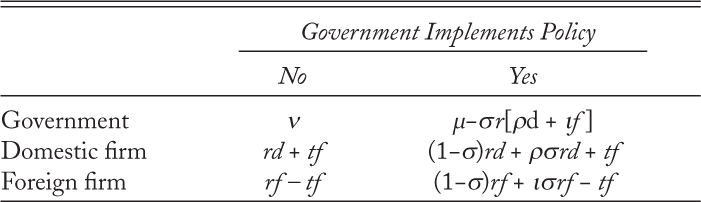
The domestic firm expects to receive compensation equal to ρσrd; it does not share in the compensation that the government expects to pay to the foreign firm. Foreign ownership therefore creates indirect benefits for the domestic firm, which stem not from compensation but from a reduced likelihood of damaging government policies being implemented. The foreign firm expects to receive compensation equal to ισrf. Table 1 reports the payoffs for the government, the domestic firm, and the foreign firm, depending on the history of the game.
The solution concept is a subgame perfect Nash equilibrium. In equilibrium, the government implements the damaging policy if
 $$\eta \gt \eta * \equiv r\sigma [\rho (1 - f*)\, + \,\iota f*],$$
which has two implications. First, as domestic property rights increase, the government is less likely to implement the damaging policy regardless of the level or presence of foreign ownership. Second, if a foreign firm covered by an investment agreement is involved, the probability that the government implements the damaging policy decreases. This implication reflects the core mechanism of our theory. Implementing a damaging policy reduces the profits of both the foreign and domestic firms. Because the foreign firm is protected by stronger property rights under an investment agreement, the government expects to pay more compensation and therefore is less likely to implement a damaging policy. This effect is driven by the inability of the government to limit the effects of damaging policies to domestic asset owners, and by indirect protection. Even with a foreign partner, the domestic firm can expect to gain compensation only through the domestic property rights system.
Payoffs for Government and Firms Given Partnership

The foreign firm accepts the partnership as long as
 $$t \le t* \equiv r[(1 - \eta *)(1 - \sigma (1 - \iota ))\, + \,\eta *].
Because t* is the expected profit, a price t that satisfies the foreign firm always exists. In the supplementary material, we report results when the foreign firm makes no payment to the domestic firm.Footnote 50 This is the least attractive scenario from the domestic firm’s perspective; it receives no compensation, only the potential deterrence of the government.
The domestic firm offers to sell a portion of its assets to the foreign firm if
 $$\iota \ge \iota * \equiv {{r[1 - \sigma (1 - \rho )] + 2\rho (1 - \rho ){\sigma ^2}{r^2} - t} \over {{\sigma ^2}{r^2}(1 - \rho )}}.$$
Equation 3 provides three insights central to the theory. First, the domestic firm is more likely to sell assets to the foreign firm as the transfer payment increases. As t increases, the right-hand side decreases, and condition three is easier to satisfy. Yet, the property rights available to the foreign firm under international law are also valuable to the domestic firm. Even if the foreign firm were to make no transfer, such that t = 0, the domestic firm may be willing to cede some of its assets to the foreign firm. In this case, the transfer of assets to the foreign firm is wholly motivated by the deterrent effect on the government. This result illustrates how firms may trade property for property rights, and it underscores how international law provides foreign firms with an advantage: their access to international law implies that they can acquire assets abroad at cheaper prices. Conversely, foreign firms without access to international law lack this advantage.
Second, the domestic firm is more likely to offer a financial stake to the foreign firm as the strength of the investment agreement, ι, increases. Although often following similar templates, investment agreements differ in strength, in particular in their delegation to arbitration bodies like the icsid.Footnote 51 Some investment treaties therefore grant higher protections to foreign firms. These firms should make particularly attractive partners for domestic firms. Together with the previous result, this suggests a distributional effect of the design of international law: firms from countries whose governments negotiated rigorous investment agreements are attractive business partners abroad and should be able to secure relatively better terms in their investments.
Third, the domestic firm has less to gain from involvement by a foreign firm as domestic property rights, ρ, increase. As a consequence, the firm requires a higher transfer price to sell its assets and, conversely, for any given price is less inclined to sell its assets to a foreign firm. By contrast, where domestic property rights are weak, the indirect protection provided by foreign firms becomes more valuable. Thus, the domestic firm is more willing to sell some of its assets when domestic property rights are weak.
The results point to the surplus created by international law. The value of the domestic firm’s assets, net of the effects of government predation, increases with the involvement of a foreign firm because of the deterrent effect of the foreign firm’s access to international law. A thought experiment illustrates the consequences of this argument. Where domestic property rights are weak and international law is strong, the domestic firm could cede some of its assets for free to the foreign firm, but the remaining assets would be worth more to the domestic firm than the value of its total assets without the involvement of the foreign firm. This surplus also ensures that a transfer t that is acceptable to both firms always exists.
This discussion leads to the first observable implication of our theory: selling assets to foreign firms covered by an investment agreement is a systematic response to weak property rights because of the added protections that the involvement of foreign firms offers to domestic firms.
—Proposition 1. Domestic firms are more likely to seek out financial relationships with foreign firms that are covered by an investment agreement as domestic property rights decrease.
To further emphasize the role of the divergence in property rights between firms, suppose the foreign firm is not covered by an investment agreement. Then, the domestic firm gains no protection under international law from selling assets to the foreign firm. Selling assets to uncovered foreign firms yields no additional protection to the domestic firm. Hence, the presence of an investment agreement, which creates the segmentation of property rights between domestic and foreign firms, is necessary for weaker property rights to increase financial ties with foreign firms. The same argument applies to ties with domestic firms: selling assets to domestic firms does not deter government predation. This results in a second observable implication of our theory:
—Proposition 2. Financial relationships between domestic firms and firms that lack coverage by an investment agreement should not be more likely as domestic property rights decrease.
The emphasis on international law sets our theory apart from arguments about the influence of foreign firms over host governments because these firms are backed by powerful home governments,Footnote 52 they have diplomatic and political connections of their own,Footnote 53 or their continued investment is valuable to the host economy.Footnote 54 Backing by the home government is firm-specific and subject to political uncertainties in the foreign firm’s home country. The economic importance to the host economy is likewise firm-specific and subject to fluctuations. By contrast, because international law provides a rule-based system of property rights, any foreign firm covered by an investment agreement has credible access to arbitration.
Last, the investment regime is distinct in that it allows firms to bring claims against governments. This has not always been the case. Initial customary international law relied on state-to-state enforcement, which is still the standard in the international trade regime.Footnote 55 Our theory underscores the consequences of the development toward investor-state dispute settlement in the investment regime: the fragmentation of ownership stakes across jurisdictions allows firms to expand their access to the protections of international law. This effect reinforces existing asymmetries in the investment regime, which benefit firms over governments, because firms, not governments, have “the right to choose the forum, rules, and legal issues.”Footnote 56Thus, firms can expand their rights relative to governments. This dynamic would not be possible in the regime over international trade, which is based on state-to-state enforcement, such that governments act as gatekeepers in the enforcement of international legal commitments.
Empirics
To evaluate the propositions, we leverage cross-country variation in property rights and in financial relationships between domestic and foreign firms, which we compile from firm-level data. Our research design further leverages variation in firms’ access to arbitration through international law. We first present results using data on financial relationships between domestic firms and foreign firms with access to arbitration through international law. We establish that where investment agreements covering foreign firms are present, weaker property rights result in more financial relationships between domestic and foreign firms, a conclusion consistent with proposition 1. To establish the role of international law and to rule out several alternative explanations, we then show that weak property rights do not increase financial relationships with several categories of firms that lack access to arbitration, a result consistent with proposition 2.
For our first set of results, we create a sample of countries not part of the Organization for Economic Cooperation and Development—plus Mexico and Turkey as non-high-income oecd countries—that have investment agreements with the US in force. We focus on investment agreements with the US for several reasons. First, the US has the largest and deepest financial market. Because of this liquidity, it is a likely source of foreign capital. Second, we implicitly control for country-specific attributes of foreign governments, firms, and markets. Third, we obtain a more representative and comparable sample than if we include firms from several home countries. Last, the US has been the investor home country with the largest number of icsid filings in the past.Footnote 57This willingness to litigate cases suggests that relationships with US firms are valuable for gaining protection.
To identify investment agreements that provide access to arbitration, we consider both bits and trade agreements with investment chapters and refer to both as investment agreements.Footnote 58 Investment chapters in several US trade agreements are comparable to bits in their investor protections, in that they allow investors to initiate disputes against host governments. In these trade agreements, the access of private parties to arbitration is limited to the investment provisions and does not extend to trade provisions, where arbitration remains the exclusive purview of governments.Footnote 59
Our dependent variable measures m&as between domestic firms and US firms announced in any given year. We collected m&a data from Thomson One, which provides firm-specific investment data.Footnote 60 Through each m&a in our data set, a US firm, as a foreign entity, obtains a financial stake in a domestic firm. Thomson One provides detailed data on each project, including the name, location, and industry of the acquiring and target company. For each country, we collect data on all m&as in which a US firm acquired parts of a domestic firm.
We exclude cases where the US firm acquired 100 percent of the domestic firm. These are cases where the domestic owners are not gaining protection but instead are exiting the market. For the same reason, we do not include m&as through which a domestic firm acquired a US firm, which could be interpreted as moving assets out of the government’s reach. Every m&a in the sample therefore represents a cross-border transaction involving a US firm as the acquiring entity. The data capture how many domestic firms form financial relationships with a foreign firm. This provides, for our purposes, advantages over alternatives, such as the total stock or inflow of foreign direct investment. Direct investment data, for instance, include greenfield investment, which occurs without the participation of domestic firms and hence is not within the scope of our theory. Likewise, if a large amount of direct investment is concentrated in a small number of projects, it protects only a small number of domestic firms. We aggregate the firm-level data to the country-year level. In our sample, the variable ranges from 0 to 37 m&as per country-year, with an average of about 2.5 m&as; for country-years with any m&as reported, the average is about 4.9 m&as per country-year.
Just as measurement error is present in foreign direct investment positions, it is likely that the m&a data are incomplete. Nonetheless, the Thomson One database is usually considered the most comprehensive source of cross-country firm activities.Footnote 61 We also have little reason to suspect that systematic measurement error explains an association between weak property rights and more m&a activity. If under-counting m&a activities is systematically related to property rights, it works against our first proposition. Countries with stronger property rights and more effective legal systems should have stricter recording standards and should produce better economic statistics, resulting in a larger number of observed m&as. By focusing on activities that involve US firms, we further hope to reduce the number of missing observations because we hold constant reporting standards on the acquiring side. Publicly listed companies in the US have to report to the Securities and Exchange Commission. The largest firms—those that tend to own foreign assets—frequently are publicly listed. Below, we offer additional results. We control for a country’s transparency with respect to economic information, we drop observations with no reported m&as, and we estimate truncated as well as zero-inflated regression models.
To measure property rights, we use the rule-of-law variable from the Worldwide Governance Indicators,Footnote 62 which is commonly used in the literature.Footnote 63 It combines several indicators of confidence in the rules of a society and the extent to which those rules are abided, such as the functioning of the judiciary and contract enforcement. We obtain the variable from the Quality of Government data set.Footnote 64 Contrary to a popular alternative, the International Country Risk Guide’s assessment of a country’s investment environment, this measure focuses on domestic property rights—the key variable in our theory—not on the perceptions of international investors. We include the latter variable in some models to control for property rights from the perspective of foreign investors.
All models include a set of control variables. First, democracies tend to be associated with better property rights and the ability of governments to attract investments.Footnote 65 We therefore include a variable coded 1 for countries with a polity score above 6; the results are also robust to using the continuous measure. Second, we include standard economic variables–—loggdp, log population, and gdp per capita—to account for the size and wealth of a country’s market. The data were obtained from the World Bank. Third, because the dependent variable captures international capital flows, we control for capital account openness.Footnote 66 Fourth, to account for a country’s geographic position, we include log distance to the US.
Fifth, foreign firms can be an important source of financing.Footnote 67 Foreign financing is most important where domestic credit markets are underdeveloped, which can be a consequence of weak property rights.Footnote 68 We control for logged domestic credit to the private sector, which was obtained from the Global Financial Development Database.Footnote 69 We consider additional measures of financing below. Sixth, we account for a country’s economic structure by including the index of economic complexity.Footnote 70 More developed and complex economies have more economic activity and more linkages with the international economy, creating more opportunities for m&as. Additionally, more complex economies are closer to the technology frontier, which may shape the attractiveness of m&as over alternative forms of international engagement to foreign firms and domestic firms.Footnote 71 Last, we include year fixed effects to account for factors that affect all countries, such as global interest rates and the availability of credit in the US, which explains investment decisions by firms and host-government policies.Footnote 72
Taking all variable limitations into account, our sample covers up to thirty-five countries between 1996 and 2014. A list of the countries and summary statistics are in the supplementary material.Footnote 73 Because our dependent variable is a count, we estimate negative binomial models. To account for the nonindependence of observations within countries and the slow temporal changes on the variable on domestic property rights, we cluster standard errors by country, which addresses arbitrary non-independence among observations within countries. The slow movement of the property rights variable implies that our results are mostly explained by cross-country differences, not by within-country variation over time. We present hierarchical models, random effects, and country fixed-effects models in the supplementary material.
Selection Into Investment Agreements
Before turning to the empirical results, we note that the set of countries with investment agreements is not a random sample. Membership in investment agreements is plausibly driven by the host government’s expectations of attracting investment. The self-selection of countries into investment agreements is an important concern in the literature on the effects of investment agreements, and it is a concern that remains largely unresolved.Footnote 74 Our research design sidesteps this debate because we are not interested in the effects of investment agreements. Instead, within the set of countries that have joined investment agreements with the US, we expect weaker property rights to be associated with more financial ties between domestic firms and US firms.
Moreover, we find no evidence that countries differ significantly or substantively in their domestic property-rights environments depending on whether they signed investment agreements with the US. The average of the property rights variable is .489 for countries without investment agreements and .477 for countries in the sample with investment agreements. This difference amounts to about 2.5 percent and with a p-value of .669, is not statistically significant. Likewise, the distribution of the property rights variable across the two samples is not significantly different.Footnote 75 The supplementary material shows that the two samples do not differ significantly on the remaining control variables either, with the exception of the geographical distance from the US.Footnote 76
Two additional concerns remain. First, countries with weaker property rights may sign investment agreements with the United States in the expectation of attracting investment, whereas countries with stronger property rights sign investment agreements because of their military alignment with the US. We therefore account for US military aid in robustness checks. Second, the signing of investment agreements may correlate with broader reform packages geared toward foreign investors and may be implemented in countries with weak property rights; this would explain a negative association between property rights and m&as if countries catch up on the foreign investment they lost in the past as a consequence of these broader reforms. In the supplementary material, we report that the results are robust to controlling for a country’s movement toward economic openness and for the investment environment as perceived by foreign investors.Footnote 77
In short, membership in investment agreements is not exogenous. But we find little evidence that self-selection into investment agreements is systematically related to our main variable of interest and do not find evidence that this self-selection presents an alternative explanation of a negative association between property rights and financial ties between domestic and foreign firms.
Results
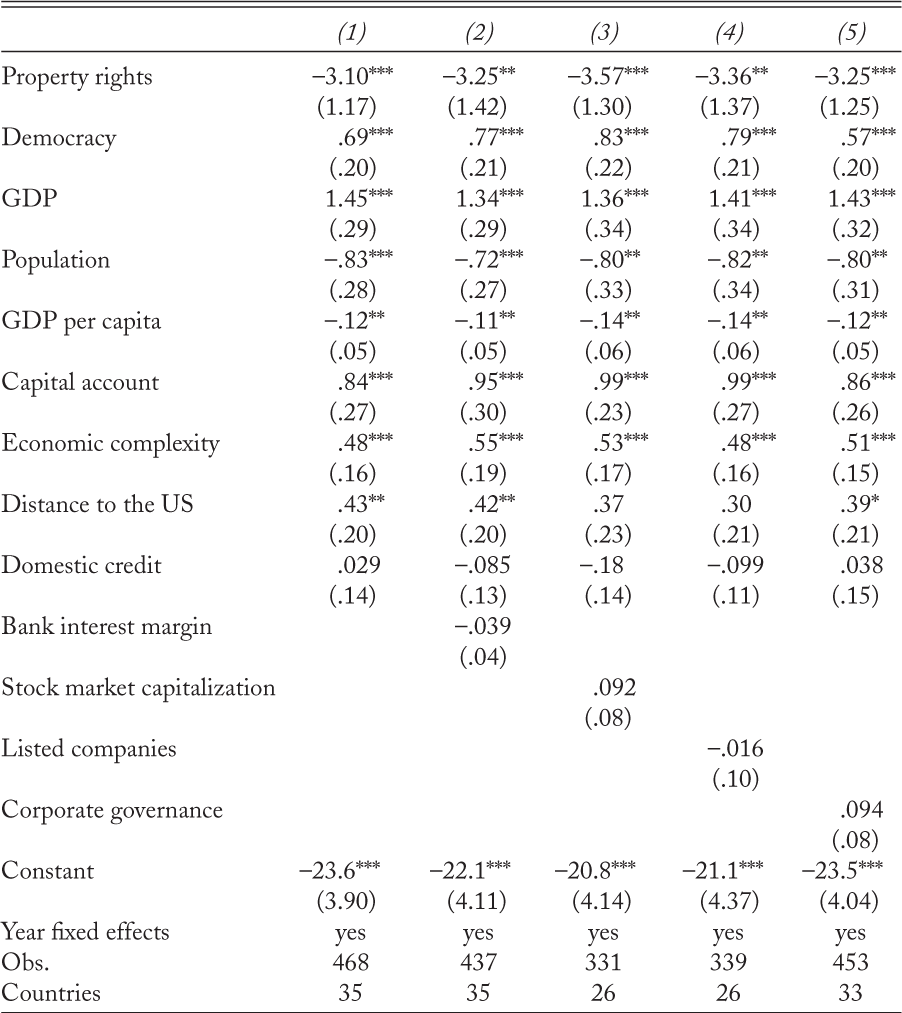
Table 2 presents the main results. Column 1 reports our baseline model. As expected, an increase in property rights is associated with fewer financial relationships (in the form of m&as), between foreign and domestic firms. The coefficient is statistically significant at the 5 percent level and substantively large. Moving from the 10th to the 90th percentile on the property rights variable reduces the number of m&as by about 60 percent, from 4.3 to 1.8. In terms of countries in the sample, this shift is comparable to the difference between Ecuador (with weak property rights) and Uruguay (with strong property rights) in 2007.
These results are consistent with the theory that domestic firms tap into the property rights available to foreign firms by selling assets to those firms. As property rights deteriorate, domestic firms increase their involvement with US firms through m&as in an attempt to benefit from the foreign firm’s access to international law.
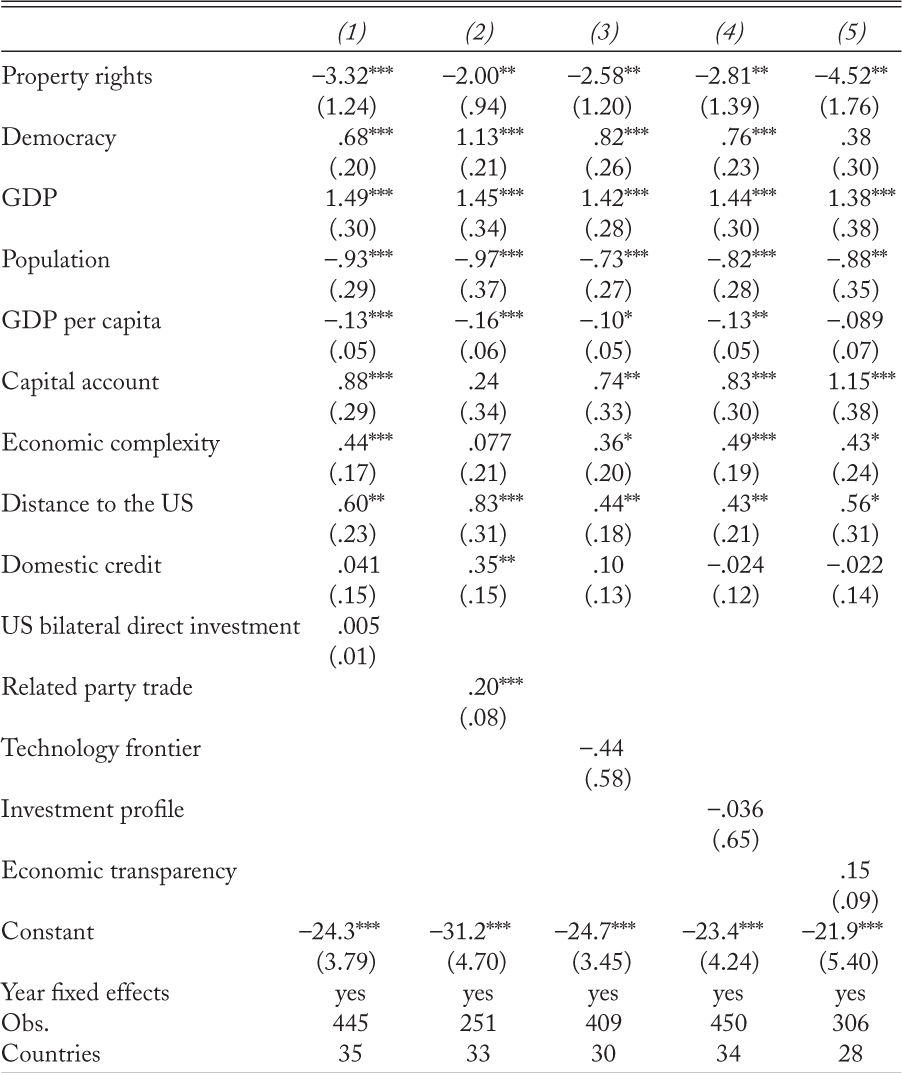
The remaining models in Table 2 and Table 3 introduce control variables to account for two alternative explanations: domestic financing constraints and the motivations of foreign firms for forging business relationships with domestic firms.
Financing Constraints
Domestic firms may seek ties to foreign firms because the domestic financial system is underdeveloped, making it difficult to find financing for new investment projects. At the same time, foreign firms may be willing to enter these markets because they promise elevated returns. Table 2 includes several variables to account for the domestic financial environment, which tends to correlate with property rights.
In column 2, we include the bank interest margin, defined as net interest revenue as a share of interest-earning assets. Where banks earn higher margins on lending, the financial system is less efficient and borrowing more costly. In column 3, we include log stock market capitalization, relative to gdp, to account for the overall size of the domestic financial market. In column 4, we include the number of listed companies as an alternative measure of the size of the domestic financial market.Footnote 78 In column 5, we include a measure of corporate governance, minority shareholder rights, which was obtained from the World Bank’s Doing Business database.Footnote 79 Weaker corporate governance laws may make it more difficult for firms to find domestic financing, leading them to find new sources of financing in markets with stronger shareholder protections and to also benefit from those stronger shareholder protections themselves.Footnote 80
Property Rights and M&As with US Firms: Domestic Financial Environmenta

Coefficient estimates and standard errors (clustered by country); negative binomial regressions; ***significant at 1 percent, **significant at 5 percent, *significant at 10 percent.
a Countries with US Bits or trade agreements with investment chapters.
The negative coefficient on property rights remains across all models and retains its statistical significance, allaying concerns that the results are driven by the coincidence of financing constraints and weak property rights.
Foreign-Firm Motivations
The results may be explained by the motivations of US firms to invest in host countries. Below, we present results from bond and equity issues, which are based on the unilateral decision of a domestic firm and potentially create a foreign ownership stake in the future—without an explicit involvement of foreign investors at the time these issues are made. These data therefore allow us to bracket the incentives of US firms to get involved in domestic markets.
Table 3 offers models to account for the motivations of foreign firms. First, we exploit that some of the reasons for US firms to invest in host countries do not require the participation of domestic firms. US firms may decide to enter the domestic market because the protections implied by investment agreements create an advantage over competitors in an environment of weak property rights. If that is the case, these investments should not be limited to projects that involve domestic firms. Greenfield investment, without participation of domestic partners, would be just as attractive to US firms in those contexts. We therefore include the bilateral direct investment position with the US (data are from the Bureau of Economic Analysis),Footnote 81 which allows us to hold constant the more general demand by US firms for investments in the domestic economy.
Second, US firms may invest in the domestic economy to expand production networks. Again, this expansion may be more attractive where investment agreements create an advantage for US firms rela tive to competitors. But it need not involve domestic partners. Including a variable for the presence of production networks therefore allows us to control for the motivations of foreign firms to invest in the domestic economy more generally. We rely on data from the US Census Bureau on related party trade, defined as (logged) imports and exports between US firms and affiliated firms abroad, to capture the presence of such production networks.Footnote 82
Property Rights and M&As with US Firms: Foreign-Firm Motivationsa

Coefficient estimates and standard errors (clustered by country); negative binomial regressions; ***significant at 1 percent, **significant at 5 percent, *significant at 10 percent.
a Countries with US Bits or trade agreements with investment chapters.
Third, foreign firms may choose to form m&as with domestic partners over alternative forms of engagement if technology transfers are driving investments in the host country; moreover, domestic firms may seek relationships to foreign firms to gain access to new technology.Footnote 83 To account for the potential for technology transfers, we estimate a country’s proximity to the technological frontier as a country’s total factor productivity relative to that of the US, using data from the Penn World Table.Footnote 84 The results show that distance from US technology is not significantly related to m&a activity.
Fourth, we account for investment protections from the perspective of foreign investors by including the investment profile index from the International Country Risk Guide.Footnote 85 Including this variable allows us to interpret the coefficient on domestic property rights as property rights net of the protections perceived by foreign firms. This variable is also commonly used to account for the possibility that foreign firms seek domestic m&as over licensing arrangements to avoid the expropriation of technology.Footnote 86 The protections afforded to international investors have small and statistically insignificant effects on m&as, an observation consistent with the argument that the domestic environment is less important to foreign investors protected by investment agreements.
Fifth, we include an index of economic transparency.Footnote 87 Plausibly, connections to domestic firms are most important to US firms where governments are less inclined to disclose information. Where transparency is low, connections to domestic firms may help foreign firms obtain information about political processes or even broad macroeconomic trends. In our sample, transparency is associated with more m&as, although the coefficient estimate is not statistically significant and the substantive effect is small.
That the coefficient on property rights retains its sign and statistical significance when accounting for these motivations of foreign firms reinforces the interpretation that domestic firms seeking foreign partners drive the results.
Additional Robustness Checks
The supplementary material provides additional results.Footnote 88 These account for the following: changes in capital account and trade openness, which reflect a country’s movement toward liberal economic policy; dependence on the US through military aid; the presence of migrant networks; participation in International Monetary Fund programs, which tend to couple privatization demands with reforms to the property rights regime; the production of natural resources, which tends to be capital-intensive and located in countries with weak property rights; and the exchange rate level and regime. We remove m&as involving the privatization of state-owned companies from the sample, which may still enjoy privileged access to the government. The results are robust to these changes.
The Role of International Law: Uncovered versus Covered Firms
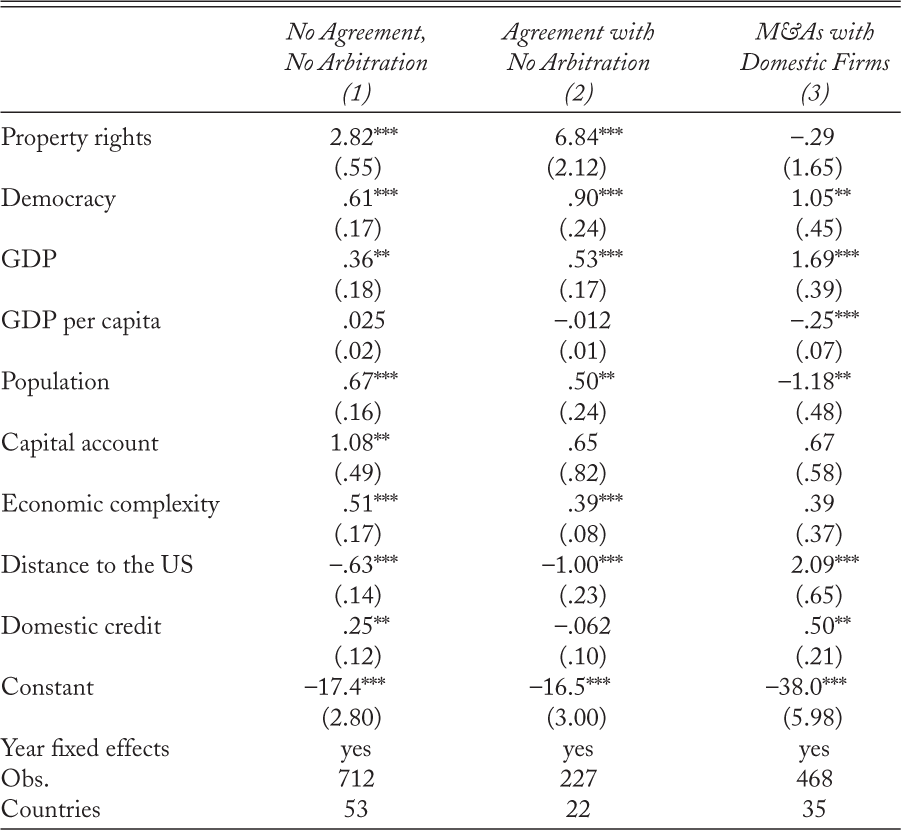
If the previous results are explained by the protections of foreign firms under investment agreements and their access to arbitration, then the negative effect of property rights should disappear for firms that lack access to arbitration under international law. Although large multinational corporations may form individual contracts with governments that provide access to arbitration, these contracts do not offer systematic access to arbitration for domestic firms with foreign owners. Table 4 presents three results that underscore the importance of this access.
First, where no investment agreement exists, US firms cannot grant domestic firms protection through international law. We therefore create a sample of m&as between US firms and firms in countries without US investment agreements. As shown in column 1 of Table 4, the negative effect of property rights disappears in this sample. Instead, property rights have a positive, statistically significant effect.
Second, the US signed several investment framework agreements with other countries. These agreements declare in rather general terms a common desire to foster economic exchange between the US and the partner country. They lack any clear stipulations to protect US firms, and they provide no access to arbitration or any other mechanisms that would allow firms to challenge host-government policies. This sample therefore includes countries with sufficiently close ties to the US to result in investment framework agreements but without protections extended to US investors. The negative association between property rights and m&as should disappear in this sample. To identify these agreements, we draw on the United Nations Conference on Trade and Development for a list of investment agreements involving the US and determine from the agreement text whether investors have access to arbitration.Footnote 89 The negative association between property rights and m&as disappears in this sample. Property rights again have a positive, statistically significant effect, as shown in column 2 of Table 4.
M&As between Firms without Access to Arbitrationa

Coefficient estimates and standard errors (clustered by country); negative binomial regressions; ***significant at 1 percent, **significant at 5 percent, *significant at 10 percent.
a Column 1: m&As between domestic firms and US firms not covered by US BITs or trade agreements with investment chapters. Column 2: m&As between domestic firms and US firms covered by US investment framework agreements or other investment agreements that do not provide access to arbitration. Column 3: domestic m&As in countries with US BITs and trade agreements with investment chapters.
Third, we replace the dependent variable with domestic M&as. M&as between firms from the same country cannot grant additional protection through international law, and the negative association between domestic property rights and m&as should again disappear. We obtain a count of domestic m&as from Thomson One.Footnote 90 To allow for a better comparison, the sample is identical to our main sample and includes only countries that have investment agreements with the US. The results, reported in column 3 of Table 4, show that domestic property rights have little effect on domestic m&as. The effect of domestic property rights is small and statistically indistinguishable from zero.
These results lend additional support to our theory, which emphasizes differential access to international law between firms. In general, m&As are not more popular in countries with weak property rights. Instead, weaker property rights drive financial ties only with firms that have access to international law. That the effect of property rights depends on participation in investment agreements rules out several alternative explanations: that foreign firms choose m&as over greenfield investments where property rights are weak to navigate corrupt political systems;Footnote 91 that foreign firms choose m&as over licensing technology to domestic firms in environments with weak property rights;Footnote 92 and that US firms are more likely to invest where property rights are weak because of the US government’s extraordinary will (combined with its economic and political power) to defend private investments abroad.Footnote 93
Bond and Equity Issues as an Alternative to M&As
Domestic firms can also acquire ties with foreign firms by issuing bonds or equity. Although the literature on investment agreements typically focuses on foreign direct investment, bonds or equity that a foreign firm acquires are also protected under common stipulations in investment agreements. Any action by the government that is detrimental to the domestic firm also affects the value of its bonds and equity and therefore harms foreign investors holding these assets.Footnote 94 This coverage has been validated by international arbitration tribunals. For example, Motorola loaned $2 billion to the Turkish telecommunications firm Telsim; the loan provided Motorola with no direct ownership or oversight capability. Following fraud allegations, the Turkish government took ownership of Telsim and placed “Turkey’s own financial claims against the telecom firm ahead of those of Motorola.”Footnote 95 In 2005, Motorola filed an icsid case against Turkey. The icsid tribunal accepted jurisdiction in the case, and a settlement was reached out of court.
The example of Motorola implies that domestic firms have an alternative route of obtaining protection under investment agreements by issuing bonds or equity. Because issuing bonds or equity is a uni-lateral decision by the domestic firm and involves no foreign firm at the time the issue is made, these data further allow us to bracket many motivations of the acquiring foreign firm. This upside brings a disadvantage with it: compared with m&as, the ties between domestic and foreign firms are loose. The domestic firm may not know who is acquiring these assets.
We obtain data on the number of bond and equity issues by domestic firms from Thomson One.Footnote 96 These bond and equity issues cover a variety of assets, such as mortgage-backed securities, debt instruments, and stock issues. We exclude any issues by government agencies. Although we cannot determine who purchased these assets, Thomson One provides information on the target market of bond and equity issues. We restrict our data to bond and equity issues targeted at the US market.
Replacing m&as with the variable on equity and bond issues, we replicate the main models from Table 2. Weaker property rights are associated with more bond and equity issues (see the supplementary material for results).Footnote 97 Moving from the 10th percentile of the property rights variable to the 90th percentile results in a reduction in bond and equity issues from 4.7 to 1.2. In the supplementary material, we also report results when adding bond and equity issues to the m&a data to obtain a more comprehensive measure of financial relationships between firms. The results corroborate our findings: where property rights are weak, firms seek foreign stakeholders that can defend their rights in response to damaging government policies. Moreover, mirroring the results for m&as, the negative association is limited to issues by firms in countries with investment agreements with the US, and it disappears for domestic issues.
Conclusion
We develop a theory that identifies international financial relationships between firms as a response to weak property rights: domestic firms use ties to foreign firms to benefit through international law from stronger, rule-based property rights than their domestic environment provides.
This article speaks to several broader debates. First, we highlight a novel effect of capital mobility. Capital mobility has long been viewed as a constraint on governments because asset owners can threaten to move their assets abroad and out of reach of their government.Footnote 98 Although this literature emphasizes the constraining effects of the threat of capital outflows, our theory emphasizes the constraining effects of capital inflows. Domestic asset owners can constrain their government by attracting foreign capital that is covered by international law. Domestic firms do not have to threaten capital flight. They can stay put if they instead forge relationships with covered foreign firms. Investments from covered foreign firms, in the form of capital inflows, therefore reduce the need of domestic firms to exit their home market. For governments, this dynamic reinforces the challenge of regulating domestic markets without deep restrictions to international economic transactions.Footnote 99
Second, our work has new implications for understanding the distributional consequences of international law. In the domestic market, firms that can tap into the protections afforded to foreign firms benefit; they gain an advantage relative to their competitors that lack relationships to foreign firms. These advantages can have substantial consequences for the structure of domestic markets. Firms that enjoy improved protections against government interference may have better access to new sources of financing, they may engage in parts of the economy that are more subject to political risk, and they may expect elevated returns because of limited competition.
Moreover, domestic firms with foreign links lose incentives to lobby the government for property rights improvements: such improvements would erode their advantage by disproportionately benefiting competitors. International law and international financial relationships may thus dampen the pressure on governments to implement domestic reforms and effectively insulate them from reform demands, providing an explanation for the erosion of institutional quality in these contexts.Footnote 100
The distributional consequences of international law also extend to international markets, where firms from countries with investment agreements become attractive business partners not only for the capital and technology they provide, but also for their access to international law. This effect awards firms from countries with investment agreements an advantage relative to firms from other countries. Selling assets to foreign firms allows domestic firms to “import” property rights. International law becomes a source of comparative advantage in this trade. The theory suggests that countries and firms may gain a comparative advantage not only from factor endowments and technology, but also from international institutions. This perspective complements a growing literature that focuses on domestic institutions as a source of comparative advantage in international trade.Footnote 101
Last, individual firms increasingly sign investment contracts with host governments. Some of these contracts, which are outside the framework of international law, provide access to arbitration similar to the stipulations in investment agreements.Footnote 102 Such contracts reinforce the advantages of global firms that are able to negotiate their own terms, especially when they are backed by powerful home governments, such as the United States, which historically have been willing to intervene on behalf of their firms operating abroad.Footnote 103 This development raises new questions for the future of the global investment regime. The further decentralization of property rights may simultaneously contribute to a shift of authority from governments to individual firms and perpetuate the market power of countries like the United States. And if firm-government contracts are implicitly backed by state-to-state diplomacy, the repudiation of legalization returns economic state-craft to the forefront of debates over the governance of international financial markets.Footnote 104 The interplay between firms, governments, and international law remains a promising area for future research.
Supplementary Material
Supplementary material for this article can be found at https://doi.org/10.1017/S0043887119000017.
Data
Replication data for this article can be found at https://doi.org/10.7910/DVN/CWFTZX.
Acknowledgments
We thank Vincent Arel-Bundock, Bill Clark, Rick Cupitt, Nehemia Geva, Bobby Gulotty, Florian Hollenbach, Soo Yeon Kim, Haillie Lee, Quan Li, Helen Milner, Sonal Pandya, Clint Peinhardt, Michael Plouffe, Paul Poast, Erica Owen, Michelle Taylor-Robinson, Rachel Wellhausen, and three anonymous reviewers and the editors of World Politics for comments. We also thank seminar participants at Texas A&M University, Humboldt Universität zu Berlin, and the University of Chicago’s Program on International Politics, Economics, and Security (pipes) workshop, as well as audiences at the annual conferences of the American Political Science Association, the International Studies Association, and the International Political Economy Society. Weiwen Yin provided outstanding research assistance.
Authors
Timm Betz is an assistant professor of political science at Texas A&M University. His research focuses on the role of domestic and international institutions in explaining government and firm behavior. He can be reached at timm.betz@tamu.edu.
Amy Pond is an assistant professor of political science at Texas A&M University. She studies how global markets affect taxation and regulation. She is interested in the politics of finance, trade, redistribution, and development. She can be reached at apond@tamu.edu.