Introduction
This article focuses on what are often referred to as ‘low-level services’, a term that is sometimes used by health care professionals to refer to services that help older people to continue living in their own homes for as long as possible (Clark et al., Reference Clark, Dyer and Horwood1998). Concern has been expressed with the notion ‘low level’, as it suggests that some services are less important than others (Clough et al., Reference Clough, Manthorpe, Raymond, Sumner, Bright and Hay2007). In considering a range of community-based services and activities that support older people (aged 70 plus) living in remote rural communities in England, we would argue from the outset that such services are only low level in terms of both their costs and profile when compared to other more mainstream services (such as medical, community and residential care initiatives) designed to meet the needs of senior citizens.
Many such services that offer that ‘little bit of help’ (Baldock and Hadlow, Reference Baldock and Hadlow2002) to older people to help sustain their self-confidence, identity and residence in their own homes are delivered under contract by the voluntary and community sector. The voluntary and community sector is that part of the economy beyond the public and private sectors, and is variously known as the voluntary and community sector/social economy/third sector. For the sake of brevity we adopt in this article the inclusive ‘voluntary and community sector (including social enterprises)’, commonly abbreviated to VCS. Specifically, we draw on data and insights from a recent qualitative study that focused on six services which variously provide lunch clubs; welfare rights information and advice; befriending and community warden services for older people living in villages, hamlets or dispersed rural settings in three English Regions (the East Midlands, West Midlands and the East of England).
In a paper on the health and quality of life of older people in rural England, Milne et al. (Reference Milne, Hatzidimitriadou and Wiseman2007) concluded that older people in rural areas are invisible, or at best peripheral, to policy development. Yet older people are concentrated in rural as opposed to urban England, and such areas are generally characterised by an ageing population (Wenger, Reference Wenger2001). In recent decades the number of older rural residents has been boosted by the in-migration of people in middle age and older age (Hardill, Reference Hardill, Lowe and Speakman2006), and ‘ageing has become a powerful factor in shaping rural areas . . . 1 in 12 is over 75’ (Lowe and Speakman, Reference Lowe and Speakman2006: 9). Older adults in rural areas pose specific challenges for those charged with service delivery because of the ‘rural premium’ inherent in delivering low-level public services in the countryside (Alcock et al., Reference Alcock, Brannelly and Ross2004; Craig and Manthorpe, Reference Craig and Manthorpe2000).
Social care services for older adults have long been delivered by a ‘mixed economy’ of providers across England (Beckford, Reference Beckford and Wuthnow1991). The role of the VCS in public services has become a key strand of the drive to improve public service delivery, and specifically caring services for older adults (Alcock et al., Reference Alcock, Brannelly and Ross2004; Law and Mooney, Reference Law and Mooney2007). Since the 1990 NHS and Community Care Act, the VCS has played an increasingly important role in public service delivery for disabled adults and older people (Osborne and McLaughlin, Reference Osborne and McLaughlin2004). Under New Labour, the VCS has continued to deliver public services, and has also become involved in the design of the public policy space for public services (Blackmore, Reference Blackmore2005; HM Treasury, 2002; House of Commons, 2006). The scale of engagement of the VCS within social policy is highlighted by the calculation that 35.7 per cent of the sector's funding now comes from statutory sources (Reichardt et al., Reference Reichardt, Kane, Pratten and Wilding2008). In the new mixed economy of welfare, the contracting out of service delivery may involve the public, private and voluntary and community sectors, in combinations that vary spatially. We therefore today find very diverse modes of service delivery.
There has been a shift in public funding mechanisms for the VCS to deliver public services from grants to contracts (Alcock et al., Reference Alcock, Brannelly and Ross2004; Audit Commission, 2007). Contract funding is awarded for the provision of a particular service and is conditional upon a mutually binding agreement with a formal legal status. Such funding is increasingly for services delivered using the rubric of Full Cost Recovery (FCR) under contracts rather than grant aid (Wilding et al., Reference Wilding, Clark, Griffith, Jochum and Wainwright2006). This ‘new contract culture’ in state and VCS relations has resulted in significant changes in both the organisation and operation of organisations in the VCS (Billis and Glennerster, Reference Billis and Glennerster1998).
While some such services (especially health care and social care) are delivered through a formal organisational structure, by different combinations of the public, private and VCS, other services are delivered less formally. Such ‘fourth sector’ service delivery (Williams, Reference Williams2003) involves informal neighbouring and time giving on a one-to-one basis in recognition of an ‘unmet need’ at grass-roots level, on the ground. These informal neighbourhood community-based services and activities that rely upon localised networks are part of the fabric of rural community life (Le Mesurier, Reference Le Mesurier, Lowe and Speakman2006; Wenger, Reference Wenger2001), and include a diverse range of activities such as befriending and home visiting by members of church groups, social activities at village halls, informal gatherings and social contact that occurs while accessing services at village post offices or when visiting village pubs (Age Concern, 2007).
This article highlights two key challenges faced by the VCS in delivering public services: managing precarious funding regimes from the public purse for public service contracts and a reliance on an unpaid, volunteer workforce for the frontline delivery of many services. These services are perceived as ever more demanding on public resources, and it is argued that they are likely to benefit from new ways of delivery that draw upon VCS experience and expertise (Blackmore, Reference Blackmore2005; Paxton et al., Reference Paxton, Pearce, Unwin and Molyneux2005). Since the 1990 NHS and Community Care Act, policy developments have assumed an untapped pool of volunteers ready to contribute to the provision of caring and other services at little additional cost (Wardell et al., Reference Wardell, Lishman and Whalley2000). After this brief introduction, the paper is divided into further four sections. The first focuses on the role of the VCS in service delivery, particularly in the context of rural England. The next section highlights the methods employed in the study that directly informs this article. The penultimate section presents the findings focusing on funding and workforce issues, and this is followed by some concluding comments.
The role of the voluntary and community sector in service delivery
In this section, the role of the VCS in public service delivery in rural areas is analysed using four interlinked themes: demography and ageing, rurality, volunteerism and the VCS and social policy interventions. As previously noted, demographic change is more advanced in rural than in urban England, in part the result of rural in-migration (HMG, 2009), making ‘rural England the pioneer in terms of the nation's population ageing’ (Atterton, Reference Atterton2008: 20). One fifth of England's population live in rural areas, that is settlements of 10,000 or less (Champion and Shepherd, Reference Champion, Shepherd, Lowe and Speakman2006). The perceived quality of the rural environment is one of the most important factors in the appeal of rural areas as places to live, especially when an older person is relatively fit, partnered and able to play an active part in village life (Milne et al., Reference Milne, Hatzidimitriadou and Wiseman2007). But rural life can become more difficult in later old age when physical and mental capacities are more likely to decline, when informal social networks and support structures may weaken and when partners die (Le Mesurier, Reference Le Mesurier2003, Reference Le Mesurier, Lowe and Speakman2006; Milne et al., Reference Milne, Hatzidimitriadou and Wiseman2007).
The idyllic representation of rural life centres around close-knit communities that have a strong culture of self-sufficiency, alongside an assumption that the VCS can be relied upon to plug any service gaps (Sherwood and Lewis, Reference Sherwood and Lewis2000). The VCS in rural areas is distinctive from the VCS in urban areas. For example, organisations tend to be smaller, more heavily dependent on volunteers and enjoy fewer opportunities for economies of scale as geographical dispersion can mean that providing services in rural areas can cost more (Alcock et al., Reference Alcock, Brannelly and Ross2004; DEFRA, 2003; NCVO, 2002). Managing these additional costs (the ‘rural premium’) inherent in delivering rural services to dispersed populations of older users is a constant challenge for the VCS (Craig and Manthorpe, Reference Craig and Manthorpe2000; Manthorpe and Stevens, Reference Manthorpe and Stevens2009). Moreover, rural communities get significantly less funding per head than their urban counterparts. For example, Asthana et al. (Reference Asthana, Halliday and Gibson2009) argue that the National Health Service (NHS) funding formula underestimates the healthcare needs of rural communities. Likewise, an Audit Commission (2006) study of adult social services noted that the proportion of over 65s who are helped to live at home is 40 per cent higher in the London boroughs than in rural counties.
Currently the majority of service provision for senior citizens is focused on the frailest older people with the highest needs, with financial support mainly sourced from health and social care budgets. In the context of services for older people, the VCS typically offer so-called ‘low-level services’ that fill in gaps between specialist and universal public services (Manthorpe et al., Reference Manthorpe, Malin and Stubbs2004). Small-scale local services can be innovative, especially in responding creatively to the importance older people attach to support to care for themselves, rather than being recipients of care (Clark et al., Reference Clark, Dyer and Horwood1998). Indeed, many older people perceive the services as ‘help’ rather than ‘care’ (ibid.). But the demand for these services is increasing as a result of the noted divergent demographic profiles of urban and rural areas. The ‘ageing countryside’ is posing enormous challenges for policy-makers and practitioners (Champion and Shepherd, Reference Champion, Shepherd, Lowe and Speakman2006; Manthorpe and Stevens, Reference Manthorpe and Stevens2009).
In Opportunity Age, the Government placed a particular emphasis on encouraging and supporting the development of a new vision for social care in England, with independence and choice as key messages (HMG, 2005), and a framework for cross-sector reform was set out in Putting People First: A shared vision and commitment to the transformation of Adult Social Care, a ‘Ministerial Concordat’ (Department of Health, 2007). One method of delivering independence and choice in social care is via personal budgets, originally piloted as individual budgets (IBs) (Manthorpe and Stevens, Reference Manthorpe and Stevens2009). These resources can be used flexibly according to an individual's priorities and desired outcomes (HMG, 2005). IBs were piloted from 2005–7, and were largely used to pay for personal care, domestic help and social, leisure and educational services (Glendinning et al., Reference Glendinning, Challis, Fernandez, Jacobs, Jones, Knapp, Manthorpe, Moran, Netten, Stevens and Wilberforce2008).
The analysis of these pilots revealed that they were welcomed by users because they gave them more control over their lives, as well as producing better outcomes for the costs incurred (ibid.). However, the staff involved in piloting them encountered challenges, including devising processes for determining levels of IBs (ibid.). There may also be opportunities for the VCS to assume new roles and responsibilities in terms of case management and support planning for IBs as well as becoming more adaptable and flexible in the services offered (ibid.). But Manthorpe and Stevens (Reference Manthorpe and Stevens2009), in their study of the possible impact of the personalisation of social care services in rural England, highlighted that personalisation potentially generates a new set of challenges in terms of the loss of income for the VCS, as well as pointing out that it will be the VCS that is called upon to provide much-needed information and advice on the personalisation agenda. Although IBs will benefit those eligible for social care support, increasing numbers are excluded by tightening eligibility criteria and means testing (Age Concern/Help the Aged, 2009).
In the 2008 consultation, The Case for Change, the Department of Health describes the social care system as: ‘the activities, services and relationships that help people to be independent, active and healthy – as well as able to participate in and contribute to society – throughout their lives’ (Department of Health, 2008: 13). This description goes beyond ‘care’ and ‘services’; it implies delivering support and care that older and disabled people need to live fulfilling lives (Yeandle, Reference Yeandle2009). The message of the need for reform of the care and support system appeared in Shaping the Future of Care Together, the Government's Green Paper published on 14 July 2009 (Department of Health, 2009). It highlighted the challenges faced by the current system and emphasised the need for radical reform, including cost containment and making more use of telecare (see also Yeandle, Reference Yeandle2009). However, such policy prescriptions pay minimal attention to the challenges faced by local providers who deliver community-based services and activities for older people in rural areas.
In summary, as the scale of demographic change is more advanced in rural than urban England, the pressure on services that help and support older people to remain in their homes is particularly pronounced. In recent years, the VCS has been playing an increasingly prominent role in delivering these public services under contract. But such services are more costly to deliver in rural areas, in part because of the distances involved in serving a dispersed population (the ‘rural premium’), and also because of the problems inherent in recruiting volunteers and paid staff in rural locations. In the following section we briefly describe the methods employed in our recent study of community-based services and activities which support older people in remote rural England.
Methods employed
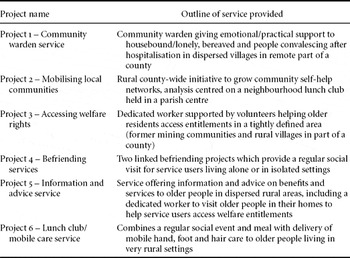
A charity active across England delivering help to older adults commissioned research to identify and evaluate existing effective practice in delivering services to older people aged 70 plus in remote rural communities. Fieldwork was carried out in a variety of appropriate rural locations across three English regions: the East and West Midlands and the East of England, which represent 37 per cent of the land area of England and 30 per cent of the population (Hardill et al., Reference Hardill, Benneworth, Baker and Budd2006). Local branches of the national charity which funded the research were invited to put forward services for inclusion in the study. Subsequently, six services, two in each of the three regions, were chosen. Projects 1, 2, 4 and 6 aimed to alleviate the social isolation of older rural people in various ways. Projects 3 and 5 offered information/advice and practical help in accessing welfare benefits and services (see Table 1).
Village services

The projects represent a small part of the range of services provided by the charity. The staff that manage and administer them routinely have a wide portfolio of services for which they are responsible. All the paid staff directly involved in day-to-day service delivery worked part-time on fixed-term contracts. Five projects used volunteers for service delivery (Project 1 is the exception). The information and advice projects (Projects 3 and 5) are about expanding the number of older citizens accessing their rights to benefits, and thereby enhancing economic inclusion (Craig, Reference Craig2004). The remaining four projects focus on overcoming social isolation (Projects 1, 2, 4 and 6). One project (Project 4) had some service users who did not fit the criteria for the service (in terms of their dementia), while another (Project 3) had requests for help from people who did not reside in the geographical area in which the charity was contracted to deliver the service.
Study participants

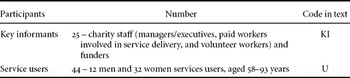
A total of 69 participants were interviewed in the course of the fieldwork. Of these, 25 were key informants and 44 were older people who made use of one of the six services under consideration. Within the sample of key informants interviewed, 19 worked for the charity, six were managers/chief executives responsible for the service overall and seven were paid workers involved in the day-to-day delivery of services to service users. A further six were volunteer workers involved in delivering rural services to older people. The remaining six key informants interviewed had specific insights into the funding arrangements of services. Of the 44 service users interviewed, 32 were women and 12 were men, reflecting the fact that more service users were women. They were between 58 and 93 years of age. Four users within the sample were aged below 70 years, and while these four respondents were chronologically younger than their fellow participants, they had much in common with certain older users. All four had physical impairments that had developed with the passage of time, and the two who were living alone clearly valued the companionship that the service they used offered. These participants illustrate that chronological age is but one aspect of the ageing process and that ill health and social isolation may ‘age’ people in other ways.
Interviews were tape-recorded, transcribed verbatim and analysed using grid analysis and thematic code and retrieve methods (Ritchie et al., Reference Ritchie, Spencer, O'Connor, Ritchie and Lewis2003). Following an initial reading of all transcripts, an overview grid that provided a descriptive summary of the key informant interviews was produced. This enabled a range of broad common key themes (such as ‘financial matters’, ‘service delivery’) within the data to be identified. Relevant sections of data were then assigned to appropriate thematic codes, and more refined sub-categories identified and allocated to appropriate text within the transcripts. A QSR Nudist 6 package was used to help facilitate this process of classifying and ordering the data. This approach helped to ensure that analysis was both systematic and grounded directly in the concerns of respondents.
Interview transcripts were anonymised and identifying locations removed. Respondents subsequently received a copy of their transcript and were invited to feed back any further responses/reflections to the research team. This article draws specifically on the qualitative data generated in semi-structured interviews with key informants (that is, paid staff, volunteers and funders) to consider the challenges facing the VCS when delivering community-based services to older people living in remote rural settings in England.
Making ends meet: Managing money and people when delivering community-based services for older people in rural England
The majority of current funding agreements for service delivery held by the VCS are for one year only, and very few charities delivering public services achieve full cost recovery. In addition, only one in eight charities delivering public services achieved full cost recovery all of the time (Charity Commission, 2007). Government policy since the 1990 NHS and Community Care Act has assumed that the VCS will use unpaid volunteers to deliver services at little additional cost (Wardell et al., Reference Wardell, Lishman and Whalley2000). These two key dimensions – the funding of services and ongoing issues related to the terms and conditions of the personnel (that is, paid staff and volunteers) used to deliver them – were consistent concerns of our respondents. We first examine the funding of the services and then turn to explore workforce matters.
The six projects considered here had quite different funding arrangements. For example, Project 6 was financed by a fixed-term grant, while Project 2 was funded by an annual contract alongside service-level agreements with the statutory sector. Another (Project 1) relied on annual contracts with multiple funders (the statutory sector and charitable trusts) and some had had a range of funding sources since they were established (for example, Project 4). The diverse mechanisms used to support the six services are illustrative of a wider complex jigsaw of funding sources on which charities often have to rely to support and deliver services (Alcock et al., Reference Alcock, Brannelly and Ross2004). The short-term nature of much funding had a profound impact as service managers tried to maintain their services to older adults in rural locations. The six projects faced an annual funding dilemma, demanding entrepreneurial behaviour on the part of managerial staff.
A lot of my job is spent finding . . . pots of money, building up relationships with trusts . . . trying to find a way of keeping the service going. There is no long-term money . . . we just can't plan. You're getting some projects that are only for a year and it takes three or four months to get started, three months to wind down because the staff have to know what's happening. (KI22, male, full-time manager for charity)
Those respondents delivering services with annually negotiated service-level agreements acknowledged that the statutory sector also faced recurrent annual budget problems as they juggled competing priorities while trying to maintain services which supported critical cases of serious, ongoing need. However, the routine reality of delivery of services for older people in the countryside was one of annual cutbacks in budgets and/or the freezing of funding at the previous year's level due to increasing competition for scarce resources. For one project the level of funding has remained the same for the last four years, while another project has experienced annual cutbacks of 10 per cent for three years.
As grant income to run services is for a finite period, it also creates problems as demand for the service endures beyond the period of the grant. The manager of Project 1 (KI1) related how the maximum term of six years allowed by the grant funding body had elapsed, and that the service was potentially in jeopardy unless a new long-term funder could be found. In the short term, the charity was allocating £12,000 of its own money to keep the service going. Unfortunately, he indicated that the funding shortfall would also mean that the contribution from older users of the service would also have to increase substantially from £4.50 per person per visit to £7.50. Other respondents also indicated that future funding for their services was uncertain and this necessitated drawing on the charity's core funds to maintain current levels of provision as initial, time-limited funding came to an end.
Once the funding finished and we saw the results and what a need it was, then yes it was decided that's not a service we can take away lightly. So now we're funding it through core funds. Until we can find other funding streams. (KI22, male, full-time manager for charity)
Although aware of the costs of delivering a service, project managers were routinely unable to achieve full cost recovery (cf. Charity Commission, 2007). Funding arrangements were underpinned by an inherent assumption that allocated money should be used to establish and maintain frontline service provision. Consequently, several projects received little or no money to cover project administration/management costs:
The project was pared to the bone and as a consequence there were no funds for admin support . . . just sufficient funds to cover her salary [of the worker delivering the service]. (KI23, female, part-time paid worker for charity)
What we hadn't anticipated is that the funder wouldn't fund my salary. So it was a moral obligation. We are a cheap option. (KI9, female, part-time paid worker for charity)
Voluntary sector performance can be hard to define and measure (AVECO, 2008); also, charities are increasingly required to gather quantitative and qualitative evidence to present to funders looking for evidence of service impact. Therefore, managing and delivering projects often brought additional administrative burdens for hard-pressed service providers. This included regular surveys of service users to gather qualitative and more holistic feedback on what the service meant to them and, in some cases, other household members. As they receive funding from a number of sources, they are likely to be subject to a number of regulatory regimes, with different approaches to performance management and reporting. The administrative burden of such record-keeping was consistently noted by respondents:
There were targets, lots of stats [sic] to collect . . . I looked at the contract and understood the implications so I collected stats . . . I did a monthly, six-monthly and final reports . . . on claims, visits, phone calls, surgeries, talks etc. (KI23, female, part-time paid worker for charity)
In short, while the six projects had different funding arrangements, they all failed to receive funds to cover full administration and management costs. Moreover, projects routinely had to draw on their own financial reserves to maintain much-valued services as grant funding ended or rising costs were not met by annual increases (see Dwyer and Hardill, Reference Dwyer and Hardill2008).
We now look at the added costs of delivering services in rural areas, the ‘rural premium’. All the key informants commented on the ‘rural premium’ (that is, the extra overheads incurred in delivering services in rural areas), with meeting transport costs a central and consistent concern.
The geography makes a big difference. Because in this particular scheme, the warden actually does a lot of mileage going between the villages . . . none of the villages have a shop. (KI15, female, full-time manager for charity)
Transport in the southern region of the area that we administer is very sparse and to this end we, therefore, have our own minibus. This is where one of the biggest costs is. (KI1, male, full-time manager for charity)
The above quotes summarise the major concerns highlighted by key informants. Delivering services to a dispersed population of service users with often limited mobility was a constant challenge (see also Alcock et al., Reference Alcock, Brannelly and Ross2004). For the four projects where services were provided directly to service users in their homes (Projects 1, 3, 4 and 5), the financial costs of transport, combined with staff travelling time, in effect limited the number of service users whose needs could be met.
Workforce issues
As previously noted, the charity that delivered the six projects relies on both paid staff and volunteers to deliver the six services. The paid staff who were engaged in service delivery were largely women employed part-time on fixed-term contracts; and both men and women held management roles (see also Machin and Ellis Paine, Reference Machin and Ellis Paine2008). Working above contracted hours was a strong and recurrent theme, especially for part-time female staff engaged in service delivery. As one manager acknowledged, ‘they theoretically work part-time . . . a certain number of hours a week [but] they put an enormous amount more in’ (KI10, female, full-time manager for charity). Another staff member responsible for day-to-day service delivery commented:
The worst thing about the job is the travel and the stress . . . there was no back up, no admin help, I was on my own. I had a problem with excess hours, it was stressful and pressured and it made me feel ill. (KI23, female, part-time paid worker for charity).
These part-time paid workers often gave additional help to service users above and beyond their specified role. This included workers signposting users to other services offered by the charity we worked with and other providers.
If the warden realises that somebody is constantly struggling financially, then they've got access to our information service . . . The warden will go in and . . . suss out where areas of need are . . . plug him into all of our other services. (KI15, female, full-time manager for charity)
They use us as an information service and quite often I will follow something through for them or help with it. I don't need to do that. (KI3, female, part-time paid worker for charity)
In some respects, therefore, the part-time paid workers employed on the various projects could perhaps be viewed as willingly adding to their own workloads by taking on tasks that, strictly speaking, lie outside their particular job description. However, it needs to be remembered that the women who provide the services are themselves often steeped in a rural culture that, as noted above, places great emphasis on informal systems of support to make up for the absence of formal service provision that is more likely to be available in urban settings (Le Mesurier, Reference Le Mesurier, Lowe and Speakman2006; Wenger, Reference Wenger2001). Indeed, the boundaries between their professional role as project workers and more informal caring and support were often blurred. For example:
If somebody needs something in the town where I live then I'll do it in my time and get it for them and take it the next day . . . Sometimes if they are not too far away I will go and visit . . . I went to see a gentleman last week who had been a client and he's now gone into a home. So I took his, one of his neighbours with me, and we went to visit him. It's very hard. You get closer to some than you do to others which is always going to be the case. But there was one that [died], I just sobbed buckets . . . When she died it was awful. It was like losing my Nan. (KI16, female, part-time paid worker for charity)
Such dilemmas are indicative of the reality of serving the needs of vulnerable older service users and also of the wider ethos of many paid workers in the voluntary sector who find it difficult to deliver support strictly within the confines of a specified contract (Baines et al., Reference Baines, Wilson and Hardill2008). Billis and Glennerster (Reference Billis and Glennerster1998) present the notion of ‘stakeholder ambiguity’ to capture this ‘closeness’ to service users.
As Raynes et al. (Reference Raynes, Clark and Beecham2006) note, many community-based services for older people rely heavily on volunteers. Five of the six rural services under consideration here made extensive use of (usually older) volunteers; without them the services would have ceased to function.
I have 187 volunteers in [service name] . . . without those 187 volunteers . . . it would not exist. (KI1, male, full-time manager for charity)
Some volunteers were engaged in an advisory capacity or undertook committee work that utilised managerial or professional skills; others undertook clerical duties, including raising money and administrative and organising work. However, most were engaged in service delivery, including visiting or befriending isolated older people in their own homes, and driving users to and from the various village halls and so on where luncheon clubs were held (see also Murphy et al., Reference Murphy, Wedlock and King2005).
Once again, however, the particular demands of providing a service in rural areas impacted on service providers whose capacity to deliver services was spatially constrained by the dispersed character of the population in the more remote parts of rural England.
It can be difficult to get workers and volunteers. Simply providing the service is difficult . . . you can be talking about a farm track a mile and a half off the next tarmac road. (KI10, female, full-time manager for charity)
It's always an issue getting volunteers [in rural areas]. And we do particularly targeted work to try and get volunteers in appropriate area. (KI7, female, full-time manager for charity)
As the above quotations highlight, often the pool of volunteers with the right skills and in broadly the right location and with access to a private car to allow them to serve a geographically dispersed population was finite. Those charged with managing and delivering identified this as a key constraint when planning rural services.
Conclusion
In recent years the VCS has been playing a greater role in public service delivery, and the challenges they face in providing rural services are being increasingly documented (for example, Help the Aged/Age Concern, 2005; Milne et al., Reference Milne, Hatzidimitriadou and Wiseman2007). In this paper, we have drawn on a recent qualitative study that focused on six community-based services delivered by the VCS which support older people to continue to live independently in remote rural areas in England to illuminate the impact of two particular issues – uncertain funding regimes and reliance on volunteer labour – the sector faces in delivering public services. As we have highlighted, funding levels and regimes are precarious. Full cost recovery was not achieved as contracts issued for the services we reviewed tended not to cover administrative and management costs. The short-term competitive funding arrangements that finance many services create a disproportionate administrative burden and deflect resources away from frontline services. It is clear that rural community-based services, of the type reviewed in this article, would be unsustainable without the continuing goodwill, commitment and generosity of both paid staff and older volunteers working in the VCS.
Over the period we undertook the research, personal budgets (originally known as individual budgets) were piloted and evaluated elsewhere. They form an important vehicle for the delivery of a new vision for social care in England, built around the key notions of independence and choice (Department of Health, 2005). Recent analyses of these individual budget pilots revealed that, while they were welcomed by users because they gave them more control over their lives (Glendinning et al., Reference Glendinning, Challis, Fernandez, Jacobs, Jones, Knapp, Manthorpe, Moran, Netten, Stevens and Wilberforce2008; see also Manthorpe and Stevens, Reference Manthorpe and Stevens2009), the reality for older service users in rural areas with sparse populations is often a distinct lack of choice when it comes to services (Wenger, Reference Wenger2001; Scharf and Bartlam, Reference Scharf and Bartlam2006). Personalisation potentially generates a new set of challenges for the VCS in terms of the loss of income, as well as increased demand, as they will be called upon to provide much-needed information and advice on the personalisation agenda (Manthorpe and Stevens, Reference Manthorpe and Stevens2009). Moreover, a number of the service users we interviewed were frail and accessed the services we reviewed because family members had made arrangements on their behalf. The independence and choice of older users may well be undermined when choices are effectively made by others, even if they are acting in the best interest of older relatives.
In delivering services to older people in rural areas, the surveyed organisations incurred additional transport costs: the rural premium that accrues when the service users are dispersed over a wide geographical area. A further dimension of the rural premium related to recruiting volunteers with the right skills in the right locations which constrained the capacity of the charity to deliver some services.
Population projections indicate that the demand for community-based services will continue to increase, placing additional strain on already tight budgets. It has also been reported elsewhere (Age Concern/Help the Aged, 2009) that increasing numbers are excluded from services by tightening eligibility criteria and means testing. It is highly likely that this situation will get worse after the 2010 General Election, when the pressure to reduce public spending, including health and social care budgets, may well result in cutbacks to ‘low-level’ community-based services as providers fight to maintain service provision for the frailest older people with the highest needs. The delivery of community-based services by the VCS is being impeded by managerialism, cost containment and short-termism, which together can negate the distinctive advantages that VCS involvement might otherwise bring to the sustainability of support for older people in areas of very low population density.
Acknowledgements
This article draws on research funded by Age Concern England. We are grateful to the participants in this research. The analysis of public service delivery has been informed by research funded by the Economic and Social Research Council undertaken by Irene Hardill with Dr Sue Baines, Manchester Metropolitan University and Mr Rob Wilson, Newcastle University (RES 172250051). The views expressed here are those of the authors alone.