Introduction
Otosclerosis is characterised by abnormal bone growth in the otic capsule of the temporal bone. In 70–80 per cent of cases, the disease occurs bilaterally, with a higher female prevalence (female: male = 1:2).Reference Declau, Van Spaendonck, Timmermans, Michaels, Liang and Qiu1,Reference wGordon2 The most common location of involvement of otosclerosis is the bone just anterior to the oval window at a small cleft known as the fissula ante fenestram, which affects about 90 per cent of cases and causes conductive hearing loss associated with stapes fixation. Less frequently, otosclerosis may cause sensorineural hearing loss (SNHL) or mixed hearing loss depending on the extent and progression of the disease.Reference wGordon2,Reference Cureoglu, Schachern, Ferlito, Rinaldo, Tsuprun and Paparella3
Otosclerosis is one of the most common causes of adult-onset conductive hearing loss. It has a prevalence of 0.3–0.4 per cent in Caucasians, with a lower prevalence in blacks, Asians and Native Americans.Reference Schrauwen and Van Camp4,Reference Ealy and Smith5 Hearing aids and surgical treatment are the most common current treatment options for otosclerosis. Stapes surgery is a safe procedure, with excellent hearing outcomes and a low rate of complications, including a less than 1 per cent risk of post-operative SNHL, vertigo, tinnitus or failure to close the air–bone gap.Reference Vincent, Sperling, Oates and Jindal6
Three techniques of stapes surgery have evolved: total stapedectomy, partial stapedectomy and stapedotomy.Reference House7 In the latter, most recent technique, a small footplate hole is created to allow the insertion of a piston prosthesis. In experienced hands, the three techniques have been reported to achieve similar clinical outcomes.Reference Persson, Harder and Magnuson8 However, many authors believe that small fenestra stapedotomy is less traumatic to the inner ear, is associated with a lower incidence of post-operative SNHL, is associated with fewer vestibular complications such as perilymph fistula and prolonged vertigo, and results in better high-frequency hearing improvement compared with stapedectomy.Reference Cheng, Agrawal and Parnes9,Reference McGee10
A stapedotomy fenestration of the oval window can be created using a microdrill, a laser or Fisch micro-perforators, with no significant differences in the surgical outcome or complication rate.Reference Somers, Vercruysse, Zarowski, Verstreken and Offeciers11,Reference Gjuric12
A large number of stapes prostheses (pistons), with different shapes (loop and shaft), sizes, materials (titanium, fluoroplastic, platinum, stainless steel and nitinol), shaft diameters (range, 0.3–0.8 mm) and crimping styles (manually crimping, heat crimping and self-crimping), have been developed in order to increase the hearing outcome success rates and decrease post-operative complications, with variable results reported in the literature.Reference Marchese, Cianfrone, Passali and Paludetti13
This study aimed to evaluate the influence of different piston variables (materials, shaft diameter and crimping method) on hearing following stapedotomy performed for otosclerosis.
Materials and methods
After obtaining institutional review board approval from our university hospital, the medical records of consecutive adult patients with otosclerosis who underwent stapedotomy were retrospectively reviewed.
All patients had progressive conductive hearing loss with an intact tympanic membrane, and no history of previous middle-ear surgery or head trauma. Some patients had a positive family history of hearing loss. Otosclerosis was clinically suspected and later confirmed by surgical exploration.
All stapedotomies were performed by the same surgeon. Patients were operated under general anaesthesia, and the endaural approach was used in all cases. After elevation of the tympanomeatal flap, curettage of the scutum and separation of the incudostapedial joint, stapedial fixation was confirmed by gentle palpation of the ossicular chain. The stapedial tendon was cut, and the posterior crus of the fixed stapes was drilled with a Skeeter® drill system using a 0.6 mm crura saw; this was followed by downfracture of the anterior crus using a right-angled needle. The distance between the long process of the incus and the footplate was measured, with the addition of 0.5 mm. Small fenestra stapedotomy was performed by the skeeter drill using a 0.6 mm diamond burr. Then, the piston was inserted and anchored around the long process of the incus. According to the type of prosthesis, the loop was manually crimped or self-crimped around the incus. No soft tissue grafts were used to seal the oval window.
Prophylactic antibiotic and 16 mg dexamethasone were given during surgery in all cases. Patients were discharged home on the day after surgery on oral antibiotics and analgesia, which were taken for one week.
The pistons used were a titanium K-Piston (manual crimping loop) and a titanium soft-clip piston (self-crimping) (Heinz Kurz Medizintechnik, Dusslingen, Germany), and a fluoroplastic (self-crimping) piston (Grace Medical, Memphis, Tennessee, USA).
The data were analysed in groups according to the piston material (titanium vs fluoroplastic), shaft diameter (0.4 mm vs 0.5 mm) and crimping style (manual crimping vs self-crimping). Pre- and post-operative air–bone gaps, air–bone gap difference, success rate, and operative time were evaluated for all groups.
Audiometric data were collected after a minimum of one year of follow up. Pre- and post-operative air–bone gaps were calculated by subtracting the bone conduction threshold from the air conduction threshold at frequencies of 0.5, 1, 2 and 3 kHz. The air–bone gap difference was calculated by subtracting the post-operative air–bone gap from the pre-operative air–bone gap.
A post-operative air–bone gap of 10 dB or less was considered to indicate successful surgery. Post-operative SNHL was defined as a mean bone conduction deterioration exceeding 10 dB at the frequencies 1, 2 and 4 kHz, while overclosure referred to an apparent improvement in bone conduction hearing due to the Carhart phenomenon at the same frequencies, according to the American Academy of Otolaryngology – Head and Neck Surgery guidelines.14
We excluded paediatric patients, patients with follow up of less than one year, those who had undergone previous middle-ear surgical procedures, and revision cases.
The Mann–Whitney U test was used for non-parametric data analysis. For categorical data analysis, the chi-square test or Fisher's exact test was used, as appropriate. A p-value of less than 0.05 was considered statistically significant.
Results
Fifty-one patients (58 ears) who underwent stapedotomy for otosclerosis, and who fulfilled our inclusion and exclusion criteria, were included in this study. Their mean age was 36.4 years (range, 18 to 59 years; standard deviation (SD) ± 10.8). Twenty-seven patients (47 per cent) were male and 31 (53 per cent) were female.
Stapedotomy was performed on the right side in 31 ears (53 per cent) and on the left side in 27 ears (47 per cent). The corda tympani was accidentally cut during surgery in three cases. The facial nerve was dehiscent in 11 ears; however, the surgical procedures were completed without difficulties. Middle-ear adhesions around the stapes were found in nine cases. Patients were followed up for at least 12 months after stapedotomy (mean, 35 months; range, 12–60 months).
A post-operative air–bone gap of 10 dB or lower was achieved in 44 cases, with a success rate of 75.9 per cent; 52 cases (89.7 per cent) had air–bone gap of 20 dB or lower. The average piston length was 4.4 mm (range, 4–5 mm) and the average post-operative audiometric improvement was 22 dB (SD ± 8 dB). The mean overclosure was 6.4 dB (range, 1–14 dB; SD ± 4 dB) (Table 1).
Patients' demographic features and clinical characteristics

SD = standard deviation; post-op = post-operative; ABG = air–bone gap; SNHL = sensorineural hearing loss; pre-op = pre-operative
The mean post-operative air–bone gap at 0.5, 1, 2 and 3 kHz was 10, 11, 5 and 7 dB, respectively. Although the air–bone gap was highest at 1 kHz and lowest at 2 kHz, no statistically significant difference was found between the measured frequencies (p > 0.05).
Post-operative SNHL occurred in two cases (3 per cent); in one case the mean bone conduction deterioration was 14 dB, and in the other it was 12 dB.
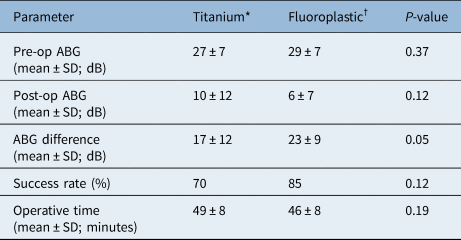
The success rate (air–bone gap of 10 dB or lower) was higher for cases with fluoroplastic than titanium pistons, but this difference was not significant (85 per cent vs 70 per cent, p = 0.12) (Table 2). The success rates for pistons with shaft diameters of 0.5 mm and 0.4 mm were 79 per cent and 72 per cent, respectively. No significant differences were found for any audiometric parameters (Table 3).
Comparison between titanium and fluoroplastic pistons

*n = 31; †n = 27. Pre-op = pre-operative; ABG = air–bone gap; SD = standard deviation; post-op = post-operative
Comparison between piston shaft diameters

*n = 25; †n = 33. Pre-op = pre-operative; ABG = air–bone gap; SD = standard deviation; post-op = post-operative
There were no statistically significant differences between the manual crimping and self-crimping pistons in regard to audiometric results, success rate or operative time (Table 4).
Comparison between piston crimping methods

*n = 24; †n = 34. Pre-op = pre-operative; ABG = air–bone gap; SD = standard deviation; post-op = post-operative
Revision stapedotomy was performed for two patients because of a short prosthesis. Another two patients had an eroded long process of the incus, for which malleo-stapedotomy was conducted. None of the patients had prolonged vertigo or prolonged taste disturbance. Furthermore, delayed healing, tympanic membrane perforation and sagging of the scutum were not seen.
Discussion
Otosclerosis is a common ear disease all over the world; 10 per cent of all hearing loss and 18–22 per cent of adult conductive hearing loss is caused by this disease.Reference wGordon2,Reference Ealy and Smith5 Nowadays, stapedotomy is considered the most commonly performed surgical procedure to correct the conductive hearing loss caused by otosclerosis. It is a highly successful surgery, with success rates ranging between 70 per cent and 95 per cent, and with a low rate of complications.Reference Vincent, Sperling, Oates and Jindal6,Reference Dhooge, Desmedt, Maly, Loose and Van Hoecke15
Many surgeons have focused on the prosthesis (piston) as an important factor in the post-operative outcomes. They have studied the effect of different prosthesis materials, shaft diameters and crimping styles. However, there is no clear evidence that one prosthesis design achieves significantly better post-operative hearing outcomes than another.Reference Marchese, Cianfrone, Passali and Paludetti13,Reference Laske, Röösli, Chatzimichalis, Sim and Huber16,Reference Ruckenstein and Nicolli17
In this study, fortunately, we were able to analyse different stapes piston variables using similar sample sizes. All patients were operated on with the same technique by the same surgeon. Our results showed that higher success rates (but not significantly higher) were achieved in cases where fluoroplastic pistons, pistons with a shaft diameter of 0.5 mm and self-crimping pistons were used, compared with titanium pistons, pistons with a shaft diameter of 0.4 mm and manual crimping pistons, respectively (p > 0.12).
Massey et al.Reference Massey, Kennedy and Shelton18 compared the post-operative hearing results of 218 patients who underwent stapedotomy; 35 patients received titanium prostheses and 183 received Teflon prostheses. Surgical success was achieved in 86 per cent of the Teflon group compared with 71 per cent of the titanium group, with no significant difference. The overall rate of SNHL was 2.8 per cent (1.6 per cent in the Teflon group vs 8.6 per cent in the titanium group). This difference was not statistically significant and may have been caused by manipulation of the stapes suprastructure or footplate, rather than the prosthesis itself.
Casale et al.Reference Casale, De Franco, Salvinelli, Piazza, Vincenzi and Zini19 compared the hearing results obtained after primary stapedotomy involving the implantation of 30 fluoroplastic pistons with a shaft diameter of 0.6 mm and 30 titanium pistons with a shaft diameter of 0.4 mm. They found statistically significant bone conduction improvements at 1 kHz and 2 kHz in favour of the fluoroplastic group.
There is inconsistent evidence for the effect of piston shaft diameter in primary stapedotomy on hearing outcomes for otosclerosis patients. Theoretically, the best hearing results could be achieved by using a larger shaft diameter, because it will transmit more sound energy into the vestibule because of the larger surface area of contact.Reference Wegner, Eldaebes, Landry, Grolman and Bance20 In contrast, HüttenbrinkReference Hüttenbrink21 suggested that the small surface area of contact for smaller pistons (minimum of 0.4 mm) is compensated by a much larger vibration amplitude. Casale et al.Reference Casale, De Franco, Salvinelli, Piazza, Vincenzi and Zini19 suggest that an increase in shaft diameter results in greater hearing improvement at the low-frequency threshold, while a decrease in diameter results in greater improvement at high frequencies. However, in practice this issue remains controversial, and inconsistent acoustic results with different piston diameters have been reported.
A systematic review of the effect of piston diameter in stapes surgery revealed that approximately 50 per cent of the included studies showed no significant difference in hearing outcomes regarding the shaft diameter, while the other 50 per cent showed a significantly better hearing outcome associated with the use of pistons with a larger shaft diameter rather than a smaller one. None of the studies showed a difference in SNHL incidence.Reference Wegner, Verhagen, Stegeman, Vincent and Grolman22
Gristwood and VenablesReference Gristwood and Venables23 compared the hearing results following stapedotomy using pistons with a 0.6 mm shaft diameter (332 cases) versus a 0.8 mm diameter (52 cases). They found that shaft diameter had little effect on the outcome, except at 6 kHz and 8 kHz, where the 0.6 mm piston appeared to have a significant advantage. Furthermore, Sennaroǧlu et al.Reference Sennaroğlu, Unal, Sennaroğlu, Gürsel and Belgin24 reported statistically significant differences in hearing outcomes at 0.5, 1 and 2 kHz for the 0.8 mm diameter piston group compared with the 0.6 mm group. In a meta-analysis and systematic review, Laske et al.Reference Laske, Röösli, Chatzimichalis, Sim and Huber16 found that a 0.6 mm diameter prosthesis was associated with significantly better results than a 0.4 mm prosthesis.
A temporal bone model showed a modest effect of piston diameter on hearing results following stapedotomy using 0.4 mm, 0.6 mm and 0.8 mm pistons.Reference Wegner, Eldaebes, Landry, Grolman and Bance20 Marchese and colleaguesReference Marchese, Cianfrone, Passali and Paludetti13 compared 112 cases of stapedotomy using a 0.6 mm piston diameter with 100 cases using 0.4 mm pistons. They found that an increase in piston diameter gave better results, especially at low frequencies. In contrast, others reported statistically insignificant differences in hearing results between 0.4 mm and 0.6 mm pistons.Reference Shabana, Ghonim and Pedersen25,Reference Cavaliere, Ricciardiello, Mesolella and Iengo26
A review of the limited literature revealed that Hornung et al.Reference Hornung, Brase, Zenk and Iro27 compared pistons of 0.4 mm diameter (nitinol-polytetrafluoroethylene) in 18 cases with those of 0.5 mm diameter (‘SMart’ pistons) in 21 cases, with a follow-up time of 12 months or more. In that study, the mean post-operative air–bone gap was 4.4 dB (SD ± 3.1) in the 0.4 mm group versus 5.7 dB (SD ± 5.0) in the 0.5 mm group. with success rates of 94 per cent and 90 per cent, respectively, which were statistically insignificant. We found the same insignificant differences in our study for both the mean post-operative air–bone gap and the surgical success rate (p > 0.3).
In general, a smaller diameter prosthesis is the preferred choice when the facial nerve is prominent or the oval window is particularly narrow. Otherwise, an experienced surgeon should be able to achieve good hearing results with whichever prosthesis is used.Reference Ruckenstein and Nicolli17,Reference Cavaliere, Ricciardiello, Mesolella and Iengo26
Good prosthesis fixation keeps the piston in place and secures long-time hearing improvement. Very loose or very tight crimping may cause incus erosion. Hence, manual crimping requires the surgeon to have a good feeling of the appropriate applied force; otherwise, incus dislocation or inner-ear damage may occur.Reference Huber, Schrepfer and Eiber28 A self-crimping piston does not fully encircle or apply tight pressure on the incus, theoretically reducing the risk of strangulation.Reference Ruckenstein and Nicolli17
Wegner et al.Reference Wegner, Swartz, Bance and Grolman29 conducted a systematic review on the effect of different crimping techniques in stapes surgery. They found that seven studies comparing manual crimping with self-crimping pistons showed no significant difference, or showed a difference in favour of manual crimping. However, statistical significance was reached in three studies, with mean differences of 22.7–26.0 dB, in favour of no crimping. None of the crimping methods seemed to result in increased complications.
Tange and GrolmanReference Tange and Grolman30 retrospectively analysed the air–bone gap closure obtained using a crimping and a non-crimping titanium prosthesis. They reviewed 126 cases; 63 patients received a titanium K-Piston prosthesis and 63 patients received a titanium CliP® piston. The overall results of both pistons were good, but there was no statistically significant difference between the two prostheses in terms of the success rate (p = 0.57).Reference Tange and Grolman30 Schrötzlmair et al.Reference Schrötzlmair, Suchan, Kisser, Hempel, Sroka and Müller31 compared 28 titanium pistons (manual crimping) with 13 clip pistons (self-crimping). They found a statistically significant difference in favour of clip pistons. In our study, no significant difference was found between these methods of crimping.
We believe that the variable results reported by different authors might be explained by study design, sample size, selection bias, differences in reporting audiometric results, and differences in surgical experience. In our opinion, the latter is the main factor influencing the post-operative outcomes, rather than the prosthesis specifications. We were able to achieve favourable results with low complication rates with whichever prosthesis was used. However, further prospective, double-blind, randomised, controlled clinical trials, conducted on a larger number of patients and with long-term follow-up time, may be necessary to prove whether different piston designs do have an impact on post-operative air–bone gap and success rate, and affect the risk of complications such as incus necrosis or SNHL.
Most previous studies investigating the effects of the piston on the outcome of stapes surgery have compared the effect of one prosthesis specification with another. ManghamReference Mangham32 was the only person to report the comparison of three piston variables, using either a titanium 0.6 mm CliP piston, or a platinum-ribbon Teflon 0.5 mm or a 0.6 mm piston. The author found that the Teflon piston produced better hearing results than the titanium piston; the superior results of Teflon were explained as being due to the larger actual shaft diameter. In addition, the mean air–bone gap for the Teflon 0.6 mm piston (5.1 dB) was significantly smaller than that for the titanium 0.6 mm piston (8.1 dB) and the Teflon 0.5 mm piston (7.5 dB); however, the success rates did not differ.
The limitations of this study include its retrospective design and the relatively small number of patients. However, its findings are of great value given that it is only the second study in the literature to report the influence of the three prosthesis variables (material, shaft diameter and crimping) in stapes surgery performed for otosclerosis.Reference Hornung, Brase, Zenk and Iro27 In addition, it is only the second study to compare 0.4 mm shaft diameter pistons with 0.5 mm diameter pistons.Reference Mangham32
• Stapedotomy is the most popular surgical treatment for otosclerosis
• The influence of piston specifications on hearing following stapedotomy remains controversial
• The impact of piston variables (materials, shaft diameter and crimping method) on hearing following stapedotomy for otosclerosis was evaluated
• Piston material, shaft diameter and crimping method had no statistically significant effect on stapedotomy success rate
• Surgical experience is likely to be the main factor contributing to the best outcome and low complication rate
Our results show that piston material, shaft diameter and crimping method have no statistically significant effects on the success rate of stapedotomy. High-quality studies with a larger sample size and long-term follow up may be necessary to confirm these findings. We believe that surgical experience is the main factor needed to achieve the best outcome with low complication rates.
Competing interests
None declared