


1. Introduction
The generation of radiation by motion of the electrons in electromagnetic field and the existence of a damping force, due to the emission of energy, are two complementary effects, which have studied since the beginning of the previous century (Thomson, Reference Thomson1881; Lorentz, Reference Lorentz1916; Abraham, Reference Abraham1932; Dirac, Reference Dirac1938). The number of the papers treating these effects increased exponentially, starting in the 1970s, after the development of high-power lasers (Sarachik, Reference Sarachik and Schappert1970; Esarey, Reference Esarey, Ride and Sprangle1993; Harteman, Reference Harteman and Luhmann1995). More recently, the emergence of the ultraintense laser pulses, generated by the technique of chirped pulse amplification, has made it possible to obtain beam intensities greater than 1018 W/cm2. At such intensities, the study of the effect of radiation reaction becomes increasingly important, due to new applications, such as the generation of very energetic radiations (Eden, Reference Eden2004), and the acceleration of particles in very intense electromagnetic fields (Mourou, Reference Mourou, Tajima and Bulanov2006; Faure, Reference Faure, Rechatin, Norlin, Lifschitz, Glinek and Malka2006). At the same time, these applications are limited to ultrahigh laser beam intensities, due to the effect of radiation damping (Mao, Reference Mao, Kong, Ho, Che, Ban, Gu and Kawata2010; Hadad, Reference Hadad, Labun, Rafelski, Elkina, Klier and Ruhl2010; Deng, Reference Deng, Nakajima, Zhang, Lu, Shen, Liu, Li and Xu2012).
In previous papers (Popa, Reference Popa2011; Reference Popa2012), we proved that the electrical field which results from the Liènard-Wiechert relation, due to the motion of the electron in the laser field, is a periodic function of only one variable, that is, the phase of the incident electromagnetic field. This property simplifies significantly the calculation model for the generation of hard radiations, in interactions between very intense laser fields and particles. Indeed all the functions which are involved in calculations are composite functions of only one variable, and their mathematical properties can be analyzed accurately. A synthesis of the applications of this method is presented by Popa (Reference Popa2013a; Reference Popa2013b).
We show now that this method can be used also for accurately modeling the radiation reaction in interactions between very intense laser beams and relativistic electron beams. Our analysis is made in the inertial system S′ in which the initial electron velocity is zero. We use the Landau-Lifschitz form of the radiation reaction force (Landau, Reference Landau and Lifshitz1987), which is a version of the Lorentz-Abraham-Dirac damping force (Lorentz, Reference Lorentz1916; Abraham, Reference Thomson1932; Dirac, Reference Dirac1938). We prove that the radiation reaction force, as well as the rate of change of the damping energy, resulted by the action of this force, are periodic functions of only one variable, which is the phase of the laser field. With the aid of this property, the calculations are strongly simplified, because the average values of the damping and external forces, on one hand, and the average kinetic energy, on other hand, can be easily calculated over one period. At the same time, the damping energy, can be obtained without calculating the electron trajectory. Our approach is made in the most general case, when the degree of polarization of the electromagnetic field, the initial phase of the incident field, and the initial energy of the electron have arbitrary values.
More specifically, we calculate the maximum intensity of the laser beam at which the radiation reaction can be neglected, its dependence on the angular frequency of the field and on the initial electron energy, and the effect of the lowering of the maximum intensity value, due to increasing the initial electron energy. At the same time, the increasing of laser beam intensity in the ultrarelativistic regime has some collateral effects, such as the electron acceleration and the decrease in the variation of the field phase at the point where the electron is situated. These effects are used in the calculation of the radiation reaction parameters. Our results are compared with a series of data reported in recent papers. The equations are written in the International System.
2. Initial hypotheses
We analyze the radiation damping effect in the case of a system composed of a very intense laser beam, interacting with a relativistic electron beam. We consider the following initial hypotheses:
(h1) In a Cartesian system of coordinates, the intensity of the electric field and of the magnetic induction vector of the laser beam, denoted, respectively, by  ${\bar E_L}$ and
 ${\bar B_L}$, are elliptically polarized in the xy-plane, while the wave vector, denoted by
 ${\bar k_L}$, is parallel to the oz-axis. The expressions of the electric field and of the corresponding magnetic induction vector are
 $$\mathop {\overline E }\nolimits_L = {E_{M1}}\cos{\rm \eta} \overline i + {E_{M2}}\sin{\rm \eta} \overline j\comma \;$$
 $$\mathop {\overline B }\nolimits_L = - {B_{M2}}\sin{\rm \eta} \overline i + {B_{M1}}\cos{\rm \eta} \overline j\comma \;$$
where η is the phase of the electromagnetic field,  $\overline i$,
 $\overline j$, and
 $\overline k$ are versors of the ox, oy, and oz axes, E M1, E M2 are the amplitudes of the electric field oscillations in the ox and oy directions, and B M1 and B M2 are the amplitudes of the magnetic field oscillations in the oy and ox directions.
The following relations are also valid:
 $${\rm \eta} = {{\rm \omega} _L}t - \left\vert {\mathop {\overline k }\nolimits_L } \right\vert z + {{\rm \eta} _i}\comma \; \quad \left\vert {\mathop {\overline k }\nolimits_L } \right\vert c = {{\rm \omega} _L}\comma \;$$
and
 $${E_{M1}} = c{B_{M1}}\comma \; \quad {E_{M2}} = c{B_{M2}}\comma \; \quad c\mathop {\overline B }\nolimits_L = \overline k \;\times\; \mathop {\overline E }\nolimits_L\comma \;$$
where ωL is the angular frequency of the laser electromagnetic field, c is the speed of light, ηi is an arbitrary initial phase, and t is the time in the xyz system in which the motion of the electron is studied.
It follows that the electromagnetic field described by Eqs. (1) and (2) is obtained by the superposition of two electromagnetic fields, linearly polarized along the ox and oy directions. We denote by I L the average value of the intensity of the laser beam and by I L1 and I L2, respectively, the average intensities of the components linearly polarized along the ox and oy directions. Since 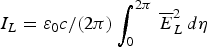 ${I_L} = {{\rm \varepsilon} _0}c/\lpar 2\pi \rpar \vint_0^{2 \pi} \, \mathop {\overline E }\nolimits_L^2 d{\rm \eta} $ and so on, where ε0 is the vacuum permitivity, we obtain the following relations:
 $$\eqalign{&{I_L} = \displaystyle{1 \over 2}{{\rm \varepsilon} _0}c\left({E_{M1}^2 + E_{M2}^2 } \right)\comma \; \quad {I_{L1}} = \displaystyle{1 \over 2}{{\rm \varepsilon} _0}cE_{M1}^2 \comma \; \cr & {I_{L2}} = \displaystyle{1 \over 2}{{\rm \varepsilon} _0}cE_{M2}^2.}$$
(h2) We suppose that E M1 > E M2 and the degree of the polarization of the field is given by Crawford (Reference Crawford1999), written for the average intensities of the two components of the field. Taking into account (5), this relation can be written
 $$P = \displaystyle{{{I_{L1}} - {I_{L2}}} \over {{I_{L1}} + {I_{L2}}}} = \displaystyle{{E_{M1}^2 - E_{M2}^2 } \over {E_{M1}^2 + E_{M2}^2 }}.$$
We see that when P = 1, the field is linearly polarized, and when P = 0, the field is circularly polarized.
The initial data for our calculations are I L, λL, P, E 0, and ηi, where λL is the wavelength of the electromagnetic field and E 0 is the initial energy of the electron.
With the aid of the Eqs. (5) and (6), we obtain:
 $${E_{M1}} = \sqrt {\displaystyle{{{I_L}} \over {{{\rm \varepsilon} _0}c}}\lpar 1 + P\rpar } \, \, \, {\rm and} \, \, {E_{M2}} = \sqrt {\displaystyle{{{I_L}} \over {{{\rm \varepsilon} _0}c}}\lpar 1 - P\rpar }.$$
(h3) We consider the following initial conditions, when the components of the electron velocities, denoted by v x, v y, and v z, have the following values, in the laboratory system, which is denoted by S:
 $$\eqalign{&t = 0\comma \; \quad x = y = z = 0\comma \; \quad {v_x} = {v_y} = 0\comma \; \quad {v_z} = - \vert \mathop {\overline V }\nolimits_0 \vert \cr & \quad {\rm and} \quad {\rm \eta} = {{\rm \eta} _i}\comma \; }$$
where the value  $\vert \mathop {\overline V }\nolimits_0 \vert $ results from the following relations:
 $${E_0} = {\gamma_0}m{c^2}\comma \; \, \, {\gamma_0} = \displaystyle{1 \over {\sqrt {1 - \mathop {\overline {\rm \beta} }\nolimits_0^2 } }} \, \, {\rm and} \, \, \mathop {\overline {\rm \beta} }\nolimits_0 = - \displaystyle{{\vert \mathop {\overline V }\nolimits_0 \vert } \over c}\overline k\comma \;$$
where m is the electron mass, while β0 and γ0 are the well-known symbols used in the relativistic theory.
(h4) We use the conventions of Landau and Lifshitz (Landau, Reference Landau and Lifshitz1987) to write the four-vectors and the electromagnetic field tensor. So, the contravariant and covariant components of the four-vector of the coordinates are denoted, respectively, by x i and x i. These components are, respectively, (ct, x, y, z) and (ct, −x, −y, −z). Similarly, the contravariant components of the four-velocity vector, which are given by the relation u i = d x i/ds, and the covariant components of the same vector, given by u i = d x i/ds, are, respectively, the (γ, γβx, γβy, γβz) and (γ −γβx, −γβy, −γβz). In these relations, βx = v x/c, βy = v y/c and βz = v z/c, where v x, v y, and v z are the components of the electron velocity, while 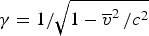 $\gamma = 1/\sqrt {1 - \mathop {\overline v }\nolimits^2 /{c^2}} $ and ds = (c/γ)dt are the infinitesimal interval in the four dimensional space.
The contravariant and the covariant electromagnetic field tensors, where the index i = 0, 1, 2, 3 labels the rows, and the index k = 0, 1, 2, 3 the columns, are given, respectively, by the following relations:
 $$\eqalign{&{F^{ik}} = \left[{\matrix{ 0 & { - {E_x}} & { - {E_y}} & { - {E_z}} \cr {{E_x}} & 0 & { - c{B_z}} & {c{B_y}} \cr {{E_y}} & {c{B_z}} & 0 & { - c{B_x}} \cr {{E_z}} & { - c{B_y}} & {c{B_x}} & 0 \cr } } \right]\semicolon \; \cr & {F_{ik}} = \left[{\matrix{ 0 & {{E_x}} & {{E_y}} & {{E_z}} \cr { - {E_x}} & 0 & { - c{B_z}} & {c{B_y}} \cr { - {E_y}} & {c{B_z}} & 0 & { - c{B_x}} \cr { - {E_z}} & { - c{B_y}} & {c{B_x}} & 0 \cr } } \right]\comma \;}$$
where E x, E y, E z, B x, B y, and B z are the components of the electromagnetic field in the Cartezian system xyz.
(h5) We use the Landau-Lifschitz (LL) form (Landau, Reference Landau and Lifshitz1987) of the radiation reaction force. The equation of motion of the electron, in four-dimensional form, written in the International System (LL use the Gaussian System), is
 $$m{c^2}\displaystyle{{d{u^i}} \over {ds}} = - e{F^{ik}}{u_k} + {g^i}\comma \;$$
where e is the absolute value of the electron charge and g i is the radiation damping correction term, which is given by the contravariant vector (Landau, Reference Landau and Lifshitz1987)
 $${g^i} = \displaystyle{{{e^2}} \over {6\pi{{\rm \varepsilon} _0}}}\left({\displaystyle{{{d^2}{u^i}} \over {d{s^2}}} - {u^i}{u^k}\displaystyle{{{d^2}{u_k}} \over {d{s^2}}}} \right).$$
By expressing d 2u i/ds 2 in terms of the tensor of the external field, namely
 $$\displaystyle{{d{u^i}} \over {ds}} = - \displaystyle{e \over {m{c^2}}}{F^{ik}}{u_k}\comma \;$$
together with
 $$\displaystyle{{{d^2}{u^i}} \over {d{s^2}}} = - \displaystyle{e \over {m{c^2}}}\displaystyle{{\partial {F^{ik}}} \over {\partial {x^l}}}{u_k}{u^l} + \displaystyle{{{e^2}} \over {{m^2}{c^4}}}{F^{ik}}{F_{kl}}{u^l}\comma \;$$
and substituting these relations in (11), the following relation results (Landau, Reference Landau and Lifshitz1987):
 $$\eqalign{{g^i} & = - \displaystyle{{{e^3}} \over {6\pi{{\rm \varepsilon} _0}m{c^2}}}\displaystyle{{\partial {F^{ik}}} \over {\partial {x^l}}}{u_k}{u^l} - \displaystyle{{{e^4}} \over {6\pi{{\rm \varepsilon} _0}{m^2}{c^4}}}{F^{il}}{F_{kl}}{u^k} \cr & \quad + \displaystyle{{{e^4}} \over {6\pi{{\rm \varepsilon} _0}{m^2}{c^4}}}\left({{F_{kl}}{u^l}} \right)\left({{F^{km}}{u_m}} \right){u^i}.}$$
This relation is used for many evaluations of radiation corrections (Zhidkov, Reference Zhidkov, Koga, Sasaki and Uesaka2002; Hadad, Reference Hadad, Labun, Rafelski, Elkina, Klier and Ruhl2010; Bulanov, Reference Bulanov, Esirkepov, Kando, Koga and Bulanov2011). The first terms on the right-hand side of Eqs. (11) and (14) stand for the nonrelativistic expression of the damping force, while the second and, respectively, the second and the third terms on the right-hand side of the same equations, correspond to the relativistic component of the damping force (Landau, Reference Landau and Lifshitz1987).
We observe that Eq. (12) is identical to the motion equation of the electron, written in the tensorial form, when the damping force is very small, compared to the external force. Since (12) has been used to obtain (14), it follows that this last equation is rigorously valid only for the domain the intensity values I L of the laser beam for which the damping force, denoted by  $\mathop {\overline F }\nolimits_d $, is very small compared to the external electromagnetic force, denoted by
 $\overline F$. We will show that this condition is fulfilled throughout our calculations.
The tensorial relation (10) corresponds to four equations, written in three dimensional space. The three space components, for i = 1, 2, 3, are the equations of motion of the electron, while the time component, for i = 0, is the equation of the rate of change of the electron energy. The relation (10) corresponds to the following motion equations, which are written in three-dimensional notation.
 $$mc\displaystyle{d \over {dt}}\left({\gamma{{\rm \beta} _x}} \right)= \left({ - e{E_x} - ec{{\rm \beta} _y}{B_z} + ec{{\rm \beta} _z}{B_y}} \right)+ \displaystyle{1 \over \gamma}{g^1}\comma \;$$
 $$mc\displaystyle{d \over {dt}}\left({\gamma{{\rm \beta} _y}} \right)= \left({ - e{E_y} + ec{{\rm \beta} _x}{B_z} - ec{{\rm \beta} _z}{B_x}} \right)+ \displaystyle{1 \over \gamma}{g^2}\comma \;$$
 $$mc\displaystyle{d \over {dt}}\left({\gamma{{\rm \beta} _z}} \right)= \left({ - e{E_z} - ec{{\rm \beta} _x}{B_y} + ec{{\rm \beta} _y}{B_x}} \right)+ \displaystyle{1 \over \gamma}{g^3}\comma \;$$
It is easy to see that F x = (−eE x − ecβyB z + ecβzB y) and so on, are the spatial components of the external force, and F dx = (1/γ)g 1 and so on, are the spatial components of the damping force.
Similarly, Eq. (10) corresponds to the following time component equation. This equation can be written in the following form using three-dimensional notation:
 $$\displaystyle{d \over {dt}}\left({m{c^2}\gamma} \right)= - ec\left({{{\rm \beta} _x}{E_x} + {{\rm \beta} _y}{E_y} + {{\rm \beta} _z}{E_z}} \right)+ \displaystyle{c \over \gamma}{g^0}\comma \;$$
We see that −ec(βxE x + βyE y + βzE z) is the rate of change of the electron energy, due to the interaction with the electromagnetic field, while (c/γ)g 0 is the rate of change of the damping energy, due to the action of the damping force.
(h6) The integral of the four-force, given by (11), over the world line of the motion of the electron, leads to the following relation of the total momentum ΔP i (Landau, Reference Landau and Lifshitz1987):
 $$\Delta {P^i} = - \displaystyle{{{e^2}} \over {6\pi{{\rm \varepsilon} _0}}} \int \displaystyle{{d{u_k}} \over {ds}}\displaystyle{{d{u^k}} \over {ds}}d{x^i}\comma \;$$
The temporal term of the contravariant vector ΔP i, namely ΔP 0, is the damping energy, that is the energy radiated by the particle under the action of the electromagnetic field. This energy is denoted by E d.
We assume that the radiative effects are negligible when the damping energy is much smaller than the kinetic energy of the electron. Since the damping energy increases continuously, when the time increases from 0 to τL, the length of the laser pulse, and the kinetic energy varies periodically in this interval, we assume that the maximum value of the laser beam intensity, denoted by I LM, at which the effect of the damping reaction can be neglected, corresponds to the relation
 $$\displaystyle{{{E_d}} \over {{E_{kav}}}} = 0.1\comma \;$$
where E kav is the average value of the kinetic energy.
(h7) The LL approach is based on the assumption that the damping force is smaller than the external force. This assumption leads to two requirements, given by the relations (75.11) and (75.12) from Landau (Reference Landau and Lifshitz1987). These relations, written in the International System, are, respectively,  $\left\vert {\mathop {\overline E }\nolimits_L } \right\vert \ll 6\pi{\varepsilon_0}{m^2}{c^4}/{e^3} = 2.722 \times {10^{20}} \, V/m$ and λL ≫ e 2/(3ε0mc 2) = 11.8 × 10⁻¹⁴ m. These conditions are overhelmingly satisfied in our calculations.
Since the LL relations are classical, another condition has to be satisfied. This is the requirement that the Compton relation be satisfied at the classical limit, written in the proper reference system of the electron (Bamber, Reference Bamber1999; Boca, Reference Boca and Florescu2009). This condition is
 $${C_q} = \displaystyle{{\hbar \mathop {{\rm \omega} ^{\prime}}\nolimits_L } \over {m{c^2}}} \ll 1\comma \;$$
where C q is the coefficient of the second term in the denominator of the Compton relation, ħ is the normalized Planck constant and ω′L is the angular frequency of the laser field, in the proper system S′ of the electron.
We will show that the relation (7) is fulfilled throughout the paper. From this point on, no approximation is made in order to calculate the damping force and damping energy, and their variation with the laser beam parameters.
3. Space and time components of the damping force and total momentum four-vectors
We calculate now the space and time components of the contravariant vectors g i and ΔP i, which will be used in this paper. We note that the calculations are simplified because the components of the electromagnetic field depend only of two spatio-temporal coordinates, t and z, due to the formula for η, and the z components of the field are zero. For example, we have:
 $$\eqalign{ \displaystyle{{\partial {F^{1k}}} \over {\partial {x^l}}}{u_k}{u^l} &= \sum\limits_{l = 0}^3 \, \left[{\left({\sum\limits_{k = 0}^3 \, \displaystyle{{\partial {F^{1k}}} \over {\partial {x^l}}}{u_k}} \right){u^l}} \right]\cr & = \left({\displaystyle{{\partial {F^{10}}} \over {\partial {x^0}}}{u_0} + \displaystyle{{\partial {F^{13}}} \over {\partial {x^0}}}{u_3}} \right){u^0} + \left({\displaystyle{{\partial {F^{10}}} \over {\partial {x^3}}}{u_0} + \displaystyle{{\partial {F^{13}}} \over {\partial {x^3}}}{u_3}} \right){u^3} \cr & = \left({ - {E_{M1}} \sin {\rm \eta} \displaystyle{{{{\rm \omega} _L}} \over c}\gamma + c{B_{M1}} \sin {\rm \eta} \displaystyle{{{{\rm \omega} _L}} \over c}\gamma{{\rm \beta} _z}} \right)\gamma \cr & \quad + \left({{E_{M1}} \sin {\rm \eta} \left\vert {\mathop {\overline k }\nolimits_L } \right\vert \gamma - c{B_{M1}} \sin {\rm \eta} \left\vert {\mathop {\overline k }\nolimits_L } \right\vert \gamma{{\rm \beta} _z}} \right)\gamma{{\rm \beta} _z}.}$$
The space components of the contravariant vector g i, given by Eq. (11), lead to the following components of the radiation damping force
 $$\eqalign{ {F_{dx}} &= \displaystyle{{{e^2}{\rm \omega} _L^2 \gamma} \over {6\pi{\varepsilon_0}{c^2}}}{a_1} \sin {\rm \eta} \mathop {\left({1 - {{\rm \beta} _z}} \right)}\nolimits^2 \cr & \quad - \displaystyle{{{e^2}{\rm \omega} _L^2 {\gamma^2}} \over {6\pi{\varepsilon_0}{c^2}}}\lpar a_1^2 \cos{^2}{\rm \eta} + a_2^2 \sin{^2}{\rm \eta} \rpar {{\rm \beta} _x}\mathop {\left({1 - {{\rm \beta} _z}} \right)}\nolimits^2 \comma \; }$$
 $$\eqalign{ {F_{dy}} &= - \displaystyle{{{e^2}{\rm \omega} _L^2 \gamma} \over {6\pi{\varepsilon_0}{c^2}}}{a_2}\cos {\rm \eta} \mathop {\left({1 - {{\rm \beta} _z}} \right)}\nolimits^2 \cr & \quad - \displaystyle{{{e^2}{\rm \omega} _L^2 {\gamma^2}} \over {6\pi{\varepsilon_0}{c^2}}}\left({a_1^2 \cos{^2}{\rm \eta} + a_2^2 \sin{^2}{\rm \eta} } \right){{\rm \beta} _y}\mathop {\left({1 - {{\rm \beta} _z}} \right)}\nolimits^2 \comma \;}$$
 $$\eqalign{ {F_{dz}} &= \displaystyle{{{e^2}{\rm \omega} _L^2 \gamma} \over {6\pi{\varepsilon_0}{c^2}}}\left({{a_1}{{\rm \beta} _x} \sin {\rm \eta} - {a_2}{{\rm \beta} _y}\cos {\rm \eta} } \right)\left({1 - {{\rm \beta} _z}} \right)\cr & \quad + \displaystyle{{{e^2} {\rm \omega} _L^2 } \over {6\pi{\varepsilon_0}{c^2}}}\left({a_1^2 \cos\!{^2} {\rm \eta} + a_2^2 \sin\!{^2} {\rm \eta} } \right)\left[{1 - {\gamma^2}{{\rm \beta} _z}\left({1 - {{\rm \beta} _z}} \right)} \right]\left({1 - {{\rm \beta} _z}} \right),} \;$$
where we have separated the term due to the relativistic effect, in the second term of the second hand member.
The damping energy E d is equal to the temporal component of the total momentum ΔP i, given by (19). It easy to show that ΔP 0, written with the aid of the three-dimensional notation, is given by the following relation.
 $${E_d} = \Delta {P^0} = \displaystyle{{{e^2}{\rm \omega} _L^2 } \over {6\pi{\varepsilon_0}c}}\vint_{{t_1}}^{{t_2}} \, {\gamma^2}\left({a_1^2 \cos{^2}{\rm \eta} + a_2^2 \sin\!{^2}{\rm \eta} } \right)\mathop {\left({1 - {{\rm \beta} _z}} \right)}\nolimits^2 dt\comma \;$$
where t 1 and t 2 are the time moments between which the energy is calculated.
4. Periodicity properties in the inertial system S′
4.1. Periodicity Property of External Force and Kinetic Energy
Our analysis is performed in the inertial system S′ in which the initial velocity of the electron is zero. The Cartesian axes in the systems S(t, x, y, z) and S′(t′, x′, y′, z′) are parallel, and the system S′ moves with velocity  $-\left\vert {{\bar V_0}} \right\vert $ along the oz axis. Since our analysis is performed in the S′ system, we have to calculate the parameters of the laser field, denoted by
 $\mathop {\overline E }\nolimits^{\prime}_L $,
 $\mathop {\overline B }\nolimits^{\prime}_L $,
 $\mathop {\overline k }\nolimits^{\prime}_L $ and
 ${{\rm \omega} ^{\prime}_L}$, in the S′ system.
The contravariant wave vectors have, respectively, the following components in the S and S′ systems: ( ωL/c, k Lx, k Ly, k Lz) and (ω′L/c, k′Lx′, k′Ly′, k′Lz′). Using the Lorentz transformation, given by relations (11.22) in Jackson (Reference Jackson1999), we have
 $$\displaystyle{{{{{\rm \omega} ^{\prime}}_L}} \over c} = \displaystyle{{{{\rm \omega} _L}} \over c}{\gamma_0}\left({1 + \left\vert {\mathop {\overline {\rm \beta} }\nolimits_0 } \right\vert } \right)\comma \;$$
 $${k^{\prime}_{Lz^{\prime}}} = \left\vert {\mathop {\overline k }\nolimits_L^{\prime} } \right\vert = \left\vert {\mathop {\overline k }\nolimits_L } \right\vert {\gamma_0}\left({1 + \left\vert {\mathop {\overline {\rm \beta} }\nolimits_0 } \right\vert } \right)\comma \;$$
 $${k^{\prime}_{Lx^{\prime}}} = {k_{Lx}} = {k^{\prime}_{Ly^{\prime}}} = {k_{Ly}} = 0\comma \;$$
where
 $$\displaystyle{{{{{\rm \omega} ^{\prime}}_L}} \over {\left\vert {\mathop {\overline k }\nolimits_L } \right\vert }} = \displaystyle{{{{\rm \omega} _L}} \over {\left\vert {\mathop {\overline k }\nolimits_L } \right\vert }} = c.$$
Since the scalar product between the four-dimensional wave vector and the space-time four vector is invariant, it follows that the phase of the electromagnetic wave is invariant (Jackson, Reference Jackson1999), and we have
 $${\rm \eta} = {{\rm \omega} _L}t - \left\vert {{{\bar k}_L}} \right\vert z + {{\rm \eta} _i} = {{\rm \omega} ^{\prime}_L}t^{\prime} - \left\vert {{{\bar k^{\prime}}_L}} \right\vert z^{\prime} + {{\rm \eta} _i} = {\rm \eta} ^{\prime}\comma \;$$
where  $\bar r$ and
 $\bar r^{\prime}$ are the position vectors of the electron in the two systems.
We use equations (11.149) from Jackson (Reference Jackson1999), which give the Lorentz transformation of the fields. We write these relations in the International System, and using (4) and (29), we obtain the following expressions for the components of the electromagnetic field in the S′ system:
 $${\bar E^{\prime}_L} = {\gamma_0}\left({{{\bar E}_L} + {{\bar {\rm \beta} }_0} \times c{{\bar B}_L}} \right)= {\gamma_0}\left({1 + \left\vert {{{\bar {\rm \beta} }_0}} \right\vert } \right){\bar E_L}\comma \;$$
 $${\bar B^{\prime}_L} = {\gamma_0}\left({{{\bar B}_L} - {{\bar {\rm \beta} }_0} \times {{\bar E}_L}/c} \right)= {\gamma_0}\left({1 + \left\vert {{{\bar {\rm \beta} }_0}} \right\vert } \right){\bar B_L}.$$
By virtue of the relation (12), the external force can be calculated from the following system of equations for the electron motion, written in the S′ system:
 $$m\displaystyle{d \over {dt^{\prime}}}\left({\gamma ^{\prime}{{v^{\prime}}_{x^{\prime}}}} \right)= {\gamma_0}\left({1 + \left\vert {{{\bar {\rm \beta} }_0}} \right\vert } \right)\left({ - e{E_{M1}}\cos {\rm \eta} + e{{v^{\prime}}_{z^{\prime}}}{B_{M1}}\cos {\rm \eta} } \right)\comma \;$$
 $$m\displaystyle{d \over {dt^{\prime}}}\left({\gamma ^{\prime}{{v^{\prime}}_{y^{\prime}}}} \right)= {\gamma_0}\left({1 + \left\vert {{{\bar {\rm \beta} }_0}} \right\vert } \right)\left({ - e{E_{M2}}\sin {\rm \eta} + e{{v^{\prime}}_{z^{\prime}}}{B_{M2}}\sin {\rm \eta} } \right)\comma \;$$
 $$m\displaystyle{d \over {dt^{\prime}}}\left({\gamma ^{\prime}{{v^{\prime}}_{\!\!z^{\prime}}}} \right)= {\gamma_0}\left({1 + \left\vert {{{\bar {\rm \beta} }_0}} \right\vert } \right)\left({ - e{{v^{\prime}}_{\!\!x^{\prime}}}{B_{M1}}\cos {\rm \eta} - e{{v^{\prime}}_{\!\!y^{\prime}}}{B_{M2}}\sin {\rm \eta} } \right)\comma \;$$
where v x′′, v y′′ and v z′′ are the components of the electron velocity in S′ and
 $$\gamma ^{\prime} = {\lpar 1 - {{\rm \beta} ^{\prime}_{x^{\prime}}}^2 - {{\rm \beta} ^{\prime}_{y^{\prime}}}^2 - {{\rm \beta} ^{\prime}_{z^{\prime}}}^2 \rpar ^{ - {1 \over 2}}}\comma \;$$
with β′x′ = v′x′/c, β′y′ = v′y′/c, and β′z′ = v′z′/c.
The solution of the system of equations (33)–(35), which leads to the expressions of β′x′, β′y′, γ′, dγ′/dt′ and dη/dt′, is presented in our previous papers (Popa, Reference Popa2011; Reference Popa2012). For the completeness of the presentation, we will give it briefly below.
Using (4) and (26), the equations of motion become
 $$\displaystyle{d \over {dt^{\prime}}}\left({\gamma ^{\prime}{{{\rm \beta} ^{\prime}}_{x^{\prime}}}} \right)= - {a^{\prime}_1}\mathop {{\rm \omega} ^{\prime}}\nolimits_L \left({1 - {{{\rm \beta} ^{\prime}}_{z^{\prime}}}} \right)\cos{\rm \eta}\comma \;$$
 $$\displaystyle{d \over {dt^{\prime}}}\left({\gamma ^{\prime}{{{\rm \beta} ^{\prime}}_{y^{\prime}}}} \right)= - {a^{\prime}_2}{{\rm \omega} ^{\prime}_L}\left({1 - {{{\rm \beta} ^{\prime}}_{z^{\prime}}}} \right)\sin{\rm \eta}\comma \;$$
 $$\displaystyle{d \over {dt^{\prime}}}\left({\gamma ^{\prime} \mathop {{\rm \beta} ^{\prime}}\nolimits_{z^{\prime}} } \right)= - \mathop {{\rm \omega} ^{\prime}}\nolimits_L \left({\mathop {a^{\prime}}\nolimits_1 \mathop {{\rm \beta} ^{\prime}}\nolimits_{x^{\prime}} \cos{\rm \eta} + \mathop {a^{\prime}}\nolimits_2 \mathop {{\rm \beta} ^{\prime}}\nolimits_{y^{\prime}} \sin{\rm \eta} } \right)\comma \;$$
where a′1 and a′2 are the relativistic parameters
 $${a^{\prime}_1} = \displaystyle{{{\gamma _0}\left({1 + \left\vert {\mathop {\overline {\rm \beta} }\nolimits_0 } \right\vert } \right)e{E_{M1}}} \over {mc{{{\rm \omega} ^{\prime}}_L}}} \, \, {\rm and} \, \, {a^{\prime}_2} = \displaystyle{{{\gamma _0}\left({1 + \left\vert {\mathop {\overline {\rm \beta} }\nolimits_0 } \right\vert } \right)e{E_{M2}}} \over {mc{{{\rm \omega} ^{\prime}}_L}}}.$$
These parameters are relativistic invariants, because, by virtue of (1), (26), (31), and (40), we have
 $${a_1} = {a^{\prime}_1} = \displaystyle{{e{E_{M1}}} \over {mc{{\rm \omega} _L}}} \, \, {\rm and} \, \, {a_2} = {a^{\prime}_2} = \displaystyle{{e{E_{M2}}} \over {mc{{\rm \omega} _L}}}.$$
Note. Despite the fact that a relativistic electron beam interacts with the laser beam in the S system, the electron motion in the S′ system can be non-relativistic, if a 1≪1 and a 2≪1.
The initial conditions in the system S′ are the following:
 $$t^{\prime} = 0\comma \; \, x^{\prime} = y^{\prime} = z^{\prime} = 0\comma \;\,{v^{\prime}_{x^{\prime}}} = {v^{\prime}_{y^{\prime}}} = {v^{\prime}_{z^{\prime}}} = 0 \, \, {\rm and} \, \, {\rm \eta} = {\rm \eta} ^{\prime} = {{\rm \eta} _i}.$$
We multiply (37), (38), and (39), respectively, by β′x′, β′y′ and β′z′. Taking into account that β′x′2 + β′y′2 + β′z′2 = 1 − 1/γ′2, their sum leads to
 $$\displaystyle{{d \gamma ^{\prime}} \over {dt^{\prime}}} = - {{\rm \omega} ^{\prime}_L}\left({{a_1}{{{\rm \beta} ^{\prime}}_{x^{\prime}}}\cos {\rm \eta} + {a_2}{{{\rm \beta} ^{\prime}}_{y^{\prime}}}\sin {\rm \eta} } \right).$$
From (39) and (43) we obtain d(γ′βz′′)/dt′ = dγ′/dt′. We integrate this relation with respect to time between 0 and t′, taking into account the initial conditions (42), and obtain γ′ − 1 = γ′β′z′. In virtue of (3), we have
 $$1 - {{\rm \beta} ^{\prime}_{z^{\prime}}} = \displaystyle{1 \over {{{{\rm \omega} ^{\prime}}_L}}}\displaystyle{{d{\rm \eta} } \over {dt^{\prime}}} = \displaystyle{1 \over {\gamma ^{\prime}}}.$$
We integrate (37) with respect to time between 0 and t′, taking into account (42) and (44), and obtain γ′βx′′ = −a 1(sin η − sin ηi), or
 $${{\rm \beta} ^{\prime}_{x^{\prime}}} = \displaystyle{{{{\,f^{\prime}}_1}} \over {\gamma ^{\prime}}}\; {\rm where}\; {\,f^{\prime}_1} = - {a_1}\left({\sin {\rm \eta} - \sin {{\rm \eta} _i}} \right).$$
Similarly, integrating (38) and taking into account (42) and (44), we obtain
 $${{\rm \beta} ^{\prime}_{y^{\prime}}} = \displaystyle{{{{\,f^{\prime}}_2}} \over {\gamma ^{\prime}}}\; {\rm where}\; {\,f^{\prime}_2} = - {a_2}\left({\cos {{\rm \eta} _i} - \cos {\rm \eta} } \right).$$
We substitute the expressions of β′x′, β′y′ and β′z′, respectively, from (45), (46), and (44) into βx′′2 + βy′′2 + βz′′2 = 1 − 1/γ′2 and obtain the expression of γ′:
 $${\rm \gamma} ^{\prime} = \displaystyle{1 \over 2}\left({2 + {{\,f^{\prime}}_1}^2 + {{\,f^{\prime}}_2}^2 } \right).$$
From (44) we obtain
 $${{\rm \beta} ^{\prime}_{z^{\prime}}} = \displaystyle{{{{\,f^{\prime}}_3}} \over {{\rm \gamma} ^{\prime}}}\; {\rm where}\; {\,f^{\prime}_3} = {\rm \gamma} ^{\prime} - 1.$$
With the aid of the above relations, we obtain the components of the external force:
 $${F^{\prime}_{x^{\prime}}} = - mc{a_1}{{\rm \omega} ^{\prime}_L}\left({1 - {{{\rm \beta} ^{\prime}}_{\!\!z^{\prime}}}} \right)\cos {\rm \eta}\comma \;$$
 $${F^{\prime}_{y^{\prime}}} = - mc{a_2}{{\rm \omega} ^{\prime}_L}\left({1 - {{{\rm \beta} ^{\prime}}_{\!\!z^{\prime}}}} \right)\sin {\rm \eta}\comma \;$$
 $${F^{\prime}_{z^{\prime}}} = - mc{{\rm \omega} ^{\prime}_L}\left({{a_1}{{{\rm \beta} ^{\prime}}_{\!\!x^{\prime}}}\cos {\rm \eta} + {a_2}{{{\rm \beta} ^{\prime}}_{\!\!y^{\prime}}}\sin {\rm \eta} } \right).$$
The kinetic energy of the electron is
 $${E^{\prime}_k} = m{c^2}\left({\gamma ^{\prime} - 1} \right).$$
We observe that, by virtue of Eqs. (45)–(48), γ′, β′x′, β′y′, and β′z′ are periodic functions of η. From the relations (49)–(52) it follows that F′x′, F′y′, F′z′ and E′k are also periodic functions of only one variable, namely η.
4.2. Periodicity Property of the Damping Force and of the Rate of Change of the Damping Energy
The components of the radiation damping force, given by Eqs. (22)–(24), can be written in the system S′, as follows:
 $$\eqalign{ {F^{\prime}_{dx^{\prime}}} &= \displaystyle{{{e^2}{{{\rm \omega} ^{\prime}}_L}^2 {\rm \gamma} ^{\prime}} \over {6{\rm \pi} {\varepsilon_0}{c^2}}}{a_1}\sin {\rm \eta} {\left({1 - {{{\rm \beta} ^{\prime}}_{z^{\prime}}}} \right)^2} \cr & \quad - \displaystyle{{{e^2}{{{\rm \omega} ^{\prime}}_L}^2 {{{\rm \gamma} ^{\prime}}^2}} \over {6{\rm \pi} {\varepsilon_0}{c^2}}}\lpar a_1^2 {\cos ^2}{\rm \eta} + a_2^2 {\sin ^2}{\rm \eta} \rpar {{{\rm \beta} ^{\prime}}_{x^{\prime}}}{\left({1 - {{{\rm \beta} ^{\prime}}_{z^{\prime}}}} \right)^2}\comma \; }$$
 $$\eqalign{ {{F^{\prime}}_{dy^{\prime}}} &= - \displaystyle{{{e^2}{{{\rm \omega} ^{\prime}}_L}^2 \gamma ^{\prime}} \over {6{\rm \pi} {\varepsilon_0}{c^2}}}{a_2}\cos {\rm \eta} {\left({1 - {{{\rm \beta} ^{\prime}}_{z^{\prime}}}} \right)^2} \cr & \quad - \displaystyle{{{e^2}{{{\rm \omega} ^{\prime}}_L}^2 {{ \gamma ^{\prime}}^2}} \over {6{\rm \pi} {\varepsilon_0}{c^2}}}\left({a_1^2 {{\cos }^2}{\rm \eta} + a_2^2 {{\sin }^2}{\rm \eta} } \right){{{\rm \beta} ^{\prime}}_{y^{\prime}}}{\left({1 - {{{\rm \beta} ^{\prime}}_{z^{\prime}}}} \right)^2}\comma \; }$$
 $$\eqalign{ {{F^{\prime}}_{dz^{\prime}}} &= \displaystyle{{{e^2}{{{\rm \omega} ^{\prime}}_L}^2 \gamma ^{\prime}} \over {6{\rm \pi} {\varepsilon_0}{c^2}}}\left({{a_1}{{{\rm \beta} ^{\prime}}_{x^{\prime}}}\sin {\rm \eta} - {a_2}{{{\rm \beta} ^{\prime}}_{y^{\prime}}}\cos {\rm \eta} } \right)\left({1 - {{{\rm \beta} ^{\prime}}_{z^{\prime}}}} \right)\cr & \quad + \displaystyle{{{e^2}{{{\rm \omega} ^{\prime}}_L}^2 } \over {6{\rm \pi} {\varepsilon_0}{c^2}}}\left({a_1^2 {{\cos }^2}{\rm \eta} + a_2^2 \;{{\sin }^2}\;{\rm \eta} } \right)\cr & \quad \times\left[{1 - {{ \gamma ^{\prime}}^2}{{{\rm \beta} ^{\prime}}_{z^{\prime}}}\left({1 - {{{\rm \beta} ^{\prime}}_{z^{\prime}}}} \right)} \right]\left({1 - {{{\rm \beta} ^{\prime}}_{z^{\prime}}}} \right).}$$
The damping energy, given by Eq. (25), has the following expression in the S′ system:
 $$E_d^{\prime} = \displaystyle{{{e^2}{\rm \omega} _L^{{\prime}2} } \over {6{\rm \pi} {{\rm \varepsilon} _0}c}}\vint\nolimits_{t_1^{\prime} }^{t_2^{\prime} } {{\gamma ^{{\prime}2}}\lpar a_1^2 \;{{\cos }^2}\;{\rm \eta} + a_2^2 {{\sin }^2}{\rm \eta} \rpar {{\lpar 1 - {\rm \beta} _{{z^{\prime}}}^{\prime} \rpar }^2}d{t^{\prime}}\comma \; }$$
where t′1 and t′2 are the time moments between which the energy is calculated. By virtue of the initial conditions (42), we have t′1 = 0 and t′2 = τ′L. Using the Lorentz relations, it follows that the length of the laser pulse, in the system S′, denoted by τ′L, is given by the following relation:
 $${{\rm \tau} ^{\prime}_L} = \displaystyle{{{{\rm \tau} _L}} \over {{\gamma _0}}}.$$
The rate of change of the damping energy is
 $${R^{\prime}_{de}} = \displaystyle{{d{{E^{\prime}}_d}} \over {dt^{\prime}}} = \displaystyle{{{e^2}{\rm \omega} ^{\prime 2}_L } \over {6{\rm \pi} {{\rm \varepsilon} _0}c}}{\gamma ^{\prime 2}}\left({a_1^2 \;{{\cos }^2}\;{\rm \eta} + a_2^2 \;{{\sin }^2}\;{\rm \eta} } \right){\left({1 - {{{\rm \beta} ^{\prime}}_{z^{\prime}}}} \right)^2}.$$
We have proved above that γ′, β′x′, β′y′, and β′z′ are periodic functions of η. It follows that the components of the damping force, namely F′dx′, F′dy′, F′dz′, and the rate R′de, are also periodic functions of only one variable, that is, the phase of the incident field.
Using (44), we change variables dt′ = 1/[ω′L(1 − β′z′)]dη, in the integral in Eq. (56), and obtain:
 $${E^{\prime}_d} = \displaystyle{{{e^2}{{{\rm \omega} ^{\prime}}_L}} \over {6{\rm \pi} {\varepsilon_0}c}}\vint_{{{\rm \eta} _i}}^{{{\rm \eta} _i} + \Delta {\rm \eta} } {{{\gamma ^{\prime}}^2}} \left({a_1^2 \;{{\cos }^2}\;{\rm \eta} + a_2^2 \;{{\sin }^2}\;{\rm \eta} } \right)\left({1 - {{{\rm \beta} ^{\prime}}_{z^{\prime}}}} \right)d{\rm \eta} \comma \;$$
where Δη is the variation of the phase of the electromagnetic field, at the point where the electron is situated, which corresponds to the time variation, equal to the length of the laser pulse. The relation (44) leads to the following equation, which can be used to calculate Δη:
 $${{\rm \tau} ^{\prime}_L} = \displaystyle{1 \over {{{{\rm \omega} ^{\prime}}_L}}}\vint_{{{\rm \eta} _i}}^{{{\rm \eta} _i} + \Delta {\rm \eta} } {\gamma ^{\prime}} d{\rm \eta} = \displaystyle{1 \over {{{{\rm \omega} ^{\prime}}_L}}}\vint_{{{\rm \eta} _i}}^{{{\rm \eta} _i} + \Delta {\rm \eta} } {\displaystyle{1 \over {1 - {{{\rm \beta} ^{\prime}}_{z^{\prime}}}}}} d{\rm \eta}.$$
4.3. Connection between the Electron Acceleration and the Decreasing of Δη, at Ultrarelativistic Values of I L
All the physical quantities involved in our analysis, namely γ′,  $\overline {\rm \beta}^\prime $,
 $ E^{\prime}_k $,
 $\overline F^\prime $,
 $ {\overline F }^{\prime}_d $ and
 $\mathop {R^{\prime}}\nolimits_{de} $ are functions of only one variable, that is η, the phase of the field at the point in which the electron is situated. It follows that our analysis can be made in the domain of η. Using Eqs. (29), (30), (42), and (44), we can calculate the time t′ and the coordinate z′ which correspond to a certain value of η, with the aid of the following relations:
 $$t^{\prime} = \displaystyle{1 \over {{{{\rm \omega} ^{\prime}}_L}}}\vint_{{{\rm \eta} _i}}^{\rm \eta} {\gamma ^{\prime}} d{\rm \eta} \; {\rm and}\; z^{\prime} = ct^{\prime} - \displaystyle{{\rm \eta} \over {\left\vert {{{\bar k^{\prime}}_L}} \right\vert }}.$$
Now we keep constant the values of τL and ωL, and vary I L starting from values corresponding to the non-relativistic regime, up to values corresponding to the ultrarelativistic regime. All the computations are made using a MATHEMATICA 7 program.
We consider first the non-relativistic regime, when I L has medium values, on the order 1016 W/cm2. In this case, in Figures 1a, 1b, and 1c we show, respectively, typical variations of β′x′, β′y′, and β′z′, calculated with the aid of the relations (45), (46), and (48). From these figures we see that the motion in the plane xy is dominant, namely β′z′ is smaller compared to β′x′ and β′y′, and β′y′≪1. It follows that, in virtue of (42) and (44), the following relations are valid
Typical variations of β′x′, β′y′, and β′z′ when η varies in the interval [ηi, ηi + 4π], in the non-relativistic regime, shown, respectively, in figures (a), (b), and (c). Calculations are made for I L = 1016 W/cm 2, λL = 0.800 × 10⁻⁶ m, τL = 50 × 10−15 s, P = 0.5, E 0 = 109 eV, and ηi = 300.

 $$\displaystyle{{d{\rm \eta} } \over {dt^{\prime}}} = {{\rm \omega} ^{\prime}_L}\left({1 - {{{\rm \beta} ^{\prime}}_{z^{\prime}}}} \right)\cong {{\rm \omega} ^{\prime}_L}\comma \; \; {\rm \eta} \cong {{\rm \omega} ^{\prime}_L}t^{\prime} + {{\rm \eta} _i}\; {\rm and}\; \Delta {\rm \eta} = {{\rm \omega} ^{\prime}_L}{{\rm \tau} ^{\prime}_L}.$$
Typical variations of β′x′, β′y′, and β′z′, in the relativistic regime, for high values of I L, on the order 1020 W/cm2, are shown, respectively, in Figures 2a, 2b and 2c. From these figures we see that the motion in the direction of propagation of the laser wave is dominant, namely β′x′ and β′y′ are smaller, compared to β′z′ and β′z′ is very close to 1. In this case, the ratio 1/(1 − β′z′) is very big and it increases more, for bigger values of I L. From Eq. (60) it follows that Δη decreases, when 1/(1 − β′z′) increases, in order to keep τ′L constant.
Typical variations of β′x′, β′y′, and β′z′ when η varies in the interval [ηi, ηi + 4π], in the relativistic regime, shown, respectively, in figures (a), (b), and (c). Calculations are made for I L = 1020 W/cm 2, λL = 0.800 × 10⁻⁶ m, τL = 50 × 10−15 s, P = 0.5, E 0 = 109 eV, and ηi = 300.

The limit case is when β′z′ ≅ 1, namely, when the electron moves almost together with the front of the electromagnetic wave, and the phase of the wave in the point where the electron is situated, remains approximately constant.
We denote by n the integer part of Δη/2π, and taking into account the periodicity property of R′de, the expression of the damping energy becomes:
 $${E^{\prime}_d} = n\vint_{{{\rm \eta} _i}}^{{{\rm \eta} _i} + 2{\rm \pi} } {\displaystyle{{{{R^{\prime}}_{de}}} \over {{{{\rm \omega} ^{\prime}}_L}\left({1 - {{{\rm \beta} ^{\prime}}_{z^{\prime}}}} \right)}}} d{\rm \eta} + \vint_{{{\rm \eta} _i} + 2n{\rm \pi} }^{{{\rm \eta} _i} + \Delta {\rm \eta} } {\displaystyle{{{{R^{\prime}}_{de}}} \over {{{{\rm \omega} ^{\prime}}_L}\left({1 - {{{\rm \beta} ^{\prime}}_{z^{\prime}}}} \right)}}} d{\rm \eta}.$$
The average value of the kinetic energy is
 $${E^{\prime}_{kav}} = \displaystyle{1 \over {2{\rm \pi} }}\vint_{{{\rm \eta} _i}}^{{{\rm \eta} _i} + 2{\rm \pi} } m {c^2}\left({\gamma ^{\prime} - 1} \right)d{\rm \eta}.$$
We note that, in the ultrarelativistic case, when Δη < 2π, the relations (63) and (64) become:  ${E^{\prime}_d} = \vint_{{{\rm \eta} _i}}^{{{\rm \eta} _i} + \Delta {\rm \eta} } {{{R^{\prime}}_{de}}} /\left[{{{{\rm \omega} ^{\prime}}_L}\left({1 - {{{\rm \beta} ^{\prime}}_{z^{\prime}}}} \right)} \right]d{\rm \eta} $ and
 ${E^{\prime}_{kav}} = \left({1/\Delta {\rm \eta} } \right)\vint_{{{\rm \eta} _i}}^{{{\rm \eta} _i} + \Delta {\rm \eta} } m {c^2}\left({\gamma ^{\prime} - 1} \right)d{\rm \eta} $.
The ratio between the damping energy and average kinetic energy is
 $${R_E} = \displaystyle{{{{E^{\prime}}_d}} \over {{{E^{\prime}}_{kav}}}}.$$
Since the average components of the external force are sometimes relatively close to zero, in order to compare the external and damping forces, it is more suitable to use the root mean square (Hoehn, Reference Hoehn and Niven1985 of  $\bar F^{\prime}$ and
 ${\bar F^{\prime}_d}$. The mean values of these forces, denoted, respectively, by
 $\left\vert {{{\bar F^{\prime}}_{rms}}} \right\vert $ and
 $\left\vert {{{\bar F^{\prime}}_{drms}}} \right\vert $, are as follows:
 $$\left\vert {{{\bar F^{\prime}}_{\!\!\!rms}}} \right\vert = {\left[{\displaystyle{1 \over {2{\rm \pi} }}\vint_{{{\rm \eta} _i}}^{{{\rm \eta} _i} + 2{\rm \pi} } {\left({{{F^{\prime}}_{\!\!x^{\prime}}}^2 + {{F^{\prime}}_{\!\!\!y^{\prime}}}^2 + {{F^{\prime}}_{\!\!\!z^{\prime}}}^2 } \right)} d{\rm \eta} } \right]^{1/2}}\comma \;$$
 $$\left\vert {{{\bar F^{\prime}}_{\!\!\!drms}}} \right\vert = {\left[{\displaystyle{1 \over {2{\rm \pi} }}\vint_{{{\rm \eta} _i}}^{{{\rm \eta} _i} + 2{\rm \pi} } {\left({{{F^{\prime}}_{\!\!\!dx^{\prime}}}^2 + {{F^{\prime}}_{\!\!\!dy^{\prime}}}^2 + {{F^{\prime}}_{\!\!\!dz^{\prime}}}^2 } \right)} d{\rm \eta} } \right]^{1/2}}\comma \;$$
with the note that, in the ultrarelativistic case, when Δη < 2π, these relations become:
 $$\left\vert {{{\bar F^{\prime}}_{\!\!\!rms}}} \right\vert = {\left[{\left({1/\Delta {\rm \eta} } \right)\vint_{{{\rm \eta} _i}}^{{{\rm \eta} _i} + \Delta {\rm \eta} } {\left({{{F^{\prime}}_{\!\!\!x^{\prime}}}^2 + {{F^{\prime}}_{\!\!\!y^{\prime}}}^2 + {{F^{\prime}}_{\!\!\!z^{\prime}}}^2 } \right)} d{\rm \eta} } \right]^{1/2}}$$
and
 $$\left\vert {{{\bar F^{\prime}}_{\!\!\!drms}}} \right\vert = {\left[{\left({1/\Delta {\rm \eta} } \right)\vint_{{{\rm \eta} _i}}^{{{\rm \eta} _i} + \Delta {\rm \eta} } {\left({{{F^{\prime}}_{\!\!\!dx^{\prime}}}^2 + {{F^{\prime}}_{\!\!\!dy^{\prime}}}^2 + {{F^{\prime}}_{\!\!\!dz^{\prime}}}^2 } \right)} d{\rm \eta} } \right]^{1/2}}.$$
The ratio between the mean values of the damping and external forces is
 $${R_F} = \displaystyle{{\left\vert {{{\bar F^{\prime}}_{\!\!drms}}} \right\vert } \over {\left\vert {{{\bar F^{\prime}}_{\!\!\!rms}}} \right\vert }}.$$
5. Calculation of radiation damping parameters and comparison with results from literature
We use an algorithm similar to that presented in the papers by Popa (Reference Popa2011; Reference Popa2012) to calculate the ratio between the damping energy and the average kinetic energy, and the ratio between the damping force and external force. This algorithm has the following stages. In the first stage, we use the initial data, which are I L, λL, τL, P, ηi, and E 0, to calculate γ0, β0, E M1, E M2, E′M1, E′M2, ωL, ω′L, τ′L, a 1, and a 2. In the second stage, we start with a value for the variable η and calculate successively f′1, f′2, γ′, f′3, β′x′, β′y′, β′z′, R′ de, E′k, F′x′, F′y′, F′z′, F′dx′, F′dy′, and F′dz′. In the third stage, we calculate with the aid of simple software the integrals which lead to Δη, E′d, E′kav,  $\left\vert {{{\bar F}_{\!rms}^{\prime}}} \right\vert $ and
 $\left\vert {{{\bar F^{\prime}}_{drms}}} \right\vert $. Finally, we calculate the ratios R E and R F.
In Figure 3, we show typical variations of the ratio R E with respect to the electron energy E 0, for different values of λL and I L. Similar variations are shown in Figures 4 for the ratio R F. The variations shown in Figures 3 and 4 are linear. The linearity is explained, in the case of the curves from Figure 3, by the fact that E′d is proportional to ω′L, which is, in its turn, proportional to γ0 and E 0. On the other hand, E′k does not depend on E 0. In the case of the curves from Figure 4, the linearity is explained by the fact that F′d is proportional to ω′2L, while F′ is proportional to ω′L, resulting that their ratio is proportional to ω′L, which is, in its turn, proportional to E 0.
Variation of the ratio between the damping energy and average kinetic energy, R E, with initial electron energy, E 0, for different values of I L and λL, for τL = 50 × 10−15 s, P = 0.5 and ηi = 300. Curve 1 is for I L = 1022 W/cm 2 and λL = 1.064 µm, curve 2 is for I L = 1022 W/cm 2 and λL = 0.800 µm, curve 3 is for I L = 1021 W/cm 2 and λL = 0.800 µm, curve 4 is for I L = 1021 W/cm 2 and λL = 1.064 µm, curve 5 is for I L = 1020 W/cm 2 and λL = 0.800 µm and curve 6 is for I L = 1020 W/cm 2 and λL = 1.064 µm.

Variation of the ratio between the mean values of damping force and external force, R F, with initial electron energy, E 0, for different values of I L and λL, for τL = 50 × 10−15 s, P = 0.5 and ηi + 300. Curve 1 is for I L = 1022 W/cm 2 and λL = 1.064 µm, curve 2 is for I L = 1022′W/cm 2 and λL = 0.800 µm, curve 3 is for I L = 1021 W/cm 2 and λL = 0.800 µm, curve 4 is for I L = 1021 W/cm 2 and λL = 1.064 µm, curve 5 is for I L = 1020 W/cm 2 and λL = 1.064 µm and curve 6 is for I L = 1020 W/cm 2 and λL = 0.800 µm.

The analysis of the curves from Figure 3 shows that, by virtue of relation (20), the radiation reaction effect has to be taken into account for laser beam intensities higher than 1021 W/cm2, and for electron energies higher than 1 GeV, when R E = E′d/E′ kav > 0.1.
The data from Figure 4 show that the LL assumption from hypothesis (h5) is fulfilled for our calculations, namely the damping force is much smaller than the external force.
The condition for the validity of the classical treatment, resulted from Compton's relation and shown by Eq. (21), is also fulfilled by our calculations. In Table 1, we show typical results of the calculations, for relatively high values of laser beam intensity and initial electron energy, for which the C q term from Compton's relation, is much smaller than unity.
Typical variations of R E, R F and C q with E 0, for I L = 1022 W/cm2, λL = 0.800 µm, τL = 50 × 10−15 s, P = 0.5 and ηi = 300.

Our results are in agreement with the data presented in the literature. As an example, our results are in agreement with the condition for significant damping, (Thomas, Reference Thomas, Ridgers, Bulanov, Griffin and Mangles2012). This condition is ψ > 1, where  ${\rm \psi} = 10\sqrt {2{{\rm \pi} ^3}} {{\rm \omega} _L}{\gamma _0}{{\rm \tau} _0}a_0^2 $. In this relation, τ0 is a specific time, having the value 6.4 ×10⁻²⁴ s and a 0 is the relativistic parameter, when initial field is linear polarized. This relation is verified by our data from Figure 3. For example, we consider the data from curve 3 of Figure 3, which correspond to the case when R E = 0.1216 and the damping reaction has to be taken into account: λL = 0.8 µm, I L = 1021 W/cm2, a 1 = 18.7 and E 0 = 4 GeV. Making the approximation a 1 ≈ a 0, we obtain ψ = 3.26, which verifies the condition of the existence of damping reaction, from the paper (Thomas, Reference Thomas, Ridgers, Bulanov, Griffin and Mangles2012).
Also, in the paper by Hadad (Reference Hadad, Labun, Rafelski, Elkina, Klier and Ruhl2010), it is shown that the radiation reaction dominated regime starts when γ0a 02 ≈ 108 (see Eq. (41) from that paper). This value is in agreement with our results, because in our case the radiation regime is dominating when E 0 is of the order 5 GeV, corresponding to γ0 of the order 10000 and I L is of the order 1022 W/cm2, corresponding to a 0 on the order of 100 (see Fig. 3).
Compared to the approaches from the literature, which are very diverse, our treatment is based on the periodicity property proved in the paper, which leads to a solution which does not use any approximation.
6. Conclusions
We have presented an accurate calculation of the radiation damping force and damping energy, in interactions between very intense laser beams and relativistic electron beams, in the proper inertial system S′ of the electron. We have used the relations of Landau and Lifschitz, without making any approximation, to calculate the radiation reaction parameters. We have found that, for laser beam intensity on the order 1022 W/cm2, and for electron energy greater than 1 GeV, the damping energy is comparable to the average energy of the electron, in the S′ system. Our analysis is potentially important, because it shows that the applications of the interactions between laser beams and relativistic electron beams for the generation of very energetic radiations have limitations at the values of I L and E 0 for which the radiation reaction is significant.
Acknowledgments
This work was supported by a grant of Romanian National Authority for Scientific Research, CNCS-UEFISCDI, project number PN-II-ID-PCE-2011-3-0204 and by Program Nucleus, LAPLAS 4.
Supplementary material
To view supplementary material for this article, please visit http://dx.doi.org/10.1017/S026303461400041X.



