I. INTRODUCTION
Heusler alloys can exhibit properties relevant for promising applications, such as magnetoresistance effect, ferromagnetic shape-memory effect, considerable magnetocaloric effect (MCE), large magnetic field-induced strain, magnetic field-induced martensitic transition (MT), exchange bias, and half-metallic behavior.Reference Chernenko1,Reference Dunand and Müllner2 Most of the aforementioned properties are related to the thermoelastic MT (a first-order phase transition) between the high temperature austenitic phase (AP) and the low temperature martensitic phase (MP) involving both structural and magnetic properties of Heusler alloys.Reference Dunand and Müllner2
Heusler alloys are proposed for applications involving magnetic solid state cooling, energy harvesting, and actuators.Reference Chernenko1–Reference Kuz’min4 For most of these applications, the development of low dimensional Heusler alloys (thin films, ribbons, or wires) is highly desirable. One of the most promising applications of materials presenting MCE is magnetic solid state cooling presenting potentially better energy efficiency as compared to conventional cooling techniques.Reference Acet, Manosa, Planes and Buschow3 For enhancement of the efficiency of a refrigeration machine, an increase of the surface-to-volume ratio is needed to accelerate the heat exchange rate. The heat exchange rate and hence the cooling power of a magnetic refrigerator can be considerably enhanced when the low dimensional magnetocaloric materials with enhanced surface-to-volume are used.Reference Kuz’min4,Reference Zhukov, Rodionova, Ilyn, Aliev, Varga, Michalik, Aronin, Abrosimova, Kiselev, Ipatov and Zhukova5 Most of Heusler alloys are brittle. Therefore use of conventional metallurgical processing for preparation of low dimensional Heusler alloys is quite restricted.Reference Dunand and Müllner2 Hence, a few attempts have been recently taken to prepare either thin Heusler-type wires or thin films.Reference Zhukov, Rodionova, Ilyn, Aliev, Varga, Michalik, Aronin, Abrosimova, Kiselev, Ipatov and Zhukova5–Reference Wang, Zheng, Nie, Ren, Wang, Müllner and Dunand10
The conventional technique allowing preparation of the bulk Heusler alloys is arc-melting followed by a long high temperature (about 1173 K) annealing.Reference Chernenko1,Reference Acet, Manosa, Planes and Buschow3 Instead, for fast fabrication of Heusler alloys, rapid quenching technique can be used.Reference Dunand and Müllner2,Reference Zhukov, Rodionova, Ilyn, Aliev, Varga, Michalik, Aronin, Abrosimova, Kiselev, Ipatov and Zhukova5–Reference Zhukov, Ipatov, del Val, Zhukova and Chernenko7 As compared to the thin film preparation technique, rapid quenching from the melt allows fast and less-expensive method of preparation of different alloys in the form of either ribbons or wires.Reference Zhukov, Ipatov, Talaat, Blanco, Hernando, Gonzalez-Legarreta, Suñol and Zhukova11 These versatile features of rapid quenching techniques are quite attractive for the massive preparation of the samples.
Particularly, magnetocaloric wire-shaped materials can be appropriate for the MCE applications.Reference Kuz’min4,Reference Zhukov, Rodionova, Ilyn, Aliev, Varga, Michalik, Aronin, Abrosimova, Kiselev, Ipatov and Zhukova5
Presently, a few techniques involving rapid quenching from the melt allowing preparation magnetic wires are known:
(i) So-called “in-rotating water” method allowing fabrication of wires with typical diameters of the order of 80–150 μm. For the diameter reduction, a cold-drawn process can be used.Reference Zhukov, Ipatov, Talaat, Blanco, Hernando, Gonzalez-Legarreta, Suñol and Zhukova11 For brittle crystalline wires, the use of the aforementioned cold-drawn process is limited by the poor mechanical properties typically exhibited by the crystalline wires. Moreover cold-drawn can induce stresses and damage the surface and hence additional post-processing is needed for optimization of magnetic properties of cold-drawn wires.
(ii) Melt extracted method allowing preparation of microwires with typical diameters of 30–60 μm. These microwires usually do not present perfectly cylindrical cross section and hence their magnetic properties can be affected by the aspect ratio.Reference Zhukov, Ipatov, Talaat, Blanco, Hernando, Gonzalez-Legarreta, Suñol and Zhukova11
(iii) Taylor–Ulitovsky technique allowing preparation of long (up to a few km) glass-coated metallic microwires with the typical metallic diameters ranging from 1 to 30 μm and glass-coating thickness 0.5–20 μm.Reference Zhukov, Ipatov, Talaat, Blanco, Hernando, Gonzalez-Legarreta, Suñol and Zhukova11 This method allows preparation of the thinnest magnetic wires, i.e., with the highest surface-to-volume ratio.Reference Zhukov, Rodionova, Ilyn, Aliev, Varga, Michalik, Aronin, Abrosimova, Kiselev, Ipatov and Zhukova5–Reference Zhukov, Ipatov, del Val, Zhukova and Chernenko7,Reference Zhukov, Ipatov, Talaat, Blanco, Hernando, Gonzalez-Legarreta, Suñol and Zhukova11 But the presence of glass-coating is the source of additional stresses.Reference Zhukov, Ipatov, Talaat, Blanco, Hernando, Gonzalez-Legarreta, Suñol and Zhukova11
The Taylor–Ulitovsky technique involves melting of the metallic alloy inside the glass tube with subsequent quenching and drawing from the melt.
This method in fact is known since 60sReference Ulitovsky, Maianski and Avramenco12,Reference Kraus, Schneider and Wiesner13 but only in last two decades, it became a common tool for the fabrication of amorphous, nanocrystalline, microcrystalline, or granular microwires.Reference Zhukov, Ipatov, Talaat, Blanco, Hernando, Gonzalez-Legarreta, Suñol and Zhukova11,Reference Chiriac, Ovari and Marinescu14,Reference Zhukova, Blanco, Ipatov and Zhukov15 The quite fast quenching rate that can be achieved during rapid solidification of microwire from the melt is beneficial for the preparation of amorphous microwires.Reference Zhukova, Blanco, Ipatov and Zhukov15 However this technique is suitable for rapid preparation of thin metallic wires with crystalline structure.Reference Zhukov, Ipatov, Talaat, Blanco, Hernando, Gonzalez-Legarreta, Suñol and Zhukova11 The other advantage of Taylor–Ulitovsky method is the existence of flexible, thin, biocompatible, and insulating glass-coating allowing preparation of metallic microwires even from the brittle alloys.Reference Zhukov, Ipatov, Talaat, Blanco, Hernando, Gonzalez-Legarreta, Suñol and Zhukova11,Reference Talaat, Alonso, Zhukova, Garaio, García, Srikanth, Phan and Zhukov16 Indeed thin, flexible, highly transparent, and insulating glass coatings and substrates provide many advantages for a number of applications, including medicine.Reference Talaat, Alonso, Zhukova, Garaio, García, Srikanth, Phan and Zhukov16,Reference Wagner, Gleskova, Cheng, Sturm, Suo and Crawford17
Previously Heusler-type magnetic wires have been successfully prepared using the above-mentioned rapidly quenching techniques.Reference Zhukov, Rodionova, Ilyn, Aliev, Varga, Michalik, Aronin, Abrosimova, Kiselev, Ipatov and Zhukova5–Reference Zhukov, Ipatov, del Val, Zhukova and Chernenko7,Reference Wang, Zheng, Nie, Ren, Wang, Müllner and Dunand10,Reference Zhukov, Ipatov, Talaat, Blanco, Hernando, Gonzalez-Legarreta, Suñol and Zhukova11,Reference Zhukov, Ipatov, del Val, Taskaev, Churyukanova and Zhukova18–Reference Aronin, Abrosimova, Kiselev, Zhukova, Varga and Zhukov20 Recently reversible superelastic behavior up to 4% tensile strain have been reported in thicker (226 µm in diameter) magnetic NiMnGa wire coated by glass using drawing from the melt.Reference Wang, Zheng, Nie, Ren, Wang, Müllner and Dunand10 It is worth mentioning that the preparation method used in Ref. Reference Wang, Zheng, Nie, Ren, Wang, Müllner and Dunand10 is different from the aforementioned Taylor–Ulitovsky technique because it allowed preparation of rather thick (90–400 µm) wire coated by glass.Reference Wang, Zheng, Nie, Ren, Wang, Müllner and Dunand10 As reported elsewhere thick enough glass coating does not present good mechanical properties and consequently thicker microwires do not present versatile functionalities typical for thin glass-coated microwires.Reference Talaat, Alonso, Zhukova, Garaio, García, Srikanth, Phan and Zhukov16
Glass-coated technique is proved to be suitable for the preparation of microwires from Heusler alloys with close to ambient Curie temperature and moderate MCE.Reference Zhukov, Rodionova, Ilyn, Aliev, Varga, Michalik, Aronin, Abrosimova, Kiselev, Ipatov and Zhukova5–Reference Zhukov, Ipatov, del Val, Zhukova and Chernenko7,Reference Zhukov, Ipatov, Talaat, Blanco, Hernando, Gonzalez-Legarreta, Suñol and Zhukova11 But most of the previous attempts for achievement of MT in glass-coated Heusler-type microwires were not successful. Strong enough internal stresses (of the order of 100–1000 MPa), low average grain size, and disordered structure associated to melt quenching fabrication technique must be responsible for hindering of realization of the MT.Reference Zhukov, Ipatov, Talaat, Blanco, Hernando, Gonzalez-Legarreta, Suñol and Zhukova11 Only quite recently observation of MT has been reported for properly annealed at relatively high temperature Ni–Mn–Ga glass-coated microwires.Reference Zhukov, Ipatov, del Val, Taskaev, Churyukanova and Zhukova18
Consequently searching for appropriate post-processing conditions is an important task to achieve MT and therefore versatile properties in Heusler-type microwires.
In the present paper, we report on our last results on preparation and processing of NiMnGa microwires with aim to achieve the MT after appropriate post-preparation annealing.
II. EXPERIMENTAL DETAILS AND SAMPLES
We prepared glass-coated microwires with nominal composition Ni2MnGa (metallic nucleus diameter, d = 22.3 μm and total diameter of D = 40.3 μm) using a Taylor–Ulitovsky technique described elsewhere.Reference Zhukov, Rodionova, Ilyn, Aliev, Varga, Michalik, Aronin, Abrosimova, Kiselev, Ipatov and Zhukova5–Reference Zhukov, Ipatov, del Val, Zhukova and Chernenko7,Reference Zhukov, Ipatov, Talaat, Blanco, Hernando, Gonzalez-Legarreta, Suñol and Zhukova11
The as-prepared microwires have been annealed in a conventional furnace to release the internal stresses and restore a more ordered state. Previously as a rule, we used annealing temperatures, T ann, about 773–823 K. But such annealing conditions were not appropriate for realization of MT in glass-coated Ni–Mn–Ga microwires. Recently we observed that only longer (4 h) annealing at higher temperature (973 K) is appropriate for observation of MT in glass-coated microwires.Reference Zhukov, Ipatov, del Val, Taskaev, Churyukanova and Zhukova18 Therefore presently we modified the annealing conditions and used the annealing temperature of 923–973 K.
The chemical composition of the metallic nucleus evaluated using EDX was quite homogeneous indicating almost the same composition in different parts of microwire. From the EDX data, we determined that the chemical composition of the metallic nucleus is Ni2.52Mn0.54Ga0.94. The composition of the metallic nucleus is different from the stoichiometric one (Ni2MnGa). This difference is related to the peculiarities of the preparation method involving alloy melting and casting.
Structure and phase composition have been studied using a BRUKER (D8 Advance, Bruker AXS GmbH, Karlsruhe, Germany) X-ray diffractometer. Cu Kα (λ = 1.54 Å) radiation was used in all the patterns.
The magnetization curves were measured using PPMS (Physical Property Magnetic System, Quantum Design Inc., San Diego, CA) vibrating-sample magnetometer at temperatures, T, between 5 and 400 K. A magnetic field, H, from 50 Oe to 85 kOe was directed along the sample axis. The microwire bunch was used for magnetic measurements revealing relative changes of magnetization, therefore the results are presented in terms of the normalized magnetization, M/M 5K, where M 5K is the magnetic moment measured at 5 K at H = 85 kOe.
III. RESULTS AND DISCUSSION
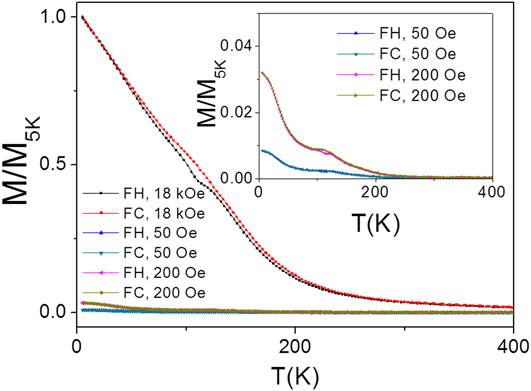
Temperature dependence of magnetization, M/M 5K, of the as-prepared samples exhibits small hysteresis in field cooling and field heating curves at about 100 K (Fig. 1). Magnetization, M/M 5K, rapidly drops with temperature (see Fig. 1) indicating that at nearly room temperature, the as-prepared samples are not ferromagnetic. Magnetization and M/M 5K(T) of the as-prepared samples considerably depend on applied magnetic field.
Temperature dependence of magnetization measured in the as-prepared NiMnGa microwire. The M/M 5K(T) dependencies measured at low field are presented in the inset.

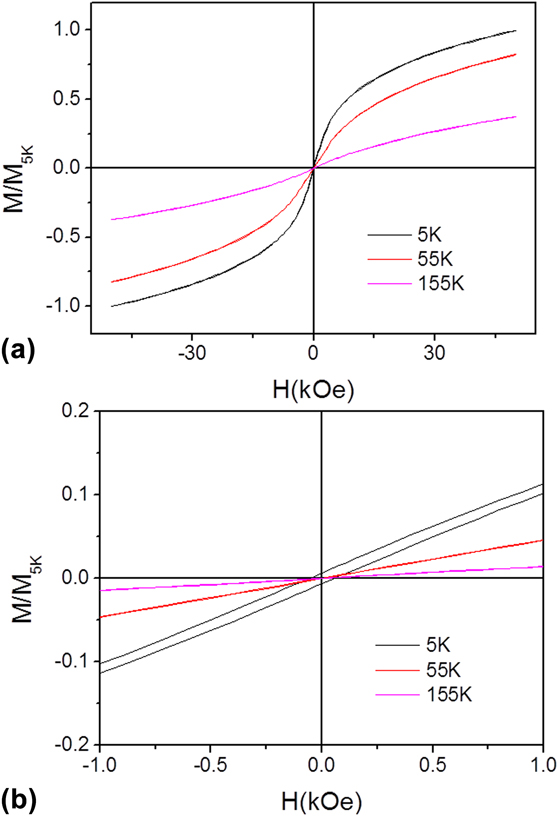
Additionally M/M 5K(H) dependencies do not present saturation even at 5 K [Fig. 2(a)]. At temperatures above 5 K, the as-prepared samples do not present coercivity [Fig. 2(b)]. These features of the as-prepared sample can be attributed to the magnetic and atomic disorders.
Magnetization curves of the as-prepared NiMnGa microwire measured at maximum field 50 kOe (a) and 1 kOe (b).

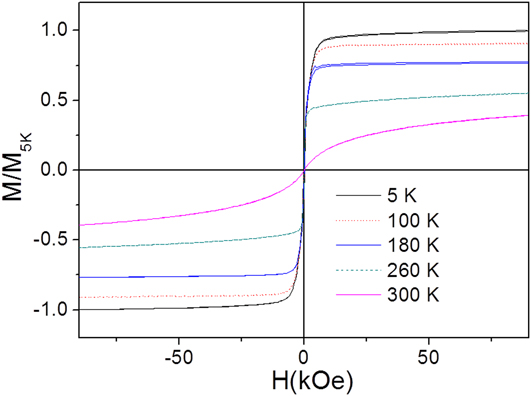
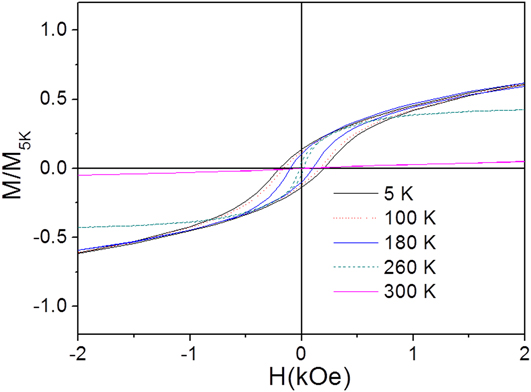
After annealing of NiMnGa microwires (T ann = 973 K for 2 h), we observed considerable change of magnetic properties. The character of M/M 5K(H) dependencies of annealed NiMnGa microwires becomes completely different from the as-prepared samples: all M/M 5K(H) curves present saturation at relatively low H-values up to 260 K (Fig. 3). At low temperatures, annealed samples present coercivity, H c, of about 200 Oe (Fig. 4). Coercivity decrease is observed with temperature increasing. Finally considerable magnetic softening can be appreciated at about 260 K (see Fig. 4).
Magnetization curves of NiMnGa microwire annealed at 973 K (2 h).

Low field magnetization curves of NiMnGa microwire annealed at 973 K (2 h).

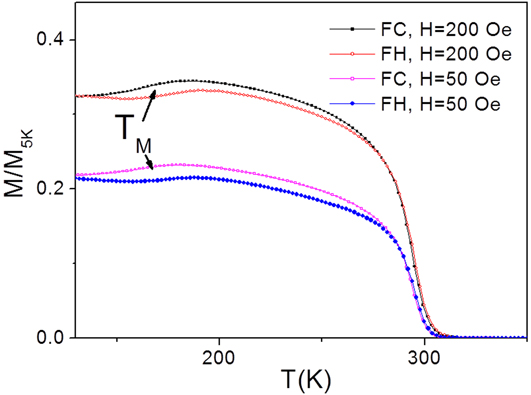
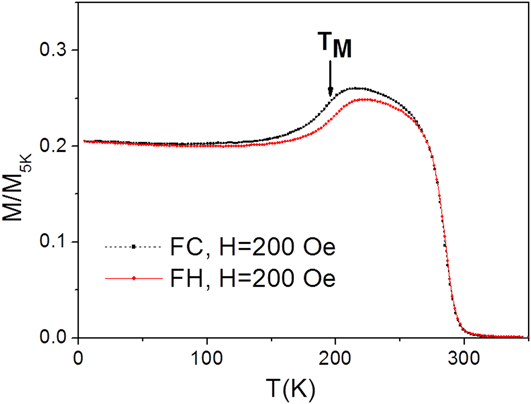
A ferromagnetic ordering with Curie temperature, T C, near room temperature (T C ≈ 300 K) is observed in the samples annealed at 923 and 973 K (Figs. 5 and 6). Similar to the previously reported results on Heusler-type microwires,Reference Aronin, Abrosimova, Kiselev, Zhukova, Varga and Zhukov20,Reference Zhukova, Ipatov, Granovsky and Zhukov21 an increasing of M/M 5K-values at heating for low H-values (H = 200 Oe) right below T C (Fig. 6) can be seen. Such maximum on M/M 5K(T) dependences in some of previous publications has been discussed considering the Hopkinson effectReference Zhukov, Rodionova, Ilyn, Aliev, Varga, Michalik, Aronin, Abrosimova, Kiselev, Ipatov and Zhukova5 since magnetic softening is usually observed at the same temperatures range (Fig. 4). However, in some cases, this maximum on M/M 5K(T) dependences can be observed even for high magnetic fields.Reference Zhukov, Ipatov, Talaat, Blanco, Hernando, Gonzalez-Legarreta, Suñol and Zhukova11 Therefore the origin of such maximum on M/M 5K(T) dependences is also discussed considering a structural transformation.Reference Zhukov, Rodionova, Ilyn, Aliev, Varga, Michalik, Aronin, Abrosimova, Kiselev, Ipatov and Zhukova5,Reference Zhukov, Ipatov, Talaat, Blanco, Hernando, Gonzalez-Legarreta, Suñol and Zhukova11
M/M 5K(T) dependencies of NiMnGa glass-coated microwires annealed at T ann = 923 K for 2 h.

M/M 5K(T) dependencies of NiMnGa glass-coated microwires annealed at T ann = 973 K for 2 h.

The most relevant feature of observed M/M 5K(T) dependences for the NiMnGa microwire annealed at 923 and 974 K (for 2 h) is that they clearly show the hysteretic anomalies typical for the MT (see Figs. 5 and 6). This anomaly is more appreciable after annealing at 973 K (see Fig. 6). It is worth mentioning that at lower annealing temperatures (773 K), such hysteretic behavior was not observed.Reference Zhukov, Ipatov, del Val, Taskaev, Churyukanova and Zhukova18 Consequently, annealing conditions (temperature and time) are essentially important for realization of the MT.
Qualitatively, observed M/M 5K(T) dependences of annealed samples are similar to those observed in the bulk Heusler-type alloys.Reference Chernenko1,Reference Khovailo, Chernenko, Cherechukin, Takagi and Abe22,Reference Kazakov, Prudnikov, Granovsky, Perov, Dubenko, Pathak, Samanta, Stadler, Ali, Zhukov, Ilyin and Gonzalez23 Generally, the anomalies in the temperature dependences of the magnetization for the bulk NiMnGa alloys can be explained considering three phase transition temperatures: T CM—Curie temperature of MP, T M—temperature of MT, and T C—Curie temperature of the high temperature (cubic) AP.Reference Khovailo, Chernenko, Cherechukin, Takagi and Abe22–Reference Sanchez-Alarcos, Perez-Landazabal, Recarte, Rodrıguez-Velamazan and Chernenko24 The sequence of these transitions is determined by the chemical composition of the Ni–Mn–Ga alloy which is very convenient to express via the valence electron concentration per atom, e/a.Reference Chernenko1,Reference Chernenko, L’vov, Zagorodnyuk and Takagi25,Reference Wu and Yang26
The Curie temperature, T C, of AP can be evaluated from M/M 5K(T) dependences as a temperature at which magnetization drops to zero. However, more precisely, T C-value can be evaluated from the first derivative of the magnetization.Reference Shevyrtalov, Zhukov, Zhukova and Rodionova27
The T C-values evaluated from Figs. 5 and 6 are smaller than those reported for alloys presenting e/a ≈ 7.63 (calculated considering real chemical composition of studied microwire).Reference Chernenko1,Reference Sanchez-Alarcos, Perez-Landazabal, Recarte, Rodrıguez-Velamazan and Chernenko24–Reference Wu and Yang26
The sharp change in magnetization at T M can be associated with a MT from the magnetic state (MP) characterized by lower magnetic moment to a ferromagnetic AP state with higher magnetic moment (Figs. 5 and 6). This assumption is confirmed by the change of hysteresis loop character observed at around 260 K (Fig. 4).
Observed changes upon annealing can be related to stress relaxation as well as to the structural changes.
X-ray studies of the as-prepared and annealed samples have been performed at room temperature. The XRD peak shape and position are affected by various factors, such as internal stresses, chemical composition, phase separation, or instrument resolution. In the present case, the measurements have been performed in the same samples. Therefore observed evolution of XRD spectra must be attributed to the changes related to annealing.
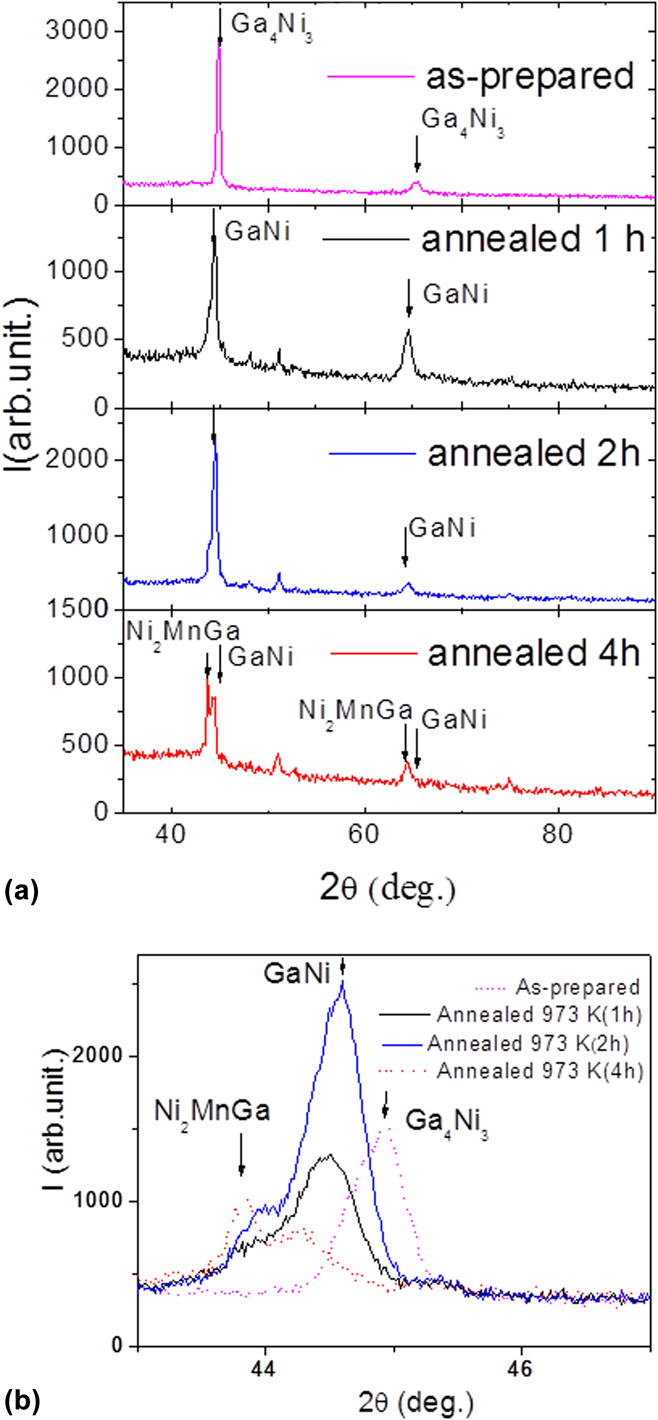
The diffraction peaks of all crystalline phases observed in the XRD pattern are quite close to each other and even overlapped (see Fig. 7). However certain structural changes (i.e., intensity and positions of XRD peaks) can be appreciated after annealing [see Fig. 7(a)]. Most evident changes can be appreciated from the analysis of the first XRD peak [see Fig. 7(b)].
XRD (a) and first diffraction peak (b) of the as-prepared and annealed NiMnGa microwires at 973 K for different times.

Corresponding to each diffraction peak, phases are identified using the database (International Center for Diffraction Data, www.icdd.com).
The fitting of the diffractogram of the crystalline peak is performed using the Gaussian function.
Such fitting allows us to calculate the following:
(i) The area of the Gaussian that is proportional to the amount of the corresponding crystalline phase.
(ii) The width of the Gaussian half-height (subtracting the line corresponding to the amorphous background) with Scherrer formula gives us the average grain size, D g.
The average crystalline grain size, D g, can be evaluated from the analysis of the first crystalline peak position and width using the well-established Debye–Scherrer correlationReference Zhukov, Ipatov, Talaat, Blanco, Hernando, Gonzalez-Legarreta, Suñol and Zhukova11,Reference Zhukov, Ipatov, del Val, Taskaev, Churyukanova and Zhukova18
 $${D_{\rm{g}}} = {{K\lambda } \over {\varepsilon \cos 2\theta }}\quad ,$$
where K is a dimensionless shape coefficient of the order of 0.9 (that can vary with the actual shape of the crystallite), ε is the full width at half maximum of the first crystalline peak, and 2θ is the peak position.
The XRD pattern of the as-prepared sample (with broad peak) fits better to coexistence of the Ga4Ni3 bcc phase (interatomic distance a = 1.1411 nm, D g ≈ 26 nm) and amorphous phase. XRD of annealed at 973 K (1 h) NiMnGa microwires fits better to the mixed structure consisting of 50% GaNi cubic (a = 0.2873 nm, D g ≈ 27 nm) and 50% Ni2GaMn fcc phases (a = 0.5805 nm, D g ≈ 9 nm). Increasing annealing time, we observed further changes of XRD patterns. Thus, the further increasing of the content of the GaNi cubic phase is observed after annealing at 973 K (2 h). Finally the XRD pattern of the sample annealed at 973 K (4 h) fits better to increasing of Ni2GaMn fcc phase content in expense of the GaNi cubic phase and D g growing. In NiMnGa microwire annealed at 973 K for 4 h, the content of the Ni2GaMn fcc phase is about 75% and D g ≈ 29 nm (see Fig. 7).
The aforementioned analysis involving the Debye–Scherrer correlation allows estimation of the average grain size. More detailed information can be provided using direct structural methods like transmission electron microscopy or atomic force microscopy (AFM). Recently the nanocrystalline structure of both as-prepared and annealed microwires with the same nominal composition (Ni2GaMn) prepared using the same technique has been confirmed by the AFM studies. In particular, the annealed samples present grain size distribution ranging from 20 to 60 nm.Reference Shevyrtalov, Zhukov, Zhukova and Rodionova27
It is worth mentioning that the as-prepared samples present mixed nanocrystalline–amorphous structure.
Additionally, amorphous glass coating contributes with a broad halo at small angles (2θ ≈ 15–20°). This part of spectra is not presented in Fig. 7.
It is worth mentioning that the magnetic ordering of the samples with the nanocrystalline structure can be different from the sample with larger grain size. This difference can be related to a larger contribution of the grain boundaries in nanocrystalline structures.Reference Tietze, Audehm, Chen, Schutz, Straumal, Protasova, Mazilkin, Straumal, Prokscha, Luetkens, Salman, Suter, Baretzky, Fink, Wenzel, Danilov and Goering28 Indeed the structure of grain boundaries is considered as consisting of flat (faceted) and curved (rough) portions. In most cases, facets are parallel to the most densely packed planes of coincidence site lattice formed by two lattices of abutting grains.
For the nanocrystalline materials, the specific grain boundary area increases with decreasing of the average grain size.Reference Tietze, Audehm, Chen, Schutz, Straumal, Protasova, Mazilkin, Straumal, Prokscha, Luetkens, Salman, Suter, Baretzky, Fink, Wenzel, Danilov and Goering28 Therefore, consideration of the intergranular regions’ contribution in nanocrystalline materials allows better understanding of properties.Reference Hernando, Navarro, Hadjipanayis and Siegel29 Additionally, increasing of stresses with increasing of the specific grain boundary area in nanocrystalline Heusler alloys can affect magnetic properties.
Consequently the magnetic ordering of nanocrystalline materials even presenting the same crystalline phases can be different from the bulk alloys.Reference Hernando, Navarro, Hadjipanayis and Siegel29,Reference Zhukov, Ipatov, Talaat, Aronin, Abrosimova, del Val and Zhukova30
On the other hand, observed peculiarities in magnetic properties of studied NiMnGa microwires can be related to the evolution of the phase content upon annealing.
Usually the paramagnetic ordering is reported for the GaNi phase.Reference Hsu, Wang and Guo31 Additionally, paramagnetic ordering is reported for the Ga4Ni3 phase observed in the as-prepared microwires and also previously observed for NiGa thin films.Reference Aurongzeb, Song, Kipshidze, Yavich, Nyakiti, Lee, Chaudhuri, Temkin and Holtz32 Therefore the origin of ferromagnetic ordering of studied microwires can be related to either amorphous phase observed in the as-prepared microwires or Ni2MnGa phase observed after long annealing.
It is worth mentioning that in NiMnGa thin films deposited on the cold substrate, the paramagnetic behavior in a wide temperature range has been previously observed.Reference Besseghini, Gambardella, Chernenko, Hagler, Pohl, Mullner, Ohtsuka and Doyle8 Similar to the studied NiMnGa microwires after annealing of NiMnGa thin films, a restoring of a ferromagnetic state has been reported.Reference Besseghini, Gambardella, Chernenko, Hagler, Pohl, Mullner, Ohtsuka and Doyle8 Such a difference of NiMnGa thin films with respect to bulk NiMnGa materials was explained considering internal stresses related to the preparation method.
The fabrication method of the glass-coated microwires involves simultaneous rapid solidification from the melt of metallic alloy and glass-coating with quite different thermal expansion coefficients.Reference Antonov, Borisov, Borisov, Prokoshin and Usov33–Reference Zhukov, Gonzalez, Torcunov, Pina, Prieto, Cobeño, Blanco, Larin and Baranov35 Both rapid solidification itself and presence of glass coating with different thermal expansion coefficients are the main factors responsible for the appearance of strong internal stresses distributed in a complex way within the microwires. According to all theoretical calculations and indirect experiments, the axial internal stresses in glass-coated microwires arising during the preparation process are the highest within the most part of the metallic nucleus.Reference Zhukov, Ipatov, Churyukanova, Talaat, Blanco and Zhukova36 The estimated value of internal stresses in microwires is between 100 and 1000 MPa.Reference Zhukov, Vázquez, Velázqez, Hernando and Larin37 The stress induced by the magnetic field in NiMnGa bulk alloys is between 1 and 7 MPa, i.e., much lower than the stress induced by the glass coating. Therefore the stresses induced by the glass coating can impede the first-order phase transition and hence internal stresses relaxation is needed.Reference Dunand and Müllner2
Consequently after high temperature annealing (923–973 K), studied microwires present M/M 5K(T) dependencies more similar to that reported for bulk Heusler alloys exhibiting the hysteresis on the temperature dependence of magnetization attributed to the MT as well as a drastic change of magnetization at the Curie temperature, T C, around 300 K, as a result of the improved structural order and precipitation of the Ni2MnGa phase. The T C values observed in Figs. 5 and 6 are still smaller than those evaluated from the phase diagram for e/a ≈ 7.63 (calculated considering real chemical composition of studied microwire).Reference Chernenko1
As discussed elsewhere, the alloys with e/a ≈ 7.55–7.7 must display the high sensitivity of their crystalline structure on mechanical stress and magnetic field.Reference Chernenko1 As mentioned above, M/M 5K(T) dependences of the as-prepared microwires considerably affected by applied magnetic field. Although similar to thin films,Reference Besseghini, Gambardella, Chernenko, Hagler, Pohl, Mullner, Ohtsuka and Doyle8 these features of the as-prepared sample have been attributed to the magnetic and atomic disorder in part considerable influence of M/M 5K(T) dependences on magnetic field can be related to e/a-values.
As mentioned in Sec. I, one of the peculiarities of glass-coated NiMnGa microwires is the existence of insulating biocompatible glass coating additionally allowing improvement of mechanical properties especially in the case of fragile metallic wires (as the case of studied NiMnGa) surrounded by flexible glass coating.Reference Zhukova, Cobeño, Zhukov, de Arellano Lopez, López-Pombero, Blanco, Larin and Gonzalez38
On the other hand, as shown above, the presence of the glass coating considerably affects magnetic properties of glass-coated microwires because of additional internal stresses. Therefore most previous attempts on preparation of thin glass-coated microwires presenting MT have not been completely successful.Reference Zhukov, Rodionova, Ilyn, Aliev, Varga, Michalik, Aronin, Abrosimova, Kiselev, Ipatov and Zhukova5–Reference Zhukov, Ipatov, del Val, Zhukova and Chernenko7,Reference Wang, Zheng, Nie, Ren, Wang, Müllner and Dunand10,Reference Zhukov, Ipatov, Talaat, Blanco, Hernando, Gonzalez-Legarreta, Suñol and Zhukova11 In the present study, we used higher annealing temperature that allowed us to achieve better internal stresses relaxation, disorder reduction, and precipitation of the Ni2GaMn fcc phase. Consequently, the structure of both as-prepared and annealed NiMnGa microwires looks rather different from bulk NiMnGa materials.
Finally the composition of metallic nucleus is different from the stoichiometric one (Ni2MnGa). This difference is related to the peculiarities of the preparation method involving alloy melting and casting. As discussed above, the sequence of phase transitions of the Ni–Mn–Ga alloy and hence phase composition and Curie temperature of studied microwire are determined by the chemical composition (usually expressed via e/a ratio).
Consequently, the structure of both the as-prepared and annealed Ni2.52Mn0.54Ga0.94 microwires is rather different from Ni2MnGa bulk materials.
Therefore additional efforts like preparation of the ingot for microwire casting with excess of Mn are needed to achieve the versatile properties reported for the stoichiometric (Ni2MnGa) alloy. However, although microwires prepared from the Ni2Mn2Ga ingot present some interesting features (i.e., exchange bias and enhanced coercivity),Reference Zhukov, Ipatov, del Val, Churyukanova and Zhukova39 the MT was not realized in microwires with Ni2Mn2Ga nominal composition.
IV. CONCLUSIONS
We successfully prepared long (up to few meters) and flexible Heusler-type glass-coated Ni2.52Mn0.54Ga0.94 microwires. Annealing conditions strongly affect the hysteresis loops, the temperature dependence of magnetization, and Curie temperature of prepared Ni2.52Mn0.54Ga0.94 microwires. After annealing of Ni2.52Mn0.54Ga0.94 microwires allowing internal stresses relaxation, disorder reduction and recrystallization we observed the hysteretic anomaly in M/M 5K(T) dependencies and considerable magnetic softening at about 260 K that can be interpreted as the first-order phase transformation. Observed experimental results have been discussed in terms of nanocrystalline structure of the as-prepared and annealed samples, magnetic ordering of phases identified in the as-prepared sample and appearing under recrystallization and internal stresses relaxation after annealing. Flexible and insulating glass-coating is beneficial for improvement of mechanical properties in the case of fragile wires but the presence of the glass coating considerably can affect the structure and magnetic properties of NiMnGa microwires. Therefore appropriate annealing conditions for realization of MT must be identified.
ACKNOWLEDGMENTS
This work was supported by Spanish Ministry of Economy and Competitiveness (MINECO) under MAT2013-47231-C2-1-P Project, by the Basque Government under Elkartek RTM 4.0 grant and under the scheme of “Ayuda a Grupos Consolidados” (Ref. No. IT954-16). The authors thank for technical and human support provided by SGIker (Magnetic Measurements Gipuzkoa) of UPV/EHU. A.Z. and V.Z. wish to acknowledge support of the Basque Government under Program of Mobility of the Investigating Personnel (Grant Nos. MV-2017-1-0025 and MV-2017-1-0030 respectively).