Although healthcare-associated infection rates have decreased dramatically for a number of infections, this has not been the case for Clostridium difficile infection (CDI). 1 Hospital-onset CDI rates decreased by 8% from 2011 to 2014, 22% short of the US Department of Health and Human Services (HHS) goal of a 30% decrease. 1 Clostridium difficile has been labeled an “urgent threat” by the Centers for Disease Control and Prevention (CDC).Reference Evans and Safdar 2 In an effort to reduce CDI, hospital-onset CDI is a publicly reported, pay-for-performance metric.
Risk factors for CDI have been previously described in the literature.Reference Garey, Sethi, Yadav and DuPont 3 Important risk factors that have been identified in many studies include the use of both antibiotics and gastric acid suppression therapy, which includes proton pump inhibitors and histamine blockers.Reference Dial, Alrasadi, Manoukian, Huang and Menzies 4 , Reference Donskey 5 These are potentially preventable risk factors where interventions targeting a decrease in unnecessary use of these medications could lead to decreased C. difficile rates. Other risk factors for CDI such as age and comorbid conditions are not usually preventable.Reference Evans and Safdar 2 Comorbid conditions identified as risk factors for CDI in various studies include liver disease, organ transplant, weight loss, inflammatory bowel disease, recent bowel surgery, congestive heart failure, renal failure, coagulopathy, and malignant tumors.Reference Evans and Safdar 2 , Reference Khanafer, Vanhems, Barbut and Luxemburger 6 – Reference Rodemann, Dubberke, Reske, Seo and Stone 9 However, no US studies have assessed whether these comorbidities as captured by International Classification of Diseases, Tenth Revision, Clinical Modification (ICD-10-CM) codes are risk factors for CDI. If comorbid conditions captured by ICD-10-CM codes are identified as CDI risk factors, these could eventually be used for risk adjustment and prediction rules. The aim of the current study was to investigate whether comorbid conditions captured by ICD-10-CM codes are risk factors for CDI after controlling for important risk factors such as antibiotic and gastric acid suppression therapy use and thus determine whether electronically available comorbid conditions may be candidates for risk adjustment.
METHODS
We performed a retrospective cohort study among all adult patients admitted to the University of Maryland Medical Center (UMMC), a 755-bed tertiary-care hospital located in Baltimore, Maryland. The University of Maryland Institutional Review Board approved this study.
The cohort was created using the hospital’s central data repository, which is a relational database containing administrative, pharmacy, clinical, and laboratory data from electronic medical records. The cohort included all adult patients (aged ≥18 years) admitted to UMMC between November 7, 2015, and May 31, 2017. Data extracted included age, gender, race or ethnicity, ICD-10-CM codes, medication administration, length of stay, C. difficile test date, and C. difficile test result. Validation of a random sample of the fields used was performed by chart review. In this study and in prior studies, the positive and negative predictive values of the fields in the electronic medical record or central data repository were >99%.Reference Harris, Jackson and Robinson 10 – Reference Harris, Fleming and Bromberg 13
Per CDC NHSN case definition, a patient was considered to have hospital-onset CDI if the patient tested positive for C. difficile at least 3 days after hospital admission and had no prior positive in the preceding 14 days. 14 Throughout the study period, testing for toxigenic C. difficile in liquid stool samples was performed using a nucleic acid amplification test (NAAT, Illumigene C. difficile assay, Meridian Bioscience, Cincinnati, OH). The laboratory did not test stool specimens that were formed. Best practice alerts recommending against C. difficile in the presence of diarrhea due to laxative use and against repeat testing went into effect in the electronic medical record on December 20, 2016.
The ICD-10-CM codes were mapped to appropriate comorbid components of the Elixhauser comorbidity index as outlined by Quan et al.Reference Quan, Sundararajan and Halfon 15 The Elixhauser comorbidity index is a sum of 30 unweighted comorbid conditions in which possible scores range from 0 to 30.Reference Elixhauser, Steiner, Harris and Coffey 16 Multiple ICD-10-CM codes were used in defining each comorbidity component, but the components were operationalized as binary variables. For example, a patient was considered to be positive for the lymphoma component binary variable if his or her medical record had any of the following ICD-10-CM codes: 200.x-202.3x, 202.5-203.0, 203.8, 238.6, 273.3, V10.71, V10.72, or V10.79.Reference Quan, Sundararajan and Halfon 15
Patients were considered to have received antibiotic or gastric acid suppression therapy if they had received at least one dose from the time of hospital admission until the time of a positive C. difficile test or until discharge for patients who did not develop the outcome. Antibiotic use was analyzed in individual classes in the bivariate analysis and in 1 of the multivariable models. Histamine blocker and proton pump inhibitors were analyzed as separate classes. In the primary multivariable model, antibiotic use was analyzed as a binary variable defined as whether patients received or did not receive any systemic antibiotic to analyze whether comorbid conditions were risk factors beyond all antibiotic use. Antibiotic therapy and gastric acid suppression therapy use were analyzed because of their association with C. difficile in prior studies.Reference Dial, Alrasadi, Manoukian, Huang and Menzies 4 , Reference Donskey 5
Bivariate associations were performed using log binomial regression. Age was considered a continuous covariate in bivariate analysis due to its previously established linear associations with CDI.Reference Jump 17 Candidacy for covariates in a multivariable analysis was determined by the significance of association in the bivariate approach as indicated by P<0.10. The linearity of association between CDI and total Elixhauser score was assessed, and due to its linear association, the Elixhauser index was analyzed as a continuous variable. Age was assessed for linear association with CDI and was analyzed as a continuous variable. Tests for effect modification and confounding between antibiotic use and Elixhauser score were conducted. Multivariable log binomial regression was used to assess the risk of CDI. We conducted a likelihood ratio test to assess model fit for models with and without the Elixhauser Index. A second multivariable logistic regression model was conducted to analyze individual antibiotics, individual comorbid conditions, age, and gastric acid suppression. Stepwise regression was used for variable selection. Because the outcome was rare, we interpreted the odds ratios as risk ratios. Analyses were performed using SAS version 9.4 software (SAS Institute, Cary, NC).
RESULTS
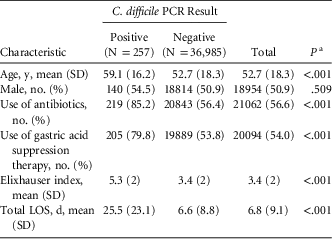
Of 37,246 patient admissions that met entry criteria, 3,001 had a C. difficile test performed, of whom 257 (8.5%) were positive and met the CDC definition for hospital-onset C. difficile infection (CDI). The CDI incidence rate for our hospital was 9.5 per 10,000 patient days in calendar year 2015 and 9.1 per 10,000 patient days in calendar year 2016. Among patients with CDI, the average length of hospital stay was 10.8 days (standard deviation [SD], 10 days) before a positive result. Among all patients in the cohort, the mean age was 52.7 years (SD, 18 years) (Table 1). Among patients with CDI, 80% had gastric acid suppression therapy compared to 54% of those without CDI (P<.001), and 88% of persons with CDI had antibiotic therapy compared to 58% of persons without CDI (P<.001). The mean Elixhauser score among all patients in the cohort was 3.4 (SD, 2). Patients with CDI had a mean Elixhauser score of 5.3 (SD, 2), and those without CDI had a mean score of 3.4 (SD, 2; P<.001).
Selected Characteristics of Patients Admitted to University of Maryland Medical Center in Baltimore, Maryland, Between November 7, 2015, and May 31, 2017 by Clostridium difficile Infection Status

NOTE. PCR, polymerase chain reaction assay; SD, standard deviation; LOS, length of hospital stay.
a P value is for the t test or χ2 test as appropriate for continuous and categorical variables, respectively.
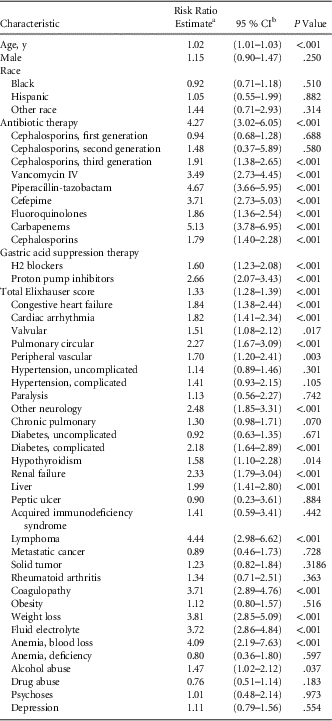
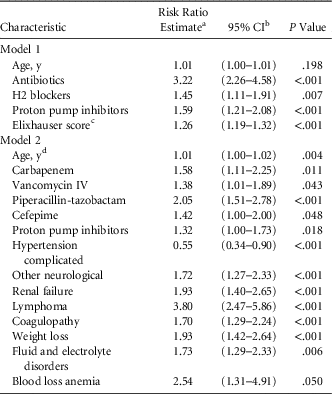
In the bivariate analysis, age, antibiotic use for all antibiotic classes, gastric acid suppression therapy use, and Elixhauser score were significantly related to CDI (Table 2). After controlling for any antibiotic use, age, and gastric acid suppression in a multivariable log binomial regression, for every one-point increase in Elixhauser score, there was 1.26 times the odds of having CDI (95% CI, 1.21–1.33) in model 1 (Table 3). We compared this model to one without the Elixhauser Index and found that the model with the index was a better fit (P<.0001). The individual antibiotic and individual comorbid condition multivariable model is presented in model 2 (Table 3). Carbapenem, vancomycin, piperacillin-tazobactam, and cefepime were individual antibiotics statistically associated with CDI. Malnutrition, coagulopathy, lymphoma, renal failure, and neurological conditions were statistically associated with CDI. Complicated hypertension was statistically protective.
Risk Ratios and 95% Confidence Intervals (CI) for the Associations Between Selected Covariates and Clostridium difficile Infection

a Estimates are obtained from a log binomial regression.
b Wald 95% confidence intervals.
Multivariable Regression to Assess Risk of Clostridium difficile Infection

NOTE. CI, confidence interval.
a Estimates are obtained from a logistic regression.
b Wald 95% CI.
c For each additional comorbidity, the risk of CDI increases by 26%.
d For each 1 year in age, the risk of CDI increases by 1%.
DISCUSSION
Patients with comorbid conditions identified by ICD-10-CM codes had a greater risk of hospital-onset C. difficile infection. Specifically, patients with higher Elixhauser scores (representing greater number of comorbidities) had a greater risk of CDI. This association remained strong even when controlling for important confounding variables of antibiotic therapy, age, and gastric acid suppression therapy.
A nested case-control study among French patients using ICD-10 codes found that chronic renal or liver disease and malnutrition were comorbid conditions that were risk factors for CDI while controlling for other confounding variables.Reference Khanafer, Vanhems, Barbut and Luxemburger 6 Among these comorbid conditions, 2 were found in our study as well. The French study measured these comorbid conditions by chart review, whereas in our study, electronically available ICD-10 codes were used, which has practical implications for broader application of such risk adjustment. In a study in Boston, a secondary analysis of an existing dataset was performed specifically to assess the risk of gastric acid suppression therapy for nosocomial CDI.Reference Howell, Novack and Grgurich 7 Using ICD-9 codes mapped to Elixhauser index components to control for possible confounding and similarly to our study, investigators found that an increase in the number of comorbid conditions was associated with an increased risk of CDI.
Current CDC NHSN hospital-onset CDI models adjust for the following variables: (1) academic or nonacademic affiliation, (2) bed size, (3) type of C. difficile testing, (4) community-onset prevalence, and (5) number of ICU beds. However, none of these variables are patient-level risk factors; therefore, they may not completely account for the patient case mix and associated nonmodifiable CDI risk at different hospitals.Reference Dudeck, Weiner, Malpiedi, Edwards, Peterson and Sievert 18 Our group has demonstrated that comorbid conditions identified by ICD codes are significant risk factors for surgical site infections and central-line–associated bloodstream infections.Reference Jackson, Leekha and Magder 19 , Reference Jackson, Leekha and Magder 20 We have also shown that risk adjustment models using ICD codes and accounting for comorbidity had better predictive discrimination and calibration than the current CDC models for these infections.Reference Jackson, Leekha and Pineles 21 A study in California showed substantial variation in hospital rankings when adjusting for group-level hospital characteristics including comorbid conditions.Reference Datta, Kazerouni and Rosenberg 22 These issues lead many hospital epidemiologists to desire better risk adjustment modeling and analysis before national reporting of outcomes occurs.Reference Datta, Kazerouni and Rosenberg 22 – Reference McGregor and Harris 24
The major limitation of this is study is that it is a single-center study, which impacts the generalizability. This work needs to be repeated at multiple institutions, including hospitals with distinct characteristics such as nonacademic and nonurban hospitals. Another limitation is that our work did not adjust for the severity of illness of patients. Further work is needed in this area as evidenced by a study that showed that a hospital’s case-mix index, reflecting severity of illness, was a risk factor for CDI.Reference Thompson, Edwards, Dudeck, Fridkin and Magill 25 A criticism of the use of ICD codes in research is that they fail to capture all patient comorbidities or could reflect codes that maximize reimbursement.Reference Quan, Parsons and Ghali 26 , Reference Schneeweiss and Maclure 27 Research comparing the Charlson and Elixhauser comorbidity indices derived from ICD-9-CM codes to those same scores extracted from chart review has found that the sensitivity of the individual components varies greatly but the specificity is nearly 100%.Reference Quan, Li and Saunders 28 , Reference Leal and Laupland 29 Future work could further elucidate the association between comorbid condition scores, such as the Elixhauser comorbidity index and the Charlson comorbidity index, and their association with CDI. In addition, different results could be obtained if antibiotics were based on duration received and not just as a categorical variable. Another limitation is that we did not control for hospital admission source because it was not available in our database. It has been shown that patients who transfer from long-term care facilities are at increased risk of CDI. However, the prevalence of community-onset CDI (ie, CDI cases diagnosed within the first 3 days of hospital admission) did not change during the study period.
In conclusion, if our work is repeated at multiple institutions and shows that electronically available comorbid conditions are risk factors for CDI, the CDC and the Centers for Medicare and Medicaid Services (CMS) should strongly consider adding comorbidity-based risk adjustment to publicly reported C. difficile infection rates.
ACKNOWLEDGMENTS
We thank Colleen Reilly and Yuan Wang for database maintenance and abstraction. The opinions expressed here are those of the authors and do not reflect the official position of the Agency for Healthcare Research and Quality, the National Institute of Allergy and Infectious Diseases, or the US Department of Health and Human Services.
Financial support: This project was partially supported by the AHRQ (grant no. R01HS022291), by the NIAID (grant no. 2K24AI079040-06), by the US Department of Health and Human Services, and by the National Institutes of Health (NIH grant no. 5K24AI079040).
Potential conflicts of interest: All authors report no conflicts of interest relevant to this article.