Amid the global #MeToo movement, the #MeToo movement in China started in early 2018. For over a year, several influential cases, broad civic participation and engagement, as well as extensive discussions shocked and shook the whole country, creating a sociopolitical dynamic that was unusual in the context of persistent suppression of civil society and strict restrictions on freedom of speech. As feminist activists and researchers—Jing living and working in China, Dušica doing her fieldwork in Taiwan at the time—we were astounded by the powerful challenge that #MeToo has posed to misogynistic societies around the globe. What we have been trying to understand is how the #MeToo movement emerged and grew even as so many other social movements were suppressed in China, and what strategies the survivors, volunteers, and activists in the #MeToo movement used to break through the overwhelming censorship and restrictions.
In this essay, we address these two questions by drawing on Xiong Jing's experiences as an activist and on her interviews with three core survivors and volunteers in the #MeToo movement, as well as our analysis of the national and transnational sociopolitical environment in which #MeToo in China emerged and evolved. We argue that three central features of the #MeToo movement in China enabled it to form and spread in the context of an authoritarian, oppressive, highly controlled and surveilled party-state: (1) decentralized organizing by numerous nonprofessional activists, (2) extensive use of social media, and (3) active domestic and overseas collaboration. These three features, as we also discuss, have been informed by and built on the struggles of previous activists, especially the legal, organizational, and performative aspects of socially transformative endeavors taking place in the last two decades. We end this essay by reflecting on some of the limitations of and challenges faced by the movement, and on three core issues to be addressed in future feminist activist and academic engagements.
CONTEXTUALIZING THE MOVEMENT: SOCIAL ORGANIZING IN AN AUTHORITARIAN STATE
At the moment when China's #MeToo emerged and evolved, the Chinese party-state was reported to have the world's most extensive and sophisticated censorship apparatus (Committee to Protect Journalists 2019) and to be the world's worst abuser of internet freedom (Freedom House 2019). Its ranking on the World Press Freedom Index dropped to near the bottom (Reporters without Borders 2019), with the media industry and new outlets operating under increasingly harsh supervision by the authorities: the traditional media industry had been in a sharp decline (Zhang and Cao Reference Zhang and Cao2017), while an extended period of government investments in information control technologies had pushed censorship and internet surveillance to unprecedented extremes (Xu and Albert Reference Xu and Albert2017).
Importantly, a set of security-related laws was introduced between 2014 and 2016: the Counter-terrorism Law, National Security Law, and Cybersecurity Law, as well as the Overseas NGO Law and Charity Law, have severely influenced the activities of grassroots NGOs. At the same time, offline surveillance and coercion continued to increase: a wide network of official and unofficial police has been getting wider, disappearances and black-jailing of social activists and rights-defending lawyers continued, while credible reports at the time asserted the establishment of a web of detention camps in which ethnic Uyghur and other Muslim people were held incommunicado (Pils Reference Pils2018; Safeguard Defenders 2020; United Nations Committee on the Elimination of Racial Discrimination 2018).
Just like many other civil society organizations and socially concerned actors, feminist groups did not escape the tightening control and suppression of the state. The Fourth World Conference on Women, held in Beijing in 1995, stimulated the establishment of a number of women's rights organizations, opening a space for the formation of a new wave of youth-led feminist activism, which, especially around 2012, pushed the issue of gender equality into the vortex of the Chinese public (Xiong Reference Xiong, Wu, Feng and Lansdowne2018).
A turning point happened in March 2015, when five feminist activists were detained for planning to launch an anti–sexual harassment campaign on public transportation. After the case of the “Chinese Feminist Five,” the feminist movement in China started to be perceived and treated by the authorities as a sensitive issue. Consequently, a number of feminist NGOs were shut down or moved underground, as the leading feminists, persistently harassed by the police, found it too difficult and dangerous to continue with their activism. Finally, the state-led stigmatization of feminism became clearer in 2017, when the vice president of the All China Women's Federation specifically distinguished the “official feminism” from “Western feminism,” where the latter was identified as a part of Western interference in China's affairs.Footnote 1
Nevertheless, the public discussions that #MeToo initiated were unprecedented for the feminist movement in China. Outside observers described it as a “sudden awakening” (Mu 2018), but #MeToo did not come out of nowhere, and it was not a simple extension or imitation of the U.S.-born movement. China's #MeToo is grounded in and a continuation of Chinese feminists’ transformative efforts in at least three aspects: consciousness raising and legal reforms related to sexual harassment, community and network building, and performative repertoires of contention.
If we trace the developments that created the awareness on which the #MeToo movement was built, we have to mention Chinese feminists’ concerns with sexual harassment, which go back to at least the 1990s. Several investigative reports on sexual harassment made by women's NGOs and activists, such as the Survey of Sexual Harassment of University Students and Graduates in ChinaFootnote 2 released by the Guangzhou Gender Education Center, were widely used as evidence during #MeToo. Furthermore, legal acts, such as the Special Provisions on Labor Protection for Female Employees, which were promulgated with the engagement of feminist activists inside and outside the state system, include the “prohibition of sexual harassment,” but without a specific definition of sexual harassment. Lastly, even when the results were far from satisfactory, several cases of sexual harassment—most notably, the 2014 case at Xiamen University and the 2017 case at the Beijing Film Academy—laid the groundwork for organizing during the #MeToo movement.
Another building block for the 2018 movement was the networking, organizing, and performing of dissent practiced by the “young feminist movement” that emerged in the early 2010s. Some strategies and activities enacted during the #MeToo movement were first used by previous young feminist activists, such as writing petitions and writing letters to the principals of universities.
#MeToo: WHAT HAPPENED IN 2018
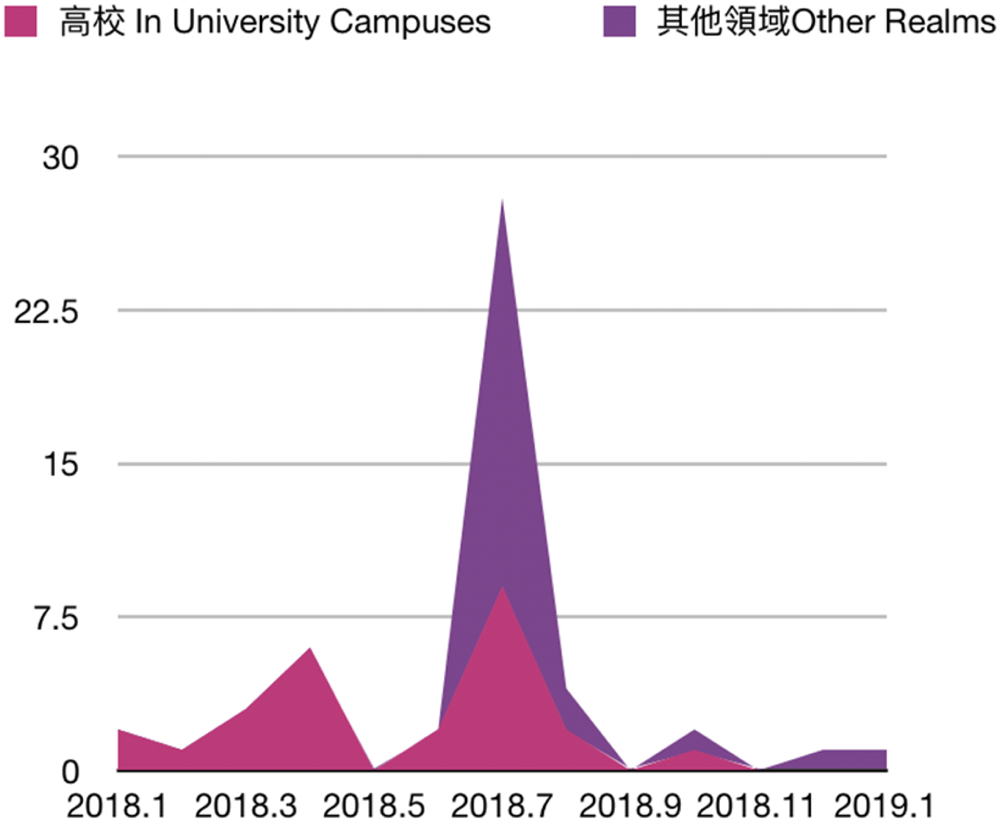
On January 1, 2018, Luo Xixi, a former student of Beijing University of Aeronautics and Astronautics who at the time resided in the United States, used her real name on Sina Weibo, a Chinese social media site resembling Twitter, to make a sexual harassment allegation against her former PhD supervisor, prominent professor Chen Xiaowu. Luo's post is considered to mark the beginning of China's #MeToo movement, as it initiated many public testimonies about sexual harassment and assault in several different social arenas. The movement lasted all through 2018, with influential individual cases acting as the driving forces that pushed the movement to its climax. In turn, the movement's peak was followed by heavy censorship that silenced and brought the discussion to a low point (see Figure 1).Footnote 3
The number of #MeToo cases in 2018. Source: #MeToo in China Archives.

#MeToo incited unprecedently wide and extensive social mobilization, with students, university teachers, factory workers, lawyers, artists, and NGO workers launching petitions and issuing statements of support. The survivor-driven #MeToo movement, its ethical righteousness, emotional influence, and the intimate relatability of the wider public with the survivors of sexual assault may be among the main reasons why, despite the censorship, the outbursts of #MeToo stories and activism have had a significant impact on society. As a result, the Department of Education pledged to start research and introduce a long-term anti–sexual harassment mechanism on campuses; in the new draft civil code, sexual harassment was included and extended the understanding of “survivor” from women to all genders; and the Supreme People's Court added “sexual harassment damage liability dispute” as a civil cause of action, effective January 2019. In July 2019, the first winning verdict in a lawsuit that used “sexual harassment” as the cause of action was announced.
HOW COULD IT HAPPEN? THREE FEATURES OF #MeToo IN CHINA
A Decentralized Movement with Mass Participation of Volunteers
Unlike the young feminist activists and labor rights activists who often applied “disguised collective actions” to lower the cost of organizing contention under repression (Fu Reference Fu2016), the #MeToo movement was not initiated by any organization. When Luo Xixi reached the independent journalist Huang Xueqin on Weibo after seeing her survey on sexual harassment in journalism, they quickly established a mutual trust, as they both recounted and started to plan how to proceed.Footnote 4 Neither Luo nor Huang was a professional activist before joining #MeToo, nor were other survivors who joined the movement.
Indeed, #MeToo was a decentralized movement that relied on the contributions of volunteers, most of whom were motivated by a simple sense of justice. As Xiong Jing was told by one survivor, behind almost every survivor who spoke out in #MeToo, there were volunteer support groups on WeChat, and some survivors became actively engaged in helping other cases. Moreover, the volunteer groups were often organized without knowing the real identities of the participating members. As Guangyan, a volunteer who got engaged in the case of her friend, explained, “When the members of our coordination volunteer team worked together for a month, we still didn't know the real name and background of each other. It was not until three months later that I met the others for the first time” (Guangyan 2019).
Decentralization of the #MeToo movement not only provided it with rich human resources and diverse strategies but also allowed the movement to avoid suppression by the authorities. Questions about the invisible “black hand”—so familiar to Xiong Jing from her own earlier investigations and questionings by the police—were put forward to the #MeToo activists: “Who led this anti–sexual harassment team? Why do you react so fast? Is there any organization behind it?,” a teacher questioned a student activist (Lion 2018). Yet, a decentralized movement does not have a “black hand” behind the scenes, and nobody can predict who will be the next to stand up.
A Movement on Social Media as a Fight against Censorship
Prior to July 2019, when Xiong Jing and a group of activists organized the #MeToo exhibition tour in four major China cities, there were no offline activities related to the movement. In the course of the #MeToo movement, survivors used social media, mainly the microblogging site Weibo and the popular online Q&A social platform Zhihu.com, to make their voices heard; the volunteers organized small groups on WeChat to support survivors; while the general public and intellectuals used Weibo and WeChat public accounts for discussion.
Most important for our thinking about the ways in which the movement was initiated and maintained in the strictly controlled and surveilled authoritarian context of China is that the online environment served as a space of censorship defiance. With inexhaustible creativity, Chinese netizens have continued a tradition of outsmarting censorship by inventing internet “memes” that exploit linguistic puns and misspellings (Abbott Reference Abbott2019). They adopted nicknames, used homophones and emojis, and converted images, all as a strategy to counter the censorship and keep the content online as long as possible (Zeng Reference Zeng, Fileborn and Loney-Howes2019).
Activists were aware of the censorship, but, as Qiqi, one of the volunteers, put it in sharing her #MeToo activism, “Censorship? Of course, but so what? By now we all know that's inevitable for any social movement in China. For us, censorship is part of the process, not the end of the story.” Zhang Leilei, a feminist activist, went further and explained: “The Chinese #MeToo movement is not only against sexual harassment. It's also about fighting against this pressure, fighting against censorship” (Mistreanu Reference Mistreanu2019).
A Movement That Collaborates with Overseas Communities
The activism of the Chinese expatriate feminist community and their collaboration with their peers in China was another hallmark of the #MeToo movement in China. After the Feminist Five case, several leading feminist activists moved out of China and started to organize overseas Chinese feminist groups as a strategy to develop political space outside China to help combat suppression back home (Lu Reference Pin2019). Socially engaged art performances, workshops, activism-oriented trainings, and the establishment of feminist groups were some of the venues used by feminists abroad to organize and mobilize overseas students and young professionals concerned about issues in China.
The intensifying suppression of the feminist movement in China, along with rising global feminist actions, such as the Women's March and the Women's Strike, stimulated Chinese expatriates, who have a relatively strong sense of their Chinese identities and connections with China (Sun Reference Sun2019). There were at least two contextual influences that helped build close connections between overseas feminist groups and local activists. First, the internet and social media—crucial for the movement back home—provided the essential preconditions to bypass the limitations of physical distance. At the same time, for Chinese feminists residing outside China's borders, the risk of being harassed, interrogated, or persecuted by the police was reduced. Hence, overseas Chinese feminists used their fluid position vis-à-vis the power of control and persecution of the Chinese government and became ardent supporters and participants in the online discussions and activism around #MeToo cases.
The escalation of party-state control over social organizing in general and feminist activities in particular influenced the fading of the movement after 2019. The COVID-19 outbreak and successive lockdowns in Chinese cities in 2020 also contributed to the pause in #MeToo-related organizing. However, the most recent legal reform opened up a space for future action: on January 1, 2021, the Civil Code of the People's Republic of China came into effect. Article 1010 stipulates that “if a person commits sexual harassment against another person's will by means of speeches, words, images or physical contacts, the victim has the right to request the perpetrator to bear civil liability in accordance with the law.”
CONCLUDING REMARKS
The #MeToo movement is undoubtedly one of the most impactful social movements in China in recent years: it gave feminist agendas unprecedented visibility; it empowered Chinese women at both the individual and collective levels (Lin and Yang Reference Lin and Yang2019); and it presented unique insights into how a movement originating in democratic countries could emerge, develop, and adapt in an authoritarian context (Zeng 2019). However, as in all social movements, there are weaknesses to be addressed and analyzed to help future activist actions.
First, while decentralization brought creativity and energy to the movement, the lack of structured and professionalized organizing remains a lingering issue. Since volunteers do not have sufficient professional skills and resources to help the victims, especially in the long run, one question to be explored further is how the movement might coordinate across different stakeholders and conduct and plan its long-term future goals and strategies without core organizers and professional activists.
Second, a large number of victims bravely spoke about their experiences of being assaulted, but what happened after they did so? At present, there is no comprehensive system to support sexual violence survivors. Psychological counseling, social work services, and legal aid are rarely available, especially for those who do not live in big cities. Thus, establishing and maintaining the support infrastructure—which demands strategic negotiation with the state as well as securing sufficient long-term funding—remains among the most challenging issues to be addressed.
Finally, how to increase the impact of the movement? Neha Kagal, Leah Cowan, and Huda Jawad in their article “Beyond the Bright Lights: Are Minoritized Women Outside the Spotlight Able to Say #MeToo?” (Reference Kagal, Cowan, Jawad, Fileborn and Howes2019, 134) remind us that “activists have rightly pointed out the erasure of poor, informally educated, low-paid, disabled, LGBT and non-urban women of color from the #MeToo movement.” In their work, Kagal, Cowan, and Jawad discuss the context of the United States, but the lack of representation of several intersectionally disadvantaged groups in the #MeToo movement speaks to the Chinese-based movement as well.
The participants in the Chinese #MeToo movement, either inside or outside China's borders, are still predominantly young urban women. Mobilization by Chinese women workersFootnote 5—a feature of the Chinese #MeToo movement that must be highlighted and certainly researched further—signals that the #MeToo movement in China, and, more broadly, Chinese feminist activism, may have a foundation for cross-class and cross-occupational solidarity not often encountered in Western contexts. We want to close our brief discussion of the #MeToo movement in China by proposing more intensive efforts by both feminist scholars and activists to gather and bring into dialogue a number of vulnerable and disadvantaged groups. These efforts may, we contend, not only offer empirical and theoretical insights into the issues related to intersectionality of women-, gender-, and sexuality-based social activism, organizing, and mobilizing, but also be a starting point from which to build a more impactful, comprehensive, and just social movement.