Introduction
The European Union finds itself at the beginning of the second decade of the third millennium in a truly turbulent period since, in the last few years, it has been confronted with the worst economic crisis since the end of the Second World War, which has threatened even the stability of the single currency. Going back five years, the outline of key EU issues looked different: there was a focus on achieving the goals of the Lisbon strategy, a debate on EU budget reform both from the perspective of expenditures and revenues, and simultaneously thorough discussion on the EU Cohesion and Agricultural policies reform to reflect changes in both internal and external environment. Mainly due to the need to focus almost all attention and political leadership to steer the European economies through the present period of economic decline, these initial plans had to be rescheduled and political discussions on the above-mentioned topics were largely postponed.
This paper focuses on just one of the issues mentioned – debate on the EU Cohesion policy reform, which, however, might of course have substantial implications for the whole EU budget. Debates on the changes to the Economic and Social Cohesion policy (ESC) are not limited to the current programming period (2007–2013), they are rather an evergreen of this policy at least since the 1980s, when less-developed countries were admitted to the Community and the policy was given a substantially larger amount of resources from the common budget both in absolute and relative terms. Nevertheless, the European Council decision taken at the end of discussion on the 2007–2013 financial perspective in 2005 that the European Commission should ‘undertake a full, wide ranging review covering all aspects of EU spending, including the CAP, and of resources, including the UK rebate, to report in 2008/9’,1 initiated a new wave of the Cohesion policy reform discussions, including proposals for profound changes. One aspect of these changes is already evident from the wording of Title XVIII of the Lisbon Treaty, which changes the name of the policy from Economic and Social Cohesion to Economic, Social and Territorial Cohesion. The debate on post-2013 Cohesion policy, which was initiated in 2007 with the publication of the Fourth Report on Economic and Social Cohesion and can be followed, for example, on the Commission web pages, covers a wide variety of issues, such as eligibility criteria to draw from the policy's funds, priorities and thematic focus of interventions, definition and inclusion of the newly introduced Territorial cohesion into the Cohesion policy framework, improvement of management, control and evaluation systems and methods, to name the most important ones.
This paper deals with one of these topics: the definition of eligibility criteria for regions and states to draw from the policy's funds. It proposes which regions and countries should be regarded as poor ones and to which extent they should be eligible for financing. Therefore, the proposal redefines the scope of the current Convergence objective and the Regional Competitiveness and Employment objective. Territorial cohesion and other issues are not covered by this paper. The reform proposal presented in this paper is supplemented with a numerical model showing the distribution of EU Cohesion policy funds across EU Member States if the reform proposals were implemented.
The results introduced in this paper are outcomes of the research intent, n. MSM 6215648904 with the title ‘The Czech Economy in the Process of Integration and Globalisation, and the Development of Agricultural Sector and the Sector of Services under the New Conditions of the Integrated European Market’, thematic area ‘Macroeconomic and microeconomic performance of the Czech economy, and the Czech government's econo-political measures in the context of the integrated European market.’ The holder of the research intent is Mendel University in Brno, Faculty of Business and Economics.
Current EU Cohesion Policy Architecture
Cohesion policy as defined in Article 174 of the Lisbon Treaty shall aim at ‘reducing disparities between the levels of development of the various regions and the backwardness of the least favoured regions’. The Treaty continues that special attention should be paid to rural areas, regions affected by industrial transition, northernmost regions with low population density, islands, cross-border and mountain regions. At the centre of this policy, however, have always been the least developed regions of Member States. Therefore, the policy has taken the form of redistribution and has served as an instrument of solidarity commonly presented in national regional policies. For the period 2007–2013 the European Council decided that 81.7% of the combined resources of the Cohesion Fund and Structural Funds (European Social Fund and European Regional Development Fund) would be allocated to the least developed regions and countries of the Union under the Convergence objective.1 Regions at NUTS 2 level with their 2000–2002 GDP per capita (GDPpc) measured in purchasing power standards (PPS) below 75% of the EU-25 level fall under the Convergence objective. Moreover, Member States with their 2001–2003 GNI per capita (GNIpc) measured in PPS below 90% of the EU-25 level also belong to the Convergence objective.
The European Council further decided that 15.8% of the Cohesion envelope would be allocated for the Regional Competiveness and Employment objective, which covers all EU regions not covered by the Convergence objective.
Finally, 2.4% of the Cohesion policy's funds is allocated for the Territorial Cooperation objective to support cross-border cooperation of bordering regions at NUTS 3 level and trans-national as well as inter-regional cooperation across the whole European Union. As outlined above, further attention will be focused only on regions falling under the Convergence and Regional Competiveness and Employment objectives.
Concerning the distribution of resources among Member States with regions eligible for the Convergence objective, the allocation method for financing from the Structural Funds takes account of the regional population, the difference between the region's GDP per capita in PPS and the EU-25 average, and in a third step the relative wealth (GNIpc PPS) of the Member State in question is compared with the Community average. This last step ensures that regions in less wealthy countries receive larger allocations than regions of the same wealth belonging to a more wealthy state. Finally, each region eligible under the Convergence objective can receive an additional €700 for each unemployed person if the regional level of unemployment is above the average rate of unemployment of all Convergence objective regions (these €700 are paid only for those unemployed who exceed the average figure).
Allocation from the Cohesion Fund under the Convergence objective corresponds to the arithmetical average of the eligible Member State's population and surface area on the total population and surface area of all states eligible for Cohesion Fund support. The result thus obtained is then multiplied by a coefficient representing the difference between Member State's GNIpc PPS and the average figure for all eligible EU countries. Theoretically, the total allocation is obtained by multiplying the average per capita subsidy of €44.7 by the eligible population. In the eligible Member States joining the EU in 2004 and later, however, the total allocation from the Cohesion Fund is set to 1/3 of the total Cohesion policy allocation.
The allocation method under the Regional competiveness and employment objective is based on a calculation where population, above-the-average unemployment at NUTS 3 level, number of jobs needed to reach 70% employment, number of people with low educational level, low population density and relative regional prosperity are all taken into account.
Besides these basic rules, many exceptions were agreed in the form of phasing-in, phasing-out and other additional arrangements, which are not the subject of detailed coverage in this paper.2 Each Member State's allocation from all instruments of regional policy (including financial instruments of rural development policy and fisheries policy, which do not fall under the Cohesion policy) is limited as a specific share of its GDP with the maximum level at 3.7893% for those states with GNIpc PPS below 40% of the EU-25 average.
Within the Convergence objective, which is most relevant for the purposes of this paper, there are 84 NUTS 2 regions eligible for funding from the Structural Funds in the period 2007–2013 and another 16 NUTS 2 regions eligible for funding from the Structural Funds on a transitional and specific basis.3 A list of these regions is provided in Table 1.

Proposal for EU Cohesion Policy Reform
The reform proposal takes as its point of departure the assumption that rich regions do not need assistance within a policy that primarily fulfils a redistribution function. Therefore financing of relatively rich regions (the current Regional Competitiveness and Employment objective) should be excluded from the Cohesion policy. This type of interventions goes completely against the spirit of the ESC policy, as it promotes widening of the gap between the rich and the poor regions. Also, changes in the Convergence objective under which poorer regions in rich Member States may receive subsidies can be recommended: rich countries should have sufficient fiscal capacity to provide financial assistance to their less developed regions and should not use for that purpose funds redistributed from other (both rich and poor) EU countries, as it is also suggested for example in A Study on EU Spending (Ref. 4, p. 93).
Thus, if we do not consider the dimension of Territorial cooperation (which should be focused on rural areas, regions affected by industrial transition, northernmost regions with low population density, islands, cross-border and mountain regions), support within the ESC policy would only go to regions in Member States poorer than the EU average (GNIpc PPS below the EU average) and, within these countries, support would only be available to NUTS 2 regions with GDPpc PPS below the EU average.
As regards other criteria currently used for deciding on distribution of resources among eligible regions (population, difference between the region's GDPpc in PPS and the EU average, GNIpc PPS of the Member State compared with the Community average and number of unemployed people), these might be simplified and reduced just to one: difference between the region's GDPpc in PPS and the EU average. Population density will be reflected within the Territorial Cooperation component of the policy. The relative wealth of a Member State would be reflected by the fact that below-the-average states will qualify while above-the-average states will not qualify for assistance for their regions. The number of unemployed people may be eliminated since regions with high long-term unemployment levels also belong among poorer regions (low production due to low utilisation of production factor), and poorer regions would be eligible anyway. A short-term increase in unemployment should rather be solved by short-term instruments such as the European Globalisation Adjustment Fund, not Structural Funds, which are designed for mid- and long-term planning.
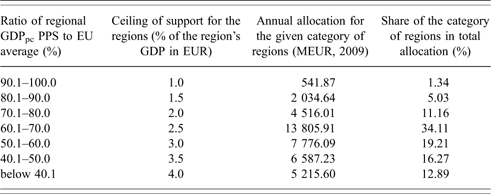
Therefore, only the difference between the region's GDP per capita in PPS and the EU average would be considered in deciding about the maximum admissible allocation to eligible regions: the wealthier the region is the lower would be the ceiling of support it can receive. The ceiling would start at 1% of the regional GDP (calculated in euros, as it is now) for regions with their GDPpc PPS between 90.1 and 100.0% of the EU average, while the highest rate of support would be at 4% of regional GDP for regions with their GDPpc PPS below 40.1 of the EU average – see Table 2.
Ceilings of support for regions from ESC policy funds depending on their degree of development.

Source: the author's own proposal.
The suggested graded ceilings of support would allow regions a smooth transition to a situation where they no longer qualify for support, with the financial flow promoting their development gradually phasing out. This approach also seems to be more suitable for long-term planning of public finance, since it allows regions to estimate the amount of support in the upcoming programming period. Currently, when regions exceed the limit of 75% of the average value, only ad hoc mechanisms are negotiated, allowing them to obtain support in a few more years to come. Another change proposed in this article is that the total sum of support for the poorest eligible regions would not be allowed to exceed 4% of the regional GDP compared with the current situation when the ceiling is set to 3.7893% and relates to the entire country's, not regional, GDP.
It is also recommendable to abolish the Cohesion Fund (CF) for several reasons. One constraint relating to interventions financed from the CF was removed already in the period 2007–2013: unlike interventions financed from the European Regional Development Fund (ERDF), interventions financed from the CF had previously been subject to the condition that only projects with expenditures exceeding €10 million could be financed. The proposed combination of the two criteria of eligibility for support from the EU funds (regions with lower-than-average wealth in countries with lower-than-average wealth) eliminates another difference between interventions from the CF and from the ERDF, since support would also be received by regions that currently exceed the applicable limit of 75% of the EU average, and ERDF subsidies at the regional level would therefore go even to states with wealth below the average, which do not have any regions below 75%. Currently, this function is performed by the Cohesion Fund. Next, and both funds finance the same type of interventions: transport and environmental projects. Finally, the last aspect related to the existence of the CF, which concerns the support from this fund being contingent on adherence by the beneficiary states to rules of fiscal discipline, may be included in the requirements concerning eligibility of states to receive support from the ERDF and the European Social Fund (ESF). Under the proposed scheme, all interventions would only take place at regional (through the ERDF) rather than national (currently through the CF) level.
The numerical model presented below calculates which regions would be eligible for support under the above provided conditions. First it is necessary to determine which Member States would be poorer than the EU average. The model respects conditions from the current programming period, where statistical data for GNIpc PPS to determine Member States eligible for period 2007–2013 were taken from the years 2001–2003. Thus, for the new programming period beginning in 2014 it is necessary to calculate the average GNIpc PPS of each country for the period 2008–2010. Since data in the Eurostat database are available for all Member States only until 2008, data for 2009 and 2010 were calculated by multiplying the 2008, respectively 2009 data by the average GNIpc PPS growth rate for the period 1999–2008. Similarly, statistical data for regional GDPpc PPS to determine regions eligible for period 2007–2013 were taken from years 2000–2002. Therefore, for the new programming period beginning in 2014 it is necessary to calculate average GDPpc PPS of each region for the period 2007–2009. Since data in the Eurostat database are available only till 2007, data for 2008 and 2009 were calculated by multiplying the 2007, respectively 2008, data by the average GDPpc PPS growth rate for the period 1999–2007.
This allows estimations of a group of countries that have lower-than-average wealth (GNIpc PPS < average of EU-27 in period 2008–2010), and then to identify regions with lower-than-average wealth inside these countries (GDPpc PPS < average of EU-27 in period 2007–2009) which would be entitled to receive funds under the ESC policy. Table 3 presents Member States and regions within them that would be eligible for financing under the proposed reform scenario. Unfortunately, since data for two countries that will probably be new members of the EU in 2014 (Croatia and Iceland) are not fully available in the Eurostat database, it is not possible to include them in the numerical model.

If we compare the results of this calculation with the situation in 2007–2013 programming period, then besides the fact that there are no longer any regions eligible on a transitional and specific basis, we can see that the German, Spanish, French and UK regions would all become ineligible for ESC policy support. The main reason for this is that the German, Spanish, French and UK GNIpc in PPS is projected to be above the EU-27 average and therefore these countries are not eligible for ESC policy support, although they still will have regions with below-the-average GDPpc PPS. However, Spain gets over this margin just by a few percentage points and therefore it might fall under the 100% limit once real, not just estimated data, are used, when they become available.
On the other hand, Italy would have almost twice as many regions eligible under this model, since the margin for regional eligibility would be shifted to 100% of the EU-27 average, compared to the current 75% margin. In addition, Italian economic growth in the first years of the new millennium was low compared with the growth rates of most other regions, especially those in the new Member States. However, just as in the case of Spain, Italy too is very close to the margin of 100% of the average GNIpc PPS (this time below it) and therefore real data for the 2008–2010 period will decide about the whole Italian eligibility.
As for other countries, the increased margin for regional eligibility would bring almost all Greek regions currently eligible on a transitional and specific basis back under the ESC policy and the number of Portuguese eligible regions would also increase. With the exception of one Romanian region, regions of all countries that joined the EU in 2004 and 2007 and eligible under the Convergence objective now would remain eligible also under the new proposed model.
Besides modelling which regions would be eligible, we can also estimate how much individual regions and countries might annually receive from the ESC policy. Therefore, the ceiling of support, expressed as a percentage of regional GDP, is included into the model. Table 4 provides a summary of the calculation for each eligible Member State: 2009 regional GDP expressed in euros is multiplied by the relevant ceiling applicable to the eligible region, as introduced in Table 2. This allows us to simulate the maximum amount to which eligible regions and, consequently, all eligible Member States would be annually entitled after 2013.

The total estimated number of eligible regions is 78 (compared with 84 Convergence regions plus an additional 16 regions eligible on a transitional and specific basis in the period 2007–2013). The largest beneficiary would be Poland, which would have also the largest number of eligible regions. Italy, Romania and the Czech Republic come next, although they would have a lower number of eligible regions than Greece, which would receive a lower allocation than these countries because its regions are wealthier and therefore a lower ceiling of support is applied to them.
As Table 5 shows, 82.48% of total allocation would go to the poorest regions with GDPpc PPS below 70% of the EU average, and 48.37% to regions with GDPpc PPS below 60% of the EU average, should the graded ceilings of support be introduced. The total volume of annual expenditures under the ESC policy amounts to €40.5 billion in 2009 prices, which corresponds to 0.34% of the EU GNI in 2007. For comparison with the current expenditures, real EU budget expenditures on the ESC policy, i.e. expenditures on all three objectives including the Territorial cooperation objective, amounted to €48.4 billion in 2009.5
Model of allocation of funds under the reformed ESC policy among regions with varying degrees of development
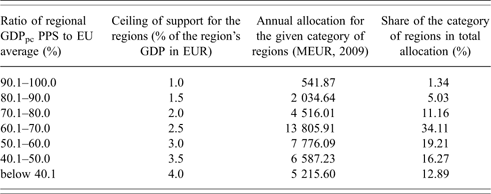
Source: the author's own calculations.
Conclusion
The EU Cohesion policy was designed as a policy to help close the gap between the level of development of poor and rich regions and states in the European Union. Therefore, it is regarded as an instrument of the redistribution function of the EU public finance. However, since the Member States still view the EU budget from the perspective of juste retour, the rich countries have always tried to get some portion of the Cohesion policy funds back home. This is contradictory to the spirit of the policy. The paper presented here therefore proposes reform of this policy and stresses the need to focus support just on development of underdeveloped regions in underdeveloped countries. Rich regions and regions in rich countries should be excluded from interventions from this policy. Another aspect of the policy – that is support for the cooperation of regions across the European Union and assistance to regions handicapped by other factors, such as remoteness or low population density – was not considered in the paper.
The paper presented a numerical model calculating support that would flow to regions with lower-than-average GDPpc PPS belonging to countries with lower-than-average GNIpc PPS. Graded ceilings of support ensure that the major part of the support would go to the poorest regions. Of course, the grades chosen might be subject to discussion and might be modulated to better reflect the needs of the regions.
The model had to deal with several shortcomings, mainly lack of official data. Therefore it would be necessary to recalculate it once data are available, approximately in two years’ time. By that time the paper should serve as discussion material in the debate on the EU Cohesion policy reform.
Petr König started his research activities in 2002 at the Faculty of Business and Economics of Mendel University in Brno, Czech Republic. He focuses on issues of public finance and European integration, mainly the topic of EU Budget Reform, EU Cohesion Policy reform and monetary union. In 2009 he graduated his PhD studies with thesis ‘Reform of the European Union budget revenues and expenditures according to the principles of the theory of fiscal federalism’. Besides articles, his publications include a monograph ‘EU Budget and Policies. Opportunity for change’ and ‘Textbook on European integration’. Next to his activities at the Mendel University he also provides lectures and training to beneficiaries of the EU Structural Funds.