Introduction
The impact of simulation on surgical training has been examined in a variety of different environments, focusing on the positive effects on participant confidence and competence in task completion.Reference Nakazato, Callahan, Kuchta, Linn, Joehl and Ujiki1,Reference Feins, Burkhart, Conte, Coore, Fann and Hicks2 A key aspect yet to be evaluated extensively, however, is how participation in simulation directly affects initial trainee opportunities and surgical productivity in the operating theatre.
The literature on using simulation as a means to reduce surgical training time is widespread, but a core element to this is trainee exposure itself. Being able to perform a surgical procedure as a junior member of the team requires a large degree of entrustment by the supervising surgeon, and such a relationship understandably takes time to establish.
Currently in the UK, the effects of the coronavirus pandemic (COVID-19) have caused almost universal disruption to operative experience for surgical trainees, particularly with elective cases. Although the potential for increased training time requirement is acknowledged,3 a further national consensus statement from ENT UK also points to the potential value of simulation in combating this difficulty.4
The importance of optimising factors to maximise active surgical participation is ever important, particularly when combined with the disappearance of the firm-based system of working, with juniors often working for numerous consultants within ever shorter training rotations.5 One means of optimising operative experience is through participation in a high-quality simulation experience. We postulate that a main outcome in task-trainer simulation is the provision of expedited surgical opportunities, helping minimise delays in taking an active role in surgery.
We sought to examine the potential impact of simulation on perceived surgical opportunities for junior grade UK surgeons as perceived by an experienced cohort of senior ENT surgeons (senior specialty registrars and consultants). We aimed to establish whether surgical trainees’ previous participation in a relevant simulated learning event changes how much of a procedure they are allowed to perform for their first time under senior surgeon supervision. In particular, we sought to quantify the extent to which simulation allowed the level of involvement in surgery to increase from passive (observing or assisting) to active, or indeed whether it would change the likelihood of the trainee performing the entire procedure. These are key measures of surgical involvement; in the UK, these measures are assessed in surgical trainees’ yearly review, informing decision-making about their progression in training.
Materials and methods
A standardised questionnaire was provided to 20 UK ENT surgeons (Appendix 1). The questionnaire stipulated that it was the trainee's first time with the respondents (senior surgeons) in the operating theatre and enquired how much of a particular operation they would expect to allow the trainee to perform according to the eLogbook (elogbook.org) levels of involvement (Table 1). Ratings were given via a numerical value, ranging from 1 for observing to 5 for performing the whole procedure with the supervisor unscrubbed, further refined at the supervisor scrubbed level, to indicate whether the trainee would do part or all of the procedure. On analysing the results, we took these anticipated roles and determined whether simulation would elevate trainees’ involvement to ‘active’ (indicated by ‘*’ in Table 1) from ‘passive’ (‘‡’) during surgery, and whether they would perform ‘part’ or none of the operation (in the case of observing) (‘†’) or ‘all’ of the operation (‘**’).
eLogbook levels of involvement

Based on supervisors’ anticipations regarding trainees’ roles, we determined whether simulation would elevate trainees’ involvement to ‘active’ (*) from ‘passive’ (‡) during surgery, and whether they would perform ‘part’ or none of the operation (in the case of observing) (**) or ‘all’ of the operation (†). Specialty trainees were refined into two levels, 3 and 4.
Seven common ENT procedures with existing validated models were included. These were: tonsillectomy,Reference Douglas, Senior and Scott6 grommet insertion,Reference Chiesa Estomba, Meléndez García, Hamdam Zavarce and Betances Reinoso7 cortical mastoidectomy,Reference Khemani, Arora, Singh, Tolley and Darzi8 microlaryngoscopy and biopsy,Reference Foulad, Bui, Dailey and Verma9 endoscopic nasal polypectomy, endoscopic sinus surgery (of any extent),Reference Alrasheed, Nguyen, Mongeau, Funnell and Tewfik10 and surgical tracheostomy.Reference Botto F, Ingrassia, Donato, Garzaro, Aluffi and Gentilli11
The grades of trainee that respondents were asked to consider varied from one year following medical school (foundation year one doctor), to core surgical trainees, to first-year specialty registrars in ENT (five years following medical school, i.e. specialty trainee year 3).
Respondents stated an expected level of involvement for trainees who had undertaken a simulation course and those who had not, for each procedure. The simulation course was a high-quality, well-established course that utilised a validated model (cadaveric, animal model or a custom three-dimensional simulator); the course had been completed within the previous two weeks. The senior surgeon was not expected to have observed the trainee in the simulation course personally.
Results
Twenty responses were collected from 13 consultants and 7 specialty registrars. These individuals provided an intended level of involvement for four grades of surgical trainees with and without prior simulation experience, for seven procedures. This resulted in a total of 1120 ‘judgements’ on the trainees’ intended level of involvement for analysis.
Half the respondents were from Greater London and the remaining from the Greater Manchester area. Respondents’ personal involvement in simulation as faculty staff was variable, with nine participants, of which six were consultants, declaring no regular involvement in delivering simulation-based training. The mean time the respondents had spent in their role was 4.35 years for registrars and 10.38 years for consultants.
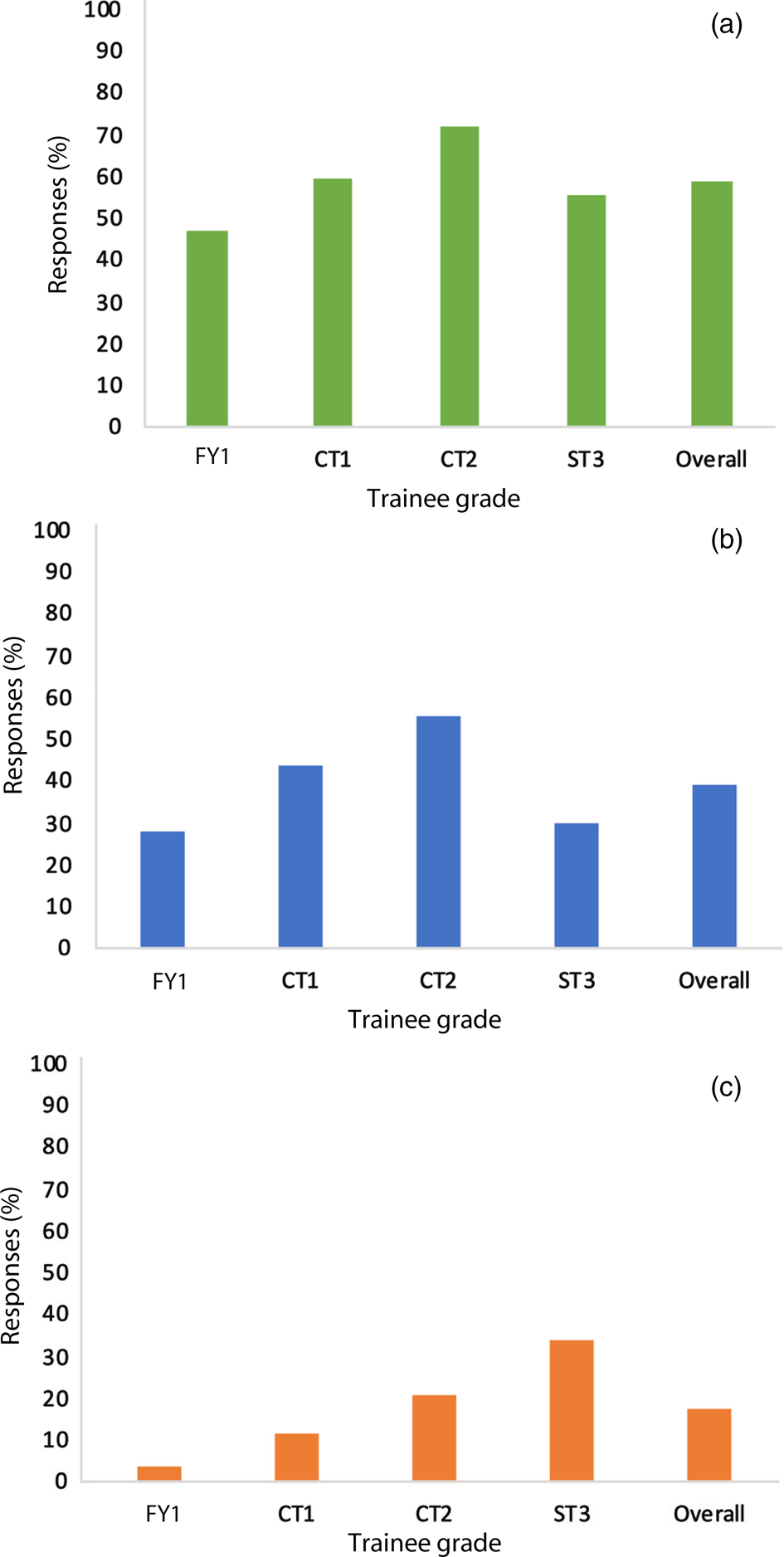
Overall, we saw a statistically significant difference in median involvement scores between the non-simulation and simulation group (p = 0.0001) according to Mann–Whitney U testing. The median score of 3 in the simulation group suggests expected trainee involvement would be greater; specifically, trainees would perform part of the procedure with the senior colleague scrubbed, as opposed to assisting for those in the non-simulation group with a median score of 2. In 59 per cent of the 560 paired simulation versus non-simulation ratings, there was a perceived increase in intended participation as a result of preceding simulation training.
On reviewing the elevation in expected involvement following simulation training, there was a change from a passive surgical role (scores 1 and 2) to an active one (scores 3–5) (whereby trainees would be expected to perform at least part of the procedure) for 39 per cent of trainees. However, expected involvement increased from performing part (score 3) to the whole of the procedure (scores 4–5) for only 17 per cent of trainees (Figure 1).
Percentage of responses that indicated an elevated level of involvement in surgery (scores 1–5) when comparing the no-simulation versus simulation groups: (a) for any increase in participation; (b) from passive (scores 1–2) to active roles (scores 3–5); and (c) from performing part (score 3) to the whole procedure (scores 4–5). FY1 = foundation year one; CT1 = core trainee year one; CT2 = core trainee year two; ST3 = specialty trainee year 3

Discussion
The journey of surgical competency from theoretical through to being able to perform a procedure unsupervised involves implicit trust from the supervisor in this learning process. The pathway to achieving competency can be divided into defined steps. Hence, ‘competence’ may be assessed in the form of entrustable professional activities, defined as the ‘responsibilities or tasks that must be done in patient care’.Reference Cate12 Such tasks may be delegated for learning purposes to a trainee. In surgery, these tasks may range from making the first incision, to inserting a drain, to performing the whole procedure. These are all entrustable professional activities, as the supervisor entrusts the trainee with the responsibility, wherein the highest level of entrustable professional activity as the trainee is being able to supervise a more junior learner.
An entrustment decision about whether a learner will be able to safely perform a task is based not just upon ability, but their perceived integrity, reliability and humility.Reference Ten Cate13 Furthermore, entrustable professional activity decisions depend upon a wide range of factors. Recent literature suggests trainee and supervisor factors as influencers, as well as the task itself, the workload, the institution's teaching culture,Reference Choo, Arora, Barach, Johnson and Farnan14 and the learner–teacher relationship over time.Reference Hirsh, Holmboe and Ten Cate15
• The coronavirus disease 2019 pandemic has resulted in reduced operative exposure for surgical trainees
• Simulation may act as a useful adjunct to supplement this deficiency, a practice supported by ENT UK in a recent consensus statement
• Recent participation in ENT surgery simulation courses elevates likely involvement in surgery for junior trainees
• Simulation appears to transform trainees’ initial involvement from observing or assisting to an active role
The potentially positive effect seen here following a simulation course may represent the preparation the trainee has made prior to performing their first case. Such ‘groundwork’, regardless of its form, may encourage the supervisor to allow the trainee to perform at a higher level. Other preparatory work may include a discussion about the procedure with the supervisor, evidence of supplementary reading, or even watching an instructional video.Reference Hamour, Mendez, Harris, Biron, Seikaly and Côté16
Simulation training appears to have a ‘psychological nudge’ effect that can influence surgical opportunity. This may act as a ‘foot in the door’ at a time when there are many reasons that can prevent the trainee from undertaking an operation, not just the trainee's unfamiliarity with the procedure and a new supervisor–trainee relationship. Because increased pressure on service delivery can inhibit training for junior trainees, simulation places the onus on the trainer to facilitate the ongoing progression of the trainee. Having previously demonstrated an active role in the procedure (in simulation), there would seemingly need to be a specific reason why the trainee may not be permitted to take part in a procedure in this case.
The limitations of this study include that it is based on the respondents’ likely actions, rather than evaluation of actual supervised procedures, which is an intended further area of assessment. There is a degree of fluidity to surgical supervision such that the actual involvement the trainee has during a procedure may change rapidly based on immediate supervisor observations of a trainee's aptitude, or in the event of unanticipated difficult anatomy or bleeding. An operation whereby it was intended the trainee would lead may not necessarily mean that the trainee will complete the procedure. Despite this, there is value in further assessing ‘training intention’ of more senior trainers, as it potentially allows calibration of expectations of junior surgeons, and provides a greater understanding of why trainers may limit active surgical participation.
Conclusion
Simulation in ENT may elevate the involvement of junior surgical trainees undertaking an operation for their first encounter with a new surgical trainer. This occurred overall in 59 per cent of the encounters described.
Undertaking a high-quality, recent simulation course would appear to be a valuable form of preparatory training for the junior surgeon prior to an index operative experience. In light of recent disruption from the Covid-19 pandemic, facilitation of simulation appears to offer a mechanism to improve junior surgeon involvement within the operating theatre environment in the face of increasingly limited opportunity. The provision of simulation is supported as a useful adjunct by ENT UK to supplement the reduced hands-on experience that trainees are experiencing currently.4
Competing interests
None declared
Appendix 1. Simulation questionnaire